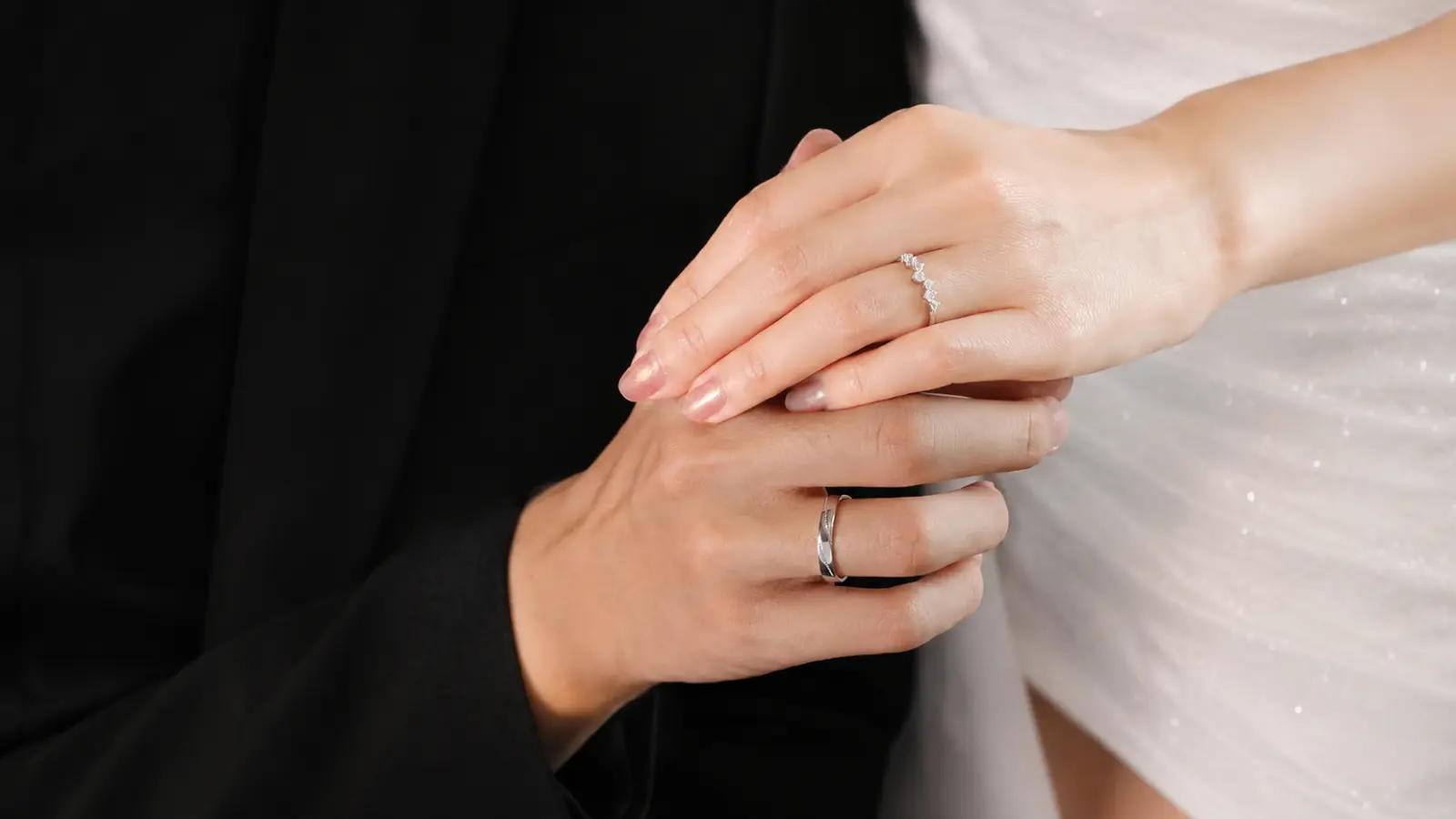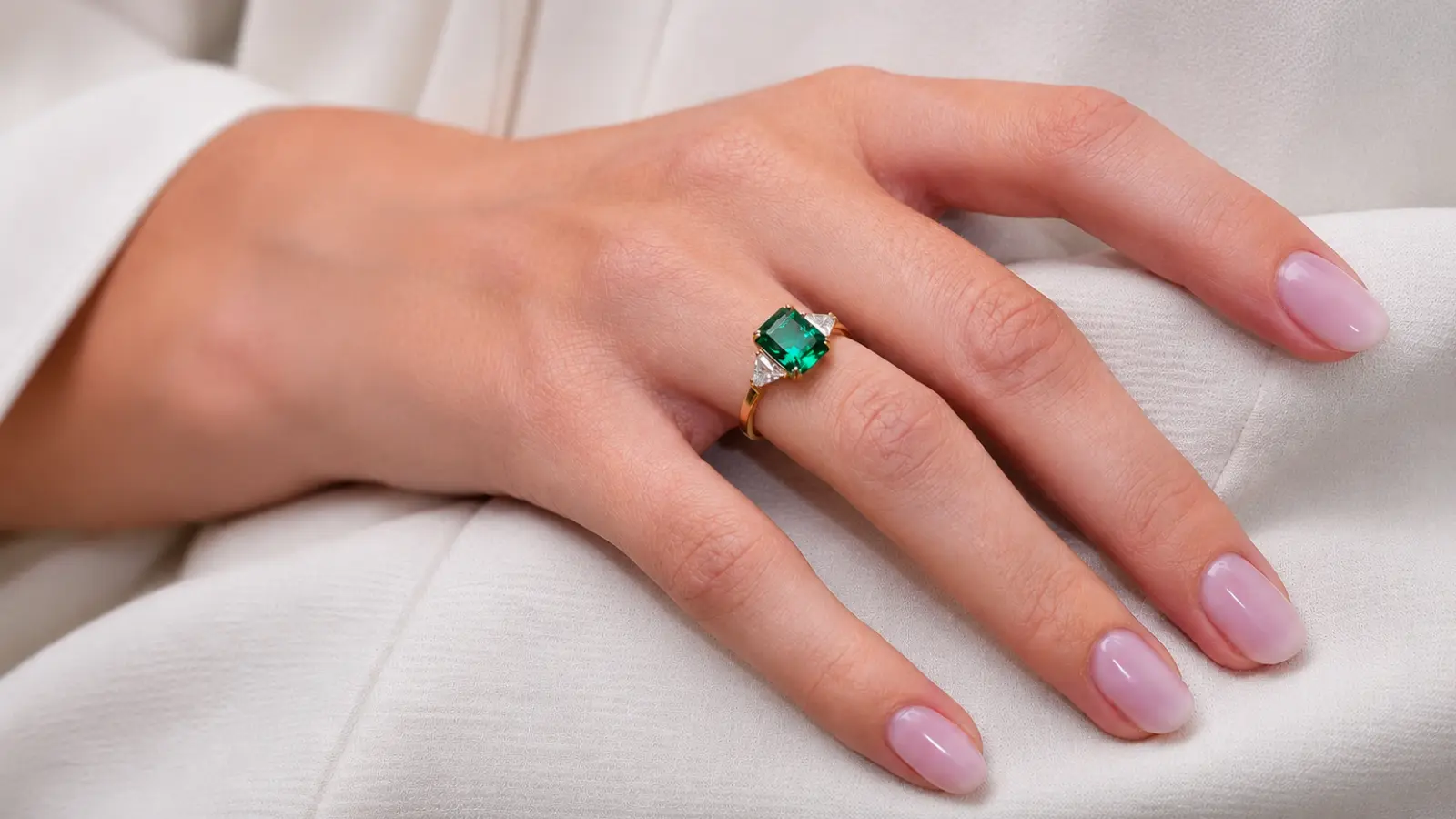
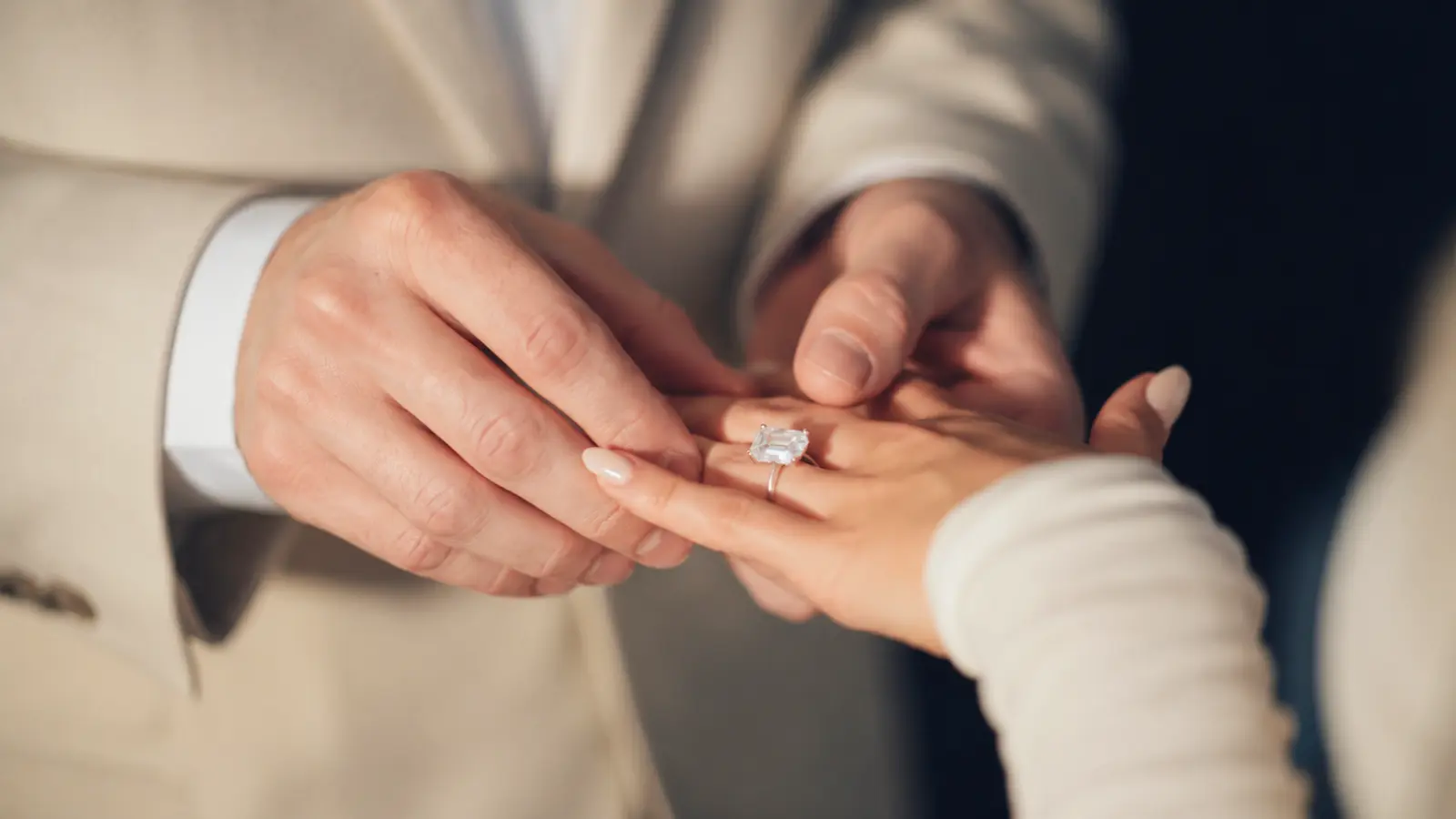
In the United States, a wedding ring is traditionally worn on the fourth finger of the left hand, commonly known as the ring finger. This tradition is followed by most American couples, although wedding ring placement varies across different countries, cultures, and personal traditions.
The answer may seem simple, but the meaning behind the wedding ring hand is more interesting. From the ancient belief in the vena amoris to right-hand traditions around the world, the finger you choose can carry cultural, practical, and personal meaning.
This guide explains what hand and finger a wedding ring goes on, why the left hand became traditional, what wearing a wedding ring on the right hand means, how it works before the ceremony, and how different cultures around the world wear their wedding rings.
What Hand Does a Wedding Ring Go On in the U.S.?
In the United States, whether you call it a wedding band or wedding ring, it traditionally goes on the fourth finger of the left hand. This is the convention followed by the overwhelming majority of American couples — across genders, across religions, and across wedding styles. It is what officiants expect, what photographers plan for, and what most Americans grew up seeing. When someone in the U.S. refers to “the ring finger,” they mean this finger — the left-hand fourth finger — without needing to specify further.
This is the answer that works for most people most of the time. Everything that follows is context — for couples who do not fit the majority convention, for couples whose families come from different traditions, or for anyone who simply wants to understand why this particular hand became the standard.
What Finger Does a Wedding Ring Go On?
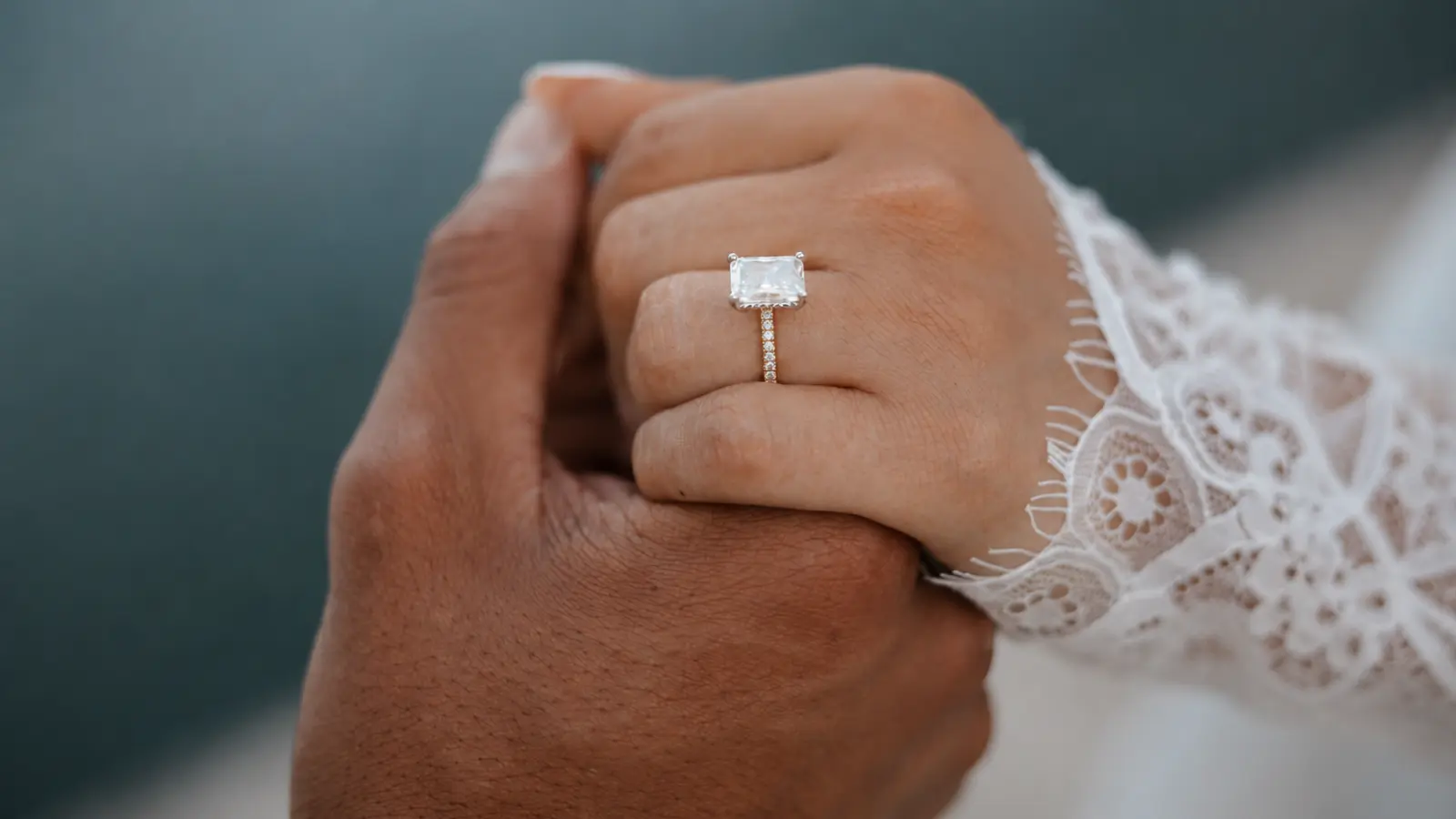
The fourth finger of the left hand — counting from the thumb as finger one. That makes the ring finger the second-to-last finger on the left hand, sitting between the middle finger and the pinky. It is called the ring finger in English precisely because of this tradition: the name of the finger is a product of the custom, not the other way around.
A few practical things worth knowing about this finger specifically:
- It is typically the thinnest of the four main fingers on most hands, which is part of why rings sit comfortably there — the natural taper creates a stopping point that keeps the ring from sliding toward the knuckle.
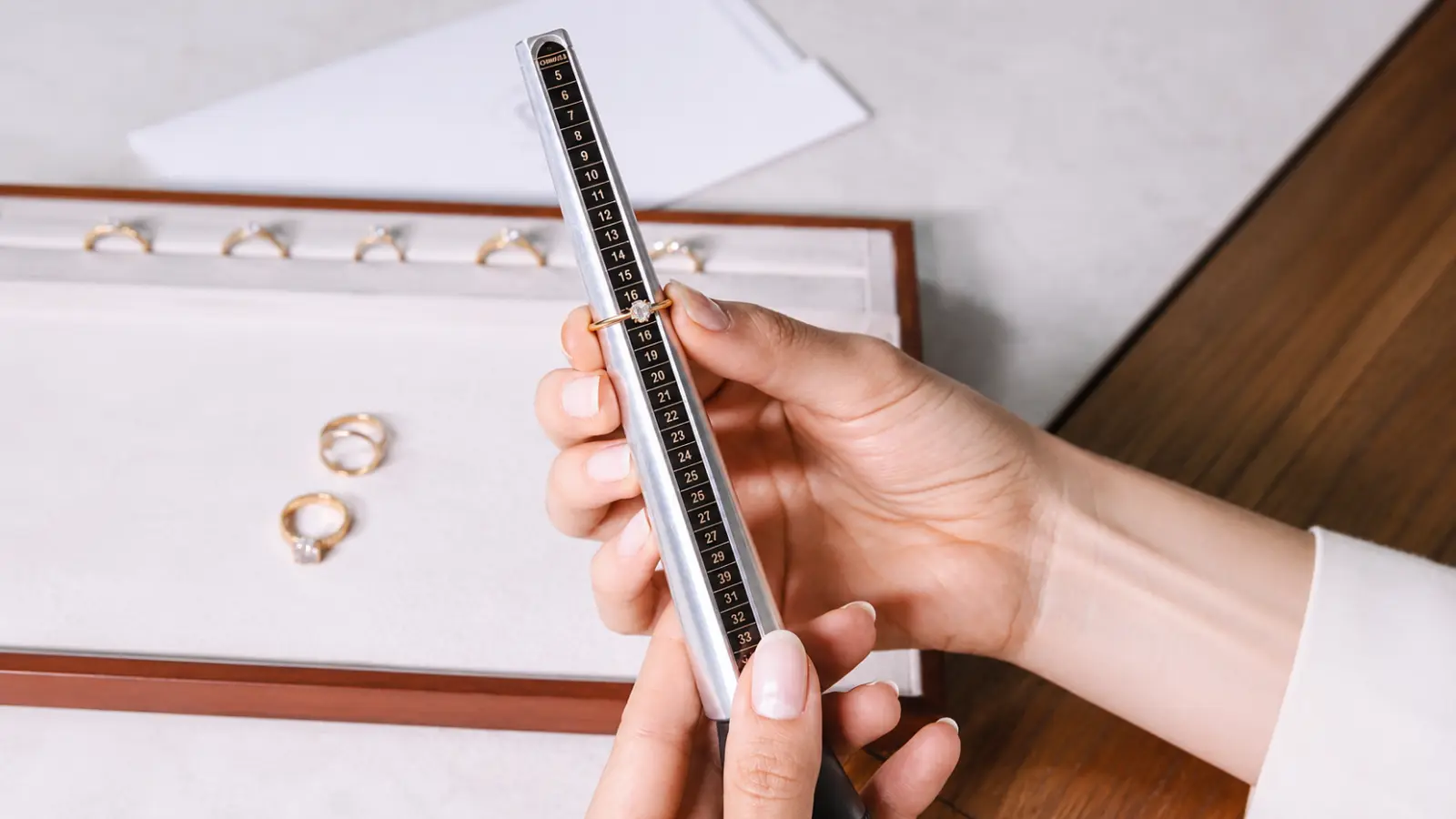
- Ring sizing for the fourth finger tends to differ from other fingers on the same hand. The ring finger and the index finger are often different sizes, sometimes significantly. Always size for the specific finger you intend to wear the ring on using our ring size calculator before ordering.
- The left and right ring fingers are not always the same size. Many people’s dominant hand runs slightly larger from regular use. A ring sized for the left ring finger may not fit the right — worth knowing if you ever anticipate moving it between hands.
In cultures where the right hand is conventional, the same finger applies — the fourth finger of the right hand. The finger is the consistent element across traditions; what changes is the hand.
Why Is the Wedding Ring Worn on the Left Hand?
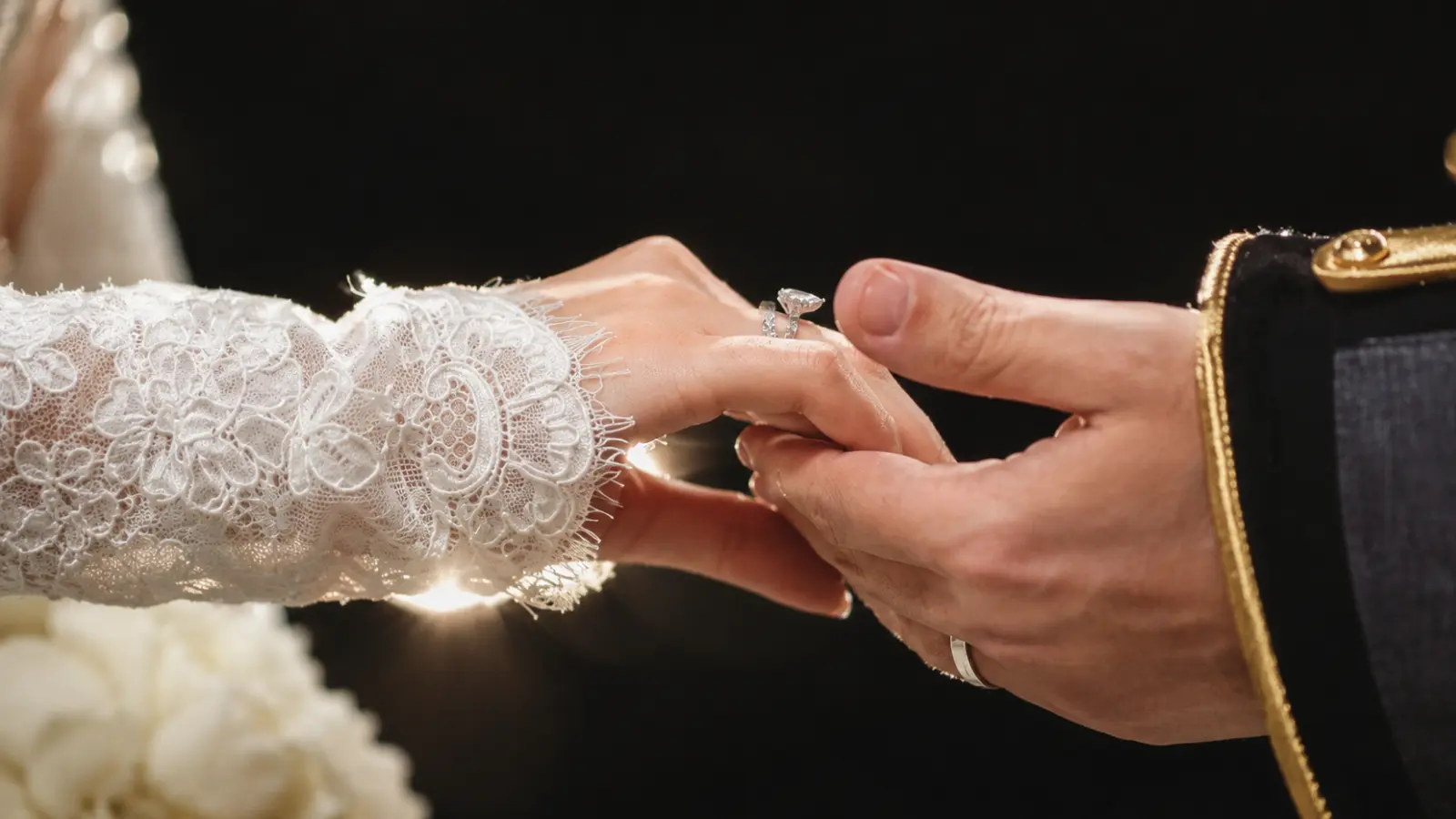
The origin of the left-hand tradition in Western countries is Roman, and it is rooted in a belief that would not survive a basic anatomy class today. Ancient Romans held that a vein — which they named the vena amoris, or vein of love — ran directly from the fourth finger of the left hand to the heart. Placing a ring on this finger was interpreted as a physical connection to the heart itself, a way of anchoring the commitment being made to the organ that represented love.
Modern anatomy does not support this. There is no vein of love. Every finger has the same basic vascular structure, and none has an uninterrupted direct connection to the heart that the others lack. The Romans were working with incomplete knowledge of the human body — not unusual for the ancient world — and the belief was sincere rather than symbolic. They genuinely thought the left ring finger was anatomically special.
What happened next is what makes the story interesting: the belief disappeared, but the wedding ring meaning attached to the tradition remained. By the time Western medicine established that the vena amoris was not real, the left-ring-finger custom had already been practiced long enough that it did not need a biological rationale to survive. It had become tradition — which is to say, it continued because it had always been done, not because the original reason still held.
A brief detour through the Reformation
In England, the left-hand tradition was interrupted during the Reformation, when Protestant custom briefly moved the wedding ring to the right hand as a rejection of Catholic practice. It returned to the left in England by the seventeenth and eighteenth centuries, where it has remained ever since. In several other European countries — Germany, the Netherlands, Norway, Russia — the Reformation shift to the right hand stayed. That divergence is why those countries follow a different convention today, and why the left-versus-right divide in wedding ring placement is essentially a map of religious history across Europe.
Even after the vena amoris was understood to be anatomically false, the phrase “closer to the heart” survived as a softer rationale for the left hand’s significance. The heart does sit slightly to the left of center in the chest, which means the left side of the body is — technically, marginally — closer to it. It is a thin physical basis for a centuries-old tradition, but traditions are good at finding new reasons to keep going.
What Does a Wedding Ring on the Right Hand Mean?
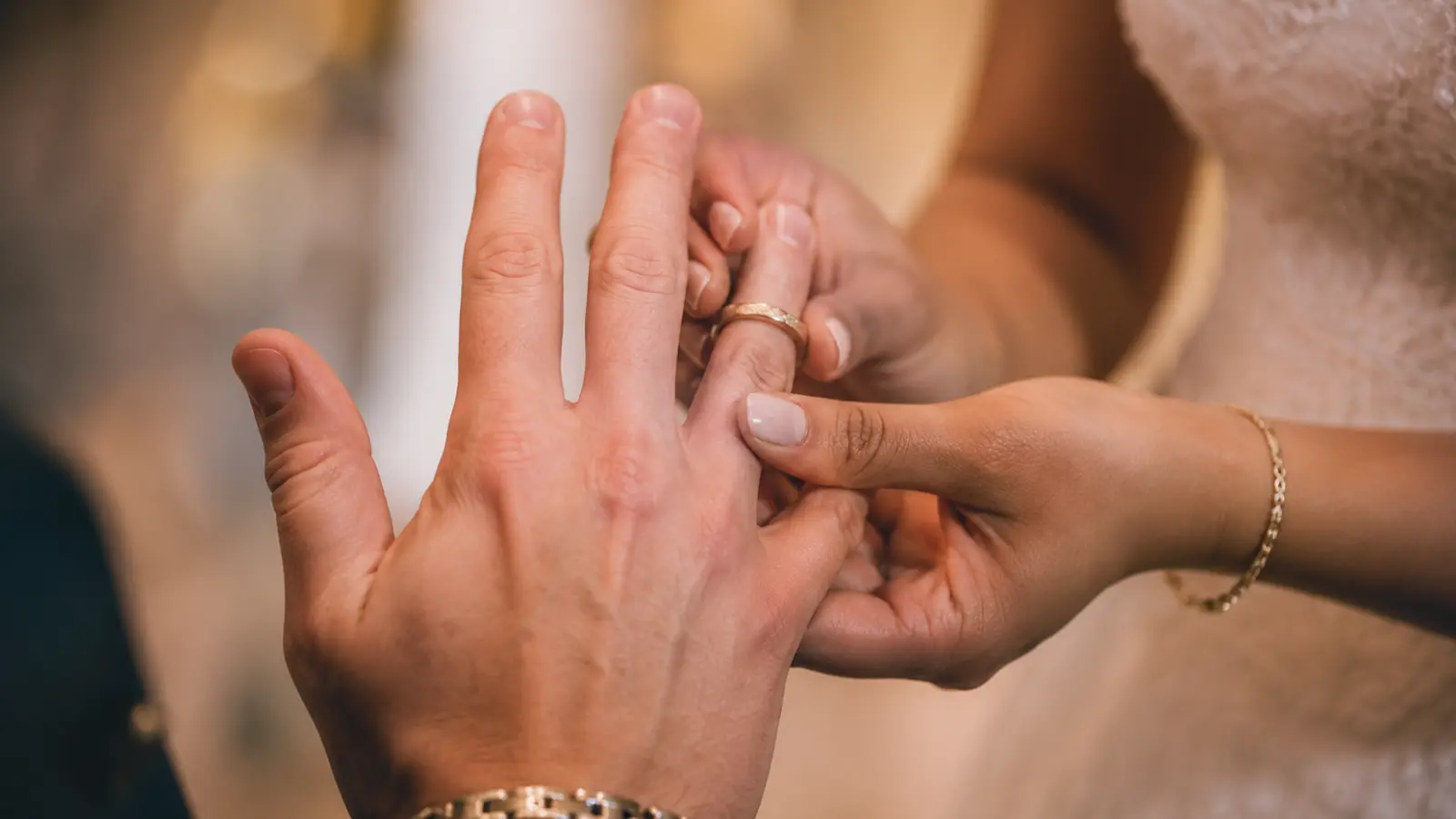
IIn the United States, a wedding ring on the right hand can mean several different things — and the interpretation depends heavily on context. It does not have a single fixed meaning the way the left-hand convention does.
It may simply be the person’s cultural tradition
The most common reason an American wears a wedding ring on the right hand is that their family background follows a different national or religious tradition. Eastern European families — Polish, Ukrainian, Russian, Greek — traditionally wear the wedding ring on the right hand. Families with roots in Germany, Norway, or Spain follow the same convention. Orthodox Christian tradition calls for the right hand. For these couples, the right hand is not a deviation from the norm; it is the norm they were raised with. Many continue it in the United States regardless of what their neighbors do, and there is no reason they should not.
It may be a personal preference
Some couples in the United States simply prefer the right hand — because it is more comfortable, because they already wear other jewelry on the left hand, because they are left-handed and find the left hand more prone to wear on the ring, or because they made a deliberate choice to do something different. None of these reasons require explanation or justification. The left-hand tradition is a convention, not a requirement.
It may signal widowhood or a life change
One recognized convention: moving the wedding ring from the left hand to the right hand after the death of a spouse. This allows someone to continue honoring their marriage — keeping the ring — while acknowledging that their status has changed. Not everyone who is widowed follows this practice, and not everyone wearing a ring on their right hand is widowed, but it is common enough in certain communities to be worth knowing.
What it does not mean
A wedding ring on the right hand in the United States does not signal an unhappy marriage, an unofficial commitment, or anything complicated. In most cases, the explanation is one of the above — cultural tradition, practical preference, or personal significance. Reading more than that into a finger placement is reading more than the evidence supports.
Wedding Ring Hand for Men and Women
In the United States, men and women follow the same convention: left hand, fourth finger. This has been standard since men’s wedding rings became a mainstream practice in the mid-twentieth century. Before World War II, it was common for only one partner — typically the wife — to wear a wedding ring. Men returning from the war who had worn rings during their service brought the habit home, and the cultural image of the wedding ring as a mutual symbol shifted accordingly. By the 1960s, men’s wedding rings were the norm rather than the exception.
There are no gendered differences in which hand or finger is conventional in the United States. What differs between men’s and women’s wedding rings is design, width, and metal choice — not placement. For more on how men’s rings differ in style and selection, the men’s wedding bands guide covers the full range of options.
Same-sex couples and non-binary individuals
Same-sex couples in the United States generally follow the left-ring-finger convention, with more personal variation than in some other traditions. Some couples wear their rings on the right hand as a nod to earlier customs within LGBTQ+ communities; others follow the left-hand convention without any distinction. Since the legalization of same-sex marriage in 2015, neither hand carries a specific meaning tied to orientation or relationship structure — it is simply a choice.
For non-binary and gender-nonconforming individuals, the same logic applies: wear the ring where it is most meaningful. The left-ring-finger tradition is available as a default if it suits the person; departing from it is equally valid. The tradition does not belong to a specific gender, and there is no alternative convention expected of non-binary wearers.
Which Hand Before and During the Ceremony
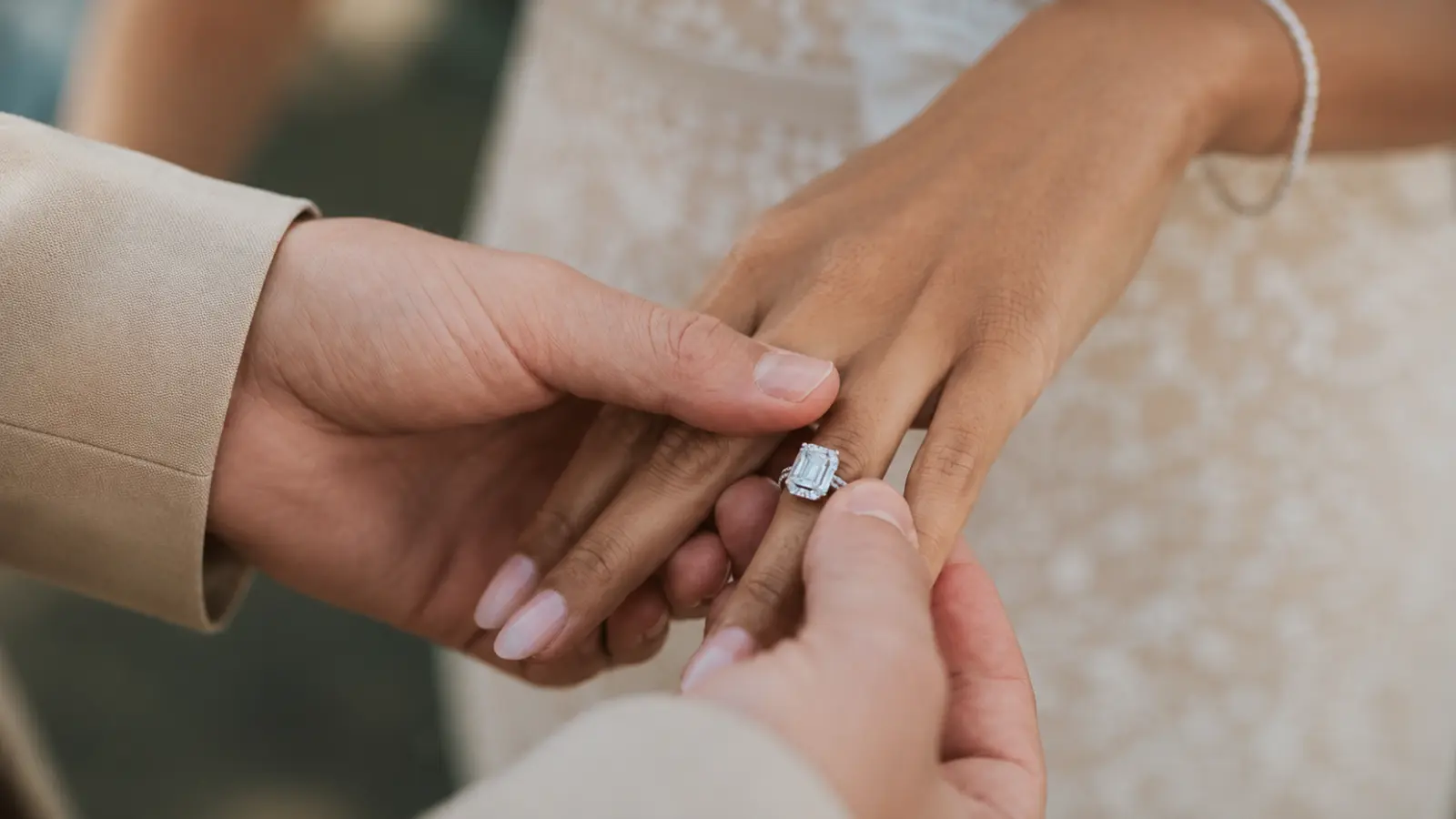
The wedding day introduces a common engagement ring vs. wedding ring question: where should each ring go during the ceremony?
The most common approach is to move the engagement ring to the right ring finger before the ceremony begins — while getting ready, before the processional. This leaves the left ring finger bare, allowing the wedding ring to be placed directly on it during the vows. After the ceremony, the engagement ring moves back to the left hand and sits on top of the wedding ring. The result is the conventional stacking order: wedding ring beneath, closest to the hand; engagement ring on top.
Some people give the engagement ring to a trusted person — a parent, the maid of honor, the best man — to hold during the ceremony, then receive it back afterward. This works, but it introduces a small risk: the ring needs to find its way back to the right person immediately after the ceremony, during a moment that tends to be emotional and distracted. Most couples who have tried both approaches find the right-hand transfer simpler and lower-stakes.
Others simply leave the engagement ring on the left hand during the ceremony and have the wedding ring placed over it, then reverse the order afterward to get the wedding ring beneath. This requires removing both rings and replacing them in the desired order — easy enough to do any time before or after the reception. And some couples do not worry about the order at all. For the couples this works for, the stacking order is a convention, not a requirement. For more on how the two rings sit together day-to-day, the how to wear wedding rings guide walks through the options.
Why Some People Wear a Wedding Ring on a Necklace
A wedding ring worn on a chain around the neck rather than on the finger is more common than most people realize — and it is almost never the complicated situation it might appear from the outside.
The most common reason is practical. Certain work environments make wearing a ring on the hand unsafe or impossible: medical workers who must remove hand jewelry before procedures, construction workers and mechanics for whom a metal ring is a safety hazard, athletes in contact sports or heavy training environments, and military personnel in active service. For all of these people, the necklace is the solution that keeps the ring on their person — close, felt, present — without the risk.
Fit is the second most common reason. Pregnancy changes ring size, sometimes significantly. Weight changes in either direction do the same. Some people have knuckles larger than their finger’s base, making a properly-sized ring uncomfortable to remove. A ring that does not fit the hand but carries real emotional weight often moves to a necklace as a better alternative than leaving it in a drawer.
A third reason is sentimental: the ring belongs to someone who is no longer living. A person who inherits a parent’s or grandparent’s wedding ring, or who wants to keep a late spouse’s ring close, often wears it on a necklace. This is a personal choice and one that deserves no interpretation beyond what the wearer offers. What wearing a wedding ring on a necklace does not signal is relationship trouble or an unofficial commitment — that reading almost never applies.
Wedding Ring Hand by Country
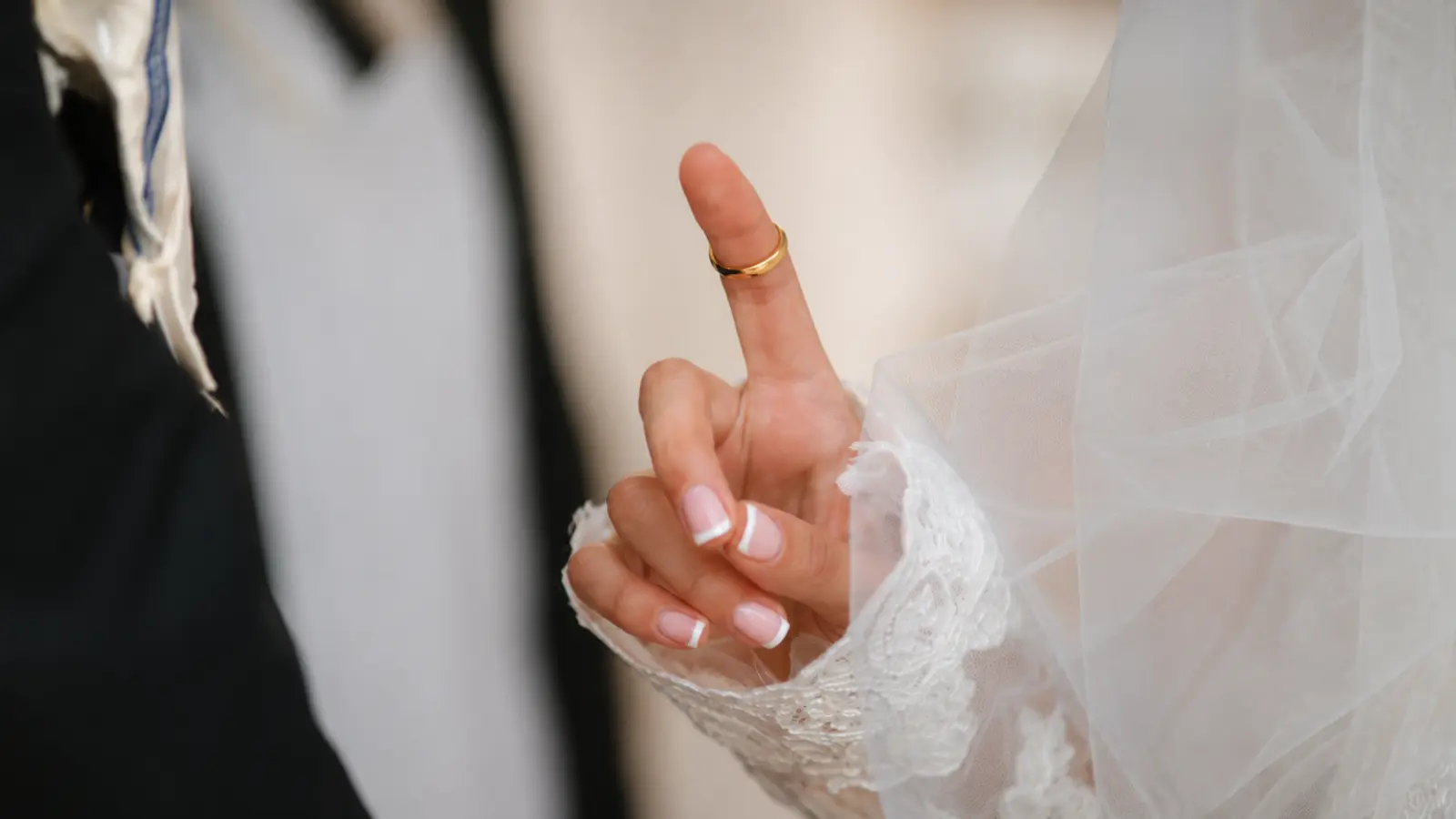
The left-hand convention is not as universal as it might seem from an American perspective. A significant portion of the world follows a completely different tradition — and knowing which countries do what matters for couples with international family connections, destination weddings, or mixed-heritage backgrounds navigating different expectations.
| Convention | Countries / Traditions |
|---|---|
| Left hand, fourth finger | United States, United Kingdom, Canada, Australia, France, Italy, Sweden, Ireland, Mexico, Brazil, Japan, South Korea |
| Right hand, fourth finger | Germany, Austria, Netherlands, Russia, Ukraine, Poland, Norway, Denmark, Greece, Spain, Portugal, Colombia, Venezuela, India (in some traditions), Eastern Orthodox Christians |
| Right index finger during ceremony, then moved | Jewish tradition — the ring is placed on the right index finger during the ceremony, then typically moved to the left ring finger |
| Varies by region or religion | India — Hindu tradition varies; some wear the ring on the right hand, some on the left; some do not use rings as wedding symbols at all |
When two traditions meet
Couples from different backgrounds often navigate different expectations, including who buys the wedding rings and which traditions to follow. One partner’s family may expect the left hand; the other’s may expect the right. The most common resolution is to choose one convention and follow it — usually the tradition of the country where the couple lives. But some couples wear their rings on different hands as a deliberate way of honoring both backgrounds. Others choose the right hand specifically because it represents the tradition that feels more personal to them.
There is no obligation to follow the convention of the country you live in if a different tradition is more meaningful. The ring’s significance comes from what it represents, not which hand it sits on. comes from what it represents, not which hand it sits on.
Wedding Ring Hand Inspiration
Wedding ring hand traditions can look different depending on culture, history, and personal meaning. Explore our inspiration board for classic wedding rings, left-hand traditions, right-hand wedding ring ideas, ring styling inspiration, meaningful details, and timeless ways couples wear their rings around the world.
Choosing the Tradition That Means the Most to You
The hand you choose for your wedding ring is shaped by history, culture, family traditions, and personal meaning. For many couples in the United States, that means the left ring finger. For others, a different choice may better represent their background or relationship.
What matters most is not only where the ring is worn, but what it represents — the commitment made, the person who placed it there, and the life connected to it.
Frequently asked questions (FAQ)
What hand does a wedding ring go on?
In the United States, a wedding ring is traditionally worn on the left hand. More specifically, it goes on the fourth finger of the left hand, commonly called the ring finger. However, some cultures wear wedding rings on the right hand, so the tradition depends on the country, religion, and personal preference.
What finger does a wedding ring go on?
A wedding ring traditionally goes on the fourth finger, also known as the ring finger. In the United States, this means the fourth finger of the left hand. In countries with right-hand wedding ring traditions, couples usually wear the ring on the same finger of the right hand.
Why do people wear wedding rings on the left hand?
The left-hand tradition is often connected to the ancient Roman idea of the “vena amoris,” or vein of love, which was believed to connect the ring finger directly to the heart. Although modern anatomy does not support this belief, the romantic tradition continued and became common in many Western countries.
What does wearing a wedding ring on the right hand mean?
A wedding ring on the right hand can have different meanings depending on the person and culture. In many countries, it is simply the traditional wedding ring hand. For others, it may represent family heritage, religion, personal preference, comfort, or a sentimental reason.
Do men and women wear wedding rings on the same hand?
Yes. In the United States, men and women traditionally wear wedding rings on the same hand: the fourth finger of the left hand. Differences between men’s and women’s wedding rings usually involve style, width, and design — not which hand they are worn on.
What happens to the engagement ring during the wedding ceremony?
Many people temporarily move their engagement ring to the right hand before the ceremony so the wedding ring can be placed directly on the left ring finger. After the ceremony, the engagement ring is usually moved back and worn above the wedding ring.