How to wear wedding rings traditionally means placing the wedding ring first on the left ring finger, closest to the hand, with the engagement ring stacked above it. This order comes from the wedding ceremony itself and the tradition that the wedding ring should sit closest to the heart.
While this is the classic way to wear a wedding ring and engagement ring together, modern couples often adjust the order based on comfort, ring design, lifestyle, or personal preference. Some rings do not sit flush together, and some people choose different arrangements that work better for everyday wear.
This guide explains how to wear wedding rings before and after the ceremony, which ring goes on first, the meaning behind traditional ring order, modern stacking options, and what to do if your engagement ring and wedding band do not sit perfectly together.
Which Ring Goes On First?
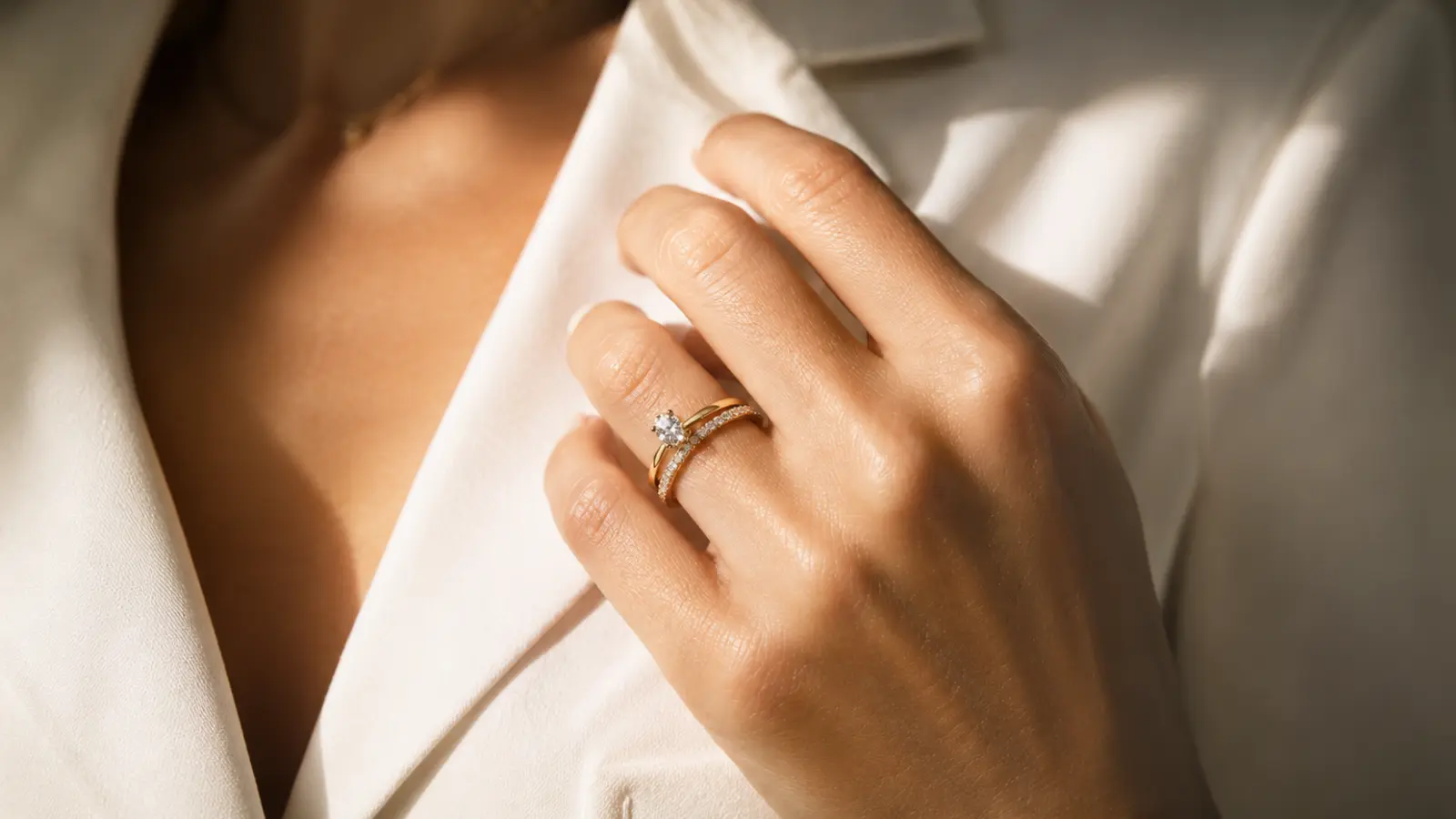
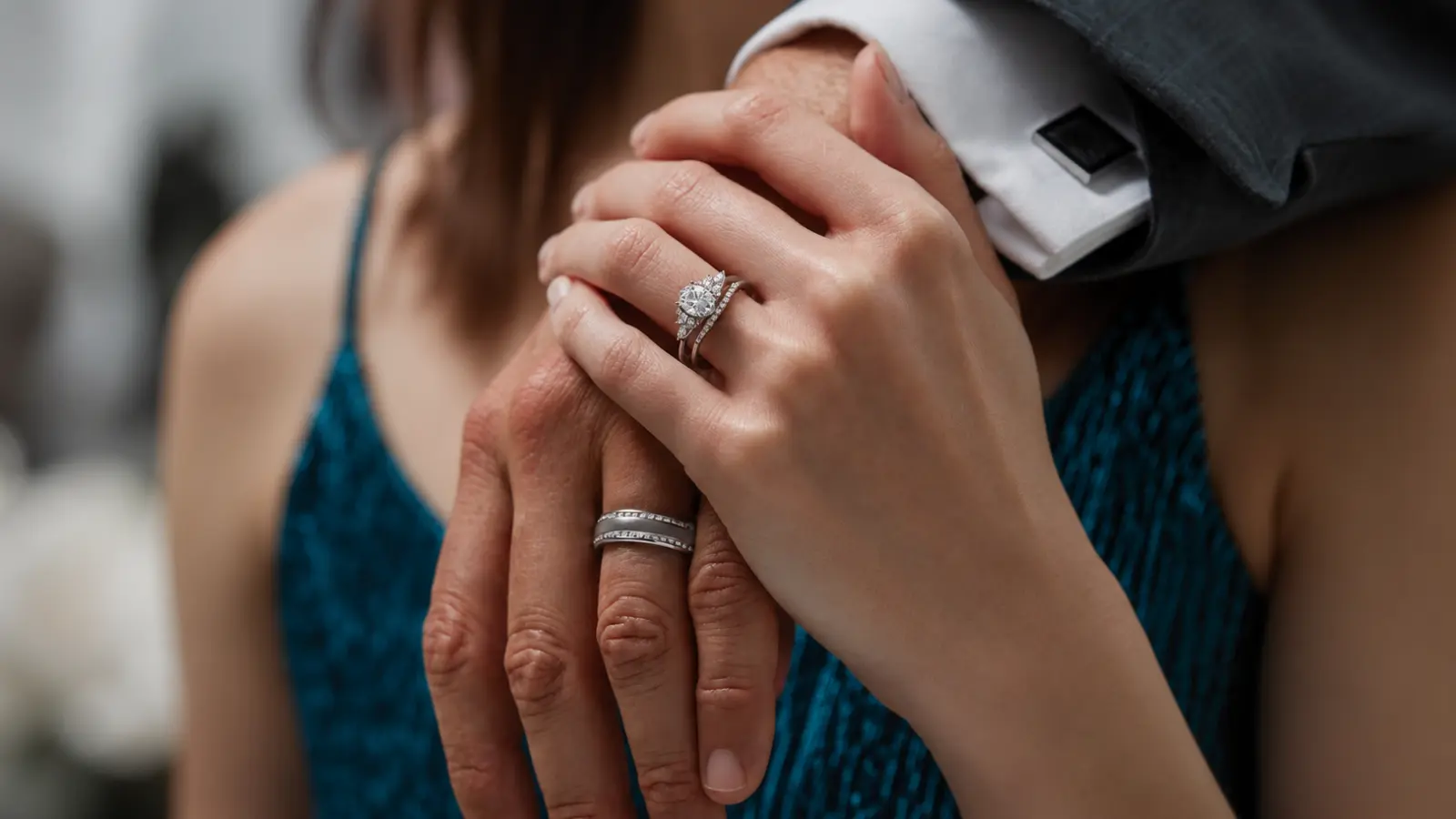
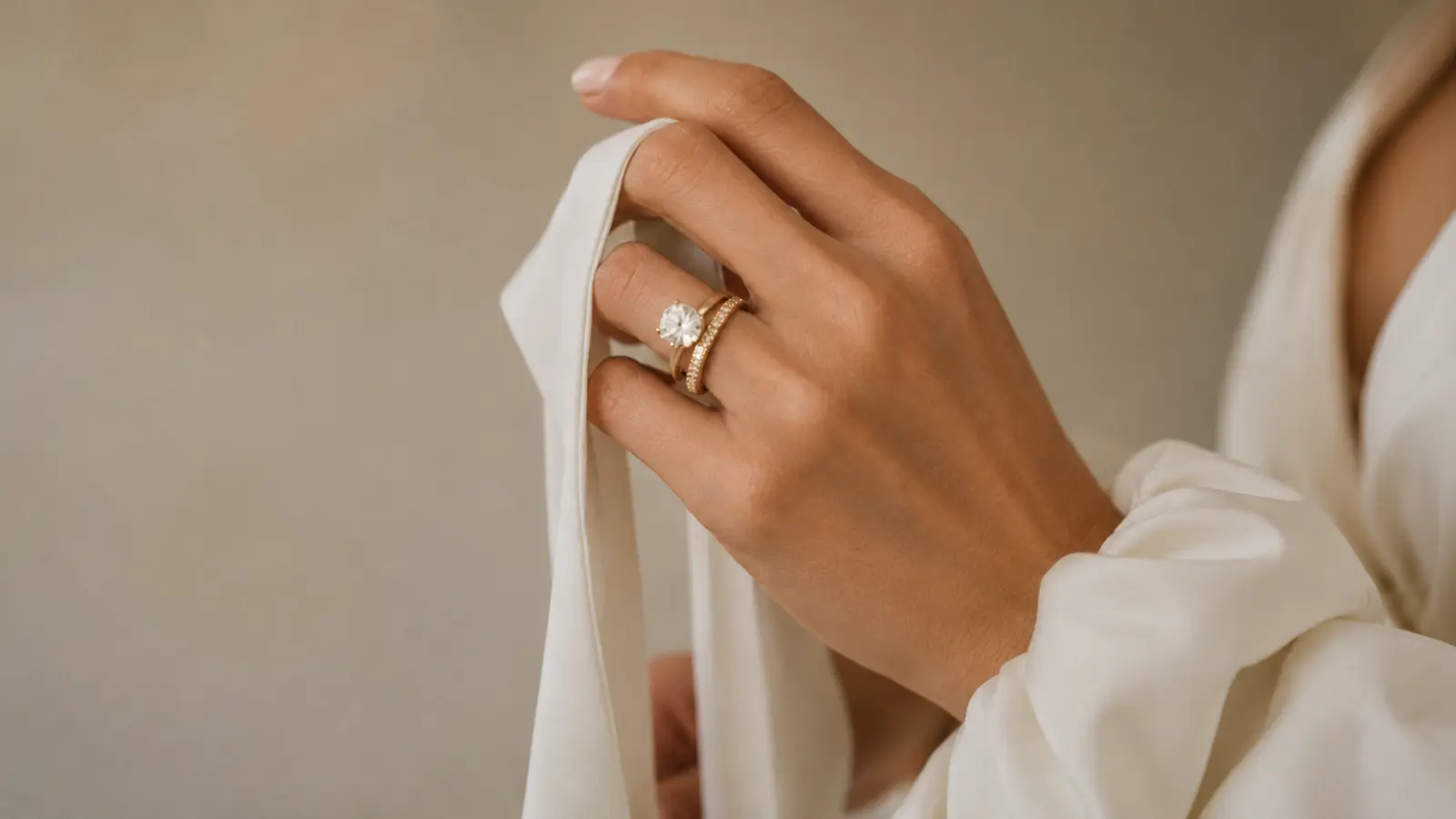
Understanding the difference between an engagement ring and wedding ring makes the traditional stacking order much easier to follow. This happens during the ceremony: the wedding ring is placed on the bare left ring finger during the exchange of vows, which means it occupies the inner position on the finger from that moment forward. When the engagement ring is placed back on the left hand after the ceremony, it sits on top of the wedding ring. The result is the traditional order: wedding ring beneath, engagement ring above.
This matters because the position a ring occupies on the finger is not something you can easily change once both rings are on — at least not without removing both and putting them back in the order you want. Understanding which ring goes where, and why, makes the ceremony itself go more smoothly, and gives you a clear answer when the question comes up in the weeks before the wedding.
Why does the wedding ring go on the bottom?
The position follows directly from the sequence of events. At the ceremony, the left ring finger is bare — the engagement ring has been moved to the right hand beforehand. The wedding ring goes directly onto the bare finger. When the engagement ring comes back afterward, it can only go on top. The symbolic reading — that the wedding ring sits “closest to the heart” in the inner position — is a natural interpretation of a practical sequence rather than the original reason for it.
That said, the symbolic logic holds up well enough that most couples choose to maintain the traditional order deliberately, even when they could easily switch it in the days after the wedding.
How to Wear Your Rings Before the Wedding
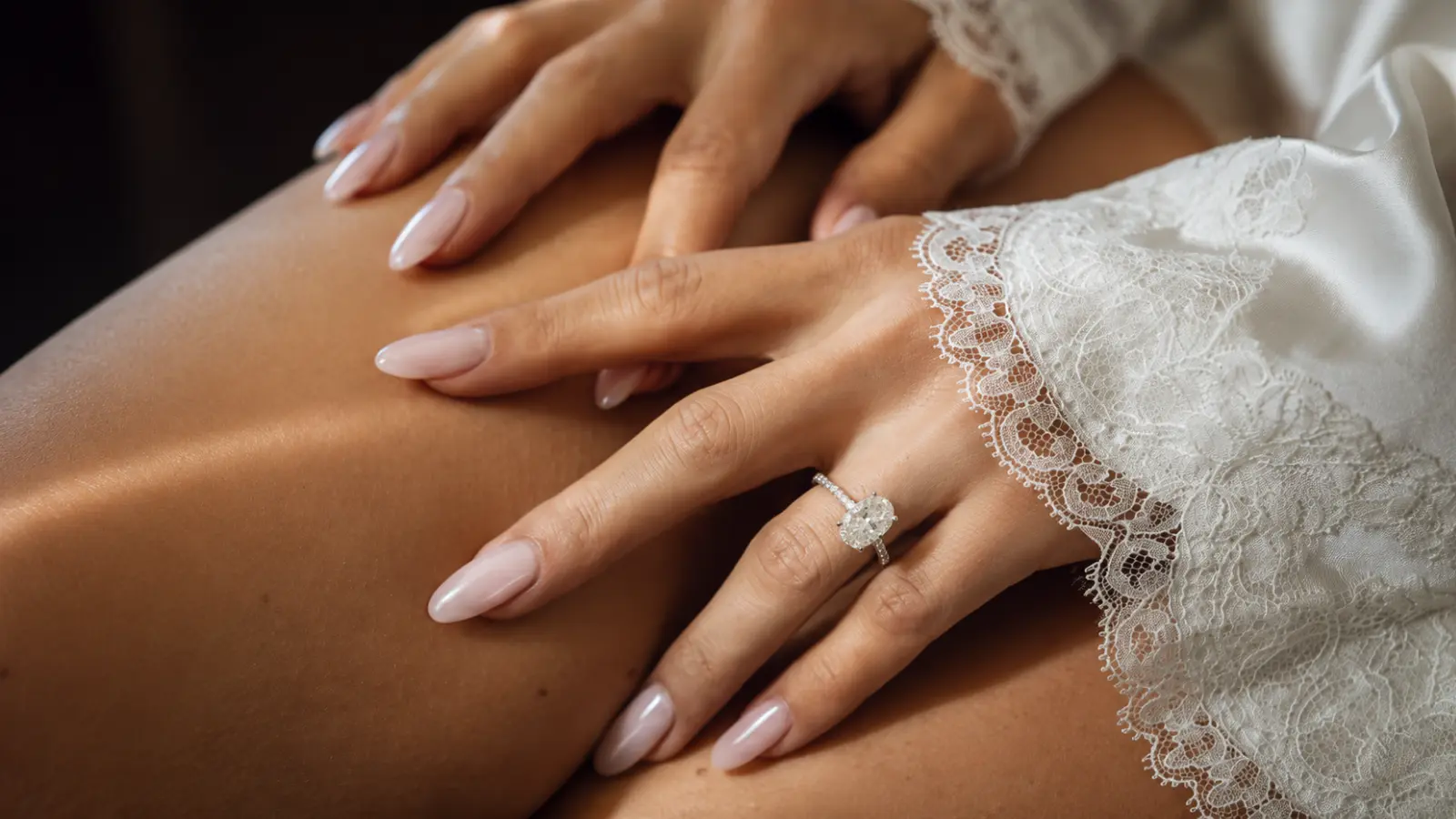
In the days and weeks leading up to the wedding, the engagement ring is worn as usual — on the left ring finger, as it has been since the proposal. Nothing about everyday wear changes during the engagement period. The question of ring management only becomes relevant on the wedding day itself, specifically in the hour or two before the ceremony begins.
On the morning of the wedding
Before the ceremony, most people move the engagement ring to the right hand, following the traditional guidance on what hand a wedding ring goes on during the exchange of vows. The goal is simple: the left ring finger needs to be completely bare when the officiant reaches the ring exchange, so the wedding ring can be placed directly onto the finger without any maneuvering. Having to remove the engagement ring mid-ceremony adds an awkward pause that most couples prefer to avoid.
Moving the ring to the right hand well before the ceremony is the most common and most straightforward approach. Many people do this as part of getting dressed or while putting on jewelry in the morning. Once the ring is on the right hand, it stays there until after the vows.
The alternative: giving the ring to an attendant
Some people prefer to give the engagement ring to a trusted attendant — a maid of honor, a sister, a mother — to hold during the ceremony. This works equally well and eliminates any concern about the ring being uncomfortable on the right hand during the ceremony. The trade-off is remembering to retrieve it afterward. If you go this route, designate a specific person and tell them explicitly what you are handing them and when you want it back. The post-ceremony is busy, and a ring is easy to forget in the movement between ceremony and reception. Most couples who have tried both approaches find the right-hand transfer simpler.
How to Wear Your Rings After the Ceremony
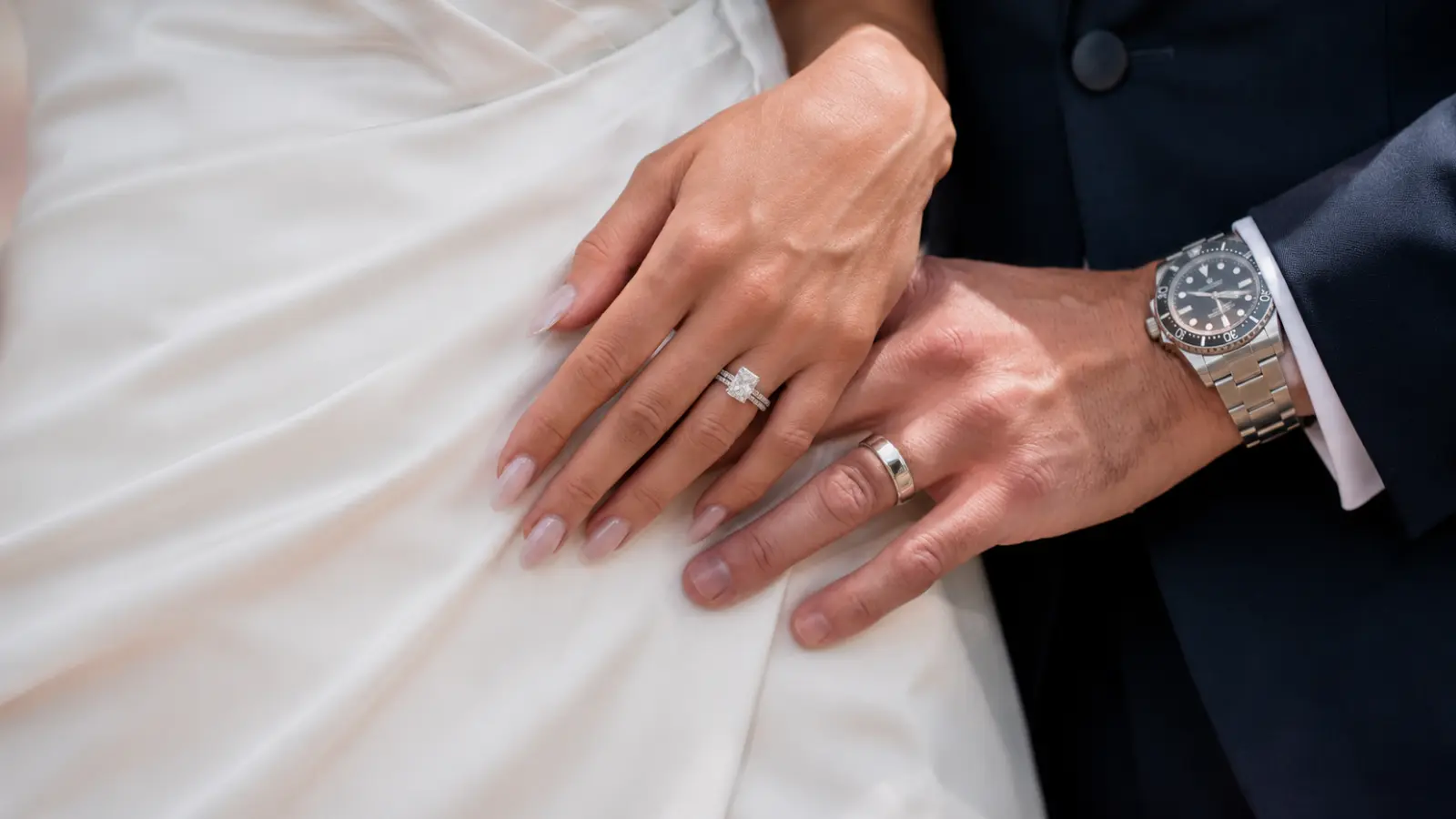
Once the wedding ring has been placed on the finger during the vows, the left ring finger is occupied. As soon as the ceremony is over — often in the first quiet moment at the reception, or in the Once the wedding ring has been placed on the finger during the vows, the left ring finger is occupied. As soon as the ceremony is over — often in the first quiet moment at the reception, or in the car on the way there — the engagement ring moves back to the left hand and goes on top of the wedding ring. This is now the permanent configuration: wedding ring on the bottom, engagement ring on top, both on the left ring finger.
Some people do this in the ceremony space immediately after being pronounced married. Others wait until they reach the reception. A few leave the engagement ring on the right hand for the entire wedding day because they want photographs of just the wedding ring first, or simply because they are occupied and the transfer is the last thing on their mind. All of these are fine — there is no deadline on the engagement ring’s return to the left hand.
What the stacking actually looks like
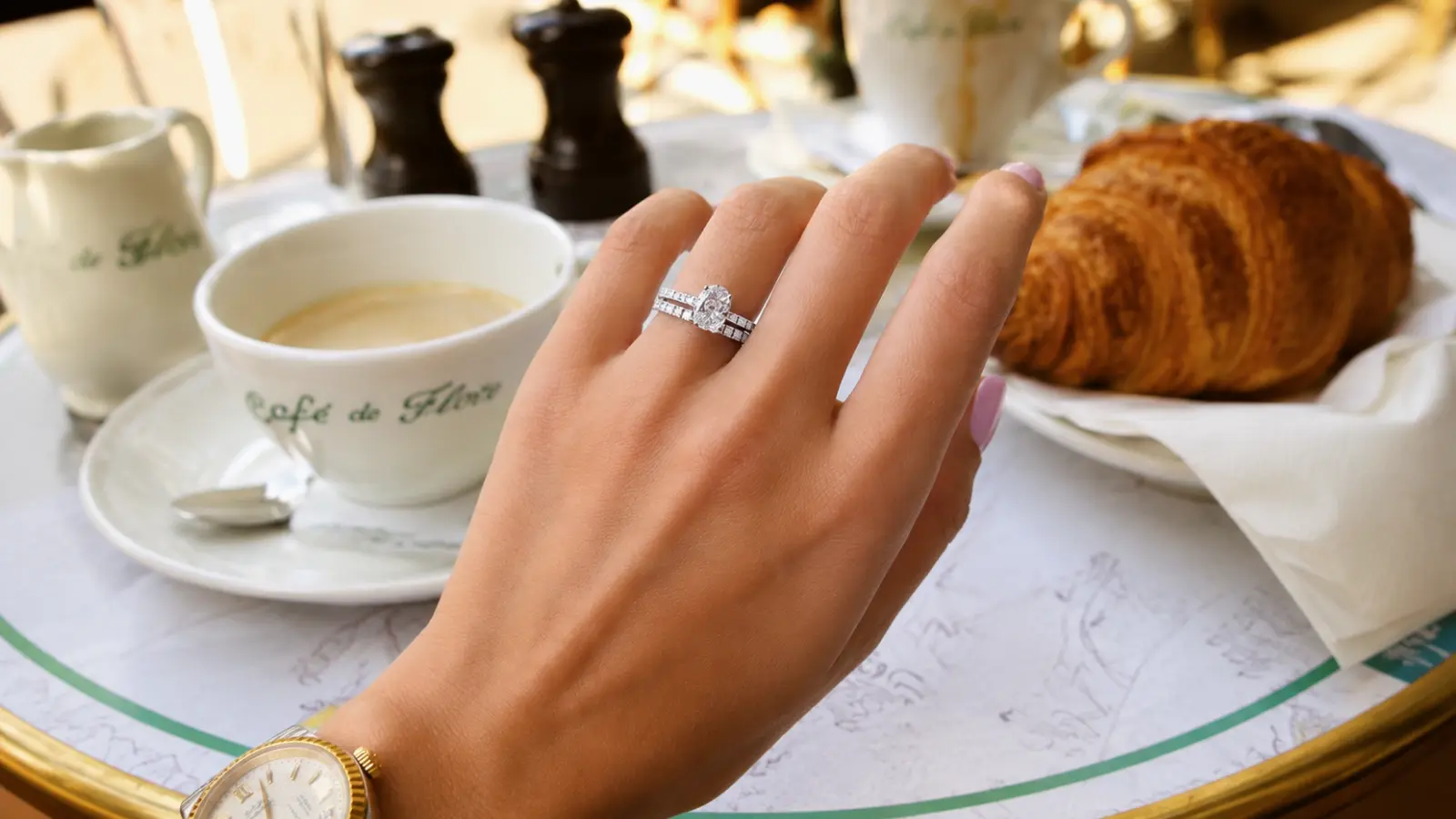
The two rings sit against each other on the finger, with the wedding ring at the base and the engagement ring above it. Depending on the profiles of both rings, this stack can look seamless and intentional — like matching wedding bands designed to be worn together — or it can reveal a visible gap or an imperfect fit. How the two rings actually sit together is one of the most practical considerations in choosing a wedding band, and it is worth addressing before the wedding rather than after. The wedding ring sets guide covers matched engagement ring and wedding band sets designed specifically to sit flush.
The Traditional Ring Order Explained
The traditional order — wedding ring on the inside, engagement ring on the outside — comes from a combination of Roman symbolism and practical ceremony choreography that has been observed in Western wedding culture for centuries.
Much of today’s wedding ring meaning comes from the ancient “vena amoris” tradition: the idea, originating in ancient Rome, that a vein ran directly from the fourth finger of the left hand to the heart. The wedding ring, representing the completed marriage, is placed in the position on the finger that is symbolically “closest to the heart” — nearest the base of the finger, in the inner slot. The engagement ring, representing the promise that preceded the marriage, sits outward from it.
It is worth noting that the vein of love is not anatomically real — modern medicine does not recognize it. But traditions do not require their original rationale to survive, and this one has. The inner position for the wedding ring is the conventional expectation in most jewelers’ and officiants’ understanding of ring etiquette, and it remains the arrangement most American couples follow.
When the two-ring convention became standard
The specific two-ring arrangement — engagement ring worn during the engagement, then joined by a wedding ring on the day — became widely practiced in the United States in the mid-twentieth century, roughly concurrent with the rise of diamond engagement rings as the standard form. Before that, many couples wore only a wedding ring, with no separate engagement ring to stack. The stacking convention is, in that sense, a relatively recent tradition, which may explain why the flexibility around it feels natural and widely accepted.
Modern Ways to Wear Both Rings
The traditional order is still followed by many American couples, but it is far from the only approach in practice. Several alternatives have become genuinely common — particularly as engagement ring designs have grown more varied and the practical challenges of stacking two rings have become better understood. Here is how people actually wear their rings today, beyond the convention.
Engagement ring on the bottom, wedding ring on top
Some people find that the engagement ring sits more naturally and more comfortably in the inner position — particularly if it is heavier than the wedding band, has a wider base, or simply stays more securely in place when it is against the finger. Wearing the engagement ring on the bottom and the wedding ring on top reverses the traditional order but is increasingly common as a personal preference rather than an error. Photographically, the result is often nearly identical — the rings read as a stack, and their individual positions are rarely legible from a distance.
One ring on each hand
Wearing the wedding ring on the left hand and the engagement ring on the right — or vice versa — is a practical solution that is also a genuine aesthetic choice for some people. It gives each ring its own space on its own finger, eliminates any fit or flush issues, and allows both rings to be appreciated individually rather than as a stack. This arrangement tends to work especially well when the engagement ring is substantial enough to be a standalone piece, or when the two rings are made from different metals and the color contrast feels more noticeable than comfortable when stacked.
Wearing only one ring
Many people wear only the wedding ring after the ceremony — particularly in professional contexts, during physical work, or simply as a preference for the lighter feel of a single band. Others wear only the engagement ring as the effective symbol of the marriage. Both are valid long-term choices. The two-ring stack is the tradition; it is not a requirement, and it does not carry more meaning than whatever arrangement the couple actually wears day to day.
Ring rotation by occasion
Some people rotate between rings depending on the day — wearing the engagement ring for dressy occasions and only the wedding band for everyday wear. This is a practical habit for anyone whose engagement ring has a high-profile setting that snags on clothing or feels uncomfortable during exercise or manual tasks. The wedding band, being lower profile by design, tends to hold up better through the range of daily activities most people move through.
What to Do If the Rings Do Not Sit Flush
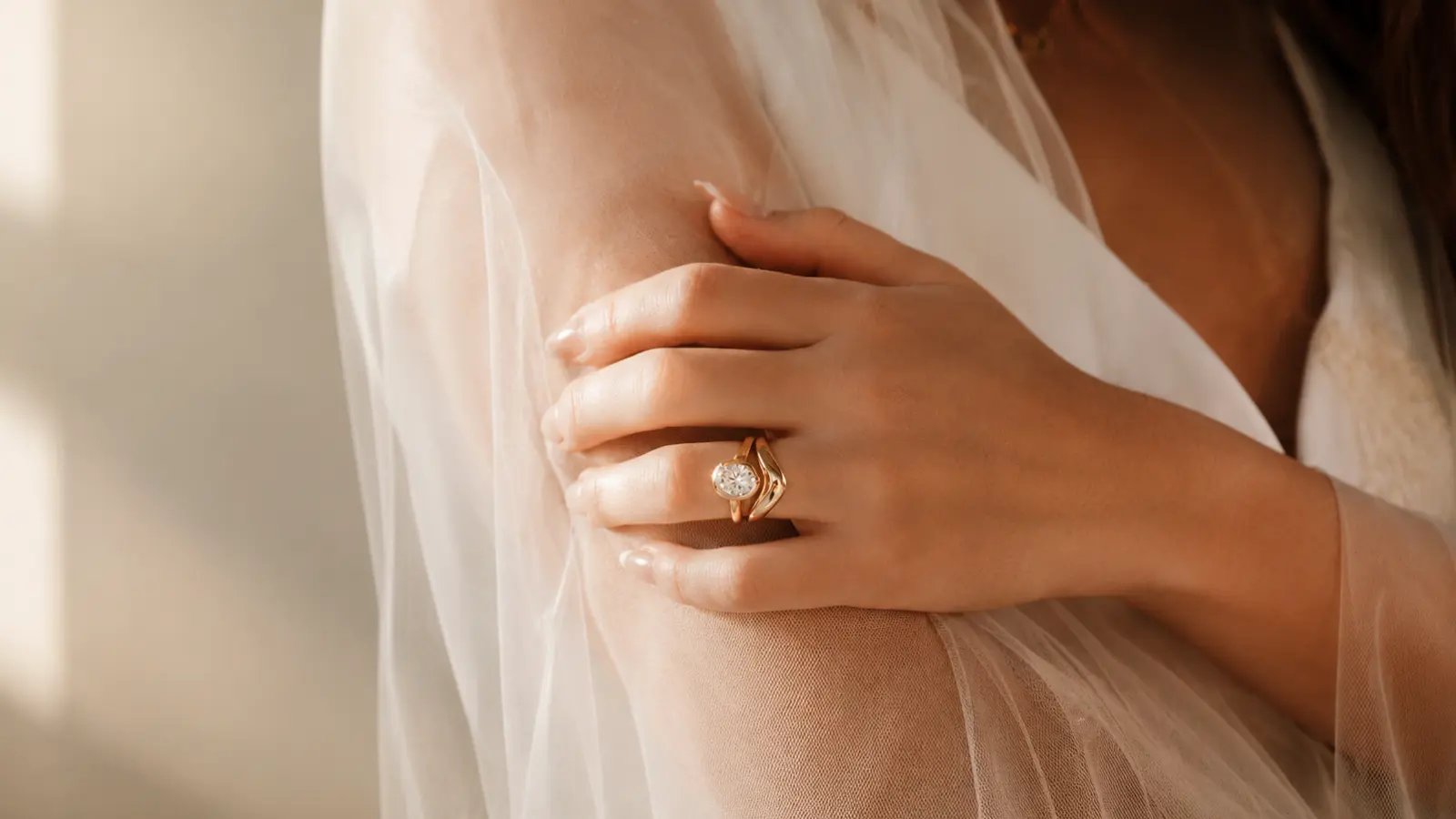
A gap between the engagement ring and the wedding band — where the two rings meet but do not touch along their full profile — is one of the more common and less anticipated problems in wearing two rings together. It happens often enough that most experienced bridal jewelers address it proactively when helping customers choose wedding bands.
The cause is almost always the same: the engagement ring has a raised or three-dimensional setting — a solitaire prong, a halo, a bezel with significant height — that prevents a straight-sided wedding band from sitting against it cleanly along the full interior curve. The rings touch at one point but separate as they extend around the finger, creating a visible wedge-shaped gap. The good news is that there are several straightforward solutions.
Option 1: A contoured or curved wedding band
The most common solution is choosing a wedding band designed to accommodate the engagement ring’s profile. A contoured band — sometimes called a curved band or a notched band — has a silhouette shaped to nestle against or around the engagement ring’s setting. These bands are widely available in most bridal collections, and many are designed as matched pairs with specific engagement ring styles.
The advantage of a contoured band is that the gap disappears: the two rings meet cleanly along their full interior profile. The trade-off is that a contoured band can feel visually incomplete when worn alone — the curved silhouette was designed to be seen in context of the engagement ring beside it.
Option 2: A custom-fitted band
A jeweler can create a wedding band fitted precisely around a specific engagement ring — shaped and sized to sit against it with no gap. This is a more involved option than choosing from a standard contoured collection, but it produces a result that no off-the-shelf band can match in terms of fit. If the engagement ring is unusual in its profile — a wide bezel, an asymmetrical design, a specific vintage setting — a custom-fitted band is often the most satisfying solution. A good jeweler who specializes in bridal jewelry will have done this many times and can walk you through what it involves.
Option 3: A very narrow band
A thin wedding band — 1.5mm to 2mm wide — will often tuck against an engagement ring with minimal visible gap, even when a standard-width band would leave a significant space. The narrow profile fits alongside the setting more naturally because it occupies less of the contoured area where the gap appears. Some people find the narrowness underwhelming visually; others find it elegant. It is worth trying a thin band against the actual engagement ring before ruling out the option.
Option 4: Wearing the rings on separate hands
If neither a contoured band nor a custom fit is practical or appealing, wearing one ring on each hand eliminates the fit problem entirely. Many people who initially see this as a workaround come to genuinely prefer it — each ring has room to be itself, there is no stack to manage, and both rings are visible and distinct in photographs.
One consistent recommendation regardless of which solution you choose: bring the actual engagement ring to the appointment when selecting the wedding band. A band that looks right in a photograph or on a display stand may produce a noticeable gap against a specific ring that the photo did not reveal. Seeing the two rings together is the only reliable way to assess fit before committing.
Should You Solder Your Rings Together?
Soldering — permanently joining the two rings at their contact point so they move as one piece — is a practical solution that suits some couples well and creates complications for others. The appeal is real: once soldered, the rings cannot shift, separate, or spin independently. The stack becomes permanently unified and wears like a single ring in terms of feel and movement.
When soldering makes sense
Soldering tends to work well when both rings fit well individually and the couple is confident about long-term fit. It is particularly useful when the rings sit well together but tend to rotate or separate during the day — creating a stack that never looks intentional despite fitting properly. For people who find managing two separate rings a persistent daily annoyance, soldering removes the problem cleanly.
The process itself is straightforward: a jeweler solders the rings in under an hour of actual work, though most shops ask for a day or two for scheduling. The cost is modest — typically in the range of $45 to $150 depending on the jeweler and the metals involved.
When to hesitate
The main trade-off is permanence. Once soldered, the rings must be separated before either can be resized, repaired, or significantly modified — and separation adds cost and carries some small risk to both rings during the process.
If there is any real chance that either ring will need significant resizing in the future, check your fit with our ring size calculator before making permanent changes — due to pregnancy, weight change, or the natural finger changes that come with age — soldering is worth deferring until ring size is more stable.
Couples who sometimes prefer to wear only the engagement ring or only the wedding band will lose that flexibility entirely after soldering. The two rings become, in practical terms, one ring with two visual components. Most reputable jewelers who work with bridal jewelry do this regularly and can tell you whether the specific rings in question are good candidates before you commit.
Daily Wear: Practical Habits That Protect Both Rings
Wearing two rings together every day introduces wear patterns that a single ring would not produce. The rings move against each other — even imperceptibly — which gradually affects both surfaces over time. Understanding this is not a reason for anxiety; it is a reason for a few deliberate habits that most jewelers recommend as a matter of course.
Metals that wear at different rates
When two rings of different metals are worn together — a platinum engagement ring and a white gold wedding band, for example — they wear against each other at different rates. Softer metals wear faster when in continuous contact with harder ones. Over years, this can cause micro-scratches at the contact point of the softer ring. If you are mixing metals, have both rings inspected by a jeweler every two to three years. Minor wear is easy and inexpensive to address when caught early; left too long, it becomes more involved.
When to remove the rings
There is no etiquette rule requiring the rings to be worn at all times. Removing both rings for exercise, swimming, manual work, food preparation, and sleep is practical and widely common. Many people with high-profile engagement ring settings find the ring snagging on fabric or pressing uncomfortably during certain activities — removing it for those moments is sensible. The wedding ring, being lower profile, often stays on through activities where the engagement ring comes off.
The one consistent practical recommendation from jewelers: store the rings in a designated spot — a ring dish, a small box, a specific place on the bathroom counter — every time they come off. Lost rings are rarely lost during dramatic events. They are almost always set down in a forgettable spot during a forgettable moment.
Cleaning two rings worn together
Soap, lotion, and debris accumulate in the space between two rings worn together more quickly than on a ring worn alone. The contact point where the inner faces of both rings touch is a spot that a toothbrush cannot easily reach from the outside. A jeweler’s ultrasonic cleaner addresses this effectively; many jewelers offer a quick cleaning as a complimentary service during routine check-up visits. At home, soaking both rings in warm soapy water and gently brushing with a soft toothbrush removes surface accumulation between professional cleanings.
Wedding Ring Stack Inspiration
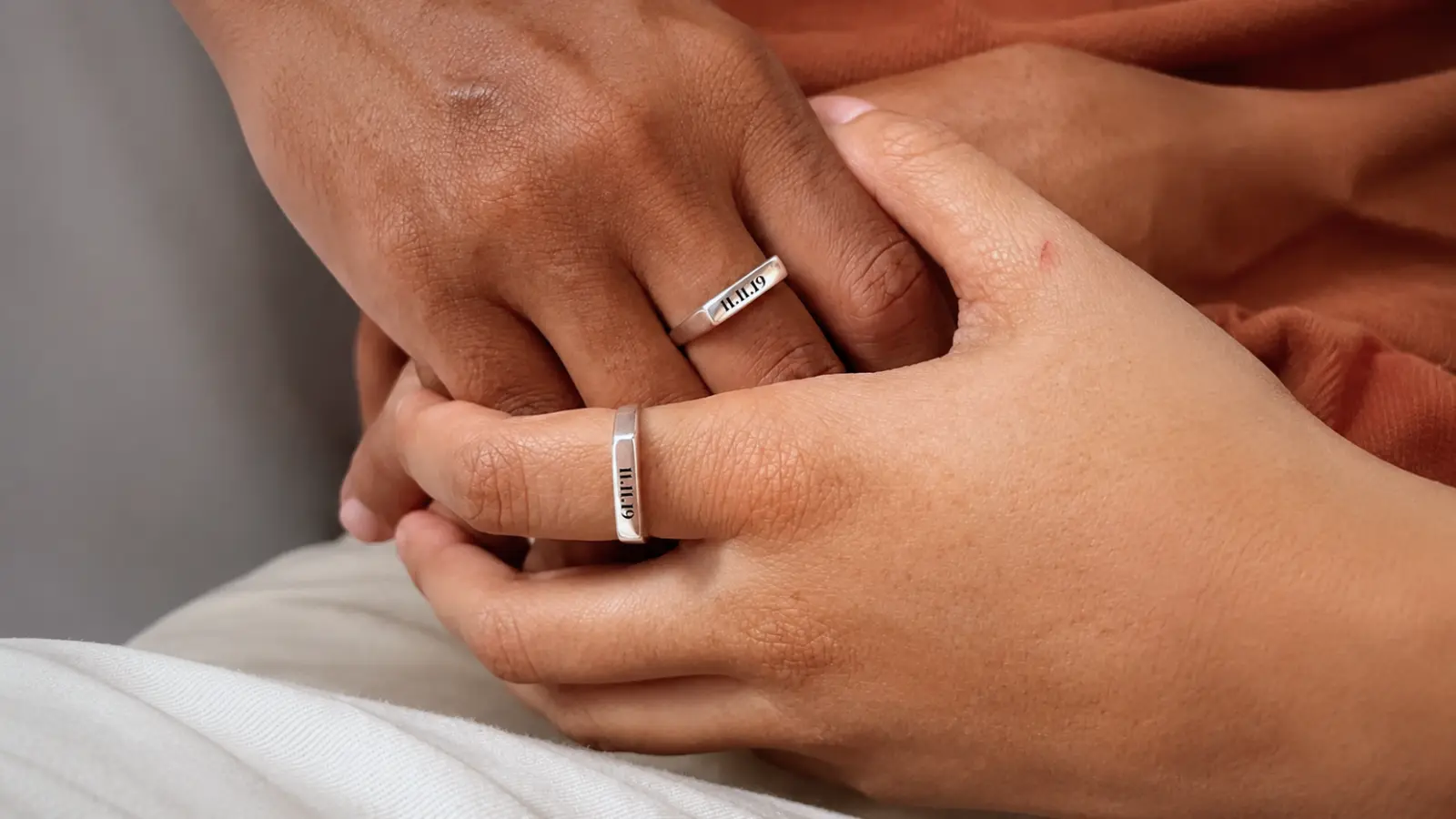
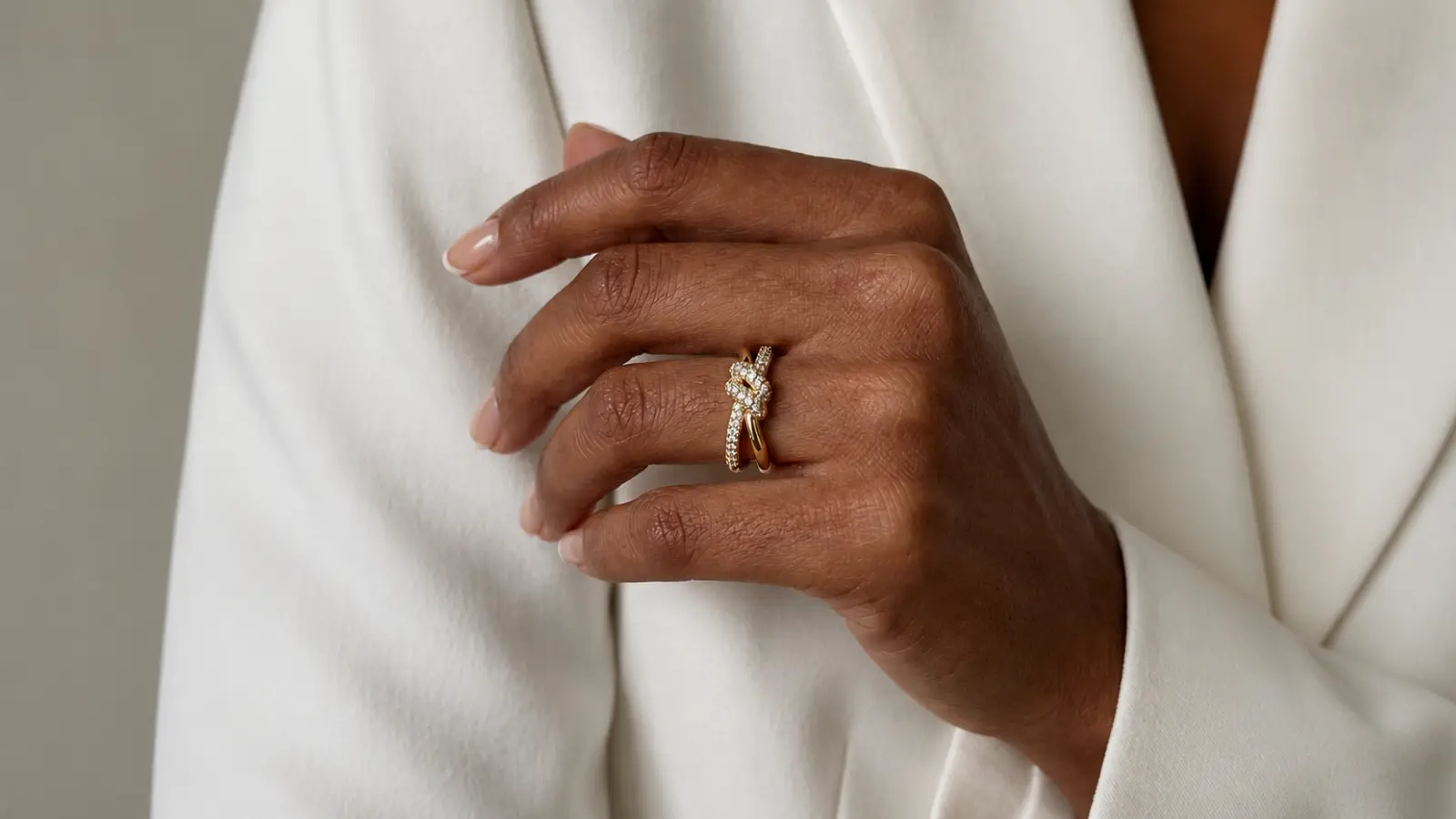
Wedding rings can be worn in many beautiful ways depending on the design, setting, metal, and personal style of each couple. Explore our inspiration board for classic wedding ring stacks, engagement ring pairings, curved wedding bands, matching sets, and modern ways to wear your rings together.
Finding the Ring Style That Works for Everyday Life
The way you wear your wedding ring and engagement ring is shaped by tradition, but it should also fit your real life. The traditional order has meaning, but comfort, design, lifestyle, and how your rings feel together matter just as much.
Whether you follow the classic wedding ring stack, wear your rings separately, or create your own arrangement, the best choice is the one that feels comfortable, meaningful, and natural in your everyday life. Your rings are not only part of the ceremony — they become part of the life and memories that follow.
Frequently asked questions (FAQ)
How do you wear a wedding ring and engagement ring together?
Traditionally, both rings are worn together on the left ring finger, with the wedding ring placed first and the engagement ring worn above it. This keeps the wedding ring closest to the hand, following the traditional idea that it sits closest to the heart. However, some people adjust the order based on comfort, fit, or personal preference.
Which ring goes on first, the wedding ring or engagement ring?
The wedding ring traditionally goes on first. During the ceremony, it is placed directly on the left ring finger. After the ceremony, the engagement ring is usually added back on top, creating the traditional wedding ring and engagement ring stack.
Does the wedding band go on top or bottom?
The wedding band usually goes on the bottom, closest to the hand, with the engagement ring above it. This is the traditional order, but it is not a strict rule. Some people reverse the order because their rings fit better or look more balanced another way.
What do you do with your engagement ring during the wedding ceremony?
Many people move their engagement ring to their right hand before the ceremony so the wedding ring can be placed directly on the left ring finger. After the ceremony, the engagement ring is moved back and worn above the wedding ring.
Can you wear your wedding ring and engagement ring on different hands?
Yes. Wearing the rings on different hands is completely acceptable, especially if the rings do not fit comfortably together. Some people also prefer this because it allows each ring to stand out individually.
What should you do if your wedding band and engagement ring do not fit together?
If the rings do not sit well together, you can choose a curved or contoured wedding band, create a custom band, wear the rings separately, or ask a jeweler about adjusting the fit. The best solution depends on the shape and design of your specific rings.