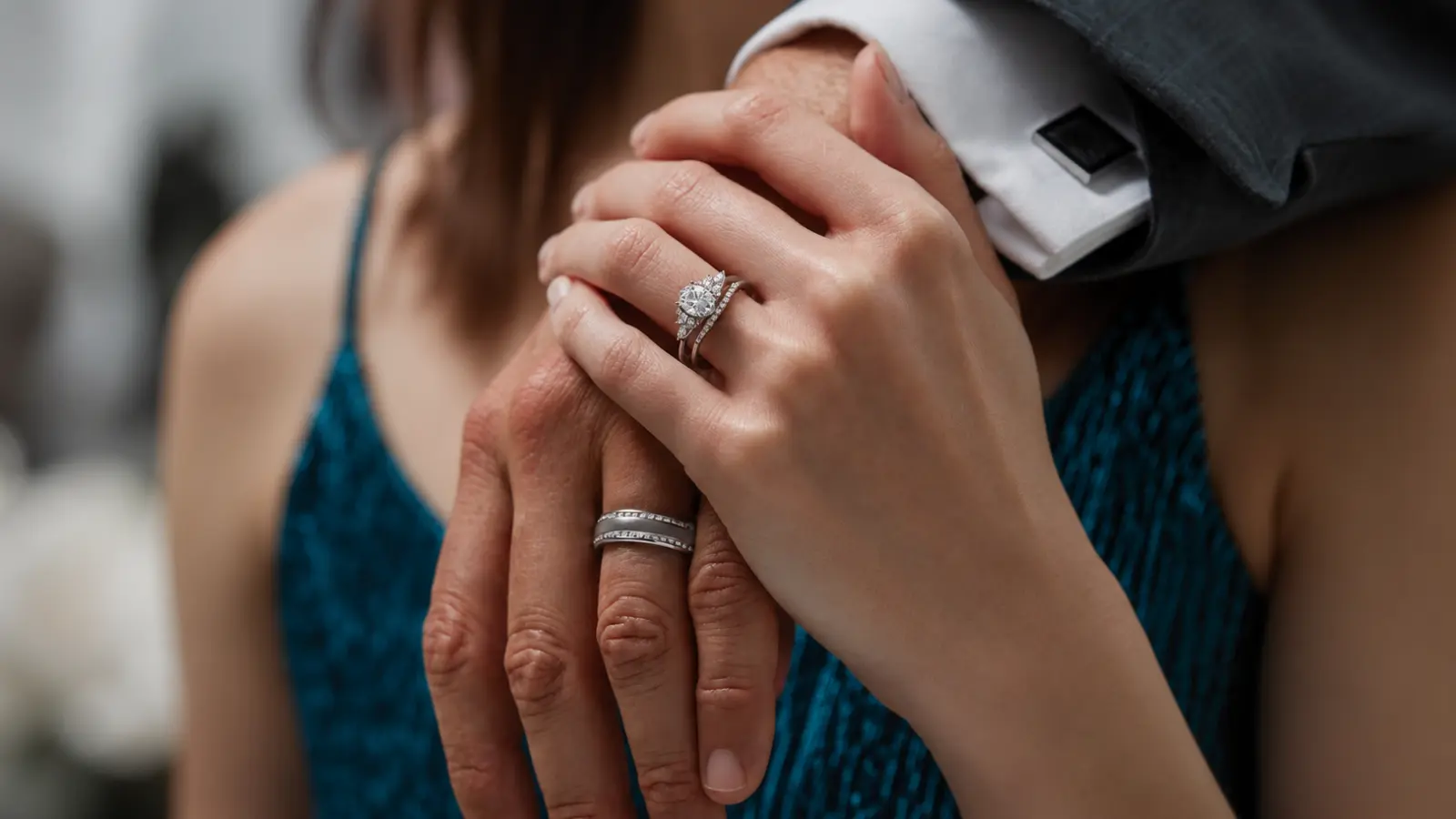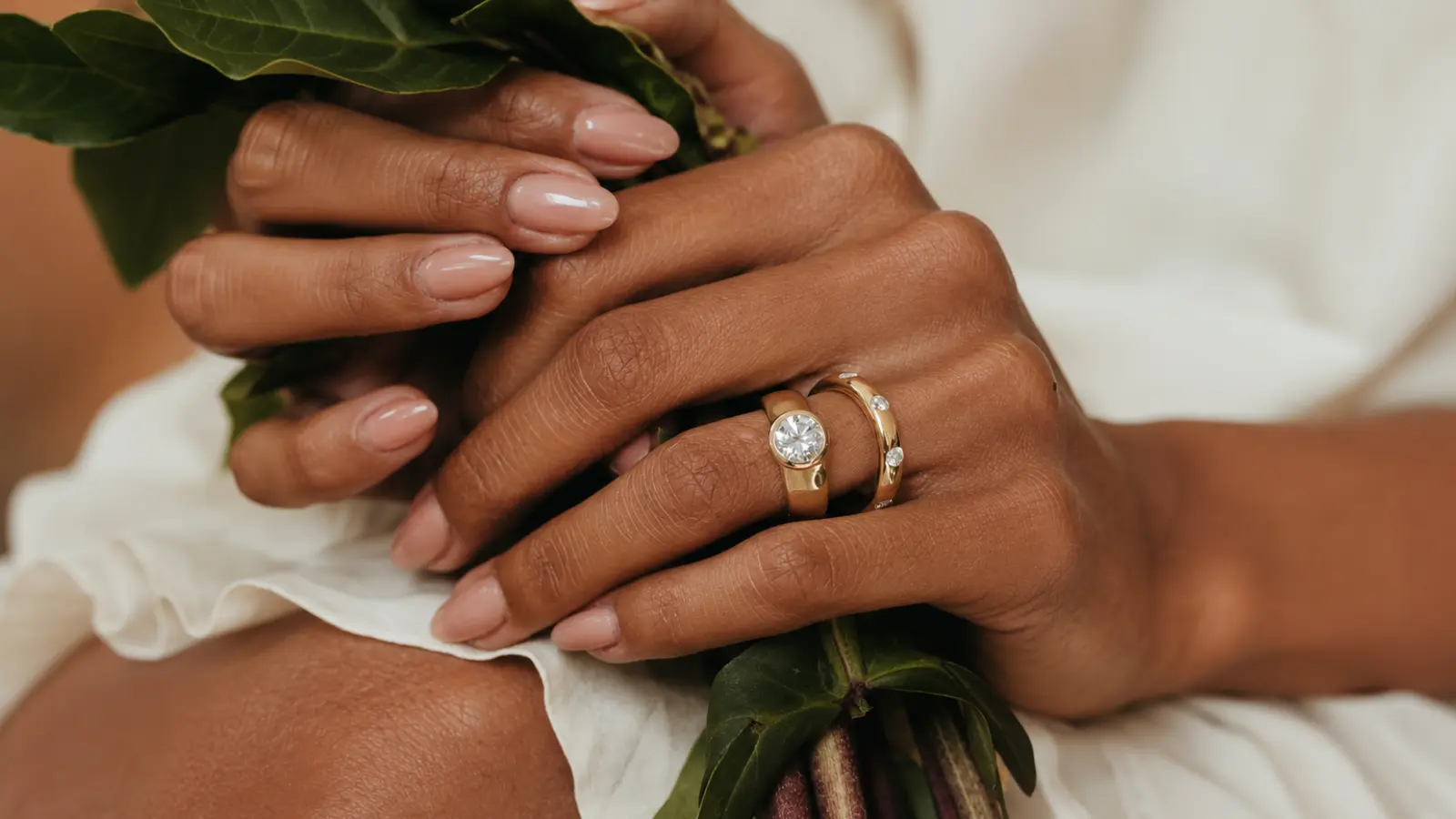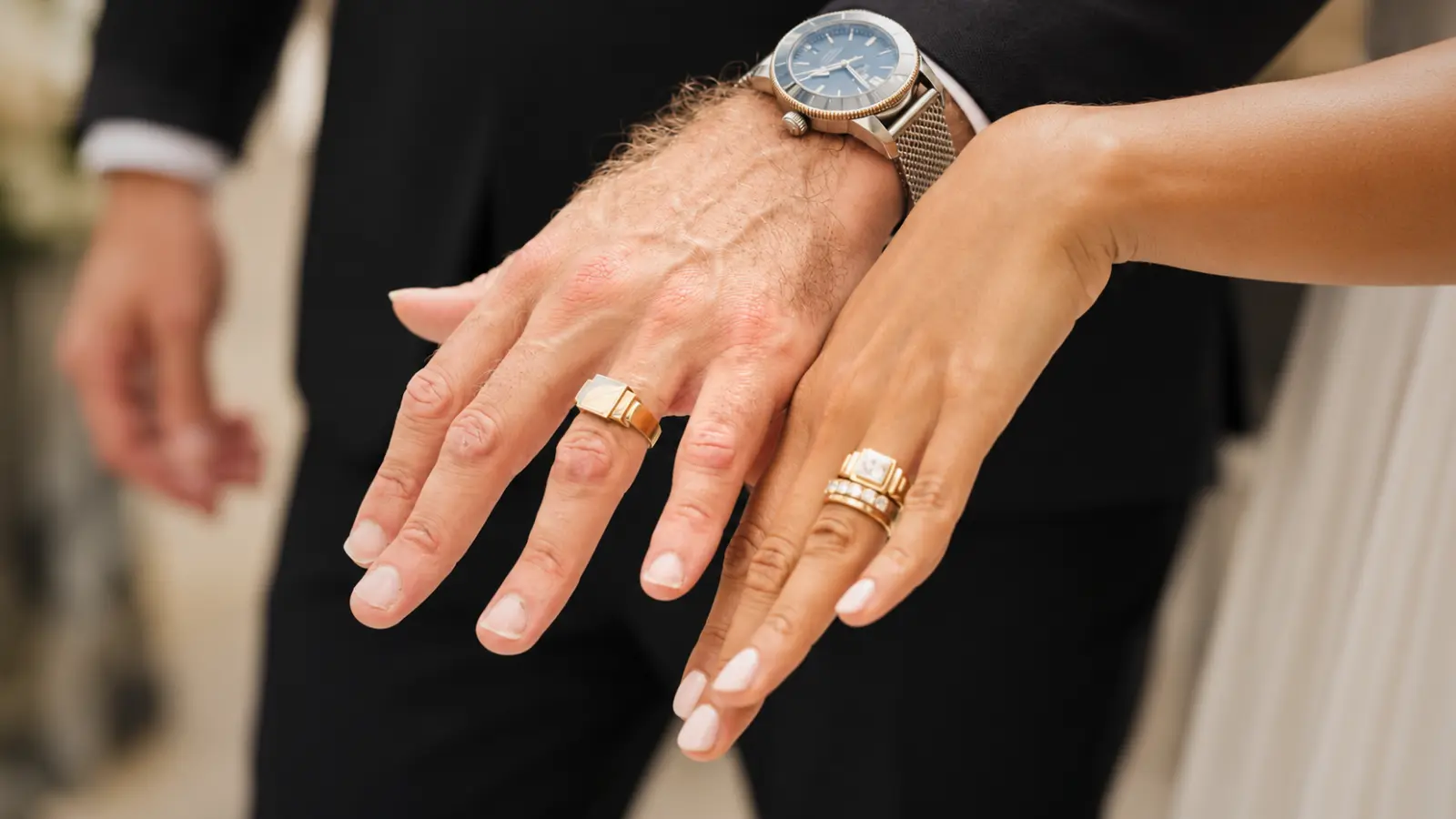
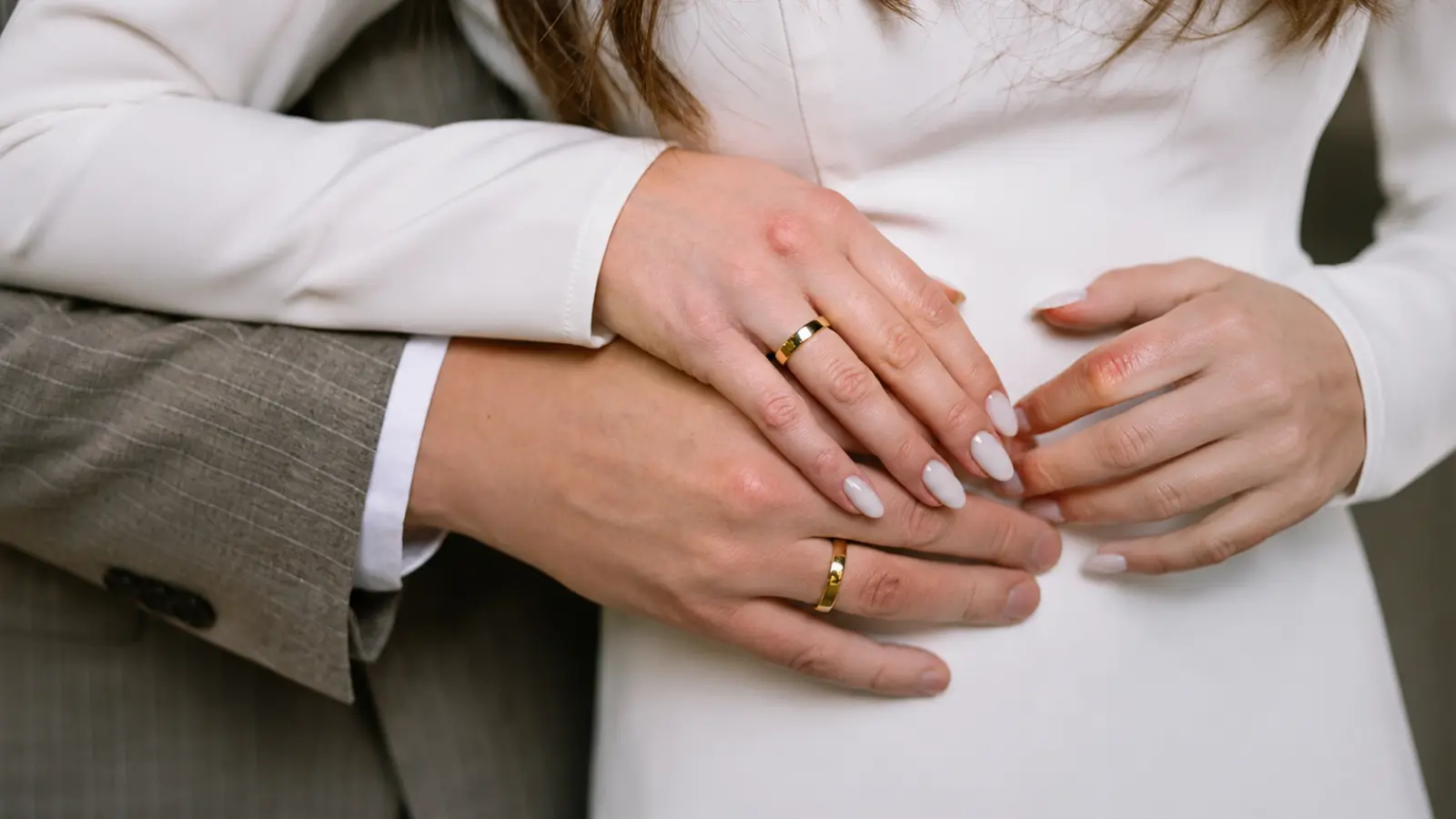
Matching wedding bands are wedding rings chosen by a couple to share a visual or personal connection, whether through the same metal, finish, design details, engraving, or overall style. Matching does not always mean identical — many couples choose coordinated bands that feel connected while still reflecting each person’s individual preferences.
Choosing matching wedding bands is about finding the right balance between unity and individuality. Two rings can belong together without having the same width, texture, stones, or exact design, especially when each partner has a different style, lifestyle, or comfort preference.
This guide explains matching wedding bands, including identical vs coordinated rings, metal combinations, finishes, textures, different widths, engraving ideas, and how to choose wedding bands that feel connected without sacrificing personal style.
Matching Wedding Bands Explained
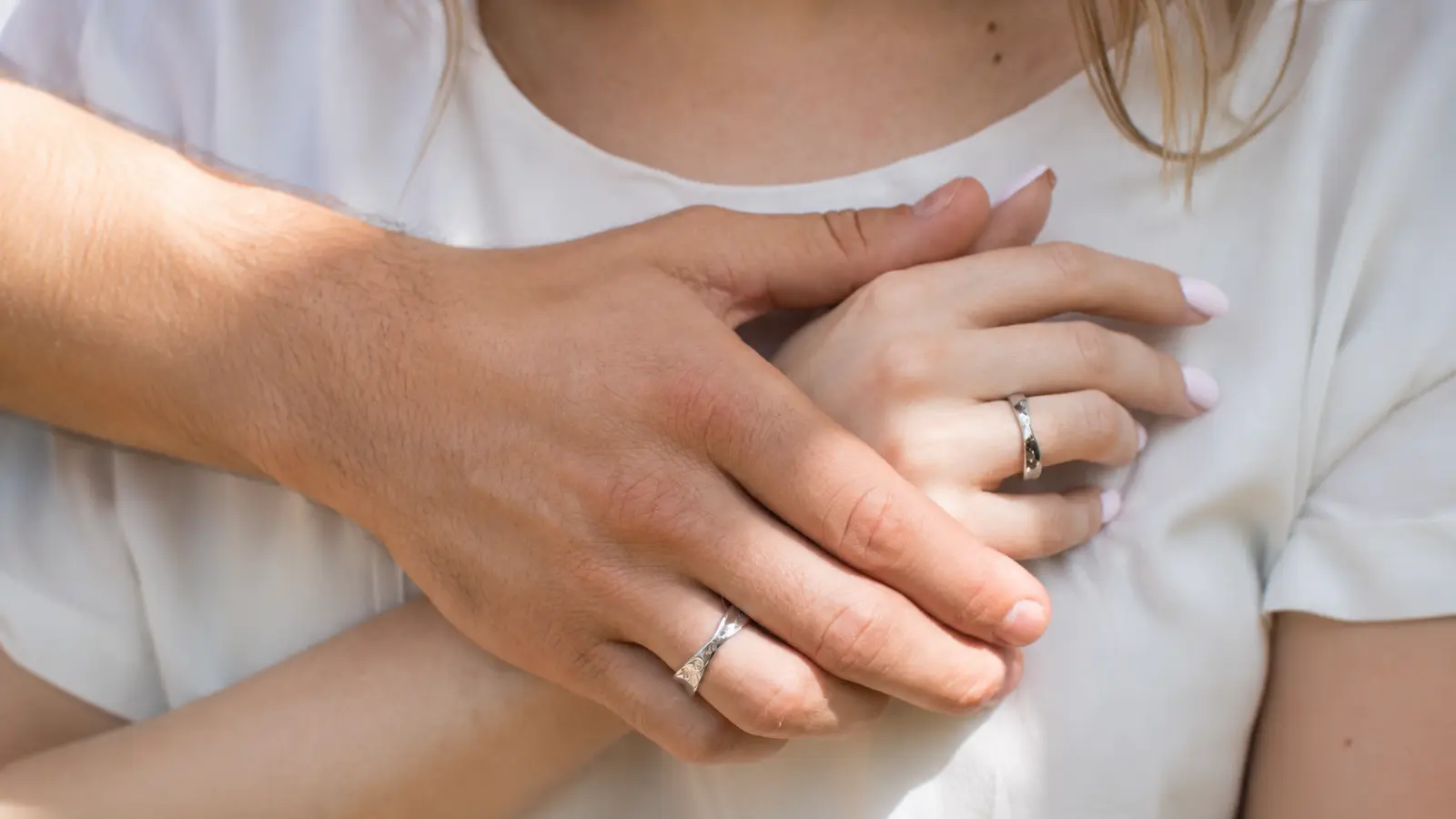
Ask ten jewelers what matching wedding bands means and you will get answers across a wide spectrum. Ask ten couples and the spread is even wider. That is because “matching” in the context of wedding rings is not a fixed category — it is a sliding scale, and different couples draw the line in different places.
The Three Points on the Scale
At one end are identical rings: the same design, the same metal, the same finish, the same profile, differentiated only by size. These rings are visually unmistakable as a set. For some couples this feels exactly right — a tangible expression of the shared commitment they are making. For others it feels like one partner’s ring is simply a smaller version of the other’s, which can be a subtle compromise for whoever has the stronger individual aesthetic.
In the middle are coordinated rings: rings that share one or two design elements — the same metal, or the same finish, or the same engraving — without being the same ring. A yellow gold band with a polished finish and a yellow gold band with a hammered texture share a metal without being identical. These pairings read as intentional to anyone looking closely, without requiring either partner’s ring to subordinate its character to the other’s.
At the other end are rings that are simply different, chosen entirely on individual terms with no attempt at coordination. These can be the right answer when the two partners have genuinely different aesthetics, different lifestyle requirements for their ring, or different values about what the ring should express.
Where Most Couples Land
Most couples who want some form of coordination end up in the middle of this scale — and that middle is wider and more interesting than it appears from the outside. A shared metal with different widths. The same finish applied to completely different profiles. A private engraving that neither ring shows on the outside but both carry inside. The sections below cover the specific coordination strategies available and when each one tends to work best.
How to Coordinate Metals
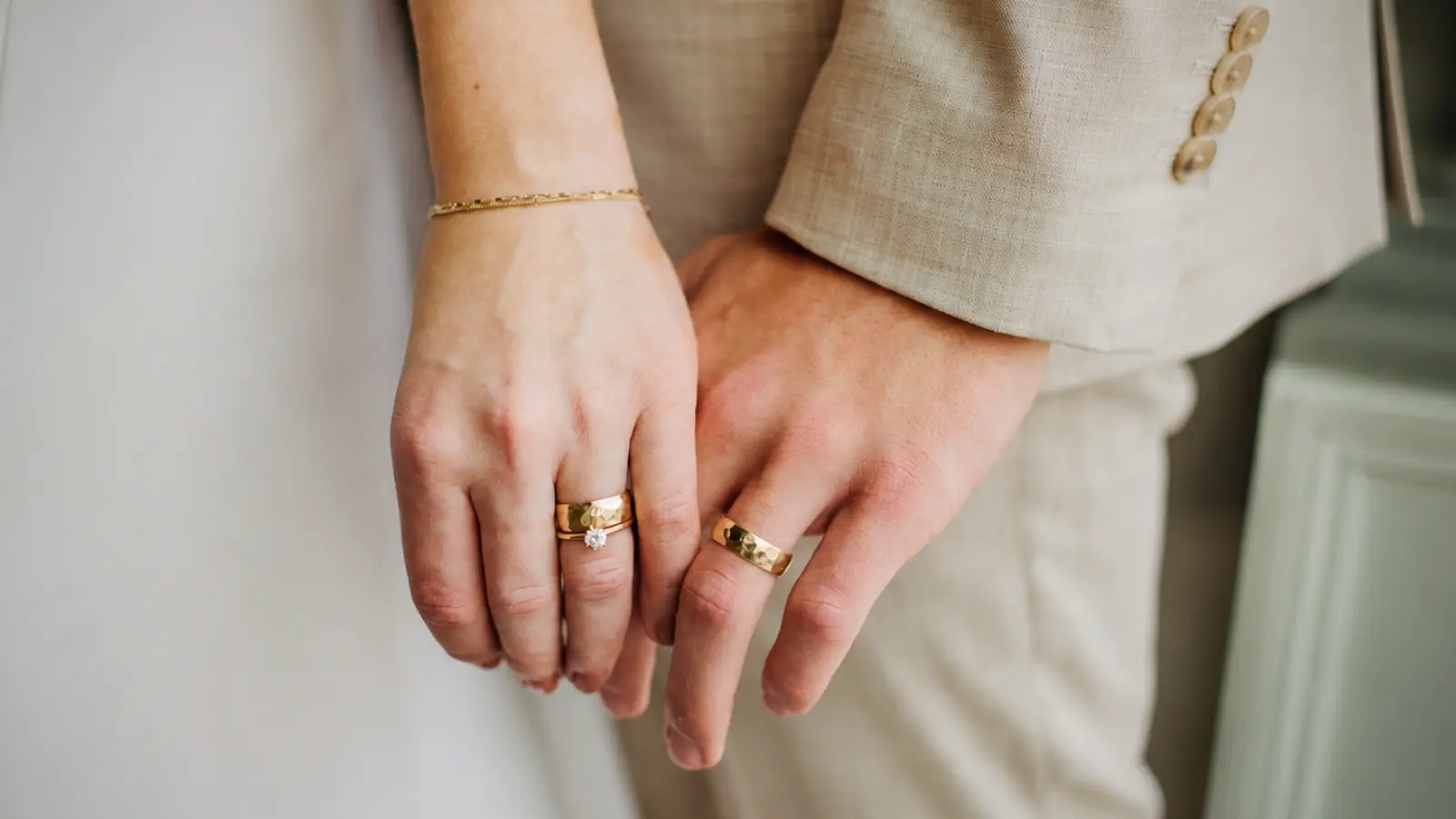
Matching the metal is the most legible form of wedding band coordination — the most immediately visible to anyone looking at the rings, and the one that creates the strongest sense of pairing. When both partners wear yellow gold, or both wear platinum, the visual connection is immediate and requires no other shared element to be apparent.
Same Metal, Same Karat
The cleanest coordination: both rings in the same metal at the same karat. Two 14k yellow gold bands. Two platinum comfort-fit bands. Two 18k rose gold rings. The advantage of this approach is that the rings can look entirely different in every other way — width, profile, texture, stone setting — and still read as a matched set because the color and material are identical. A wide hammered yellow gold band and a narrow plain yellow gold band are obviously from the same family, even if one is three times the width of the other.
Same metal at the same karat also has a practical advantage: if either ring ever needs repair or resizing, the jeweler’s work on one ring will match the other’s finish seamlessly. And if the two rings are ever worn on the same hand, they will wear against each other at the same hardness, which reduces scratching over time.
Same Metal, Different Karat — and the White Gold/Platinum Option
14k and 18k of the same gold color are visually distinguishable in side-by-side comparison, but not significantly so. The difference is subtle enough that many people do not notice it on separate hands — which makes this a practical option when one partner strongly prefers 14k for its durability and the other prefers 18k for its deeper color saturation.
White gold and platinum are visually nearly indistinguishable when both are polished — both read as a cool silver-white metal in photographs and at conversational distance. This is a useful option for couples where one partner has a strong preference for platinum and the other is content with white gold; the coordination holds well even if the materials differ.
Mixing Warm and Cool Metals
Yellow gold and rose gold are closely related in warmth and read as intentionally paired — they belong to the same color family. Yellow gold and white gold are a more significant visual contrast, which can feel like a design choice or like two unrelated rings depending on what else the rings share. Yellow or rose gold alongside platinum is the highest contrast pairing, and tends to read as uncoordinated rather than complementary unless other shared elements carry the connection.
Mixing metals is not wrong. Some couples specifically want the contrast, particularly when one partner has a rose gold engagement ring that will stack alongside the band and the other partner prefers a cooler metal. The distinction is between mixing metals as a deliberate design decision and mixing them by default without thinking through what it will look like.
| Metal Pairing | Reads As | Works When |
|---|---|---|
| Same metal, same karat | Immediately matched | Both partners are happy with the same metal choice |
| 14k and 18k, same color | Effectively matched | Partners have different durability or color preferences |
| White gold + platinum | Visually identical | One partner prioritizes platinum’s low maintenance |
| Yellow gold + rose gold | Warm and related | Deliberate warm-toned coordination; one partner has a rose gold engagement ring |
| Yellow gold + white gold | Noticeable contrast | Intentional warm/cool pairing; both partners know it won’t read as a set at distance |
| Yellow/rose gold + platinum | High contrast | When individual preference genuinely overrides coordination |
Metal is the coordination element that does the most work with the least effort. When everything else is uncertain, starting here — agreeing on the same metal — gives the rest of the decision room to breathe.
Matching Finishes and Textures
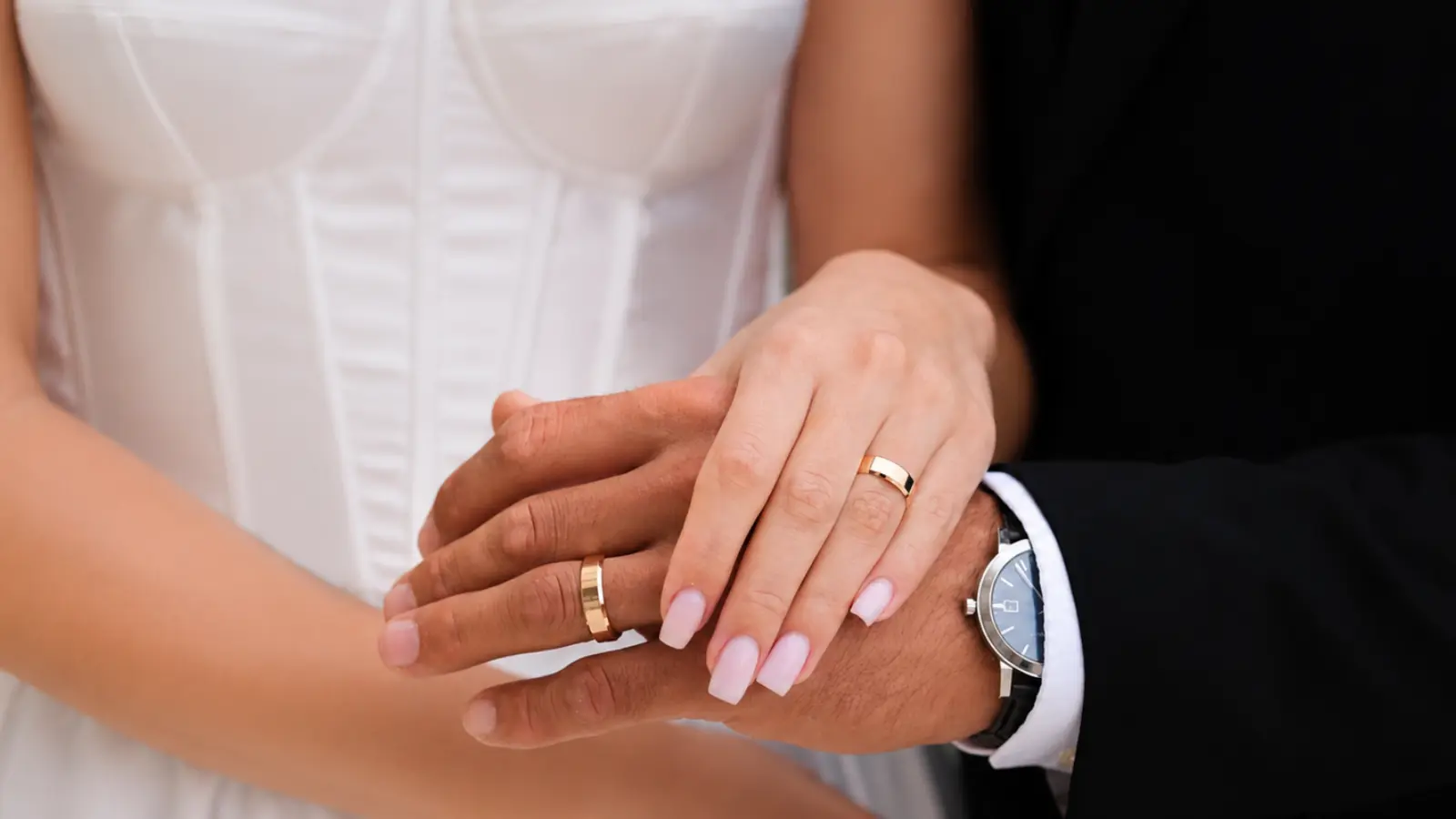
Finish is the surface quality of the metal — polished, matte, brushed, hammered, sandblasted, satin. It is distinct from the metal itself and distinct from the ring’s profile or shape. Two yellow gold bands in completely different profiles read as a matched set if they share the same finish. Two platinum bands of exactly the same profile can look quite different if one is polished and the other is matte. Finish is one of the most practical coordination choices available, because it allows both partners to choose a ring that fits their individual sense of style while retaining a shared visual element.
Polished vs. Matte — and What Each Communicates
A polished finish has a mirror-like surface that reflects light cleanly and evenly. It is the most traditional wedding band finish — the default for gold and platinum bands across most of wedding jewelry history — and the one that photographs most brightly. A polished band on yellow gold glows warmly; on platinum or white gold, it reads as clean and classic. The practical note: polished bands show scratches more readily than matte finishes, though scratches on gold can be polished out by a jeweler.
A matte finish — also called brushed, satin, or sandblasted depending on the specific technique — has a soft, non-reflective surface. Light disperses across it rather than reflecting from it, which gives the band a quieter, more understated appearance. Matte finishes tend to read as more contemporary than polished, and they conceal everyday scratches more effectively because the surface is already textured. For couples who are active or work with their hands, matte or brushed finishes tend to wear better visually over time.
Combination Finishes and Texture
Many bands combine finishes — a matte center with polished beveled edges, a hammered central section with smooth polished rails. Combination finishes are an effective coordination strategy when partners prefer different surface aesthetics: a band with a brushed center and polished edges can feel like a meeting point — each partner finds an element of their preference in the same ring design. When both partners choose a band with the same combination finish, the coordination is strong even if every other element differs.
Texture goes further than finish and refers to the physical surface pattern: hammered texture, milgrain edges, rope motifs, bark-effect surfaces, woven patterns. Matching textures — both partners choosing a hammered finish, or both choosing a milgrain edge detail — creates a coordination element that reads clearly in close-up photographs but does not require the bands to be the same design.
| Finish Type | Visual Quality | Best For |
|---|---|---|
| Polished | Mirror-bright, traditional | Classic looks, formal settings, maximum light reflection in photos |
| Brushed / Satin | Soft, directional, contemporary | Modern aesthetics, active lifestyles, hides everyday wear |
| Matte / Sandblasted | Even, non-reflective, quiet | Understated style, pairs well with flat profiles |
| Hammered | Organic, artisanal, textured | Couples who want visible character; reads well in close-up photography |
| Combination (brushed + polished edges) | Layered, defined | Partners who prefer different finishes; common ground in a single design |
Finish is worth deciding before looking at ring profiles — it narrows the field quickly and ensures both partners are choosing from rings that will visually connect once they are on the same hands at the same time.
Same Ring, Different Widths
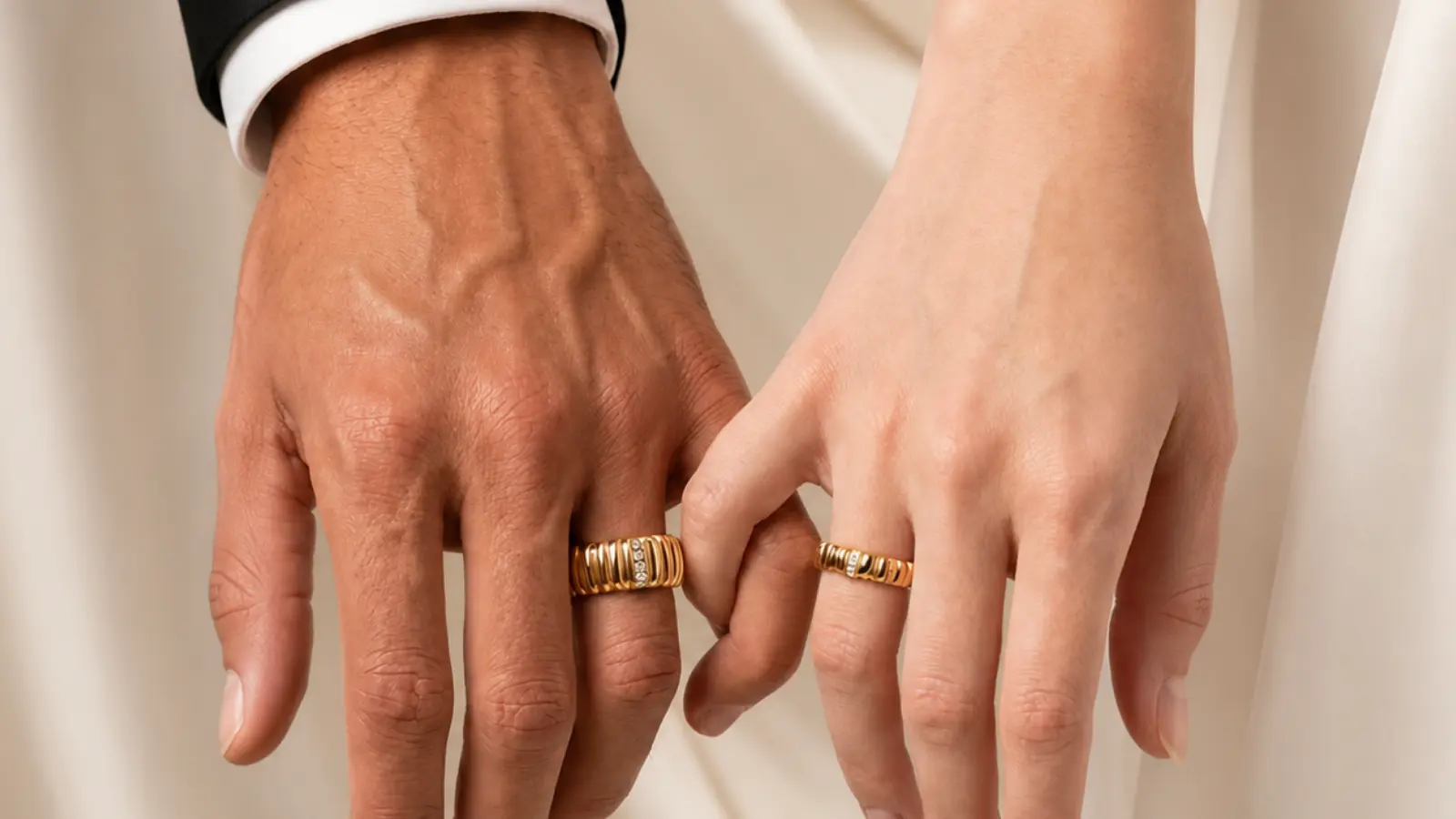
Choosing the same ring design in different widths is, for many couples, the most satisfying form of coordination — and the one most often overlooked in the early stages of ring shopping. The logic is simple: the rings share every design element — the same metal, the same finish, the same profile, the same texture — but each version is proportional to its wearer’s hand. The visual connection is immediate. The proportions are correct for each person.
Why Width Matters Differently on Different Hands
A 6mm band on one hand and a 6mm band on another will not look the same. Finger circumference, knuckle size, and hand proportion all affect how a specific width sits and reads. A 6mm band on a wider finger with a larger hand often looks sleek and appropriate; the same 6mm band on a narrower finger can look wide to the point of overwhelming the hand. Conversely, a 3mm band that reads as delicate and refined on a narrower finger can look unintentionally thin on a wider one.
The width relationship that tends to work well across most hand size combinations: one partner wearing a men’s wedding band approximately 5–7mm, the other wearing a version 2–3mm narrower. So a 6mm and a 4mm, or a 5mm and a 3mm. The proportional difference is visible enough to be clearly intentional, and the design connection is strong enough that they obviously belong together. A jeweler who sees both partners’ hands can advise on the specific combination that will look balanced on both.
What to Bring to the Appointment
If both partners are choosing from the same ring family, the most useful thing to bring to the appointment is both partners. Trying the wider and narrower versions on both hands produces a much more reliable result than imagining how a ring will look on someone who is not present. Width decisions made with one partner absent often need to be revisited.
If the engagement ring will be stacked alongside the wedding band, bring it. The combined visual width of the engagement ring and wedding band together affects how a specific band width reads — a 4mm band that looks perfectly proportioned alone may look narrow when stacked against a substantial engagement ring, or wide when set next to a very delicate one. The appointment is the only place where these relationships become visible before the purchase.
Matching Engravings
Engraving is the coordination element that exists entirely between the wearers — invisible from the outside, unknown to anyone who has not been told. A matching engraving does not make two very different rings look like a set from across a room. What it does is create a private connection between the rings that is, in some ways, more intimate than any visible design element. For couples whose individual styles are too different to coordinate through design or metal alone, engraving is often the most satisfying path to a genuine connection between the two rings.
Three Ways to Approach Matching Engravings
The same inscription on both rings. The wedding date, initials, a single word, a phrase from the vows, or a set of coordinates — duplicated inside both bands. This works because the engraving is the same; each partner knows the other’s ring says what theirs does. Simple, permanent, and widely meaningful.
Complementary inscriptions. One ring carries the beginning of a phrase; the other carries its conclusion. One ring has her initials; the other has his, followed by the wedding date. One ring is engraved in one language; the other in a second language that means something to the couple. These pairings require more thought at the planning stage but produce something more specific — a connection that only makes sense when both rings are considered together.
The same engraving style. Both rings engraved in the same script, the same typeface, by the same engraver — so even if the inscriptions differ in content, the manner of the engraving is identical. This is a subtler coordination that is rarely discussed but often noticed by the people wearing the rings.
Practical Notes on Engraving
Engraving is done on the inside of the band, which places a limit on character count based on the ring’s inner circumference. A narrower ring accommodates fewer characters; a wider ring allows longer inscriptions. Standard machine engraving handles most scripts cleanly; hand engraving adds a slightly irregular, artisanal quality that is visible at close range and looks distinct from machine work.
One thing worth confirming before finalizing: whether both rings are being engraved by the same jeweler or workshop. If one ring is purchased from one vendor and another from a second, the engraving styles may differ even if the content is the same. For couples where matching engraving matters, ordering both rings from the same source — or specifying the same engraving style to each jeweler separately — is worth the extra coordination. For full guidance on character limits, scripts, and what to write, see the wedding ring engraving.
Complementary Designs That Are Not Matching
There is a category of coordination between “matching” and “entirely different” that does not have a clean name but is, in practice, how many couples approach their rings. These are rings that feel intentionally related — that read as chosen by two people who thought about them together — without sharing a specific design element that makes them a set.
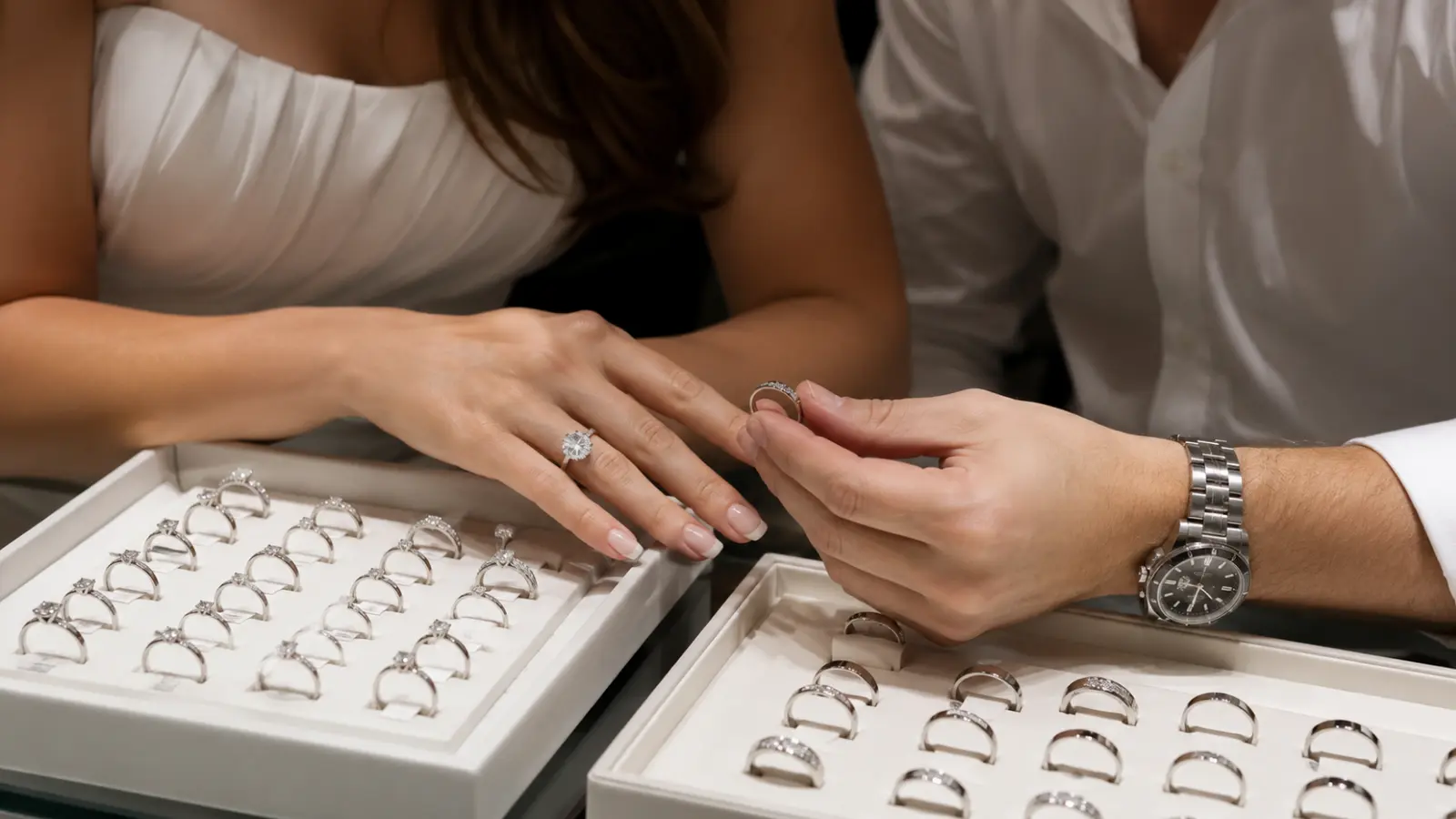
What Makes a Design Complementary
Complementary rings tend to share a design sensibility rather than a design element. A clean, minimal yellow gold band and a delicate yellow gold band with a subtle diamond pavé edge are not identical — one has stones, one does not — but they share a metal, a slim profile, and an overall restraint that makes them feel like they belong together. A wider, hammered platinum band and a narrower, smooth platinum band share a metal and a general aesthetic direction — modern, relatively simple — that creates coherence without sameness.
The most common form of complementary coordination is one partner choosing a ring with a design element — a stone, a texture, a detail — that the other partner’s ring does not have, while both rings share the underlying metal and finish. The detailed ring reads as the more expressive one; the simpler ring reads as the anchor. Together they feel balanced, each ring letting the other be what it is.
What Photographs Actually Register
In wedding photographs — particularly the close-up ring shots that most photographers include — metal and overall finish are what register most clearly. Width reads at close range. Texture reads in good light with a macro lens. Engraving does not read at all unless specifically staged for it. Stone details read clearly. This is useful context for deciding how much visible coordination matters: a pair of rings that share only a metal will look more coordinated in photographs than they might feel in hand at a jeweler. The reverse is also true — elaborate shared textures that feel richly related in person may reduce to “same metal, roughly similar look” in a photograph.
When Not to Choose Matching Bands
The case against matching wedding bands is worth making, because it is rarely made directly. Matching bands are not right for every couple — and choosing them for reasons that have nothing to do with genuine preference (because it seemed like the expected thing, because one partner deferred, because it was easier than two separate decisions) tends to produce a result where at least one partner ends up with a ring they feel neutral about rather than one they love.
When Individual Styles Significantly Differ
If one partner strongly prefers bold, statement jewelry and the other strongly prefers minimal, understated pieces, designing a ring that works for both often means designing a ring that is a compromise for each. A matching set built on compromise — neither person’s aesthetic fully expressed — may be less satisfying in the long run than two rings chosen individually, each one fully right for the person wearing it.
The question worth asking: would both partners choose this ring if they were choosing entirely independently? If the answer for one of them is clearly no, the coordination element should probably be something minor — a shared metal, a shared engraving — rather than something that determines the whole design of both rings.
When Lifestyle Requirements Differ
Someone who works in a physical profession — construction, medicine, athletics, manual trades — may need a ring made from a material and in a design that cannot coordinate with a fine jewelry option. A medical professional who needs to remove rings frequently may want a plain, durable band that is easy to put on and take off; a partner without those constraints may want something more elaborate. A silicone band and a gold band do not coordinate in any traditional sense, and attempting to force coordination at the expense of practicality is a poor trade.
When lifestyle requirements are genuinely different, prioritizing function over coordination is the right call. The more lasting regret is wearing a ring that does not work for your actual life, not wearing a ring that does not match someone else’s. For rings that express individual style rather than coordination, the unique wedding rings guide covers the full range of what is available.
The Test That Actually Matters
The most important moment in the wedding band decision is when each person puts their ring on for the first time and holds out their hand. If the response is genuine — if the ring feels like an expression of who they are — the decision was right. If the response is “it’s fine” or “I got used to it,” something was compromised that probably did not need to be. Coordination is worth pursuing when it produces two rings that each partner genuinely loves. When it requires one partner to settle, the goal of coordination has overpowered the goal of choosing a ring they will be happy wearing for decades.
Matching Wedding Band Inspiration
Matching wedding bands can be identical, coordinated, or connected through small details that make both rings feel intentional. Explore our inspiration board for matching gold bands, different width rings, matte and polished finishes, engraved bands, and wedding band ideas for couples.
Choosing Wedding Bands That Feel Connected
The best matching wedding bands are not always the ones that look exactly the same. A meaningful pair of rings should create a connection while still allowing each person to choose a design that feels natural, comfortable, and personal.
Whether your rings share the same metal, a matching engraving, a similar finish, or only the story behind them, the strongest connection comes from choosing wedding bands that represent both the relationship and the individuals wearing them.
Frequently asked questions (FAQ)
What are matching wedding bands?
Matching wedding bands are two wedding rings chosen to look connected as a pair. They may be identical rings in different sizes, or they may simply share certain details such as the same metal, finish, texture, engraving, or overall style. Matching does not always mean the rings need to look exactly the same.
Do wedding bands have to match?
No. Wedding bands do not have to match. Some couples choose identical bands because they like the symbolism of wearing the same design, while others prefer rings that coordinate without being exactly alike. The most important factor is that each person chooses a ring that feels comfortable and meaningful to wear every day.
What are the best matching wedding bands for couples?
The best matching wedding bands for couples are rings that create a connection while still fitting each person’s lifestyle and style preferences. Popular approaches include the same metal with different widths, similar finishes, matching engravings, or complementary designs. The strongest matches usually feel intentional without forcing both partners into the exact same ring.
Should couples get identical wedding bands?
Couples do not need identical wedding bands. Identical rings can be meaningful for couples who love the idea of a shared design, but they are not the only option. Many couples choose coordinated bands because they allow both people to express their own style while still creating a visual connection between the rings.
How do you coordinate wedding bands without matching exactly?
The easiest ways to coordinate wedding bands are by choosing one shared element. Couples can select the same metal, the same finish, similar textures, matching engravings, or related design details while keeping other features different. This creates a connected look without making one ring a copy of the other.
Can wedding bands be different metals?
Yes. Wedding bands can be different metals. Some couples prefer a perfectly matched look with the same metal, while others intentionally mix yellow gold, white gold, rose gold, platinum, or other materials. Mixed metals work best when the contrast feels deliberate and both rings reflect each person’s preference.