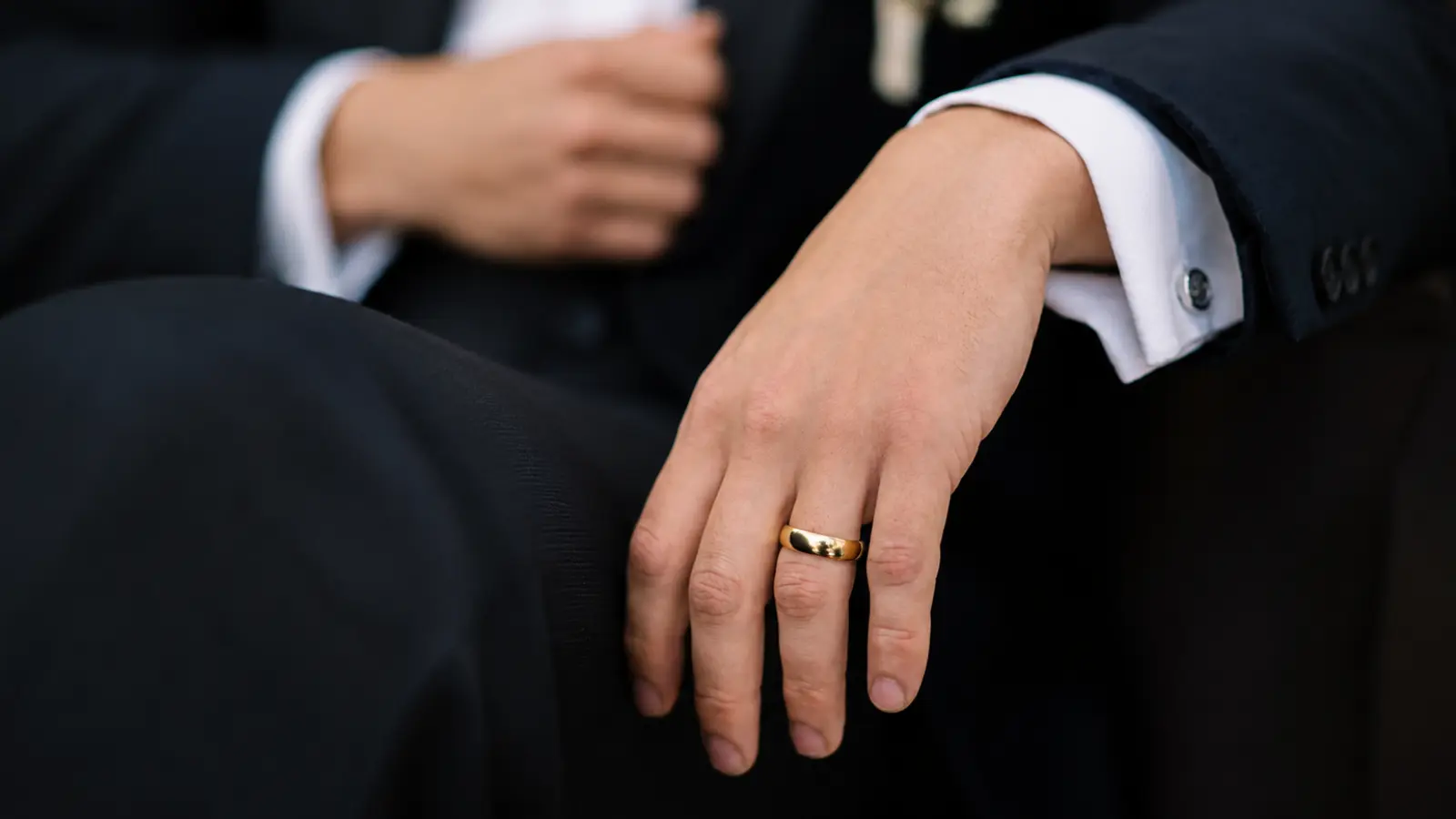
Men’s wedding bands are rings exchanged during a wedding ceremony and designed to be worn as a daily symbol of marriage. They range from classic gold and platinum bands to modern tungsten, titanium, black, and silicone wedding bands created for different styles, budgets, and lifestyles.
For many men, a wedding band is the only piece of jewelry they will wear every day for decades. That makes choosing the right one about more than appearance — the metal, width, weight, comfort, and durability all affect how the ring feels in everyday life.
This guide explains everything you need to know about men’s wedding bands, including popular styles, metal options, comfort fit choices, ring widths, active lifestyle considerations, and how to choose a wedding band he will actually want to wear.
Men’s Wedding Band Styles
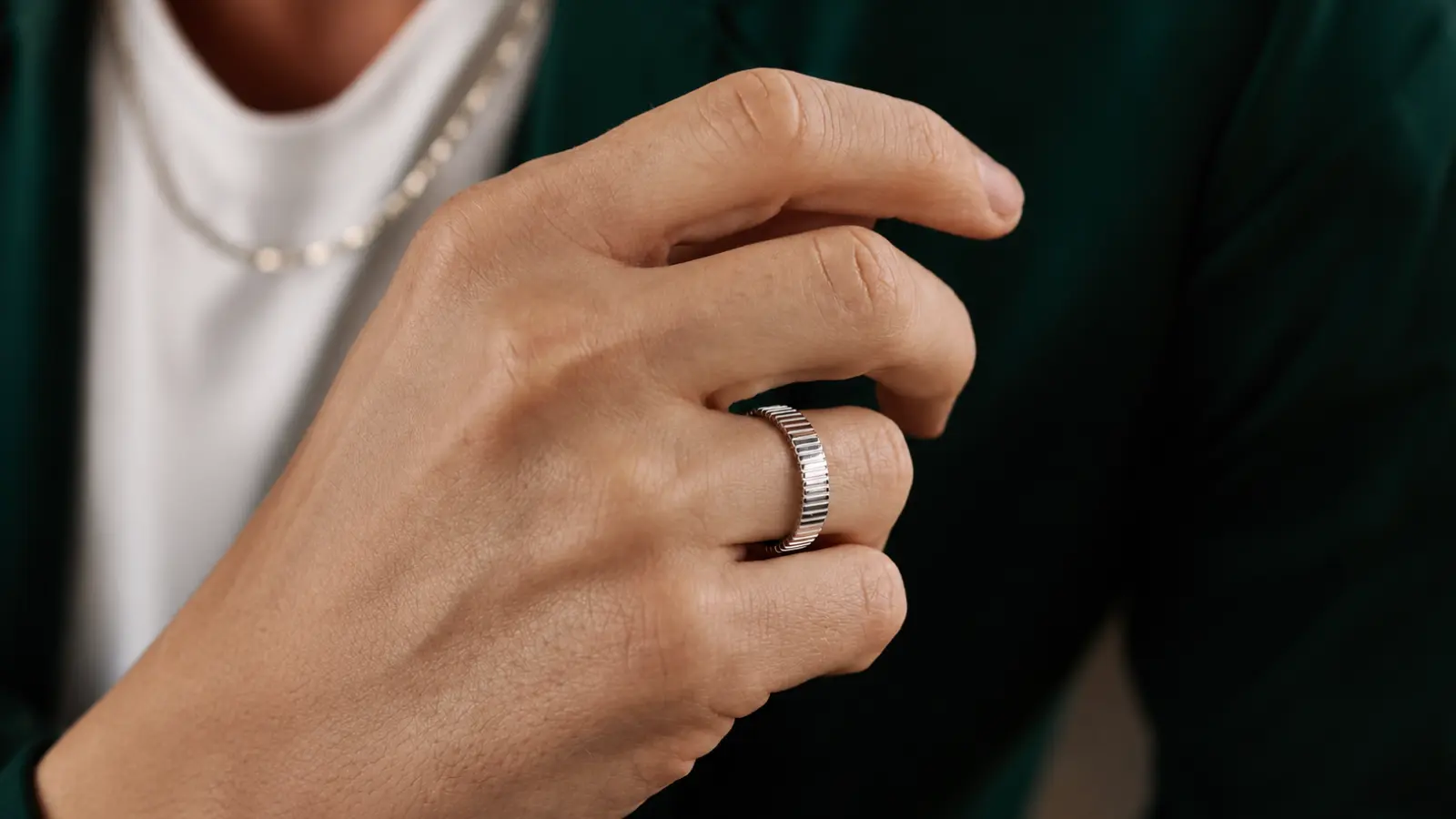
Style in a men’s wedding band comes down to three decisions made in sequence: the metal, the width, and the finish. Most men settle those three variables and find that the ring almost designs itself from there. A few also add a fourth element — a detail like a channel, an inlay, or a textured surface — that gives the ring a bit more personality. Understanding the full range of options makes the narrowing process easier and often reveals choices that would not have been considered otherwise.
Classic plain bands
A plain metal band — unadorned, no stones, no texture variation, no inlay — is the most historically consistent form of men’s wedding ring in the United States. It is what most people picture when they picture a wedding band at all. Plain bands in yellow gold, white gold, or platinum have been worn by American men since wedding rings became standard male practice in the mid-twentieth century, and they have not lost relevance.
Their appeal is in their permanence: a plain band does not read as dated because it was never particularly trendy. It simply looks like what it is. Plain bands also work across virtually every context — professional environments, casual settings, physical work — in a way that more elaborate designs sometimes do not. For men who are unsure what they want, or who know they want something they will never think twice about, a plain band in the right metal and width is reliably the right answer.
Brushed, matte, and textured finishes
Finish is one of the most underrated design variables in a men’s band. A high-polish finish catches light dramatically and reads as more formal. A brushed or matte finish has a quieter, more contemporary feel and, practically speaking, shows scratches far less than polished metal does. Many men who start with a polished band find themselves wishing for matte after a year of daily wear — the fine marks that accumulate on polished metal become visible quickly, while the same wear on a brushed finish simply deepens the texture.
A common middle ground is a band that combines both: brushed center with polished beveled edges, or a polished band with a brushed channel running through the center. These combinations add visual interest without introducing additional design elements — the ring still reads as restrained from a distance, with closer detail visible up close.
Channel and inlay designs
Bands with a channel — a recessed groove running around the ring’s circumference — add structural dimension without stones or elaborate patterning. Channels can be plain (the same metal as the rest of the band, creating a subtle shadow line) or filled with a contrasting material. Black carbon fiber inlays, wood inlays, ceramic inserts, and contrasting metal fillings are all available and popular in contemporary men’s band design. These are the kinds of details that photograph well and feel distinctive — for men who want their ring to be recognizably theirs rather than generically correct.
Diamond and stone-accented bands
Men’s diamond bands — typically channel-set or pavé styles with small stones along the top surface — have grown considerably in popularity. They are not for everyone, but for men who wear other jewelry, who have a more fashion-forward sense of style, or who simply want the ring to carry more visual weight, a diamond band achieves that without looking out of place. The key is proportion: a narrow diamond channel on a wider band looks intentional; a fully pavé-set band on a narrow shank can look borrowed from a women’s collection.
Black wedding bands
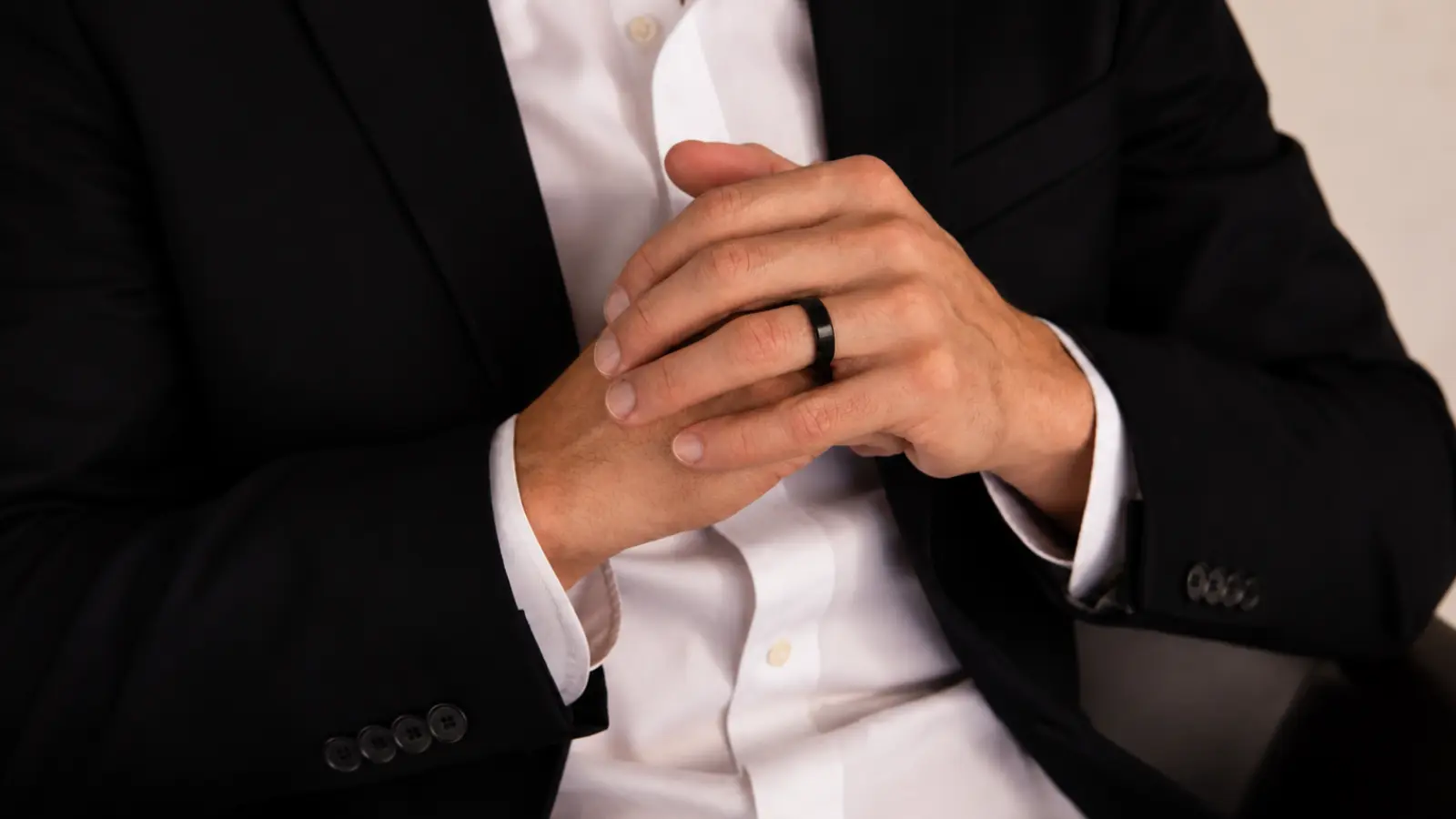
Black wedding bands — most commonly achieved through black tungsten carbide, black ceramic, or ion-plated black titanium — are among the more dramatically modern options available. They pair naturally with a contemporary personal style and photograph with a strong, confident presence. The practical note: black coatings can wear through in high-contact areas over time, revealing the base metal beneath. Black tungsten and black ceramic hold their color longer than ion-plated titanium. If a black band is the goal, asking specifically about the coloring process and its durability is worth doing before purchasing if a black band is the goal.
For men who want something genuinely distinctive beyond these options, the guide to unique wedding bands covers a wider range of non-traditional choices.
Best Metals for Men’s Wedding Bands
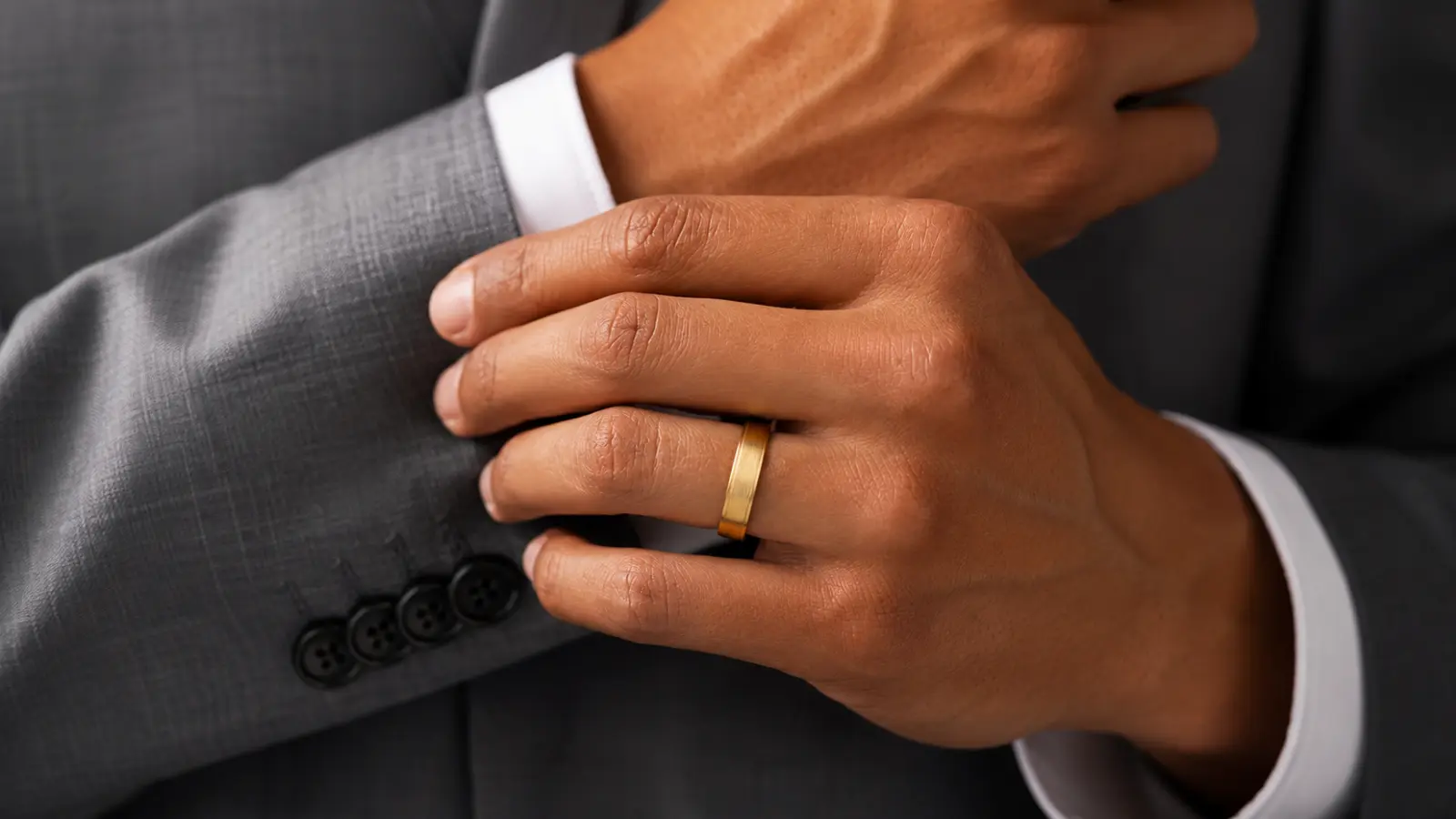
Metal choice is the most consequential decision in a men’s wedding band — more than width, more than finish, more than any style detail. It determines how the ring wears over years, whether it can be resized as the finger changes, how heavy it feels on the hand every day, and what it will look like a decade from now. Style preferences evolve; metal properties do not.
14k gold
Yellow gold is the traditional American wedding band material, and 14k is its most practical form. At 58.3% pure gold, 14k is harder and more scratch-resistant than 18k while still containing more than half gold by weight. It holds its color without any plating or treatment, can be resized by any jeweler, and develops a warm patina over years that many men genuinely prefer to the look of a new ring.
White gold achieves a silver-toned look at a lower price point than platinum, but comes with one important trade-off: it is plated with rhodium to achieve its bright white finish. That plating wears through over time — typically within one to three years depending on wear — and requires periodic re-plating to maintain the color. For men who prefer a white metal but do not want the maintenance, platinum is worth the additional cost.
Rose gold — yellow gold alloyed with copper — has become a genuinely popular option for men’s bands, particularly in contemporary and fashion-forward markets. It pairs naturally with mixed-metal ring stacks and tends to complement a wide range of skin tones, wearing the same as yellow gold in terms of durability and maintenance. For a deeper look at gold options across colors and karats, the guide to gold wedding rings covers the full range.
Platinum
Platinum is the premium choice in every measurable respect: more durable than gold, naturally hypoallergenic, and requires no plating to maintain its white color. Its density gives it a satisfying, substantial weight that many men find appealing. It does not wear away over time the way gold does — scratches on platinum displace the metal across the surface rather than removing it, which means the ring retains its mass indefinitely.
The trade-off is cost: a platinum band typically runs two to three times the price of an equivalent 14k gold band. For men who will genuinely wear the ring every day for decades and never want to think about it again, platinum earns its premium. More detail on its properties and comparison to white gold is in the platinum wedding rings guide.
Tungsten carbide
Tungsten carbide is the hardest metal available for wedding rings — roughly ten times harder than 18k gold — and holds a high-polish finish indefinitely in a way that softer metals simply cannot. It is also one of the heaviest options, which some men actively prefer: it has a presence on the hand that lighter metals do not. Tungsten bands are available at very accessible price points, making them one of the most practical choices for men who want a durable, low-maintenance ring without a precious-metal price tag.
The limitations are worth understanding clearly. Tungsten carbide cannot be resized — ever. The material is too hard to cut, stretch, or reshape by any conventional jeweler method. If a tungsten ring no longer fits, it must be replaced. Many tungsten retailers address this with lifetime replacement warranties, but the replacement inconvenience remains. Additionally, tungsten is brittle under extreme pressure: rather than bending the way gold or platinum would, it can crack — a relevant consideration in certain work and emergency medical contexts.
Titanium
Titanium is the opposite of tungsten in weight: extremely light, to the point where some men barely notice it is on the hand at all. It is three times stronger than steel, completely hypoallergenic, and essentially impervious to corrosion. For men in medical professions, outdoor careers, or physically demanding jobs, titanium has become the default practical choice — it holds up to conditions that would damage or complicate wearing a precious metal ring, at a price point that makes replacement realistic if the ring is ever lost.
Titanium can technically be resized, but not by traditional jeweler methods — it requires specialized equipment that not all shops carry. Many titanium ring owners simply replace the ring if resizing is needed. The aesthetic tends toward a cool, industrial silver-gray; titanium can be anodized in other colors, though color coatings are less durable than the base metal itself.
Silicone
Silicone bands are not a wedding ring in the traditional sense — they are a practical tool for situations where wearing a metal ring is unsafe or impractical. A silicone band will break under pressure rather than acting as a tourniquet, which makes it the appropriate choice for surgeons, electricians, mechanics, woodworkers, rock climbers, and anyone else whose work or sport creates ring avulsion risk. Most men who wear silicone bands use them in place of their metal band on the job or at the gym, and switch back the rest of the time. The guide to silicone wedding bands covers the full range of options and who typically benefits from adding one to their routine.
Metals at a glance
Every metal brings a different combination of durability, weight, price, and long-term flexibility. This comparison covers the most commonly worn options side by side:
| Metal | Weight Feel | Resizable? | Scratch Resistance | Price Range | Best For |
|---|---|---|---|---|---|
| 14k Yellow Gold | Medium | Yes | Moderate | $300–$900 | Classic look, long-term value, resizability |
| Platinum | Heavy | Yes | Good | $800–$2,500 | Maximum durability, hypoallergenic, premium feel |
| Tungsten Carbide | Heavy | No | Excellent | $50–$400 | Scratch resistance, substantial weight, modern look |
| Titanium | Very Light | Difficult | Very Good | $50–$300 | Active lifestyle, hypoallergenic, lightweight comfort |
| White Gold | Medium | Yes | Moderate | $300–$900 | Platinum look at lower cost; requires replating |
| Silicone | Negligible | N/A | N/A | $20–$60 | Work environments where metal rings are unsafe |
The right metal is rarely the most expensive or the most durable one available — it is the one that fits the way the wearer actually lives. Start there, and the rest of the decision gets considerably easier.
How Wide Should a Men’s Wedding Band Be?
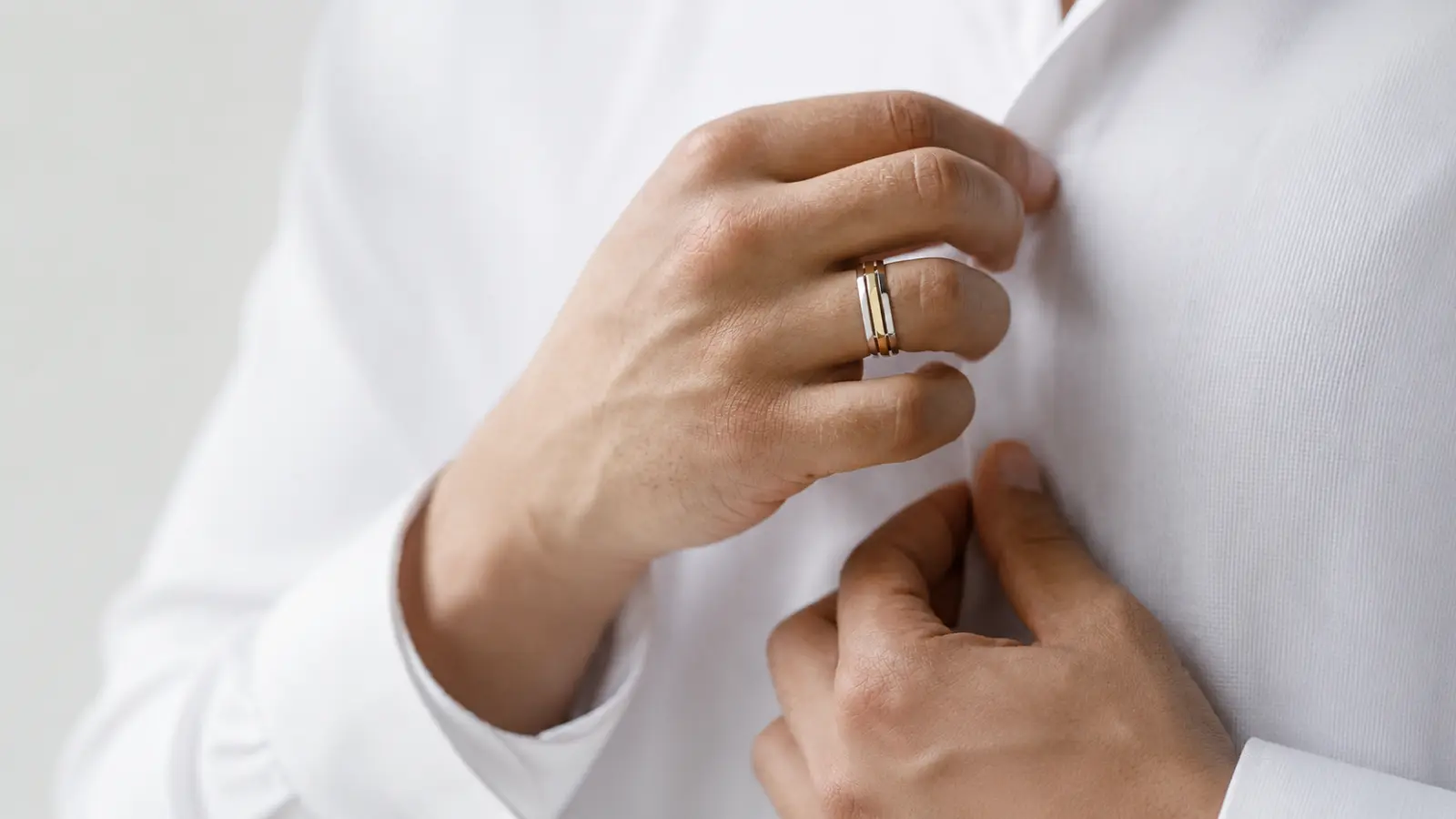
Width is the most visible design decision in a men’s wedding band and the one that most directly affects how the ring looks on the hand. A band that is too narrow for the hand it is worn on disappears; one that is too wide can feel like a statement the wearer did not intend to make. Getting the width right — relative to hand size, finger length, and personal aesthetic — is one of the decisions that benefits most from trying rings in person rather than picking a number from a chart.
4mm to 5mm: understated and traditional
Narrower bands in the 4mm to 5mm range have the closest visual relationship to the plain gold rings that American men wore through most of the twentieth century. They look proportionate on slender fingers and shorter ring sections, and they read as understated in a way that wider bands do not. Men who wear other rings, or whose partner wears a substantial engagement ring beside which they want their band to read as secondary, often find this width range the most comfortable fit — visually and physically.
4mm can look thin on a larger hand, so it is worth trying on rather than assuming the proportional math will work. Some men who gravitate toward narrower bands find that 5mm hits the right balance: present without being bold.
6mm to 7mm: the most commonly worn range
The 6mm to 7mm range is where the majority of men’s wedding bands are sold, and the reason is straightforward: it works on most hand sizes and reads as neither minimal nor statement-making. A 6mm band has enough presence to look intentional and substantial without dominating the finger. A 7mm band adds slightly more visual weight and tends to suit medium to larger hands particularly well.
For men who are genuinely uncertain about width, trying a 6mm band first is a reasonable default. It is the width that tends to photograph cleanly, wear comfortably, and look proportionate across the widest range of hand sizes. Many men who initially wanted something more distinctive end up here for exactly those reasons.
8mm and above: deliberate and bold
An 8mm band is a choice that announces itself. It is proportionate on larger hands — men with wide fingers or long ring sections often find this width looks most balanced — and it carries a boldness that narrower bands simply do not. Men who want their ring to be noticed, who have a strong personal style, or who wear other jewelry tend to be drawn to this range.
Bands 10mm and wider are sometimes called statement bands — they cover most of the visible ring section on the finger and are the clearest expression of a maximalist approach to men’s ring style. They work, but they require the right hand size and a very deliberate personal style to carry well. On a smaller hand, 8mm and above can overwhelm rather than impress — which is exactly why trying before buying matters so much at this end of the width spectrum.
Width and hand proportions: the practical guide
Finger length and ring section width matter more than hand size alone. A man with a wide palm but a short ring finger section may find that a wide band reaches his knuckle and becomes uncomfortable. A man with a long, slender finger may find a 6mm band looks underwhelming relative to the available visual space. The only reliable way to know is to try rings on the actual hand — most bridal jewelers carry a range of sample widths in a neutral metal specifically for this purpose. It is a five-minute exercise that resolves what would otherwise be a weeks-long uncertainty.
Comfort Fit vs. Standard Fit
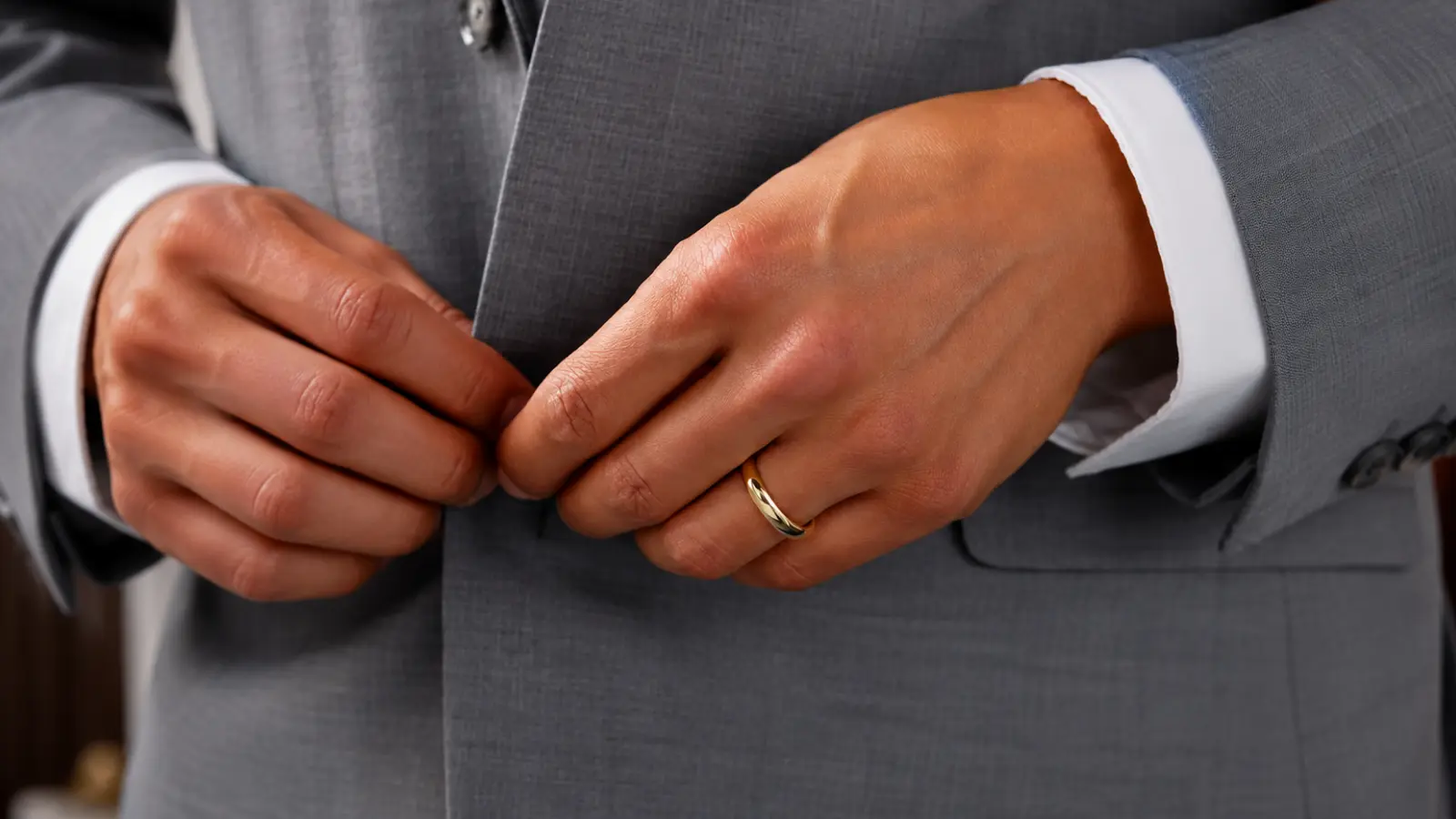
The difference between comfort fit and standard fit is entirely about the interior of the ring — what the inside of the band feels like against the finger — and it is a difference most men do not know to ask about until they have worn both and felt it for themselves.
How they differ
A standard fit ring has a flat interior: the inside surface of the band is straight-sided, making full contact with the finger along its entire width. A comfort fit ring has a rounded interior: the inside surface curves inward, creating an arch that contacts the finger primarily at the center of the band and lifts away at the edges.
The rounded interior means less total surface contact between ring and finger, which translates to a noticeably more comfortable feel during extended wear — particularly for wider bands, where a flat interior surface creates more friction and more awareness of the ring on the hand during grip-heavy activities.
Who comfort fit is for
Most jewelers recommend comfort fit for any men’s band 6mm and wider. At 4mm or 5mm, the difference is subtle and some men genuinely prefer the more secure feel of a flat interior. At 6mm and above, the comfort fit advantage becomes much more apparent — especially for men who are new to wearing jewelry and are uncertain about the sensation of a ring during the day. Men who initially say they are not sure they want a ring at all frequently find that comfort fit resolves the discomfort concern almost entirely.
The sizing adjustment
There is one practical consideration: comfort fit rings typically need to be sized half a size larger than a standard fit ring in the same width. Because the rounded interior contacts less of the finger, the ring slides on and off more easily — which means a ring that fits correctly in comfort fit is slightly loose by standard fit logic. A jeweler will account for this automatically when sizing a comfort fit band, but it is worth knowing so that a different number does not create confusion if sizing has been done before with a standard fit ring.
Can you tell by looking which fit it is?
Not reliably from the outside. Comfort fit and standard fit rings look identical from the exterior — the difference is only visible when the interior is examined directly, and only truly understood when the ring is worn. Many men’s bands are sold with comfort fit as the default without the term being prominently displayed. When in doubt, look at the inside of the ring or ask the jeweler directly. Most contemporary men’s bands from mainstream bridal retailers are comfort fit; traditionally crafted or vintage-style rings are more likely to be standard fit.
Men’s Wedding Bands for Active Lifestyles
This is where the practical reality of a men’s wedding band diverges most sharply from the idealized version. A ring that looks right in a jewelry case and photographs beautifully at the ceremony still needs to hold up through years of actual life — and for many men, that life involves conditions that precious metal rings were not designed to handle.
The two-ring approach
The most practical solution for men who work with their hands, train regularly, or have jobs where a metal ring creates safety concerns is to maintain two rings: a metal band worn in everyday life, and a silicone band worn at work or during physical activity. This is increasingly the norm rather than the exception for men in certain professions. The silicone band is inexpensive enough that losing or damaging it carries no real consequence, and the metal band is preserved for contexts where it is safe and appropriate.
The two-ring approach also sidesteps the question of which metal is most durable for an active lifestyle by separating the contexts entirely. The metal band can be chosen purely for what it looks like and means — without engineering it for survival on a job site.
Titanium for active daily wear
For men who want to wear their actual wedding band through most of their day — including workouts, outdoor activities, and hands-on work — titanium is the metal that best combines durability, lightweight comfort, and hypoallergenic properties. It will not scratch as readily as gold, requires no maintenance, and its minimal weight makes it easy to forget it is on, which reduces the temptation to take it off. Men in medical professions often choose titanium because it holds up to repeated hand-washing, gloves, and sanitizer exposure that degrades softer metals over time.
What to know about ring avulsion
Ring avulsion — a degloving injury caused when a ring catches on something during a fall or rapid movement — is the safety concern that silicone rings were created to address. It is genuinely rare, but the consequences when it does happen are serious. The professions and activities where it is most relevant include construction, electrical work, rock climbing, weightlifting, and any work around machinery with moving parts. Men in these categories should consider whether a metal ring is appropriate for their specific work context, regardless of what they wear the rest of the time.
Tungsten, notably, cannot be cut off quickly in an emergency — it requires cracking, which takes longer than cutting through gold or titanium. For men who work in environments where rapid ring removal might ever be necessary, titanium or silicone is the safer operational choice.
Finishes that hold up
For any metal, a brushed or matte finish holds up better in active daily wear than a high-polish finish. Fine scratches accumulate on polished metal quickly under physical use, and a ring that looks perfect at the wedding can look worn within months of regular activity. A brushed finish absorbs those scratches visually, so the ring continues to look consistent over time. Men who know their ring will go through a lot are generally better served by a brushed finish — even if they initially prefer the look of high-polish.
How to Choose a Wedding Band He Will Actually Wear
This is the question underneath all the others, and it is worth addressing directly. Wedding band statistics tend to show that men are significantly more likely than women to stop wearing their rings after a few years — not as a statement about their marriage, but simply because the ring is uncomfortable, inconvenient, or was chosen without full consideration of what daily wear actually requires. The goal is not to find the most beautiful ring. The goal is to find the ring that gets worn.
Start with lifestyle, not aesthetics
Before thinking about metals or styles, think about the actual days the ring will go through. Does he work with his hands? Does he train daily? Does he work in a professional environment where rings are visible and their condition matters? Does he tend to find jewelry uncomfortable or foreign on his body? Each of these factors points toward a specific set of choices — and away from others — more reliably than any aesthetic preference does.
A man who has never worn jewelry in his life is a different ring customer than a man who wears a watch and has opinions about metals. The former needs a ring that disappears on the hand; the latter may want something that carries visual weight. Starting from lifestyle and working toward style produces better outcomes than doing it in reverse.
Comfort is not a preference — it is a prerequisite
A ring that is uncomfortable to wear will not be worn. Too heavy, too wide, too tight at the knuckle, too much awareness of the metal against the finger during grip-heavy activities — any of these will erode the habit of wearing the ring over time. Trying rings in person and wearing a sample band for at least fifteen to twenty minutes while doing normal hand movements is the most effective way to avoid that outcome.
Choosing comfort fit for any band wider than 5mm is one of those decisions that sounds minor and turns out to matter quite a bit once the ring is being worn every day. A ring chosen in ten minutes from a display case, based on how it looks rather than how it feels, is a ring at real risk of ending up in a drawer.
Consider resizability honestly
Men’s fingers change over time — often more significantly than women’s, and sometimes more suddenly, due to weight change, fitness habits, or age. A ring chosen at 30 may need resizing by 40. Gold and platinum can be resized by any jeweler; tungsten and titanium generally cannot. This is not a reason to avoid alternative metals — it is a reason to know what you are choosing, and to factor in the possibility that eventual replacement may be part of the long-term picture.
The design he will not get tired of
A wedding band is worn every single day for decades. Designs that feel exciting in the moment — elaborate inlays, fashion-forward color choices, highly distinctive styling — sometimes feel like too much commitment after a few years. This does not mean choosing something boring; it means choosing something whose appeal is durable rather than immediate. A ring with strong material quality and a clean design tends to age better than one whose appeal depends on a current trend. Asking honestly: would this ring look as good to me in ten years? — is a useful filter when the choice is between something conventional and something more distinctive.
Let him choose it
The man who will wear the ring should be the primary decision-maker about the ring. Well-meaning partners who pick the band as a surprise, or who steer the decision strongly toward a style they prefer, are solving for something other than the wearer’s daily comfort and long-term satisfaction. The question of who buys the wedding rings and how that decision is approached matters more for men’s bands than it does for most other wedding jewelry decisions — precisely because men tend to be less familiar with jewelry and benefit most from being genuinely included in the process.
Men’s Wedding Band Inspiration
Men’s wedding bands come in many styles, from timeless gold rings to modern metals designed for durability and everyday comfort. Explore our inspiration board for classic bands, black wedding rings, tungsten styles, titanium bands, and wedding ring ideas made for different lifestyles.
Choosing a Wedding Band Made for Real Life
The best men’s wedding band is not always the most expensive, the heaviest, or the most unique design. It is the ring that fits naturally into the life of the person wearing it — his work, routine, comfort preferences, and personal style.
Whether he chooses a classic gold band, a platinum ring, a modern tungsten design, or a practical option for an active lifestyle, the right wedding band is the one he will still want to put on every day years after the wedding.
Frequently asked questions (FAQ)
What are the best men’s wedding bands?
The best men’s wedding bands depend on lifestyle, comfort, and personal style. Classic gold bands, platinum bands, tungsten rings, titanium bands, and silicone rings are all popular options. The best choice is usually the ring that matches how he actually lives every day — including his work, hobbies, maintenance preferences, and whether he wants a traditional or modern style.
What is the difference between men’s wedding rings and men’s wedding bands?
Men’s wedding rings and men’s wedding bands usually refer to the same piece of jewelry today. Traditionally, “band” described a simpler circular design, while “ring” could describe a wider range of styles. Most jewelers now use both terms for the ring a man wears after marriage.
What is the most popular men’s wedding band style?
Classic plain bands remain one of the most popular men’s wedding band styles because they are timeless, comfortable, and work with almost any lifestyle. Modern options like brushed finishes, black bands, tungsten, titanium, and textured designs are also popular for men who want something more distinctive.
What is the best metal for a men’s wedding band?
The best metal depends on what matters most to the wearer. Gold is traditional and easy to resize, platinum is durable and low maintenance, tungsten is extremely scratch-resistant, and titanium is lightweight and practical for active lifestyles. There is no single best metal for every man.
What width should a men’s wedding band be?
Many men choose wedding bands between 6mm and 8mm wide. A 6mm band offers a balanced, classic appearance that works for many hand sizes, while an 8mm band creates a bolder look. Narrower or wider bands may work better depending on finger size, comfort, and personal preference.
Is a comfort fit wedding band better?
A comfort fit wedding band is often preferred because the inside of the ring is slightly rounded, making it easier to wear for long periods. It is especially helpful for wider men’s bands or for men who are not used to wearing jewelry every day.