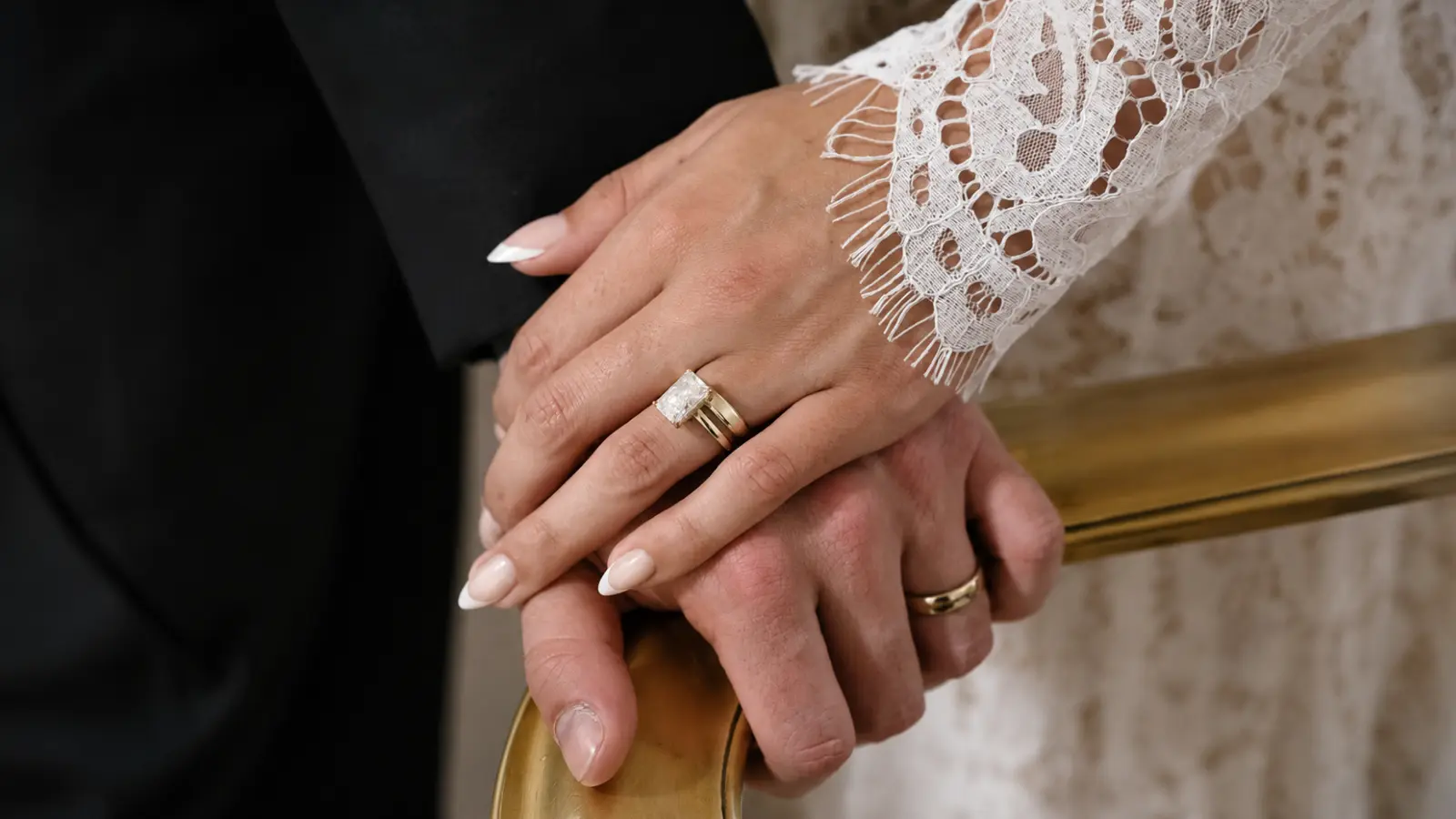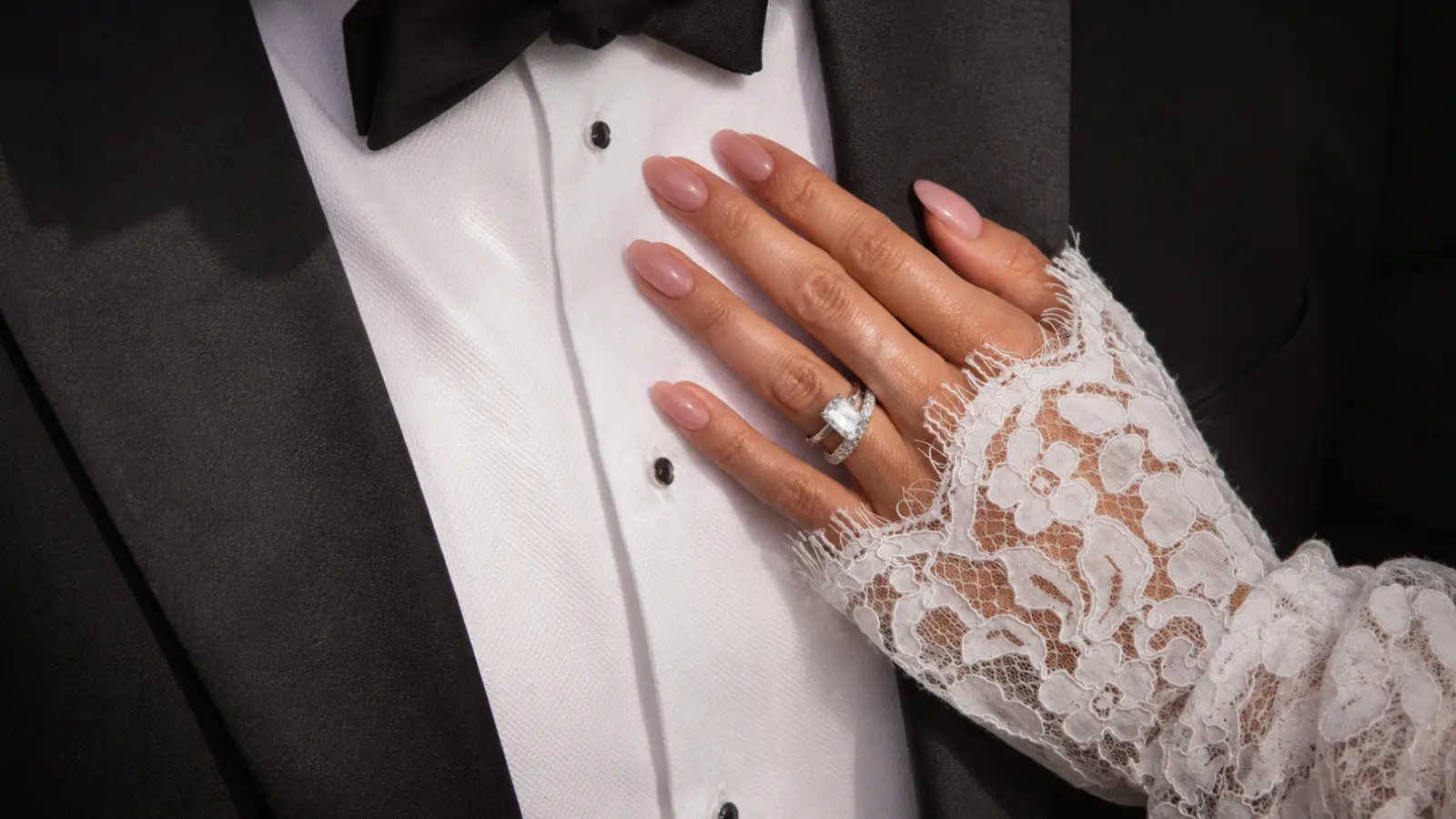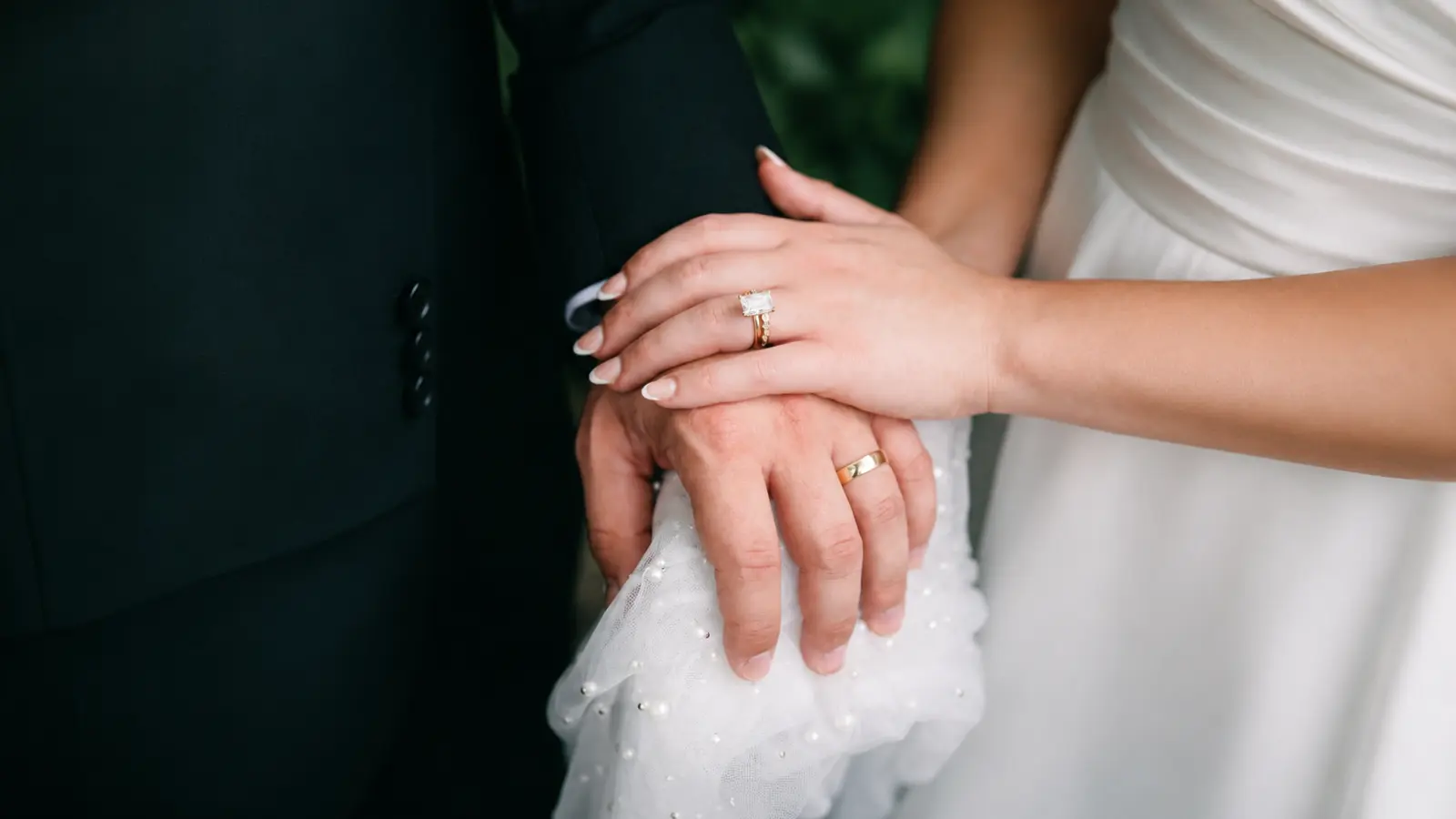
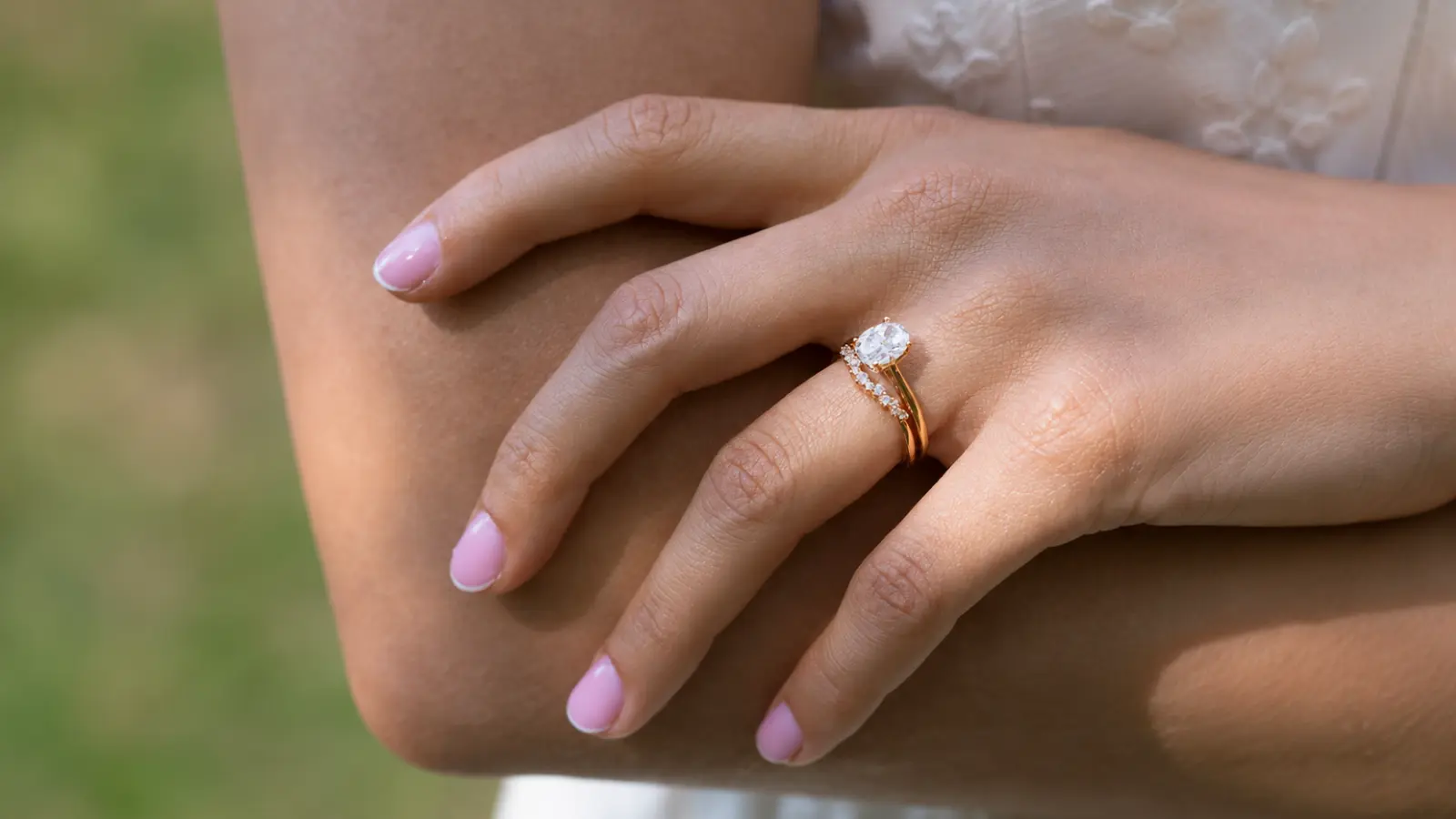
An engagement ring and wedding band set is a pair of rings designed to be worn together on the same finger, with the wedding band created to complement the engagement ring’s shape, style, and setting. These sets help create a more seamless fit between the two rings, especially when the engagement ring design makes pairing difficult.
Choosing the right wedding band is not only about matching the metal or style. The way the rings physically sit together matters just as much — from avoiding unwanted gaps to choosing between straight, curved, contoured, or custom bands that work with the engagement ring’s shape.
This guide explains engagement ring and wedding band sets, including flush fit designs, curved wedding bands, matching by diamond shape, buying together vs separately, and how to choose a combination that looks beautiful and feels comfortable for everyday wear.
What Is an Engagement Ring and Wedding Band Set?
An engagement ring and wedding band set is two rings — one for the proposal, one for the ceremony — designed by the same jeweler to be worn permanently together on the same finger. The term most people encounter for this is a bridal set, and the defining feature is not simply that the rings share a metal or a style, but that the wedding band’s physical shape was built around the engagement ring’s specific setting profile.
This distinction matters more than it might seem. When two rings are chosen independently — from different collections, different jewelers, different moments — they may share a metal and still produce a poor fit, because no one accounted for how the engagement ring’s setting geometry would interact with the wedding band’s profile. A raised prong setting, a halo, a bezel with significant height above the shank: any of these can prevent a straight-sided wedding band from sitting cleanly against the engagement ring, leaving a visible gap where the two rings meet. In a bridal set, that gap is designed away before either ring is made.
What a set includes in practice: the engagement ring is typically the design statement — a center stone, an elaborate setting, the visual centerpiece of the pair. The wedding band is lower-profile, shaped along its inner curve to sit flush against the engagement ring’s base. Both rings share the same metal, and in most sets the stone quality and any side stones are matched in grade and design language so that the two rings read as a single, intentional piece when worn together.
A set is not the only way to achieve this result. A jeweler can create a custom-fitted band around an existing engagement ring, which produces an equivalent fit without requiring both rings to be purchased from the same collection. And some engagement rings — those with particularly low-profile settings or plain shanks — sit well beside many independently chosen bands without any custom fitting required.
For a broader view of the different types of ring sets available — including trio sets, his and hers pairs, and wedding band sets without an engagement ring the wedding ring sets covers every format.
Benefits of Buying a Set
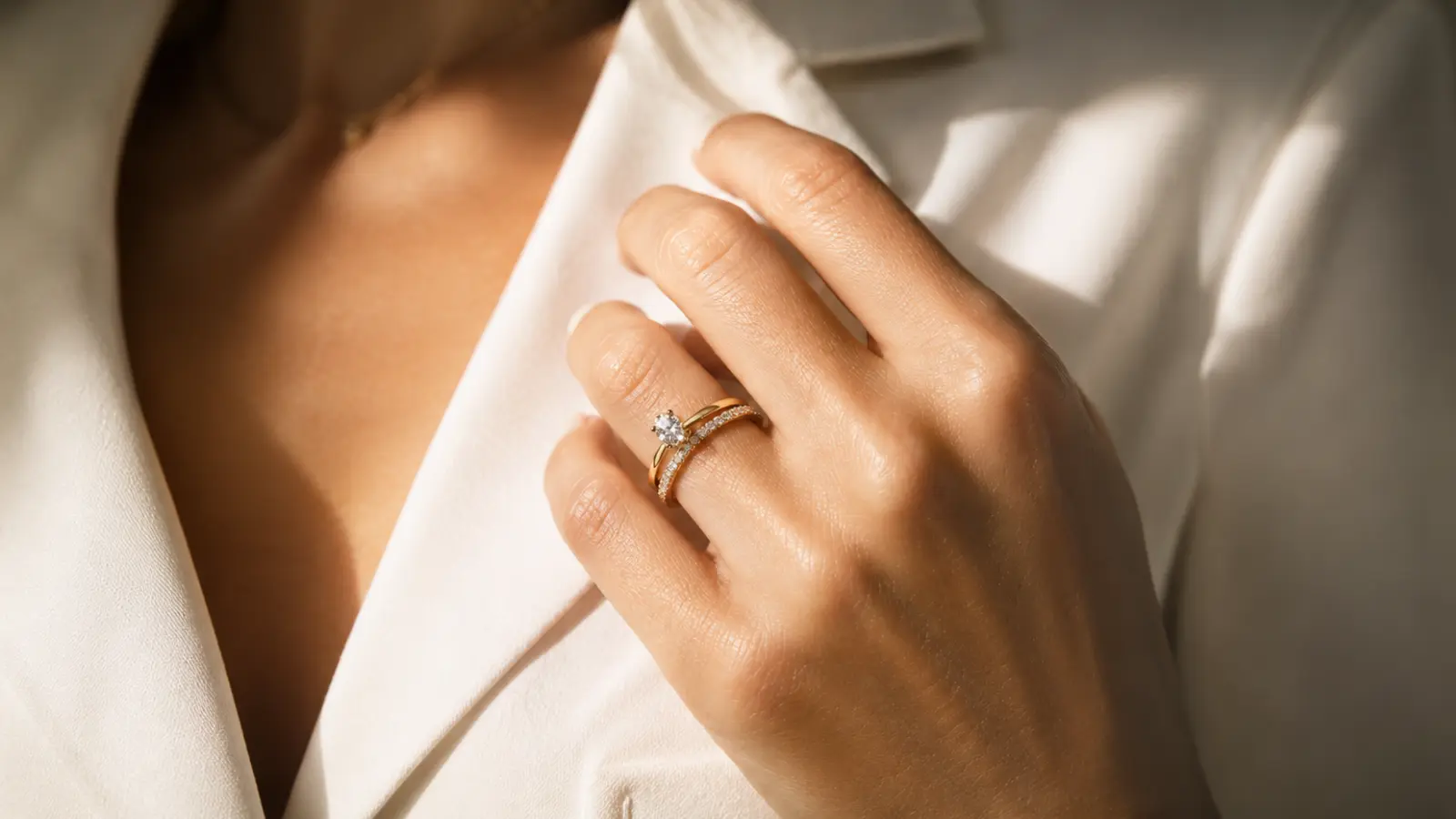
The primary benefit of a bridal set is fit certainty — and for engagement rings with raised or three-dimensional settings, this is not a small thing. Most people who encounter the fit problem describe the experience the same way: they found a wedding band they loved, tried it against their engagement ring, and saw a gap they had not anticipated. The band that looked perfect on its own looked mismatched on the finger. For rings with high prong settings, halo designs, or cathedral profiles, this is not an edge case — it is the expected result when a straight-sided band meets a raised setting. A set eliminates that result by design.
The second benefit is visual coherence. Two rings designed by the same jeweler at the same time share a consistency that independently sourced rings rarely achieve without significant effort. The metal color will be the same rather than close — which matters more than most people expect, because white gold and platinum, or two different alloys of yellow gold, can look notably different under the same light. The stone grades will be calibrated to look right side by side. The width relationships, the profile heights, and the design details will be worked out in relation to each other rather than in parallel.
Cost is a third advantage worth naming directly. A bridal set priced as a package is almost always less expensive than the same engagement ring purchased individually plus a separately sourced band that achieves equivalent fit and quality. For couples managing a defined jewelry budget, this efficiency is meaningful.
What a set does not offer is unrestricted choice. The wedding band in a bridal set is designed to complement the engagement ring in that set — which means its shape, its stone arrangement, and its overall aesthetic are not entirely independent decisions. For someone who has a specific, clear vision for the wedding band that differs from what the set’s design language allows, a set may constrain rather than simplify. The benefits are real; so are the trade-offs.
How to Match a Wedding Band to an Engagement Ring
Matching a wedding band to an engagement ring is a two-part problem: the physical fit, and the visual relationship. Both matter, and they require different thinking.
Getting the Fit Right
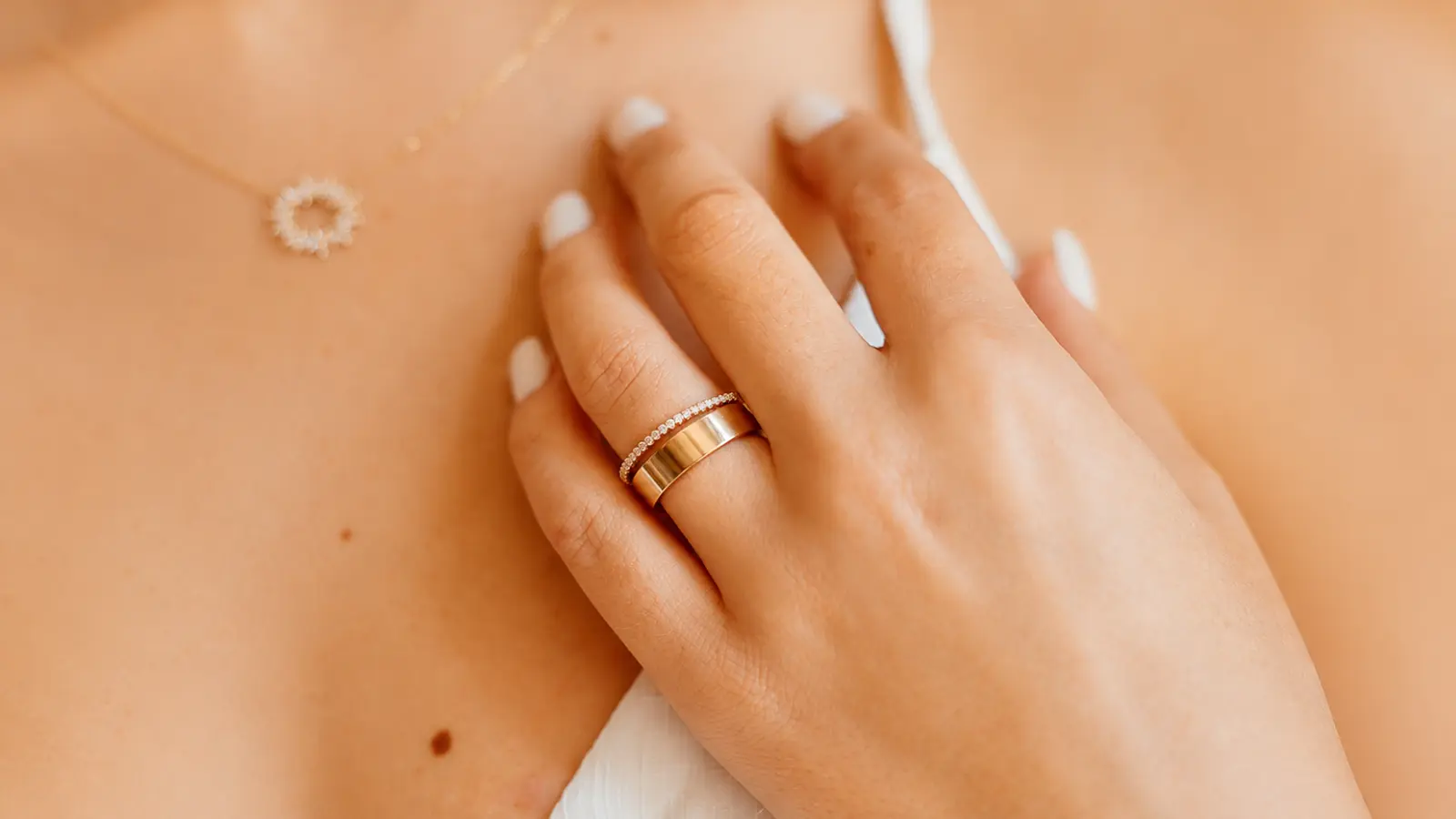
The physical fit question comes first, because it is the more objective of the two. The engagement ring’s setting height determines which types of wedding bands will work beside it. A ring with a low bezel setting, a flat pavé, or a plain shank with no significant elevation can sit cleanly beside most straight bands. A ring with prongs, a raised halo, a cathedral setting, or any design element that creates height above the shank level will likely produce a gap against a straight band.
The way to determine which category the engagement ring falls into is direct: try a straight band next to it on the actual finger. If a gap appears and it bothers you, the solution is a contoured band — a band whose inner silhouette is curved or notched to accommodate the engagement ring’s profile. If the gap appears and it does not bother you, a straight band is fine. Some couples come to appreciate the slight separation between the two rings as a visual feature rather than a flaw — each ring occupies its own space, and the negative space between them becomes part of the aesthetic.
Getting the Visual Relationship Right
The most common mistake in matching a wedding band to an engagement ring is trying to match too much. When the wedding band attempts to echo every design element of the engagement ring — the same stonework arrangement, the same profile height, the same visual weight — the result often feels over-coordinated in a way that works against both rings. The engagement ring’s distinctiveness is diluted by repetition; the wedding band looks derivative rather than complementary.
The approach that tends to produce the most satisfying long-term result with matching wedding bands is sharing one element and letting everything else contrast. Metal color is the most natural shared element — a band in the same metal as the engagement ring reads as intentional without requiring any further coordination. Within that shared metal, contrast usually serves the pair better than matching: a narrow, plain band next to an elaborate pavé halo creates a visual rest point that makes the halo more striking. A slightly textured band next to a high-polish solitaire adds interest without competition.
A Note on Width and Metal Mixing
Width is the most effective variable to work with. A band at roughly half the visual width of the engagement ring’s shank tends to sit in good proportion with it. A band that approaches the same visual width as the engagement ring starts to compete for dominance of the stack. A band that is dramatically narrower — 1.5mm to 2mm — reads as a delicate accent that makes the engagement ring the clear centerpiece.
Metal mixing, when done intentionally, can work well and is no longer considered an etiquette misstep. A yellow gold wedding band next to a white gold engagement ring is a deliberate choice many people make for practical or aesthetic reasons. What matters is that the mixing feels like a choice rather than an accident — when two rings share a metal but one appears slightly more yellow due to alloy differences, it reads as unintentional. When they are clearly different metals, it reads as deliberate.
One consistent recommendation from experienced bridal jewelers: bring the engagement ring to every appointment where a wedding band is being considered. No photograph, no display stand, no individual try-on will give you the information that both rings on the actual hand provides.
Curved and Contoured Bands
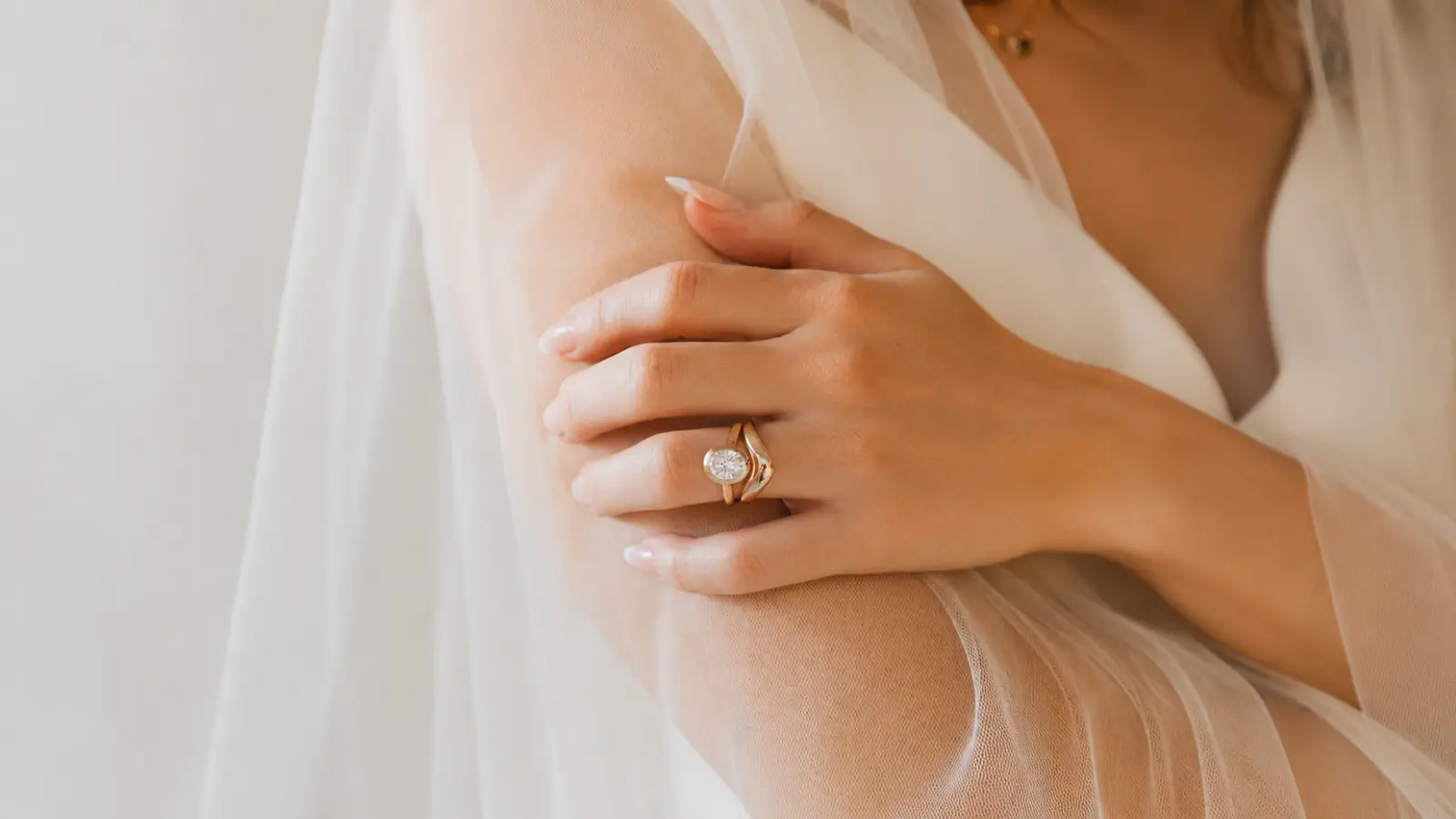
A contoured wedding band — also called a curved band, a fitted band, or a notched band depending on the jeweler — is a band whose silhouette is not a straight rectangle when viewed from the side, but instead curves or angles to accommodate the engagement ring’s profile. It is the most practical solution to the gap problem, and also the most widely misunderstood piece of bridal jewelry in terms of what it actually is and how it works.
The geometry is straightforward. A standard engagement ring’s setting extends above the level of the shank. When a straight-sided wedding band is placed next to this setting, the two rings make contact at their bases but separate as they curve around the finger. A contoured band is shaped so that its inner silhouette follows the engagement ring’s profile — curving inward where the engagement ring’s setting pushes outward — which allows the two rings to meet along their full inner length. The result, when the fit is right, is a pair of rings that looks like it was designed to be worn as a single piece.
The Main Contoured Band Styles
There are four styles worth knowing, each suited to different engagement ring profiles and personal preferences.
The curved band has a smooth arc along its top edge, shaped to follow the round curve of the engagement ring’s shank and setting base. It works best with round and oval center stones whose settings have a symmetrical, centered profile. The curve is subtle enough that the band can look nearly straight when worn alone — it is most visible in profile.
The chevron or V-band has two straight sides that meet in a point or gentle angle, forming a shape that frames the engagement ring’s center stone from below. It is particularly well-suited to fancy-shaped diamonds — ovals, marquises, pears, emeralds — where the elongated setting extends laterally across the finger. The V creates a visual frame that emphasizes the stone’s shape rather than working against it.
The notched band has a specific cutout shaped to accommodate a particular engagement ring’s basket or prong structure. Unlike a curved band — which follows a general arc — a notched band is fitted to a specific setting geometry. It is the most precise fit solution and most closely associated with formal bridal sets, because it requires knowing the exact ring it will sit against.
The shadow band sits slightly away from the engagement ring rather than flush against it, creating a small, deliberate gap between the two rings. It is not a flush fit solution — it is an aesthetic choice for couples who prefer breathing room between the two rings and want that space to look intentional.
One Thing Most Jewelers Won’t Tell You
A contoured band is designed to be worn with the engagement ring. On its own — on days when only the wedding band is worn — the curvature can look slightly odd, because the band’s entire visual identity is organized around the absent ring beside it. If you anticipate wearing only the wedding band regularly — while traveling, at the gym, in professional contexts — look specifically for a band that functions well as a standalone piece. Not all contoured bands have this quality, but many of the shallower curved styles do. It is worth asking a jeweler to show you how the band reads on the finger without the engagement ring next to it before committing.
Ring Sets by Diamond Shape
The center stone’s shape is the single most important factor in determining which wedding band will sit well beside an engagement ring. Different shapes create different setting profiles, extend differently across the finger, and pair more naturally with certain band silhouettes. Understanding these relationships makes the matching process significantly more direct.
Round Diamond
The round brilliant is the most forgiving shape for wedding band compatibility. Its symmetrical, centered profile means the setting extends equally in all directions, and a straight band often sits cleanly beside a round solitaire on a plain shank. The exception is a high cathedral setting, a raised prong, or a significant halo — those push a straight band away just as much as any fancy shape would.
For a round in a relatively low setting, the widest range of wedding band styles will work: plain bands, diamond bands, pavé bands, and milgrain or vintage-detailed bands all pair naturally. The round’s symmetry gives the eye a clear center of gravity, and almost any band silhouette can relate to it intelligibly. The limiting factor is always setting height, not stone shape.
Oval Diamond
Oval is one of the most popular fancy shapes, and also one of the shapes that most frequently creates a gap issue with a straight wedding band. The oval’s elongated profile extends across the finger laterally in a way that creates significant curved space on each side of the setting. A straight band meets the oval’s base but diverges from it almost immediately, producing a noticeable gap.
The most common and most satisfying wedding bands for oval engagement rings use a chevron or V-shaped profile, which frames the oval’s elongated shape from below and fills the lateral space without competing with the stone. A thin curved band that follows the oval’s arc is the other natural option. A very narrow straight band (under 2mm) can also work — the narrowness minimizes how visible the gap is, and some people prefer the look of that slight separation.
Cushion Diamond
Cushion-cut diamonds share some of the oval’s lateral extension, particularly wider cushion cuts, and tend to pair well with curved or V-shaped bands for the same reasons. A modified cushion with a more compressed shape can sit beside a straight band more cleanly. Many cushion engagement rings are set in halos, which add additional profile height and make a contoured band the stronger default choice.
Cushion settings with pavé along the shank — a common design — mean the wedding band needs to accommodate not just the center stone’s height but the shank’s decorated surface. A plain contoured band tends to work better beside a decorated cushion shank than a second pavé band, which can make the stack feel visually crowded.
Emerald and Asscher Diamond
These step-cut shapes have a flat table and a relatively low profile compared to brilliant cuts, which means the setting height above the shank is often less dramatic. Many wedding bands for emerald cut engagement rings can sit cleanly beside a solitaire on a plain shank with little or no gap. The visual geometry of step cuts — horizontal, rectilinear, architectural — pairs well with a clean straight band that shares the same linear aesthetic.
A thin baguette band echoes the step-cut’s geometry in a way that feels designed rather than coincidental. A curved or V-shaped band can also work with an emerald or Asscher, though the contrast between the curved band and the rectangular stone is more noticeable than it would be with a round or oval — which is not a problem, just something to consider when trying options.
Pear Diamond
The pear’s asymmetrical shape creates a specific challenge: the pointed end extends toward the shank and can be very close to or touching the wedding band’s surface. The rounded end creates the oval-style lateral gap. One of the most practical wedding bands for pear shaped engagement rings is a V-shaped band oriented toward the pointed end of the pear — this frames the stone’s silhouette and is structurally protective of the pointed tip, which is the most vulnerable part of a pear setting.
Some couples with pear engagement rings wear a narrow plain band that sits only beside the rounded end, letting the pointed end be unframed. It is less conventional but visually coherent when the intention is clear.
Marquise Diamond
The marquise extends significantly across the finger on both sides, and the two pointed ends face the same proximity challenge as the pear’s point — the tips extend close to or past the band’s surface level. Among wedding bands for marquise engagement rings, a V-shaped band that frames the pointed ends is one of the most common and practical pairings. A straight band will leave a pronounced gap along the marquise’s long sides and may contact or crowd the points at the ends, which is uncomfortable and potentially damaging to prong settings over time.
Princess and Radiant Diamond
Square and rectangular fancy cuts create a setting footprint wider than a round solitaire but usually more contained than an oval or marquise. A straight band often works beside a princess or radiant on a relatively plain shank, because the square shape’s lateral extension is more symmetrical and moderate. A pavé or diamond band pairs naturally with princess and radiant settings — the diamond density continues the setting’s sparkle in a way that feels compositionally consistent.
For princess cuts in high prong settings, a contoured band will produce a cleaner fit than a straight band. The elevated corner prongs of a princess cut are a common source of the gap problem, and they are often underestimated as a fit variable before the two rings are tried together.
Should You Buy the Set Together?
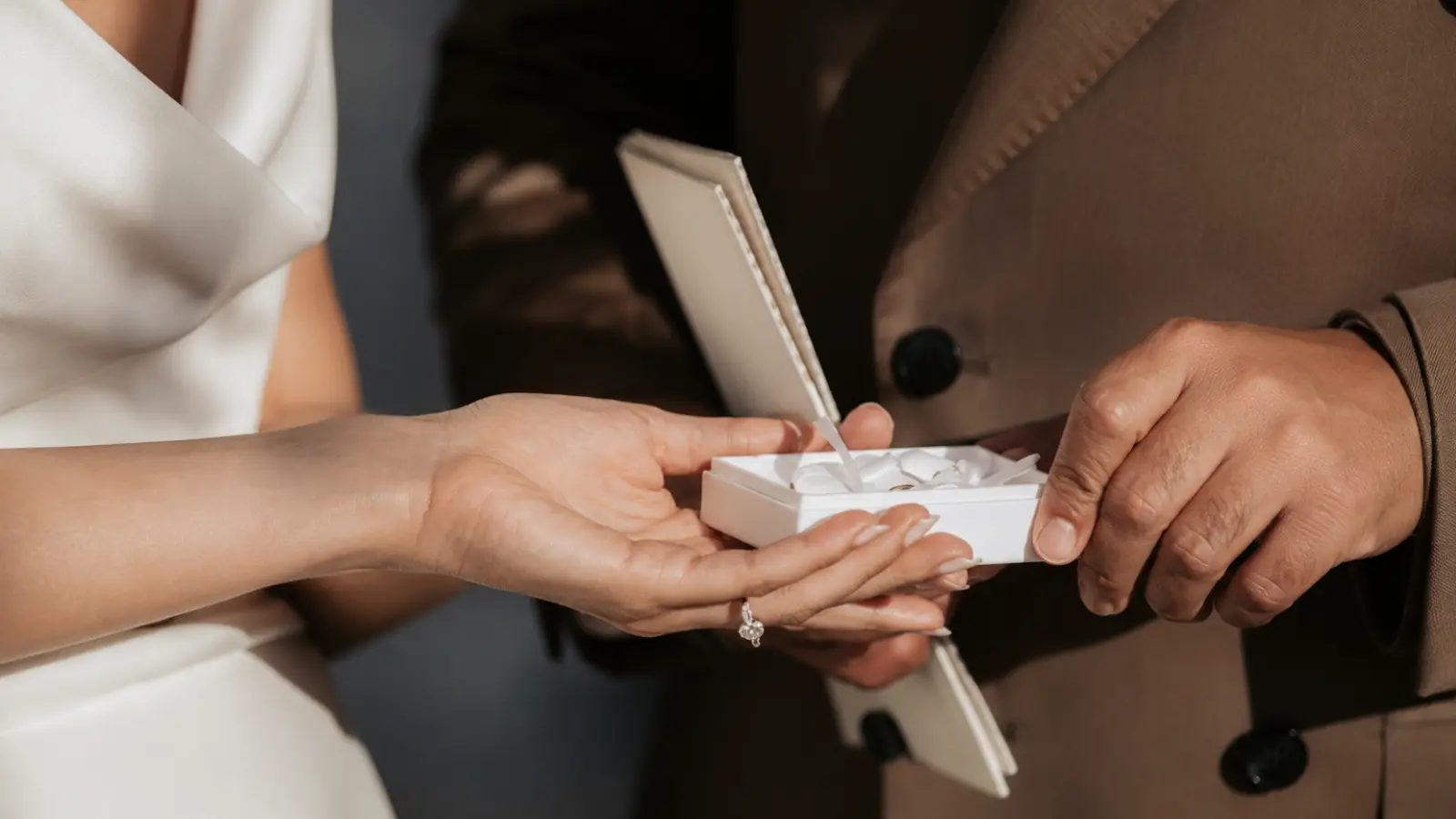
The question of whether to buy the engagement ring and wedding band at the same time is one of the most common in the bridal jewelry process — and the answer depends more on the specific engagement ring and the situation around the purchase than on any general rule.
The Case for Buying Together
The argument for buying both rings at once is strongest when the engagement ring is being chosen collaboratively — no surprise element, both people selecting rings in conversation. In that situation, buying both from the same jeweler in the same appointment allows the fit relationship to be assessed before either is purchased, the wedding band to be shaped specifically for the engagement ring’s profile, and the total cost to benefit from set pricing.
For couples who have identified an engagement ring with a prominent setting and want to be sure the wedding band will sit flush, the simultaneous purchase eliminates the fit problem entirely. It also eliminates the later effort of finding a compatible band — which, for complex settings, can require several appointments and still produce an imperfect result.
The Case for Buying Separately
Buying separately is the right path when the proposal is intended as a surprise. The wedding band then becomes a separate decision, made later, with the actual engagement ring already on hand — which is actually the most reliable fit-testing situation possible. Couples in this situation are often better served by taking their time with the wedding band choice rather than rushing to match a ring they have not yet seen in context.
The one situation where buying separately requires the most planning: when the engagement ring has an unusual or asymmetrical setting that standard wedding bands are not designed to accommodate. A very wide shank, a non-standard setting profile, or a custom-designed ring may have no off-the-shelf set band available. In those cases, a custom-fitted band — made by a jeweler with the engagement ring physically present — is usually the cleanest solution.
The Timing Question Is Separate from the Fit Question
Some couples prefer the wedding band to be its own decision, made closer to the wedding, with its own moment of selection. The engagement ring is the proposal gift; the wedding band is the thing chosen together, for the ceremony, with full consideration of everything decided since the engagement began. That sequencing gives the wedding band its own significance rather than folding it into the engagement ring purchase as a secondary decision. It is a valid reason to buy separately that has nothing to do with fit or budget — and it is worth naming as a reason, not just a constraint.
What neither timing nor budget should determine: the quality of the fit. Whether the rings are purchased together or separately, the wedding band that ends up on the finger for the next several decades should sit comfortably against the engagement ring and be a ring the wearer will want to keep wearing. That outcome is achievable either way — it just requires different amounts of effort depending on the sequence.
For more detail on how the two rings are actually worn together — stacking order, what to do before the ceremony, and how to handle the day itself — the how to wear wedding rings covers all of it.
Engagement Ring and Wedding Band Inspiration
Engagement ring and wedding band sets can create a seamless, balanced look when the rings are designed to work together. Explore our inspiration board for matching bridal sets, curved wedding bands, diamond pairings, flush fit designs, and beautiful ways to style your wedding ring stack.
Choosing Rings That Belong Together
An engagement ring and wedding band set works best when both rings feel connected without losing what makes each one special. The right pairing should balance beauty, comfort, fit, and the way the rings will be worn together through everyday life.
Whether you choose a perfectly matched bridal set, a curved wedding band, or a separate ring that complements your engagement ring, the best combination is the one that feels natural every time you look at your hand.
Frequently asked questions (FAQ)
What is an engagement ring and wedding band set?
An engagement ring and wedding band set, also called a bridal set, includes two rings designed to be worn together on the same finger. The engagement ring and wedding band are created to match in style, metal, proportion, and fit so they look intentional as a pair.
Should your wedding band match your engagement ring?
Your wedding band does not have to perfectly match your engagement ring. Some people prefer a matching bridal set, while others choose a band that complements the engagement ring through metal, shape, or style. The best pairing is one where both rings look balanced together while still feeling like pieces you love individually.
Is it better to buy an engagement ring and wedding band together?
Buying them together can be a good choice because the rings are designed to fit correctly from the beginning. This is especially helpful for engagement rings with higher settings, halos, or unique shapes. Buying separately gives you more freedom to choose a wedding band later, but it requires checking that the two rings sit comfortably together.
What type of wedding band looks best with an engagement ring?
The best wedding band depends on the engagement ring’s shape and setting. Simple solitaire rings often pair well with straight bands, while raised settings, halos, and certain diamond shapes may need curved or contoured bands. The goal is choosing a band that complements the engagement ring without competing with it.
What is a contoured wedding band?
A contoured wedding band is a band shaped to follow the outline of an engagement ring. Instead of being completely straight, it may curve or have a custom shape that allows the two rings to sit closer together. Contoured bands are commonly used when a standard band leaves a visible gap.
What is a flush fit wedding band?
A flush fit wedding band sits directly next to the engagement ring with little or no visible space between them. Whether a flush fit is possible depends on the engagement ring setting and the shape of the wedding band. Some rings naturally allow a flush fit, while others require a curved or custom band.