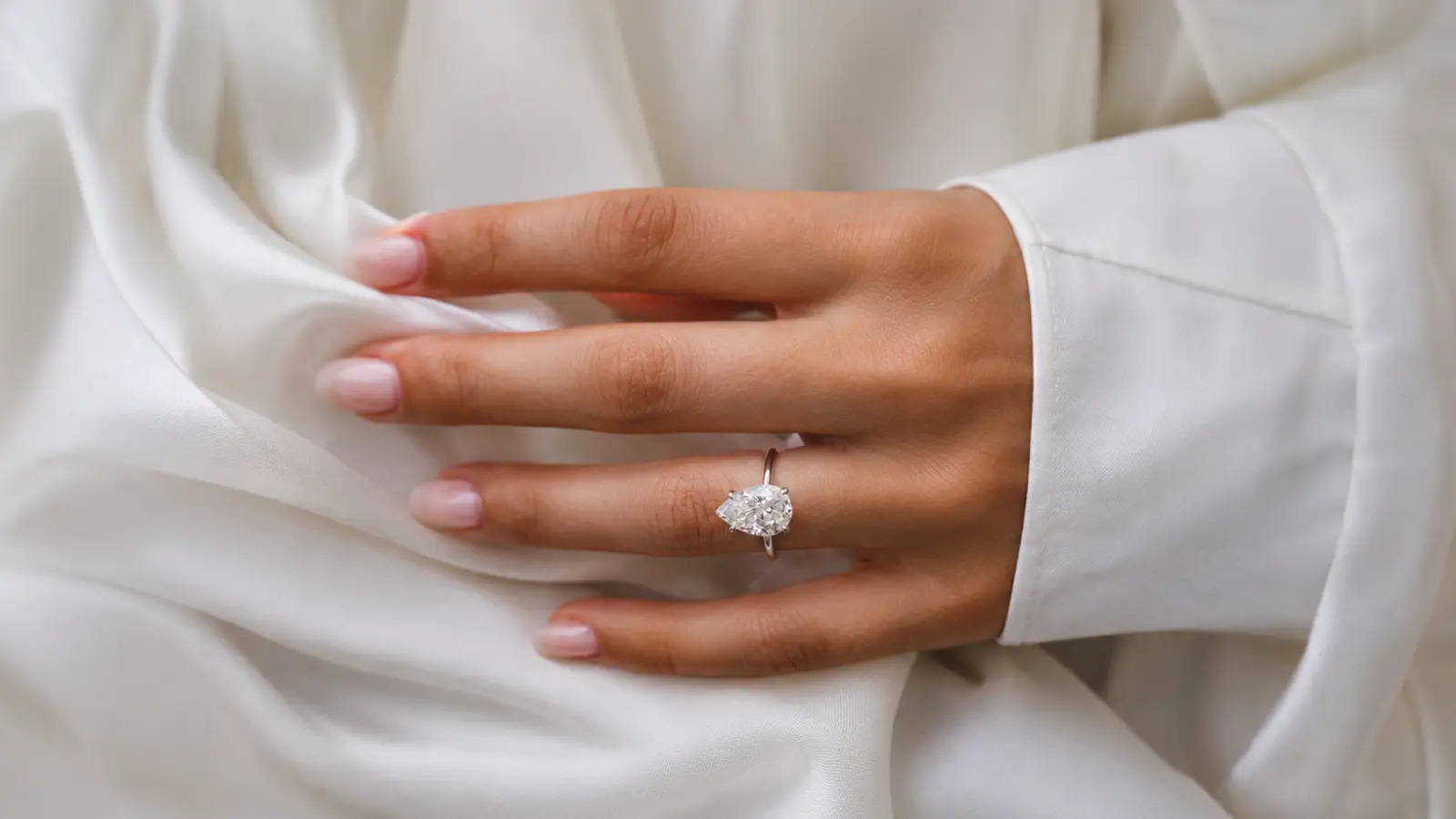
Wedding bands for pear shaped engagement rings are designed to complement the pear cut’s unique combination of a rounded end and pointed tip, creating a balanced fit between the engagement ring and wedding band. Because pear shaped stones have an asymmetrical silhouette, choosing the right band often depends on the setting height, stone direction, and how closely you want both rings to sit together.
Finding the perfect wedding band is not only about matching a beautiful style. Curved bands, chevron designs, open bands, and custom options can all create different looks depending on whether you want a seamless stack, a modern pairing, or more flexibility for everyday wear.
This guide explains everything about wedding bands for pear shaped engagement rings, including curved vs. chevron bands, open designs, point-up and point-down orientations, stack ideas, common fit problems, and how this pairing fits within different wedding rings and wedding bands.
Best Wedding Bands for Pear-Shaped Engagement Rings
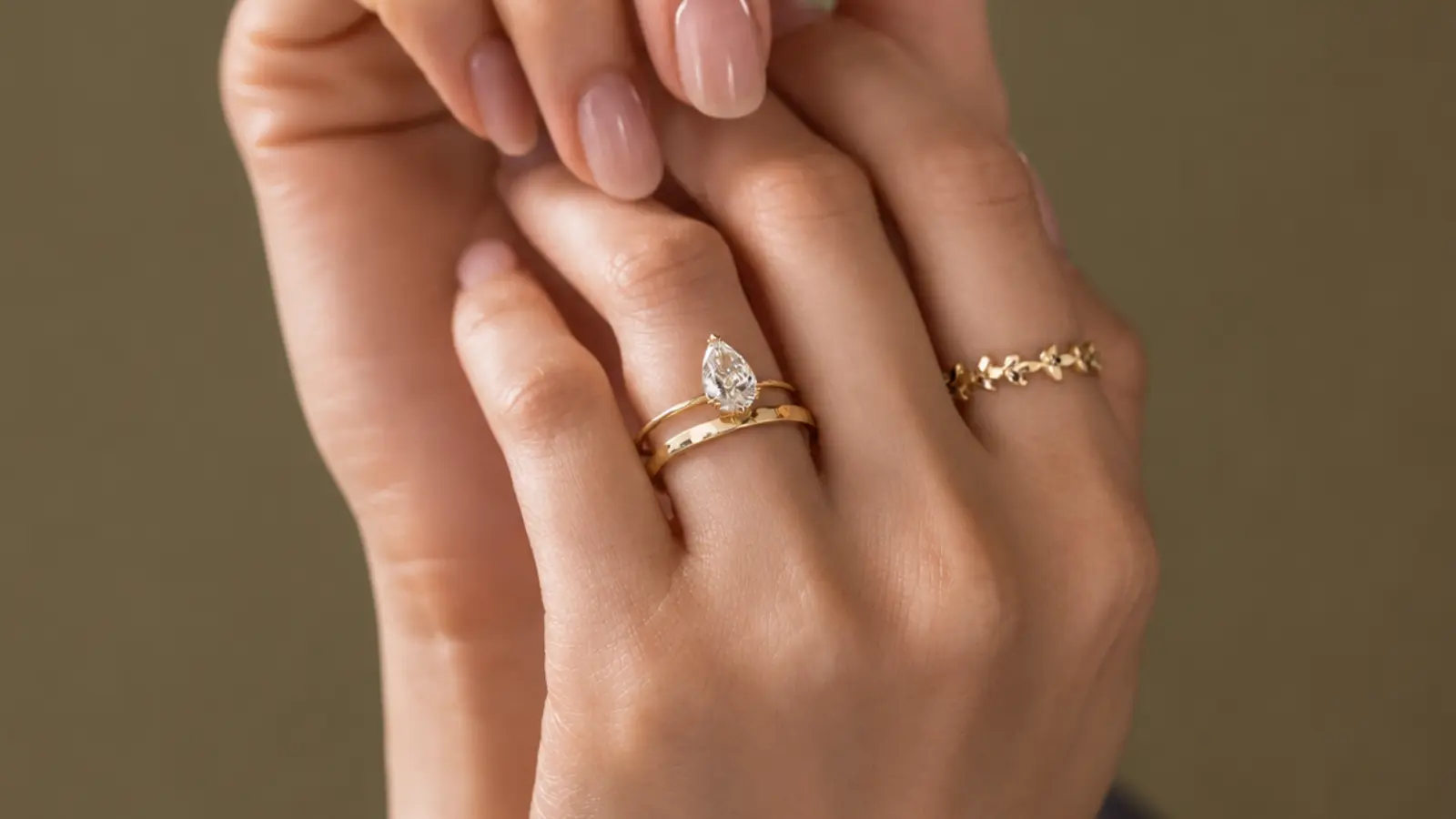
The pear cut’s defining characteristic, the pointed tip, is what drives every wedding band decision. Unlike a round or cushion stone, which sits symmetrically on the finger, a pear creates an asymmetrical profile that a straight-sided wedding band cannot follow without leaving a noticeable gap on one side. The good news is that the bridal jewelry market has developed several band styles specifically suited to this challenge, and most experienced jewelers are familiar with fitting them.
The right band type depends on three things: the height and profile of the pear’s setting, the direction the point is worn (up or down), and whether you intend to wear both rings together every day or prefer the flexibility to wear them separately. Those three factors narrow the options quickly.
For everyday stacking: a contoured band
If you plan to wear the engagement ring and wedding band together consistently, a contoured band, curved or chevron, is usually the most satisfying long-term solution. These bands are shaped to follow the engagement ring’s profile rather than fight it, which means the two rings sit flush without a gap or with only a minimal one. The stack looks cohesive rather than improvised, and neither ring shifts against the other during wear.
For flexibility: an open band or a slim straight band
If you anticipate removing one ring or the other regularly, for work, exercise, or simply personal preference, an open band or a very narrow straight band may be a better fit for how you actually live. Open bands frame the pear rather than nesting against it, which means the “fit” question becomes irrelevant. A slim band (1.5mm to 2mm wide) will also sit against most pear settings with a smaller visible gap than a full-width straight band, though the gap will still be present to some degree depending on the specific setting profile.
For a seamless result: a custom-fitted band
When the engagement ring has an unusual or high-profile setting, a large pear with dramatic prong placement, a custom bezel, a vintage setting with a distinctive silhouette, a jeweler-made band shaped specifically to that ring’s profile is often the cleanest solution. Custom fitting is more expensive than choosing from a standard contoured collection, but it produces a result that no off-the-shelf band can reliably match. A jeweler who specializes in bridal work will typically have done this for pear shapes before and can tell you upfront whether a standard curved band will work or whether custom fitting is genuinely warranted.
Curved and Chevron Bands
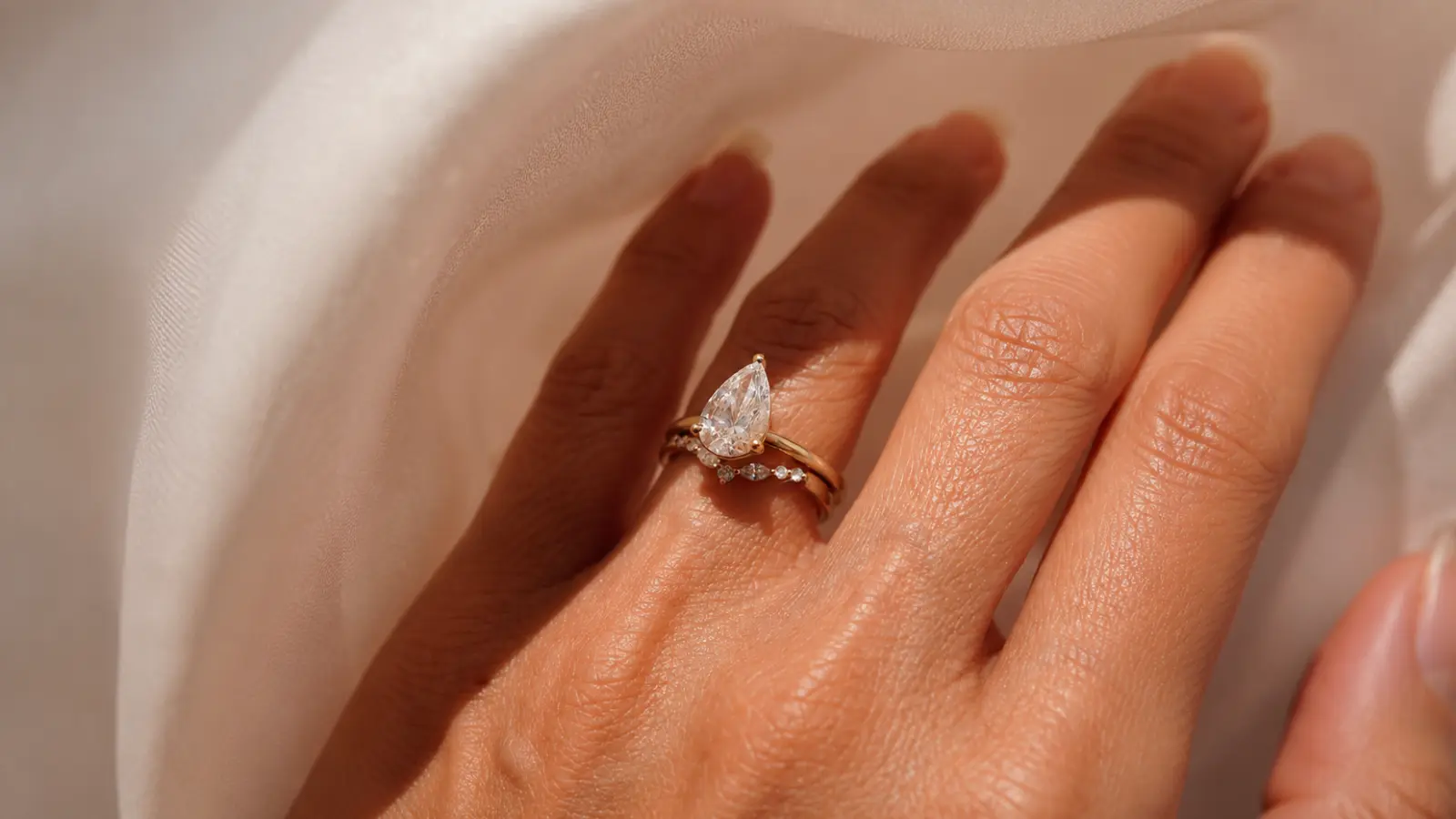
These two band types are the most commonly recommended solutions for pear-shaped engagement rings, and they are often discussed as though they are the same thing. They are not. Understanding the distinction helps you identify which one is the better fit for your specific ring and orientation.
Curved bands
A curved band has a gentle arc along its profile, instead of running in a straight line from one side of the finger to the other, the band bows slightly inward at the center. That inward curve creates space for the engagement ring’s setting to sit alongside the band without creating a gap. Curved bands work well with pear-shaped rings when the pear is worn point-down, because the rounded end of the stone faces the outside and the curved band follows the profile of the rounded base more naturally.
The curve in these bands varies. A slight curve works for moderately raised settings, while more pronounced curved wedding bands suit taller or wider pear profiles. Most jewelers who carry bridal collections will have curved bands in a range of arc depths, it is worth comparing a few against the actual engagement ring before committing to one.
Chevron bands
A chevron band comes to a V-point or a sharper angle at the center of the band rather than a smooth arc. Where a curved band follows a gentle bow, a chevron makes a deliberate geometric statement. The pointed center of the chevron is what makes it particularly well-suited to pear-shaped rings worn with the point facing up: the V of the band aligns with the pointed tip of the stone, and the two angles read as a coordinated choice rather than an accidental match.
Chevron bands have the added advantage of working well worn alone. Because the V-shape is visually interesting on its own, a chevron band does not feel incomplete or oddly shaped the way a curved band sometimes can when the engagement ring is off. This makes chevrons a strong option for people who rotate their rings regularly or who sometimes prefer wearing only the wedding band.
Symmetry and the pear’s orientation
One consideration that applies to both curved and chevron bands: the pear shape is not symmetrical, and the band’s curve may be more or less visible on the rounded side versus the pointed side. Most standard curved bands are designed to accommodate a symmetric stone (oval, round) and have a uniform arc. Against a pear, that arc may fit well on the rounded end but leave a slight gap at the tip, or vice versa. This is not a flaw in the band, it is the nature of an asymmetrical stone. A jeweler can confirm whether the specific band being considered sits evenly against both sides of a specific pear setting, or whether one side will have a minor residual gap that may or may not be noticeable in practice.
Open Wedding Bands
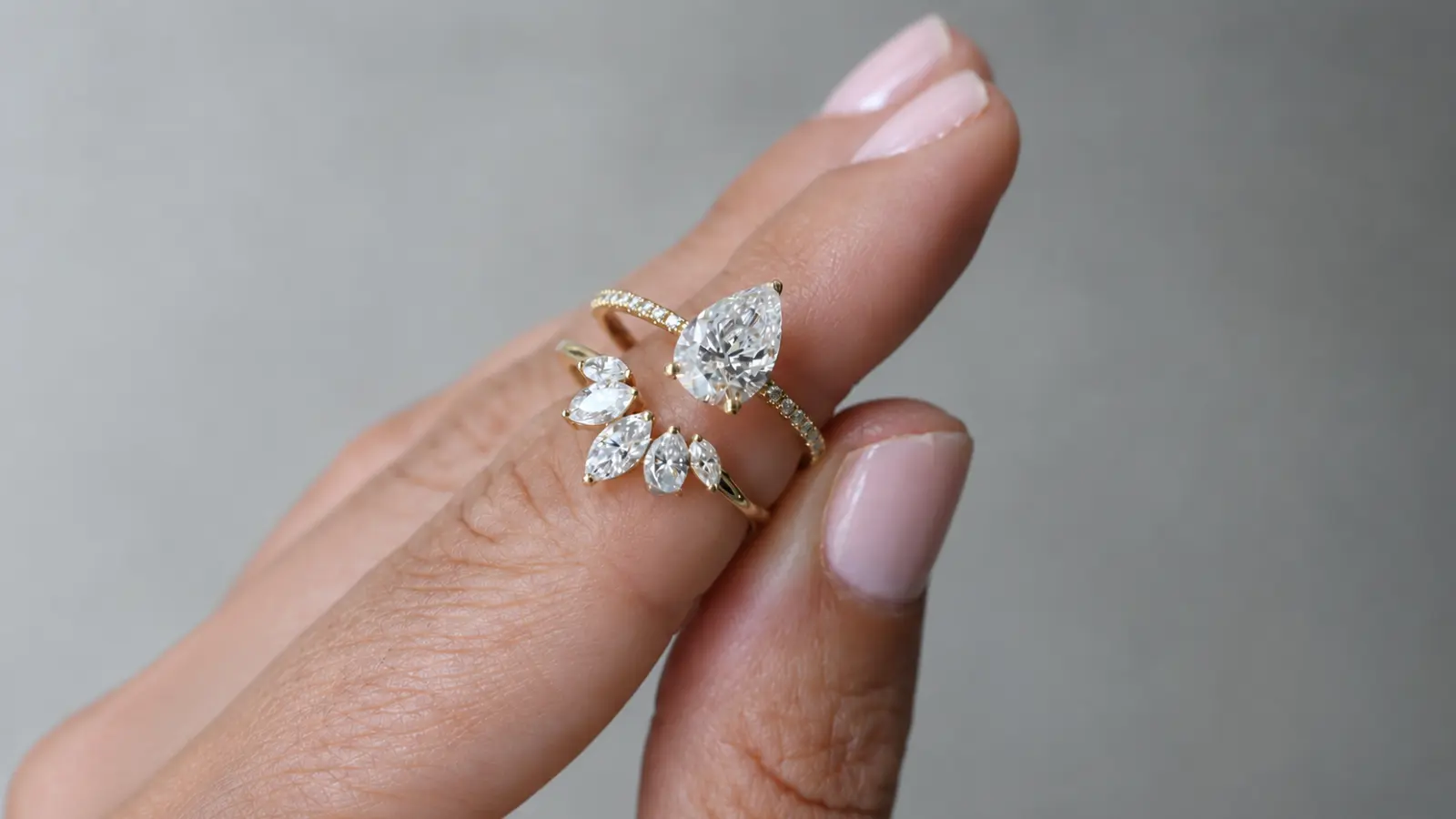
An open band, sometimes called a bypass band, has a deliberate gap at the front rather than forming a complete circle. The two ends of the band stop short of meeting, leaving a space that frames the center of the finger rather than encircling it. For pear-shaped engagement rings, this design sidesteps the fit problem entirely: instead of trying to nestle against the pointed tip of the setting, the open band simply frames the pear from either side.
How open bands work with a pear stone
The open ends of the band flank the pear stone on both sides, which can complement the stone’s elongated shape rather than competing with it. Worn together, the pear and the open band create a composition, the stone floats between the two open ends of the band, that can feel more architectural and intentional than a traditional stacked look. It reads as a design choice rather than a workaround, which is part of why open bands have become a genuinely popular option for non-round stones rather than simply a fallback for difficult settings.
When open bands work especially well
Open bands tend to be the strongest option when the pear’s setting is particularly high or the tip prong is prominent enough that curved bands still leave a visible gap on one side. They also work well for wearers who prefer a lighter look overall, the open front creates a sense of negative space that prevents the finger from looking overly covered in metal and stone. For a pear-shaped ring that is itself quite substantial, an open band can be a more balanced choice than stacking two solid rings side by side.
What to watch for with open bands
The main practical consideration is ring spinning. Open bands, by virtue of their design, have a defined front and back. If the band rotates during wear, which rings often do, especially on fingers where the knuckle is significantly larger than the base, the open gap can shift around the finger and sit in an unintended position. Some open bands address this with a slightly weighted or asymmetrical design that helps keep the front oriented correctly. It is worth asking a jeweler specifically about spin tendency before purchasing an open band if this is likely to be a concern for your hand.
Which Side Should the Point Face?
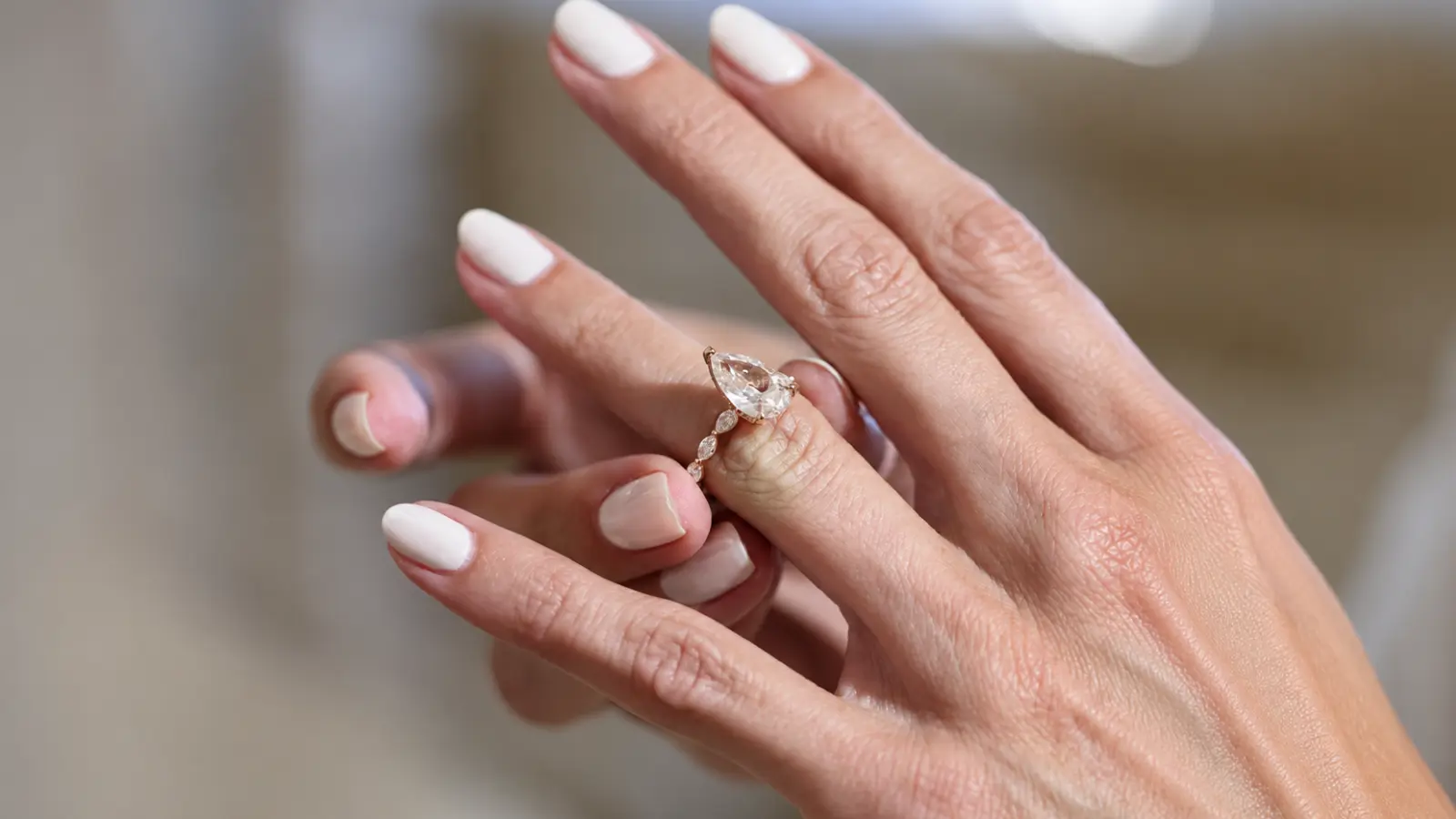
This is one of the more frequently debated questions among pear-shaped ring wearers, and the answer is genuinely that both are correct. Point-up and point-down are both commonly worn orientations with distinct visual effects, and neither carries an etiquette requirement or a tradition that overrides the other. What the direction does affect, practically and meaningfully, is which wedding band styles will fit most cleanly.
Point-up: the traditional orientation
Wearing the pear with the point toward the fingernail is the more established convention, and for most people it is where they start. Point-up visually elongates the finger, which is one of the reasons pear shapes are often recommended for shorter fingers, the ascending line of the stone draws the eye upward and creates the impression of length. In photographs, point-up tends to be a striking orientation because the tip of the stone is the visual terminus of the hand.
For wedding band fitting, point-up works most naturally with chevron bands, since the V of the chevron aligns with the ascending point of the stone. Curved bands can also work well in point-up orientation, particularly when the curve is pronounced enough to accommodate the tip’s height without leaving a gap on that side.
Point-down: the modern alternative
Point-down, with the rounded end of the pear toward the nail and the tip pointing toward the knuckle, has grown steadily more popular. Part of the appeal is visual: the rounded top of the pear presents a softer silhouette when looking at the hand head-on, and many wearers find it looks more balanced from the perspective of someone across a table. Some wearers also report that point-down feels more secure, since the tip prong sits between the ring and the palm rather than extending out toward the fingertip where it may catch on fabric or surfaces.
For wedding band fitting, point-down can make curved bands work slightly more naturally on the rounded side, but the pointed end, now facing the knuckle, still needs to be accommodated on the band’s inner edge. A jeweler who sees the actual ring in point-down orientation can assess whether a standard curved band handles both sides of the pear cleanly or whether a custom fit is a better investment.
The practical test
If you have been wearing your engagement ring for some time already, you likely have a strong orientation preference by now, even if you have not consciously thought about it in those terms. The question to ask before choosing a wedding band is simply: which direction am I actually wearing this ring, and which band style accommodates that direction most cleanly? Reversing a long-standing orientation to suit a particular band style is generally the wrong order of priorities. Choose the band that works with the direction you naturally wear the ring.
Pear-Shaped Ring Stack Ideas
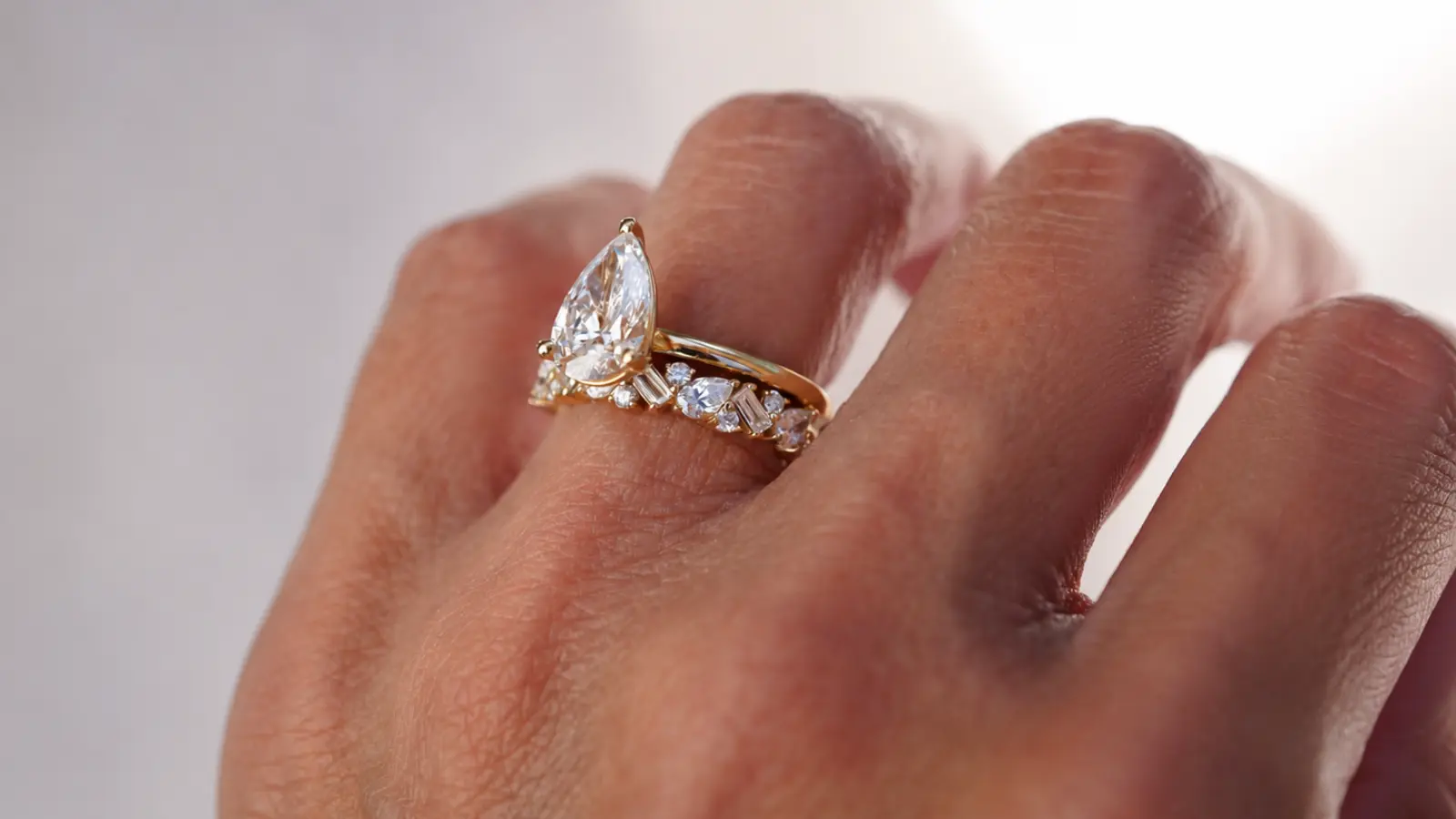
The pear shape is a strong focal point, it has a distinctive silhouette that reads clearly from a distance, and it photographs well in a way that many more symmetrical cuts do not. Building a stack around it is less about adding visual complexity and more about framing what is already there. The most successful pear stacks tend to be restrained on both sides of the stone, keeping the pear as the dominant element rather than burying it in adjacent rings.
The classic two-ring stack
A single curved or chevron wedding band paired with the pear engagement ring is the most enduring option and the one that most jewelers and photographers point to as the cleanest result. Done well, with a band that fits the setting cleanly and reads as a deliberate pairing rather than an afterthought, a two-ring stack on a pear is elegant rather than minimal. The engagement ring carries all the visual weight it was designed to carry, and the wedding band establishes the marriage without competing.
Metal choice matters here. A wedding band in the same metal as the engagement ring can make engagement ring and wedding band sets feel more visually unified. A mixed-metal stack, say, a yellow gold curved band paired with a white gold or platinum pear setting, is a modern alternative that some wearers prefer, though it requires more deliberate thought about whether the contrast is intentional-looking or just mismatched. If in doubt, matching metals is the lower-risk choice.
Adding a third ring
Some wearers add stackable wedding rings, such as a slim eternity or pavé band, while keeping the pear engagement ring as the centerpiece. This works well when the outer band is genuinely thin (1.5mm to 2mm) and when the stones, if present, are small enough not to compete visually with the pear. A wider or more substantial third ring tends to overwhelm the stack and draws the eye away from the stone rather than toward it.
The spacing of a three-ring stack also benefits from planning. Some wearers wear the three rings on the same finger; others keep the engagement ring and wedding band on the left ring finger and wear the third ring on a different finger or even the right hand. Either arrangement can look intentional: the key is that it reads as chosen rather than accumulated.
Wearing the rings on separate hands
If the pear’s setting makes a flush-fitting band difficult to source, wearing the engagement ring and wedding band on separate hands is a practical and increasingly common arrangement. The pear, worn on one hand, functions as a statement ring with no fitting complications. The wedding band, worn on the other hand, can be any style, it is freed from the constraint of needing to sit against the pear’s specific setting. Many people who initially choose this arrangement for practical reasons come to genuinely prefer it aesthetically. For a full overview of ring-wearing arrangements and what makes each one work, see our how to wear wedding rings.
Fit Mistakes to Avoid
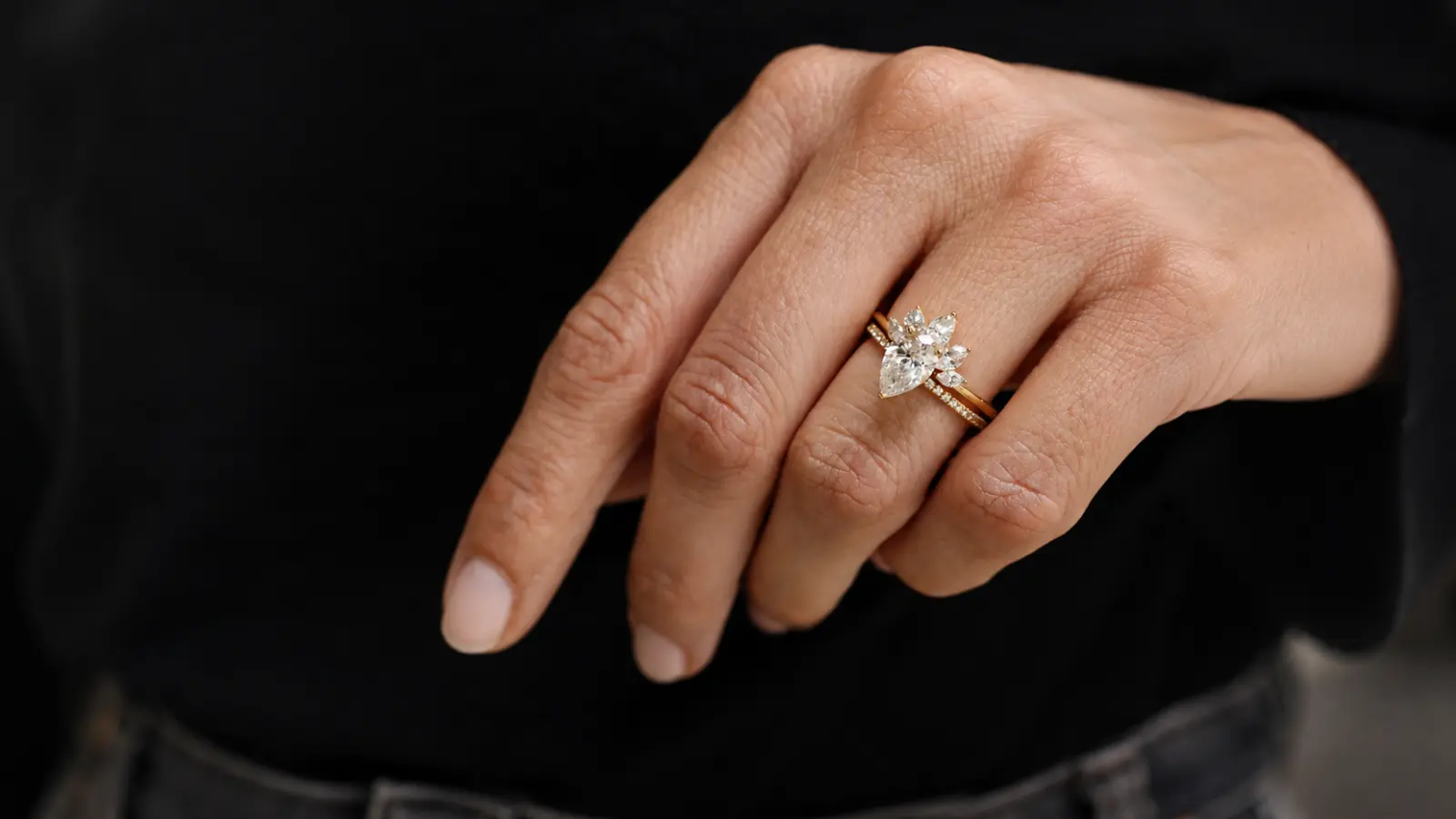
Most of the difficulties people encounter when pairing a wedding band with a pear-shaped engagement ring come down to a small number of avoidable errors. These are not complicated mistakes, they are the kind that happen when the shopping process moves faster than the decision-making process, or when a band that looks right in a photograph turns out not to work against the actual ring.
Buying a straight-sided band without trying it first
This is the most common mistake by a significant margin. A straight-sided wedding band looks clean and simple on a display stand or in a product photograph. Against a pear-shaped engagement ring, the same band almost always leaves a visible gap at the pointed tip of the setting, because the straight profile of the band cannot follow the pear’s asymmetrical contour. The gap is not always dramatic, it depends on the height of the setting and the width of the band, but it is almost always present, and it tends to be more noticeable in person and in photographs than the wearer anticipates before purchase.
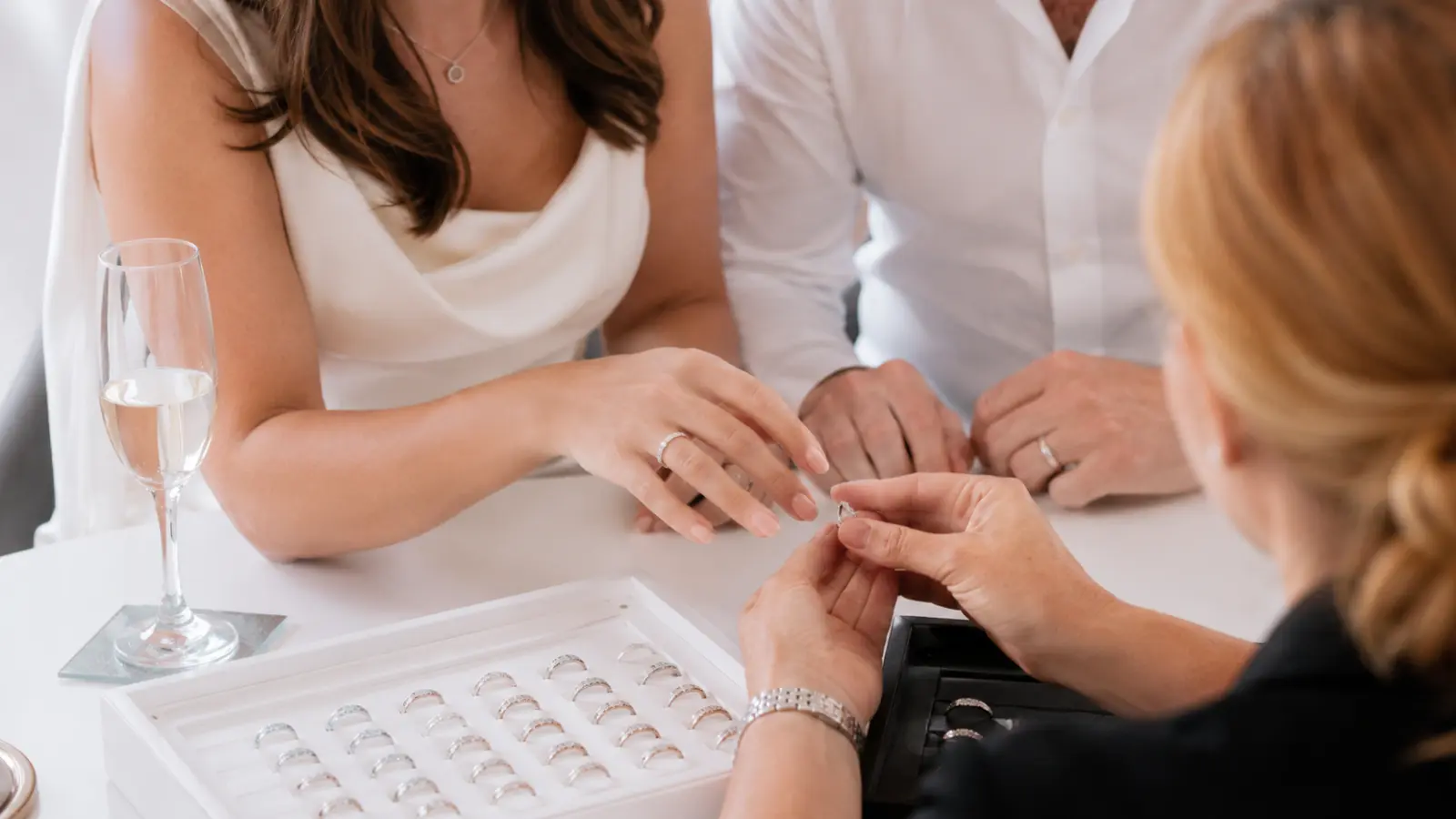
The fix is straightforward: try the band against the engagement ring before committing to it. Bring the engagement ring to the appointment. A band that looks perfect on its own may be obviously wrong against the specific pear it will live beside for decades.
Choosing a band that is too wide
Wider bands, anything above about 4mm, tend to exaggerate the fit problem with pear-shaped rings. A wider band covers more of the contoured area around the setting, which means any gap that exists becomes more visible simply because there is more band surface for the gap to run along. Narrower bands (2mm to 3mm) tend to minimize any residual gap because they occupy less of the space where the band and setting diverge. If a contoured band is not available in the exact profile needed, a narrower band is often the most practical alternative.
Overbuilding the stack
Adding too many rings on either side of the pear is a mistake that often only becomes apparent after the fact, usually in the wedding photographs. Pear-shaped stones are visually strong and directional; they draw the eye along their length. A wide or heavily stacked set of bands can interrupt that visual line and make the overall hand look crowded rather than intentional. The pear tends to look best with one or two slim bands alongside it, rather than a substantial stack that competes with the stone’s natural presence.
Shopping without knowing the point direction
Which direction the point faces, up or down, affects which band profiles will fit cleanly. A chevron band, for example, aligns most naturally with a point-up pear; worn against a point-down pear, the V of the chevron faces in the wrong direction relative to the stone’s tip and the resulting combination can look unresolved. Knowing the intended orientation before shopping narrows the options meaningfully and prevents bringing home a band that is technically the right type but the wrong version of that type for how the ring is actually worn.
Waiting until shortly before the wedding to choose the band
Pear-shaped rings often require curved, chevron, or custom-fitted bands that are not carried in standard inventory at most jewelry retailers. If a contoured band needs to be ordered, or if a custom fit is warranted, lead times can run from several weeks to several months. Starting the wedding band search at least three to four months before the wedding date, rather than in the final weeks, is a practical safeguard that prevents the need to rush a decision that will be worn for the rest of your life.
Pear Shaped Engagement Ring Wedding Band Inspiration
Wedding bands for pear shaped engagement rings can create completely different looks depending on the shape, setting, and style you choose. Explore our inspiration board for curved bands, chevron designs, open bands, diamond stacks, and elegant pear ring combinations.
Choosing a Wedding Band That Complements Your Pear Shaped Ring
The best wedding band for a pear shaped engagement ring is not simply the one that looks beautiful on its own. It is the band that understands the shape, balance, and character of the ring you already chose — creating a combination that feels intentional every time you wear them together.
Whether you choose a curved band, a chevron design, an open style, or a custom fit, the right pairing should highlight what makes your pear shaped ring unique. A wedding band should not compete with your engagement ring — it should become the piece that completes the story.
Frequently asked questions (FAQ)
What wedding band looks best with a pear shaped engagement ring?
The best wedding band for a pear shaped engagement ring is one that works with the stone’s asymmetrical shape instead of fighting against it. Curved bands, chevron bands, and open bands are popular choices because they create space for the pointed end of the pear. The right option depends on the ring setting, the direction you wear the pear, and whether you want a seamless or more modern stacked look.whether you prefer a seamless fit or a more separated stacked look.
Does a pear shaped engagement ring need a curved wedding band?
A pear shaped engagement ring does not always need a curved wedding band, but many pear rings benefit from one because a straight band often leaves a visible gap near the pointed end. A curved band follows the shape of the engagement ring and creates a closer fit. Higher settings, larger pears, and more dramatic profiles are more likely to need a curved or custom-shaped band.
Is a chevron band better for a pear shaped ring?
A chevron band can be one of the best choices for a pear shaped ring because the V shape naturally complements the pointed tip of the stone. It works especially well when the pear is worn with the point facing toward the fingernail. However, a softer curved band may be better for someone who wants a more subtle look or wears the pear in a different direction.
Should a pear shaped engagement ring point up or down?
A pear shaped engagement ring can be worn either way. Point-up, with the tip facing the fingernail, is the more traditional choice and visually lengthens the finger. Point-down creates a different balance and has become a popular modern preference. The best direction is the one you naturally prefer wearing, but it is important to choose a wedding band that fits that orientation.
What mistakes should you avoid when choosing a wedding band for a pear ring?
The biggest mistakes are choosing a straight band without checking the gap, selecting a band that overwhelms the pear shape, ignoring the point direction, or buying a band without trying it next to the actual engagement ring. Because pear rings are asymmetrical, small differences in setting height and shape can completely change how a wedding band fits.
Are open wedding bands good for pear shaped engagement rings?
Yes. Open wedding bands can work especially well with pear shaped engagement rings because they frame the stone instead of trying to sit directly against the setting. This avoids many common fit problems and creates a more intentional design. The main consideration is comfort and making sure the open section stays properly positioned during daily wear.