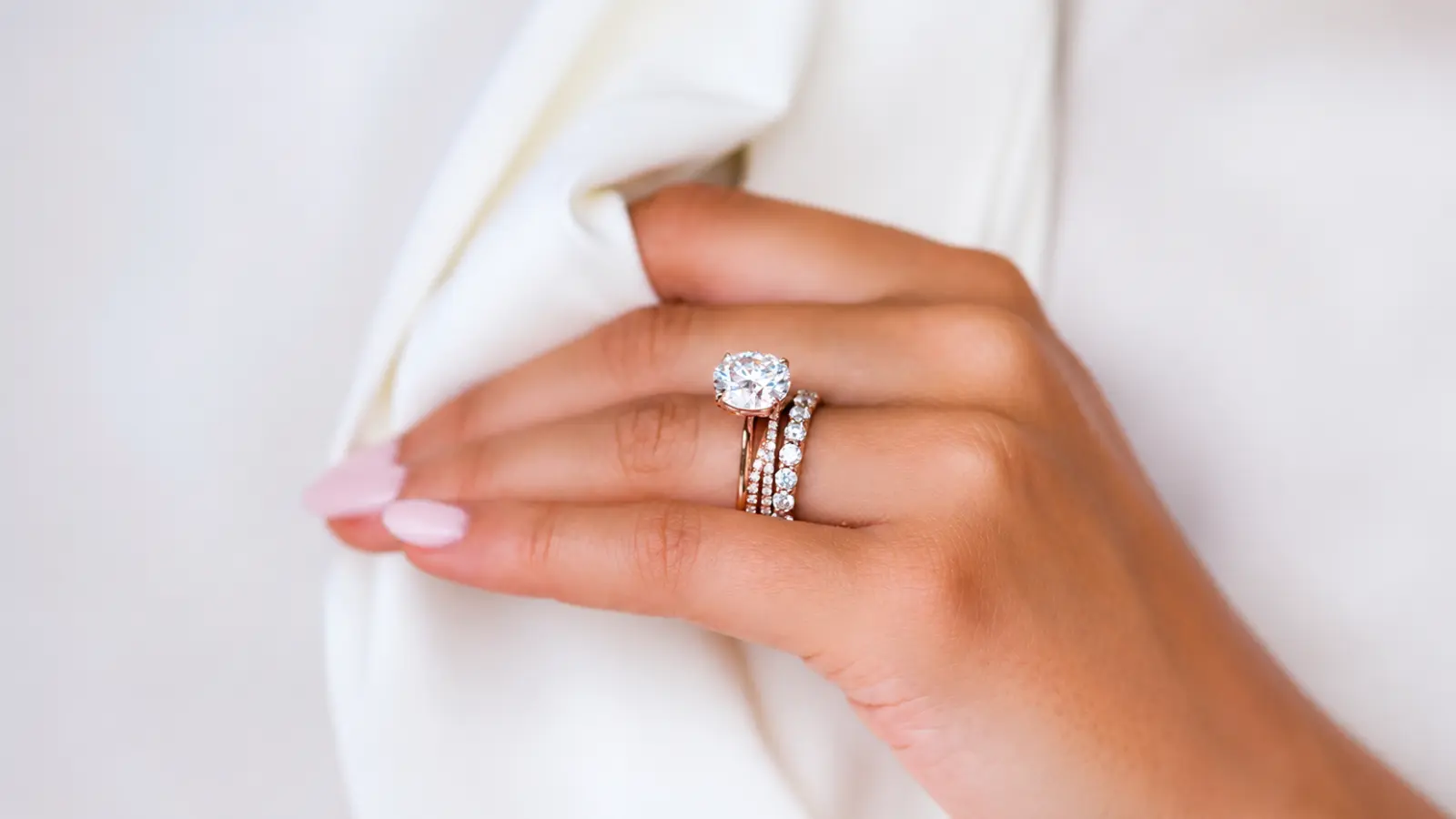
Stackable wedding rings are wedding rings and bands designed to be worn together on the same finger, creating a layered look that often includes an engagement ring, wedding band, and additional meaningful rings such as anniversary bands. A wedding ring stack can be simple and classic or gradually built over time with different styles, metals, and details.
Creating a beautiful ring stack is about more than adding more rings. The best combinations consider balance, comfort, proportions, metal choices, and how each band works with the engagement ring you wear every day.
This guide explains stackable wedding rings and how to build a wedding ring stack, including which rings to combine, the best stackable wedding bands, how to mix metals, where anniversary bands go, and the most common stacking mistakes to avoid.
What Is a Wedding Ring Stack?
A wedding ring stack is two or more rings worn together on the left ring finger as a coordinated set. The most basic version — an engagement ring and a wedding band worn together after the ceremony — is technically a stack, even if most people do not think of it that way. The concept of intentionally building a stack became more widely discussed as thin, individually unassuming bands became easier to find and more explicitly marketed as pieces meant to be layered.
What makes something a stack rather than just a collection of rings is some degree of visual relationship between the pieces. The rings share a metal, a width range, a stone type, or a design language — something that makes them read as a group rather than an accumulation. A stack that works has internal logic. One that does not tends to look like a drawer of rings emptied onto a finger.
How a stack takes shape over time
Most wedding ring stacks build out from the engagement ring, which typically sets the tone. Its metal, profile, and stone size effectively determine what can sit next to it without competing or disappearing. The wedding band comes next — chosen to complement the engagement ring rather than match it exactly. Additional bands, if added, extend the stack outward from there.
The tradition of wearing multiple rings on the same finger is not new — historical examples appear across many cultures and centuries. What is relatively recent is the idea of the stack as an intentional aesthetic project, one that grows over time with each ring carrying its own meaning. An anniversary band at year five. A birthstone band added when a child is born. A thin pavé band purchased simply because the existing stack needed something lighter between two heavier rings. This kind of accumulation, when done with some attention to how the rings relate to each other, is what most people mean when they talk about a wedding ring stack today.
How to Build a Wedding Ring Stack
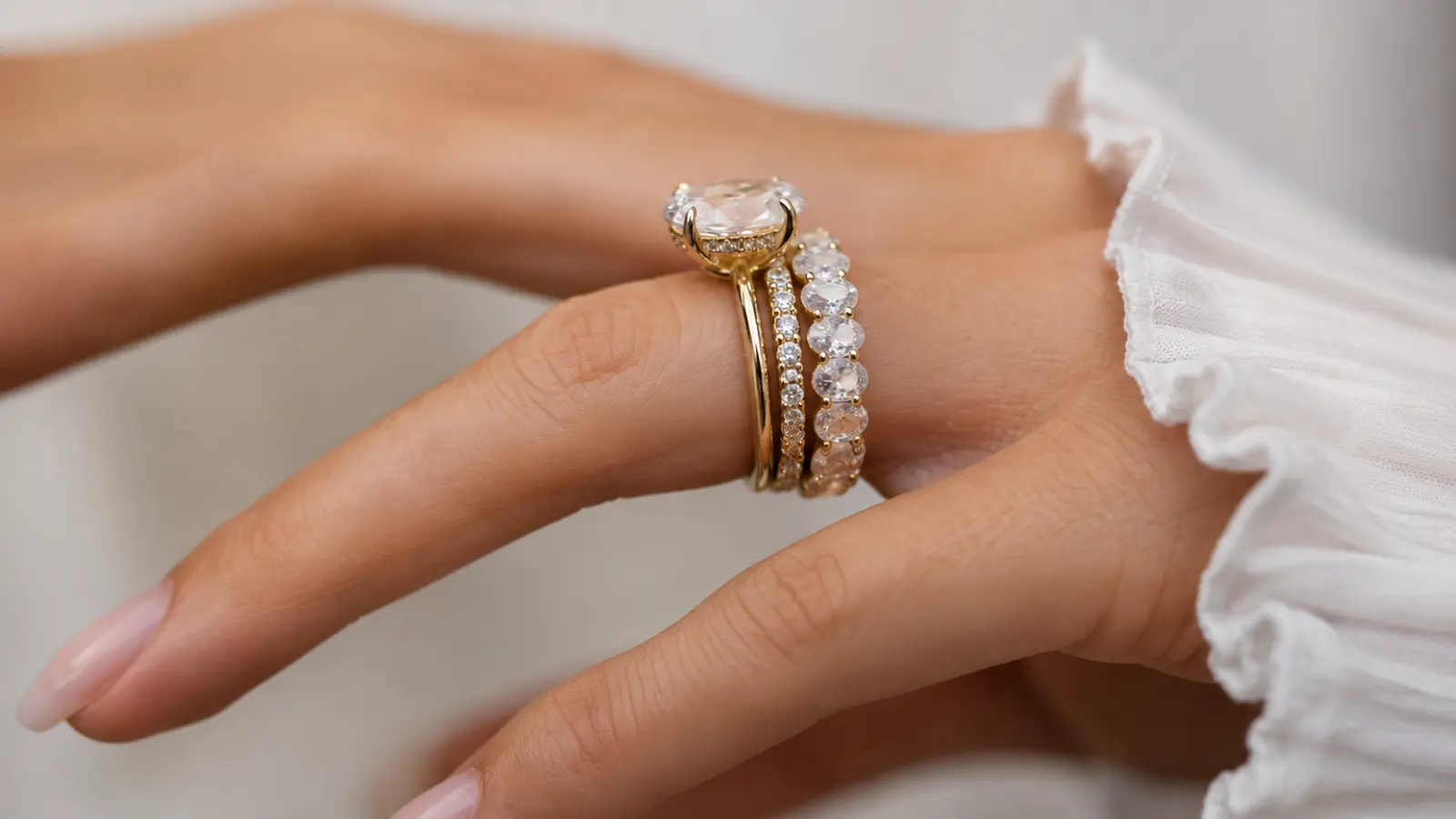
Building a wedding ring stack is a sequential process, not a shopping list. The engagement ring comes first — and in most cases, it already exists before any stacking decisions are made. Every subsequent choice flows from it.
Start with the engagement ring as the anchor
The engagement ring sets the constraints for everything else in the stack. Its metal determines which metals will coordinate without clashing. Its profile — the height of the setting, the width of the shank, the shape of the prongs or bezel — determines what can sit against it cleanly. Its visual weight determines how much the surrounding bands need to carry to create balance.
A delicate solitaire on a thin shank, for example, will be overwhelmed by a wide diamond eternity band placed directly against it. The same solitaire works beautifully beside a 1.5mm plain gold band and a matching thin pavé band on the other side. The engagement ring is not just one element in the stack — it is the starting point from which every other element derives its appropriate size, weight, and distance.
Choose the wedding band to complement, not compete
The wedding band sits in the innermost position of the stack — closest to the hand, placed on the finger first at the ceremony. Two practical considerations matter above most others: how it sits against the engagement ring’s setting, and how comfortable it is to wear day after day.
If the engagement ring has a raised or prominent setting — a high solitaire, a cathedral prong, a halo — a straight-sided wedding band will often leave a visible gap between the two rings where the engagement ring’s profile rises away from the finger. A curved or contoured band, shaped to nestle against the setting, closes that gap. Many engagement rings sold through bridal collections come with a matched wedding band specifically designed to sit flush. Choosing from those paired options, or having a custom band made, produces a cleaner result than choosing a straight band and hoping for the best.
For more on choosing a band that sits well with a specific engagement ring, the guide to how to wear wedding rings covers fit, flush, and stacking order in detail.
Add the anniversary band as the third ring
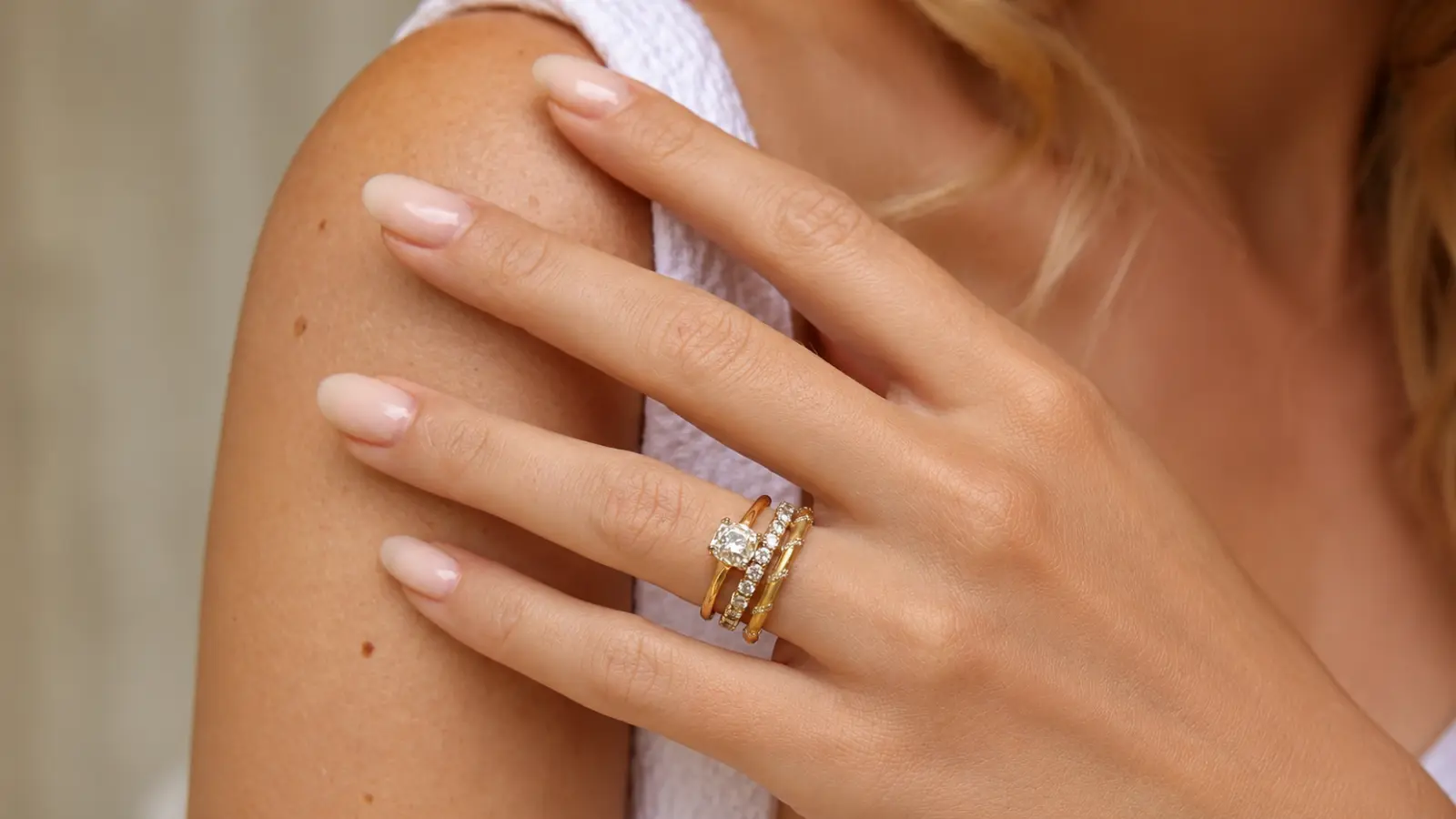
When a third ring enters the stack, it most commonly goes on the outer side of the engagement ring — creating a framing effect, with a band on either side of the center stone. The wedding band stays in the inner position; the engagement ring stays in the center; the anniversary band sits outermost. This is the arrangement most jewelers recommend because it tends to photograph cleanly and distributes visual weight evenly.
An anniversary band can also go on the right hand entirely, particularly if the left-hand stack is already full, or if the anniversary band is substantial enough — a full diamond eternity band, for example — to look better given its own hand rather than compressed into an existing stack. Neither approach is more correct than the other; it depends on how the specific rings look in each configuration.
One placement that rarely works as well as it sounds: adding a third band directly between the engagement ring and the wedding band, in the innermost position. This pushes the engagement ring further up the finger, creates fit issues in most cases, and tends to make the engagement ring look less anchored. The outer side is the more successful placement in nearly every configuration.
Build gradually, not all at once
One thing that distinguishes a stack that looks genuinely personal from one that looks purchased is the sense that it was built over time. A set of three matching bands bought simultaneously and worn together immediately can look cohesive — but it can also look like a costume rather than a story. Many of the most visually interesting wedding stacks are the ones where the rings were acquired at different points in a marriage, and where each ring’s origin is legible to the person wearing it, even if not to anyone else.
This is worth saying because some couples feel subtle pressure to build a complete stack quickly. Most of the elaborate stacks that surface on social media were built over years, not weeks.
Stackable Wedding Bands
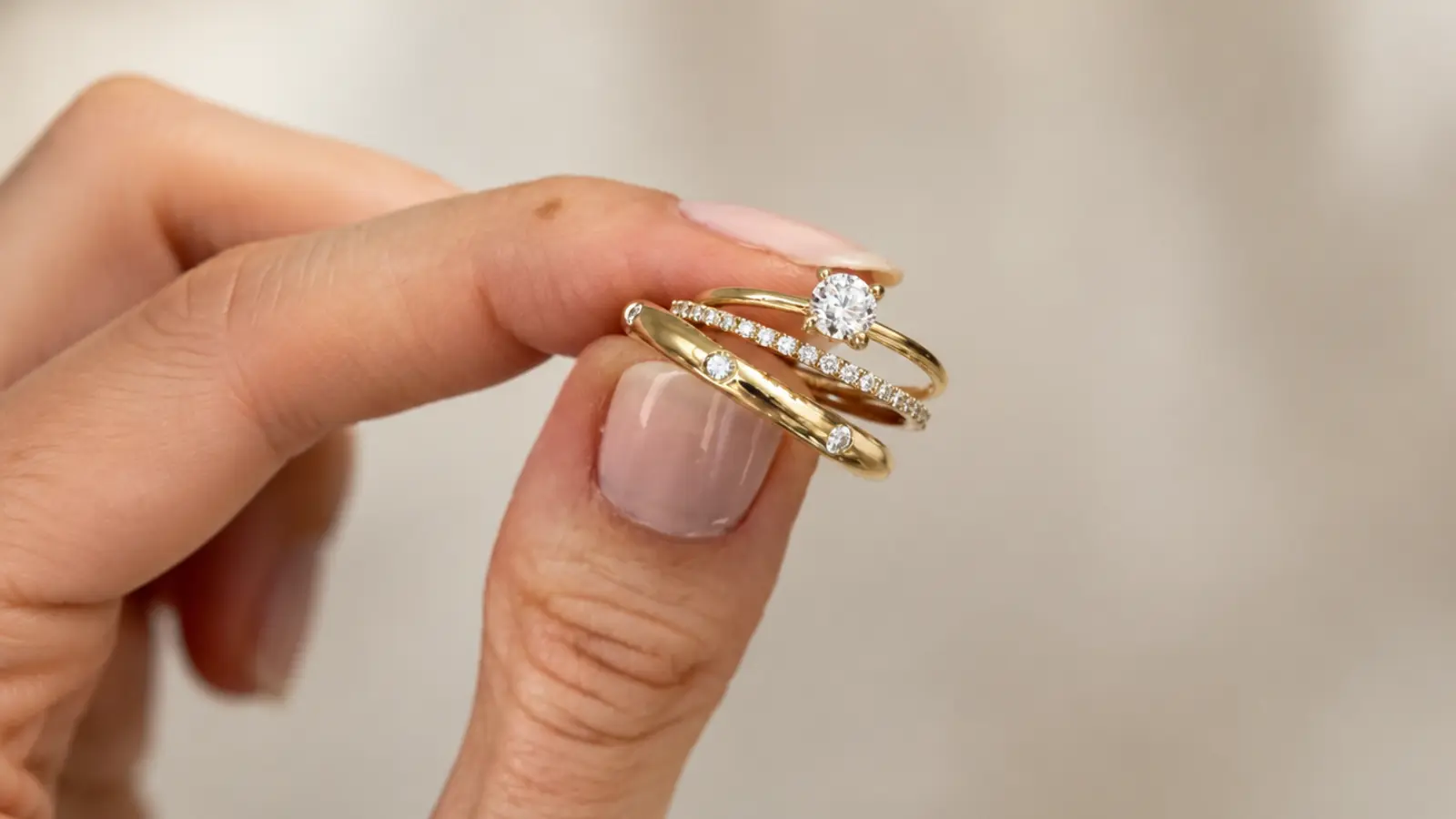
Stackable wedding bands are bands designed specifically for multi-ring wear: thin enough, low-profile enough, and visually restrained enough to sit beside other rings without dominating the finger or creating fit problems. Most fall in the 1.5mm to 2.5mm width range — narrow enough to add layers without creating a wide, rigid mass on the finger, substantial enough to be visible and purposeful as individual rings.
Plain metal bands
A thin plain metal band — a smooth, unadorned circle in yellow gold, white gold, rose gold, or platinum — is the most flexible stackable band available. It can sit against virtually any engagement ring without competing, adds subtle warmth or contrast depending on the metal, and wears comfortably for years without maintenance beyond occasional cleaning. Plain thin bands are also the easiest to add to an existing stack without disrupting what is already working. Their simplicity is not a limitation; it is precisely what makes them useful in a context where everything else is already contributing something.
Thin diamond and pavé bands
Thin pavé bands — a narrow shank set with small diamonds in a continuous or partial line — are among the most popular stackable choices in bridal collections. The diamond coverage adds sparkle and texture without the visual dominance of a full eternity band, and the narrow width keeps them proportionate beside most engagement rings. A thin pavé band beside a plain band beside an engagement ring creates a stack with variation in texture without variation in width, which is a reliable and versatile combination.
For couples interested in adding more diamond coverage to a stack, the guide to diamond wedding bands covers the range of styles from partial coverage to full eternity bands, and the practical considerations around wearing a diamond eternity band every day.
Channel-set and bezel-set bands
Channel-set bands — where small stones sit in a continuous channel of metal, with no exposed prongs — are a practical alternative to pavé for people who find that prong-set rings snag on fabric or catch during daily wear. The enclosed setting protects the stones more effectively and creates a smoother outer surface. Bezel-set bands, where each stone is individually enclosed in a rim of metal, offer similar protection with a slightly more architectural look. Both styles stack cleanly and wear durably, which makes them particularly good for women who are hard on jewelry.
Twisted, textured, and contoured bands
A twisted band — braided metal, a rope-style design, or a hammered finish — adds texture to a stack without adding stones. These tend to work best in a supporting role: one twisted band in a stack of two or three plain or pavé bands gives the stack visual interest without making it chaotic. A stack composed entirely of twisted and textured bands, by contrast, tends to look busy. One textured piece surrounded by quieter ones is the more successful approach.
Contoured or curved bands are shaped specifically to accommodate the profile of a particular engagement ring — cut to follow the curve of the setting so the two rings sit flush with no gap. These excel as wedding bands and are less useful as standalone stackable additions, since their silhouette is designed to be seen in context. If the wedding band is already contoured, adding a straight-sided band on the outer side of the engagement ring tends to work well — the contoured band handles the fit challenge on the inner side, and a straight band on the outer side is not subject to the same gap issue.
Mixing Metals in a Ring Stack
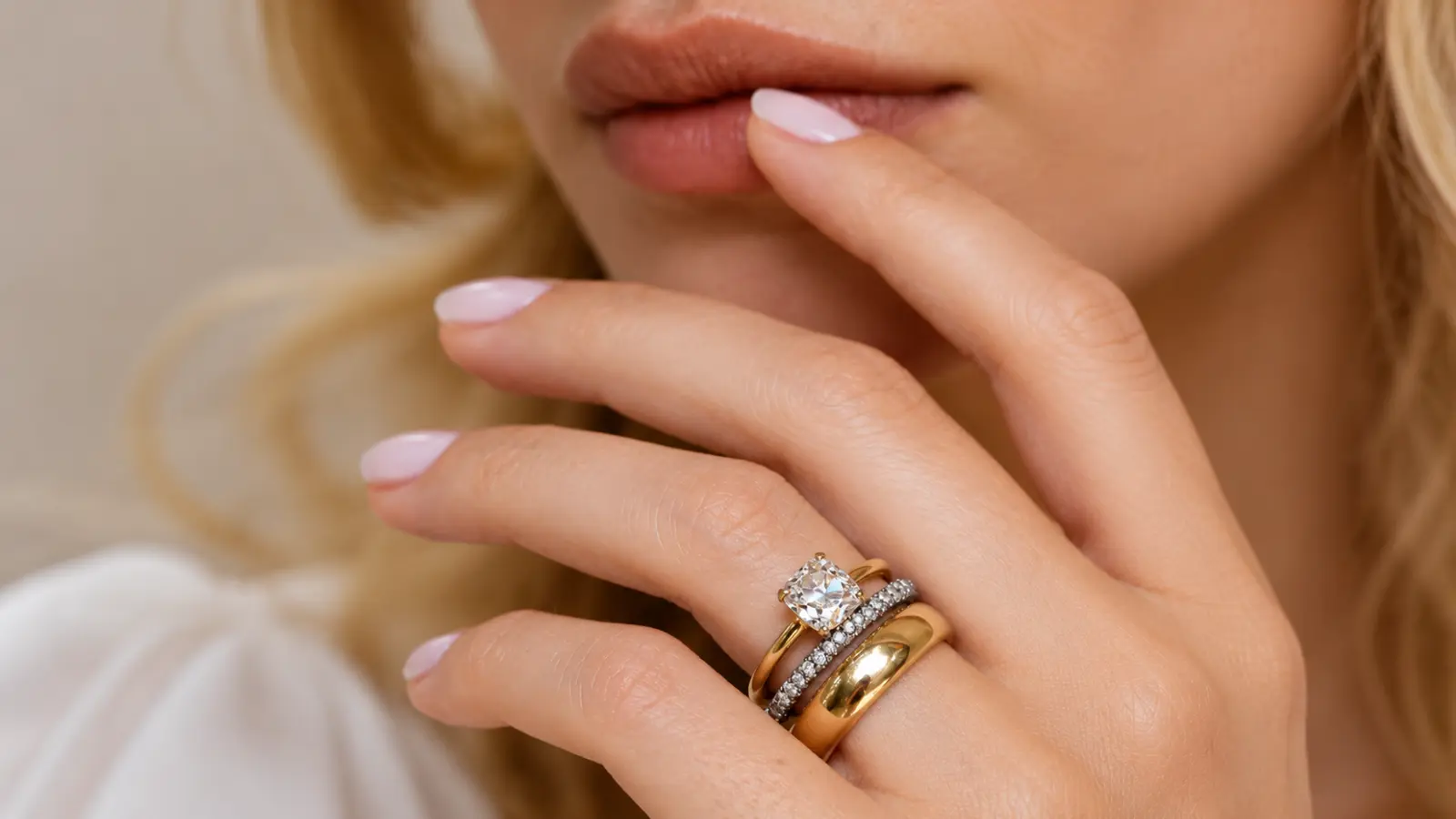
Mixed-metal stacks — combining yellow gold, white gold, rose gold, and platinum in the same collection of rings — are widely worn and more accepted now than at any previous point in mainstream bridal jewelry. The general principle is that the metals in a stack should feel like a choice, not a consequence of assembling rings without thinking about how they relate to each other. That distinction is visible in the final result.
Two metals: the most manageable combination
A stack that combines two metals — yellow gold bands alongside a white gold or platinum engagement ring, for example, or rose gold accents alongside a yellow gold base — tends to read as intentional and cohesive. The two metals create contrast that looks deliberate, and as long as at least one of them appears more than once in the stack, the eye reads the combination as a system rather than a mismatch.
The most common two-metal combination in contemporary stacks is yellow gold with platinum or white gold. Yellow gold brings warmth and a historically rich visual quality; platinum or white gold provides a clean, modern counterpoint. This combination works at virtually any ratio and photographs well in most lighting conditions — which is one reason it has become something of a default for mixed-metal stacks.
Rose gold in a stack
Rose gold has a distinct warmth that is different from yellow gold — more pink, more contemporary in feel — and it can be combined with either yellow gold or white metals in a stack. Rose gold beside white gold or platinum creates a soft, romantic contrast. Rose gold beside yellow gold can work too, though the two warm tones tend to blend together more than they contrast in person, particularly under warm indoor light. If the goal is a visually distinct combination, pairing rose gold with a white or silver-toned metal is typically the more successful approach.
When three metals becomes one too many
Three different metals in a single stack — yellow gold, rose gold, and platinum, for example — is possible but requires careful management. At that point, the stack needs a clear visual anchor: one metal that appears more than once, one that appears as an accent, and one used sparingly. Without that structure, three metals can start to look assembled from separate collections rather than considered as a group. Trying the specific rings together before committing is especially important at this level of complexity.
A practical note on wear
Different metals wear at different rates. When a softer metal — yellow gold or rose gold — is in continuous contact with a harder one — platinum, for example — the softer metal wears more quickly at the contact point. Over years, this can produce micro-scratching where the rings touch. It is a minor concern rather than a disqualifying one; most people with mixed-metal stacks address it through routine jeweler check-ups every two to three years, with a professional polish at each visit to keep both rings in good condition.
How Many Rings Is Too Many?
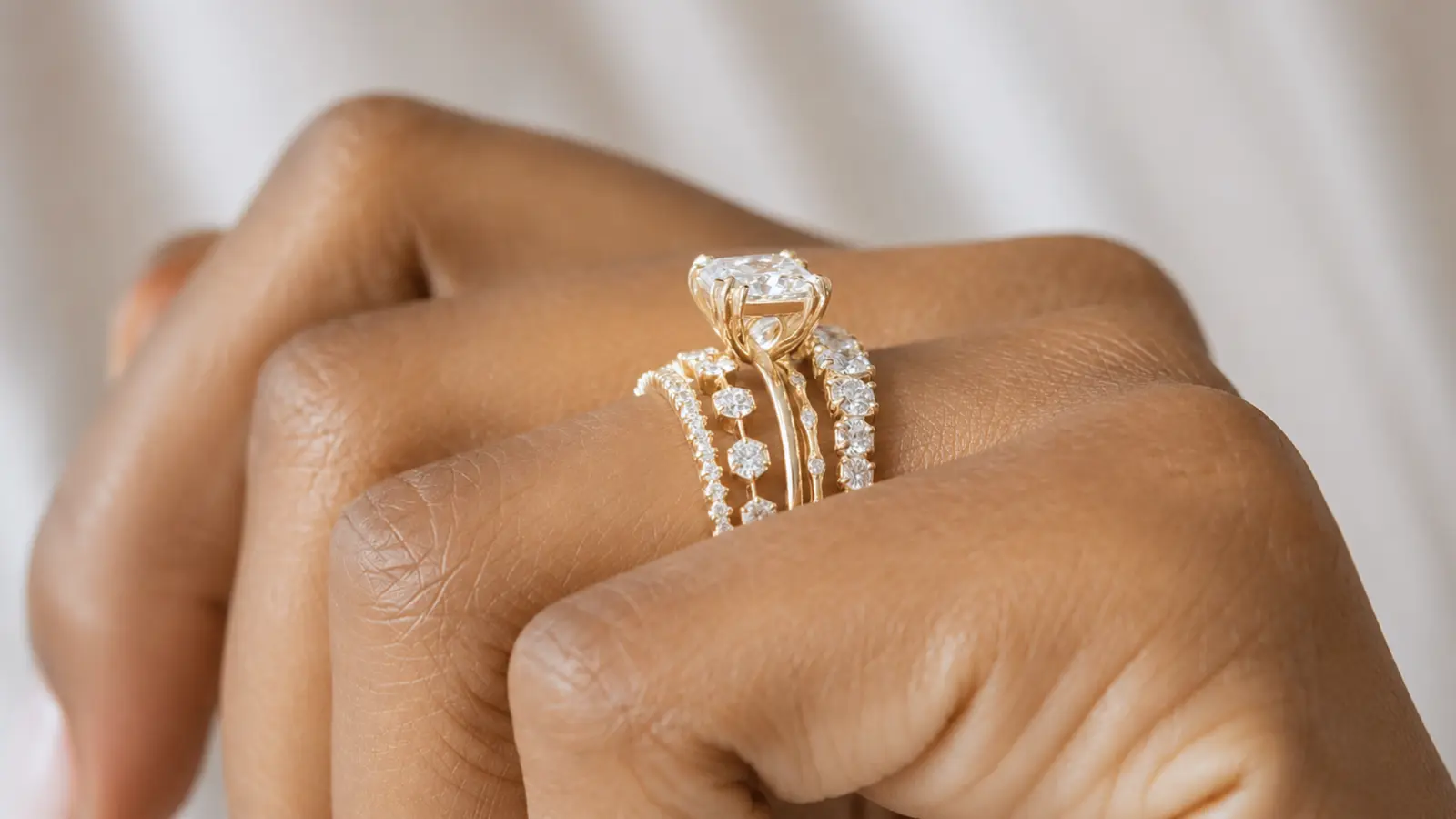
Two rings is a stack. Three rings, chosen with care, tends to work beautifully. Four rings is where most fingers reach a natural limit — visually, physically, and photographically. Five or more is possible, but it requires very deliberate curation, and the result almost always reads better in a flat lay photograph than on an actual hand going through a normal day.
The practical consideration: rings that look proportionate individually can create a rigid, uncomfortable mass when worn together. A stack of four rings may cover the entire section of the finger between the knuckle and the hand, which limits natural movement and creates pressure during everyday activities. People with very slender fingers often feel this limit at three rings rather than four. The only reliable way to know where your own limit falls is to try the specific rings together on your actual finger — not on a display stand.
The visual question to ask yourself
Beyond comfort, there is a visual question worth asking: does the stack look like a collection, or does it look like a statement? Both can be intentional. A bold, maximalist stack with four or five rings is a legitimate aesthetic choice — but it needs to be made as a choice, not arrived at by default through gradual accumulation without periodically stepping back to look at the whole.
The test most experienced jewelry stylists suggest: look at the full stack and identify the strongest ring. If that ring is still visible as the focal point, the stack is probably balanced. If every ring is competing for the same visual attention, the stack is likely one ring too many. Removing the weakest piece and seeing whether the stack improves is often the most useful thing a person can do.
Rings on other fingers
One option that many people overlook when the ring finger reaches its limit: moving additional rings to other fingers. A thin band on the middle finger, a slim ring on the pinky, or a statement ring on the index finger extends the layered look without compressing everything onto a single overloaded digit. This keeps the ring finger stack legible and balanced while still allowing a jewelry-forward look overall — and it opens up a lot of options for rings that are interesting on their own but do not belong in the main stack.
Wedding Ring Stack Mistakes to Avoid
Most ring stack mistakes are not irreversible — bands can be removed, sold, or repurposed. But a few are costly enough, or subtle enough, to be worth understanding before the fact rather than after. Here are the ones that come up most consistently.
Buying bands without trying them against the engagement ring
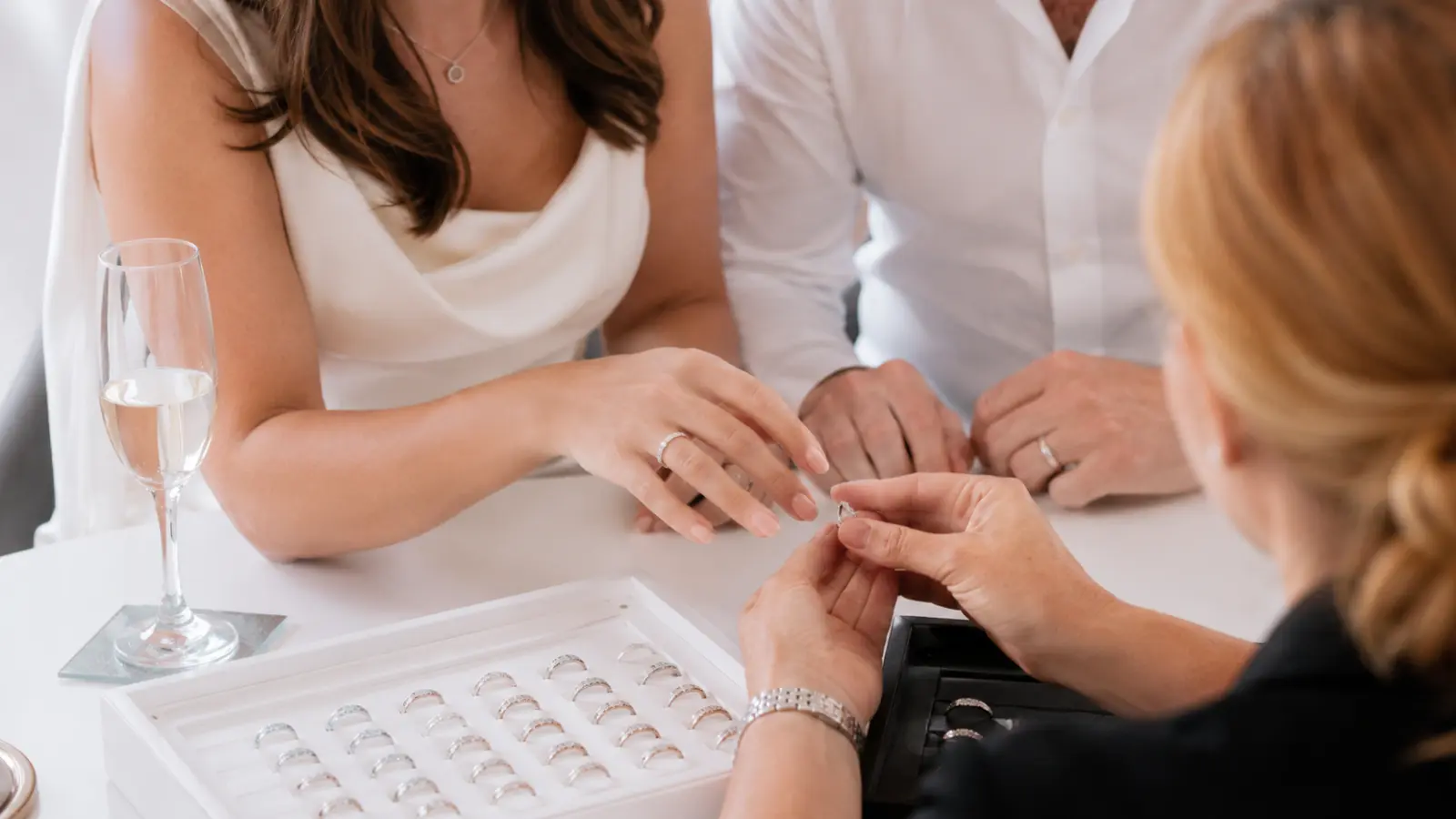
This is the most common and most fixable mistake. A band that looks right on a website or in a display case can look entirely different against a specific engagement ring — too wide, too narrow, the wrong proportion, or simply leaving a visible gap because of the engagement ring’s setting height. Bringing the engagement ring to the appointment when choosing stacking bands is the single most useful thing a person can do. Any reputable bridal jeweler will encourage this, and most will have try-on samples in the relevant widths.
Mixing too many design elements at once
Width variation, metal variation, stone variation, texture variation — each of these can add interest to a stack. All of them at once produce noise. A stack that works well tends to vary in one or two dimensions while staying consistent in others. Wide bands, narrow bands, twisted bands, pavé bands, and plain bands, all in different metals, all on the same finger, rarely look like a curated collection. More often, they look like the person was not sure what they wanted and tried everything simultaneously.
Choosing style over daily wearability
A stack that photographs beautifully but is genuinely uncomfortable to wear every day is not a successful stack — it is a stack that lives on Instagram and stays in a drawer the rest of the time. High-set prongs catch on fabric. Very wide stacks restrict movement. Sharp-edged bands press uncomfortably against adjacent fingers. These are real problems that do not appear in photographs and do not reveal themselves until the rings are worn through a full day of actual life. Try the stack for at least a few hours before committing to it as a permanent arrangement.
Adding a third ring that overwhelms the engagement ring
The engagement ring is almost always the most significant piece in a wedding ring stack — symbolically, visually, and in terms of investment. A wide diamond eternity band placed directly beside a delicate solitaire, for example, draws the eye away from the solitaire rather than directing attention toward it. The bands surrounding the engagement ring should support it, not rival it. If a potential addition makes the engagement ring look smaller or less important, that is a clear signal the proportions are off.
Soldering a stack too early
Soldering — permanently joining the rings so they move as one piece — is a practical solution for stacks that shift during wear. But soldering too early, before the stack is truly final, creates complications when a ring needs to be added or removed later. It also eliminates the possibility of wearing the rings independently, which some people find they want on certain occasions. Most jewelers recommend waiting at least a year before soldering, to allow the stack to settle into something stable before making it permanent. The guide to how to wear wedding rings covers the soldering decision in detail.
Ignoring scale relative to hand size
Ring scale matters more in a stack than it does with a single ring. A stack of five narrow bands on a small hand can look proportionate and elegant; the same five bands on a wider finger may look underwhelming. A bold, wide-banded stack that works on longer fingers can look overwhelming on a shorter ring section. This is another reason why trying the actual rings on the actual hand — not evaluating them from images alone — is worth the inconvenience of an in-person appointment.
Find Your Ring Size Before You Order
Not sure which size to order? Use our free ring size calculator to measure an existing ring, enter a known measurement, or measure your finger at home.
Wedding Ring Stack Inspiration
Stackable wedding rings can create a personal combination of styles, metals, and meaningful details collected over time. Explore our inspiration board for classic wedding ring stacks, diamond bands, mixed metals, anniversary rings, and beautiful ways to wear your engagement ring and wedding bands together.
Creating a Wedding Ring Stack That Tells Your Story
A wedding ring stack is not only about wearing more rings together. The most meaningful stacks are built with intention — combining pieces that fit your style, your everyday life, and the moments you choose to remember along the way.
Whether your stack includes only an engagement ring and wedding band or grows over time with anniversary bands and personal details, the best combination is one that feels balanced, comfortable, and connected to the story behind each ring.
Frequently asked questions (FAQ)
What are stackable wedding rings?
Stackable wedding rings are rings designed to be worn together on the same finger, creating a layered look. Most wedding stacks start with an engagement ring and wedding band, then may include anniversary bands, diamond bands, or meaningful rings added over time. The goal is to create a combination that feels balanced, comfortable, and personal.
How do you stack wedding rings correctly?
Start with the main rings you already wear, usually the wedding band and engagement ring. Traditionally, the wedding band is placed closest to the hand, followed by the engagement ring. Additional bands, such as anniversary rings, are usually added around them to create balance. However, the best arrangement depends on comfort and how the rings fit together.
What order do you wear a wedding ring stack?
The traditional order is wedding band first, engagement ring second, and anniversary band or additional stacking rings on the outside. This places the wedding ring closest to the hand while allowing extra bands to frame the engagement ring. Some people change the order based on style, symmetry, or comfort.
How many rings should be in a wedding stack?
Most wedding ring stacks include two or three rings. Two rings — an engagement ring and wedding band — create the classic bridal stack. Three rings add more dimension with an anniversary band or additional meaningful ring. Larger stacks can work, but they require more attention to proportion, comfort, and balance.
What are the best wedding bands for stacking?
The best bands for stacking are usually thin, comfortable designs that sit well next to other rings. Popular options include plain metal bands, thin diamond bands, pavé bands, eternity bands, and curved bands designed to fit around an engagement ring.
Can you mix metals in a wedding ring stack?
Yes. Mixing metals like yellow gold, white gold, rose gold, and platinum can create a beautiful wedding ring stack. The key is making the combination look intentional by repeating colors, balancing proportions, and choosing rings that share some common design elements.