A wedding band for oval engagement ring should complement the elongated shape of the center stone while balancing fit, proportion, and everyday comfort. Because oval diamonds and gemstones extend differently than round stones, the right band depends on the engagement ring’s setting height, shank width, and overall design.
Choosing the right wedding band is not only about finding a beautiful match. A straight band, curved band, pavé design, or stackable combination can completely change how an oval engagement ring looks on the hand, especially when considering gaps, halos, and the visual length of the stone.
This guide explains how to choose a wedding band for an oval engagement ring, including straight vs. curved bands, pavé options, ideal widths, oval ring stacks, hidden halo considerations, common fit problems, and how this pairing fits within different wedding rings and wedding bands.
Best Wedding Bands for Oval Engagement Rings
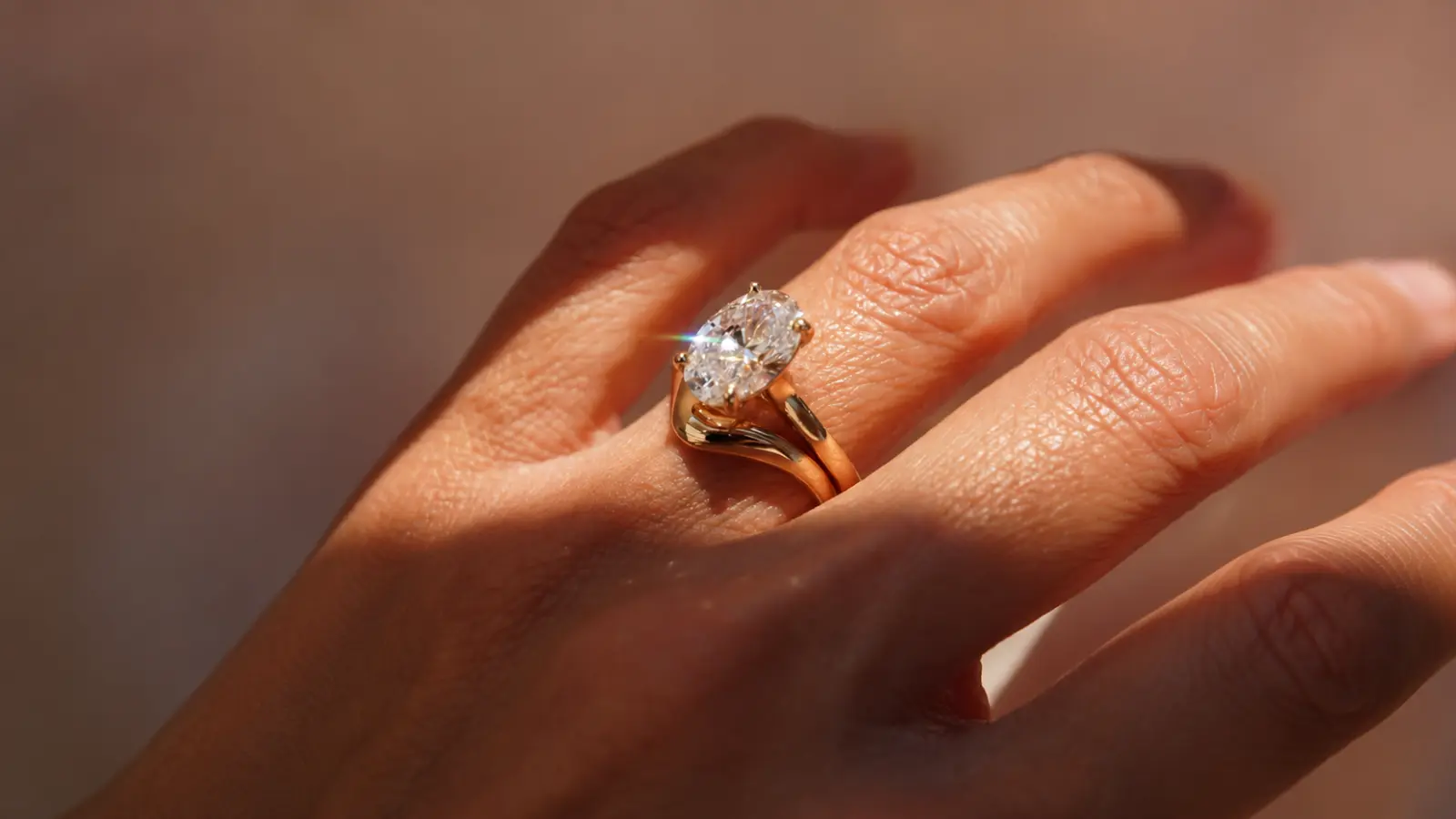
There is no single universally correct wedding band for an oval engagement ring, the right choice depends on the specific ring’s profile, the wearer’s aesthetic, and how the combination will be worn day to day. What there is: a clear set of band types that consistently work well with oval rings, and a clear set of reasons why each one does what it does.
Gently curved or contoured bands
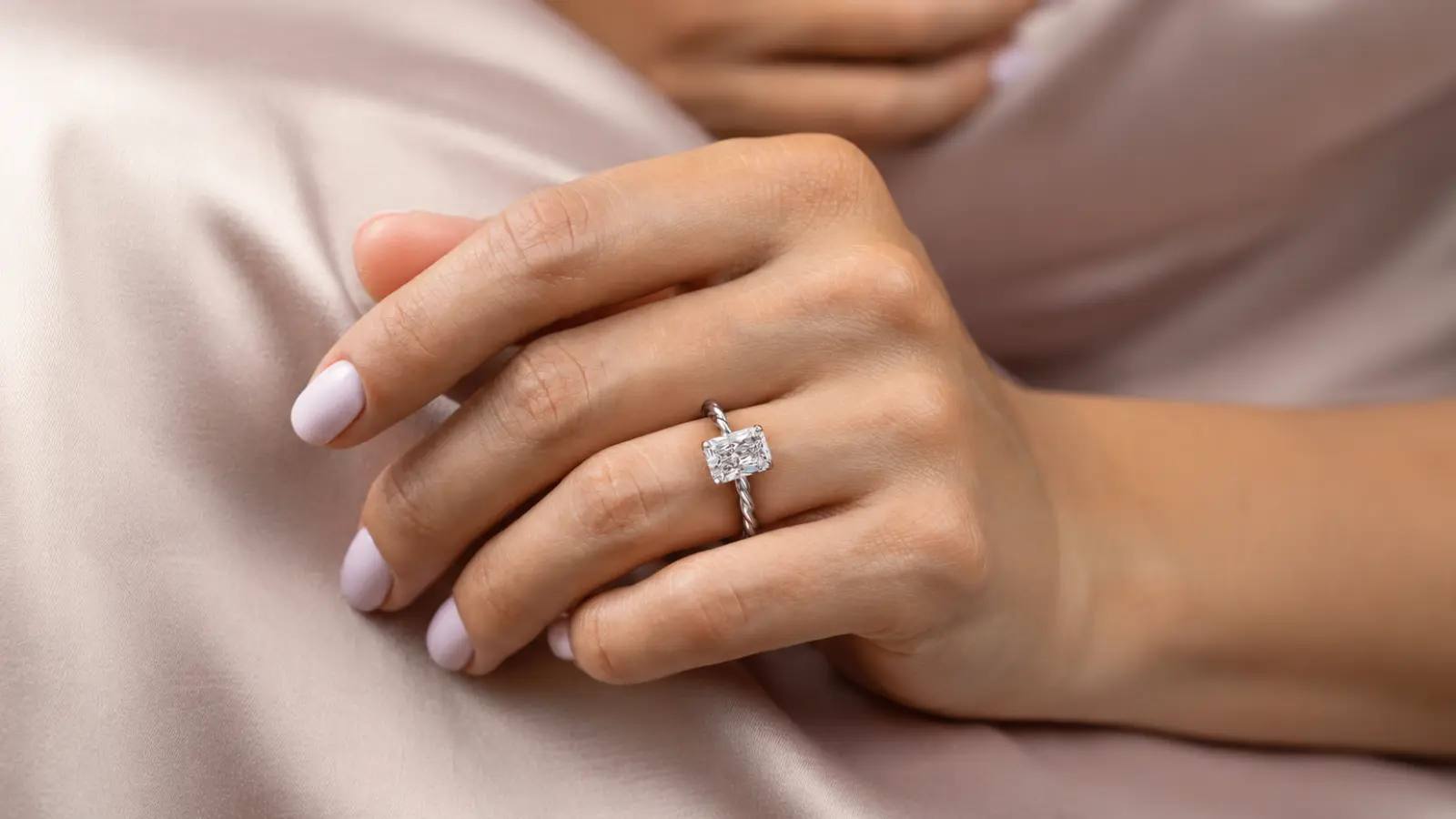
A gently curved band, one with a smooth inward arc on the side that faces the engagement ring, is the most consistently recommended choice for oval engagement rings, and the reason is geometric. An oval stone’s longest dimension runs parallel to the finger, but the stone’s outline curves outward from the shank at its widest midpoint. A straight band pressed against that curve creates a visible gap exactly where the oval stone extends furthest from the shank. A curved band whose arc depth matches that curve eliminates the gap, creating a flush combination that reads as a unified set.
The key word in that recommendation is gently. The curve needed for most oval rings is not severe: a soft inward arc, not a deep V-notch suited to a marquise or pear. An over-curved band beside an oval ring will sit with its own gap, this time on the far edge of the curve where the band and the ring diverge again. Matching the arc depth to the specific oval ring’s actual profile is what produces a flush fit; approximating it from a photograph produces varying results. The curved wedding bands covers arc depths, fitting considerations, and when custom versus ready-made makes sense.
Thin plain metal bands
A thin plain band, 1.5mm to 2mm wide, in the same metal as the engagement ring’s shank, is the simplest and most versatile wedding band option for an oval ring. Its narrow width minimizes the gap issue that wider straight bands create: a 1.5mm band’s thin edge presses against the oval ring’s shank with a gap so small that it is rarely perceptible in daily wear or photography. It adds the symbolism and presence of a wedding band without introducing any visual competition with the oval stone. And it wears comfortably alongside virtually any oval setting profile, from the lowest bezel to the most elevated cathedral, without requiring the curve to be precisely matched.
Thin plain bands are also the most stackable foundation for an oval ring combination. Because they are proportionally restrained, they leave visual room for a second band to be added on the other side of the engagement ring later, an anniversary band, a thin pavé band, without the combination becoming crowded. For wearers who know they want a growing stack, starting with one thin plain band and building from there is the most flexible approach.
Thin pavé bands
A thin pavé band, small diamonds set continuously along a narrow shank, typically 1.5mm to 2.5mm wide, adds sparkle alongside the oval stone without competing with it. The proportional narrowness is what makes this work: a thin pavé band catches and returns light beside the oval, reinforcing the stone’s brilliance rather than dividing the eye’s attention. A wider pavé band, or a band with larger stones set more prominently, begins to compete with the oval stone visually, creating a combination where neither the stone nor the band clearly dominates, which tends to look busy rather than intentional.
Shadow bands
A shadow band, a very narrow curved or plain band that traces the engagement ring’s silhouette closely, is the minimal-presence option for wearers who want a distinct wedding band without anything that visually affects the oval ring’s appearance. Shadow bands at 1mm to 1.5mm wide are nearly invisible from a normal viewing distance, adding the substance of a wedding band without drawing any attention to themselves. They are the right choice for wearers who love the oval ring exactly as it is and do not want the wedding band to change anything about how it reads.
Straight vs. Curved Bands
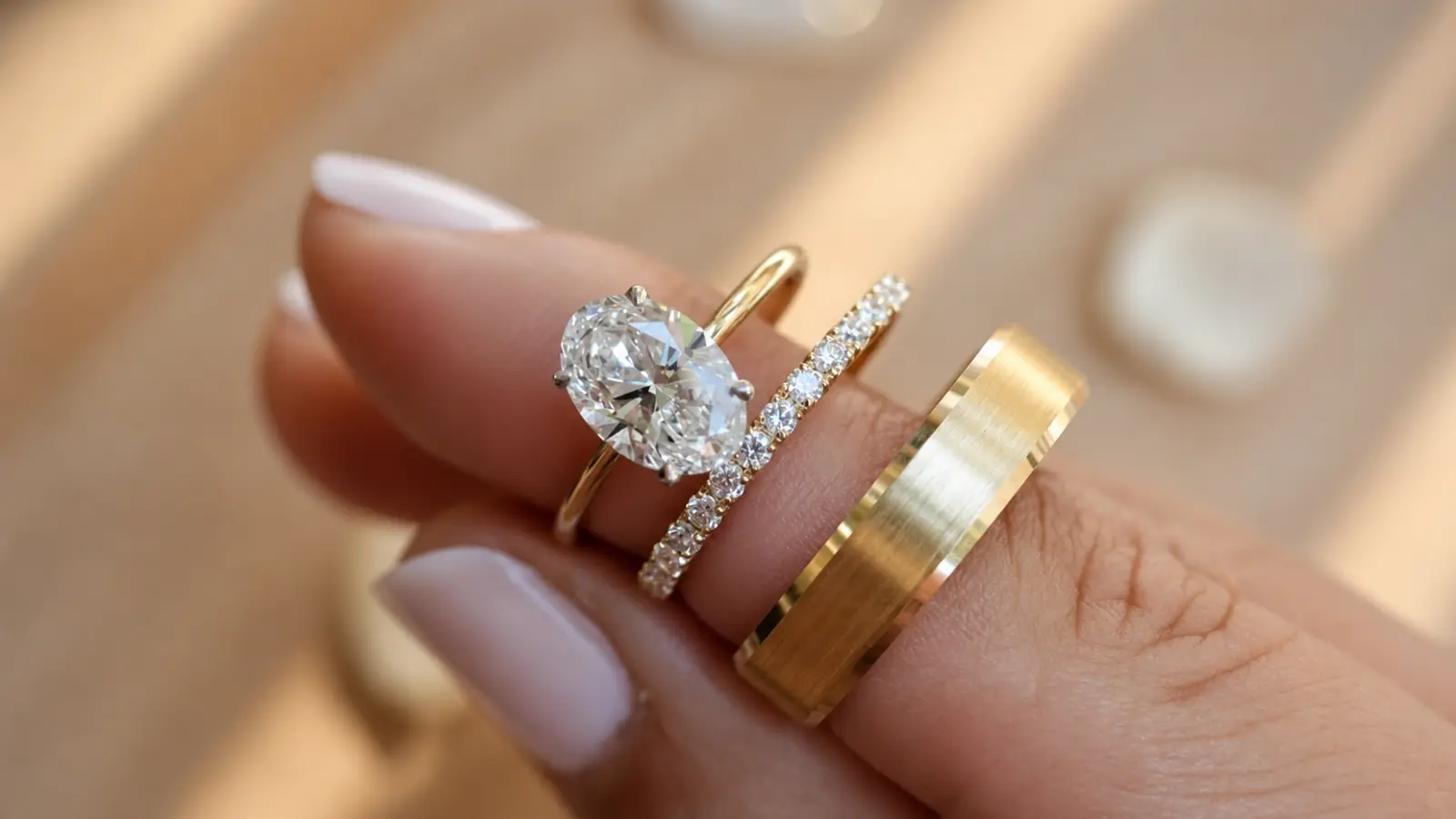
The straight-versus-curved question matters more with oval engagement rings than with most other stone shapes, for a reason that is worth understanding before making the decision either way.
Why oval rings create more gap than round rings
A round brilliant engagement ring has a circular outline, it extends the same distance from the shank at every point around its circumference. When a straight band is placed beside a round ring, the gap between the two rings is consistent and relatively small if the setting is low, or visible and consistent if the setting is high. The gap is shaped by the setting height, not by the stone’s outline.
An oval ring behaves differently. The oval stone extends further from the shank at its widest midpoint than it does at its narrower ends. This means that even a relatively low-set oval creates a small peak at the stone’s equator, a point where the outline pushes outward toward the band, that a straight band cannot follow without leaving a gap. The gap is usually small for low-set ovals and progressively larger for higher settings. It is also almost always most visible from directly above, which is exactly the angle that appears in photographs. This is why oval ring wearers frequently notice the gap after seeing photos of their rings and wonder if something is wrong. Nothing is wrong: the geometry is just doing what oval geometry does.
When a straight band works
A straight band works cleanly beside oval rings in two situations. The first is a very low-set oval, a bezel-set oval, a low tension setting, or an oval stone set close enough to the shank that the stone’s outline barely rises above the band contact point. In these cases, the gap created by a straight band is small enough that most wearers accept it without noticing it. The second situation is a deliberate aesthetic choice: the wearer prefers the visual separation between two distinct rings and finds the flush, unified look of a curved band less appealing. Both reasons are valid. The distinction is whether the wearer is accepting a gap they wish was not there, or actively choosing a look that includes the separation.
When a curved band is clearly better
A curved band is clearly the better choice for high-set oval solitaires, oval rings with standard halos, and any oval setting where the stone’s outline is prominently above the shank. In these cases, the gap against a straight band is large enough to be consistently distracting, visible in every photograph, noticeable during daily wear, and the kind of thing that occupies mental real estate for the wearer in a way that a clean, flush combination does not. The small additional cost of a curved band over a straight band in most bridal collections is a minor consideration relative to decades of looking at the combination on the hand.
The most practical advice: before deciding between straight and curved, place the straight band alongside the actual oval engagement ring and look at the combination from directly above. If the gap does not bother you in that moment, a straight band is a viable choice. If the gap is the first thing you see, it will be the first thing you see in every photograph for the rest of the marriage. A curved band solves that problem definitively.
Pavé Bands With Oval Rings
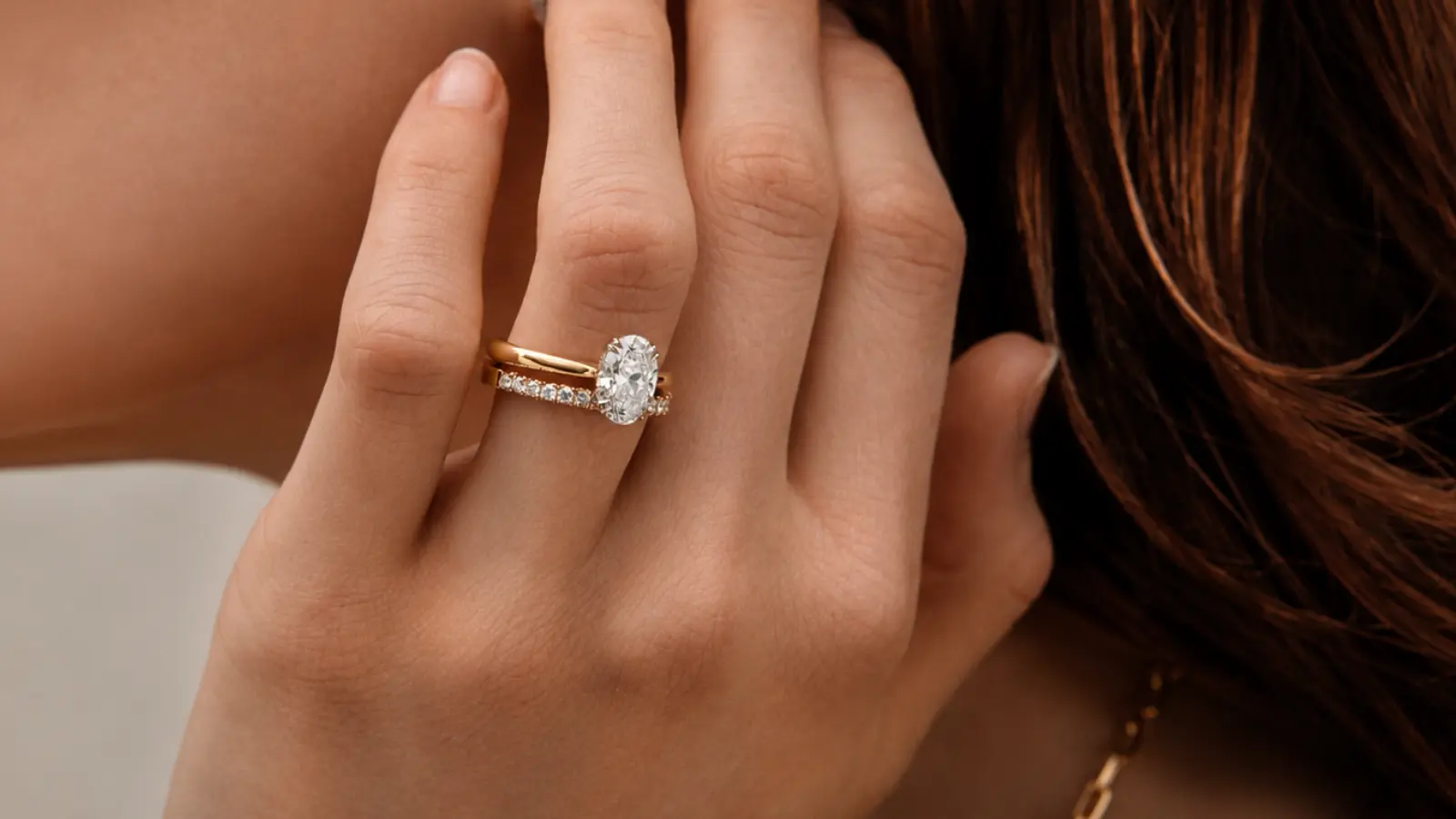
Pavé bands and oval engagement rings are a natural pairing, the oval’s brilliant faceting and the continuous sparkle of a pavé band reinforce each other visually, creating a combination with significantly more light return than either piece alone. The challenge is proportion: a pavé band that is too wide or too heavily set competes with the oval stone rather than complementing it, and the combination looks cluttered rather than brilliant.
Width is the primary variable
The guideline that works across the widest range of oval rings: the pavé band should be narrower than the oval stone is wide at its widest point. This sounds obvious but requires attention in practice. A 1-carat oval stone might be 7mm wide; a 2-carat oval might be 9mm or wider. A 3mm pavé band beside a 7mm oval reads as a proportional accent. The same 3mm band beside a smaller oval can read as nearly as wide as the stone, drawing the eye away from the center stone toward the band. Scaling down, sometimes to a 1.5mm or 2mm pavé band, is often necessary for smaller or more modestly sized oval stones.
Stone size in the pavé band matters
Beyond the band’s width, the individual stone size within the pavé setting affects how prominently the band reads relative to the oval center stone. Bands with very small pavé diamonds create the refined sparkle often seen in diamond wedding rings, without competing with the oval center stone. Bands with larger individual stones (0.02 carats or more) read as individual diamonds even in continuous setting, which gives the band a more prominent visual identity. For oval rings whose center stone is not large, a finer pavé setting is generally more successful than a coarser one.
Curved pavé bands
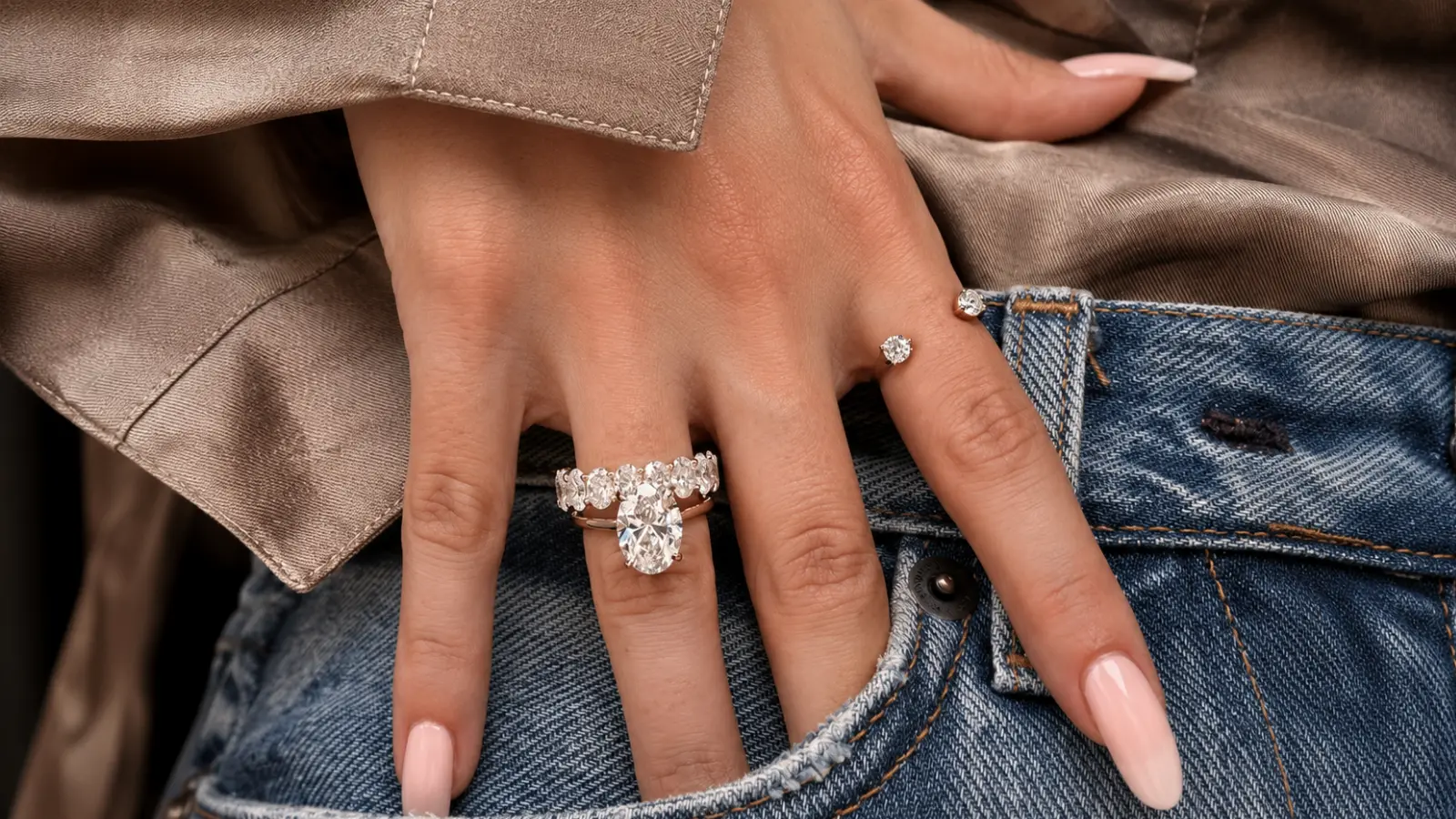
A pavé band can be curved or straight. A curved pavé band offers the fit advantage of a contoured band with the sparkle of a diamond setting, and for oval rings, particularly those with moderate to high settings, a curved pavé band is often the single most effective wedding band choice available. It sits flush, adds diamonds, and does not compete with the center stone if properly proportioned. The proportional rules are the same as for plain curved bands: the arc must match the oval ring’s actual profile, which requires fitting in person rather than ordering by size alone.
The hidden halo consideration
A hidden halo, small diamonds set beneath the oval center stone, visible from the side rather than from above, does not change the outer profile of the ring in a way that significantly affects how a band fits. A straight or curved band placed beside a hidden halo oval ring encounters the shank in approximately the same position as it would on a ring without the hidden halo. What the hidden halo does affect is the visual context: the side diamonds of the hidden halo are visible at the contact point between the ring and the band, and a band that sits very tightly against the setting may partially cover them. A band with a small amount of clearance, which a gently curved band naturally provides, tends to display the hidden halo diamonds more fully.
The standard halo, which extends outward around the stone’s perimeter, is a different matter entirely. A standard halo on an oval ring creates the same gap challenge as a halo on any other center stone shape, the halo frame extends toward the wedding band and creates a gap equal to the frame’s depth against any straight band. A curved band is strongly recommended for oval rings with standard halos.
Oval Ring Stack Ideas
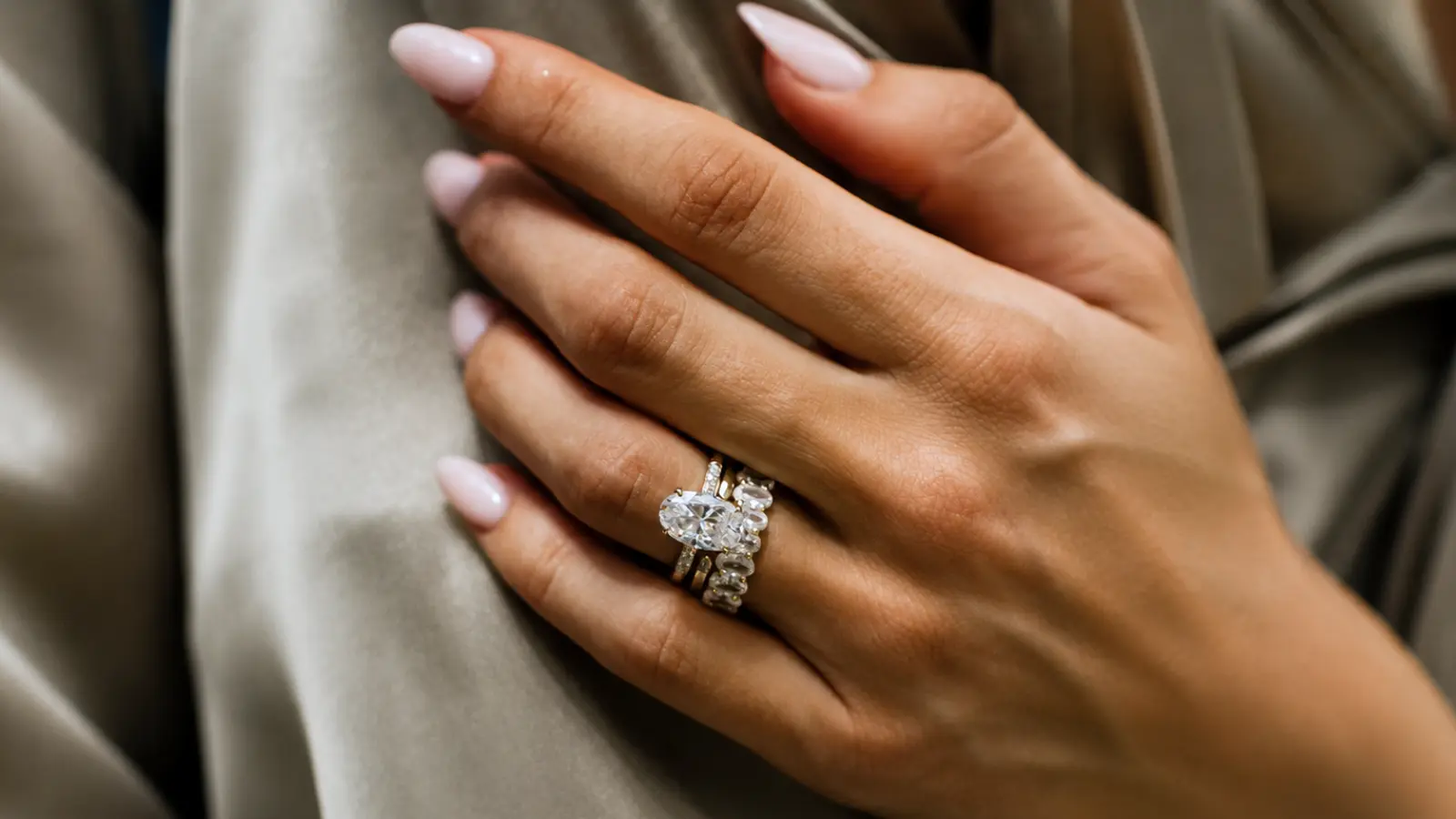
Oval engagement rings stack beautifully, the stone’s elongated shape and prominent silhouette creates a natural focal point that additional bands can frame without competing, as long as the bands are kept proportionally restrained. The most successful oval ring stacks follow a consistent principle: thin bands on either side of the engagement ring, creating a symmetrical frame that draws the eye toward the stone rather than away from it.
The classic two-band frame
One band on each side of the oval engagement ring, the wedding band on the inner side and an anniversary or second band on the outer side, is the arrangement that works most consistently with oval rings. When both bands are thin (1.5mm to 2.5mm) and similar in width, the combination creates a symmetrical frame around the oval stone that reinforces its presence. When the two bands are significantly different in width, the asymmetry can read as unintentional rather than considered.
In terms of style, the most frequently photographed oval stacks pair one plain metal band with one thin pavé band, one on each side of the engagement ring. The plain band provides a quiet counterpoint that lets the oval stone and the pavé band each carry their own visual contribution without the entire combination competing for attention everywhere at once.
Mixing metals with an oval ring
Oval engagement rings, particularly those in rose gold or yellow gold, stack well with mixed metal bands. A yellow gold oval ring beside a thin white gold or platinum pavé band creates a contrast that reads as intentional, warm center, cool accent, and one that many wearers find more interesting than a fully matched metal combination. Mixed metal stacking with oval rings follows the same rules as mixed metal stacking generally: two metals read as a choice, three metals require more careful management. The guide to stackable wedding rings covers mixed metal stacking logic in full.
How many bands work with an oval ring
Oval engagement rings typically max out at two additional bands, one on each side, before the stack starts to crowd the stone’s silhouette. The oval’s elongated outline already occupies significant visual real estate on the finger; adding three or more bands around it begins to make the combination feel congested rather than curated. Three-band stacks with oval rings (wedding band, engagement ring, anniversary band) work well when all three bands are thin. Four or more bands beside an oval ring is possible but requires exceptional proportional restraint to avoid making the stone look visually compressed.
The asymmetric stack
An asymmetric stack, one slightly more prominent band on one side of the oval ring, a thinner or simpler band on the other, is a less conventional but workable approach for wearers who find perfectly symmetrical stacks too predictable. A curved pavé band on the inner side and a very thin plain band on the outer side, for example, places more visual weight on one side of the oval without overwhelming the stone. The asymmetry works best when it is clearly intentional, a significant width or detail difference between the two bands, rather than the result of not quite matching what was already there.
Common Fit Issues
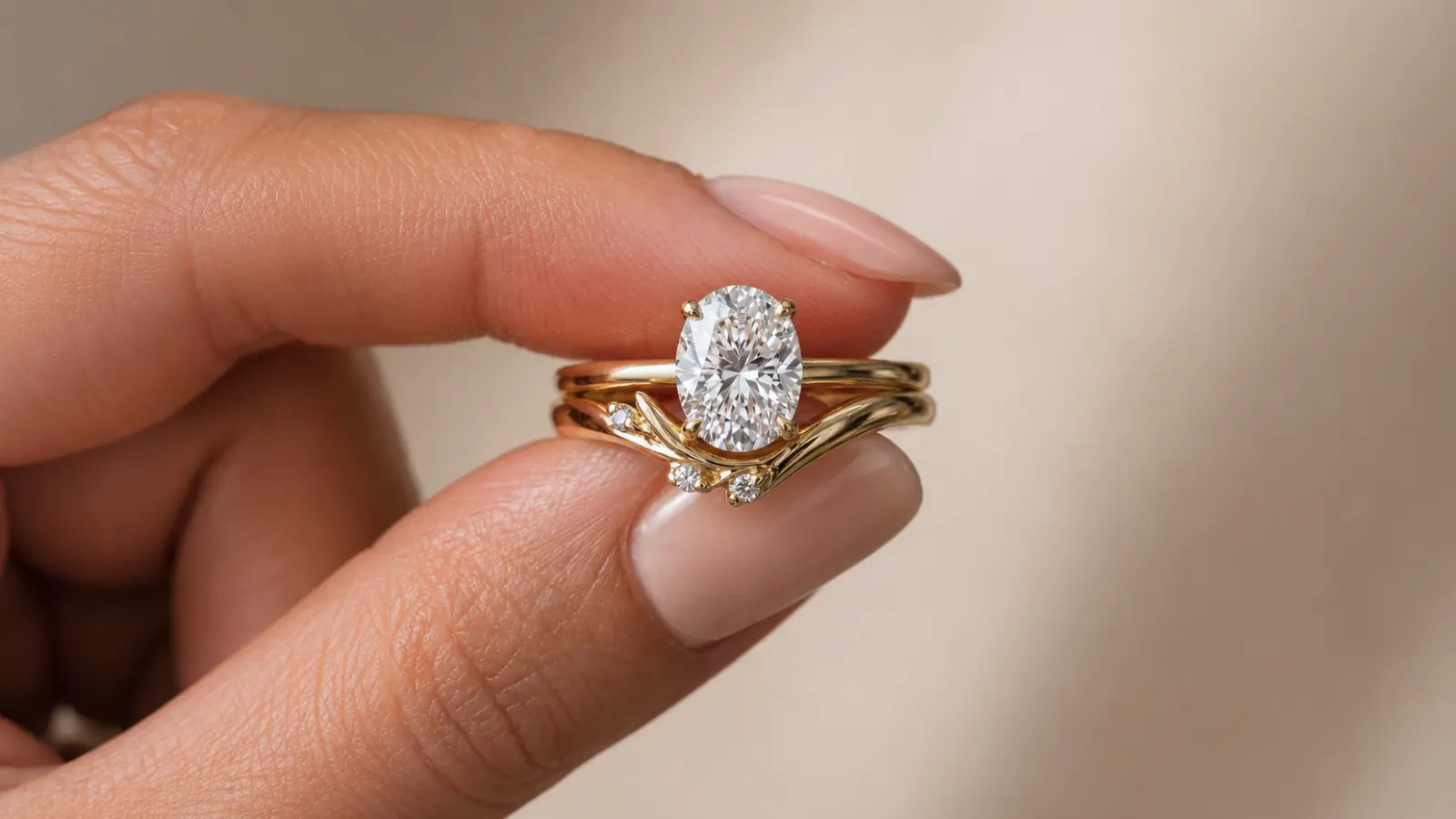
Oval engagement rings have more variation in their setting profiles than many other popular stone shapes. A 1-carat oval set in a low bezel and a 1-carat oval set in a high prong cathedral are dramatically different rings in terms of their height, their gap behavior with adjacent bands, and their proportional relationship to any band placed beside them. This variability means that fit issues with oval ring bands are more common, and more specific to the individual ring, than with rounder, more standardized shapes.
The gap that persists despite a curved band
The most common disappointment is a curved band that was chosen based on photographs or a size description and that, when worn beside the actual oval ring, still leaves a visible gap. This happens when the curved band’s arc depth does not match the oval ring’s actual profile. A ready-made curved band engineered for a standard arc depth will fit a wide range of oval settings, but not all of them. High-set ovals with prominent cathedral profiles, oval rings with unusually wide stones, and ovals with standard halos may require a more precisely fitted custom curved band to eliminate the gap entirely. Confirming the fit in person before purchasing is the only reliable way to avoid this outcome.
The band that makes the oval look shorter
A band that is too wide for the oval ring’s proportions creates a specific visual problem: it interrupts the oval stone’s elongated silhouette by introducing a horizontal element that optically shortens the stone. The oval’s length-to-width ratio, the visual stretch that makes it distinctive, is partially negated by a wide band beside it. This is particularly noticeable with bands wider than 4mm beside oval stones smaller than 1.5 carats. The solution is straightforward: choose a narrower band. The proportional relationship between the oval’s dimensions and the band’s width is the most important single variable in the aesthetic success of the combination.
The spinning problem
Oval engagement rings spin more readily than round rings because the stone’s elongated shape and heavier head create a weight imbalance that pulls the ring toward the palm side of the finger. This is not a sizing issue, it happens even on rings that fit correctly. A wedding band worn alongside the oval ring provides natural counterbalance: the combined weight of two rings on the finger distributes more evenly than a single top-heavy ring alone, and the two rings pressing against each other reduce the independent rotation of each one.
If the oval ring continues to spin significantly after a wedding band is added, a narrow guard ring on the inner side of the combination provides additional stabilization. For rings that are also slightly loose, professional resizing is the more reliable long-term solution. More on ring fit, spinning, and the tools available to address it is in the how to wear wedding rings.
The pavé shank contact point
Many contemporary oval engagement rings have pavé or micro-pavé diamonds running along the sides and shoulders of the shank. A wedding band that presses directly against those side stones accumulates contact wear at that point over years of daily wear, the metal edges of the band and the small diamonds in the pavé setting rub against each other with every movement. A curved band that lifts slightly away from the shank at the contact point reduces that friction. A plain band pressed firmly against a pavé shank is the most common source of micro-damage in oval ring combinations over the long term, and it is worth mentioning to the jeweler when selecting the wedding band to get their assessment of the specific setting’s vulnerability.
How to Choose the Right Band Width
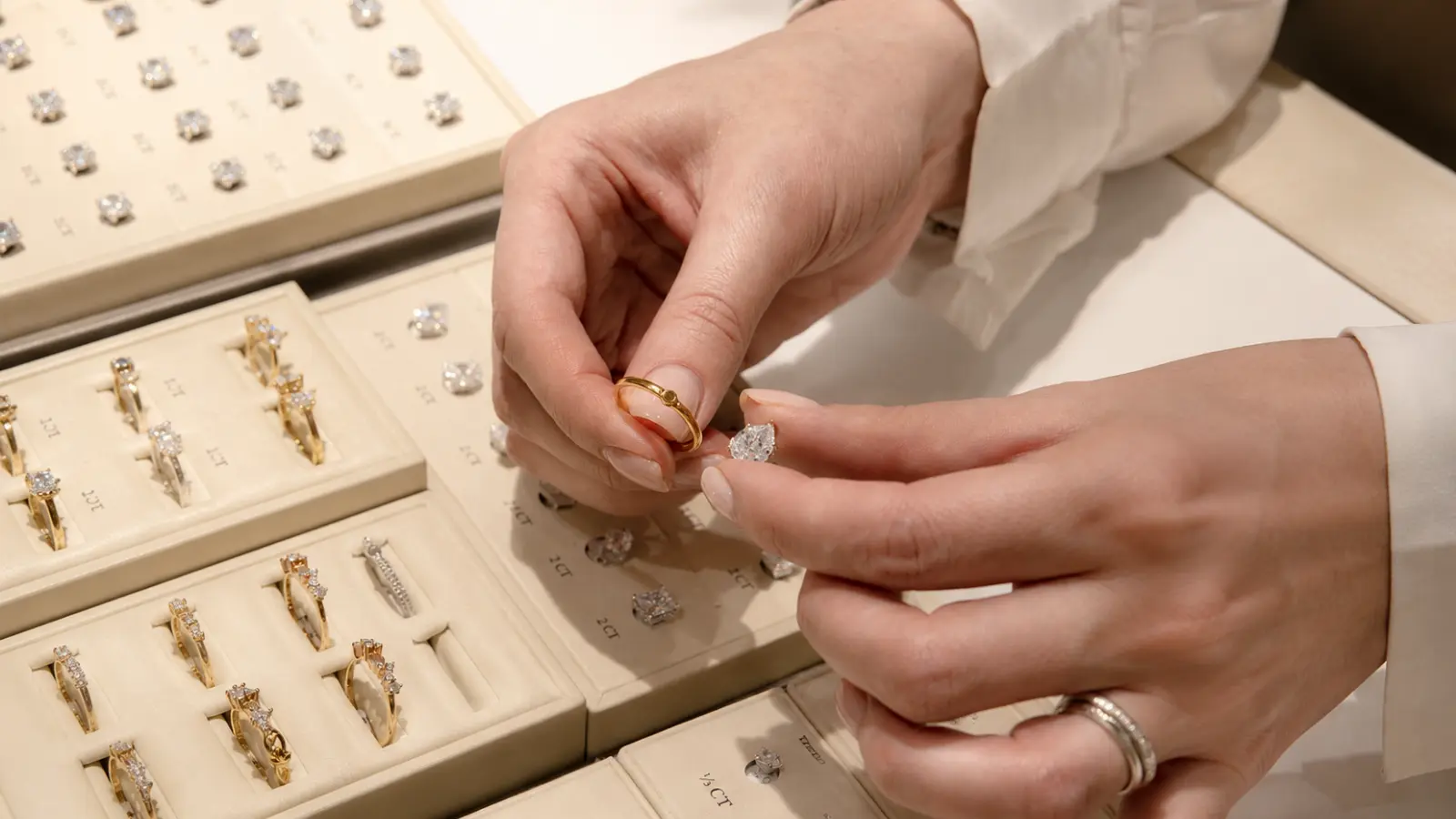
Width is the variable that most directly affects whether a wedding band complements or competes with an oval engagement ring. Choosing width correctly requires understanding two relationships simultaneously: the band’s width relative to the oval stone’s dimensions, and the band’s width relative to the engagement ring’s shank width.
The stone dimension relationship
The oval stone’s width at its widest point sets an informal ceiling for the wedding band. A band that approaches or exceeds the oval stone’s width in visual presence, either through its own width or through the size of stones set within it, draws the eye away from the center stone rather than toward it. Most oval stones in the 1-carat to 2-carat range that represent the majority of oval engagement rings have a widest dimension between 7mm and 9mm. A wedding band that stays below 3mm in width consistently reads as a complement rather than a competitor across this range of stone sizes.
For oval stones larger than 2 carats, stones with a width of 9mm or more, slightly wider bands (3mm to 4mm) can work proportionally. The stone’s visual weight is substantial enough to carry a wider band beside it without the band dominating. But even here, erring on the narrower side is the more forgiving choice, and it is worth confirming the proportion on the actual hand before committing to a wider option.
The shank width relationship
The second proportional check: the wedding band should not be significantly wider than the oval engagement ring’s own shank. An oval ring on a 1.5mm thin shank paired with a 5mm wide wedding band creates a visual mismatch between the two elements that reads as inconsistency rather than contrast. The wedding band’s width should feel like it belongs in the same family as the shank, similar or narrower, not dramatically wider. If the engagement ring has a thin, delicate shank, the most proportional women’s wedding bands will usually be thin and delicate as well.
Width by oval ring type, a quick reference
| Oval Ring Profile | Recommended Band Width | Why |
|---|---|---|
| Thin shank solitaire, low setting | 1.5mm to 2mm | Matches the ring’s delicacy; avoids visual weight mismatch |
| Standard shank solitaire, moderate height | 2mm to 3mm | Proportional to the shank; fits most oval stone sizes cleanly |
| Cathedral or high-set solitaire | 2mm to 3mm, curved | Curved band eliminates gap; narrow width avoids competing with stone |
| Oval with standard halo | 1.5mm to 2.5mm, curved | Halo adds visual width; narrower band prevents combination from looking overloaded |
| Oval with hidden halo | 2mm to 3mm, straight or curved | Hidden halo does not add outer width; standard sizing applies |
| Large oval (2ct+), wider shank | 3mm to 4mm | Stone’s size supports a slightly wider band; confirm proportion in person |
| Pavé shank oval ring | 1.5mm to 2mm, curved preferred | Curved band reduces contact with pavé stones; narrow width avoids visual competition |
The in-person confirmation rule
No table or guideline replaces the information available from placing a band beside the actual oval ring on the actual finger. Oval stones vary significantly in their length-to-width ratios, setting heights, and shank profiles, two rings described identically can look different enough that a band suited to one is not well suited to the other. Bringing the engagement ring to the jeweler appointment, trying every band option against it, and evaluating the result in natural light from above is the single most reliable step in the process. It takes twenty minutes and prevents the far more costly problem of a band that looked right in photographs and wrong on the hand.d evaluating the result in natural light from above is the single most reliable step in the process. It takes twenty minutes and prevents the far more costly problem of a band that looked right in photographs and wrong on the hand.
Oval Engagement Ring Wedding Band Inspiration
Finding the right wedding band for an oval engagement ring is about balancing shape, sparkle, and proportion. Explore our inspiration board for curved bands, pavé designs, thin gold bands, diamond stacks, hidden halo pairings, and elegant oval ring combinations.
Choosing a Wedding Band That Complements Your Oval Ring
The best wedding band for an oval engagement ring is not always the most detailed, the widest, or the one with the most sparkle. It is the band that works with the shape you already love — supporting the oval’s length, balancing the proportions, and making the entire combination feel intentional.
Whether you choose a simple gold band, a curved design, a pavé wedding band, or a layered stack, the right pairing should make your engagement ring feel more complete without taking away what made it special in the first place. The strongest combinations are the ones where both rings feel like they were always meant to belong together.
Frequently asked questions (FAQ)
What wedding band looks best with an oval engagement ring?
The best wedding band for an oval engagement ring is one that balances the shape, setting height, and proportions of the center stone. Thin curved bands, delicate pavé bands, and narrow classic bands often work well because they frame the oval without competing with its elongated shape. The best choice depends on whether you prefer a seamless fit or a more separated stacked look.
Does an oval engagement ring need a curved wedding band?
An oval engagement ring does not always need a curved wedding band, but curved or contoured bands often create the closest fit. Oval stones can leave a visible gap with straight bands because of their elongated shape and setting profile. A curved band follows the outline of the engagement ring and creates a more connected appearance, especially with higher settings or halo designs.
Can you wear a straight wedding band with an oval engagement ring?
Yes, a straight wedding band can look beautiful with an oval engagement ring. Lower-set oval rings often pair well with straight bands, and some people prefer the small gap because it creates a more relaxed stacked look. If you want the rings to sit completely flush with no visible space, a curved or custom band may be a better choice.
What width wedding band is best for an oval engagement ring?
Most oval engagement rings pair well with wedding bands between 1.5mm and 3mm wide because this range adds detail without overpowering the center stone. Very wide bands can make smaller oval diamonds appear less elongated. The ideal width depends on the size of the oval, the engagement ring band, and the overall balance on your hand.
What are the biggest mistakes when choosing a wedding band for an oval ring?
The biggest mistakes are choosing a band that is too wide, ignoring the gap created by the setting, selecting a curved band that does not match the oval’s shape, or choosing diamonds that compete with the center stone. The wedding band should support the oval engagement ring rather than becoming the main focus of the combination.
Should you choose a simple or diamond wedding band for an oval engagement ring?
Both simple and diamond wedding bands can work beautifully with oval engagement rings. A simple metal band keeps attention on the oval stone and creates a timeless look, while a pavé or diamond band adds extra sparkle and a more detailed style. The best choice depends on whether you want the oval diamond to stand alone or become part of a more decorative stack.