Meteorite wedding rings are wedding bands made with pieces of real meteorite, most commonly iron-nickel meteorites like Gibeon meteorite, creating a naturally unique pattern that cannot be replicated. Known for their cosmic origin, distinctive Widmanstätten patterns, and one-of-a-kind appearance, meteorite rings are among the most unusual alternatives to traditional wedding bands.
The appeal of a meteorite wedding ring goes far beyond appearance. Each piece of meteorite carries a history billions of years old, formed in space long before becoming part of a ring. However, meteorite is also a material that requires realistic expectations because it can rust, contains nickel, and needs more care than many traditional metals.
This guide explains meteorite wedding rings, including Gibeon meteorite, Widmanstätten patterns, pros and cons, rust prevention, care, men’s styles, durability, and how meteorite compares with other wedding rings and wedding bands before you choose.
What Is a Meteorite Wedding Ring?
A meteorite wedding ring is a band that incorporates real meteorite — not a synthetic material, not a pattern inspired by meteorite, but an actual slice of iron-nickel alloy that traveled through space and fell to Earth. The meteorite is cut, sliced thin, polished, and acid-etched to reveal the structure within, then set into a wedding band either as an inlay or, in some cases, as the primary outer material of the ring itself.
The overwhelming majority of meteorite rings on the market use Gibeon meteorite, which was discovered in Namibia in the 19th century and is classified as a fine octahedrite — a type of iron meteorite known for producing an exceptionally clear, well-defined crystalline pattern when processed. Gibeon is the standard because it is relatively available, takes a clean polish, and produces consistent results in inlay work. Other meteorite types are occasionally used, but Gibeon is what most reputable makers work with.
In terms of construction, most meteorite wedding rings follow one of two configurations:
- Meteorite inlay: A structural band made from gold, platinum, titanium, or tungsten, with a strip of meteorite set into a channel on the outer face. The metal provides the strength; the meteorite provides the visual. This is the most common and practical option.
- Full-face meteorite: Meteorite as the primary outer surface of the ring, often wrapped around a metal liner. These are less common, more expensive, and require more attentive care — but they produce a ring that is almost entirely meteorite in appearance.
The meteorite used in rings is genuine extraterrestrial material, certified by makers who source it from reputable dealers, and it comes with documentation of its classification and origin. When someone asks whether the meteorite in a ring is real, the answer from any legitimate maker should be unambiguous and verifiable.
Why Meteorite Rings Are Unique
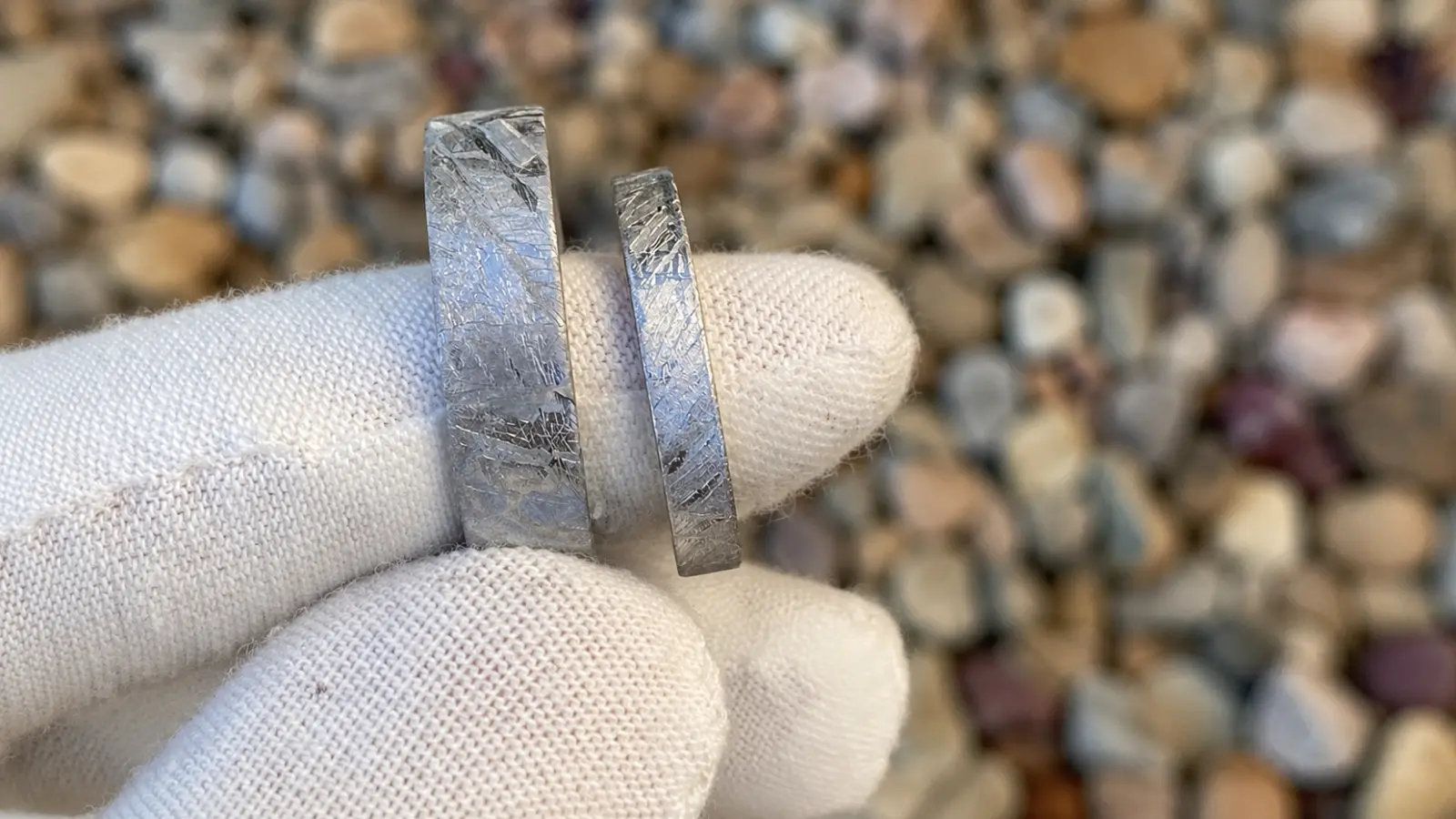
The word “unique” is used loosely in the jewelry market. With meteorite rings, it is technically accurate in a way that applies to almost nothing else in any retail category. Three things set the material apart.
The Widmanstätten Pattern
The defining visual characteristic of a meteorite ring is the Widmanstätten pattern — a crystalline geometric structure of interlocking bands and lines that forms in iron-nickel meteorites as a result of extraordinarily slow cooling. When an iron-nickel asteroid cools by roughly one degree Celsius per million years, the iron and nickel within it segregate into distinct crystalline bands. The resulting structure, visible only when the meteorite is sliced and etched with a mild acid, is one of the most distinctive natural patterns in existence.
This pattern cannot be reproduced. No manufacturing process, no casting technique, and no surface treatment can create a Widmanstätten pattern — it is a direct product of cosmic time and conditions that existed only in the early solar system. Every section of meteorite produces a slightly different pattern, which means that every meteorite ring is genuinely one of a kind in a way that even custom-designed metal rings are not. Two rings made side by side from the same meteorite will have different patterns.
Age and Origin
Gibeon meteorite formed approximately 4.5 billion years ago — roughly the same age as the solar system itself. The asteroid it came from predates the Earth. The piece of meteorite in a wedding ring has been through the formation of the solar system, billions of years of orbit in the asteroid belt, entry into Earth’s atmosphere, and recovery in the Namibian desert — all before it was cut and set into a band.
For couples exploring alternative wedding rings, that scale of time adds a dimension few other materials can approach. A wedding ring made with material that old is wearing something genuinely cosmic — and that is not a metaphor.
Rarity in Context
Iron meteorites are not common. The total known mass of Gibeon meteorite recovered is measured in tons — substantial in meteorite terms, but a genuinely finite resource. Reputable makers source authenticated material through established meteorite dealers. The supply is not infinite, and while meteorite rings are not endangered as a product category in the near term, the material they are made from is not renewable in any meaningful timeframe. That matters to some buyers more than others, but it is part of the material’s honest story.
Do Meteorite Rings Rust?
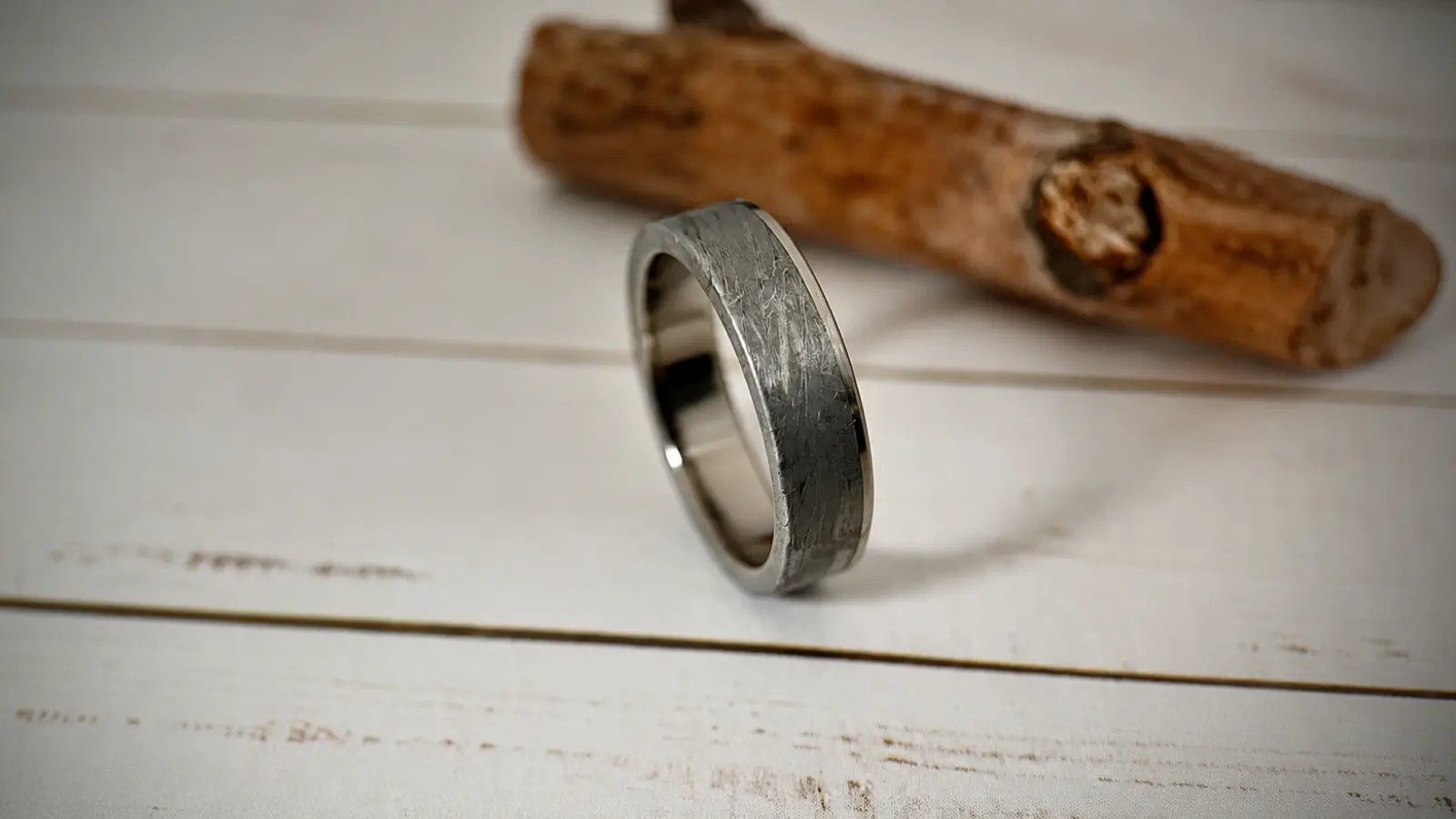
Yes — and any maker or retailer who does not address this clearly is doing buyers a disservice. Meteorite is an iron-nickel alloy, and iron rusts. The same material that fell from space and survived atmospheric entry will develop reddish-brown surface oxidation when exposed to moisture, oxygen, and the salts present in sweat. It is not a defect or a sign of poor quality. It is the nature of the material, and understanding it before purchasing is essential.
What Rust on a Meteorite Ring Actually Looks Like
Surface oxidation appears as small reddish-brown spots or a general dulling of the meteorite surface. It develops gradually with cumulative moisture exposure and tends to appear first in areas where the Widmanstätten pattern creates fine grooves — places where moisture can collect and sit. Left unaddressed, the oxidation will spread and obscure the pattern.
Importantly, rust on a well-made meteorite inlay ring is usually a cosmetic concern, not a structural one. It does not compromise the integrity of the ring. But it does require maintenance to manage, and the visible pattern — the whole reason most people buy the ring — is the thing most affected.
How Makers Address It
Most reputable makers treat the meteorite surface with a dilute acid etch followed by a protective coating — typically a wax, lacquer, or Renaissance Wax-style product — before the ring leaves their shop. This slows the oxidation process significantly but does not prevent it permanently. The coating wears down with daily use, and the underlying meteorite will begin to oxidize as protection diminishes.
That means a meteorite ring requires periodic re-treatment: re-etching the surface to remove existing oxidation and reapplying a protective finish, typically every one to two years depending on the wearer’s habits and environment. Many makers offer this as a service, sometimes included in a lifetime care policy. One of the more important questions to ask before purchasing: do they offer re-etching, what does it cost, and what is the turnaround?
Managing Rust in Daily Life
The single most effective habit is removing the ring before any water exposure — showering, swimming, washing dishes, or working in wet conditions. Sweat is also a factor: people with physically demanding jobs or who exercise while wearing the ring will see oxidation develop faster. A few practical habits make a real difference:
- Remove the ring before water contact — every time, not just sometimes
- Wipe the ring dry after contact with sweat or moisture
- Store it away from bathroom humidity when not wearing it
- Apply a protective wax coat (like Renaissance Wax) every few months at home
- Schedule professional re-etching when spotting or dulling becomes visible
For wearers in humid climates or high-sweat professions, maintenance may be needed more frequently than the one-to-two-year guideline. In dry climates and lower-contact lifestyles, the interval can extend considerably. Either way, the care requirement is real — it should be factored in before the purchase, not discovered after.
Meteorite Wedding Bands for Men
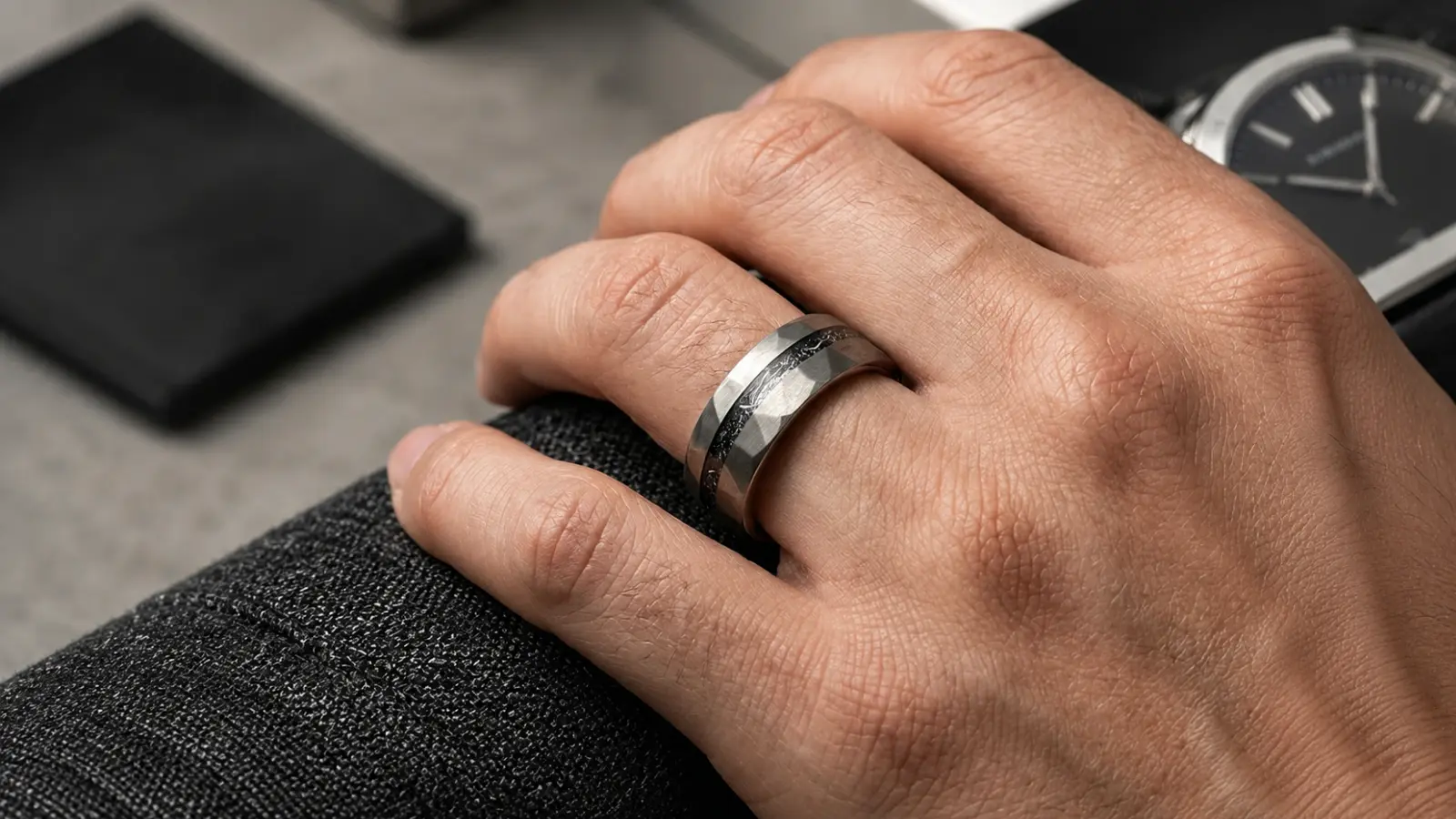
Men’s meteorite wedding bands represent the largest segment of the meteorite ring market, and the reasons are not difficult to understand. The material brings together qualities that many men find genuinely compelling: something rare, something with a verifiable story, something that looks unlike anything else on anyone else’s hand. The visual language of the Widmanstätten pattern — angular, crystalline, geometric — also translates particularly well at the wider widths common in men’s wedding bands.
Why the Scale Works
A meteorite inlay in a 4mm women’s ring and the same inlay in an 8mm men’s ring are different objects visually. At 8mm to 10mm — the range where many men’s bands sit — the Widmanstätten pattern has enough surface area to read clearly from a conversational distance. The geometry is visible, recognizable, and specific. At narrower widths, the same pattern can feel compressed and harder to appreciate. Standard men’s band proportions happen to be well-suited to showing it at its best.
Combination Materials
The base metal paired with a meteorite inlay significantly changes the overall character of the ring. Here is how the main options compare:
| Base Metal | Character | Best For |
|---|---|---|
| Tungsten | Near-black finish, heavy, scratch-resistant | Bold aesthetic, active lifestyles |
| Titanium | Light silver tone, lightweight, hypoallergenic | First-time ring wearers, clean modern look |
| Gold | Warm tone, resizable, classic feel | Men who want meteorite within a traditional band |
| Black Zirconium / Damascus | Dark or textured, highly distinctive | Men who want the far end of the alternative spectrum |
Meteorite inlays paired with tungsten wedding rings create strong contrast with the crystalline pattern and give the ring substantial weight on the hand. For everyday comfort, titanium wedding rings are especially appealing to men who are new to wearing rings. For someone who wants the meteorite story inside a traditional precious-metal design, gold wedding rings offer that balance. For a broader comparison of how meteorite stacks up against other distinctive materials, the unique wedding rings covers the full alternative landscape.
The Appeal of the Story
Many men who would describe themselves as indifferent to jewelry find meteorite rings genuinely interesting — not because of how they look from across the room, but because of what they are. The ring is made from material that formed before the Earth existed, traveled through space for billions of years, survived atmospheric entry, and was recovered in a desert in southern Africa. That sequence of events is verifiable, not invented. For men who value substance over decoration, the story embedded in the material is often more compelling than the visual alone.
Pros and Cons of Meteorite Rings
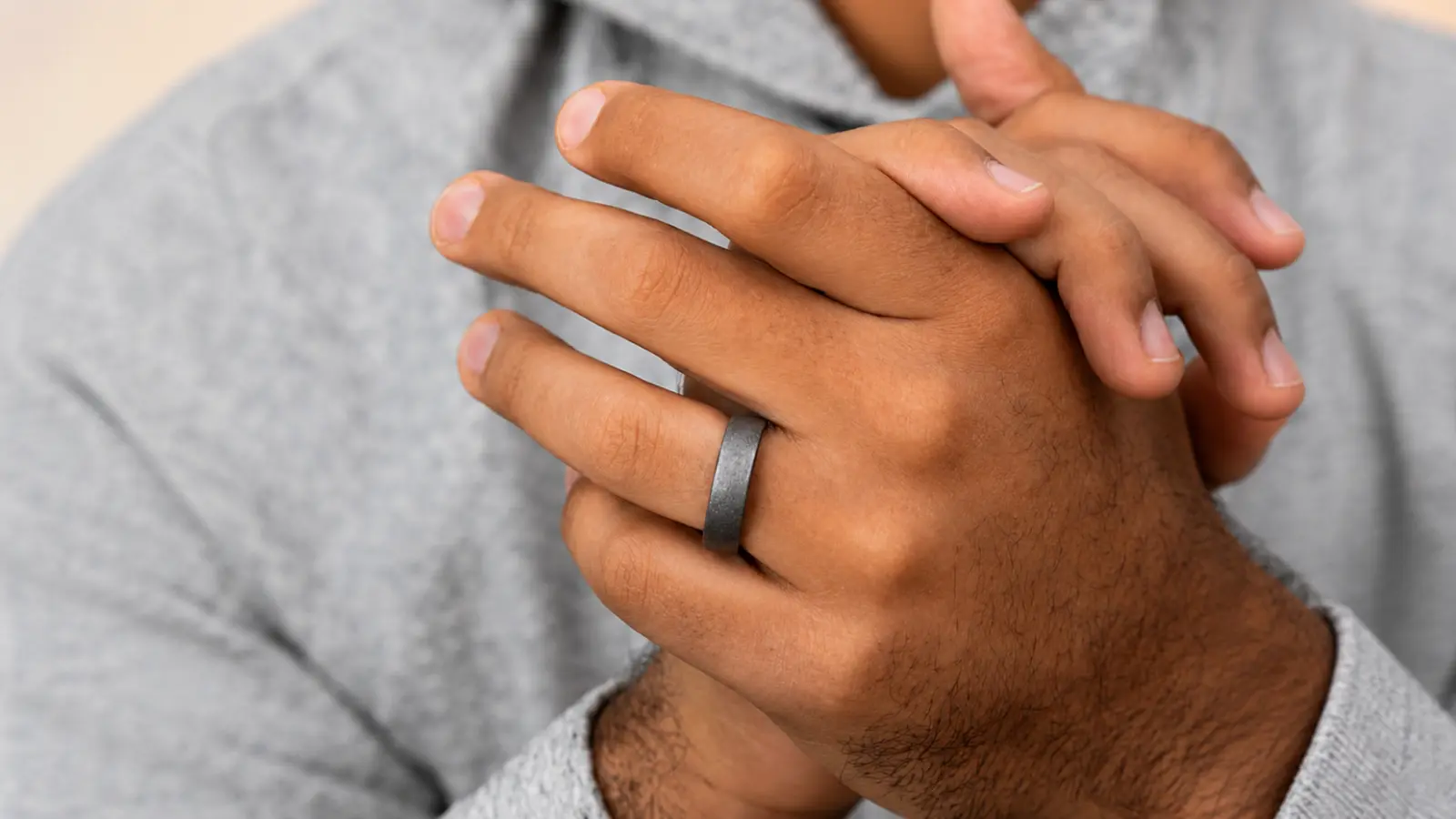
Meteorite rings are genuinely distinctive, and the qualities that make them appealing are real. So are the limitations. An honest account of both sides tends to be more useful than the version that makes the decision easy.
What Works Well
True uniqueness. Every meteorite ring has a different Widmanstätten pattern — not a styling choice or a marketing claim, but a physical reality of the material. No other wedding ring material offers this kind of guaranteed individuality. Two rings from the same meteorite, cut side by side, will not match.
A story the ring actually carries. Wearing material that is 4.5 billion years old and formed in space is an unusual thing to be able to say about any object. For couples who connect with that, the ring carries meaning that goes well beyond its visual appearance. It is cosmic history made wearable — and for the right person, that is exactly what makes it worth it.
Strong visual impact. The Widmanstätten pattern is unlike any texture found in conventional jewelry. Geometric without being manufactured, natural without being organic in the usual sense. At the right width and with good craftsmanship, it reads as distinctive from across the room and rewards closer inspection.
Flexible pairing options. Meteorite works well across a wide range of base metals — from traditional gold to modern titanium, tungsten, or black zirconium. It is versatile enough to suit a fairly wide range of personal aesthetics without losing what makes it interesting.
What Requires Realistic Expectations
Rust is real and ongoing. There is no version of a meteorite ring that does not require rust management. The protective treatments slow the process; they do not stop it. A wearer who is not committed to removing the ring before water exposure and re-treating the surface periodically will see the ring deteriorate in appearance. This is manageable for the right person — and a genuine problem for someone who wants a ring they never have to think about.
No resizing. Most meteorite rings make wedding ring resizing difficult or impossible because of the base metal and the risk of damaging the inlay. Any future size change typically means replacing the ring. Before purchasing, check your fit with our ring size calculator, especially if your ring size has fluctuated in the past.
Nickel content. Gibeon meteorite is an iron-nickel alloy, and nickel is one of the most common contact allergens. People with nickel sensitivity may experience skin irritation. Many makers offer a hypoallergenic inner liner (titanium or platinum) specifically for this reason — asking about it before purchasing is worthwhile for anyone with a known sensitivity.
Specialist care required. Re-etching the surface is not a general-jeweler task. Not all shops are equipped to handle it, and a wearer who moves or cannot locate a specialist may find themselves in an inconvenient position. Establishing a clear relationship with the original maker and understanding their long-term care policy before purchasing is a practical step many buyers skip — and later wish they hadn’t.
Price premium. Meteorite rings cost more than comparable rings in conventional or alternative metals. The material cost, sourcing, authentication, and specialized craftsmanship all contribute to a genuinely higher price point. For couples for whom the story and rarity justify the cost, this is not an objection. For couples primarily drawn to the aesthetic, there may be more cost-effective ways to achieve a similar look.
How to Care for a Meteorite Ring
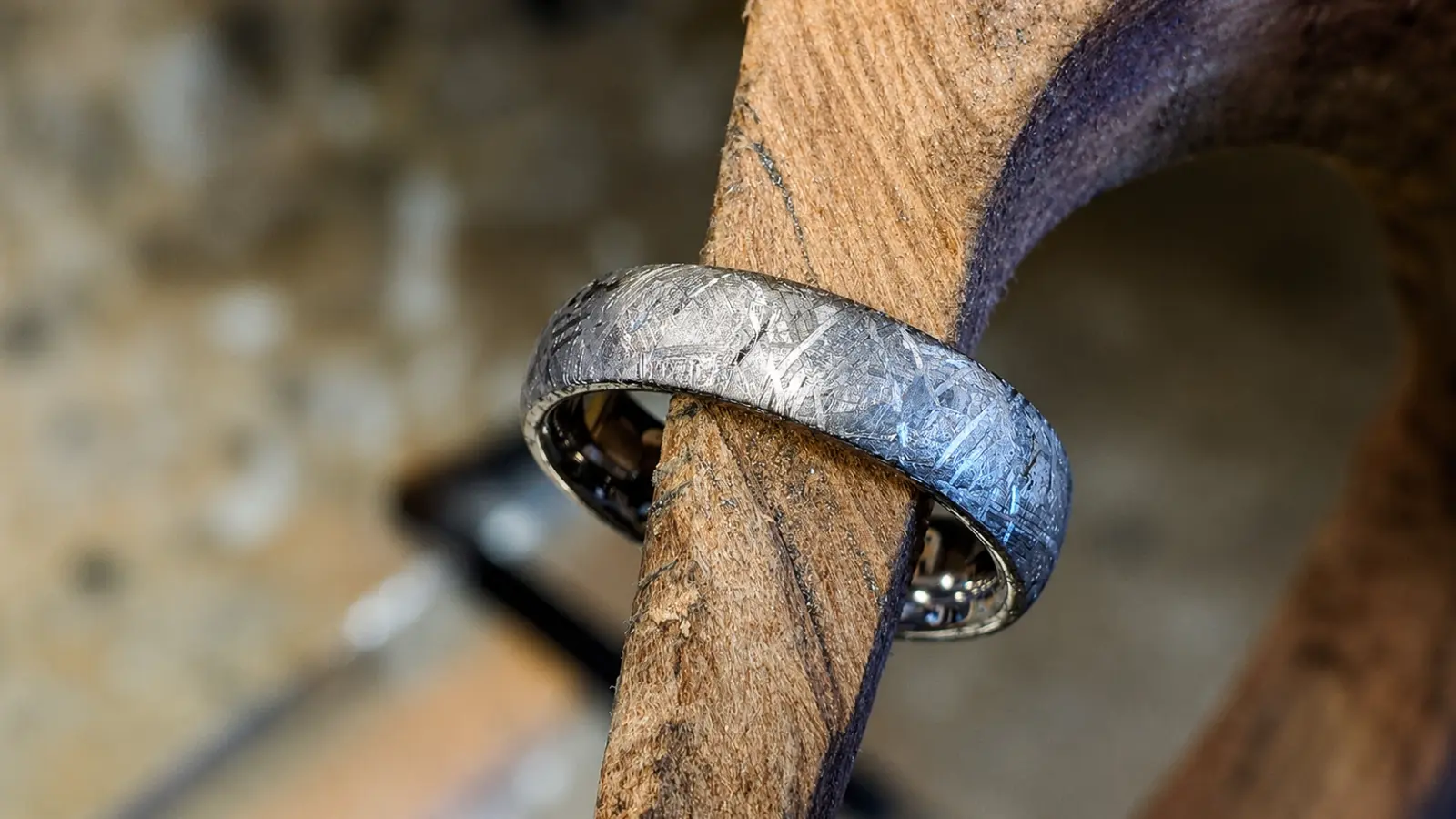
Caring for a meteorite ring is more involved than caring for a gold or platinum band — but it is also more straightforward than many people initially assume. The core maintenance framework comes down to three things: keep it dry, keep it clean, and re-treat the surface on a regular schedule.
Water and Moisture: The First Rule
Remove the ring before showering, swimming, washing dishes, or any activity involving sustained water contact. This is the single most impactful habit in meteorite ring care — more responsible for how quickly or slowly oxidation develops than anything else. Brief incidental contact is not immediately catastrophic for a well-treated ring, but regular immersion will strip the protective finish and begin the oxidation process quickly. Making removal automatic before water contact is the most practical thing a meteorite ring wearer can build into their routine.
Cleaning at Home
After contact with sweat or dust, wipe the ring with a soft, dry cloth. That is usually sufficient for routine maintenance. A few things to avoid entirely:
- Ultrasonic cleaners — they damage the protective finish and accelerate oxidation
- Steam cleaners — same issue, plus heat can affect certain protective coatings
- Silver polish, metal polish, or any abrasive product on the meteorite surface
- Liquid cleaning products of any kind
If grime has accumulated in the grooves of the Widmanstätten pattern, a barely damp cloth followed immediately by thorough drying is the safest approach. The goal is to clean the surface without introducing moisture that sits and causes oxidation.
Protective Coating and Home Maintenance
Many makers apply a protective wax or lacquer before the ring ships, and recommend reapplying a product like Renaissance Wax at home every few months to maintain the barrier. This is a simple process: apply a small amount with a soft cloth, allow it to dry, and buff gently. Done consistently, it extends the time between professional re-etchings and keeps the pattern looking clean and defined in the interim.
Professional Re-Etching: What to Expect
When surface oxidation becomes visible — reddish-brown spotting or a general dulling — the ring needs professional re-etching. The process involves removing existing oxidation and protective finish with a dilute acid, cleaning the surface, and reapplying a protective coating. Most makers offer this service, sometimes included in a lifetime care policy, sometimes for a modest flat fee. Turnaround is typically a few days to a week.
Planning for this treatment every one to two years under normal wear conditions is a reasonable baseline. High humidity climates or high-sweat lifestyles may require more frequent treatment; dry climates and lower-contact wear may extend the interval considerably. Either way, it is worth factoring into the total cost of ownership before purchasing — not just the price of the ring, but the ongoing cost of keeping it looking the way it did on the day it arrived.
Storage and Chemical Exposure
Store the ring in a dry environment: a ring box, a jewelry drawer, anywhere away from bathroom humidity and direct sunlight. Avoid storing it alongside other hard metal objects that could scratch the meteorite surface.
For chemical exposure — cleaning products, pool chemicals, mechanical solvents — remove the ring before the activity, full stop. If accidental contact occurs, rinse with the minimum water necessary, dry immediately and thoroughly, and apply a protective wax coat as soon as possible. Chemical exposure strips the protective finish rapidly and can cause discoloration or accelerated rust that is more difficult to address than ordinary oxidation.
Meteorite Wedding Ring Inspiration
Meteorite wedding rings combine cosmic history, natural patterns, and modern craftsmanship to create designs unlike traditional wedding bands. Explore our inspiration board for Gibeon meteorite rings, black meteorite bands, gold combinations, tungsten styles, and unique meteorite wedding ring ideas.
Choosing a Meteorite Wedding Ring With a Story
A meteorite wedding ring is not about choosing the most traditional or effortless material. It is about choosing something with a history, a natural pattern, and a story that no manufactured design can recreate.
Whether you choose meteorite for its cosmic origin, its distinctive appearance, or the meaning behind wearing something formed over billions of years, the right ring is one that fits both your imagination and your everyday life. The most meaningful wedding rings are not only the ones that mark a moment — they are the ones that continue carrying a story long after it.
Frequently asked questions (FAQ)
Are meteorite wedding rings made from real meteorites?
Yes. Quality meteorite wedding rings are made with pieces of real meteorite, most commonly Gibeon meteorite. The material is cut, polished, and etched to reveal its natural crystalline pattern. This pattern formed over billions of years in space and cannot be artificially recreated, which is why every genuine meteorite ring has a unique appearance.
Do meteorite wedding rings rust over time?
Yes. Meteorite contains iron, which means it can develop surface rust when exposed to moisture, sweat, or humidity. This does not mean the ring is poor quality — it is a natural property of the material. Keeping the ring dry, protecting the finish, and following proper care instructions can help control oxidation and preserve the pattern.
Can you wear a meteorite ring every day?
Yes, many people wear meteorite wedding rings every day, but they require more attention than traditional metals. A meteorite ring is best for someone willing to remove it before water exposure and maintain the surface over time. Someone who wants a completely maintenance-free ring may prefer gold, platinum, titanium, or tungsten.
Why are meteorite wedding rings so special?
Meteorite wedding rings are special because the material itself has a history unlike any traditional jewelry metal. The patterns inside the meteorite were created naturally over billions of years before being cut into a ring. No two meteorite pieces have the exact same structure, making each ring genuinely one of a kind.
What should you know before buying a meteorite wedding ring?
Before buying a meteorite wedding ring, understand the trade-off between uniqueness and maintenance. Meteorite offers a rare appearance and an extraordinary origin story, but it can rust, usually cannot be resized easily, and may require specialized care. It is best for someone who values the story of the material as much as convenience.
Are meteorite wedding rings worth the extra care?
Meteorite wedding rings are worth it for people who connect with the meaning, rarity, and individuality of the material. The maintenance can feel reasonable for someone who loves owning something truly unusual. However, people who prefer a ring they never need to think about may be happier with a more traditional material.