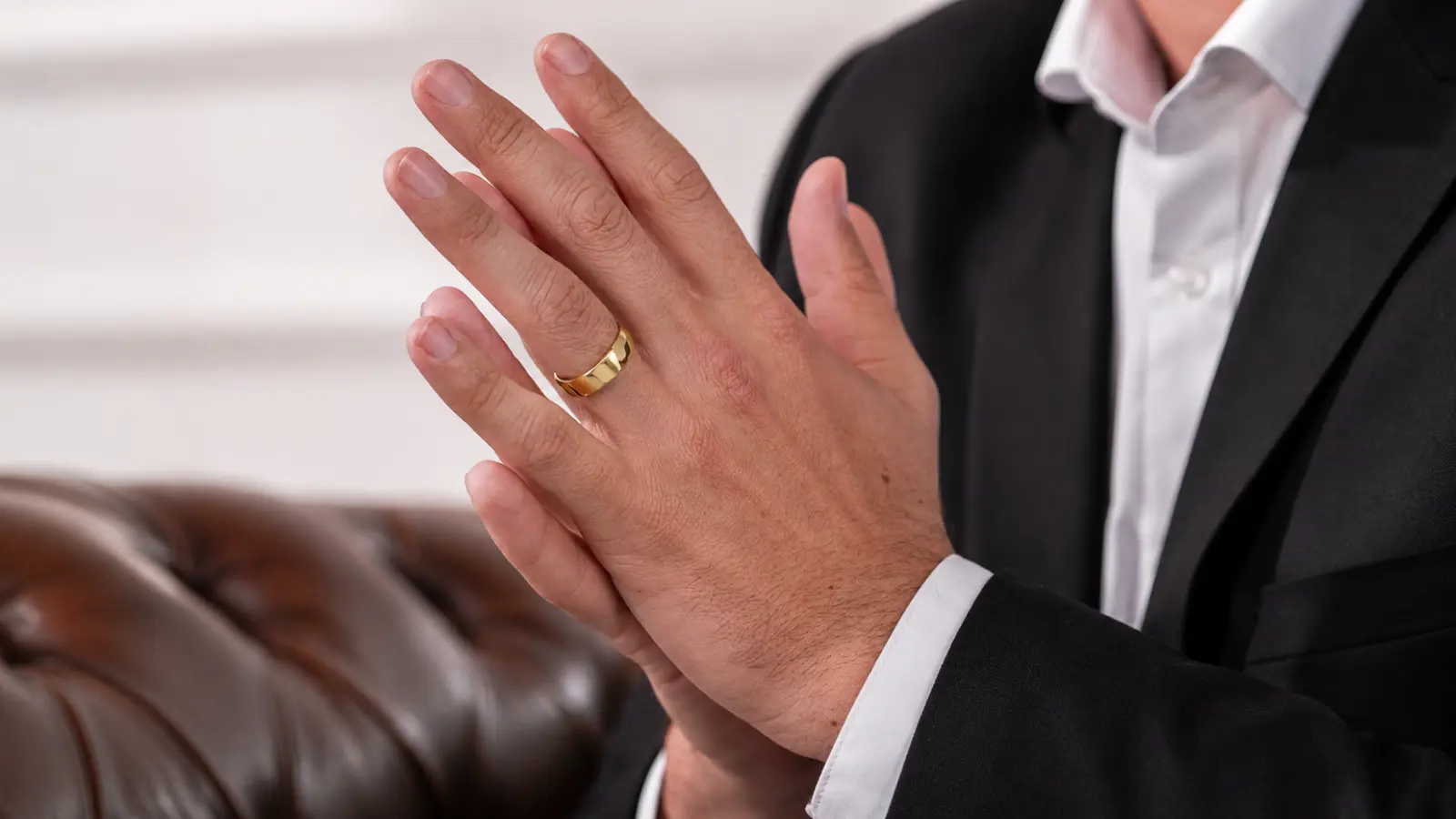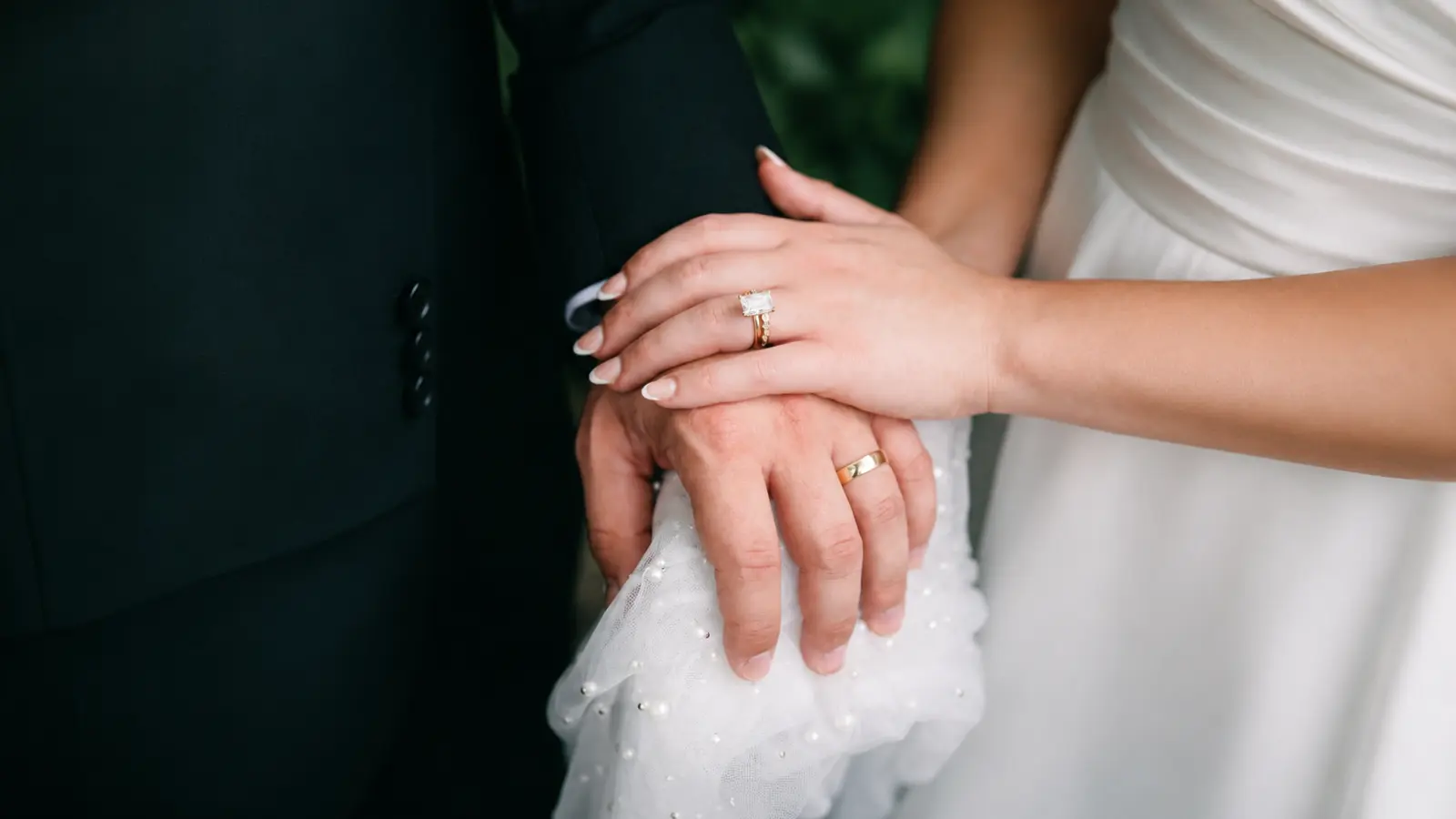
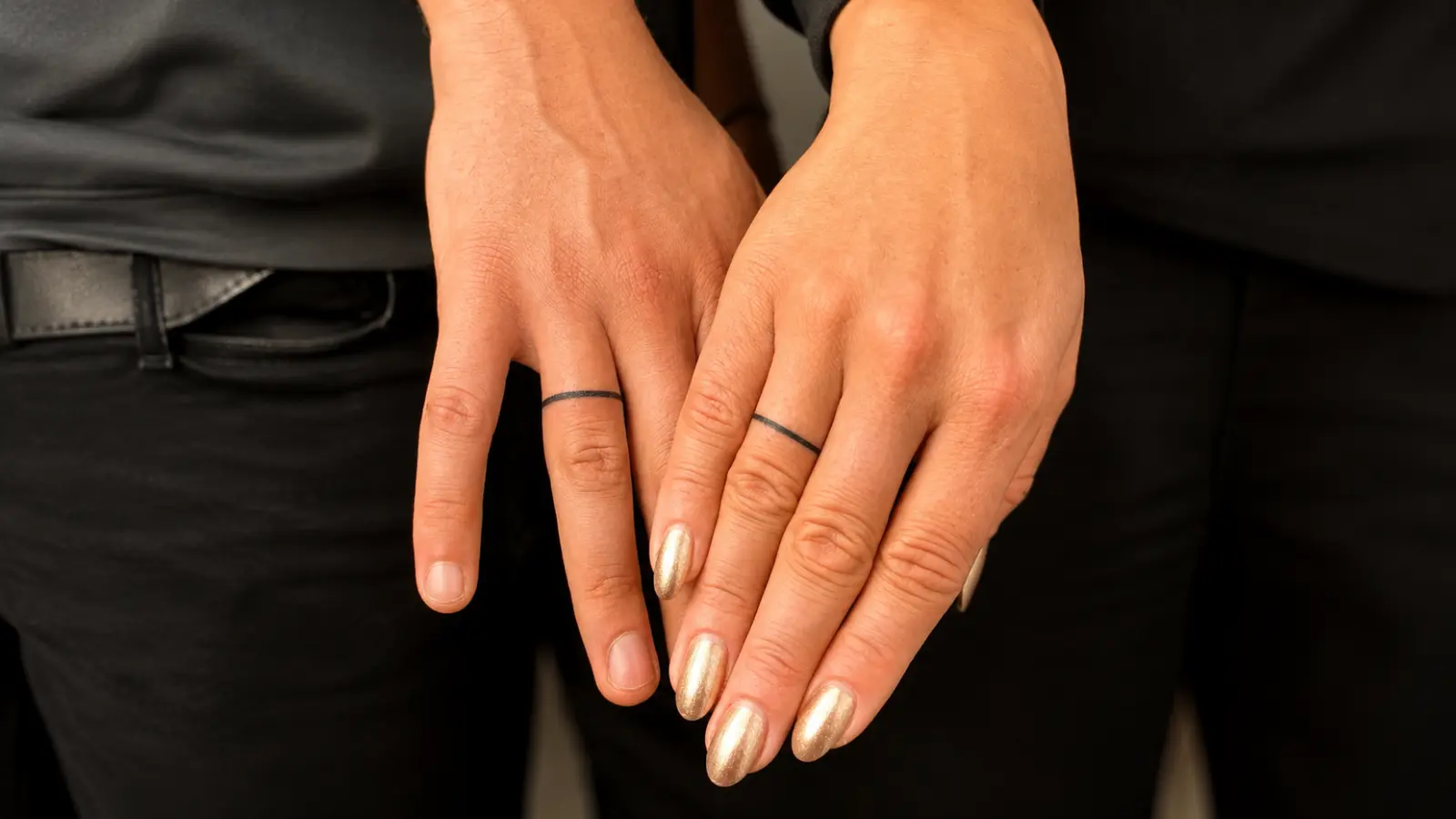
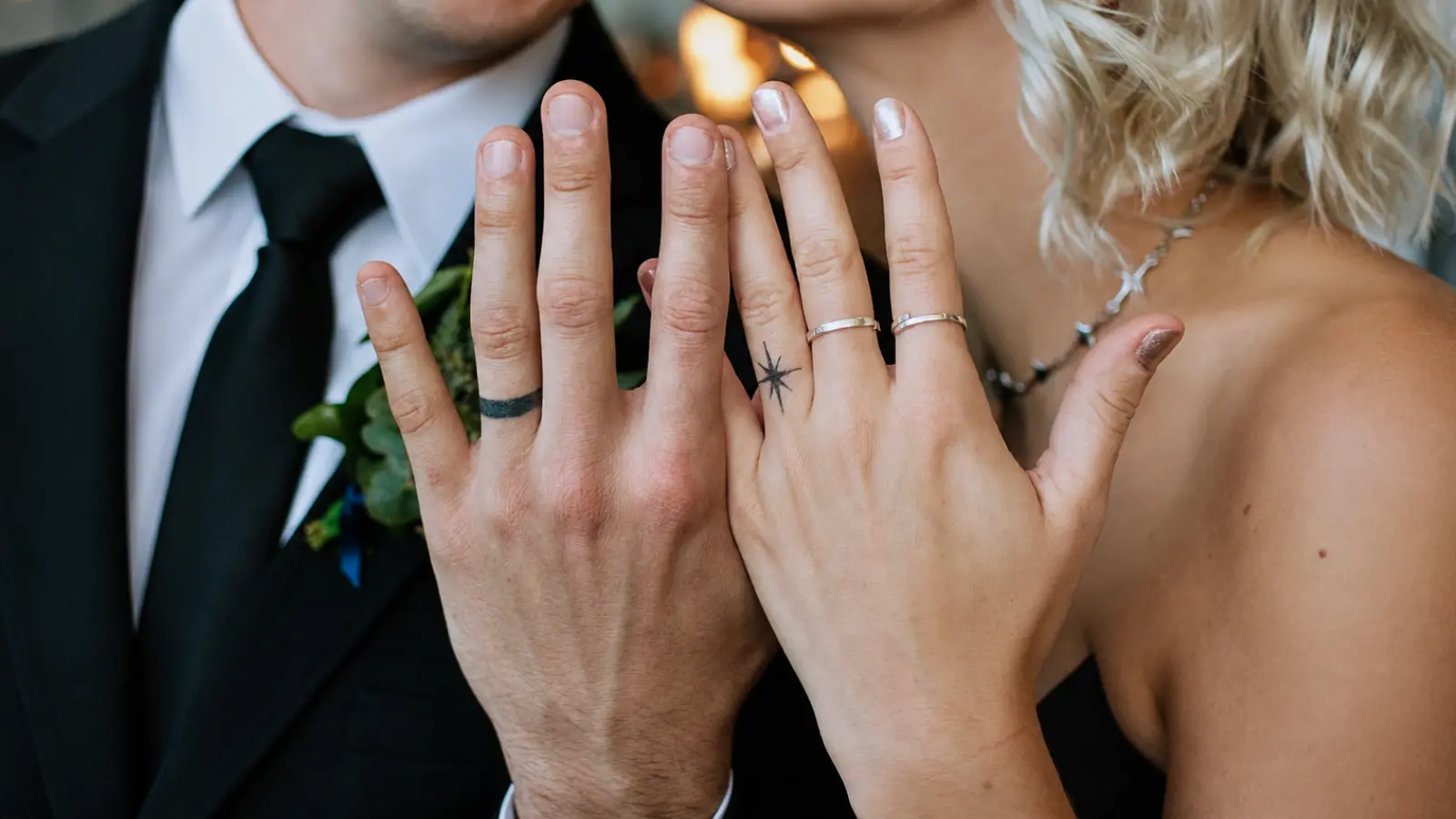
Wedding ring tattoos are designs placed on the ring finger to symbolize marriage, either replacing a traditional wedding band or adding a permanent personal meaning alongside one. They can be simple bands, initials, dates, symbols, or custom designs shared between couples.
Unlike a metal wedding ring, a tattoo becomes part of the skin, which makes the decision both meaningful and more permanent. Finger tattoos also come with unique considerations: they fade faster than many other placements, require careful design choices, and may need touch-ups over time.
This guide explores wedding ring tattoo ideas for couples, men, and women, including popular designs, meanings, pros and cons, fading, healing, and how this alternative compares with traditional wedding rings and wedding bands.
What Are Wedding Ring Tattoos?
A wedding ring tattoo is exactly what the name describes: a tattoo placed on the ring finger that functions as a permanent symbol of marriage. The most common version encircles the finger in the position a band would occupy, a continuous line, band, or design that wraps around the finger rather than sitting on one surface. Some people wear a ring tattoo alongside a metal band; others use it in place of one entirely. Some couples tattoo matching or complementary designs as a shared commitment ritual. Some get a ring tattoo years into a marriage as a deliberate act of permanence, a way of making the commitment visible on the body in a way a removable object cannot.
A Tradition Older Than the Diamond Ring
The cultural history of finger tattoos as symbols of commitment is longer than most people realize. In parts of Polynesia, Southeast Asia, and indigenous communities across the Americas, finger and hand tattoos have marked significant life commitments, including marriage, for centuries. The contemporary Western adoption of the wedding ring tattoo is a recent mainstream expression of a practice with a much older foundation.
Why Intention Matters More Than Placement
What distinguishes a wedding ring tattoo from other finger tattoos is primarily intention rather than placement. The same thin band on the ring finger reads entirely differently depending on whether it was chosen as a symbol of marriage or simply as a design the person liked. Much like traditional wedding ring meaning, the significance is supplied by the person wearing it, which is why an otherwise simple finger tattoo can carry entirely private meaning.
The conversation around wedding ring tattoos has matured considerably in recent years, and the most useful shift is toward honesty about what finger tattoos actually do over time. They are not a permanent, unchanging mark in the way a tattoo on the upper arm or back might be. The skin on the fingers is thin, constantly moving, constantly exposed to the elements, and regenerates more quickly than skin elsewhere on the body. Tattoos in this location fade and blur on a timeline that surprises many people who did not research the placement before committing to it. Understanding this before choosing a design produces a result that holds up; ignoring it produces a tattoo that may look significantly different from the inspiration photograph within a few years.
Wedding Ring Tattoo Ideas
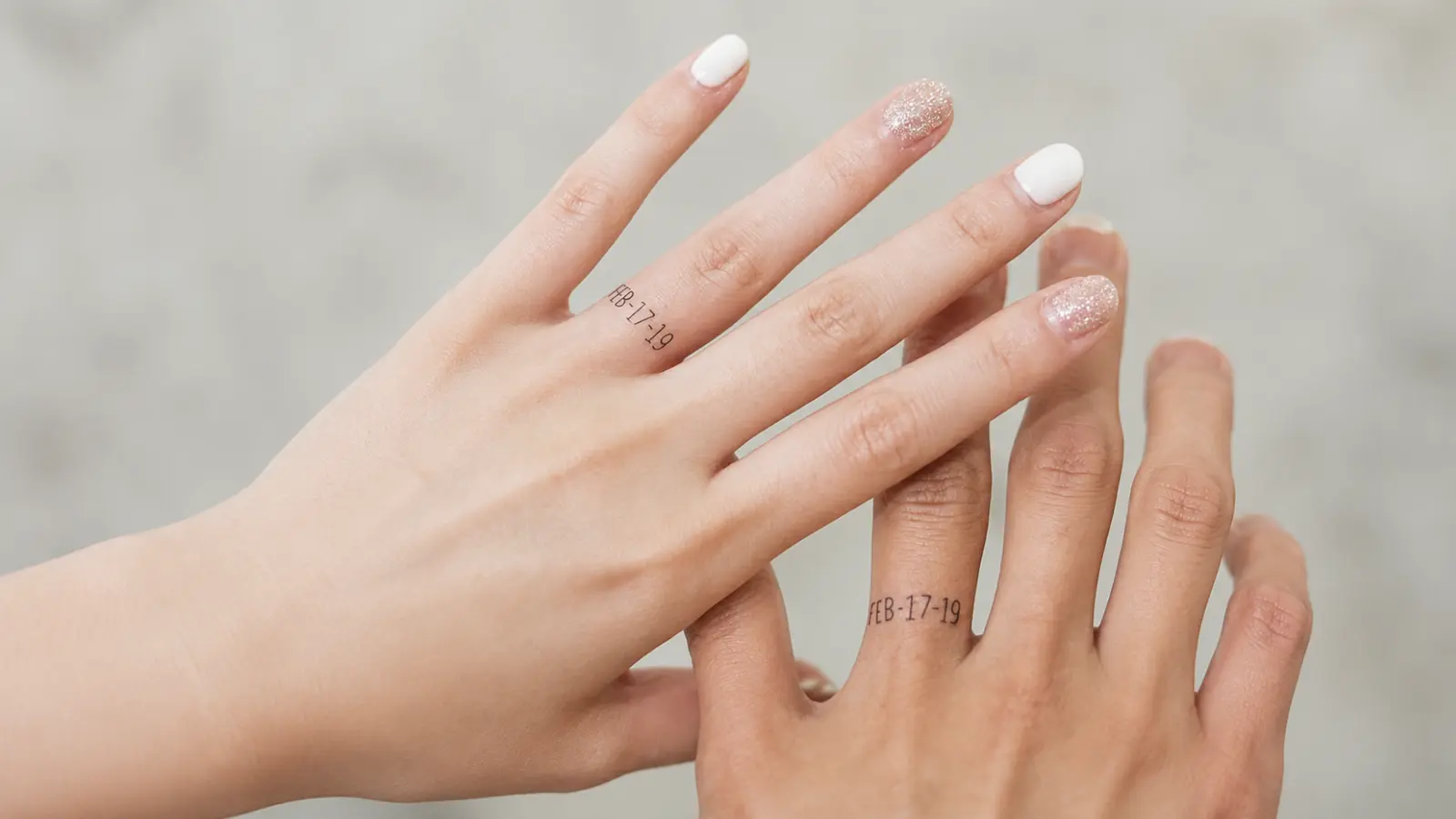
The best wedding ring tattoo ideas share a quality that is more structural than aesthetic: they are designed for finger skin rather than for the inspiration photograph. The designs that look most extraordinary in fresh tattoo photos are often the ones that look least like themselves after two or three years of daily hand use. The designs that look simple, even underwhelming, in the fresh photo are often the ones that remain legible and intentional a decade later. This is the central tension in choosing a wedding ring tattoo design, and it is worth holding consciously rather than letting the inspiration-browsing process resolve it by default.
The Solid Band
A continuous, solid band of dark ink encircling the finger is the most traditional ring tattoo design and one of the most durable. Its simplicity is structural: there are no fine lines to blur, no detail to lose, no gradient to flatten. It reads clearly as a ring at any distance and in any condition of the tattoo’s age. For people who want a wedding ring tattoo that will look intentional and maintained for as long as possible with the least amount of upkeep, a solid band in dark ink is the most reliable choice available.
The Dotted or Dashed Band
A series of dots or dashes encircling the finger rather than a continuous line is slightly more decorative than a solid band, while still bold enough to hold over time. Dots are more forgiving than fine lines because the edges of a dot blur into a filled circle rather than disappearing — a blurred dot reads as a smaller, softer dot, while a blurred fine line can read as a smear. This style is popular for people who want something more visually interesting than a solid band without the maintenance demands of intricate linework.
A Single Word or Date
The other person’s name, the wedding date, a word that carries specific meaning — engraved-style text encircling the finger or running along one side of it. Text tattoos on fingers are popular and can hold up reasonably well when the font is clean, blocky, and large enough to remain legible as the edges soften. Very fine script, ornate lettering, and small-scale text all lose legibility faster than bolder fonts. A date in numerals tends to hold better than a date spelled out in script. The word or phrase chosen should be one that will feel as true in thirty years as it does now, which is a higher standard than most text choices survive when examined that carefully.
A Personal Symbol
An initial, a small geometric shape, a symbol that belongs to the couple’s private language — a small anchor, a wave, a simple leaf, an arrow. A symbol works well as a wedding ring tattoo when it is bold enough to remain clear as the edges soften, small enough to fit the ring finger’s narrow surface without crowding, and meaningful enough to the wearer that its significance is not dependent on it looking exactly as it did when fresh. Symbols with strong geometric clarity hold better than organic or naturalistic forms.
Coordinates and Interlocking Designs
The geographic coordinates of a significant place — where the couple met, where the proposal happened, where the ceremony took place — work well in a clean sans-serif font, sized large enough to remain legible as the tattoo ages. They carry meaning that is entirely opaque to anyone who does not know the story, which many people find appealing as a form of private significance that reads as aesthetic to everyone else.
Interlocking designs go a step further: a tattoo on each partner’s ring finger that, when the hands are placed together, forms a single complete image. These are among the most visually compelling couples’ tattoo concepts and among the most demanding to execute well, since the two halves need to align precisely when the hands come together. When they work, they are genuinely striking. They also require that both partners get tattooed, and that the relationship between the two designs remains legible even when the hands are apart, which not all interlocking designs achieve.
Wedding Ring Tattoos for Couples
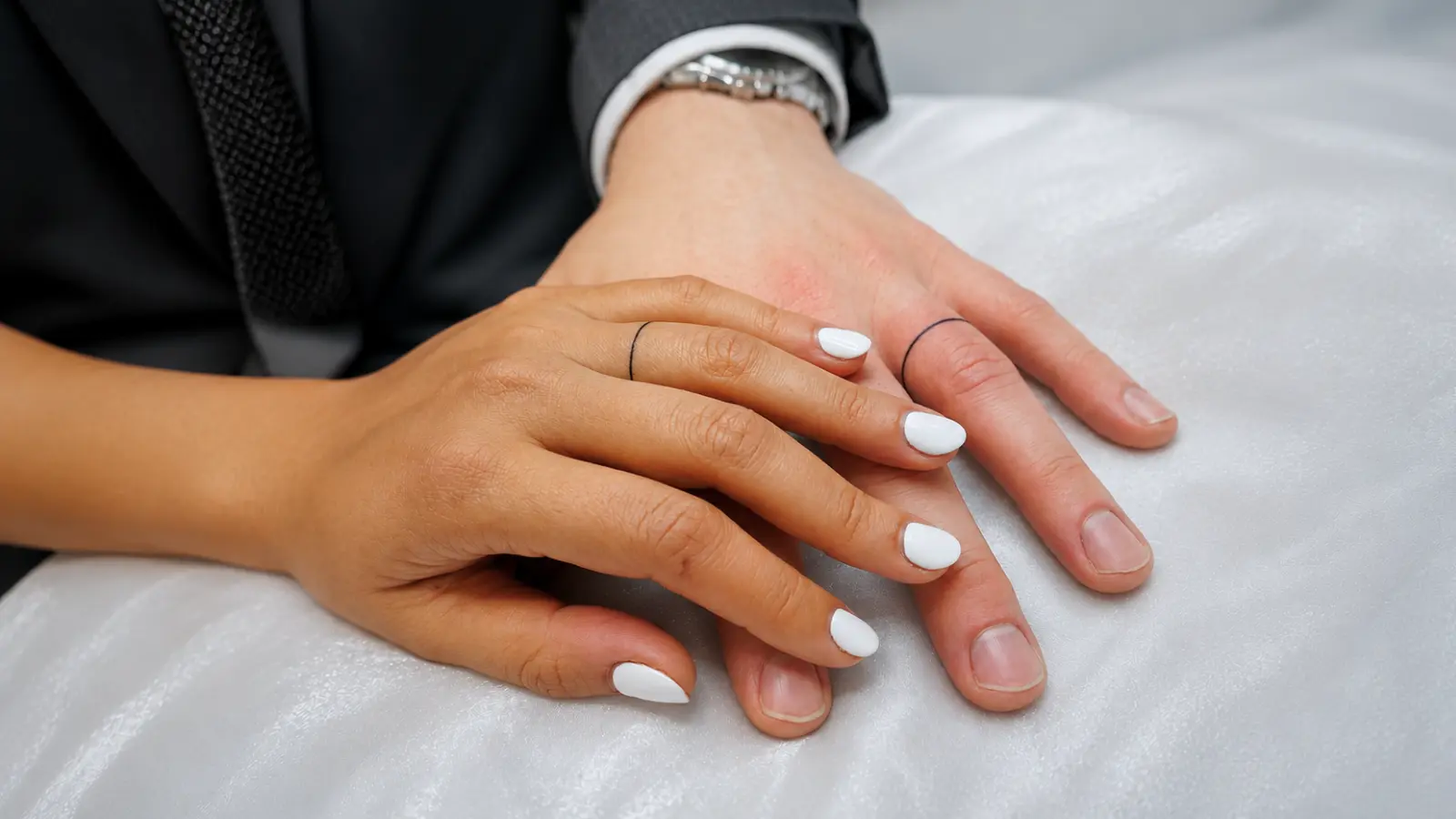
Couples who get wedding ring tattoos together face the same fundamental question that couples face when choosing any shared jewelry: how much to match, and how much to let each design be its own thing. The answers available are essentially the same as the answers available to couples choosing metal rings — identical designs, complementary designs, or entirely independent ones that share only the placement and intention.
Matching Versus Complementary Designs
Matching tattoos — the same design on both ring fingers, scaled to fit each person’s hand — are the clearest visual statement of a shared choice. When the designs are simple and bold, they hold up similarly over time on both hands. When the designs are intricate, the differences in how two people’s hands wear and age can produce tattoos that diverge more than the couple anticipated; the hands of someone who works outdoors and washes their hands constantly will age a fine-line tattoo faster than the hands of someone who works at a desk.
Complementary designs — related in concept or aesthetic but not identical — often produce more satisfying long-term results for couples whose preferences differ. One partner’s ring finger with a wave, the other’s with a shoreline. One with a word in English, the other with a translation in another language. The designs are clearly part of the same story without being the same object, which reflects something true about most partnerships and tends to age better visually than designs chosen primarily for their symmetry.
The Quiet Option: Private Placement
For couples who want the connection to be private rather than visual, the same approach that works for metal ring engraving works here: the same date, word, or symbol on the inside of each partner’s ring finger, visible only when the hand is held palm-up, invisible in most daily contexts, entirely legible to the people who know it is there. This is the quietest possible version of a couples’ tattoo and often the one that carries the most weight precisely because it is not performed for anyone else.
One consideration applies to any couples’ tattoo and is worth naming explicitly: both people need to want the tattoo independently, for their own reasons, not primarily because the other person wants it. The permanence of a tattoo makes this distinction more consequential than it might be for a purchasable, returnable, upgradeable object. For couples who want the visual connection of matching rings without the permanence of tattoos, the his and hers wedding rings guide covers how to connect two metal rings across different hands.
Wedding Ring Tattoos for Men
Men’s wedding ring tattoos have a specific practical context that drives a meaningful portion of their popularity: many men who work in environments where a metal ring is dangerous, uncomfortable, or prohibited find a tattoo a more viable permanent symbol than any wearable alternative. Electricians, mechanics, surgeons, nurses, firefighters, construction workers, and athletes are among the most naturally suited candidates for a ring tattoo, because the tattoo solves a real problem the ring cannot.
A Functional Choice as Much as a Symbolic One
For men in these situations, the ring tattoo is not primarily an aesthetic choice. It is a functional one that also carries symbolic weight. The tattoo stays on the finger through heavy work, gloves, and water without catching or conducting electricity, while men’s silicone wedding bands offer another practical option when a removable ring is preferred. This practical clarity is part of why ring tattoos have been more common among working men than in most other demographic groups for decades, often in the form of simple solid bands that were as far from precious as possible and exactly as meaningful.
Design Tendencies and What Works on Men’s Hands
In terms of design, men’s wedding ring tattoos tend toward the minimal: a solid band, a dotted line, a single word or initial, a small symbol with personal significance. The aesthetic is usually deliberate understatement, a mark that is clearly intentional without being decorative. Width matters on men’s fingers — a band that is too thin can look accidental on a wider finger, while a band that is appropriately weighted reads as intentional. Finding the right width for the specific finger, rather than defaulting to the narrowest possible line, is worth discussing with the tattoo artist beforehand.
Men who want something more elaborate — geometric patterns encircling the finger, a band with texture or detail, a design referencing a specific cultural tradition — can achieve compelling results, with the understanding that any design with significant internal detail will require more frequent touch-ups to maintain its appearance.
Wedding Ring Tattoos for Women
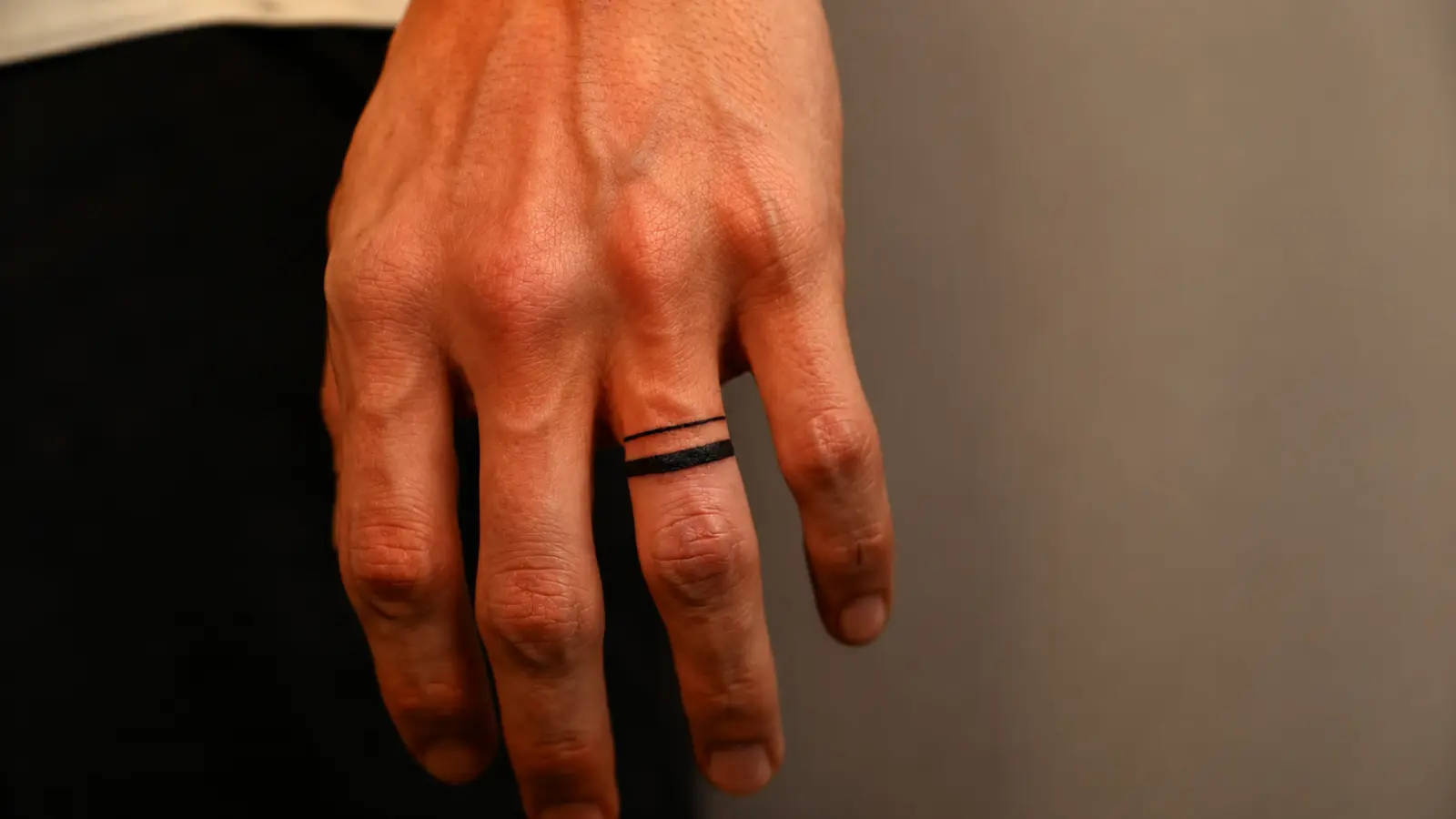
Women’s wedding ring tattoos span a wider range of design approaches than any other category in this space, from the most minimal possible mark to elaborate work covering the full finger and extending onto the hand. The popularity of fine-line tattooing in recent years has made delicate, intricate ring tattoos more common, and it has also produced more instances of beautiful fresh tattoos that have aged in ways their owners did not anticipate.
The Fine-Line Trade-Off
Fine-line designs — thin floral bands, delicate vine patterns, micro-script lettering, intricate geometric lacework — are among the most-requested wedding ring tattoo styles and among the most demanding to maintain on finger skin. The lines that look ethereal and precise when fresh become softer and less defined as the tattoo ages, and on finger skin that process happens faster than in most other locations. This does not mean fine-line designs are wrong for a ring finger, but it means choosing one requires an honest conversation with the tattoo artist about how the design is expected to look in three years, five years, ten years, and a genuine comfort with that future version.
Designs That Tend to Hold Up Best
The designs that tend to hold up best on women’s ring fingers while still offering more visual interest than a plain band: a thin solid band with one small design element, a clean word or name in a bold font rather than a fine script, a simple geometric pattern with clear edges rather than gradients, or a small symbol placed on the inner face of the finger where it is seen primarily by the wearer. Placement on the inner finger is sometimes chosen specifically because that surface experiences less UV exposure and somewhat less mechanical wear than the outer surface, which can extend the tattoo’s legibility modestly.
For women who want a ring tattoo that works alongside a metal engagement ring or wedding band rather than replacing one, placement matters. A tattoo placed directly beneath the metal ring will be covered much of the time and may wear from the ring’s contact with the skin. A tattoo placed just below the knuckle, above where the ring sits, or on the inner surface of the finger will remain visible regardless of whether the metal ring is being worn. For women exploring all the options for marking a ring finger permanently and personally, the wedding ring engraving covers inscriptions that work on the inside of a band in the same spirit as a tattoo’s private meaning.
Pros and Cons of Wedding Ring Tattoos
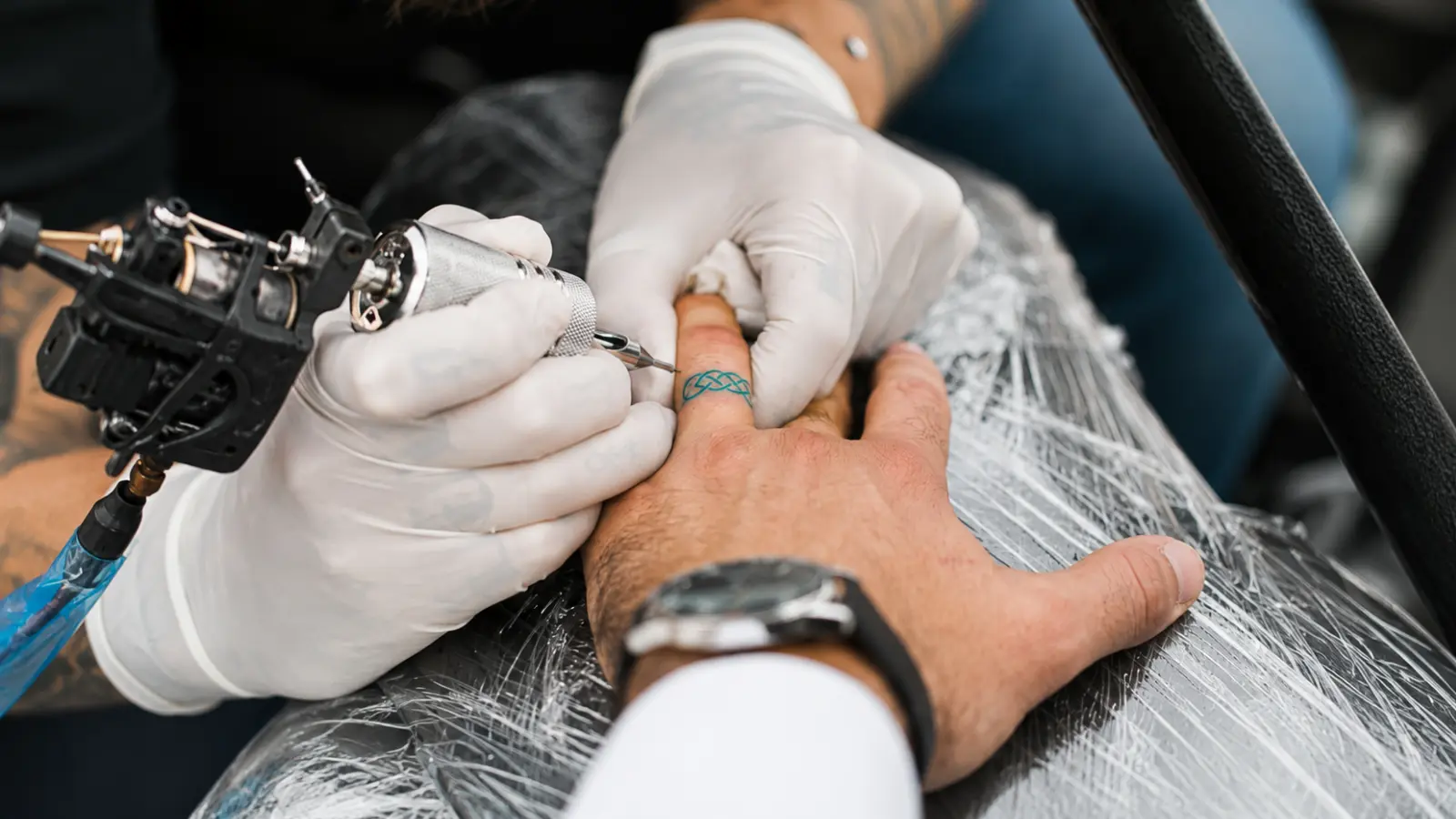
The case for and against a wedding ring tattoo is not primarily about aesthetics. It is about what kind of permanence you want, what your lifestyle actually requires, and whether the maintenance reality of finger tattoos is one you are genuinely prepared to manage.
The Genuine Advantages
Permanence as the point is the most cited advantage. A tattoo cannot be removed easily, misplaced, forgotten at home, or lost in the ocean. For people who prefer permanent alternative wedding rings, this is not a limitation but the entire reason to choose a tattoo over a traditional band — the permanence is the statement. Safety and practicality for physical work is a close second: a tattoo does not conduct electricity, catch on equipment, present a degloving risk, or require removal before medical procedures, making it the most practical permanent symbol available for people whose work makes a metal ring genuinely hazardous.
There is also no maintenance of the object itself. A metal ring can be scratched, dented, bent, lost, or stolen; a tattoo does not require a ring dish, a jeweler’s cleaning service, or an insurance policy. And there is cost efficiency over the long run: a well-executed ring tattoo from a reputable artist typically costs between $100 and $300 for a simple design, plus touch-up costs every few years, which over a lifetime is substantially less than the purchase and maintenance of a quality metal band — though the comparison only holds for people choosing the tattoo instead of a ring rather than alongside one.
The Real Limitations
Fading is not optional; it is guaranteed. This is the fact most commonly underestimated by people getting their first finger tattoo. Finger skin regenerates faster than most skin on the body, is constantly exposed to UV light, soap, water, and friction, and does not hold ink the way the upper arm or back does. A wedding ring tattoo will look softer, less precise, and less saturated within a few years of being done, and will require periodic touch-ups to maintain its original appearance. This is not a flaw in the tattoo; it is the nature of the placement.
Healing is also demanding, since the hands are used constantly, which makes keeping a healing finger tattoo clean, dry, and protected harder than healing a tattoo elsewhere, requiring genuine behavioral adjustment for two to four weeks. Professional contexts can occasionally complicate things, too: while tattoo visibility has become more accepted in recent years, a visible ring finger tattoo may still present challenges in certain workplaces or client-facing roles, a diminishing concern in most industries but a genuine one in some.
Removal is possible but not simple — finger skin makes laser removal more sensitive than removal from most other areas, and complete removal of a dark solid band can take multiple sessions over a long period. A tattoo should not be chosen with the assumption that it can be cleanly reversed if circumstances change.
The Truth Worth Saying Directly
Tastes and relationships change. Most people who get wedding ring tattoos do so at a moment of genuine certainty and genuine commitment, and many wear the tattoo happily for the rest of their lives. Some do not. A tattoo chosen at the height of a relationship’s early intensity is a tattoo that will be on the body through whatever the relationship becomes. This is not a reason to avoid the tattoo, but it is a reason to let some time, ideally years, pass between the wedding and the tattoo, so that what is being permanently inscribed is the relationship as it actually is rather than as it feels at its most heightened early moment.
What to Know Before Getting One
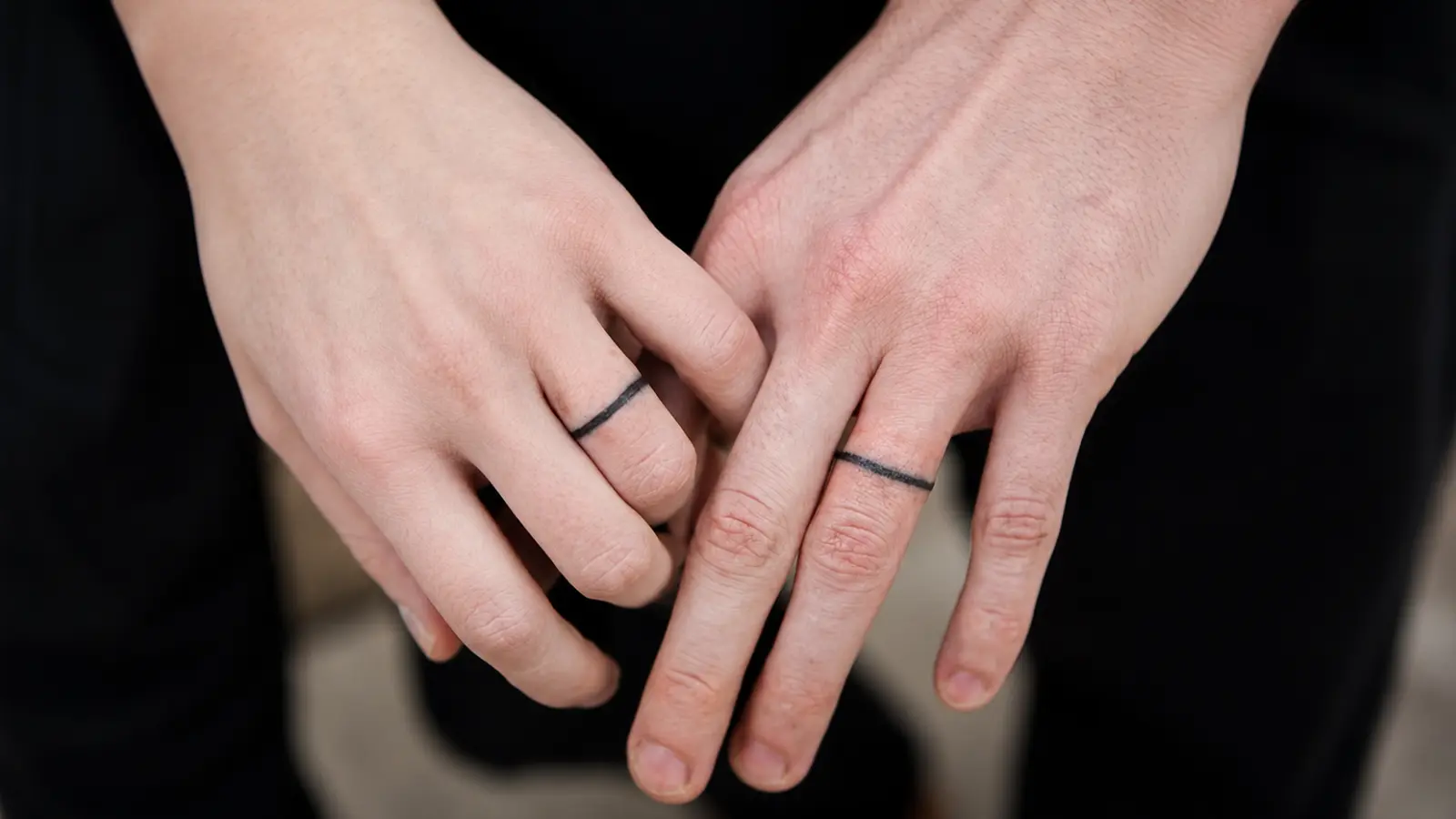
The most important decision has already been covered above: the design choice, made with an honest understanding of how finger tattoos age rather than how they look when fresh. What follows is the practical layer — the things that make the difference between a good experience and a regrettable one at the level of the appointment itself and the weeks after it.
Choose the Artist as Carefully as the Design
Finger tattoos require a specific skill set that not every tattoo artist has developed. The finger is a curved, narrow surface that is difficult to work on, and the relationship between ink saturation, line weight, and long-term legibility in this location is something experienced finger tattoo artists understand in a way that general tattoo artists may not. Looking for an artist whose portfolio includes healed finger tattoo work, not just fresh work, is the most reliable way to evaluate whether they understand what happens to finger tattoos over time. Fresh finger tattoo photographs are almost always beautiful; healed finger tattoo photographs tell the actual story.
Ask About the Healed Result, Not the Fresh One
The most useful question to ask a prospective tattoo artist is not “can you do this design?” but “how will this design look in three to five years on finger skin?” An artist who can give a specific, honest answer to that question, including what will change, what will hold, and what adjustments they would recommend, is an artist who understands the placement.
Timing Relative to the Wedding
A healing finger tattoo during the first weeks after getting it will peel, look patchy, and potentially be swollen or red. If the tattoo is planned in relation to a wedding date, scheduling it at least six to eight weeks before the ceremony allows full healing; scheduling it immediately after the honeymoon achieves the same and avoids any healing complications during travel. Getting a ring tattoo the week before the wedding, or during the honeymoon, occasionally produces beautiful photographs and more frequently produces a tattoo that is still in the patchy, awkward phase of healing when every photograph is being taken.
Sun Protection and Long-Term Maintenance
UV exposure is one of the primary causes of tattoo fading, and the hands receive more direct sun exposure than most other tattooed areas. Applying sunscreen to the tattooed finger as part of a daily routine meaningfully extends the tattoo’s legibility over time — an easy habit to establish and an easy one to neglect. Plan for touch-ups as part of the original commitment, too. A wedding ring tattoo that is never touched up will look noticeably different from its original appearance within a few years. Treating touch-ups as an expected part of having a finger tattoo, rather than as evidence that something went wrong, produces a different relationship to the maintenance.
When Not to Do It
A wedding ring tattoo is worth postponing when the decision is being driven primarily by the other person’s enthusiasm rather than genuine independent desire, when it is being done immediately before or during a wedding without time for reflection, when the relationship has not been tested by ordinary life, or when the design is being chosen primarily for how it looks in the inspiration photo rather than for how it will look on the specific finger, maintained over decades. None of these are prohibitions — they are conditions under which waiting produces better outcomes than acting. For those who want permanent personal meaning on their ring without a tattoo, the unique wedding ring covers unconventional design approaches, and the engraving guide covers the options in full.
Wedding Ring Tattoos Ideas
Wedding ring tattoos are a meaningful alternative to traditional rings, but choosing the right design matters. Explore our collection of tattoo ideas, couple designs, minimalist styles, and inspiration for a symbol made to last.
Permanent Means Something Different Here
A wedding ring tattoo represents commitment in a way a traditional ring cannot. A ring can be removed, replaced, resized, or changed over time. A tattoo becomes part of the person wearing it, which is exactly why the decision deserves more thought.
For some couples, that permanence is the reason it feels right. For others, the flexibility of a traditional wedding ring is a better match for the way they want their symbol of marriage to evolve. Neither choice is more meaningful — the right choice is the one that reflects how you want to carry that commitment every day.
Frequently asked questions (FAQ)
Are wedding ring tattoos a good idea?
Wedding ring tattoos can be a good idea for couples who want a permanent symbol of marriage, cannot comfortably wear metal rings, or prefer something that cannot be lost or removed. However, they require more consideration than traditional rings because finger tattoos fade over time, need maintenance, and cannot be easily changed. The best choice depends on your lifestyle, expectations, and how comfortable you are with permanent body art.
Do wedding ring tattoos fade over time?
Yes. Wedding ring tattoos usually fade faster than tattoos on many other parts of the body because fingers are constantly exposed to movement, washing, sunlight, and friction. Simple, bold designs with darker ink usually age better than very thin lines or highly detailed artwork. Many people need occasional touch-ups to keep a finger tattoo looking clear over the years.
What are the best wedding ring tattoo ideas?
The best wedding ring tattoo ideas are designs that balance personal meaning with long-term readability. Simple bands, initials, dates, meaningful words, geometric symbols, and minimal designs often work well because they remain recognizable as the tattoo ages. Very detailed designs may look beautiful at first but can become harder to maintain on finger skin.
Is a wedding ring tattoo better than a traditional ring?
A wedding ring tattoo is not necessarily better than a traditional ring — it represents a different type of commitment. A tattoo cannot be lost, forgotten, or damaged like jewelry, which can be helpful for certain jobs and lifestyles. A traditional ring offers more flexibility because it can be resized, changed, upgraded, or passed down. The better option depends on what kind of symbol feels right for you.
Do wedding ring tattoos hurt?
Wedding ring tattoos can feel more uncomfortable than tattoos in softer areas because the skin on the finger is thin and close to the bone. However, most wedding ring tattoos are small and take a relatively short amount of time to complete. The experience varies from person to person, but many people describe the discomfort as manageable because of the small tattoo size.
What should you know before getting a wedding ring tattoo?
Before getting a wedding ring tattoo, understand how the design will age, how often it may need touch-ups, and whether the style works well on finger skin. Choose an artist experienced with healed finger tattoos, not only fresh designs. It is also important to think about whether you want the permanence of a tattoo itself — not just the appearance of one.