A lace wedding veil is one of the most timeless and elegant bridal accessories, adding texture, romance, and beautiful detail to almost any wedding dress. The biggest question most brides have isn’t whether to wear lace it’s how to choose a veil that complements their gown without competing with it.
From delicate Chantilly edges to dramatic Alençon borders, every lace style creates a different visual effect. Understanding those differences makes choosing your veil much easier.
This guide explains everything you need to know about lace wedding veils, including lace types, dress pairings, veil lengths, styling tips, and how to create a beautifully balanced bridal look.
Types of Lace Wedding Veils
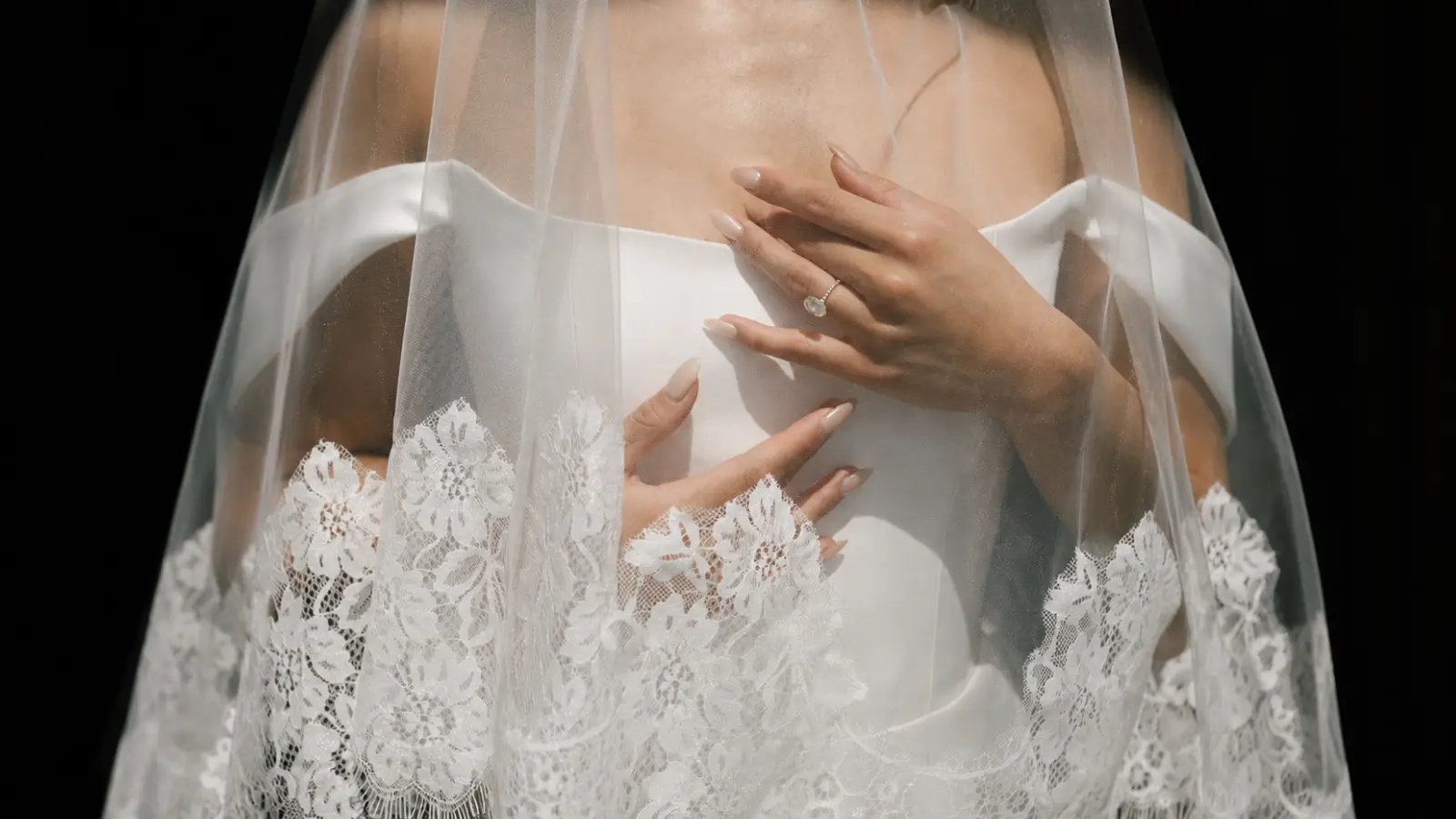
Not all lace veils are built the same way, and the difference between them matters when you’re deciding how much lace you want and how prominently it will read in the overall look. Understanding the basic construction types helps you ask the right questions at the salon rather than reacting to what’s on the rack.
Lace Edge Veil
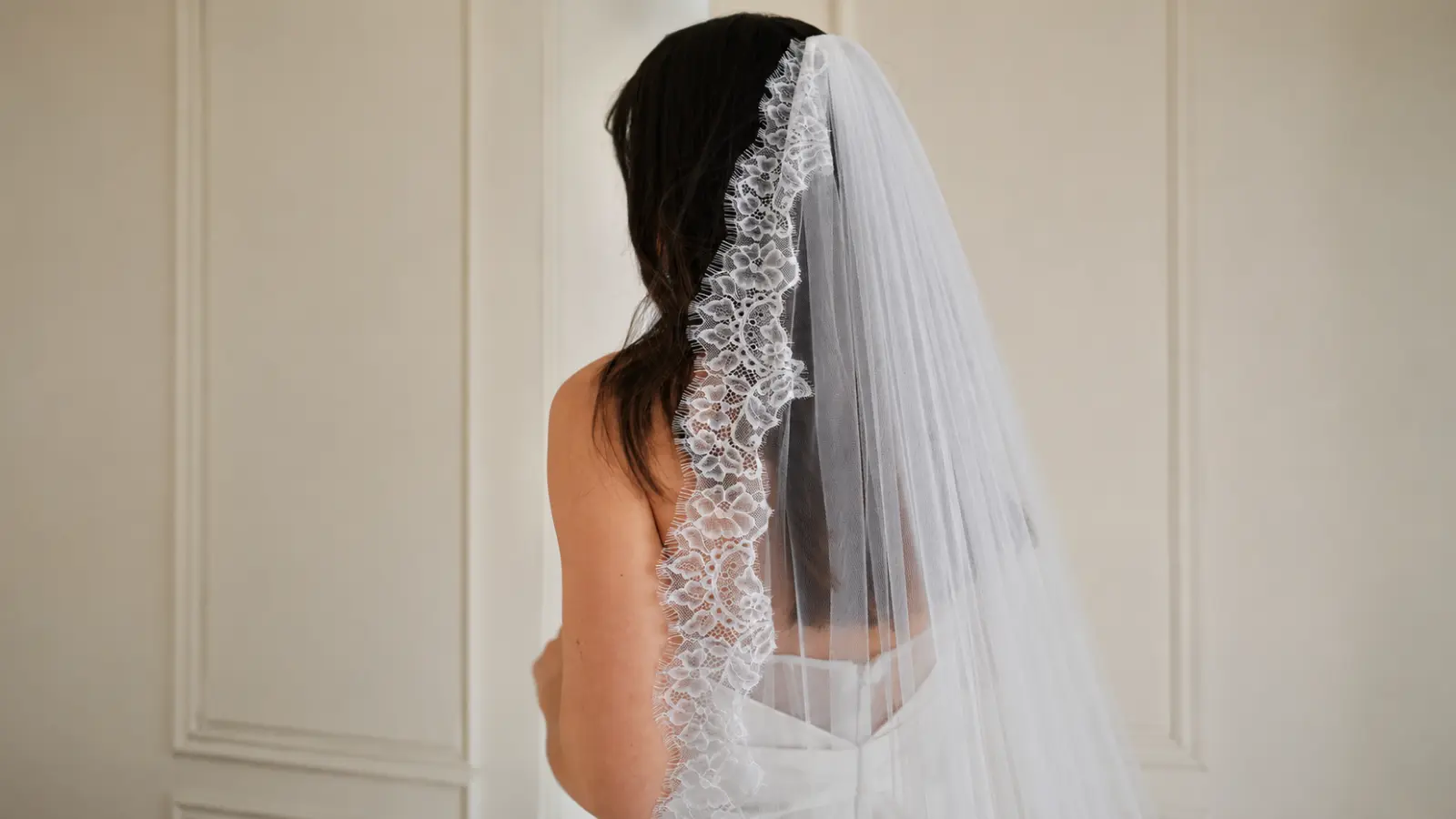
The most common type. A standard tulle veil — gathered at a comb, falling behind the bride — with a strip of lace applied along its outer border. The lace edge can be as narrow as a half-inch scallop or as wide as four to six inches of decorative trim. The tulle itself remains the dominant fabric; the lace is a finishing detail that adds texture and visual interest at the hem. This is the style most brides are picturing when they search for a lace wedding veil.
Wide-Border Lace Veil
A variation of the lace edge veil where the lace border is significantly wider — sometimes spanning several inches along the bottom and sides of the veil. At this width, the lace becomes a visual feature rather than a trim; it reads differently at a distance and adds considerable weight to the veil, particularly at longer lengths. This type works beautifully with minimal or plain dresses where the veil is meant to carry the decorative element, and requires more careful consideration with an already-detailed gown.
Full Lace Veil (Mantilla)
A veil constructed entirely of lace, or dominated by lace across its full surface. In bridal terms, this is the mantilla — a circular or oval piece draped over the head without a gathered comb. Its construction, placement, and pairing logic are specific enough to be a category of their own. This guide focuses on lace-edged tulle veils; for everything about the mantilla, see the mantilla wedding veil.
Knowing which type you’re drawn to before your appointment lets you focus the conversation rather than reacting to whatever the stylist reaches for first. The distinction between a narrow scallop edge and a wide lace border, in particular, is easy to see in a reference image but harder to explain from memory.
Lace Types Used on Bridal Veils
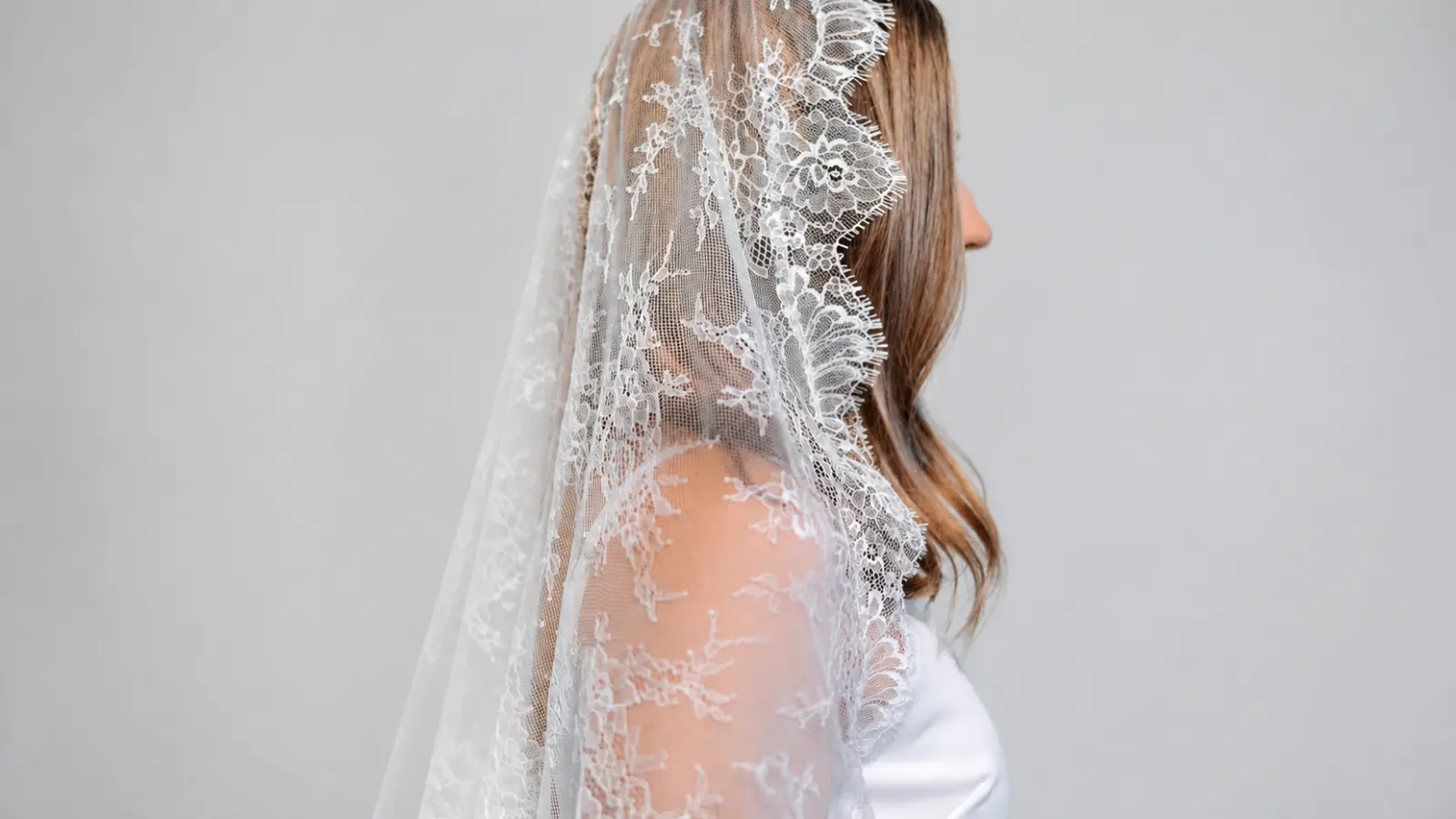
The lace used on a veil is not one thing. The type of lace affects the visual weight, the drape, the formality of the look, and critically, how it relates to the lace on the dress. Most brides encounter these in the salon without a vocabulary for them; having one makes the conversation faster and the decision more intentional.
Chantilly Lace
The most widely used lace on bridal veils. Chantilly is delicate, flat, and lightweight, with a fine floral or scrolling pattern and soft, slightly scalloped edges. It doesn’t add significant weight to the veil and drapes naturally at any length. Because it reads as refined rather than ornate, Chantilly is the most forgiving lace when it comes to pairing — it works with lace dresses, plain dresses, and every formality level.
Alencon Lace
Distinguished by a corded outline around each motif that gives the pattern a raised, sculptural quality. Alencon reads as more formal and more prominent than Chantilly, particularly at wider trim widths. It’s a strong choice when you want the lace to register clearly in photographs. Because it’s heavier and more visually dominant, it pairs best with either a plain dress where it becomes the focal point, or with a gown whose lace has similar weight and structure.
Venetian and Guipure Lace
Heavier, bolder laces with substantial, three-dimensional patterns and no net background — the motifs connect directly to each other rather than sitting on a mesh ground. Venetian and guipure lace on a veil make a strong statement and look best with simpler gowns. On a veil paired with an already-detailed dress, they can easily overwhelm the look.
Scallop Trim and Re-embroidered Lace
A scallop trim is a shaped lace edge — rather than a straight border, the hem curves in a repeating arc. It adds softness to the veil’s silhouette without adding the visual weight of a wide lace border, and is often used in combination with Chantilly or Alencon patterns. Re-embroidered lace has thread added over the base pattern for depth and texture; it’s a middle ground between the flatness of Chantilly and the full dimension of Alencon.
When comparing options at the salon, ask to see each lace type in the actual width you’re considering — not just a corner sample. A two-inch Chantilly border and a two-inch Alencon border look quite different at full veil length, and understanding how lace fits among other wedding veil materials can also help you compare weight, drape, and texture more clearly.
Can You Wear a Lace Veil With a Lace Dress?
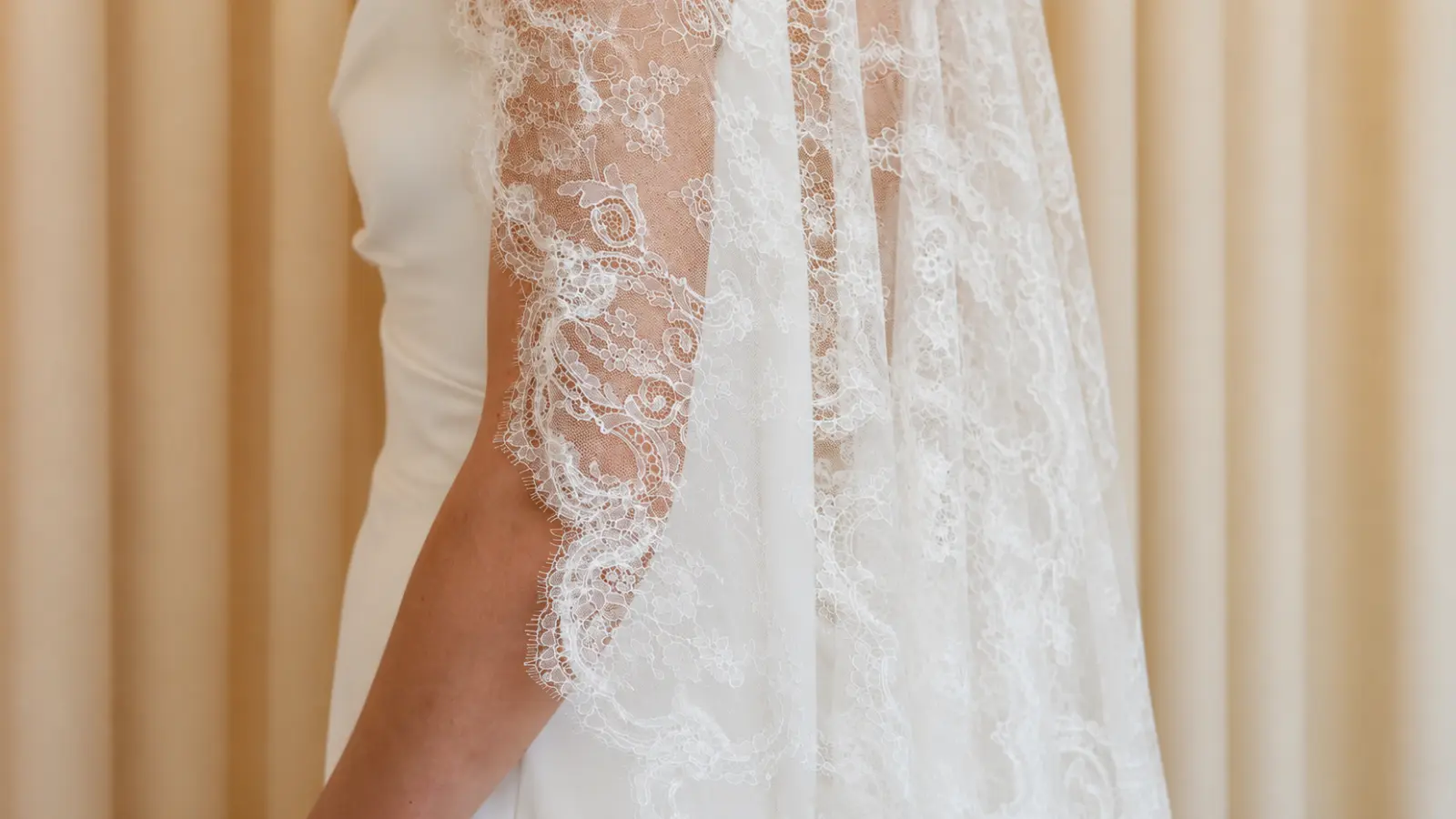
This is the question that sends most brides searching in the first place, and it deserves a clear answer: yes, a lace veil with a lace dress works — and when it’s done well, it reads as a fully considered bridal look rather than a coincidence of matching fabric. The combination becomes problematic only when two equally ornate lace elements compete for visual priority without any differentiation between them.
The principle that makes lace-on-lace work is scale contrast: the lace on the veil and the lace on the dress should differ in pattern weight, trim width, or visual prominence, so that one element leads and the other supports. A few practical applications of that principle:
- If the dress has a lace bodice with prominent pattern detail, choose a veil with a narrow, delicate lace edge — a Chantilly scallop or a light ribbon border. The dress’s lace leads; the veil’s lace echoes without duplicating.
- If the dress has an all-over lace overlay, a plain or very simply edged veil is often the strongest choice. The dress is already carrying the lace statement; the veil’s job is to complement without adding more visual complexity.
- If the dress has lace only at the hem or as an accent, the veil can carry a more substantial lace border without the two competing — the pattern weights and placement are different enough to coexist.
- Avoid pairing a wide, ornate lace border on the veil with a heavily lace-ornamented dress, unless one lace is significantly lighter or more minimal than the other. Two bold lace elements at the same visual scale tend to make both look busier than either does on its own.
One note worth keeping in mind: the lace on the veil does not need to match the lace pattern on the dress. In fact, attempting an exact pattern match usually doesn’t work — lace is made in so many variations that a near-match reads as an error rather than a coordinated decision. A complementary lace at a different scale is almost always more effective than a close approximation of the same pattern.
Lace Veil With a Plain or Minimalist Dress
The lace-with-plain-dress pairing follows a different but equally clear logic. When the dress has no lace and minimal ornamentation, the veil becomes the place where the decorative detail lives — and a lace edge can carry that role very effectively.
This is one of the most reliable combinations in bridal styling, precisely because the hierarchy is unambiguous: the dress provides a clean, uncluttered silhouette, and the veil adds the texture and craft that the gown deliberately withholds. The lace reads clearly against the plain fabric and photographs with definition. At longer lengths — chapel or cathedral — a lace-edged veil on a minimal dress creates a genuinely striking image because there’s nothing else competing with the fabric in the frame.
The practical decision here is how wide a lace border fits the scale of the look. A narrow scallop edge is a subtle nod to tradition; a wide decorative border makes the veil the focal point. Both are valid, and the right choice depends on how prominent you want the veil to be relative to the dress. If the dress is very architectural or modern in its minimalism, a lighter lace edge tends to read better than an elaborate border, which can feel tonally mismatched even if the construction is technically clean.
Dress Type and Best Lace Veil Choice
The table below brings together the most common dress situations and the lace veil choices that tend to work best with each. These are guidelines, not rules — individual dresses vary, and a single appointment with the actual gown will always be more informative than any chart. Use this as a starting point for the conversation, not a final answer.
| Dress Type or Detail | Recommended Lace Veil Approach | Why It Works |
|---|---|---|
| All-over lace overlay (full lace gown) | Plain veil, or very narrow scallop edge | The dress carries the lace; the veil adds softness without competing |
| Lace bodice, plain or tulle skirt | Narrow to medium Chantilly or scallop edge | Echoes the bodice’s lace without duplicating it; scale contrast maintained |
| Lace hem or lace accent detail | Medium-width lace border, Chantilly or Alencon | The two lace elements are at different locations; they coexist cleanly |
| Beaded or embroidered dress (no lace) | Narrow lace trim or plain veil | Beading and lace can compete; simpler veil keeps the dress as focal point |
| Plain, minimal, or crepe gown | Medium to wide lace border; any lace type | Veil carries the decorative detail; dress provides the clean backdrop |
| Floral-embroidered or heavily detailed gown | Plain edge or very light trim | Two ornate elements compete; minimal veil lets the dress read clearly |
| A-line or ballgown, any detail level | Most lace veil options; match trim weight to dress ornamentation | The most forgiving silhouette for veil experimentation |
| Sheath or column, minimal detail | Delicate scallop or narrow border; avoid very wide lace | Wide lace can overwhelm the dress’s clean line; fine trim adds without disrupting |
The common thread across every row: the veil’s lace should have a clear relationship to the dress — either echoing a detail at a different scale, or providing a decorative element the dress deliberately doesn’t have. Creating the right wedding dress with veil combination means treating those two pieces as one bridal look rather than choosing the lace veil in isolation.
Lace vs. Pearl vs. Plain Veil
Many brides narrow their veil choice down to these three options before the appointment, and it’s a useful shortlist because the three differ in what they add to the look and how they relate to the dress.
A lace edge veil adds texture, craft, and a traditional bridal quality. It works across formality levels, photographs with definition, and draws the eye to the hem of the veil in a way that reads clearly in images. It’s the most detail-forward of the three options.
A pearl edge or pearl-detail veil adds warmth, luminosity, and a softer, more romantic quality than lace. Pearl trim catches light differently — it glows rather than patterns — and tends to read as elegant without reading as ornate. It’s a strong middle-ground option for brides who want some detail on the veil but don’t want the visual complexity of lace. For a closer look at pearl veil options and pairing principles, see the pearl wedding veil.
A plain veil — raw edge, rolled hem, or simple cut edge — adds no detail of its own. Its contribution is movement, softness, and visual mass. A plain veil lets the dress speak entirely, and at longer lengths, the fabric alone creates the effect. It’s often the right call for heavily detailed gowns, for brides who prefer a clean and modern look, and for outdoor settings where the movement of unencumbered fabric is part of the appeal.
These aren’t ranked options. A plain veil on the right dress in the right setting is not less considered than an elaborate lace border — it’s a different decision with its own visual logic. The question to ask at the appointment is which detail level serves the dress you’re wearing and the look you want to create.
How Lace Reads at Different Lengths
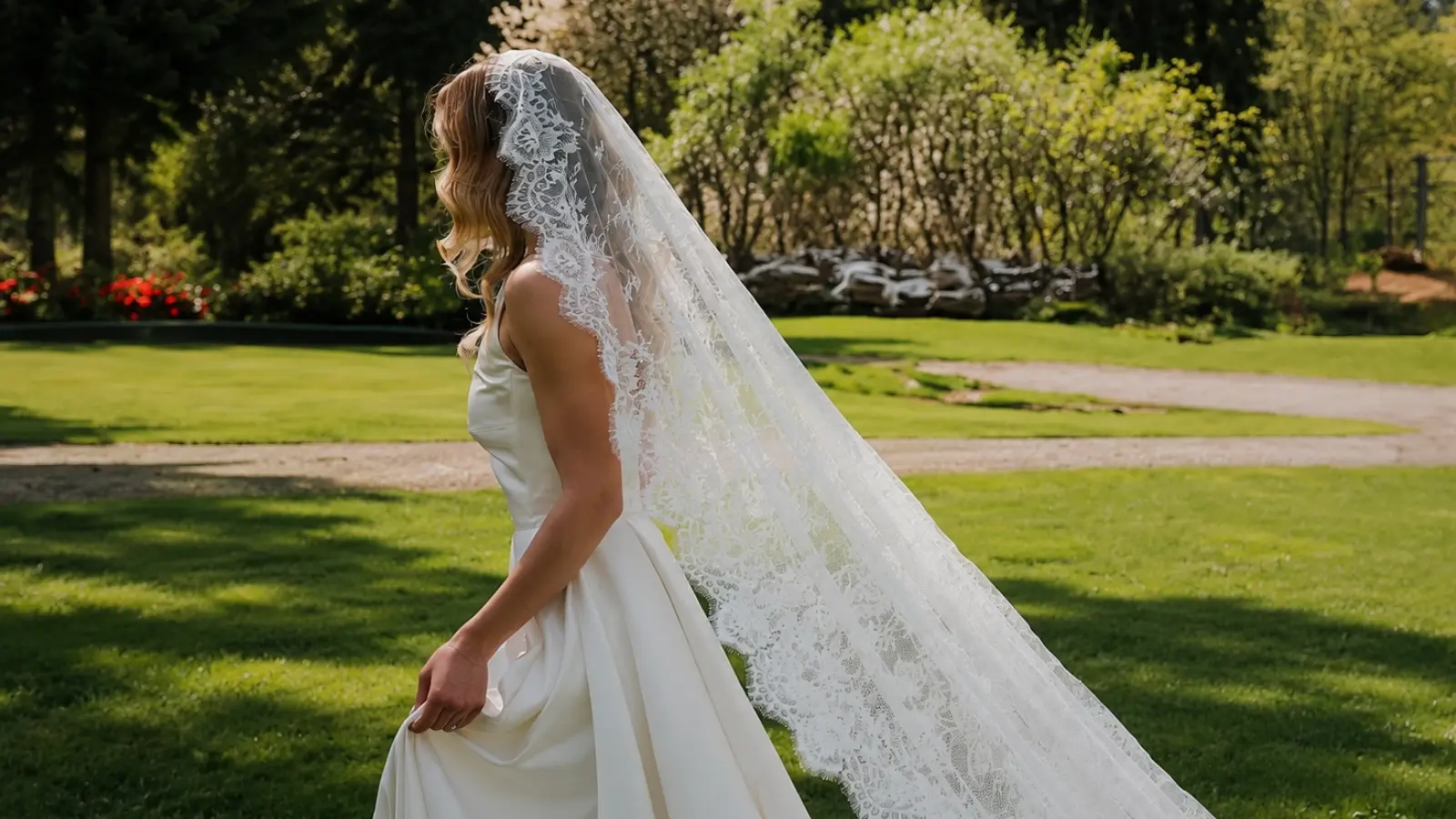
One underappreciated variable in lace veil selection is how the trim behaves at different lengths. A one-inch Chantilly scallop on an elbow-length veil reads as a soft, pretty detail. The same trim on a cathedral-length veil means that lace edge trails behind the bride for several feet — a significantly more prominent visual effect than the same trim at a shorter length.
Practically, this means:
- At fingertip or elbow length, a wider or more elaborate lace border is proportional and manageable. The total amount of lace visible at any given moment is limited by the veil’s length.
- At chapel length, even a medium-width lace border is visible across a full trailing sweep. If you want a lace detail that reads clearly in photographs — including ceremony shots from the back of the aisle — chapel length with a defined lace edge is one of the most effective combinations.
- At cathedral length, the lace edge is the visual signature of the entire trailing sweep. A bold, wide border at cathedral length makes a very strong statement. A narrow scallop at cathedral length adds texture without dominating. The longer the veil, the more carefully the lace width needs to be calibrated against the dress detail.
Before settling on a lace width, ask to see the full veil unrolled or held at its actual length, not just the trimmed sample corner. The trim reads differently across two inches versus two feet of fabric. For a full look at how each veil length differs in practice, the wedding veil lengths covers every standard measurement with practical context.
Lace Blusher Layer
A lace blusher is a face-covering front layer on a two-tier veil, where the blusher itself is trimmed in lace or made of a lace-edged fabric. It adds the framing effect of lace around the bride’s face during the processional, which photographs warmly in both close and wide shots.
The lace on a blusher tends to be more visible than lace at the hem of a trailing veil, simply because it’s at face level and in close proximity to the bride’s features throughout the ceremony. A bold or heavy lace on a blusher can be overpowering at close range; a delicate Chantilly scallop reads as soft and bridal. If the blusher and the back layer are both lace-edged, make sure the trim on each is consistent — mismatched lace on the two tiers reads as an oversight.
The blusher mechanics — the lifting moment, the choice to wear it down or pinned back, how it attaches — are covered in the blusher veil. This section is specifically about the lace detail on that layer and how it relates to the rest of the bridal look.
What to Avoid
Most lace veil mistakes fall into a few consistent patterns. These are the ones most worth knowing before you shop.
- Trying to match the lace pattern exactly. This is the most common misstep with lace dresses and lace veils. The lace on your gown and the lace on a veil are almost certainly from different manufacturers with different patterns. A near-match that isn’t quite right reads as an error; a deliberate contrast at a complementary scale reads as a decision. Don’t try to duplicate — try to complement.
- Choosing a wide lace border without trying it next to the dress. A wide, ornate lace border can look beautiful on the veil rack and feel immediately wrong next to a heavily detailed dress. The only way to know is to see them together. Bring your dress details, a fabric swatch, or at minimum a high-quality photo to the veil appointment.
- Ignoring the trim width at the intended veil length. Lace width and veil length are interdependent. A trim that feels right on a fingertip veil may be overwhelming at cathedral length. Always evaluate the lace at the actual length you’re considering, not on a sample panel.
- Treating a scallop edge and a lace border as the same thing. A scallop edge is a shaped cut in the veil’s hem — it creates a soft, decorative silhouette without any applied lace. A lace border is a separate strip of lace attached to the hem. Both are valid; they read quite differently and require different considerations when paired with the dress.
- Underestimating the weight added by lace. Heavier lace trims — Alencon, Venetian, re-embroidered — add meaningful weight to a veil, particularly at longer lengths. That weight affects how the veil hangs, moves, and holds position throughout the day. Ask to hold the full veil rather than just the sample edge, and wear it for a few minutes before deciding.
The clearest preventive measure for all of these: try the actual veil with your actual dress, or at minimum with a dress of the same silhouette and detail level. Lace decisions made in isolation — without the dress as context — are the ones most likely to need rethinking at the final fitting.
Lace Wedding Veil Inspiration
Discover beautiful lace wedding veil inspiration featuring delicate Chantilly lace, elegant Alençon designs, romantic cathedral veils, and timeless bridal looks. Explore stunning dress pairings, graceful lace details, and classic styling ideas to find the perfect lace veil for your wedding day.
Choosing the Perfect Lace Wedding Veil
A lace wedding veil is more than a beautiful finishing touch—it has the power to bring your entire bridal look together. The right lace complements your dress, enhances its details, and creates a balanced silhouette without overwhelming it.
Whether you’re drawn to a delicate lace edge or a dramatic cathedral design, the best choice is the one that feels harmonious with your gown and reflects your personal style. With the right combination of lace, length, and proportion, your veil becomes one of the most memorable details of your wedding day.
Frequently asked questions (FAQ)
How do you choose the right lace wedding veil?
Choose a lace veil by looking at the dress first. Consider the amount of lace already on the gown, the weight of the pattern, the width of the veil’s border, and the overall balance of the bridal look. The goal is not to match every detail exactly but to create harmony between the veil and the dress. One element should always lead while the other supports it.
Can you wear a lace veil with a lace dress?
Yes. A lace veil often looks intentional and elegant when the lace on the veil and the lace on the dress differ in scale, weight, or placement. If the gown already features heavy lace, a lighter veil usually creates better balance. If the dress is simple, the veil can carry a more decorative lace border without overwhelming the look.
Should a lace veil match the lace on the dress exactly?
No. Trying to reproduce the same lace pattern usually creates an almost-match that feels accidental. Different but complementary lace patterns almost always produce a more refined result. Focus on similar visual weight instead of identical motifs.
What is the difference between a lace veil and a mantilla veil?
A lace wedding veil is generally a traditional tulle veil finished with a lace border or trim. A mantilla is circular or oval, drapes over the head, and frames the bride’s face with lace around the entire silhouette. Although both use lace, they differ in construction, placement, and visual effect.
What type of lace is used on wedding veils?
Chantilly lace is the lightest and most versatile option. Alençon lace has raised corded motifs and a more formal appearance. Venetian and guipure lace create bold visual impact, while re-embroidered lace adds extra depth and texture. The best choice depends on the dress and on how prominent you want the veil to appear.
What is a lace edge veil?
A lace edge veil is a tulle veil finished with lace only around its outer border. The trim may be very narrow or several inches wide. As veil length increases, even a modest lace border becomes much more visually noticeable because it extends across the entire trailing edge.
Does veil length change how lace looks?
Yes. The same lace border appears much more dramatic on a cathedral veil than on a fingertip veil because the decorative edge extends across a much larger area. Before choosing lace width, always evaluate it together with the intended veil length rather than considering the trim in isolation.