
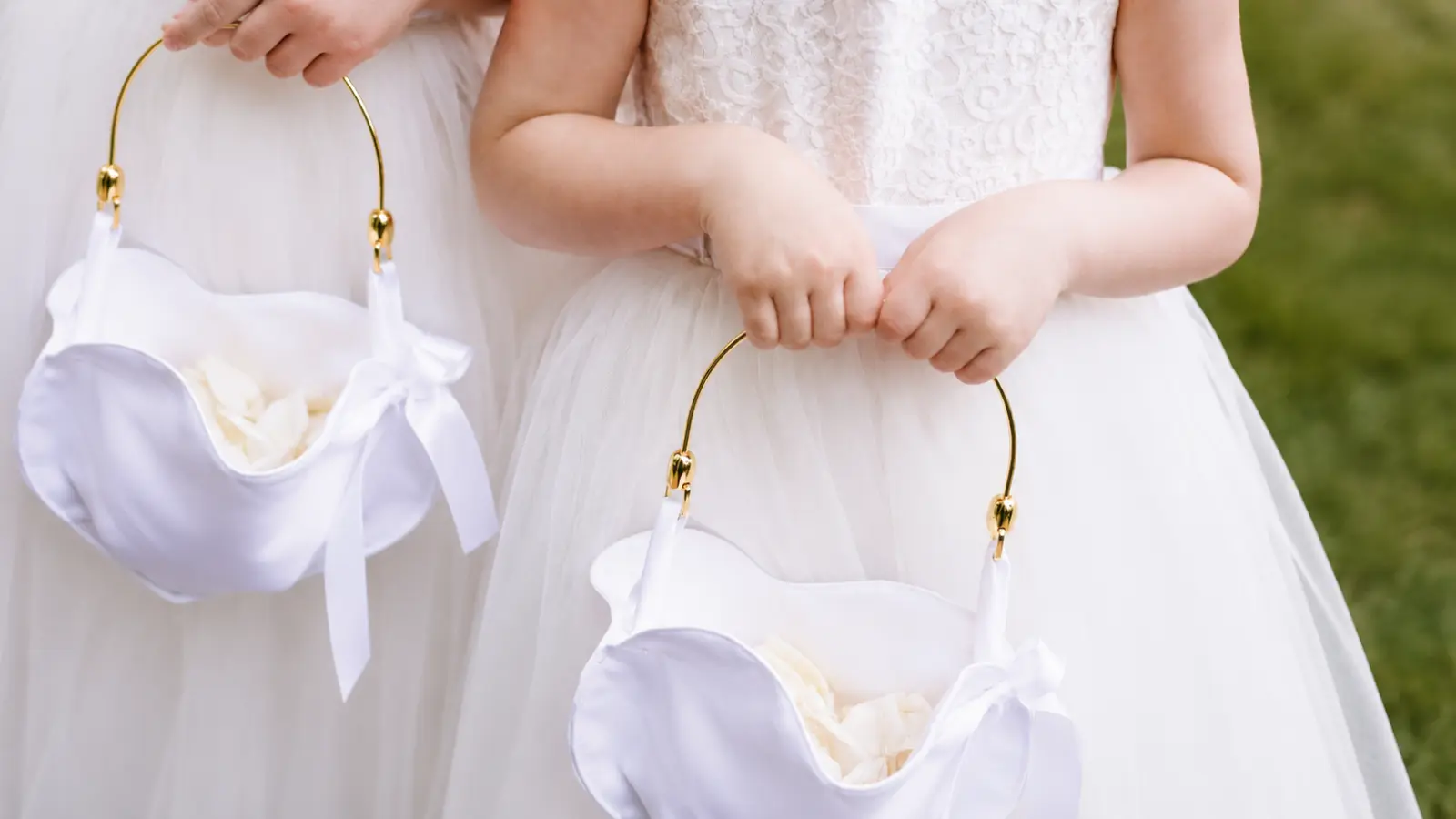
Flower girl baskets are one of the most recognizable details of a wedding processional, but carrying a basket or scattering petals is not required. The right choice depends on the child’s age, the ceremony style, and what the venue actually allows on the aisle.
A traditional petal basket may work beautifully for one flower girl, while a toddler may be more comfortable carrying an empty basket, a single flower, or nothing at all. Mini bouquets, flower wands, and simple signs can also create a meaningful processional moment without adding a complicated task.
This guide explains how to choose a flower girl basket, including petal options, venue restrictions, basket alternatives, ideas for toddlers, mini bouquets, flower wands, single flowers, signs, and the practical details that make each option easier for a child to carry.
Does the Flower Girl Need a Basket?
No — and it’s worth being clear about that upfront, because a lot of wedding planning treats the basket as a given. A flower girl basket is a tradition, not a requirement. The flower girl’s role itself is simply to walk before the bride; what she carries, if anything, is secondary to that.
The basket became standard because it gives a child something to hold and a task to complete — both useful when you’re asking a small person to walk in front of a crowd. But those same goals can be met with a bouquet, a wand, a single flower, or nothing at all. The basket earns its place when it’s genuinely the right fit: when the child is old enough to scatter petals without stopping, when the venue permits loose petals, and when the style of the wedding calls for something traditional. When any of those conditions don’t apply, another option is likely a better choice.
The Traditional Flower Girl Basket
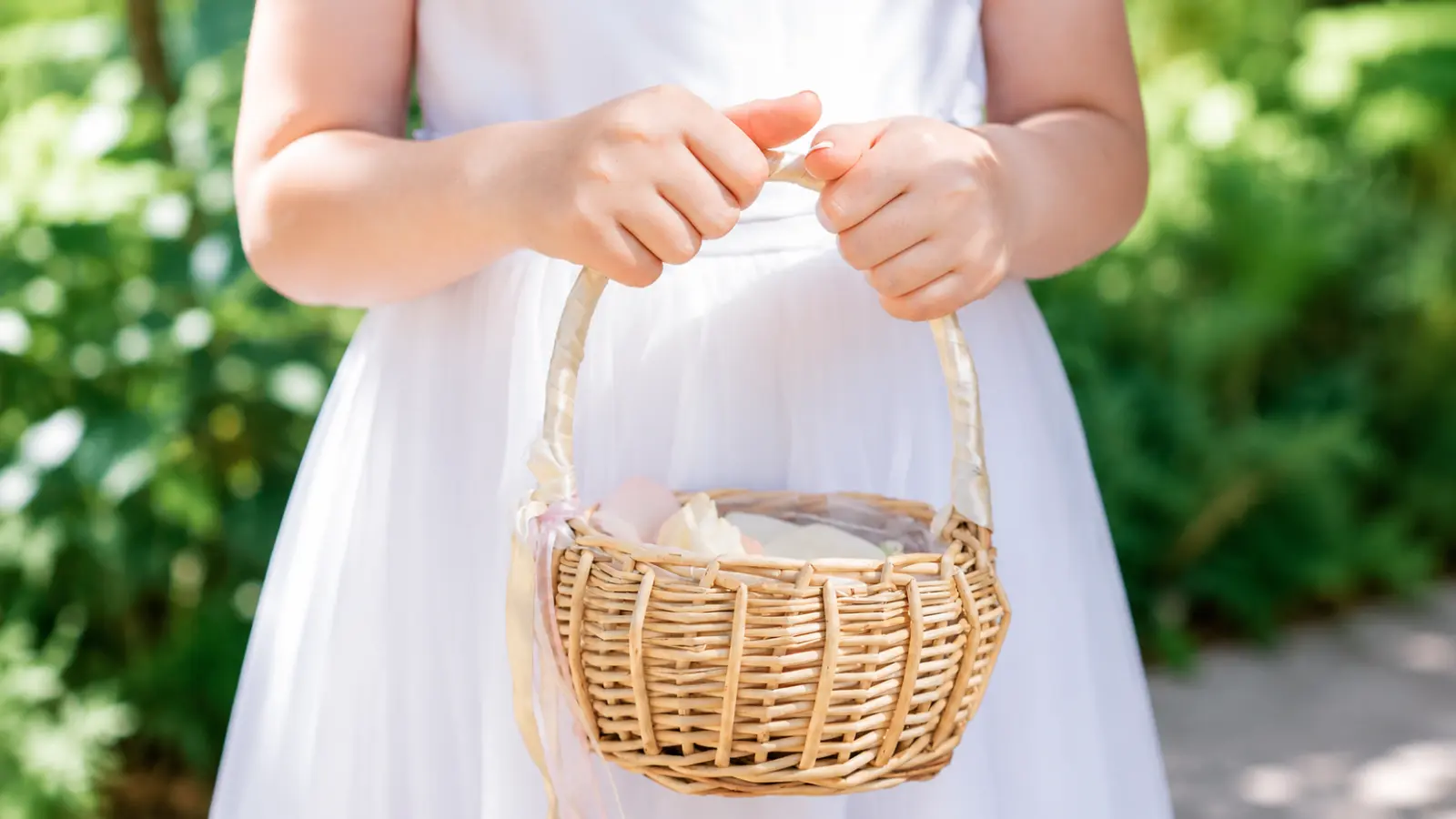
A classic flower girl basket is typically wicker or white woven, small enough for a child to hold comfortably in both hands or loop over one arm, and filled with loose petals to scatter down the aisle. The style has lasted because it works — it photographs well, gives the child a clear role, and connects to a long ceremonial tradition. It also signals to guests that the bride is about to enter, which is part of what the processional moment is designed to do.
When choosing a basket, the practical details matter more than the decorative ones. The basket should be lightweight even when filled — a heavy wicker basket with a metal handle becomes difficult for a young child to manage across a full aisle length. Handles should be smooth rather than rough or sharp-edged, and the opening should be wide enough for the child to reach in easily while walking. A basket that tips, snags, or requires two-handed concentration is going to cause problems regardless of how it looks in the product photos.
White and cream are the most traditional finishes, but natural wicker, blush, and floral-wrapped baskets all work depending on the wedding’s palette. The decoration on the basket matters less than whether the child can carry it without thinking about it.
How Many Petals Does a Flower Girl Need?
The amount of petals you need depends on the aisle length and width, the size of the petals, and how light or full you want the scatter to look. It also depends on how generously the child scatters as she walks.
Because children are unpredictable on the day, it’s worth having a little extra prepared. Petals packed into the basket tightly tend to flow out in clumps when a child reaches in, so a loosely filled basket with a slightly generous amount gives better coverage. The visual effect at aisle distance doesn’t require a carpet of petals — a light scatter reads beautifully in photos and puts less pressure on the child to be consistent about it.
If two flower girls are sharing one aisle, dividing the total between them still produces a full petal path. Each carries her own basket with half the total amount, and the visual result is essentially the same.
Fresh Petals vs. Faux Petals
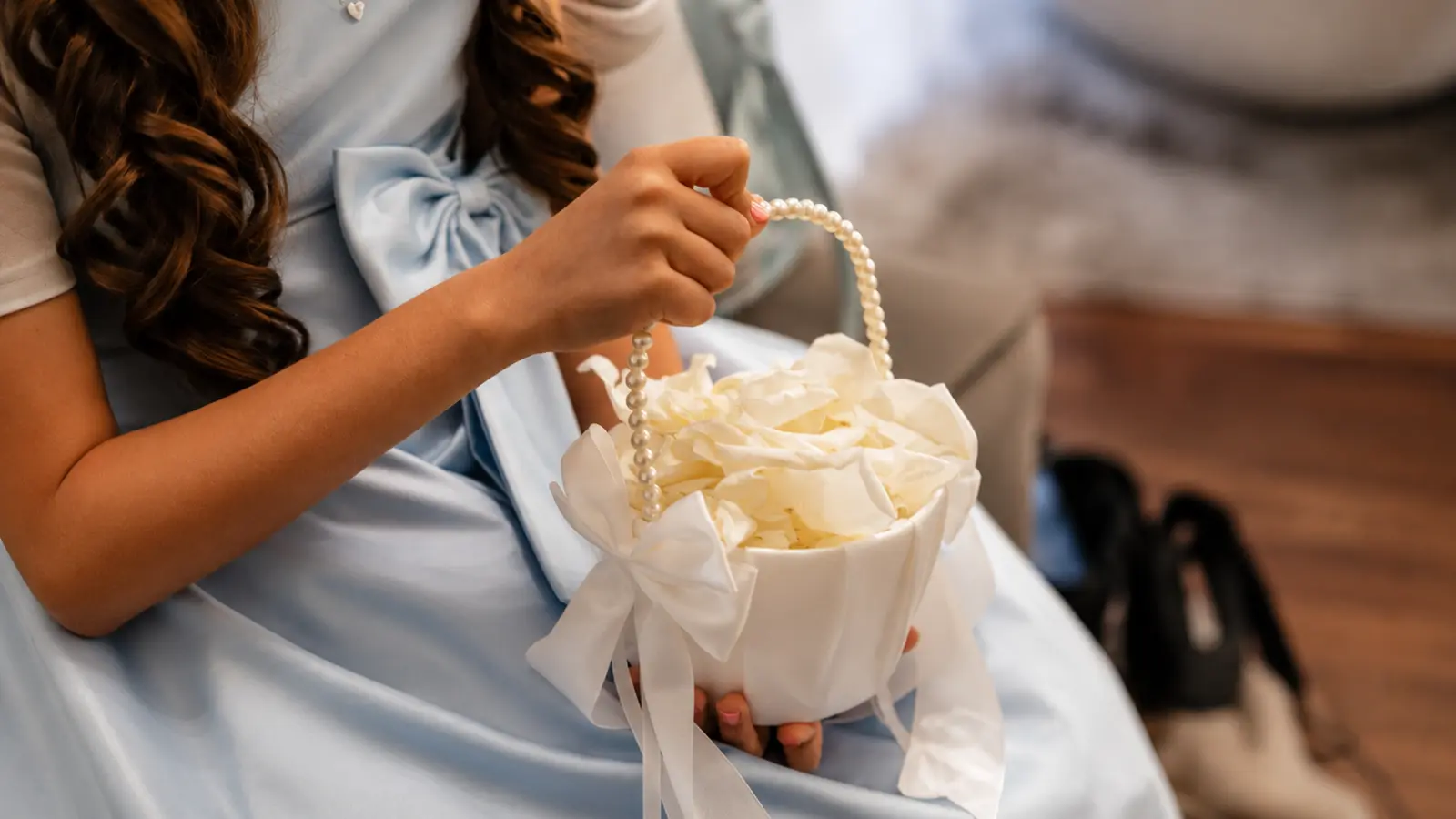
Both options are widely used, and the right choice depends on the venue, the florist’s availability, and how much the natural texture of real petals matters for the ceremony’s aesthetic.
Fresh petals — typically rose petals — have a natural look and feel that photographs beautifully up close. They’re also fragrant, which adds something genuine to the processional moment. The limitations are real, though: fresh petals can stain carpet, stone, and fabric. On polished floors or hardwood, they become a slip hazard once they’ve been walked on. They wilt quickly in heat or humidity, which matters for outdoor summer weddings. And many venues that use their own linens or have particular flooring restrictions simply don’t permit them.
Faux petals — typically silk or paper — solve most of those practical problems. They don’t wilt and may avoid some of the staining concerns associated with fresh petals. Some venues that restrict fresh petals may allow silk alternatives, but always confirm the policy first. In photos taken at aisle distance, the difference is minimal. The trade-off is texture: faux petals can look flat in very close photography and don’t carry the natural variation in color and shape that real petals do. For weddings where ceremony photography will be close and detailed, that distinction may matter. For most settings, it doesn’t.
Dried petals sit between the two — more natural-looking than silk and less perishable than fresh, but they can crumble and still create minor staining on some surfaces. They’re worth asking about if you prefer a natural option but are concerned about fresh petal logistics.
What If the Venue Doesn’t Allow Petals?
Petal restrictions are more common than most couples expect. Venues restrict loose petals for several reasons: staining risk on carpet or stone, slip hazard on polished or hardwood floors, cleanup requirements written into the rental contract, or restrictions tied to historic building guidelines. The restriction may apply to fresh petals only, to all loose petals, or to anything scattered on the aisle at all — which is why confirming the specific rule matters before committing to any petal option.
When the venue doesn’t allow petals, the flower girl role doesn’t disappear — it simply shifts to a different prop. The most natural alternatives are a mini bouquet she carries in her hands, a floral wand she holds by her side, a single flower she carries stem-down, or a small sign. An empty basket is also an option — some couples use it without any petals at all, particularly when they want the traditional basket aesthetic without the scatter. The basket reads as the flower girl’s prop; guests don’t need petals to understand the role.
If the venue permits faux or silk petals but not fresh ones, that’s often the simplest solution — the look stays the same and the logistics are actually easier. Confirm the venue’s exact policy in advance so there’s no ambiguity on the wedding day.
Empty Basket for Toddlers
For very young children, an empty basket — or a basket with only a small amount of petals that aren’t expected to be scattered — is often the most sensible choice. Scattering petals while walking in front of a crowd requires more coordination than most children at younger flower girl ages have reliably available: reaching into the basket, pulling out petals without grabbing the whole handful, releasing them while still moving forward. The result is typically a child who stops entirely, empties the basket in one go at the entrance, or holds the basket at her side and forgets about the petals altogether.
None of that is a failure. But an empty basket sidesteps the coordination problem and gives her something to hold that looks right in photos without depending on a task she may not be able to complete. The basket is visually clear and familiar; she doesn’t need to do anything with it beyond carry it. That’s a reasonable and entirely presentable approach for many children under three, and for older toddlers whose temperament makes a detailed task unlikely.
Mini Bouquet
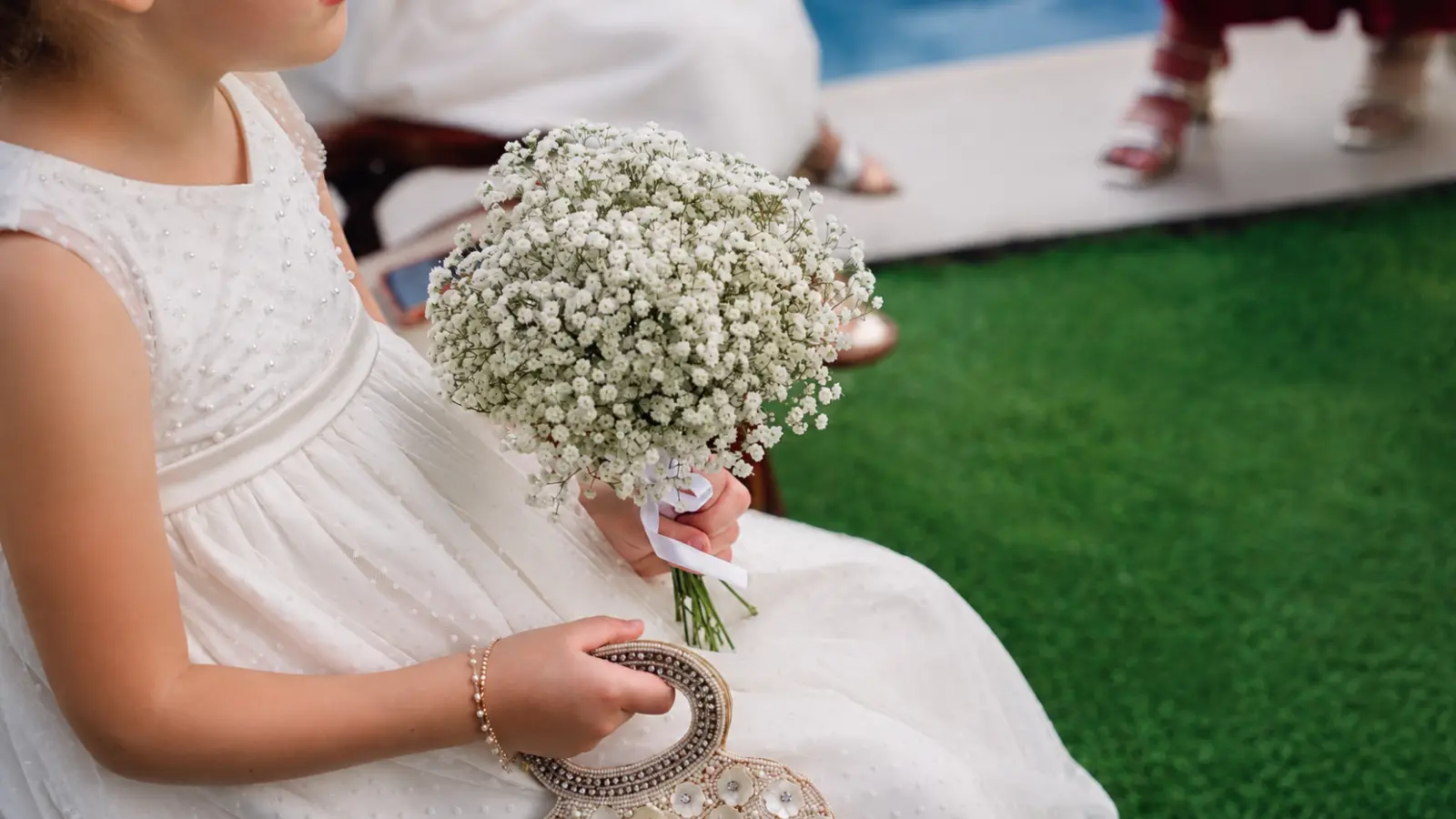
A small hand-tied bouquet is one of the most elegant alternatives to a basket, and it works particularly well for formal or traditional weddings where a petal scatter would be welcome but isn’t possible. A mini bouquet scales down the bridesmaid bouquet in both size and flower count — typically three to five blooms tied with ribbon — so the flower girl is visually connected to the rest of the bridal party without carrying something that overwhelms her.
The practical advantage over a basket is significant: a bouquet requires no task. The child simply holds it, which is far easier to manage than scattering. It’s also appropriate across a wider age range — a six-year-old with a small bouquet reads as polished and intentional in a way that a basket might not in a formal setting. If coordinated with the ceremony florals, it can look more finished than the basket alternative.
The one consideration is weight. Even a small bouquet with thick stems and multiple blooms can become heavy over the length of an aisle walk, especially for younger children. Lightweight blooms and a short stem length help — the florist can usually build something appropriately small if given the child’s age as context.
Flower Wand
A flower wand — a cluster of blooms attached to a slender, wrapped handle — is a playful alternative that photographs well at outdoor and garden ceremonies. It’s held in one hand like a prop rather than carried, which makes it intuitive for children who might struggle with managing a basket. Visually, it reads as distinct and intentional rather than simply a smaller version of something else.
The wand works best when the stem or handle is smooth, lightweight, and finished without sharp edges. Some wands are made with a simple wooden dowel wrapped in ribbon; others use a natural branch or a silk-wrapped stem. The blooms at the top should be secured well enough that they don’t shed during the aisle walk — a child who is watching petals fall off her wand is not going to make it to the front with composure intact.
At more formal indoor ceremonies, the wand can feel slightly casual, depending on the design. It’s worth having the florist mock one up before the wedding to see how the style and scale work in the context of the rest of the ceremony flowers.
Single Flower
A single long-stem flower — typically a rose, garden rose, or large bloom that matches the ceremony florals — is the most minimal option and works particularly well at weddings with a clean, uncluttered aesthetic. It requires no basket, no coordination, and no scattering. The child holds it at her side or in front of her, and the effect reads as intentional and simple in photos.
The practical concern is visibility. A single flower can be easy to miss from a distance, especially if the child holds it at her side rather than in front of her. In large venues or ceremonies with long aisles, it may not register visually the way a basket or bouquet would. For smaller, more intimate ceremonies — or outdoor settings where the floral scale is generally understated — a single stem works beautifully. In a large ballroom or cathedral, it may not carry enough visual weight to read from the back rows.
Sign Instead of a Basket
A small wooden or paper sign — typically reading “Here Comes the Bride” or simply the couple’s initials — gives a young child a clear prop without requiring any coordination at all. Signs work especially well for children who are too young to scatter petals, children who might be overwhelmed by the attention and benefit from something specific to look at and hold, or weddings where the couple wants a small moment of personality before the bride enters.
Keep the text short. A sign with more than five or six words requires the child to hold it correctly for the whole aisle walk, and a flipped or tilted sign reads poorly in photos. A simple phrase or set of initials works better than a longer message. The sign should also be sized appropriately — large enough to be legible from the first few rows, but not so large that it’s difficult for a small child to hold steady.
What to Avoid
Most flower girl prop problems come from choices that looked right in planning but didn’t account for a real child in a real ceremony. A few patterns worth avoiding:
- Heavy baskets with metal handles. A wicker basket with a decorative metal rim or heavy hardware becomes a real burden for a young child by the time she’s halfway down the aisle. Weight is the first thing to check before purchasing any basket.
- Loose embellishments on the basket. Beading, detachable flowers, or delicate trim that can be pulled off are a distraction hazard — and for toddlers, a potential safety issue. Baskets with secure, flat decoration are more practical than heavily embellished ones.
- Fresh petals on polished or hardwood floors. Even a light scatter of fresh petals on a hard floor becomes slippery once walked on. This is a slip hazard for everyone in the processional, not just the flower girl.
- Scattering expectations for children under three. The coordination required to scatter petals while walking is often beyond a toddler’s reliable ability in a high-stimulation environment. Simplify the task or remove it entirely before the wedding, not during the processional.
- Any prop the child hasn’t practiced with. Whatever she carries on the day should not be the first time she’s held it. Even a single trial run at home — carrying the basket or holding the bouquet while walking — removes one unknown from an already unpredictable moment.
The test worth applying to every option: can she hold this comfortably, at her age, for the full length of the aisle? If the answer involves any uncertainty, simplify.
Quick Comparison Guide
Every option works in the right context. This table summarizes where each one tends to fit — and the most common practical consideration for each.
| Option | Best For | Watch Out For |
|---|---|---|
| Petal basket | Classic ceremonies; children comfortable scattering petals | Venue petal restrictions; slip risk on hard floors |
| Empty basket | Toddlers; venues that restrict all petals | Keep it lightweight and easy to carry |
| Mini bouquet | Formal weddings; any age where no task is preferred | Weight — keep stems short and blooms light |
| Flower wand | Garden and outdoor weddings; playful aesthetics | Avoid sharp stems; check that blooms are secured |
| Single flower | Minimal ceremonies; intimate venues | May not have enough visual weight in large spaces |
| Sign | Very young children; couples who want a moment of personality | Keep text short; make sure it’s the right size to hold |
| Nothing | Very young children; any child who is overwhelmed | Perfectly fine — the walk itself is the moment |
The right choice is the one that accounts for the child’s age, the venue’s rules, and the ceremony’s overall aesthetic — in that order.
Flower Girl Basket Ideas & Inspiration
Explore flower girl basket ideas with petals, mini bouquets, flower wands, single blooms, signs, and simple alternatives for every wedding style and age.
What Should Your Flower Girl Carry?
The best choice is whatever the flower girl can carry comfortably and confidently down the aisle. A traditional petal basket can be beautiful, but a bouquet, flower wand, single bloom, empty basket, sign, or no prop at all can work just as well.
Start with the child’s age and comfort, then consider the venue rules and ceremony style. When the prop is simple and manageable, it supports the moment instead of becoming another task the child has to remember.
Frequently asked questions (FAQ)
Does a flower girl have to carry a basket?
No. A basket is traditional but completely optional. A flower girl can carry a mini bouquet, single flower, floral wand, sign, or nothing at all. Whatever she carries should be lightweight, safe, and easy for her age to manage while walking down the aisle.
How many flower petals does a flower girl need?
The amount depends on the aisle length and width, petal size, and how full you want the scatter to look. Ask your florist for an estimate based on your ceremony space, and prepare a little extra because children do not always scatter petals evenly.
Can a flower girl use fake petals instead of real ones?
Yes. Faux petals are often more practical because they do not wilt or stain and may be allowed at venues that restrict fresh petals. They also photograph well from normal aisle distance. Confirm the venue’s policy first, since some locations prohibit all loose petals rather than only fresh ones.
What should a toddler flower girl carry?
Keep it simple and light. An empty basket, a single flower, or nothing at all usually works better than asking a toddler to scatter petals while walking. The goal is to give her something she can hold without needing to concentrate on an additional task during the processional.
What if the wedding venue doesn’t allow flower petals?
Use an alternative such as a mini bouquet, flower wand, single bloom, sign, or empty basket. Some venues allow faux petals even when fresh ones are prohibited, while others ban anything loose on the aisle. Confirm the exact rule in advance so you can choose an option that will be allowed on the wedding day.
What can a flower girl carry instead of a basket?
Popular alternatives include a mini bouquet, single flower, floral wand, or small sign. Very young children can also walk empty-handed. Choose based on the child’s age, the formality of the ceremony, and how easy the item is to carry. The best prop is one she can manage without thinking about it.