
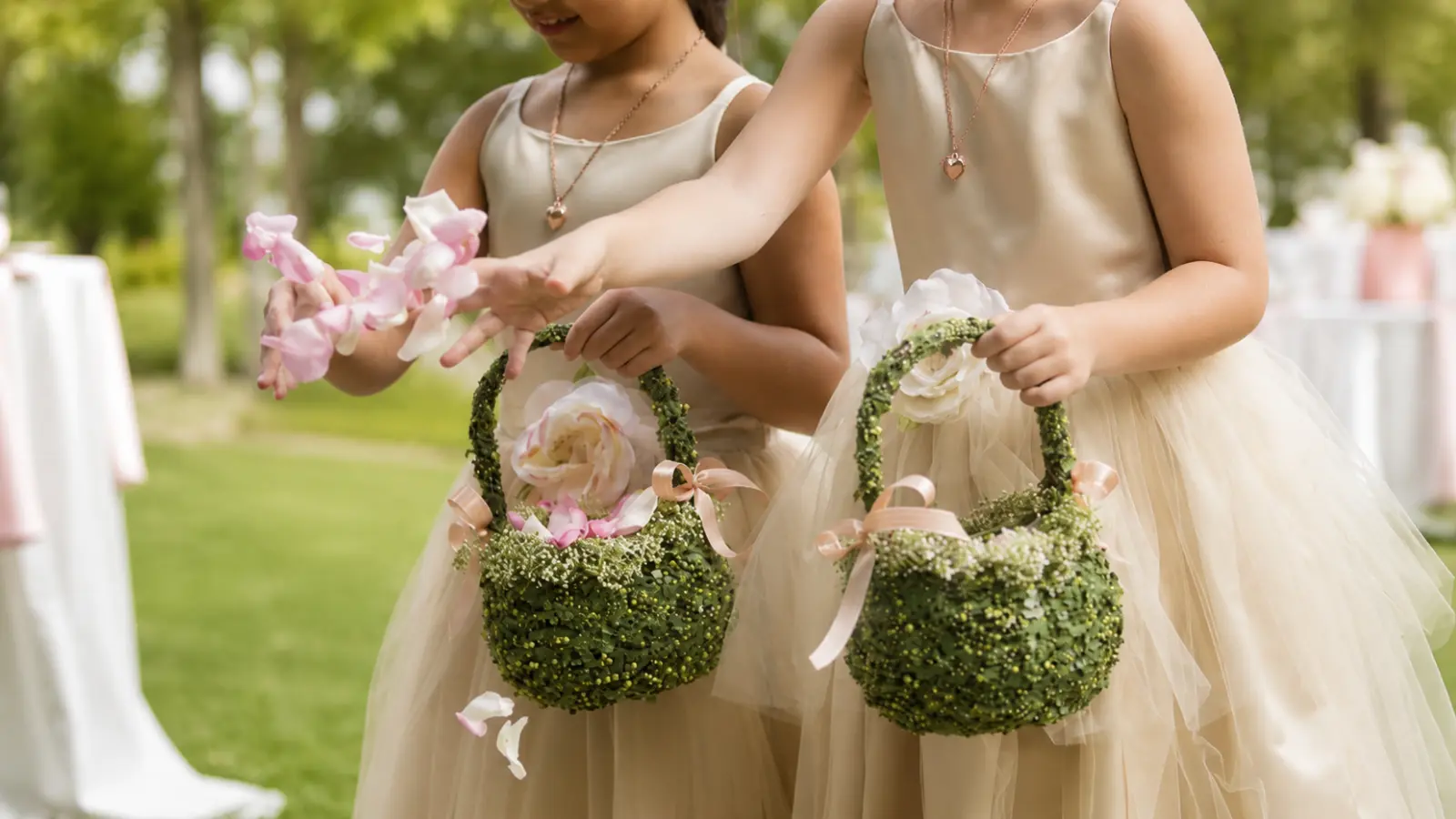
Flower girl duties are intentionally simple. Her main role is usually to walk down the aisle shortly before the bride, sometimes carrying flowers, a basket, petals, or another small item that fits the ceremony and her age.
Everything around that walk can be flexible. She may walk alone, with the ring bearer, or beside a trusted adult, and young flower girls will usually be more comfortable sitting with family once they reach the front rather than remaining standing throughout the ceremony.
This guide explains flower girl duties before and during the wedding, including rehearsal, processional order, what she can carry, whether petals are necessary, where she goes after the aisle walk, how to explain the role to a child, and how to prepare a simple backup plan.
What Does a Flower Girl Do?
At its core, the flower girl’s role has two parts: the processional walk and whatever comes after she reaches the front. The walk is the visible, ceremonial part of her participation. Everything else — what she carries, who she walks with, how long she stands — is secondary to that single moment moving down the aisle.
In practical terms, here is what the flower girl’s involvement typically looks like on the wedding day:
- She waits with the wedding party before the ceremony. Depending on the venue and the couple’s plan, she may be backstage, in a holding room, or waiting with her parents until the processional begins.
- She walks down the aisle as part of the processional. This is the center of the role. She walks from the back of the ceremony space to the front, at her own pace, usually carrying something and often scattering petals if that’s the plan.
- She reaches the front and is guided to her seat. A parent, bridesmaid, or designated adult meets her at the front and brings her to a seat — typically with her family in the front rows.
- She sits with family for the ceremony. For most young children, the flower girl’s active participation ends when she sits down. She watches the ceremony from her seat like any other guest.
That’s it. The role is brief, visually significant, and requires very little of the child beyond a willingness to walk and a small amount of pre-ceremony preparation. The simplicity is intentional — it’s what makes the role adaptable across different flower girl ages.
Flower Girl Duties Before the Wedding
The flower girl’s involvement before the actual wedding day is minimal compared to most wedding party roles, which is appropriate. She is a child, not a planner. Her pre-wedding responsibilities are limited to the rehearsal, possibly a fitting appointment for her dress, and being briefed in a simple, low-pressure way about what she’ll be doing.
From the couple’s side, the pre-wedding duties involve more planning than the child’s: ordering or making arrangements for whatever she’ll carry, coordinating with her parents about the rehearsal schedule, making sure her dress and shoes are ready and tested in advance, and deciding on a backup plan if the aisle walk doesn’t go as expected. None of this involves the child directly, but all of it shapes how smoothly her moment goes on the day.
What She Does at the Rehearsal
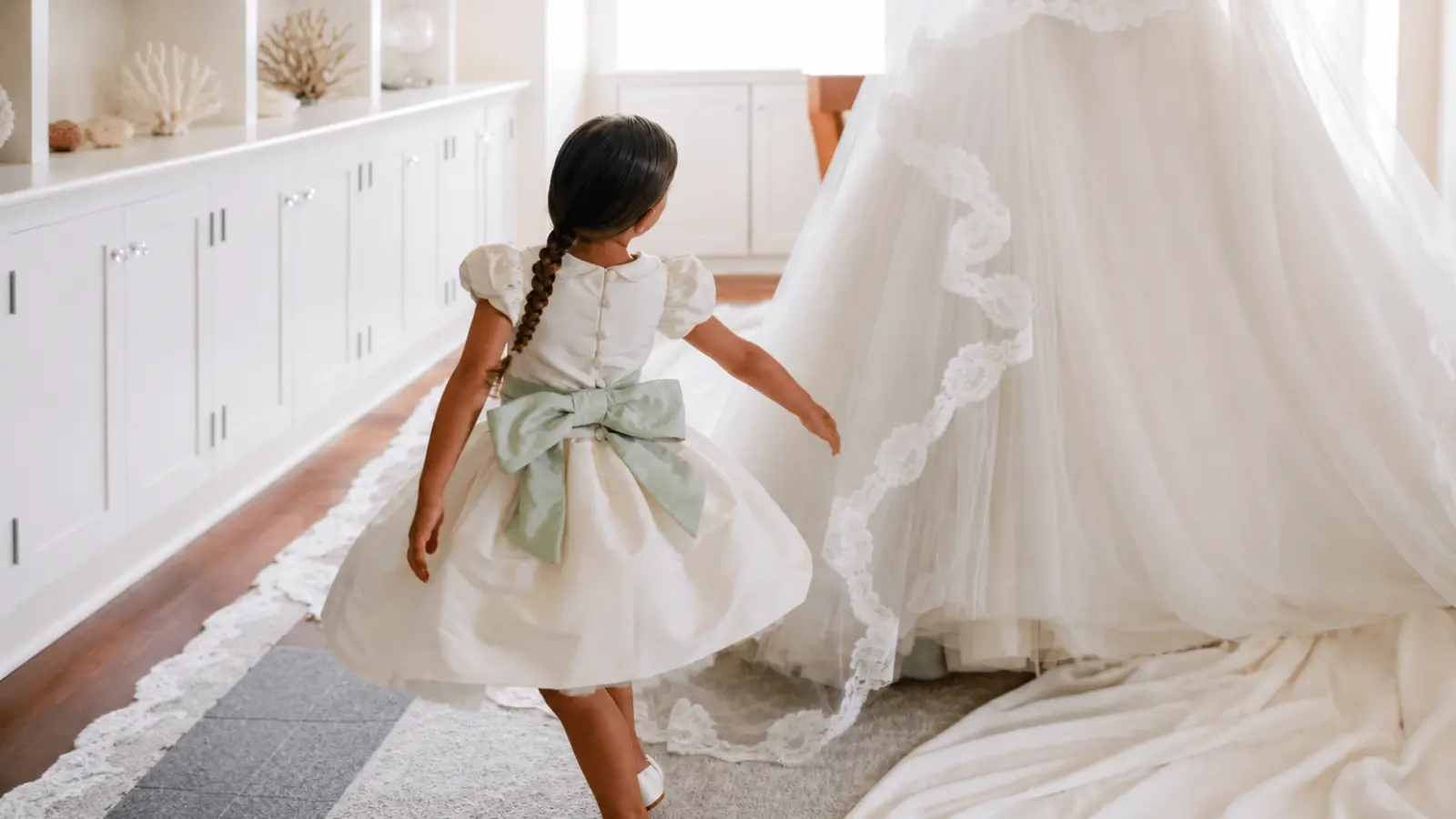
The rehearsal is the most important preparation the flower girl does before the wedding, and it should be kept simple. The goal is to give her one clear walkthrough of the aisle in the actual ceremony space — with music if possible — so that nothing about the moment feels unfamiliar on the wedding day.
At the rehearsal, the flower girl should:
- Walk the full aisle at least once, from wherever she will start to where she will end up
- Understand who she is walking with or following
- Know where to go when she reaches the front — specifically, which adult will guide her to her seat
- Practice with whatever she’ll be carrying, especially if she’ll be scattering petals
One walkthrough is usually enough. Rehearsing the same child repeatedly creates pressure and can make her feel like she’s expected to perform rather than participate. If she walks the aisle once and knows where she’s going, she’s prepared. The rest she’ll figure out in the moment — which is true of most children, and usually works out fine.
When Does the Flower Girl Walk Down the Aisle?
The flower girl walks near the very end of the processional, after the wedding party has entered and shortly before the bride. Her walk marks the approaching transition to the ceremony’s most anticipated moment — which is why her placement at the end of the processional order is intentional, not arbitrary.
In a common American wedding processional, the order may look like this:
- Grandparents are seated
- Parents are seated (or escort the bride)
- Officiant takes position at the altar
- Groom and groomsmen enter, often from the side
- Bridesmaids walk down the aisle
- Maid of honor walks
- Ring bearer walks
- Flower girl walks
- Bride enters
The timing between the flower girl reaching the front and the bride beginning her entrance is usually a brief, intentional pause — long enough for the flower girl to be seated and for the room to settle before the bridal music begins. Your officiant or wedding coordinator will typically manage this pacing on the day, but walking through it once at the rehearsal helps everyone involved understand the rhythm.
Does the Flower Girl Walk Before the Bride?
Yes. The flower girl walks before the bride in the processional — that positioning is part of the role’s traditional function. Her entrance signals to guests that the bride is next, creating a brief anticipatory pause before the ceremony’s most significant moment.
This is a common arrangement in American wedding ceremonies, although the exact processional order can vary. The flower girl’s walk is a warm, gentle transition rather than a dramatic one, which is part of what makes it work as a precursor to the bride’s entrance rather than competing with it.
Does She Walk Before or After the Bridesmaids?
Usually after. In a common processional order, the flower girl walks after the bridesmaids and shortly before the bride. By the time she enters, the full wedding party is already in place at the front, and her walk is the final processional step before the bride.
Occasionally couples adjust this order for practical reasons — for instance, if the flower girl is very young and a bridesmaid is walking with her, it may make logistical sense to pair them earlier in the processional. But the default, and the arrangement that makes the most visual and ceremonial sense, is flower girl after bridesmaids.
Can She Walk With the Ring Bearer?
Yes, and this pairing is common enough that many guests expect it. The flower girl and ring bearer often walk together — side by side or one slightly behind the other — and the combination tends to produce some of the most photographed processional moments of the day.
Whether the pairing makes sense depends on the children. If they already know each other, the dynamic tends to be natural. If they are strangers meeting for the first time at the rehearsal, introduce them early in the evening and give them a moment together before expecting them to walk in tandem in front of a room full of adults. Age proximity also helps — two children at similar developmental stages are easier to pair than a two-year-old and a seven-year-old who move at entirely different paces.
If the ring bearer and flower girl are not a natural pair — different ages, different temperaments, or simply not comfortable together — walking separately is completely fine. Each can have a clean, simple entrance on their own.
Does She Have to Toss Petals?
No. The petal toss is the most iconic image associated with the flower girl role, but it is not a requirement, and there are good reasons why many couples skip it or adapt it.
For younger children, scattering petals while walking in front of a crowd is genuinely difficult to coordinate. The child has to walk at the right pace, reach into a basket, pull out petals, scatter them in a reasonable pattern, keep moving, and respond to the visual experience of dozens of faces watching her — all at the same time. The result, especially for toddlers and three-year-olds, is often a full stop at the beginning of the aisle or an entire basket emptied in the first three feet.
Venue restrictions are also a real consideration. Some indoor venues restrict loose petals because of flooring, safety, or cleanup concerns, while outdoor venues may have environmental or cleanup restrictions. Always check with the venue before committing to a petal-scatter plan.
For older, more confident flower girls, the petal toss tends to work well and looks exactly as sweet as it sounds. The decision should just be based on the child’s actual age and the venue’s actual rules, not on assumption.
What Can She Carry Instead of Petals?
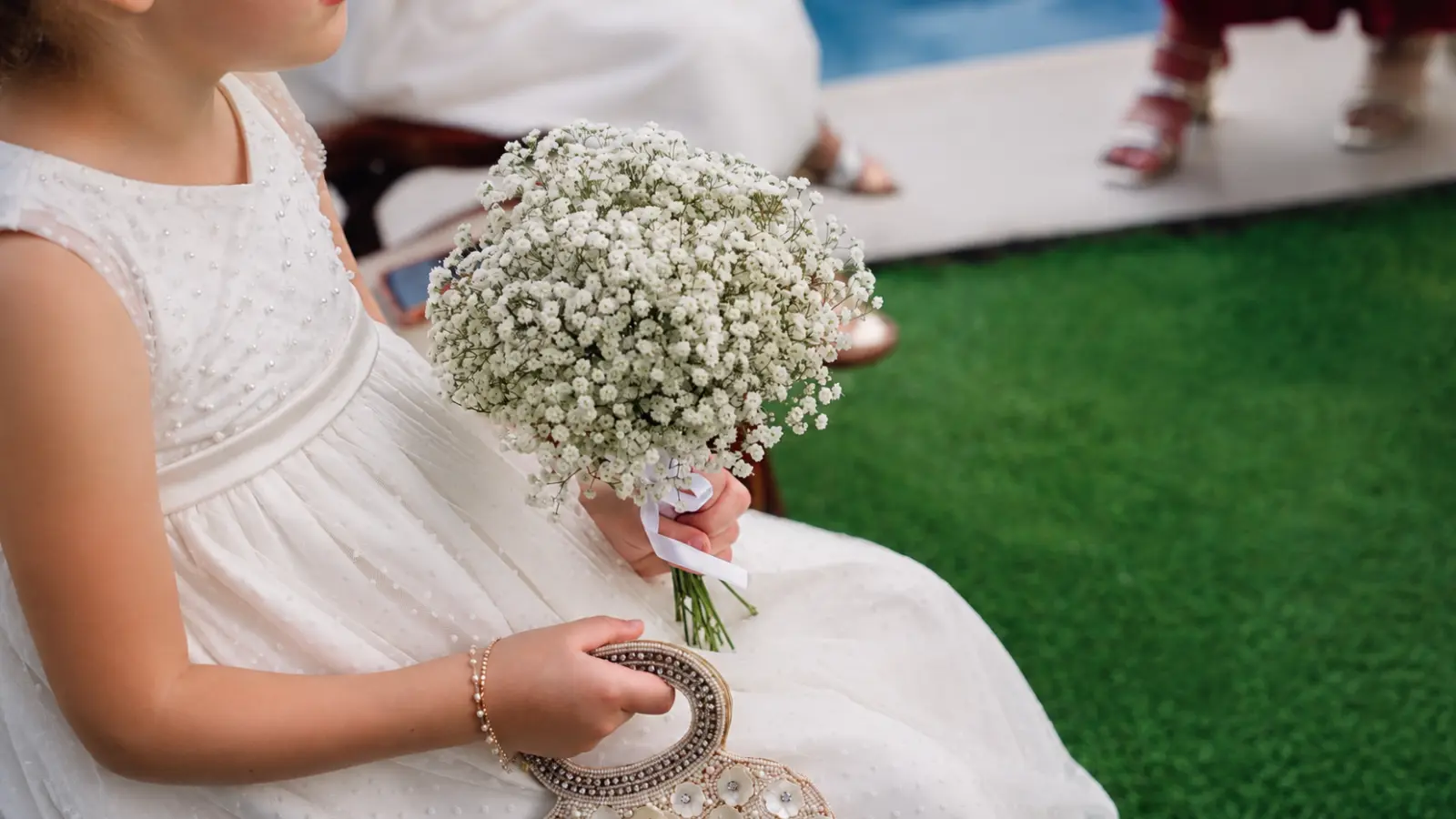
The options for what a flower girl carries are much broader than most planning conversations suggest. The basket of petals is the default image, but it is far from the only one — and for many children and ceremony styles, an alternative works better both practically and visually.
- A basket without petals. She carries the basket as a prop without scattering anything. The visual read is familiar; the coordination requirement disappears entirely.
- A small bouquet. A miniature version of the bridal bouquet, or a simple tied cluster of flowers in the wedding’s palette, photographs beautifully and requires only holding, not scattering.
- A single stem. One flower — a garden rose, a ranunculus, a peony — is a modern, understated choice that is easy for even toddlers to manage.
- A floral wand or pomander. A wand of flowers or a round floral ball on a ribbon gives the child something decorative and manageable to carry without the complexity of a basket.
- A sign or banner. A small wooden or acrylic sign that reads “Here comes the bride” or “She said yes” gives the child a clear, easy task — hold it up — and adds a moment of charm to the processional.
- Nothing at all. Walking empty-handed is a valid choice, especially for very young children or ceremonies where the visual simplicity is intentional.
The right choice comes down to the child’s age, what she can comfortably manage while walking, and what fits the ceremony’s aesthetic. More detail on basket styles and petal options is covered in the flower girl baskets.
What Happens When She Reaches the Front?
When the flower girl reaches the front of the aisle, she needs a clear, pre-planned next step — because a child who doesn’t know where she’s going tends to stop and look around, which creates an awkward pause in the processional. The plan should be decided before the rehearsal and walked through with the child so she knows exactly what to expect.
In most ceremonies, the flower girl reaches the front and is guided to her seat by a designated adult — a parent who is already seated in the front rows, a bridesmaid who steps down from the altar, or a coordinator who is standing nearby. The child should know in advance whose face to look for when she gets there and where that person will be standing or sitting.
If the flower girl is slightly older and confident, she can find her seat independently once she reaches the front. For younger children, especially toddlers, having a parent visibly waiting at the end of the aisle makes the whole walk more manageable — the child is not walking toward a crowd, she’s walking toward someone she knows.
Does She Stand or Sit?
For most ceremonies, the flower girl sits with her family after walking down the aisle. This is the arrangement that works best for young children, and it’s what most officiants and wedding coordinators recommend.
Standing at the front of a ceremony for fifteen minutes to an hour — through vows, readings, ring exchanges, and everything else — is a long time for a small child. The results are usually visible: fidgeting, sitting on the altar steps, whispering to a nearby bridesmaid, or slowly migrating toward the front pew. None of this is catastrophic, but it does draw attention away from the ceremony.
Sitting with family is a cleaner arrangement that lets the child watch the ceremony comfortably, gives her parents a way to manage any restlessness quietly, and lets the couple’s vows happen without a small person in the background trying to stay still. For older flower girls — nine or ten and up — standing with the wedding party is more feasible if that’s the plan and she’s comfortable with it. A nearby seat as a backup option is still worth having.
What If She Freezes, Cries, or Runs?
It happens. A child who walked the aisle confidently at the rehearsal may stop dead at the top of the church steps when she sees two hundred people looking at her. Or she may burst into tears. Or she may sprint to her grandmother in the third row. These are not wedding disasters — they are children being children, and most guests find these moments genuinely endearing.
The key is having a calm, pre-decided response so the moment doesn’t turn into a logistical pause. A few things that help:
- Station a parent or bridesmaid at the back of the aisle. If the child freezes or turns around, this person walks out calmly, takes her hand, and completes the walk with her. No announcement, no fuss — just a natural rescue that looks like it was always the plan.
- Give her a specific face to walk toward. Tell her in advance: “Walk toward Grandma, she’ll be right there in the front row.” A specific person and destination is more grounding for a child than “walk to the front.”
- Don’t force a rescue too quickly. A child who hesitates for a few seconds often finds her footing and keeps going. Give her a moment before stepping in — she may surprise everyone, including herself.
If she simply refuses to walk at all, a parent carrying her down the aisle or walking her to a seat from the side is a perfectly workable outcome. The moment still happens; it just looks a little different than planned.
How to Explain the Role to a Child
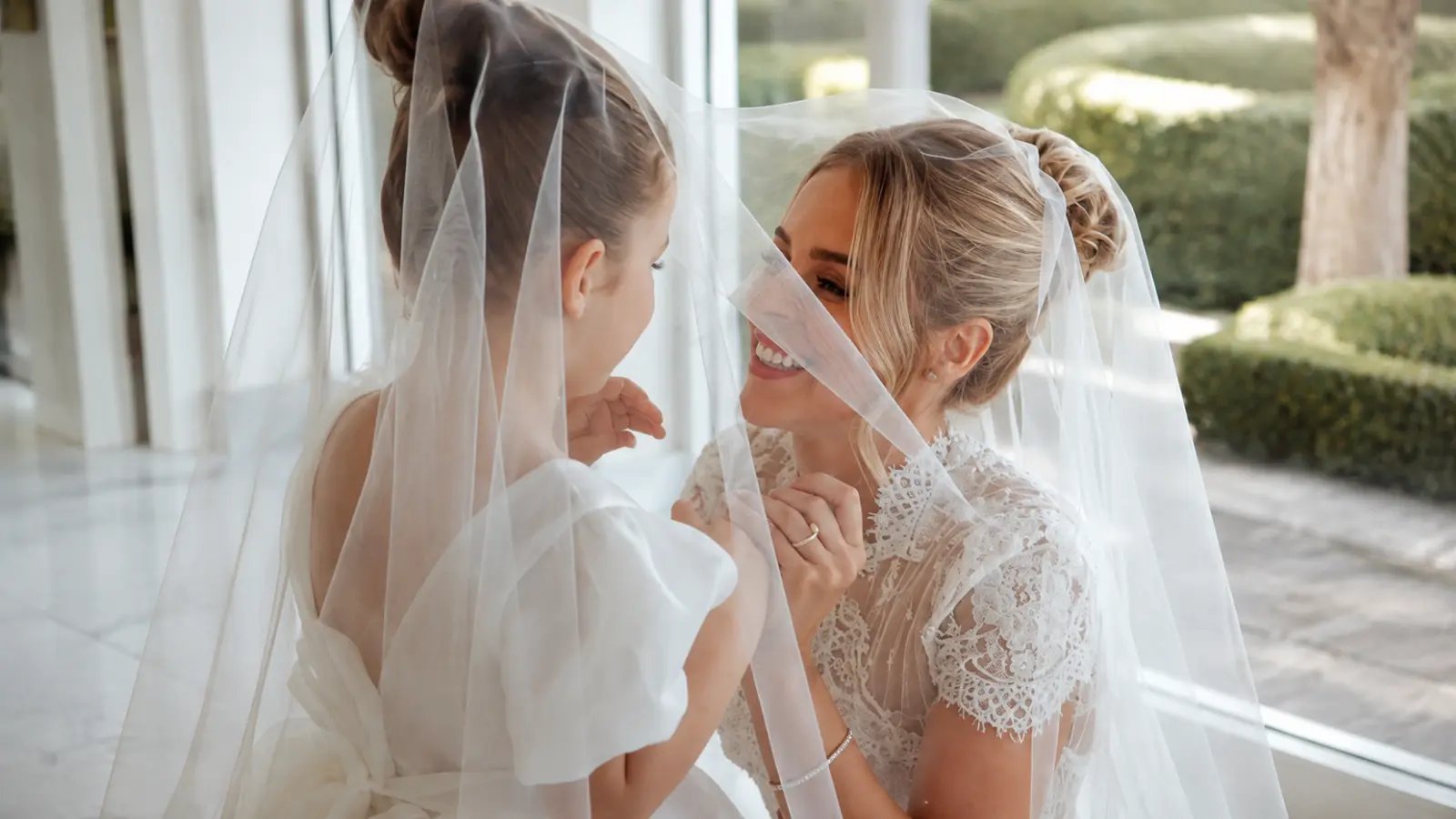
How you explain the flower girl role to a child depends on her age, but the general principle is the same across all ages: keep the explanation concrete, positive, and short. Children respond to what they’ll actually be doing, not to an abstract description of ceremonial significance.
For toddlers and young children (under five), the explanation should be one sentence: “You’re going to walk down the aisle carrying this basket, and then you’ll sit with Mommy.” That’s it. More detail creates more questions, more anxiety, and more to forget.
For children between five and eight, a slightly fuller picture works well: “You walk first, before me. You carry your basket down the aisle, and when you get to the front, Grandpa is going to be right there waiting for you. After that, you get to sit with him and watch.” Specific, visual, and tied to a person she knows.
For older children, you can share more of the ceremony’s sequence so she knows what’s happening around her: “You walk after the bridesmaids, before I come in. You’ll hear your music start, and that’s your cue.” Older children appreciate being treated as capable participants, and giving them more context tends to increase their confidence rather than overwhelm them.
What helps at any age is framing the role as something she gets to do rather than something she has to do — and making sure she knows that whatever happens on the day, she’s already part of the wedding.
Backup Plan
Every flower girl plan should include a backup, not because something is likely to go wrong, but because having one decided in advance keeps the day calm if it does. The backup should be known to the child’s parent, to whoever is coordinating the processional, and ideally to the officiant.
The most practical backup structure has two parts: a designated person and a designated response.
The designated person is whoever will step in if the child needs help — a parent at the back of the aisle, a bridesmaid at the front, or a coordinator standing just off to the side. This person should know their role before the ceremony begins, not after the child has been standing frozen at the top of the aisle for thirty seconds.
The designated response is what that person does: walks out calmly, takes the child’s hand, completes the walk together, and guides her to her seat as if that was always the plan. No announcements, no apologetic looks at the guests, no drawn-out moment. Just a calm adult and a child walking to a seat.
Having this plan in place is not pessimism — it’s the kind of thoughtful preparation that lets everyone, including the child, relax and enjoy the moment rather than hoping nothing goes sideways.
Flower Girl Duties & Ceremony Inspiration
Discover flower girl ceremony inspiration featuring petal baskets, small bouquets, aisle walks, ring bearer pairings, processional ideas, dresses, and age-appropriate wedding roles. Explore simple ways to prepare your flower girl, choose what she carries, plan where she sits, and create a comfortable ceremony experience that fits your wedding style.
Keep the Flower Girl Role Simple and Comfortable
Flower girl duties are brief for a reason. A clear aisle walk, one simple task, and a familiar place to sit afterward are usually enough to make the child feel included without turning the role into something she needs to perform perfectly.
Prepare the logistics in advance, give her a straightforward explanation, and have an adult ready to help if needed. When the expectations are flexible and appropriate for the child, even an imperfect aisle walk can become a natural and memorable part of the ceremony.
Frequently asked questions (FAQ)
What does a flower girl do at a wedding?
A flower girl’s main duty is to walk down the aisle near the end of the processional, usually shortly before the bride. She may scatter petals, carry a basket, hold a small bouquet or sign, or simply walk. Once she reaches the front, a young flower girl typically sits with her family for the rest of the ceremony.
When does the flower girl walk down the aisle?
The flower girl usually walks after the bridesmaids and maid of honor, near the end of the processional and shortly before the bride. She may walk after or alongside the ring bearer depending on the ceremony plan. Once she reaches the front and is seated, the bride’s entrance typically follows.
Can the flower girl walk with the ring bearer?
Yes. The flower girl and ring bearer can walk together if they are comfortable with each other and can manage a similar pace. Pairing often works best when the children are relatively close in age or already know each other. If their ages, temperaments, or walking speeds differ significantly, separate entrances may be easier.
Does a flower girl have to toss petals?
No. Tossing petals is traditional but completely optional. She can carry a basket without scattering anything, hold a small bouquet, single flower, floral wand, or sign, or simply walk empty-handed. Choose something appropriate for her age and coordination, and check the venue’s rules because some locations restrict loose petals.
Does the flower girl stand at the altar or sit after walking?
Most young flower girls sit with a parent or trusted adult after reaching the front. Standing through the entire ceremony can be difficult for a small child and is not necessary for the role. An older flower girl may stand with the wedding party if she is comfortable, but having a nearby seat is still a useful backup.
What if the flower girl freezes or cries during the processional?
Have a designated adult ready to help before the ceremony begins. If the flower girl stops, cries, or turns around, that person can calmly take her hand and complete the walk with her or guide her to a seat. Giving the child a familiar face to walk toward can also make the processional feel much less intimidating.