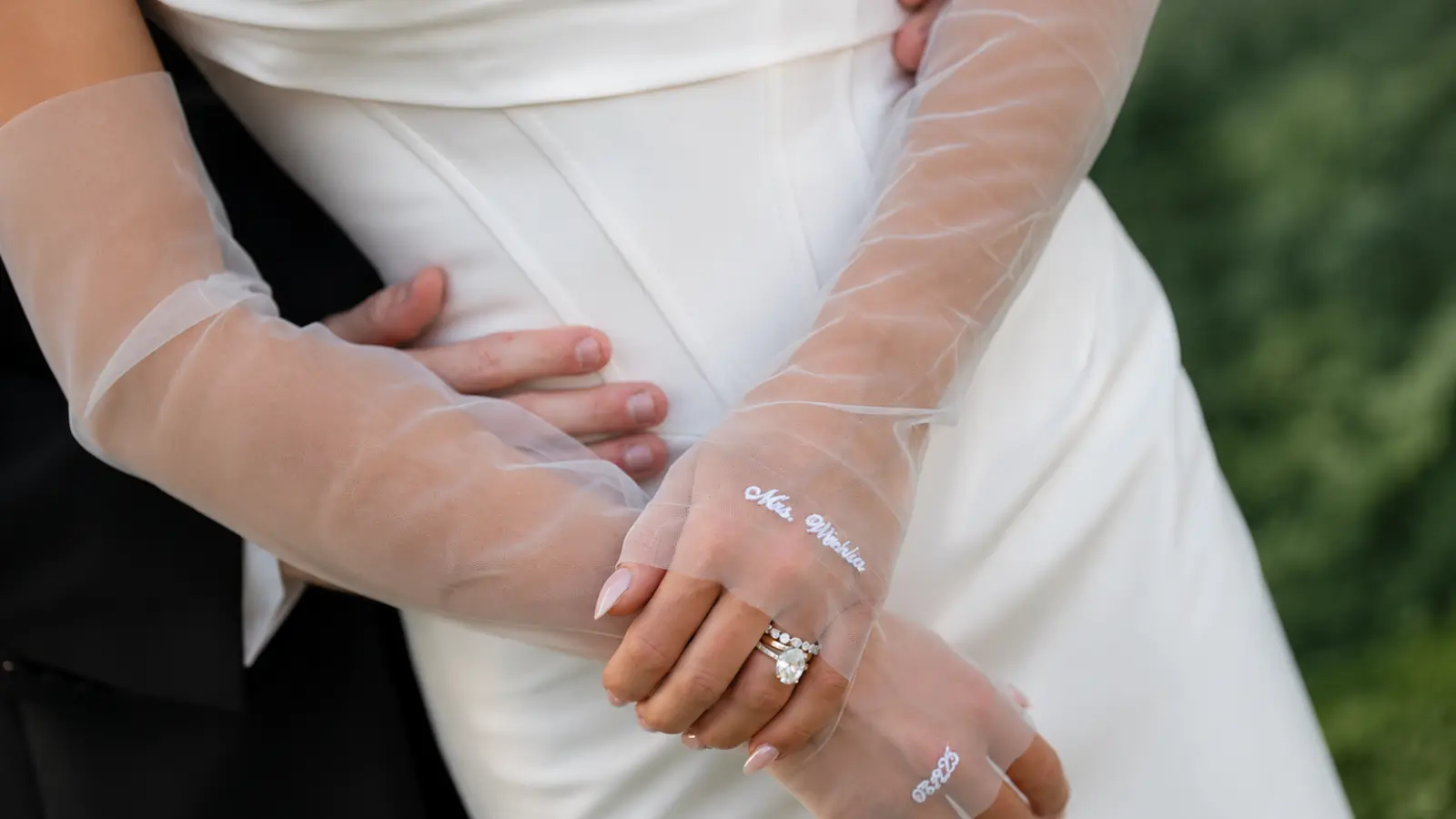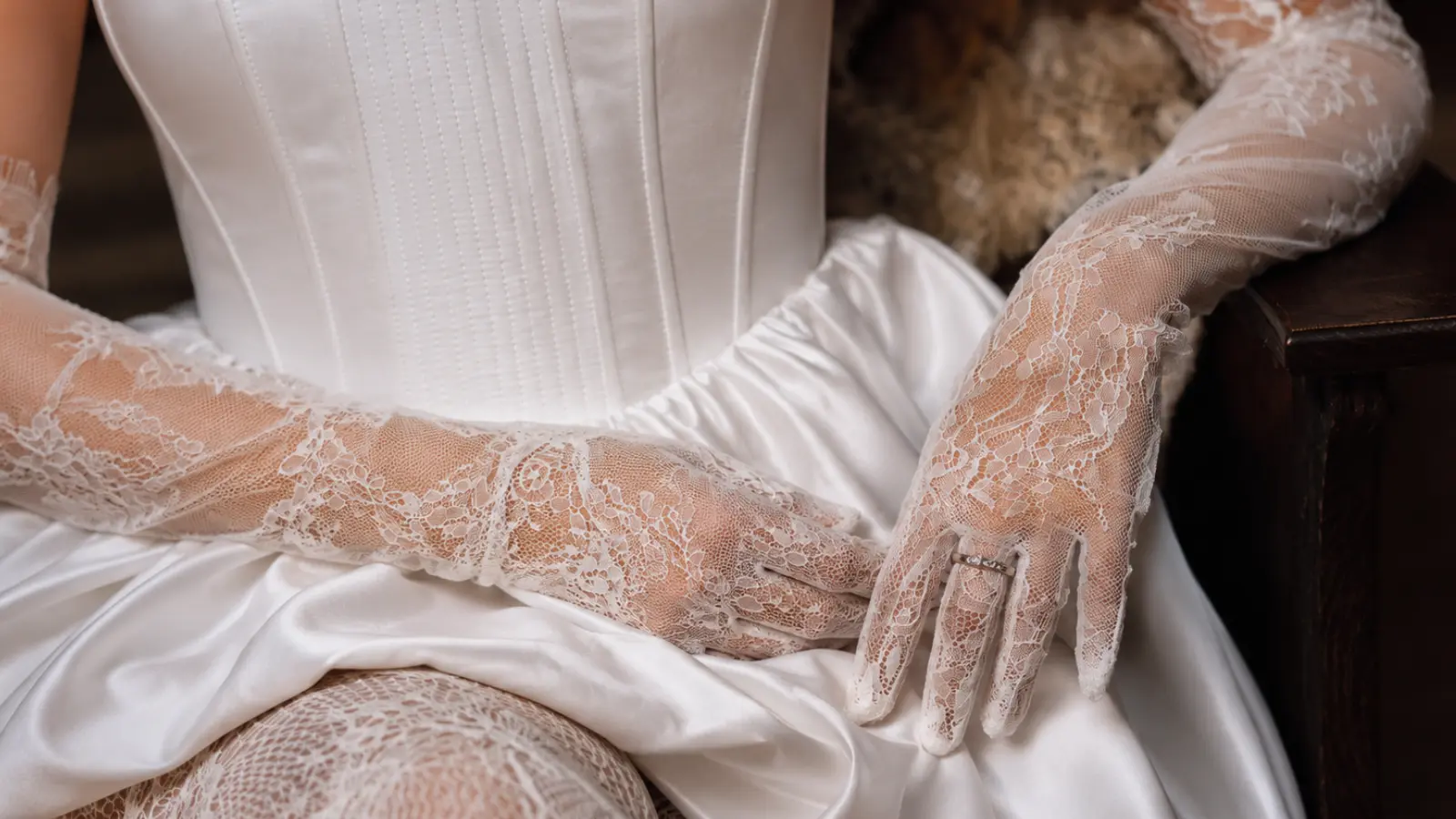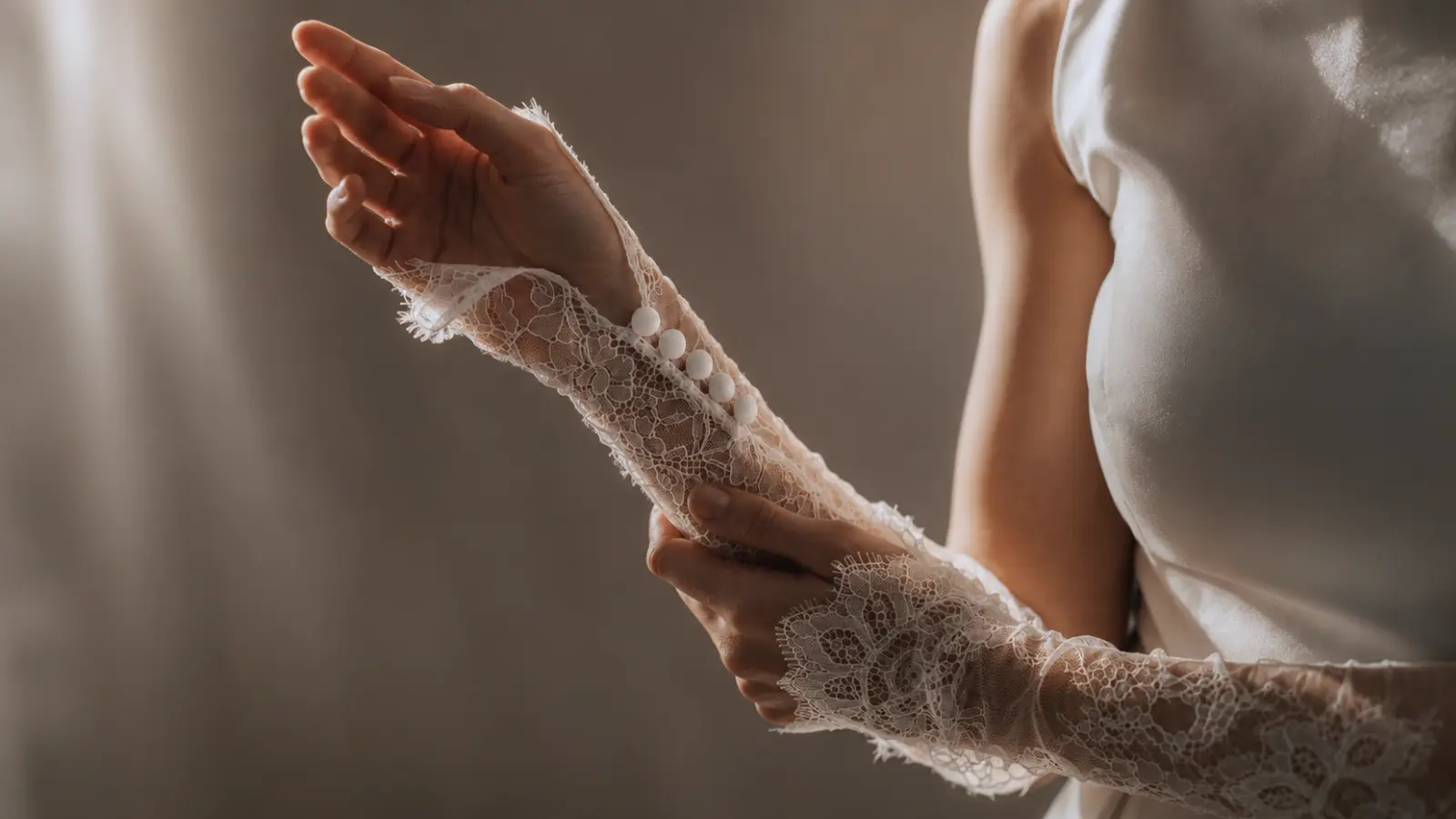
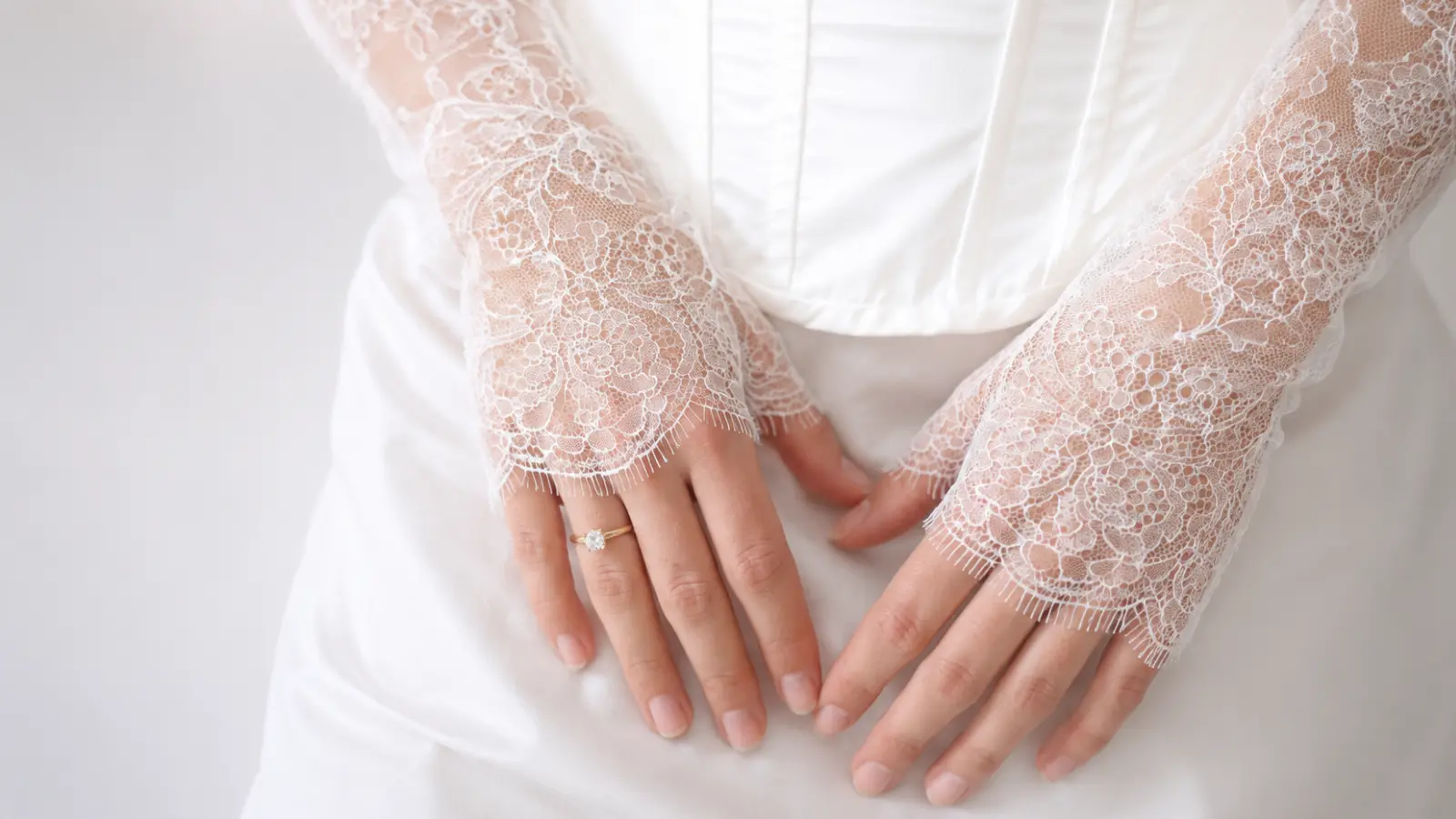
Lace wedding gloves are bridal accessories that add texture, romance, and detail to a wedding look through delicate lace patterns and fabrics. They can feel vintage, classic, modern, or editorial depending on the glove length, lace style, and the way they are paired with the dress.
Lace has a long relationship with bridal fashion — soft enough to feel romantic, but detailed enough to make a statement. On a glove, that quality becomes even more noticeable. The right lace glove feels intentional, as if it was always part of the dress styling rather than something added at the end.
This guide explains how to choose lace wedding gloves, including short, long, fingerless, white, ivory, vintage, and modern styles, how to pair lace gloves with different wedding dresses, what mistakes to avoid, how to decide whether lace belongs in your bridal look, and how to choose the right wedding gloves for your overall bridal style.
What Makes Lace Gloves Work
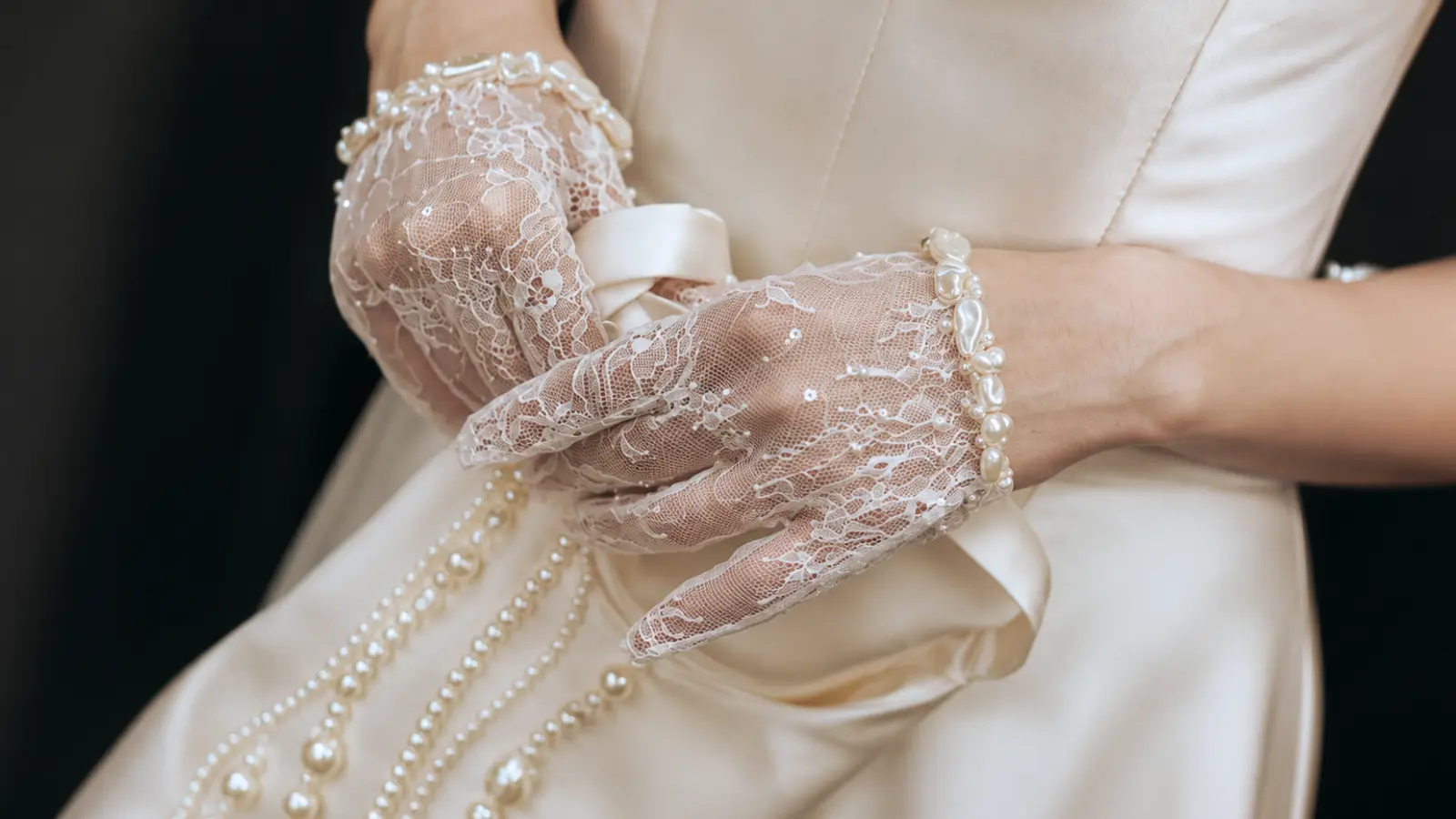
Lace is one of the most popular wedding glove fabrics because it has such a strong visual personality. Compared with many simple satin or sheer designs, lace often creates a stronger visual presence — the pattern, the texture, and the dimension it adds to the hand all register clearly, especially at close range. That’s both its appeal and its challenge as a bridal glove fabric.
What often separates a successful lace glove combination is the balance of visual weight. The glove introduces texture. If the dress is also introducing significant texture — through its own lace, beading, or embroidery — both elements need to be managed so they coordinate rather than compete. When the dress is quieter, the glove has more freedom to be expressive. When the dress is already making a strong statement, the glove needs to support rather than overlay.
The other factor is lace quality and scale. A dense, structured lace pattern reads very differently from a delicate, open-weave design. A glove with guipure or Chantilly lace carries significantly more visual weight than one with a whisper-light tulle base and minimal lace appliqué at the wrist. Understanding where your glove sits in that spectrum is the first step in pairing it well.
Quick Reference: Lace Glove Styles at a Glance
Different lace wedding gloves create different effects depending on the length, lace pattern, and how much detail the dress already has. A delicate wrist-length glove and a dramatic lace opera glove may both use the same fabric, but they create completely different bridal styles.
Use this comparison as a starting point to understand which lace glove styles naturally pair with different dresses before exploring each option in more detail.
| Lace Style | Best Dress Match | Feeling |
|---|---|---|
| Short lace gloves (wrist length) | Garden gowns, simple A-lines, tea-length vintage silhouettes | Delicate, romantic, understated |
| Long lace gloves (elbow or opera length) | Sleeveless or strapless gowns, formal settings | Dramatic, vintage-glamour, sculptural |
| Fingerless lace gloves | Most dress styles; ideal for brides prioritizing comfort | Modern, relaxed, editorial romantic |
| Dense / guipure lace | Simple gowns with minimal embellishment | Rich, vintage, bold texture |
| Delicate / open-weave lace | Lace gowns, embellished bodices, layered looks | Soft, airy, romantically layered |
| Ivory lace gloves | Ivory, champagne, or off-white gowns | Warm, cohesive, traditional |
| White lace gloves | Cool-white or bright-white gowns | Crisp, graphic, classic |
| Vintage lace gloves | Mid-century silhouettes, fitted bodices, A-line skirts | Nostalgic, feminine, portrait-ready |
How to Choose the Right Lace Wedding Gloves
Choosing lace wedding gloves starts with understanding what your dress already provides. Lace adds texture and visual detail, so the right pair should either continue the feeling of your gown or introduce something the dress does not already have.
- Choose Delicate Lace for Detailed Dresses
If your dress already has lace, embroidery, or beading, a softer lace glove usually creates better balance. A lighter pattern adds romance without creating too much visual competition.
- Choose Statement Lace for Simple Dresses
Minimal gowns can support stronger lace details because the glove becomes the main decorative element. A bold lace pattern can give a clean silhouette more personality and dimension.
- Match the Formality of the Dress
A dramatic lace opera glove naturally feels different from a short wrist-length style. The more formal the glove, the more important it is that the dress and venue support that level of detail.
Lace Glove Styles and What Each One Does
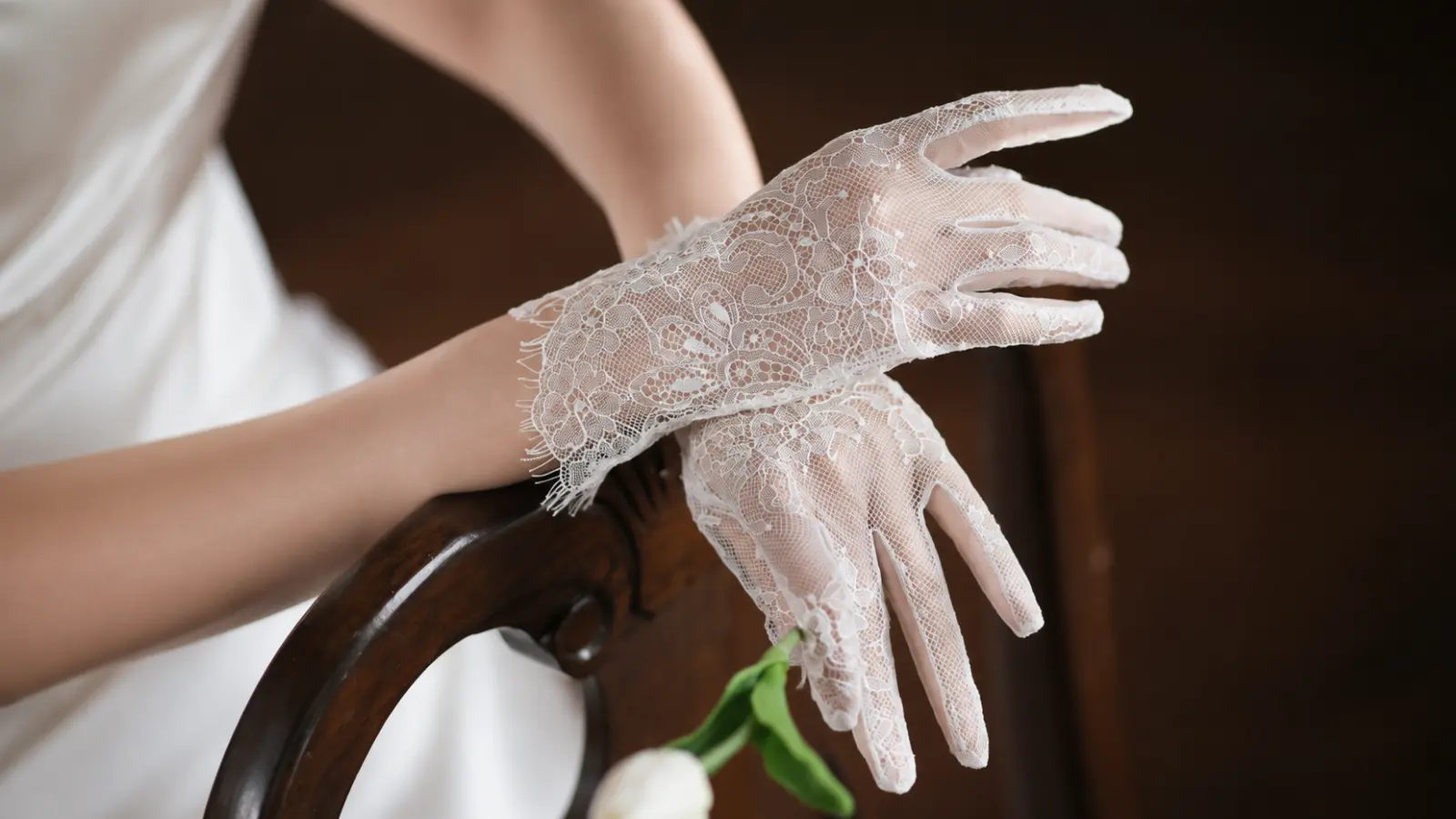
Short Lace Gloves
Short lace gloves — those ending at or just above the wrist — are one of the most versatile and approachable ways to introduce lace into a bridal look. They work across a wide range of dress styles and ceremony settings because they add a delicate textural note without committing to anything overtly formal. In a garden ceremony or a romantic outdoor setting, a short lace glove can feel as natural as a floral crown. At a more structured venue, they remain appropriate without overpowering. They’re also the easiest style to remove discretely when the moment calls for it.
Long Lace Gloves
Elbow-length or opera-length lace gloves are a more deliberate statement. They suit sleeveless and strapless gowns that leave the arm fully exposed — the length has space to be read properly rather than interrupted by a sleeve. Long lace in a dense, vintage pattern like Chantilly or Alençon has a strong period quality that suits mid-century-inspired looks. Long lace in a more open, delicate weave reads as softer and less theatrical — closer to sheer than to structured. The feel of the finished look depends heavily on the lace pattern’s density. See our full guide to long wedding gloves for more on styling extended lengths.
Fingerless Lace Gloves
Fingerless lace gloves have grown in appeal not only because they solve the ring-exchange practicality issue — fingers remain bare, so the ring placement is straightforward — but because they bring a different kind of editorial quality from traditional full-coverage gloves. The exposed fingertip against a lace-covered hand creates an intentional contrast that reads as modern rather than traditional. They suit brides who love the lace aesthetic but want the look to feel current and personal rather than period-specific. See our dedicated guide to fingerless wedding gloves for styling and pairing details.
Vintage Lace Gloves
Vintage lace gloves are defined less by their length and more by their lace pattern and construction. Dense, intricate patterns — the kind associated with mid-century bridal dressing — fall into this category. They often have a slightly heavier hand than modern lace, and the pattern scale tends to be more pronounced. They work beautifully with vintage-inspired silhouettes: fitted bodices, defined waists, A-line or tea-length skirts. Against a contemporary, minimalist gown, the same glove can feel deliberately contrasting in an interesting way, or slightly mismatched in aesthetic register — the outcome depends on how intentional the contrast feels in context.
White vs. Ivory Lace Gloves
The tone distinction in lace gloves matters just as much as it does in satin — and the visual stakes are slightly higher, because lace carries more surface variation and therefore shows color differences more readily than a flat, smooth fabric would.
White lace is cool-toned and reads as bright and crisp. Ivory lace is warmer, with cream or yellow undertones that soften the overall impression. A white lace glove placed against an ivory gown will read as noticeably brighter in photographs taken in natural light. The mismatch has a slightly jarring quality — the glove looks as though it belongs to a different outfit. The reverse creates a subtler but similar effect.
The practical approach: bring a photograph of your gown taken in natural light when shopping for lace gloves, or hold the glove directly against your dress fabric near a window. Boutique lighting — warm, ambient, and flattering — can mask tone differences that a camera will reveal clearly.
One additional note specific to lace: the thread used in lace production can vary in whiteness even within the same color category. Two gloves both labeled “ivory” can read differently depending on the thread’s specific undertone. When in doubt, see them in daylight alongside the gown before committing.
Lace Gloves With a Lace Dress
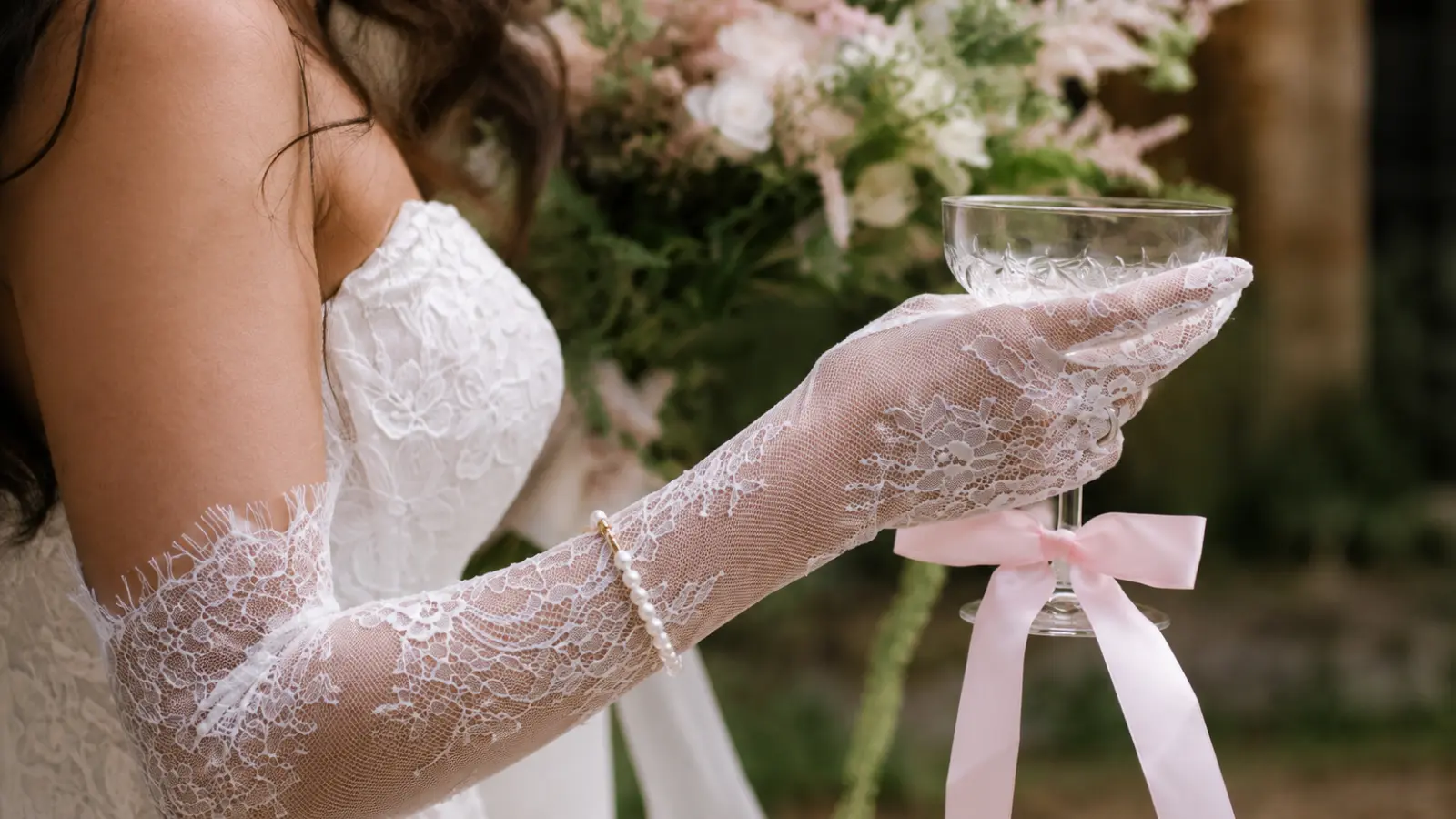
This is the combination that most brides approach with the most uncertainty — and understandably so. Two lace elements in a wedding dress with gloves can feel redundant or competing. When it works, it’s because the two pieces have been chosen in deliberate relationship to each other, not independently.
The pairing functions best when the lace patterns are coordinated in one of two ways: either closely matched in scale and weight, so the two elements feel like they belong to the same fabric family; or deliberately differentiated, so one reads as the primary lace and the other as a supporting texture. What creates visual confusion is lace patterns that are similar enough to seem like they should match but different enough to make it clear they don’t quite.
Scale is the most useful variable to work with. A gown with a fine, delicate lace overlay pairs naturally with a glove in a similarly light, open-weave lace — both elements share a gossamer quality that reinforces each other. A dress with a bold, structured lace pattern — guipure, Venetian, or heavily raised lace — is better served by a glove in a finer, less assertive lace, or by a different fabric entirely (sheer or satin), so the gown’s lace remains the focal point.
The test is simple: put both pieces on together and ask whether either one gets lost, or whether both are too loud at the same time. The goal is for one to lead and the other to support. If both are equally demanding, the balance is off.
Lace Gloves With a Simple Dress
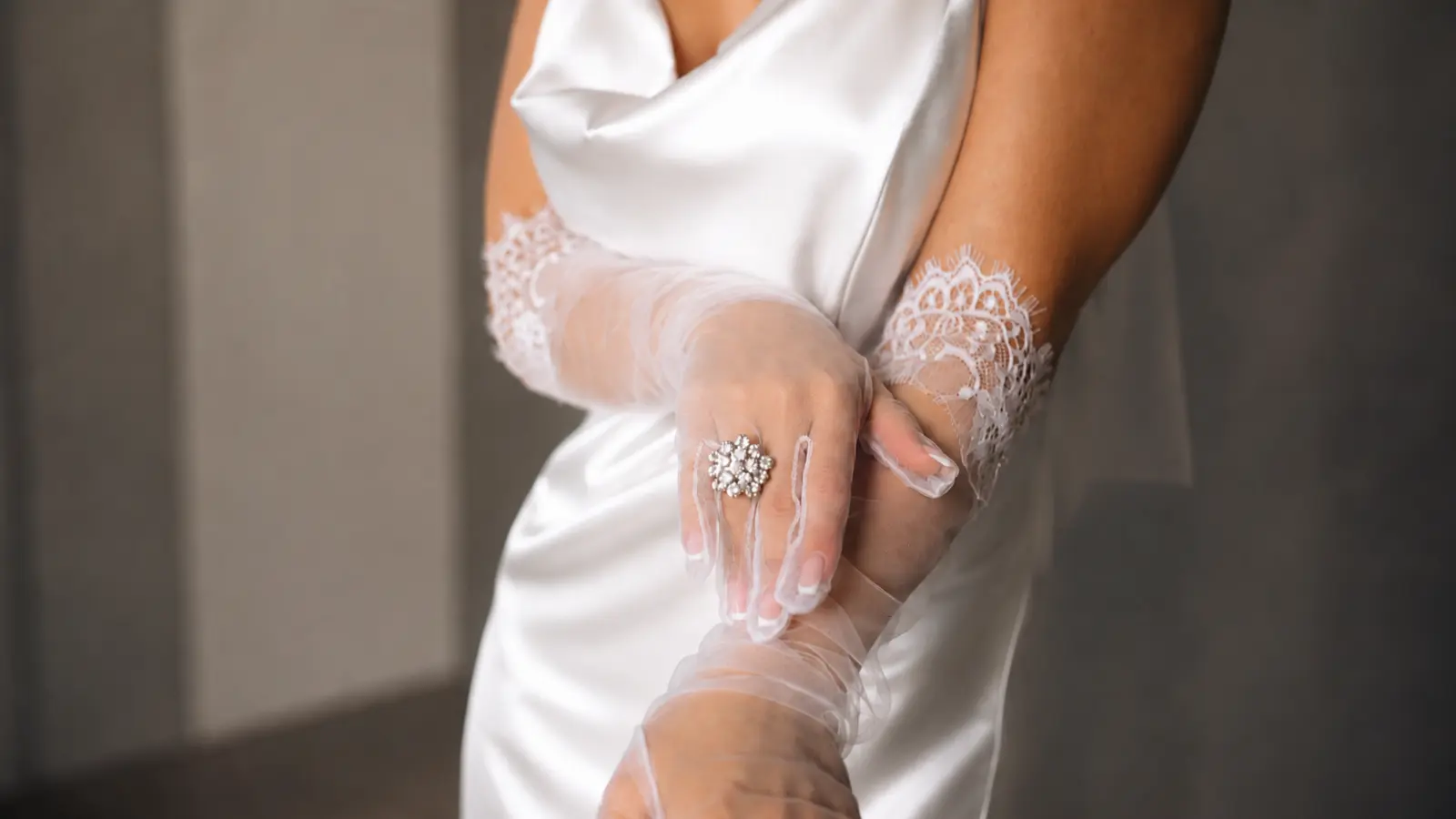
A clean, unembellished gown — crepe, plain satin, minimal chiffon — is often a beautiful backdrop for lace gloves. When the dress contributes no texture of its own, the glove becomes the textural element of the look. It has room to be seen and appreciated without competing with anything.
This combination has a strong editorial quality. A column gown in matte crepe with a delicate lace wrist glove reads as more intentional and specific than the same gown with no accessories or with a conventional bracelet. The lace introduces personality to a look that might otherwise feel slightly underdefined for a formal setting.
On a simple dress, the quality of the lace registers more clearly — both for better and for worse. A beautifully made glove with a refined lace pattern looks exceptional. A poorly constructed glove or one with an awkward synthetic quality has nowhere to hide. This is the pairing where it most pays to handle the glove in good light before purchasing and to pay attention to how the lace lies against the hand and wrist.
When Lace Gloves Look Elegant
Lace gloves have a natural elegance when the lace quality is fine, the tone is well-matched to the gown, and the rest of the look gives them visual space to be appreciated. A few specific scenarios where they tend to work particularly well:
A simple or minimally embellished dress at a garden or outdoor ceremony — the softness of lace suits natural settings in a way that satin or structured fabrics don’t always match. The texture feels appropriate to the surroundings.
A vintage-inspired silhouette at any venue — lace gloves have a period quality that reinforces rather than interrupts the aesthetic of a retro-influenced gown. They read as part of a cohesive bridal vision: intentional from head to fingertip.
A sleeveless gown in a formal setting where the bride wants arm coverage without the weight of a structured fabric — a long lace glove adds formality and coverage simultaneously while remaining softer and less constructed than satin or duchess alternatives.
A bride who wants her hands and wrists to look beautiful in close-up photographs — lace reads with exceptional detail in macro photography. The pattern, texture, and delicacy of the fabric are all visible in ways that a flat, smooth glove fabric wouldn’t reveal.
When Lace Gloves Feel Too Heavy
Lace tips into “too much” when the overall look has no quiet space left. When a gown carries significant lace embellishment, a veil has ornate trim, and the earrings are already detailed, a lace glove adds one more textured element to a look that doesn’t have room for it. Each piece individually might be beautiful. Together, they exhaust the eye.
Dense lace — guipure, raised lace, or heavy Chantilly — carries more visual weight than its delicate reputation might suggest. On a gown with an elaborate embellished bodice, a dense lace glove competes rather than complements. In that case, a sheer or satin glove almost always integrates more cleanly.
In very formal, black-tie settings, the overall styling becomes especially important because long lace gloves create a different effect from classic satin or silk styles. The formality of the setting calls for the clean precision of satin or silk rather than lace’s softer, more romantic quality. This isn’t a rule; it’s a tendency. But it’s worth considering whether the venue’s visual language matches lace’s emotional register before committing.
Finally: a lace glove that fits poorly — one that bunches at the wrist, gaps at the palm, or has an edge that sits awkwardly on the arm — loses its elegance regardless of the quality of the lace itself. Fit is as important as fabric in this category.
How Lace Gloves Photograph
Lace can be one of the most beautiful fabrics for bridal photography — it has a quality that flat, smooth fabrics don’t offer. The texture, the pattern, and the negative space within the lace all register in photographs in a way that adds dimension to images that might otherwise feel flatter.
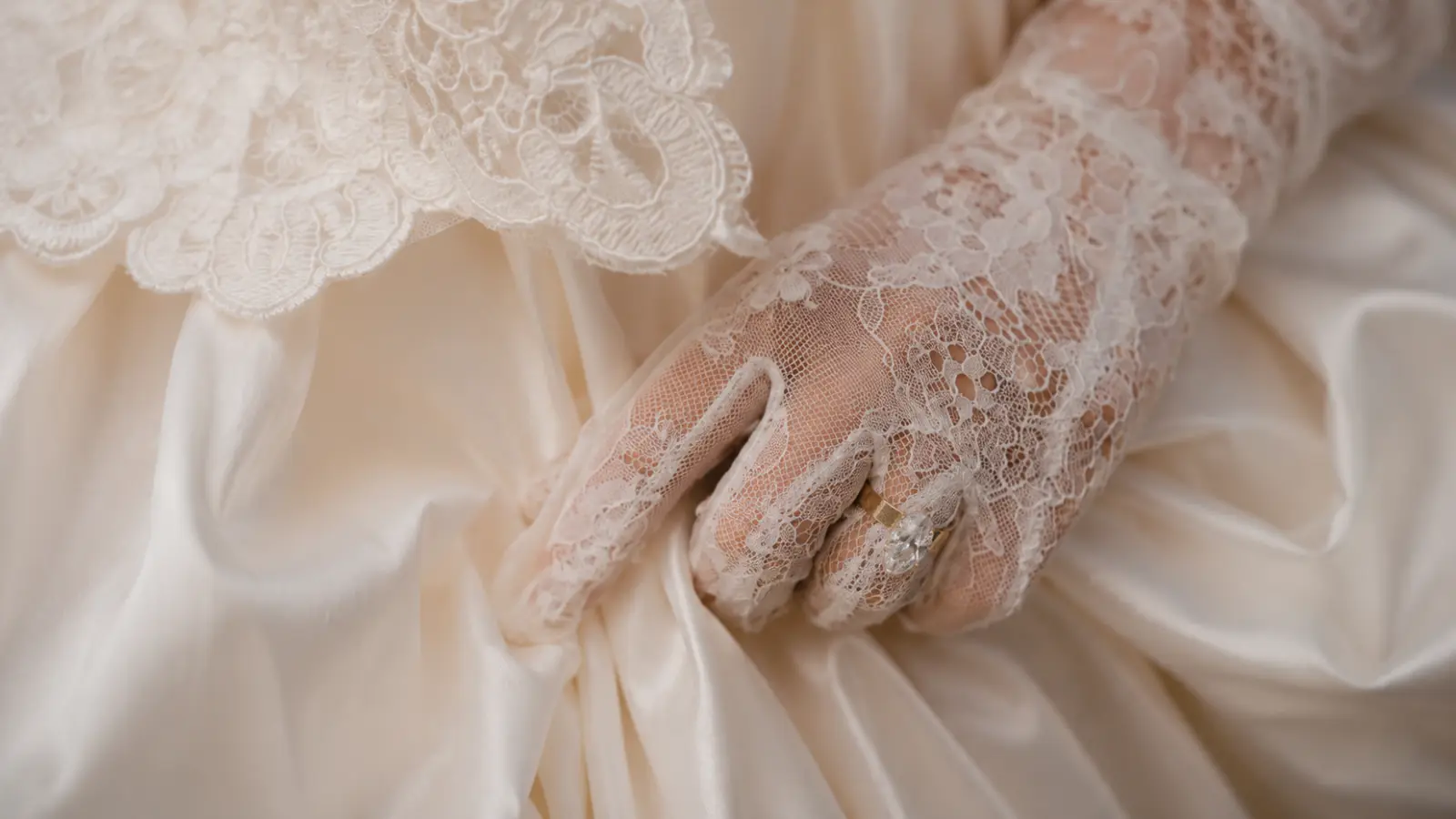
In close-up and detail shots
This is where lace gloves perform best. Hand detail shots — fingers wrapped around a bouquet stem, the ring being placed, hands clasped together — reveal the lace pattern in full. The openwork of the fabric creates shadows and highlights that add depth to the image. A well-made lace glove in a detail photograph is genuinely beautiful in a way that few other accessory fabrics achieve at close range.
In bouquet photographs
Photographs of the bride holding her bouquet are among the most frequently taken detail shots of the wedding day. Lace gloves change the visual character of these images significantly — the texture of the lace creates a romantic layering between the hands and the florals, rather than the clean contrast of bare skin against flowers. Whether that effect is preferable is a matter of personal aesthetic, but it is a meaningfully different image.
In full-length portraits
At full-length distance, lace reads as a soft, textured element rather than a pattern-specific one. The detail of the lace isn’t fully legible from a distance, but its presence adds visual complexity to the arm and hand area in a way that registers in the final image even if the specific pattern doesn’t. Short gloves contribute a small but visible textural accent; long lace gloves create a more substantial visual presence along the arm’s full length.
What natural light reveals
Photographs taken in natural light are honest about tone. A lace glove that coordinates with the gown in a fitting room can appear to mismatch in outdoor photography. Before the wedding day, take test photographs in natural light wearing the full look — gown, gloves, veil, jewelry. This is the most reliable way to confirm that the combination works as well photographically as it does in person.
Mistakes to Avoid With Lace Wedding Gloves
Pairing without seeing the pieces together
Lace-on-lace combinations in particular need to be seen together before committing. Descriptions and photographs don’t convey how two lace patterns interact when placed side by side. Hold the glove against the gown fabric — ideally in natural daylight — and look at the combined effect before making a final decision.
Choosing by pattern alone without considering weight
A lace pattern can look delicate in isolation and substantial against a gown. Pay attention to how dense the lace is — how much of the glove’s surface is covered, how heavy the thread, how structured the weave. That visual weight is what determines whether the glove complements or competes with the dress.
Overlooking the tone in artificial lighting
White and ivory are easy to confuse under warm boutique lighting, and lace shows the difference more than smooth fabrics do. Always verify the tone in natural light before finalizing.
Adding lace gloves to an already-full look
If the gown is heavily laced, the veil is trimmed, and the jewelry is detailed, a lace glove becomes surplus texture. One element needs to yield. Either simplify the other accessories, choose a different glove fabric, or reconsider the combination altogether.
Ignoring fit
Lace that doesn’t fit properly — bunching at the wrist, sliding at the palm, cutting at the fingers — loses its elegance completely. The delicacy of lace amplifies fit issues rather than hiding them. Before wearing on the wedding day, try the gloves for an extended period to confirm they stay in place comfortably.
Lace Wedding Glove Inspiration
Lace wedding gloves can add romance, texture, and personality to a bridal look, from delicate vintage-inspired details to modern statement styles. Explore lace glove ideas, including short gloves, long lace designs, fingerless styles, ivory options, and beautiful ways to pair them with your wedding dress.
When Lace Feels Like It Belongs
Lace wedding gloves work best when they feel connected to the entire bridal look, not simply chosen because lace itself is beautiful. The right pair understands the dress around it — the fabric, the silhouette, the level of detail, and the feeling the bride wants to create.
When the balance is right, lace does not overwhelm the gown or disappear beside it. It adds a final layer of texture and intention, creating a bridal look where the gloves feel like a natural part of the entire design.
Frequently asked questions (FAQ)
Are lace wedding gloves still in style?
Yes. Lace wedding gloves are still in style, but they are now worn as an intentional bridal fashion choice rather than a traditional requirement. Modern brides often choose lace gloves for romantic, vintage-inspired, garden, or editorial wedding looks. The key is pairing the lace with the right dress so the gloves feel like part of the overall design instead of an added accessory.
Can you wear lace gloves with a lace wedding dress?
Yes, you can wear lace gloves with a lace wedding dress, but the patterns and textures need to work together. The safest approach is choosing lace that either closely complements the gown or is different enough to look intentionally layered. If the dress and gloves have competing lace patterns, the overall look can feel too busy.
What wedding dresses look best with lace gloves?
Lace wedding gloves usually work best with dresses that give the lace enough room to stand out. Simple gowns, minimalist silhouettes, vintage-inspired dresses, and romantic styles often pair beautifully with lace gloves. Heavily embellished dresses can also work, but the glove design should be more subtle so the details do not compete.
Should you choose white or ivory lace wedding gloves?
Choose white or ivory lace wedding gloves based on the undertone of your wedding dress. Bright white gowns usually pair best with white lace gloves, while ivory, cream, or champagne dresses usually look better with warmer ivory tones. Checking the combination in natural light is important because small color differences are often more noticeable in wedding photos.
Are fingerless lace gloves a good choice for brides?
Fingerless lace gloves can be a beautiful option for brides who want the romantic look of lace with more comfort and practicality. They make the ring exchange easier, keep the fingers uncovered, and often feel slightly more modern than traditional full gloves. They work especially well with vintage, bohemian, garden, and contemporary bridal styles.
When should you avoid lace wedding gloves?
You may want to avoid lace wedding gloves if your bridal look already has several strong details competing for attention. A heavily laced gown, ornate veil, statement jewelry, and detailed gloves together can make the outfit feel overwhelming. Lace gloves work best when they add texture and romance without taking attention away from the dress.