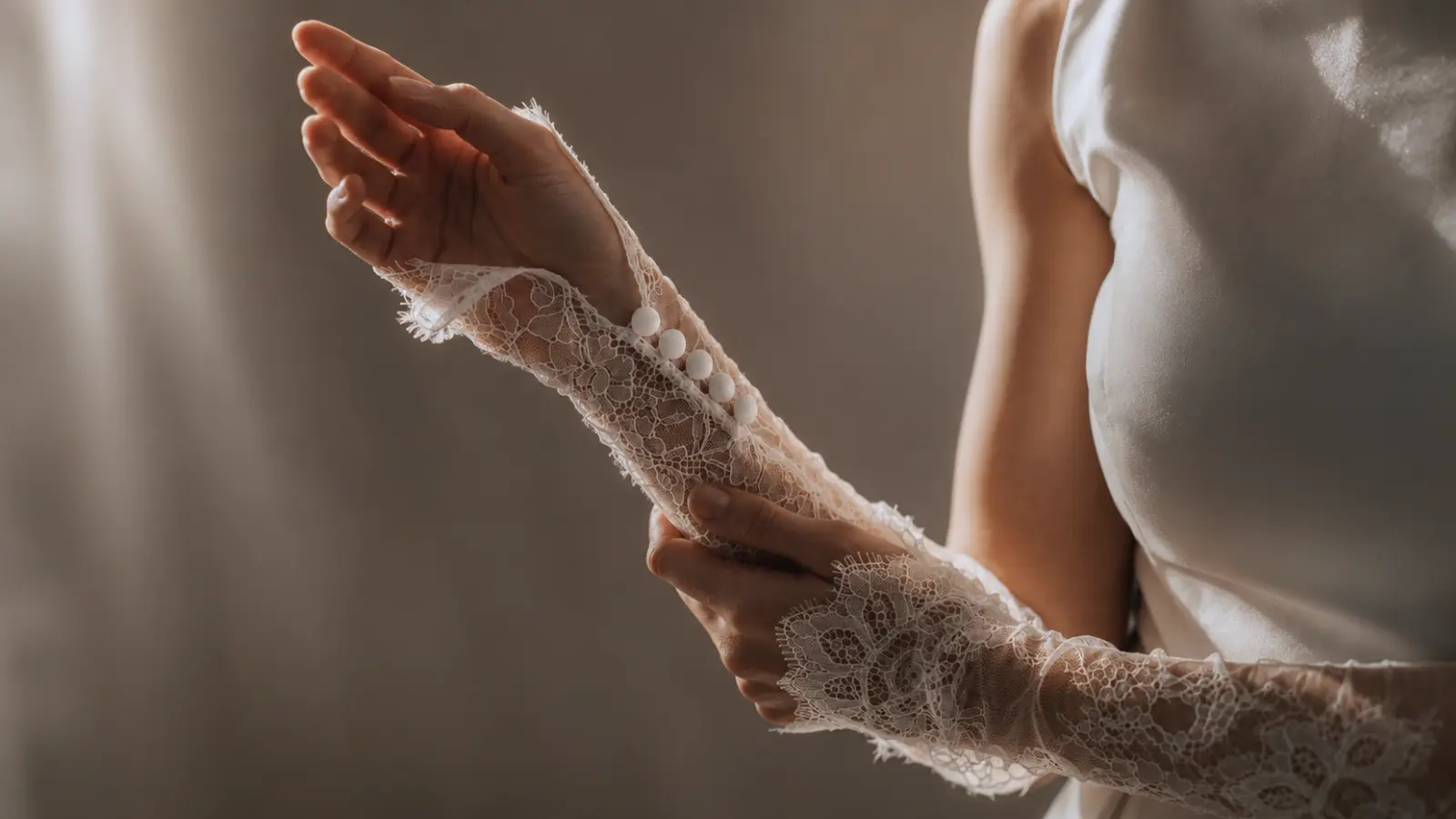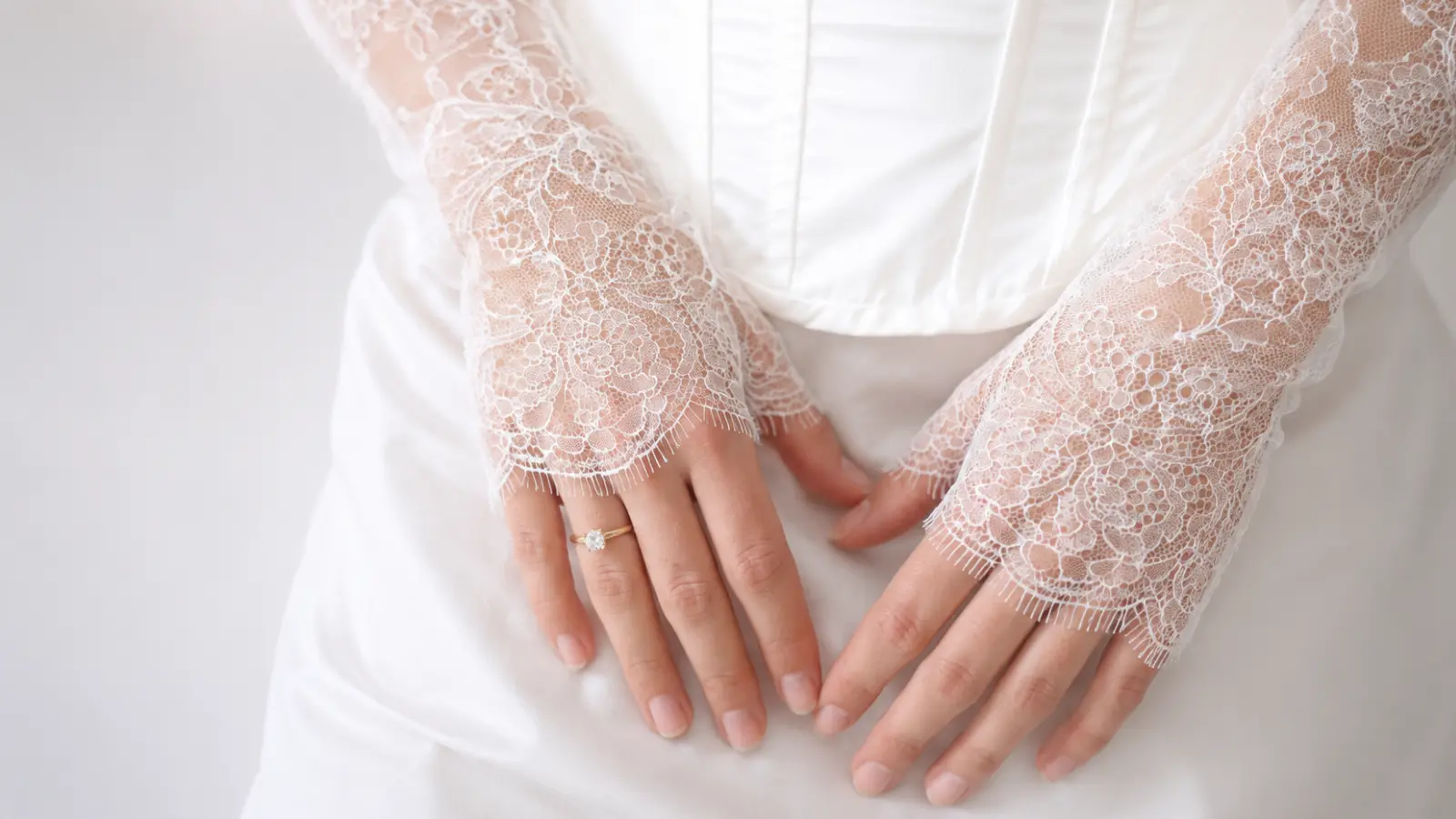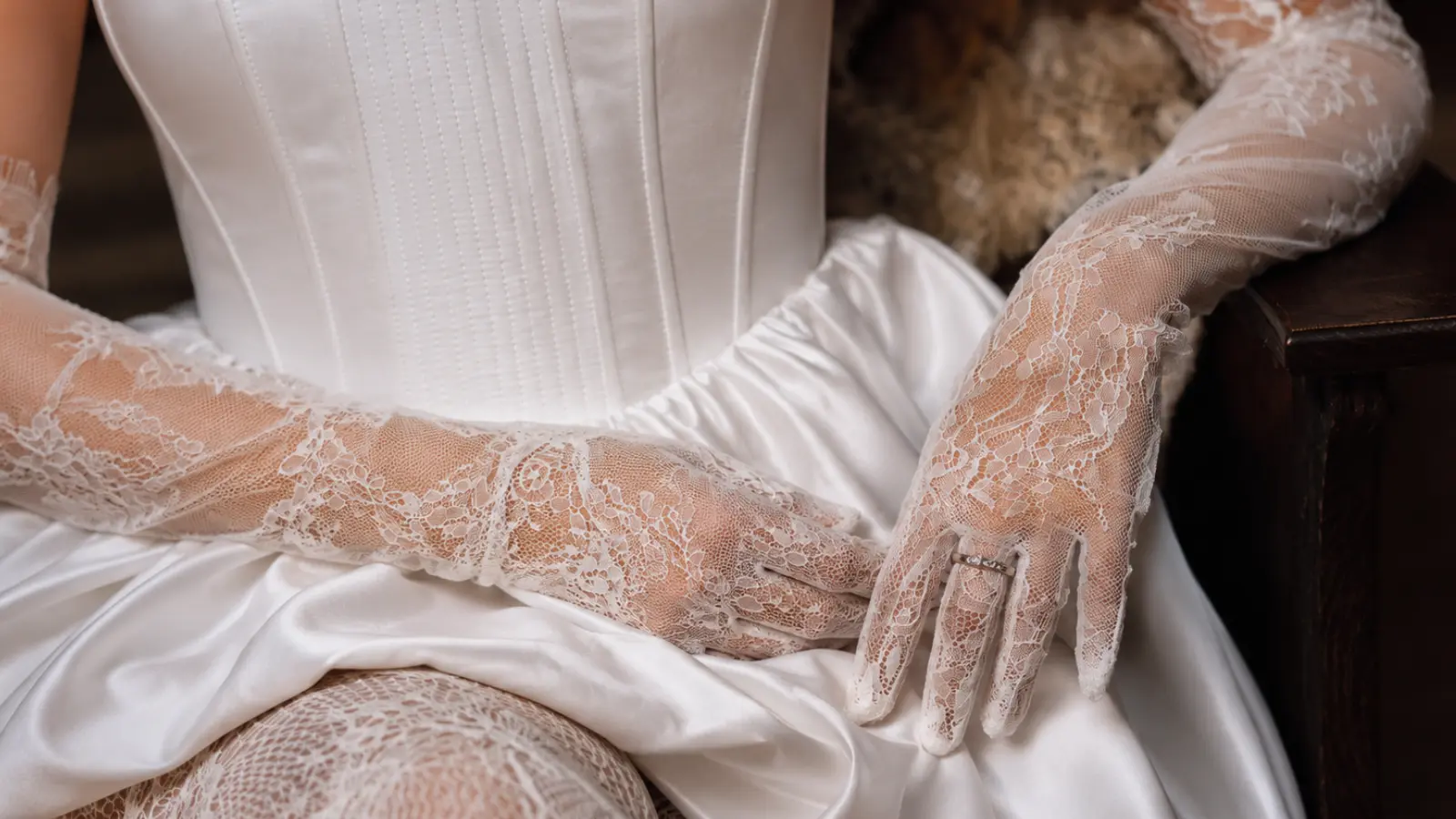
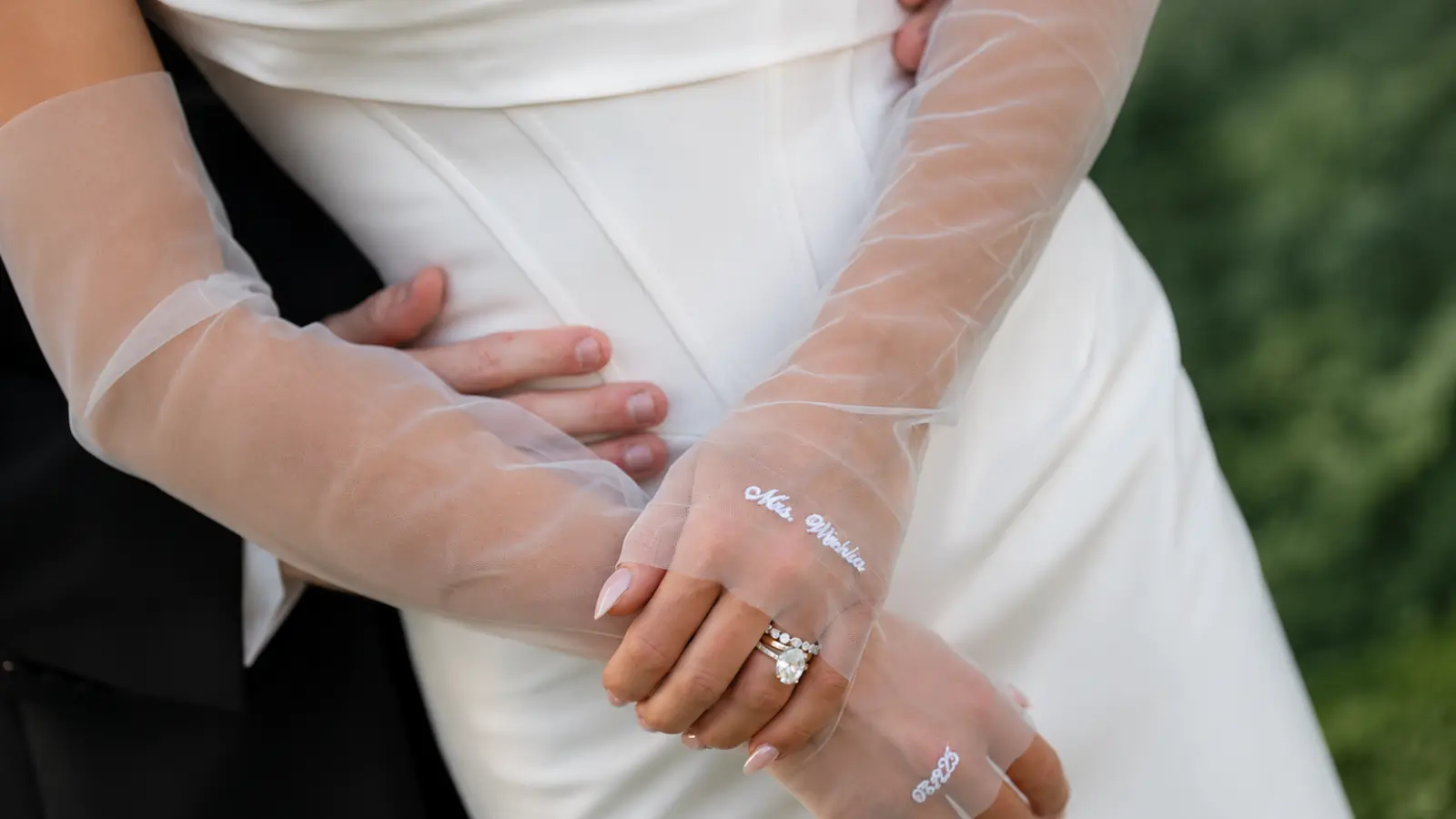
Fingerless wedding gloves are bridal gloves designed to cover part of the hand, wrist, or arm while leaving the fingers exposed. They give brides the visual effect of gloves while making moments like the ring exchange, holding a bouquet, eating, and celebrating throughout the day much easier.
Fingerless gloves are not simply an alternative to traditional gloves they follow a different design logic. The hand and wrist are still styled, the wedding ring remains visible, and the ceremony can happen without removing gloves or adjusting fabric at the altar. Fingerless styles combine the elegance of bridal gloves with the practicality many modern brides want.
This guide explains everything about fingerless wedding gloves, including lace and sheer styles, short vs. long lengths, how they work with wedding rings, when to wear them, how they photograph, and how to choose the right wedding gloves for your bridal style.
What Are Fingerless Wedding Gloves?
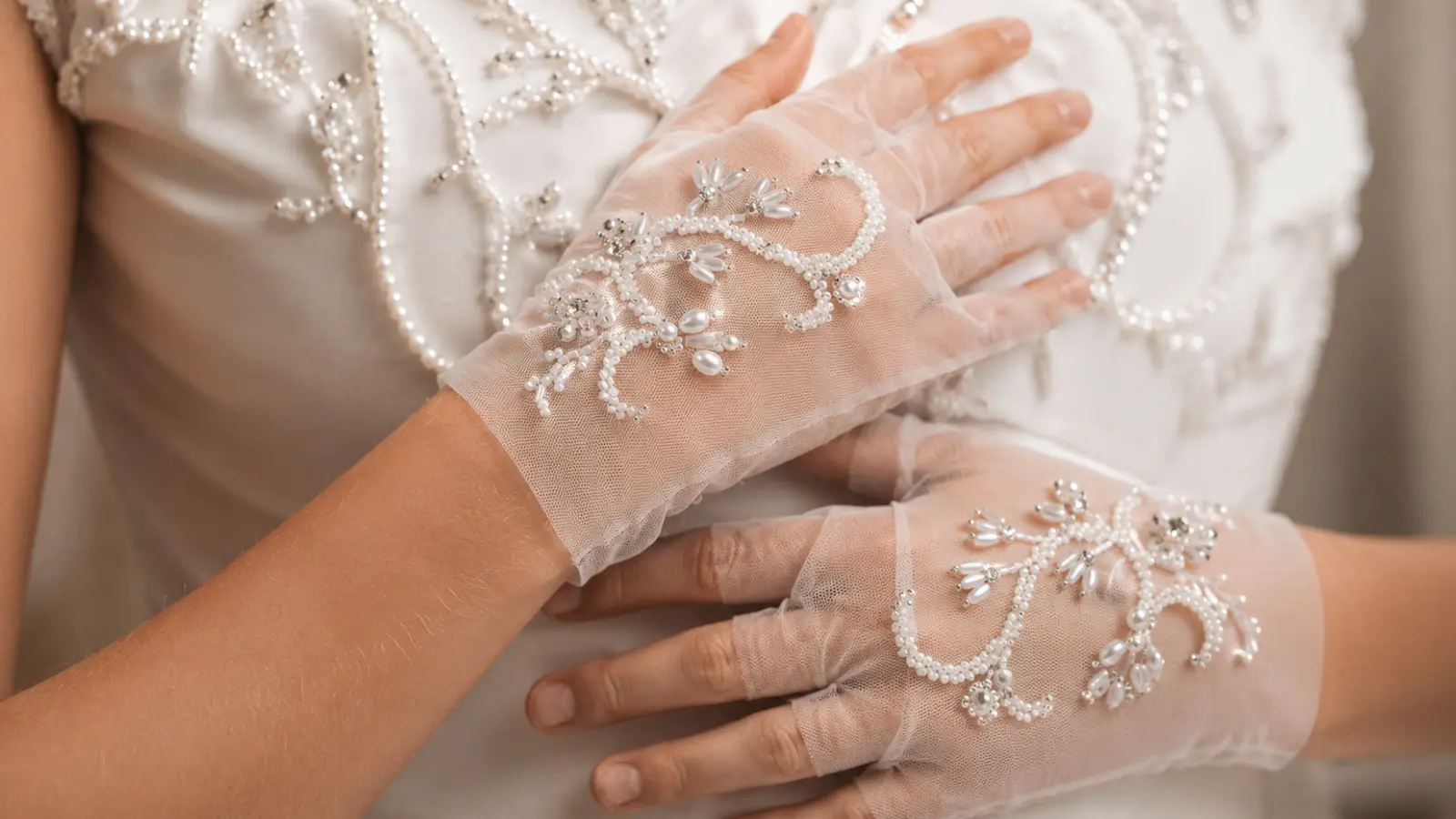
Fingerless wedding gloves cover the hand and wrist — and in longer styles, the arm — while leaving the fingers fully or partially exposed. The most common construction ends just below the knuckles, leaving all five fingers bare from the first joint. Some styles leave only the ring finger exposed through a small opening or button-tab at the seam. Others stop at mid-finger, covering just the base of each finger while leaving the tips free.
They are made in many of the same wedding glove fabrics as full-coverage bridal gloves — lace, sheer organza, tulle, and occasionally satin or silk. What changes is the construction at the hand, not the quality or formality of the glove as a whole.
Are Fingerless Gloves Formal Enough for a Wedding?
Yes — fingerless gloves can feel completely appropriate for a wedding. Formality comes from fabric, length, construction, and how the gloves work with the overall bridal look.
A long fingerless glove in fine Chantilly lace or sheer organza, worn alongside a formal sleeveless gown at a ballroom ceremony, reads as genuinely elegant. The open finger is a detail — a practical one — not a signal that the accessory is casual. What communicates formality is the quality of the fabric, the precision of the construction, and how the glove relates to the dress and the setting.
Conversely, a short fingerless glove in a casual knit or loose stretch lace at a black-tie wedding would feel underdressed — not because of the open finger, but because the material and construction don’t match the occasion. The logic is the same as it is for any other accessory: the formality of the piece lives in how it’s made and what it’s made from, not in one construction detail.
Fingerless Glove Styles: Length and Fabric
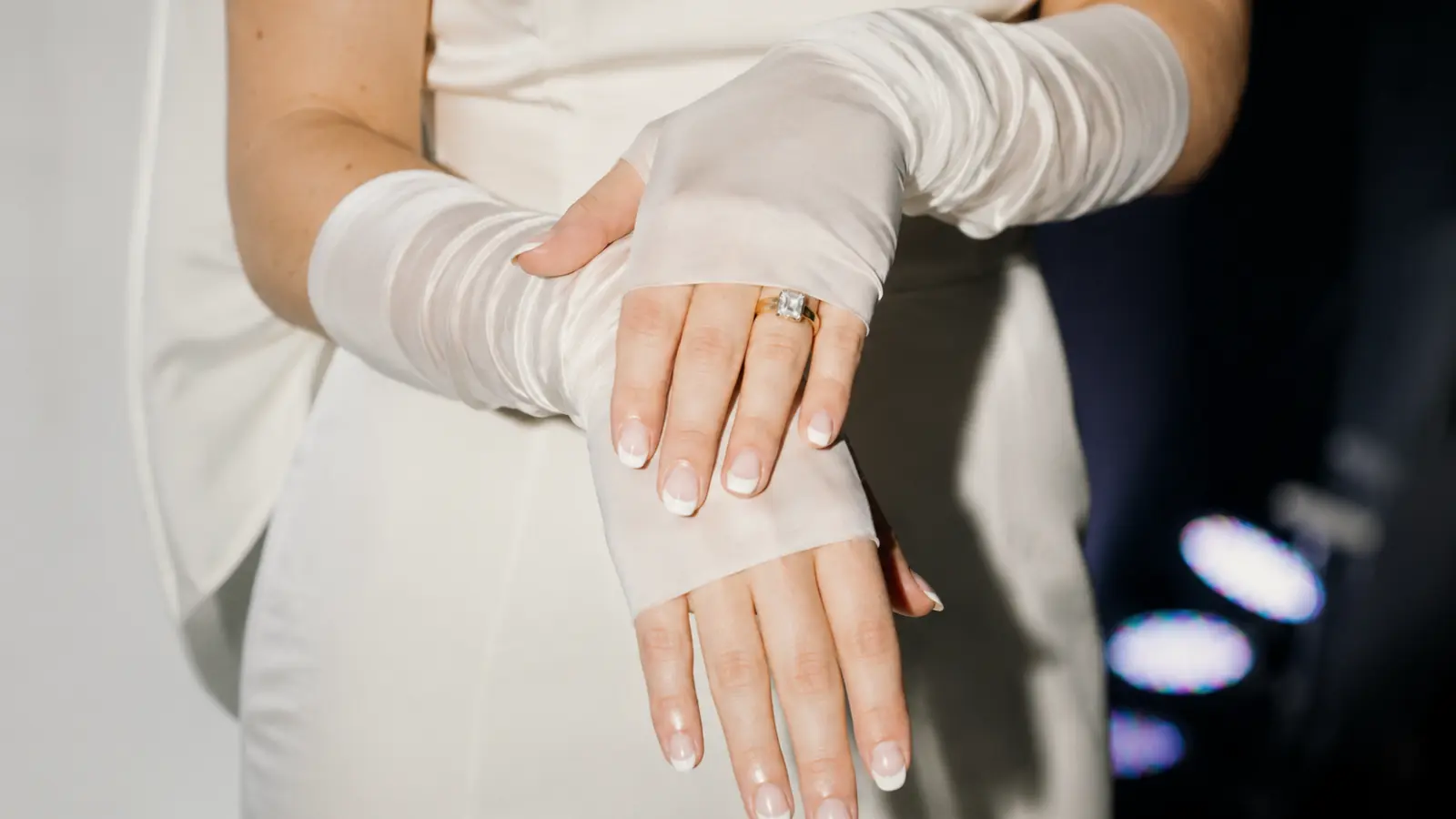
Short fingerless gloves
Short styles end at or just above the wrist, covering the back of the hand and leaving the fingers fully exposed from the knuckle. They are among the more relaxed options in the fingerless category and often suit garden weddings, outdoor ceremonies, and softer bridal styles naturally. In fine lace, they carry a delicate, romantic quality that feels appropriate even at more traditional venues. They disappear easily into the reception — small enough to tuck away without a second thought if you decide to remove them at dinner.
Long fingerless gloves
Long wedding gloves, including elbow-length or opera-length fingerless styles, make a more considered statement. The arm is covered up to the elbow or higher; the fingers remain bare. This combination suits sleeveless and strapless gowns with a formal or editorial quality, and works especially well for brides who want the full visual impact of a long glove without the ring-exchange logistics. In sheer or fine lace, a long fingerless glove has an airy, structural quality that photographs beautifully in full-length portraits.
Lace fingerless gloves
Lace is one of the most popular fabrics for fingerless bridal gloves because of the way it interacts with the hand — the openwork of the lace at the fingers transitions naturally into the exposed skin, making the edge of the glove feel intentional rather than abrupt. The lace pattern frames the hand without closing it off. Short lace fingerless gloves suit vintage-inspired and garden looks; long lace fingerless gloves suit formal and editorial looks where the arm needs coverage but the hand needs freedom. See our lace wedding gloves guide for more on pairing lace with different dress styles.
Sheer fingerless gloves
Sheer fingerless gloves — in organza, tulle, or chiffon — have a lighter, more contemporary quality than lace. They cover the hand and arm with a translucent layer that adds structure and visual interest without the pattern density of lace. Against a minimalist gown, a sheer fingerless glove can feel unexpectedly editorial — visible enough to be noticed, subtle enough not to compete. The exposed fingertips against the sheer fabric create a graphic contrast that reads particularly well in photographs.
Best Wedding Dress Styles for Fingerless Gloves

Fingerless wedding gloves work best as part of a wedding dress with gloves, rather than feeling like two pieces chosen separately. Because they expose the fingers while adding detail to the hand or arm, the right pairing depends on the gown’s shape, fabric, and overall style.
- Minimal Wedding Dresses
Simple gowns pair beautifully with fingerless gloves because the glove can become the main detail. Lace or sheer styles add texture without changing the clean feeling of the dress.
- Vintage Wedding Dresses
Fingerless lace gloves naturally complement vintage-inspired gowns, especially designs with romantic fabrics, defined waists, or softer silhouettes.
- Modern Wedding Dresses
Modern gowns often work well with sheer, sculptural, or longer fingerless gloves because the open-finger design feels more fashion-forward than traditional.
- Strapless and Sleeveless Dresses
These styles give longer fingerless gloves the most space visually, allowing the glove to become part of the overall silhouette.
Fingerless Gloves and Wedding Rings
This is where fingerless gloves distinguish themselves most clearly from full-coverage styles — and it’s a distinction worth understanding before deciding between the two.
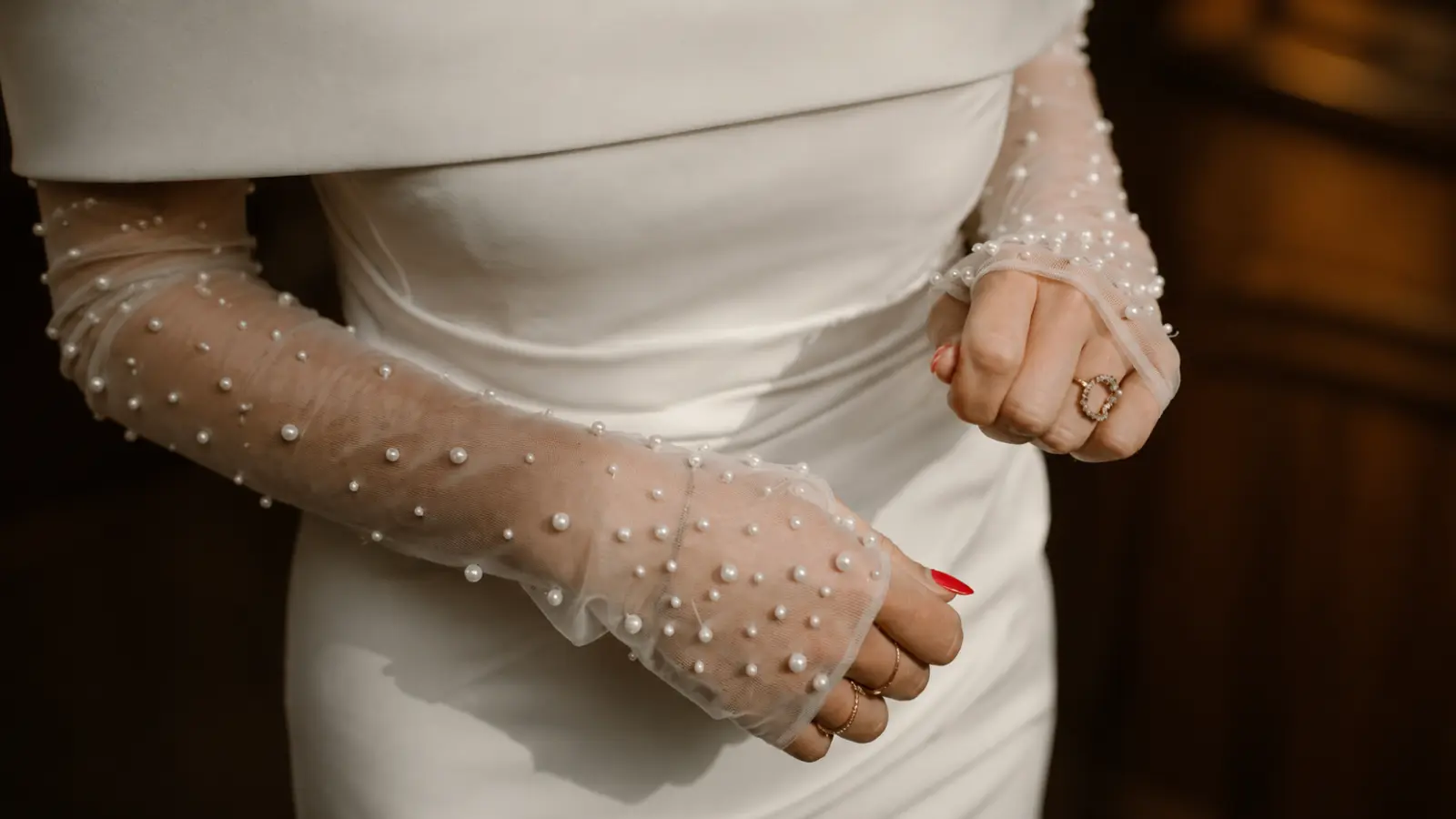
The engagement ring
With full-coverage gloves, the engagement ring is hidden beneath the fabric for much of the ceremony. Some brides move it to the right hand temporarily; others leave it under the glove. With fingerless gloves, the engagement ring sits on bare skin exactly as it normally would — visible, unobstructed, and photographed naturally throughout the day. For brides whose engagement ring is a significant part of the bridal look, that visibility matters.
The ring exchange
Full-coverage gloves require a plan for the ring exchange: remove the glove entirely, undo a button at the ring finger, or wear the ring over the fabric. Each option requires some version of preparation and coordination on the day. Fingerless gloves simplify this process because the ring finger is already exposed. The exchange happens exactly as it would without gloves — no adjustment, no designated person to hand the glove to, no moment of fumbling with a button at the altar.
Wearing both rings
After the ceremony, the wedding band and engagement ring sit together on a bare finger while the glove covers the rest of the hand. The rings are visible and unobstructed in photographs for the remainder of the day — detail shots, reception portraits, candid images. This is the most natural and photographically clean way to wear both accessories simultaneously.
Wearing Fingerless Gloves During the Ceremony
Fingerless gloves are among the most ceremony-compatible versions of this accessory. Because no adjustment is needed for the ring exchange, the glove can stay on from the moment the bride leaves for the ceremony until she chooses to remove it — which may not be until dinner, or at all.
The bouquet hold is also more natural. Full fingers wrapped around a bouquet stem create a more secure, comfortable grip than fabric-covered hands, and close-up photographs of the bouquet with bare fingertips against the glove’s lace or sheer edge have a particular visual elegance — the skin and fabric together are more interesting than either one alone.
For ceremonies that include any tradition involving touch — lighting a unity candle, pouring sand, exchanging hands during a handfasting — fingerless gloves are considerably more practical than full coverage. The hand can participate fully without the glove becoming an obstacle to the gesture.
Are Fingerless Gloves Easier for Real Weddings?
In practical terms, yes — and in ways that extend well beyond the ceremony.
Holding the bouquet
A firm, comfortable grip on a bouquet requires fingertips. Fingerless gloves allow a natural hold without the slight slippage that satin or smooth full-coverage gloves can create against a wrapped stem. The bouquet sits more securely, which matters both for comfort during a long ceremony and for how effortless the hand position looks in photographs.
Greeting and hugging guests
Cocktail hour involves a lot of handshaking, hugging, and personal contact. Full gloves create a layer of fabric between the bride and everyone she greets. Fingerless gloves keep that contact feeling natural and warm — the hand is largely bare, and the glove reads as a visual accessory rather than a physical barrier.
Dinner
Eating in full gloves is uncomfortable for most people, which means full-coverage styles typically come off before the reception dinner. Fingerless gloves are considerably more manageable at the table — handling cutlery, holding a glass, and eating feel essentially normal with bare fingers. Many brides who wear fingerless gloves keep them on through dinner without any difficulty, which extends the look through more of the reception.
Dancing
Long full-coverage gloves can feel restrictive during dancing — they limit wrist flexibility slightly and can slide during energetic movement. Fingerless styles, particularly shorter ones, tend to stay in place better and feel less constraining. The exposed fingers also mean that any dancing that involves handholding with a partner or guests happens skin-to-skin, which most people find more natural.
End of the night
Fingerless gloves are easier to manage throughout a long evening. They don’t require a bag or a bridesmaid to hold them when removed, and they can be worn and removed more casually because their smaller construction takes up less space and folds away without much thought.
How Fingerless Gloves Photograph
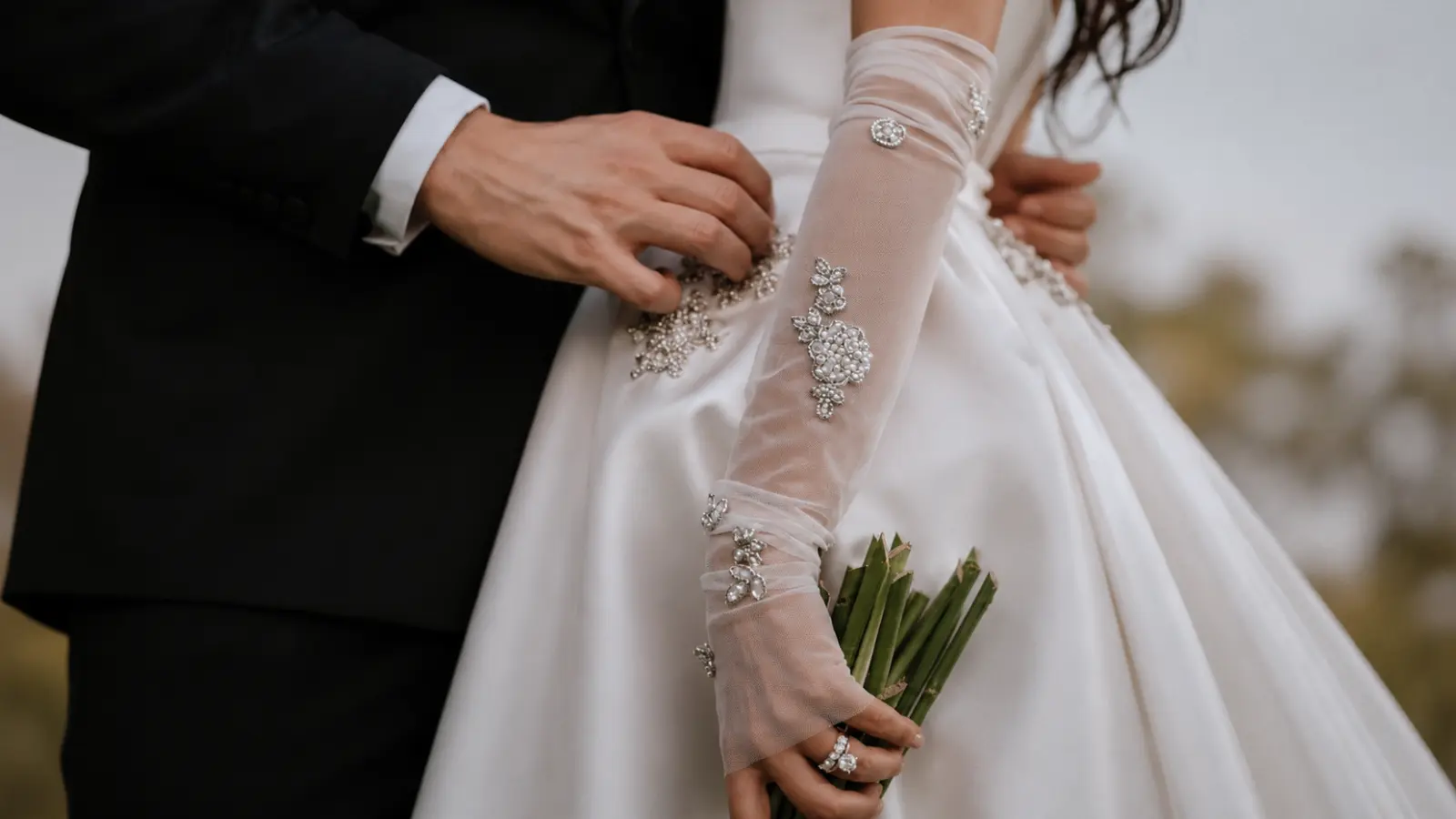
Fingerless gloves can photograph beautifully in wedding photography, especially in moments where rings, hands, and small details become the focus.
Ring detail shots
One of the most photographed details involving the hands on a wedding day is the ring. With fingerless gloves, the ring sits on bare skin — photographed exactly as it is, with the glove’s edge or lace visible in the frame as a textural border. These images are clean, layered, and elegant. The glove adds context and beauty to the shot without covering what the photograph is actually about.
Bouquet photographs
Bouquet detail shots with fingerless gloves have a quality that both bare hands and full-coverage gloves approach differently. The fingertips — bare, natural, perhaps with a refined nail color — appear above the glove edge against the florals. The contrast between skin, fabric, and flowers creates a layered image that reads as considered and beautiful. In black-and-white photography particularly, the tonal contrast between the glove’s texture and bare skin is striking.
Ceremony and portrait shots
In full-length and three-quarter portraits, fingerless gloves read much like full-coverage gloves — as a textural element along the arm and hand. The open finger isn’t particularly legible at portrait distance. What registers is the fabric, the length, and the visual line the glove creates. The practical difference between fingerless and full-coverage is almost invisible in these images; the styling choice is what shows.
Candid photography
Candid wedding photographs — the unposed moments throughout the day — tend to show hands in action: holding a champagne flute, adjusting a veil, reaching for a partner’s hand. Fingerless gloves in these images look natural and unstudied in a way that full-coverage gloves sometimes don’t, because the hands are performing normal actions without the fabric creating any visual awkwardness.
How to Choose the Right Pair
Once you’ve decided fingerless gloves suit your look and your day, the decision narrows to length, fabric, and fit.
Length follows sleeve logic
As with all bridal gloves, the length of a fingerless style should relate to the dress’s sleeve structure. Sleeveless and strapless gowns have the most flexibility — short or long both work. Dresses with sleeves that already cover part of the arm limit what lengths are actually available without creating an awkward visual pile-up where the sleeve ends and the glove begins. Let the bare skin area of your arm determine how much glove length makes sense.
Fabric follows formality
Fine lace and sheer organza are the most appropriate fingerless fabrics for formal and semi-formal weddings. For more relaxed settings — garden weddings, outdoor ceremonies, casual receptions — lighter and more informal constructions can work beautifully. The fabric should feel proportionate to the occasion.
The edge matters
In a fingerless glove, the edge at the finger cutoff is highly visible — it appears in close-up photographs and defines how polished the glove looks in person. Look for a clean finish: a rolled hem, a scalloped lace edge, a ribbon binding. A raw or poorly finished edge reads as unrefined at close range, which is precisely where fingerless gloves are seen most clearly.
Fit is non-negotiable
A fingerless glove that fits poorly — sliding toward the fingers, bunching at the wrist, pulling at the thumb — will require constant adjusting throughout the day. Try the gloves for a sustained period before the wedding and perform the actions you’ll actually do: hold a bunch of flowers, hug someone, sit and eat. Comfort and stability matter as much as appearance.
Fingerless Wedding Gloves Inspiration
Fingerless wedding gloves combine the elegance of bridal gloves with the freedom of uncovered fingers. Explore lace, sheer, short, and long fingerless glove ideas, including styles for wedding rings, bouquets, ceremonies, and different bridal looks.
The Gloves That Move With the Moment
The best wedding accessories are the ones that become part of the day instead of something the bride has to constantly manage. Fingerless wedding gloves work because they keep the beauty, texture, and intention of gloves while allowing the hands to move naturally through every important moment.
When the style, fabric, and fit are chosen carefully, fingerless gloves do not feel like a compromise between elegance and practicality. They become their own kind of bridal statement — a detail that supports both the look of the wedding and the experience of wearing it.
Frequently asked questions (FAQ)
Are fingerless wedding gloves a good choice for brides?
Yes. Fingerless wedding gloves are a good choice for brides who want the look of bridal gloves with more comfort and practicality. They keep the elegance and styling impact of traditional gloves while leaving the fingers free for the ring exchange, holding a bouquet, greeting guests, and enjoying the reception. The right pair should feel like an intentional part of the bridal look, not just a practical alternative.
Can you wear rings with fingerless wedding gloves?
Yes. One of the biggest advantages of fingerless wedding gloves is that engagement rings and wedding bands can be worn naturally on bare fingers. The rings remain visible for the ceremony, portraits, and close-up photographs without needing to place jewelry over fabric or remove the gloves during important moments.
Do you have to remove fingerless gloves during the wedding ceremony?
No. Most fingerless gloves can stay on throughout the wedding ceremony because the fingers are already uncovered. This allows the ring exchange to happen naturally without adjusting the glove, removing it, or asking someone to hold it. Many brides keep fingerless gloves on for the ceremony, photos, and parts of the reception.
Are fingerless gloves formal enough for a wedding?
Yes. Fingerless gloves can be formal enough for a wedding depending on the fabric, length, and overall styling. Long fingerless gloves made from fine lace, tulle, or sheer fabrics can feel elegant and sophisticated, while shorter styles often create a softer or more relaxed look. The formality comes from the design and how the gloves complement the dress, not from whether the fingers are covered.
What wedding dresses look best with fingerless gloves?
Fingerless gloves work especially well with strapless, sleeveless, off-the-shoulder, vintage-inspired, and minimalist wedding dresses. These styles give the gloves enough visual space while keeping the overall look balanced. The best pairing depends on matching the glove length, fabric, and level of detail with the dress.
Do fingerless wedding gloves photograph well?
Yes. Fingerless wedding gloves photograph beautifully because they frame the hands while keeping the rings visible. The exposed fingers create a natural contrast with lace, tulle, or sheer fabrics, which works especially well for bouquet photos, ring details, and close-up wedding portraits. A proper fit and matching color tone help create the most polished result.