Long wedding gloves are bridal gloves that extend beyond the wrist, creating a more dramatic, elegant, and structured wedding look. From classic elbow-length gloves to formal opera gloves, the right style can completely change the silhouette of a dress and the overall feeling of a bridal outfit.
No bridal accessory changes a silhouette quite the way a long glove does. Where jewelry adds detail and a veil adds dimension, a long glove does something more architectural — it extends the line of the body, defines the arm, and creates a visual continuity from shoulder to fingertip. The drama is real, but so is the importance of choosing the right length, fabric, and dress pairing. When the pairing is right, long gloves don’t just work. They become one of the defining elements of the entire bridal look.
This guide explains everything about long wedding gloves, including opera vs. elbow-length styles, the best dress necklines, satin, lace, and sheer fabrics, wedding ring considerations, reception practicality, photography tips, and how to choose the right wedding gloves for your bridal look.
Opera vs. Elbow Length: What’s the Difference?
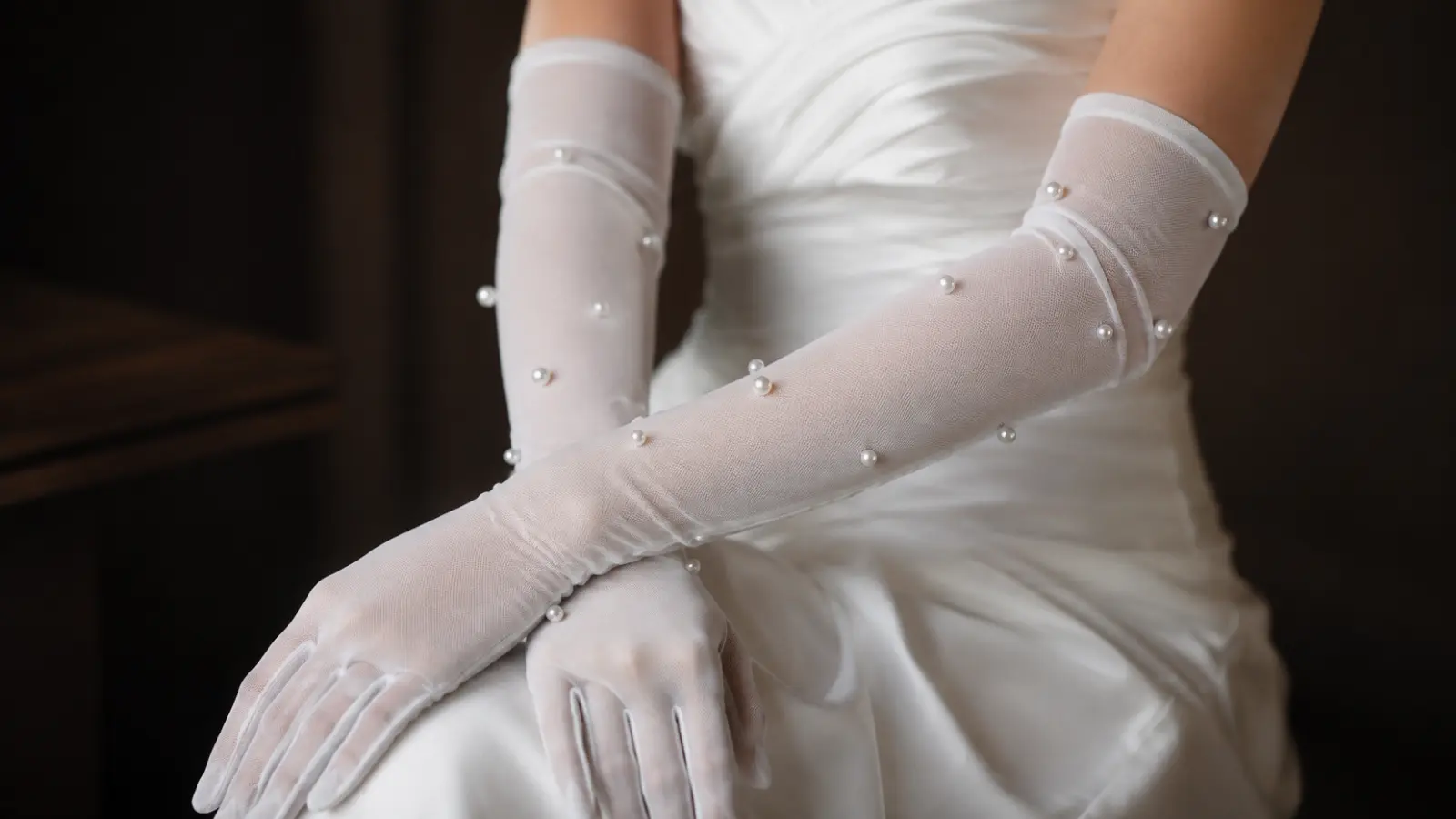
Both styles cover the forearm and read as formal. The distinction is in how far they travel up the arm — and what that distance does to the overall look.
Elbow length
Elbow-length gloves end at or just above the elbow, leaving the upper arm and shoulder bare. They are often the easier of the two long-glove options to adapt — formal enough to create visual impact, while fitting naturally into a wider range of bridal styles. They suit a wider range of ceremonies and work with both sleeveless and off-shoulder silhouettes without overwhelming them. In terms of photography, elbow-length gloves create a beautiful line through the forearm that reads clearly in portrait and three-quarter shots.
Opera length
Opera gloves extend past the elbow to the mid-upper arm, bicep, or higher — sometimes reaching as far as the underarm. This is the length most associated with black-tie formality and Old Hollywood bridal portraiture. The line they create is uninterrupted and architectural: from the top of the shoulder to the fingertip, the arm reads as a single designed element. That quality is what makes them so striking in photographs — and what makes them unforgiving in the wrong context. A formal ballroom ceremony naturally supports the drama of opera gloves, while more relaxed settings usually require more attention to styling, fabric, and balance.
The practical difference also matters: opera gloves cover more of the arm and often require more planning around comfort, movement and removal. They are a commitment — beautiful when the decision is fully considered, slightly burdensome when chosen without accounting for a full day of wear.
Most Popular Long Wedding Glove Styles
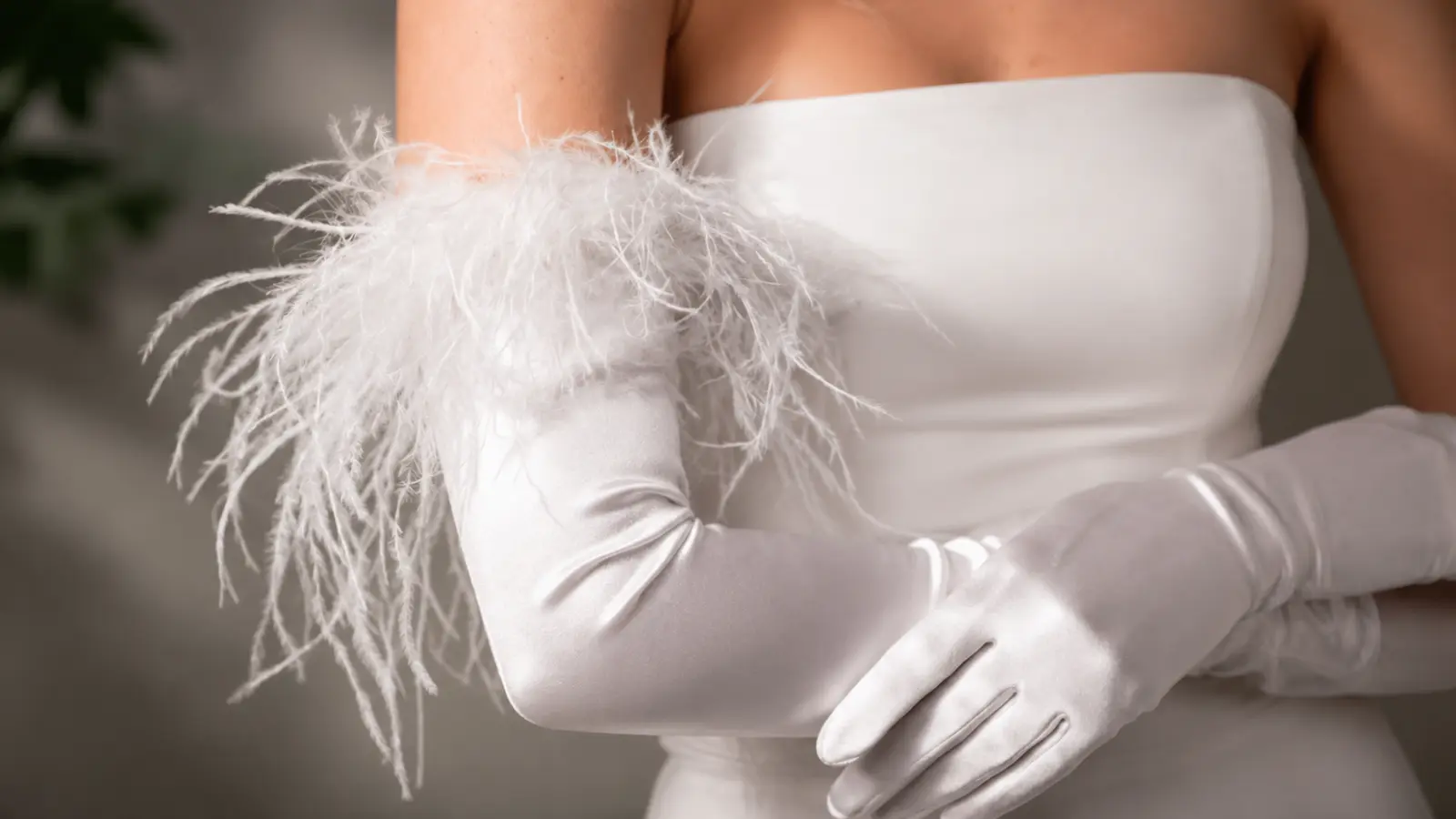
Long wedding gloves can create very different bridal looks depending on their fabric, length, and overall styling. Some feel classic and formal, while others feel softer, romantic, or more fashion-forward.
- Satin Long Wedding Gloves
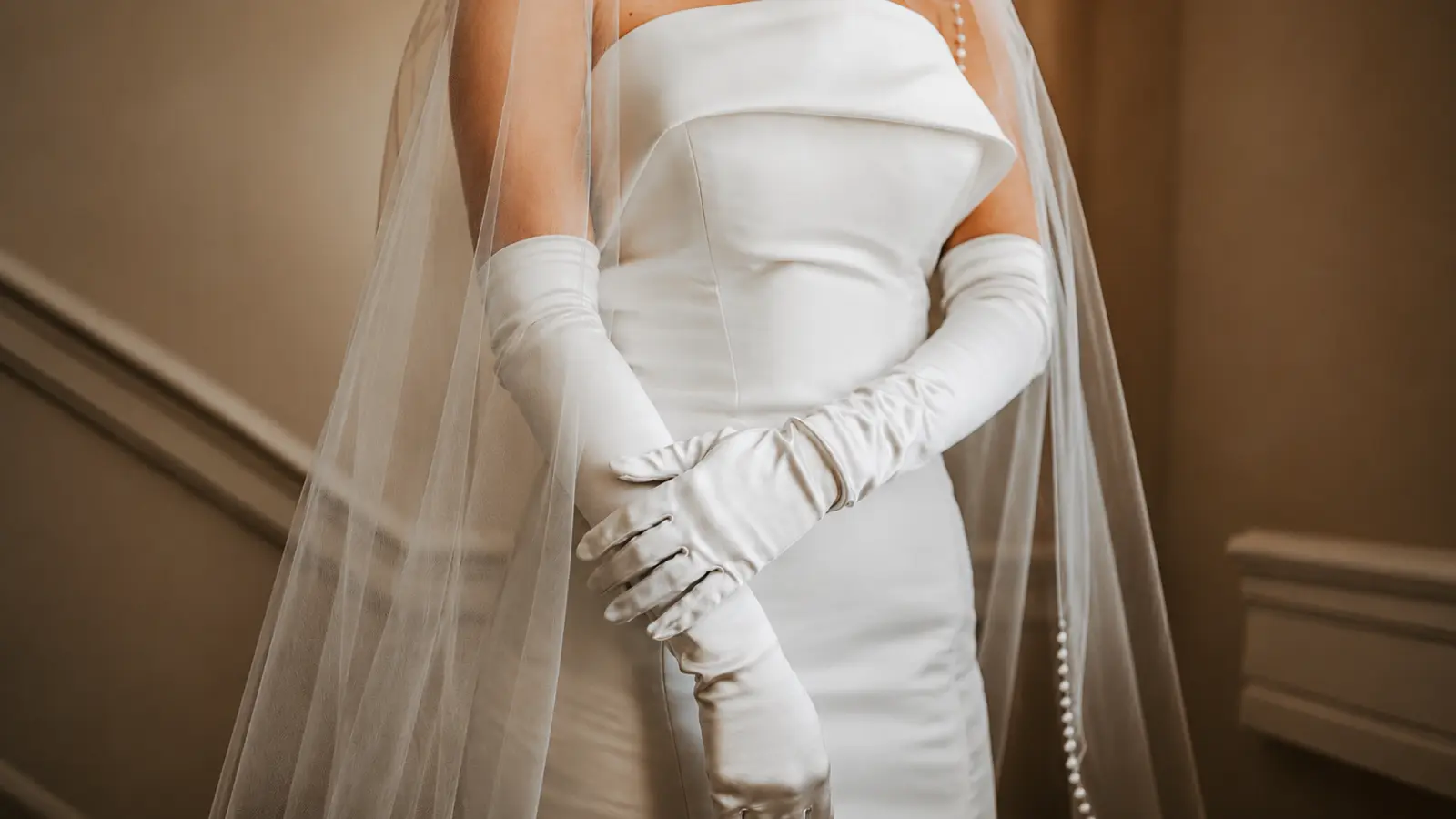
Satin long gloves create the most classic formal look. They work especially well with structured gowns and create the polished style often associated with black-tie weddings and timeless bridal portraits.
- Lace Long Wedding Gloves
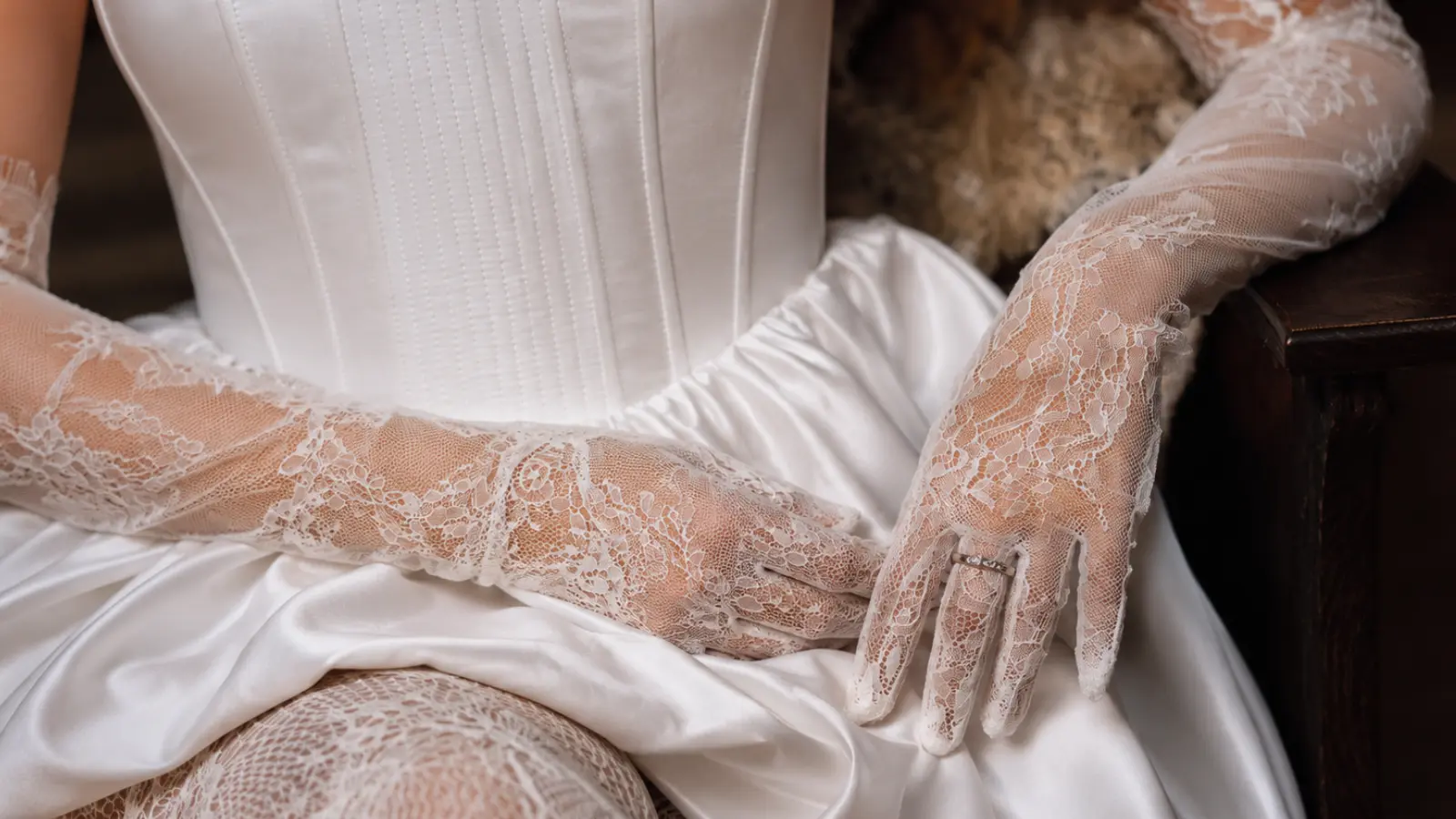
Lace long gloves add romance and texture. They pair beautifully with simpler gowns where the lace can become a featured detail without competing with other embellishments.
- Sheer Long Wedding Gloves
Sheer long gloves made from tulle or organza feel lighter and more modern. They add the visual line of a long glove while keeping the overall look softer.
- Pearl and Embellished Long Gloves
Detailed long gloves work best as a statement accessory. They usually pair better with cleaner dresses that give the embellishment room to stand out.
Best Dress Necklines for Long Wedding Gloves
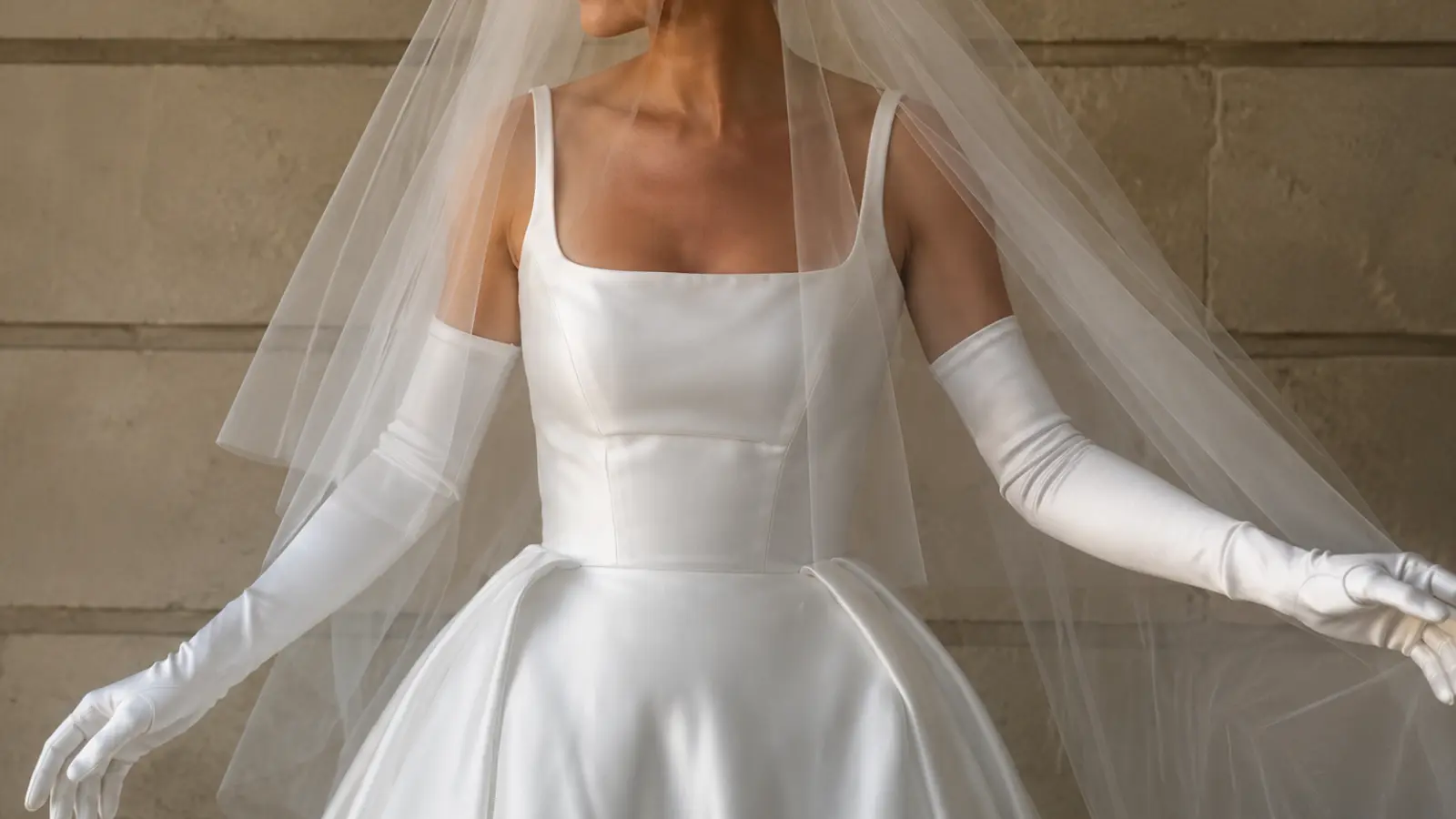
The relationship between neckline and glove length is one of the most important decisions when styling a wedding dress with gloves. What makes a long glove work is uninterrupted visual space along the arm — and the dress’s neckline and sleeve structure determine how much of that space is actually available.
Strapless dresses
A strapless silhouette is one of the most natural pairings for long gloves. The shoulder and arm are completely exposed from the bodice upward, which gives the glove its full visual run from wrist to upper arm with nothing interrupting the line. In portraits, the combination reads as a single designed arc from shoulder edge to fingertip. Elbow and opera lengths both work with a strapless neckline; the choice between them is primarily one of formality and personal scale preference.
Sleeveless dresses
A sleeveless gown with a defined strap — whether spaghetti, wide, or structured — creates a slightly different visual logic than a strapless. The strap sits at the shoulder, and the glove begins below it. The transition works as long as the strap is narrow enough not to create a competing horizontal line where the arm meets the bodice. Sleeveless structured gowns with a clean, precise strap pair well with elbow-length gloves. Opera length on a sleeveless gown depends more on the specific strap’s weight — a very delicate strap and an opera glove can feel slightly out of proportion.
Off-shoulder dresses
Off-shoulder necklines create a natural band of fabric across the upper arm, and the long glove begins below that band. The combination works when there is a visible expanse of bare skin between where the sleeve sits on the upper arm and where the glove’s top edge begins. That gap — a stretch of bare arm between sleeve and glove — is what keeps the look from feeling layered and bundled. Without it, the sleeve and the glove seem to be competing for the same real estate on the arm. Elbow-length gloves suit this neckline most reliably; opera length requires more careful fit consideration to ensure the top of the glove and the sleeve’s position don’t crowd each other.
Necklines That Are Harder to Pair With Long Gloves
Any dress with a sleeve that already covers the forearm makes a long glove redundant or creates a doubling effect. Cap sleeves, three-quarter sleeves, long sleeves, and illusion lace sleeves are all difficult to pair with long gloves — the sleeve occupies the same visual territory the glove needs, and the result feels accumulated rather than styled. The general principle: long gloves need bare arm to work. If the dress doesn’t provide it, the glove doesn’t have the space it needs to do anything except add visual noise.
Long Glove Fabrics and What Each One Does
Wedding glove fabrics change the personality of a long glove significantly — not just in texture, but in how formal they read, how they drape on the arm, and the photographic effect they create.
Satin long gloves
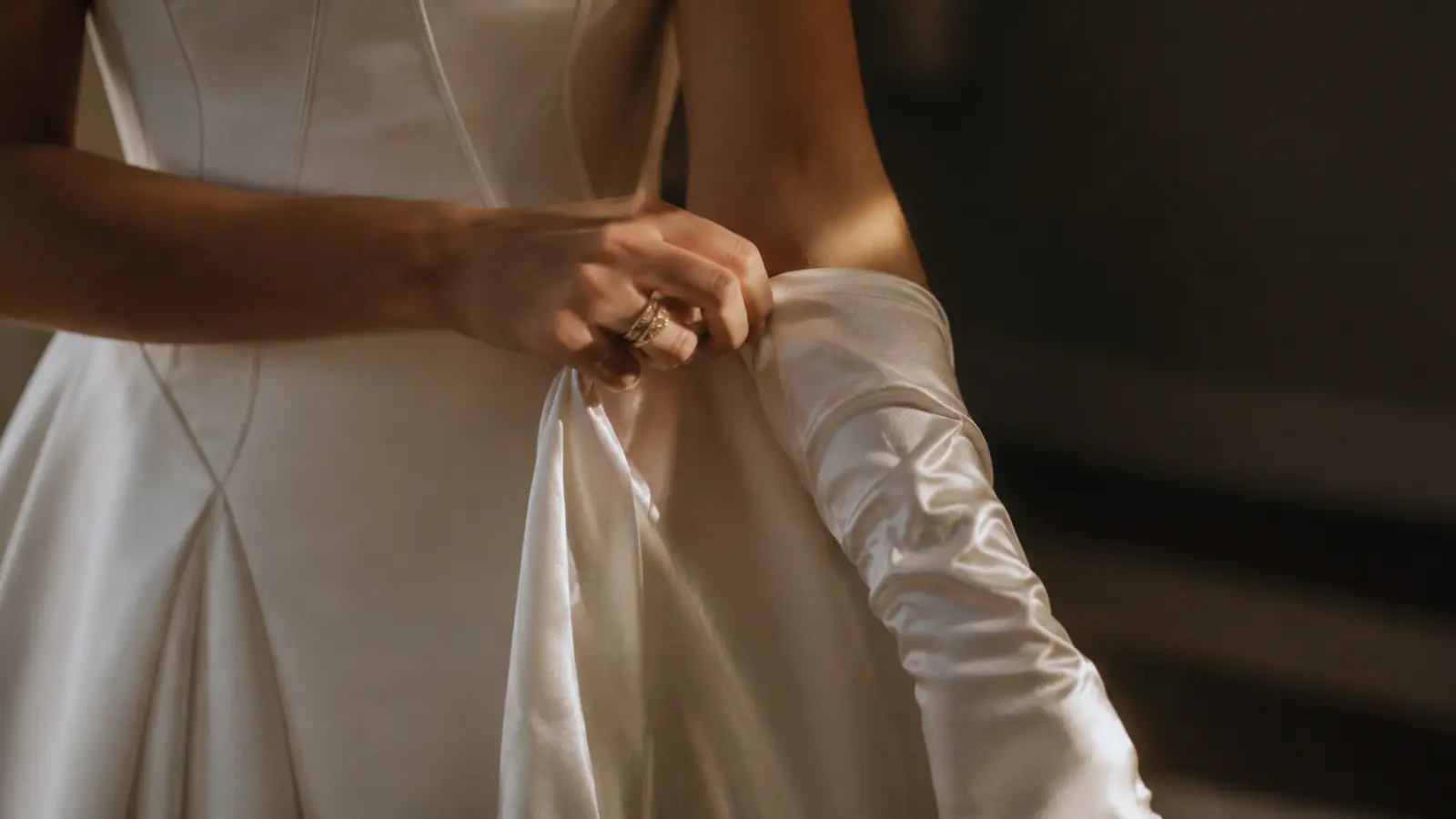
Satin is one of the most traditional fabrics for long wedding gloves. It holds its shape, drapes cleanly along the arm, and photographs with a crisp, polished finish that reads as formal from any distance. Satin long gloves suit structured gowns — duchess satin, mikado, taffeta — where the surfaces share the same aesthetic language. Against a matte or heavily textured gown, satin can look slightly disconnected in texture register, as though the glove and the dress come from different design families. The solution in those cases is either a different glove fabric or a simpler gown surface.
Sheer long gloves
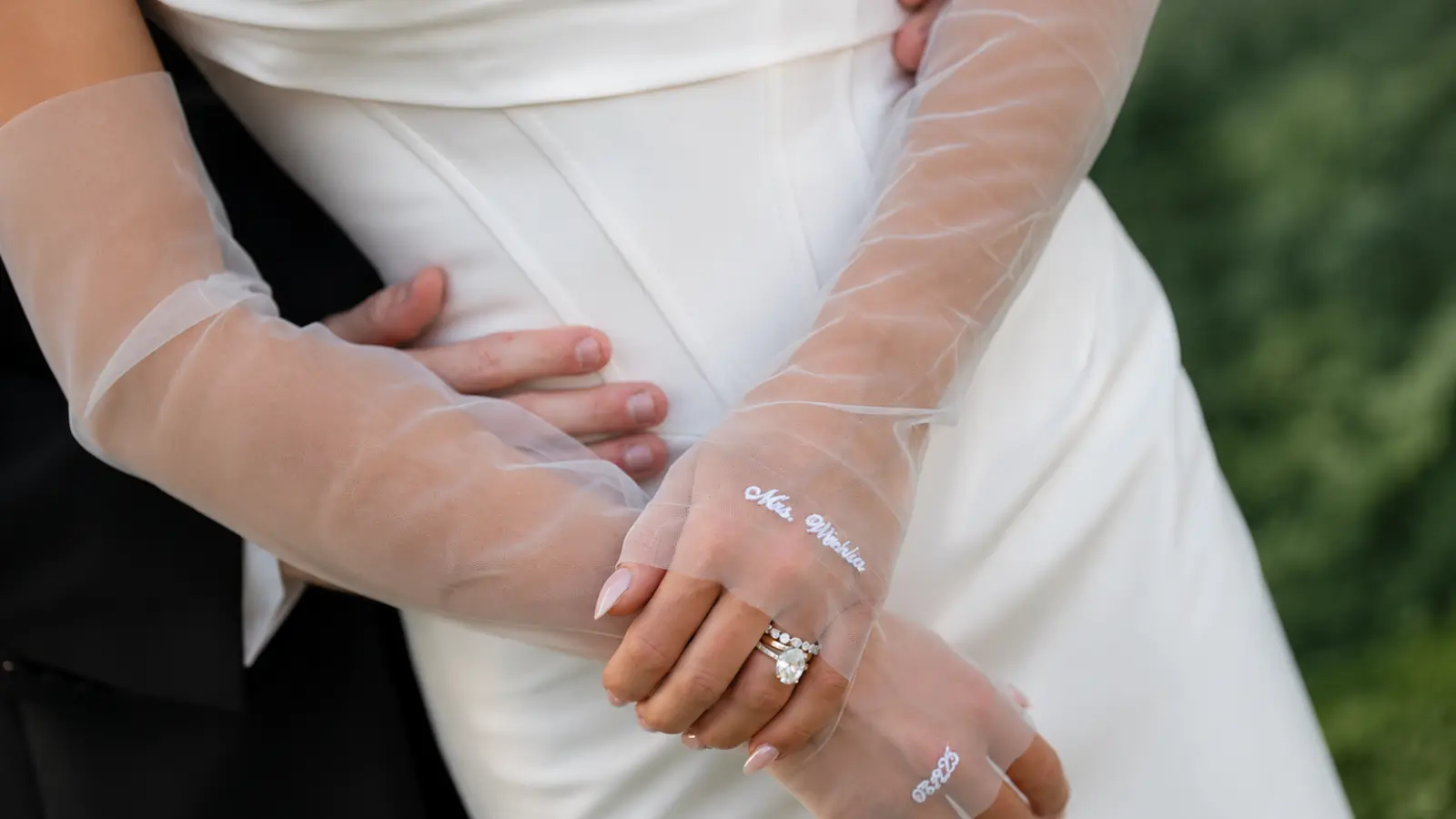
Sheer gloves — in organza, chiffon, or fine tulle — have a quality that satin can’t replicate: they cover the arm while remaining translucent, which creates a layered, airy effect rather than a solid line. The arm is visible through the fabric, softened rather than hidden. This gives sheer long gloves an editorial, contemporary quality that suits minimalist gowns exceptionally well. Brides who want even more freedom often prefer fingerless wedding gloves, since they feel lighter and less restrictive to wear for extended periods, which matters for a long event. The trade-off is that sheer gloves show every wrinkle and fit issue more clearly than an opaque fabric does — they require a precise, consistent fit to look their best.
Lace long gloves
Long lace gloves are among the most romantic options in bridal styling and among the most specific in what they suit. The lace pattern travels the full length of the arm, which means it needs to work in relationship to the gown’s own texture without competing. A heavily laced gown and long lace gloves require careful pattern coordination — if the lace scales and patterns don’t relate to each other deliberately, the combination looks busy. A clean, minimal gown gives long lace gloves the visual space they need to be appreciated in full. See our lace wedding gloves guide for detailed pairing guidance.
The Balance Rule for Long Wedding Gloves
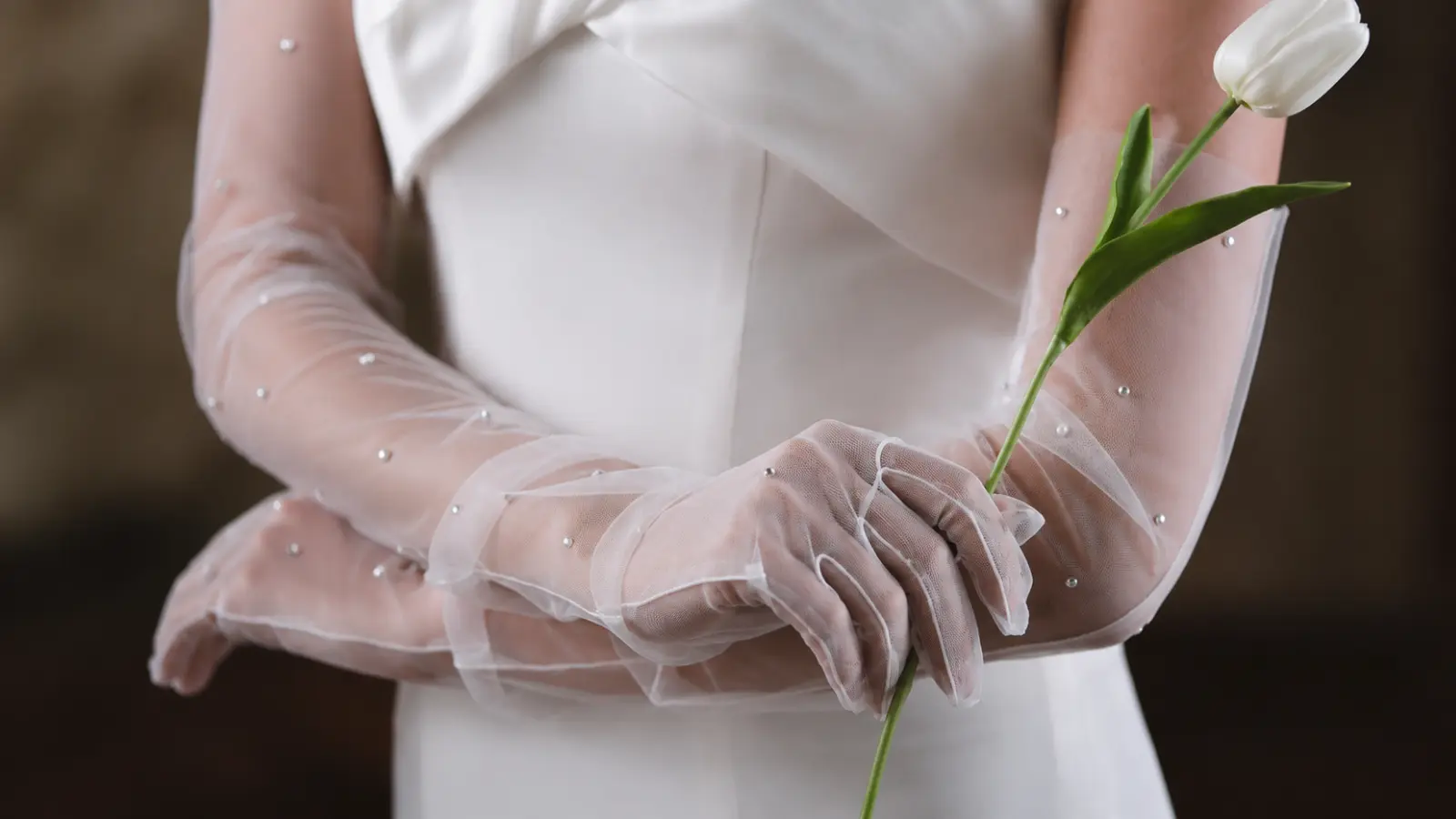
This is the principle that determines whether a long glove pairing works — and it applies regardless of length, fabric, or dress style.
More detail on the dress means a simpler glove. A cleaner dress allows a more expressive glove.
A gown covered in beading, intricate lace, or heavy embroidery is already making a full visual statement from bodice to hem. Adding a heavily embellished, textured, or patterned long glove to that look doesn’t enhance it — it overloads it. The eye has nowhere to rest. In those cases, the long glove should be as simple as possible: a clean satin in a coordinating tone, a sheer style, or something with minimal surface detail. The glove’s job is to extend the line without adding competing decoration.
Conversely, a gown with a deliberately minimal surface — clean crepe, plain satin, unadorned tulle — can carry a more expressive glove. A long lace glove, a sheer style with a delicate edge, or an embellished cuff at the wrist all have room to contribute visually without overwhelming a look that isn’t already full. The glove becomes the textural element the dress intentionally left space for.
The test is straightforward: put the complete look on and ask where your eye goes first. In many bridal looks, the eye naturally goes first to the dress and then moves toward the accessories. If the glove and gown feel like they are competing, the balance may need adjusting.
Long Gloves and Wedding Rings
Long gloves require more planning around rings than shorter styles, and the planning should happen well before the wedding day — not at the altar.
Removing the glove before the ceremony
One common approach for brides wearing long gloves is to remove them before the ring exchange and put them back on afterward. This means designating someone — typically the maid of honor — to hold the gloves during the ceremony and return them at the right moment. For many brides, this is the most practical and least complicated solution: the ring exchange happens with bare hands, and the gloves are part of the portrait photographs and reception entrance rather than the ceremony itself.
The ring-finger button
Some long gloves are made with a small button or snap at the ring finger seam, allowing that single finger to be freed for the ring placement without removing the glove entirely. This is the most elegant ceremony solution when it works — the glove stays on, the ring exchange proceeds naturally, and the visual continuity of the look is preserved through the ceremony. It requires a glove specifically made with this feature, and it’s worth rehearsing the opening and closing motion so it’s fluid on the day.
Ring over the glove
Historically, rings were worn over gloves as part of formal bridal tradition. It remains an option, but only when the glove fabric is thin and smooth enough to compress comfortably beneath a ring — and when the ring setting is not elevated enough to distort the fabric uncomfortably. With thick satin or structured long gloves, wearing a ring over the top tends to look forced and feel worse. With a fine sheer or thin silk glove, it can work as intended.
Long Gloves at the Reception
Long gloves are most at home during the ceremony and the early reception — portrait time, cocktail hour, and the reception entrance. As the evening becomes more active, most brides find a natural transition point to remove them.
Dinner is typically the first moment. Eating with long gloves on is uncomfortable in a way that shorter gloves aren’t — the fabric extends to the forearm and can feel restrictive when seated and reaching. Most brides who plan carefully choose to remove their gloves before the first course is served and make the transition a deliberate part of the evening rather than an awkward mid-meal adjustment.
Dancing is the other common transition point. Long gloves can restrict wrist movement slightly during energetic dancing, and they’re more likely to shift or slide during sustained activity. Opera-length gloves in particular are easier to enjoy in the controlled setting of portraits and cocktail hour than during an active reception.
The key is planning where the gloves live when they’re not on. A small bag in the bridal suite, handed to a bridesmaid, or tucked away at the sweetheart table — having a designated place means the removal feels intentional rather than like something that had to happen because it became inconvenient.
How Long Gloves Photograph
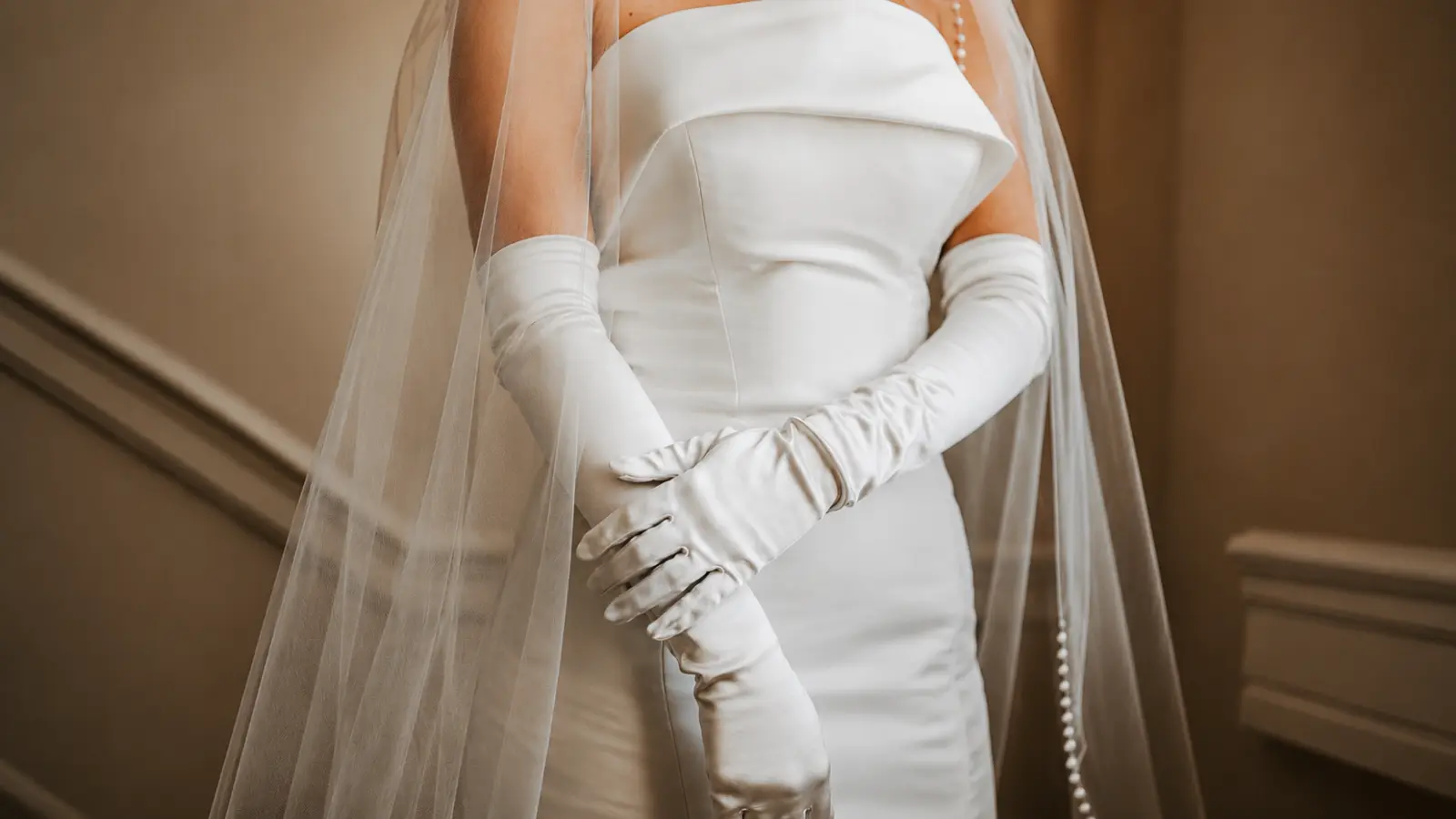
Long gloves are among the most photogenic bridal accessories for one fundamental reason: they create lines. And lines give photographs structure.
Full-length portraits
In a full-length portrait, a long glove defines the arm in a way that bare arms rarely achieve. The line from shoulder to fingertip is unbroken, deliberate, and architectural. It gives the body a visual completeness that reads as intentional in a way that’s difficult to describe in person but immediately apparent in a photograph. Wedding portraiture has a long association with long gloves precisely because of this quality — they make the image feel composed rather than candid, even when the pose is natural.
Walking photographs
Walking shots — the bride moving toward the camera, or in profile — are where long gloves perform most dynamically. As the arm moves, the glove’s fabric catches light and creates subtle motion in the image. Satin develops a shifting sheen; sheer fabric ripples slightly; lace moves with a different quality than the gown beneath it. These are the images where long gloves justify themselves most clearly, because the accessory becomes visible not just as a static element but as a part of the body’s movement through space.
Ceremony photographs
During the ceremony, long gloves are visible from a distance — to guests seated in the pews and to a photographer shooting from the back of the venue. At that distance, what reads most clearly is the silhouette: the clean vertical line of the glove alongside the gown, the expanse of fabric along the arm. Detail is secondary to proportion at ceremony distance, which is why the architectural quality of a long glove — the line it creates — matters more than its specific fabric or pattern in these shots.
What to consider before the wedding day
Take test photographs in the full look — gown, long gloves, veil — in natural light before the wedding. Pay attention to the tone relationship between glove and gown (mismatches are obvious in photographs even when subtle in person), to whether the glove’s top edge sits smoothly or creates a visible line on the arm, and to how the glove reads at full-length distance versus close-up. What you see in those test images is what your wedding photographer will capture.
Choosing Your Length and Fabric
Once you’ve established which necklines are available to you and what the dress’s embellishment level allows, the choice between opera and elbow length and among the fabric options becomes a question of register — how dramatic, how formal, how much of a statement you want the glove to make.
Elbow length is the right choice for brides who want the elegance of a long glove without the full commitment of opera-length formality. It works across a wider range of venues and ceremonies, suits both strapless and sleeveless gowns reliably, and feels proportionate at settings from garden formal to ballroom black-tie.
Opera length is for brides who want the silhouette change to be unmistakable — who want the portrait to look like a portrait. It works best when the dress, setting, and overall styling support the stronger visual statement of a glove that extends past the elbow. When those conditions are in place, no other bridal accessory achieves the same effect.
On fabric: choose based on the gown’s surface. Satin gown — satin or sheer glove. Matte gown — sheer or lace glove. Embellished gown — clean satin or sheer, never competing lace. And always verify the tone match in natural daylight before committing to any combination.
Long Wedding Gloves Inspiration
Long wedding gloves can transform a bridal look with elegant lines, romantic details, and dramatic silhouettes. Explore opera-length gloves, elbow-length styles, satin gloves, lace designs, sheer fabrics, and ideas for pairing long gloves with different wedding dresses.
The Line That Completes the Look
Long wedding gloves are not simply about adding another accessory. Their impact comes from the way they change the entire shape of a bridal look — extending the silhouette, creating movement, and making the dress and the body feel connected as one complete image.
When the length, fabric, and dress pairing all work together, long gloves do not feel like a detail added afterward. They become part of the reason the look feels memorable, creating the kind of bridal portrait where every element appears intentionally chosen.
Frequently asked questions (FAQ)
Are long wedding gloves still in style?
Yes. Long wedding gloves are still in style, but they are now worn as a deliberate bridal fashion choice rather than a formal requirement. Modern brides often choose long gloves for elegant, editorial, vintage-inspired, or Old Hollywood looks. The key is pairing them with the right dress silhouette so they feel intentional instead of like a costume.
What is the difference between opera gloves and elbow-length wedding gloves?
Opera gloves extend past the elbow and usually reach the upper arm, creating the most dramatic and formal bridal glove look. Elbow-length gloves stop around the elbow and offer a slightly softer, more versatile style. The best choice depends on your dress shape, wedding formality, and how much you want the gloves to define the overall silhouette.
What wedding dresses look best with long gloves?
Long wedding gloves usually work best with strapless, sleeveless, and off-the-shoulder dresses because these styles leave enough open arm space for the glove to create a clean line. Simple gowns can support more detailed gloves, while highly embellished dresses often look better with cleaner styles. Long gloves should feel like they complete the dress rather than compete with it.
How do you handle the ring exchange with long wedding gloves?
Most brides either remove long gloves before the ring exchange, choose gloves with a ring finger opening, or briefly uncover the finger during the ceremony. The best option depends on the glove design and personal preference. Planning this detail before the wedding day helps the ceremony feel smooth and avoids adjusting the gloves during the moment.
Can you wear long wedding gloves for the entire wedding day?
You can wear long wedding gloves for much of the wedding day, especially during the ceremony, portraits, and cocktail hour. Many brides remove them before dinner or dancing for comfort and practicality. Long gloves work best when you decide ahead of time which moments you want them included in, especially for photography.
Do long wedding gloves photograph well?
Yes. Long wedding gloves photograph beautifully because they create a continuous line from the arm to the hand, adding structure and elegance to bridal portraits. They are especially impactful in full-length photos, walking shots, and close-up images with bouquets or rings. The best results come from proper fit, balanced proportions, and a color tone that complements the dress.