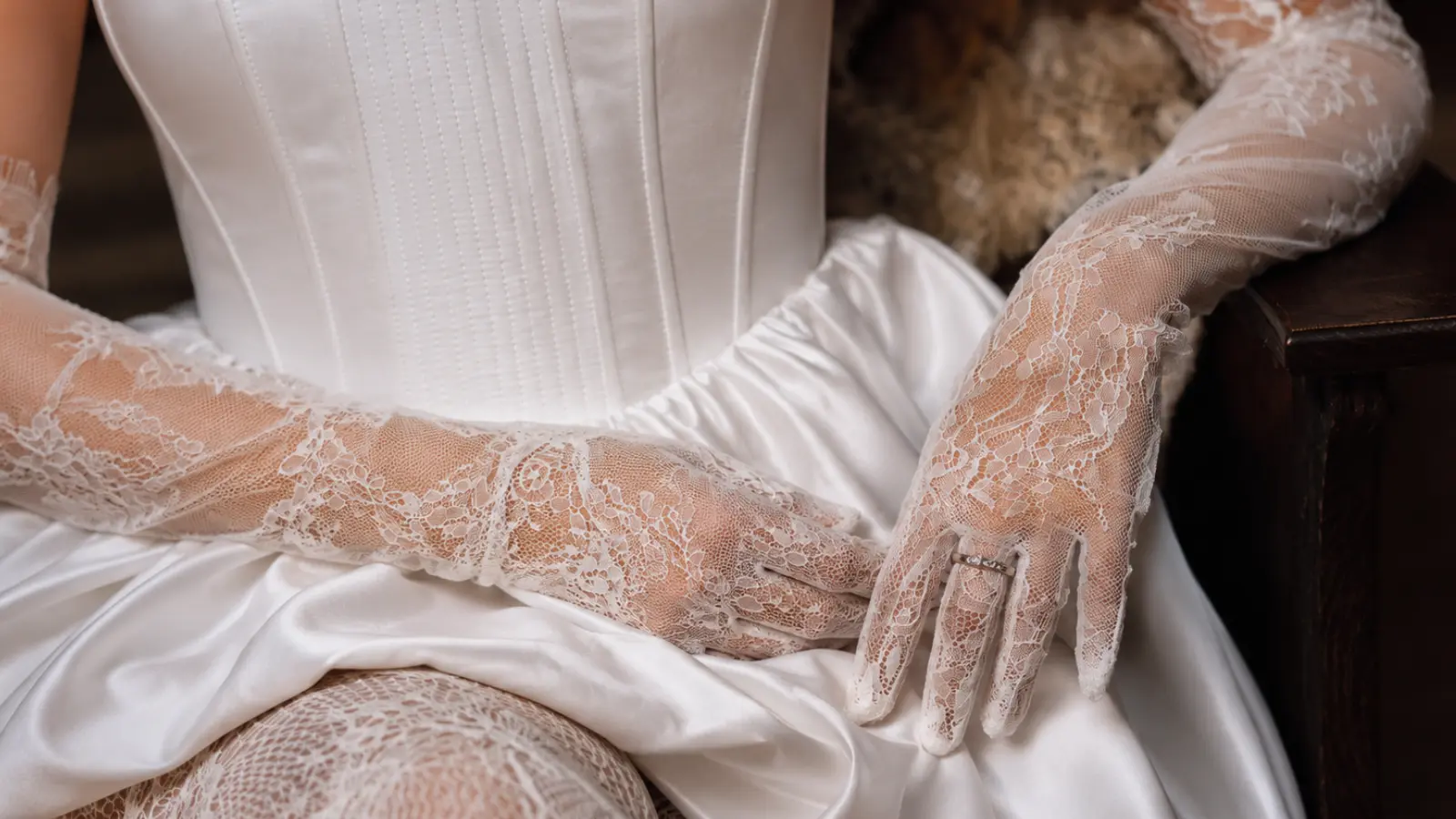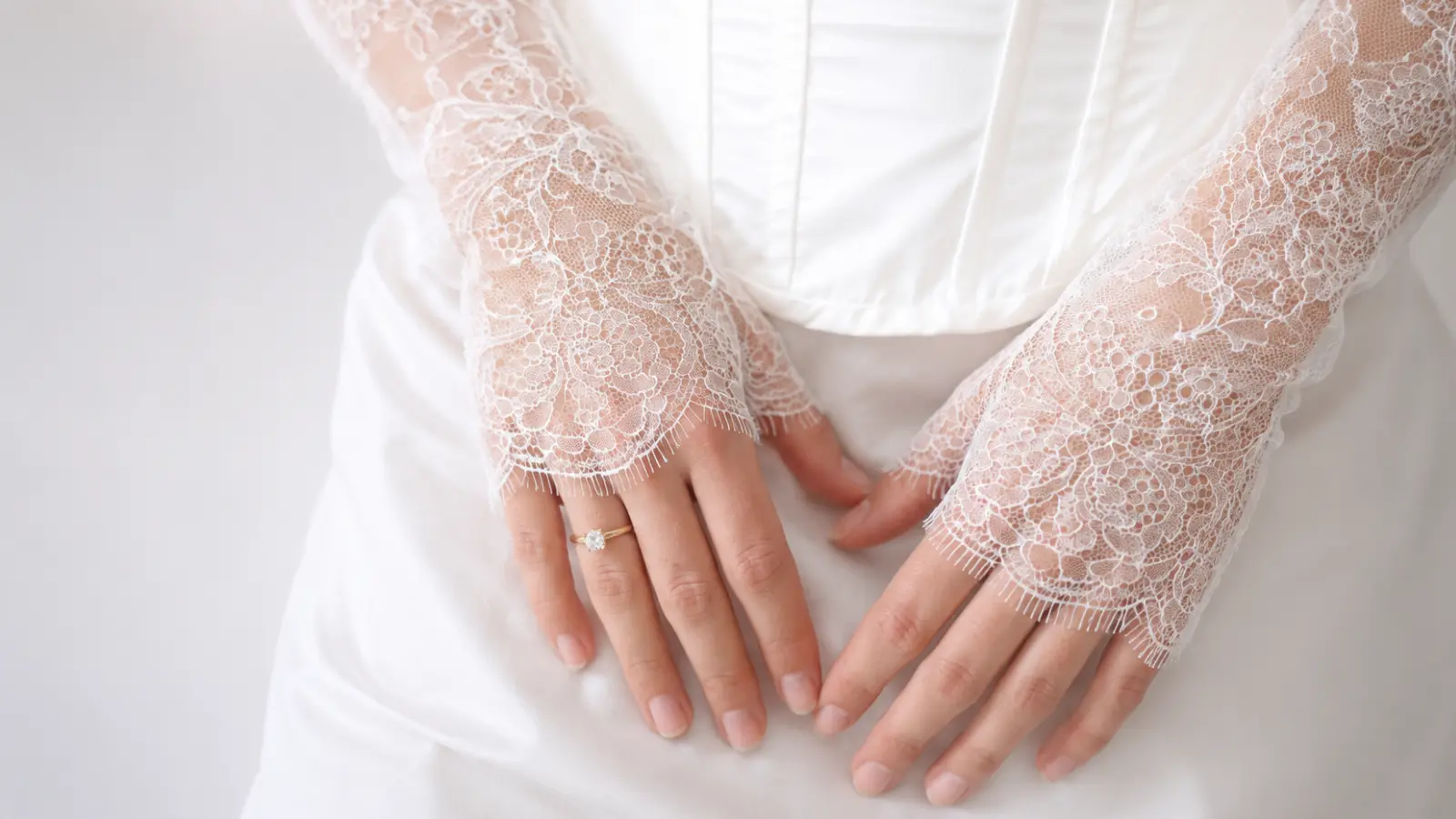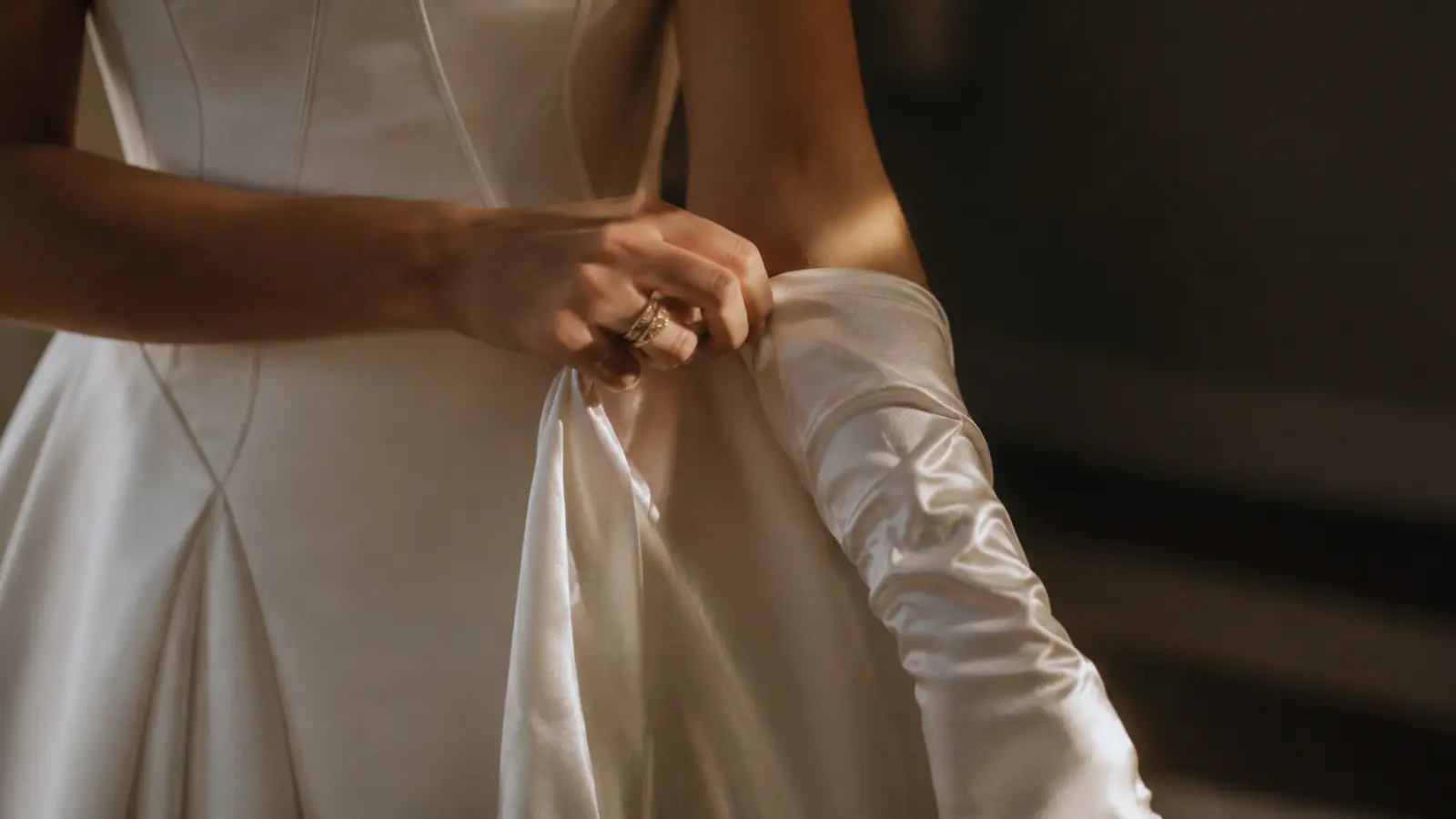
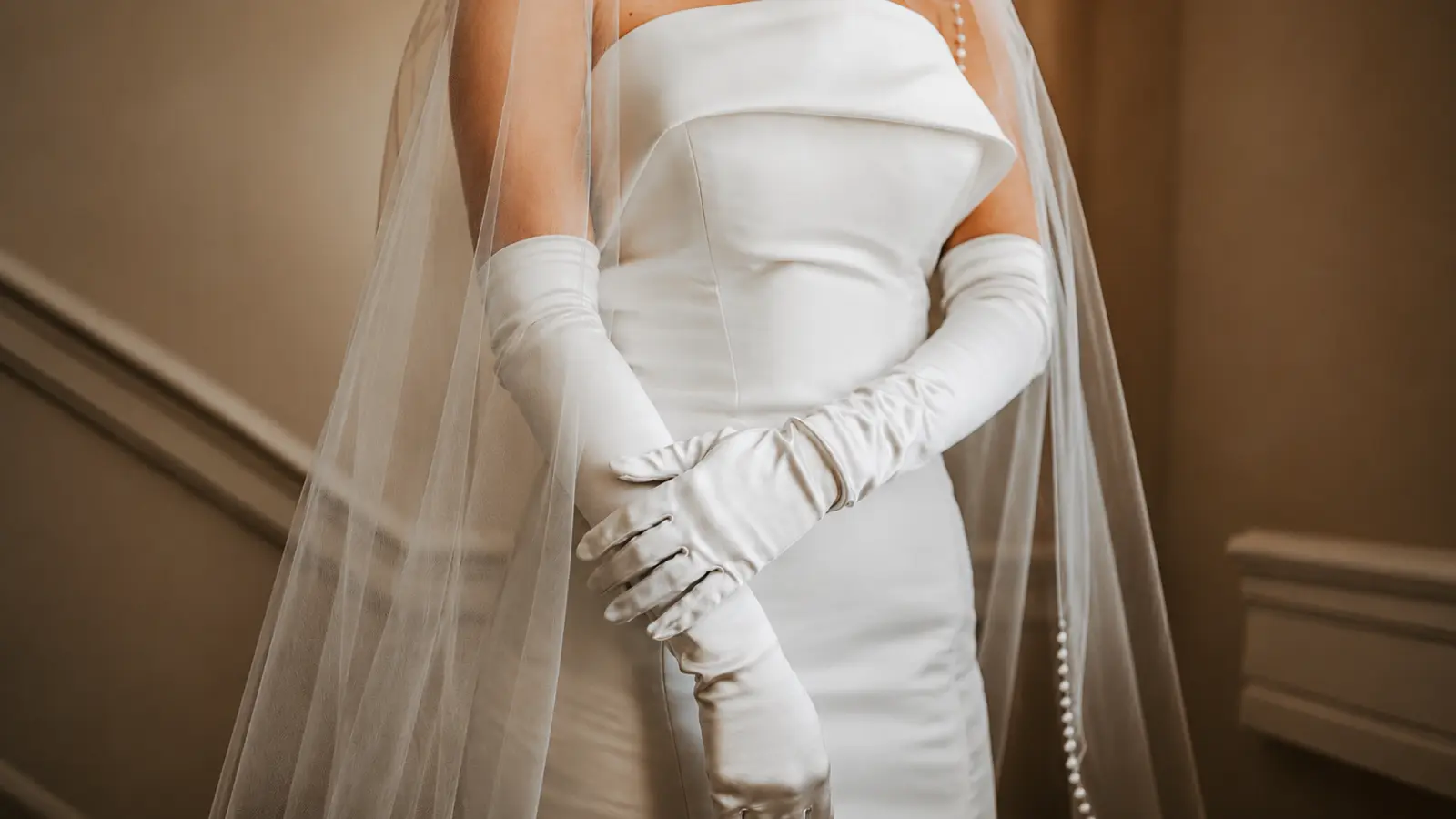
A wedding dress with gloves can create a completely different bridal look depending on the glove length, fabric, and gown style. The same dress can feel classic, romantic, vintage-inspired, or editorial simply by changing the way gloves are incorporated into the overall design.
A bridal glove does not just accessorize a dress — it can change the entire feeling of the bridal look. A simple column silhouette can feel more fashion-forward with sheer gloves, a strapless gown can become more formal with opera-length satin gloves, and a romantic dress can feel softer with delicate lace details. The goal is not just choosing beautiful gloves, but choosing the pair that belongs with the dress.
This guide explains how to style a wedding dress with gloves, including the best dress silhouettes for gloves, how to choose the right length and fabric, and when different wedding gloves work best with specific bridal styles, how to balance gloves with your veil and accessories, common styling mistakes, and how to create a bridal look that feels intentional from every angle.
What Makes Gloves Work With a Wedding Dress?
The pairings that work share a few things in common — and they are usually less about following a specific style era and more about understanding balance. What actually holds a glove-and-dress combination together is balance across three dimensions: proportion, texture, and visual weight.
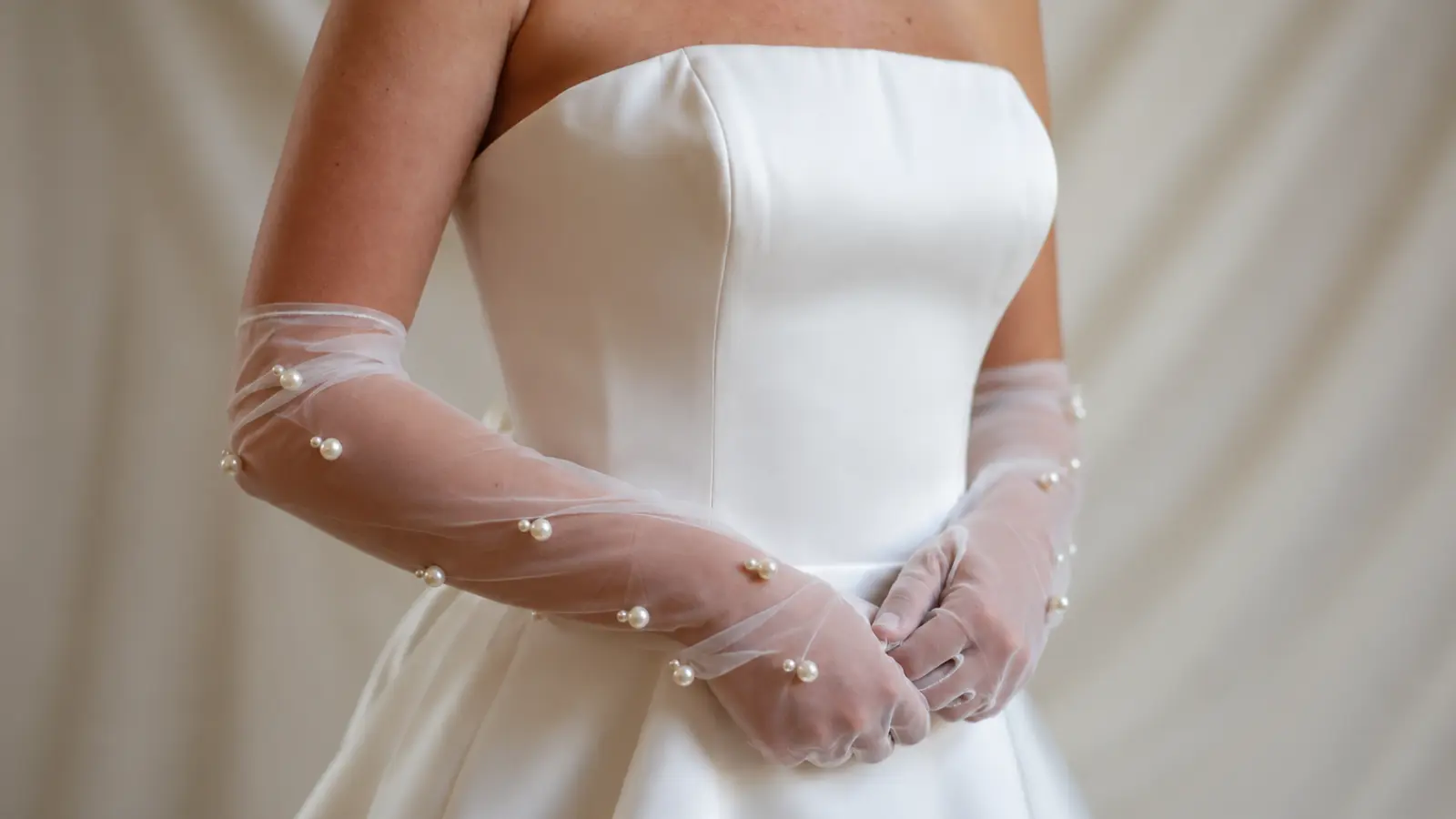
Proportion
The length of a glove needs to relate logically to the dress’s sleeve structure. When there is a clear expanse of bare arm — strapless, sleeveless, off-shoulder — a longer glove has space to read as an intentional design element. When a sleeve is already covering part of the arm, a glove that starts where the sleeve ends can look like it was added as an afterthought rather than chosen deliberately. The cleaner the transition from bare skin to glove, the more coherent the overall silhouette.
Texture
Wedding glove fabrics should feel like they belong in the same aesthetic world as the gown. Satin gloves alongside a structured satin gown share a surface logic. A sheer glove over a gown with delicate lace detailing creates continuity. Where combinations can become more challenging is when the fabrics feel like they come from very different design directions — a heavily structured satin glove on a relaxed, flowing chiffon gown, for example, where one reads as formal and the other as fluid.
Visual weight
This is the factor most often underestimated. Each accessory — gloves, veil, earrings, necklace — carries a certain visual mass. A look becomes overworked not when one item is too much, but when multiple items are all competing for attention simultaneously. Gloves work best when the rest of the look leaves them room, and when they in turn leave the gown room to be the primary statement.
Best Wedding Dress Styles With Gloves
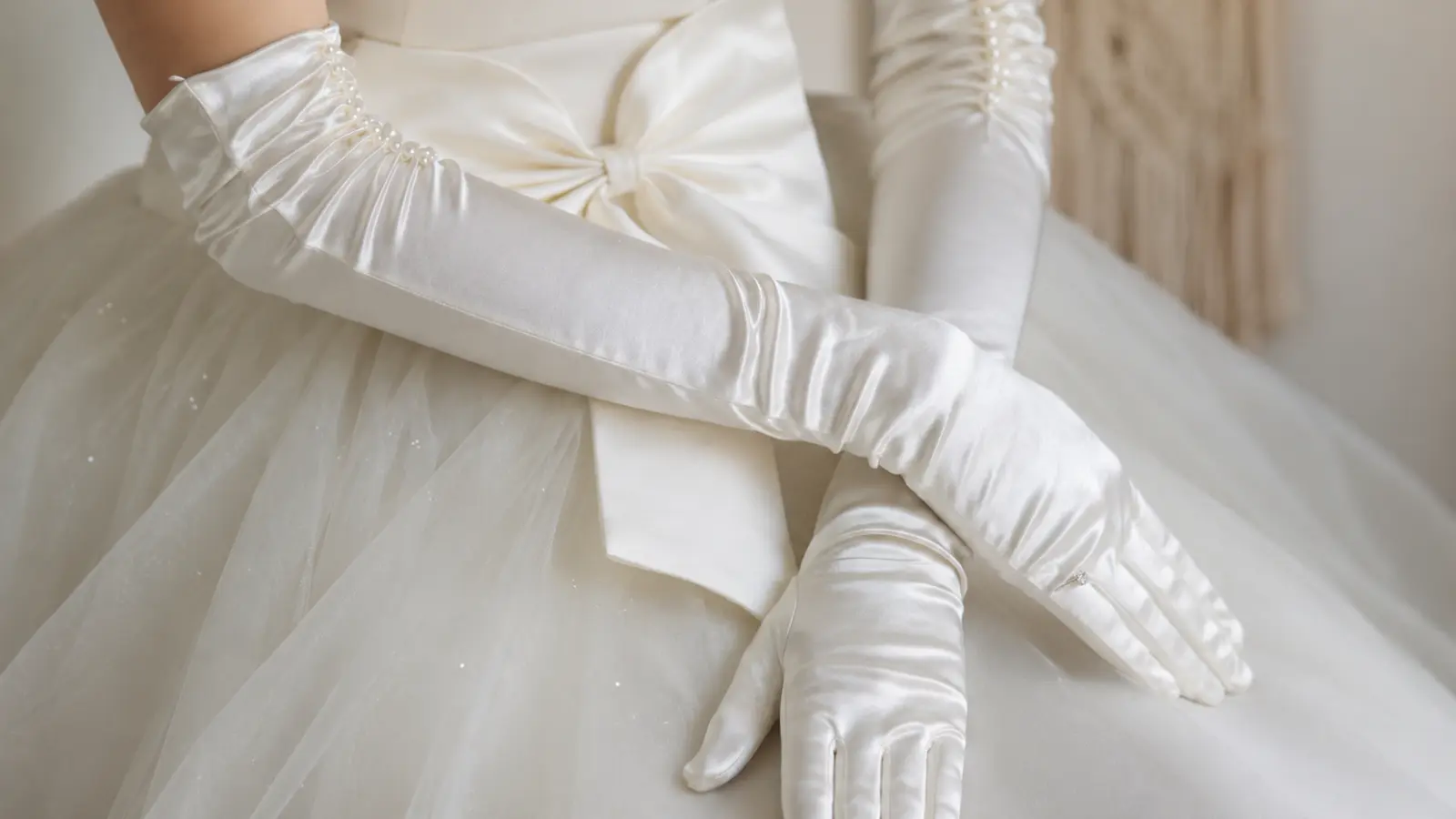
Strapless Wedding Dress With Gloves
A strapless gown is one of the most natural pairings for bridal gloves. The uninterrupted line from shoulder to fingertip gives the glove the visual space it needs to read as a complete design element rather than an addition. Long wedding gloves, including elbow-length and opera-length styles, work particularly well here they fill the bare arm in a way that feels purposeful rather than compensatory. For brides who want something a little softer, a wrist-length glove in lace or sheer fabric adds detail without committing to the full formal impact of a long pair.
What to watch: the strapless bodice often has structure built in — boning, ruching, or a fitted corset — which means the glove fabric choice matters. A structured fabric like satin or duchess reads cohesively alongside a structured bodice. A very delicate, fluid glove against a stiff structured top can feel mismatched in construction weight.
Off-Shoulder Wedding Dress With Gloves
The off-shoulder gown creates a natural visual frame at the upper arm. A glove that extends to elbow length meets that frame and continues it downward, creating an elegant, connected line. The combination has a strong romantic quality — something between vintage glamour and contemporary editorial.
Glove length is the key decision here. A glove that starts very close to where the off-shoulder sleeve sits can look layered in a way that feels accidental. Ideally there’s a clear distance between the fabric of the sleeve and the top of the glove, with a span of bare upper arm in between. That separation is what makes the combination feel styled rather than stacked.
Sleeveless Wedding Dress With Gloves
A sleeveless gown with a defined strap or structured bodice gives gloves flexibility across lengths without the concern of competing with a neckline element. This is one of the more modern and versatile combinations — it works equally well in satin for a formal setting, sheer for an editorial look, or lace for something softer and more romantic. The sleeveless silhouette is neutral enough that the glove has significant room to shape the overall mood of the look.
Ball Gown Wedding Dress With Gloves
The ball gown is the dress most associated with the drama of opera-length gloves — and for clear reason. A full skirt carries significant visual weight on its own. A long glove extends the vertical line of the bodice and creates a counterbalance to the gown’s volume below the waist. The combination reads as decidedly formal and is often associated with classic settings like grand ballrooms and cathedral ceremonies, although the overall styling matters more than the venue itself.
Ball gowns with heavily embellished bodices call for simpler gloves — a clean satin or sheer style that doesn’t add more detail to an already elaborate top half. A ball gown with a simpler bodice can carry more glove detail, such as embroidery or lace, because the glove has more room to contribute without competing.
Simple Wedding Dress With Gloves
This may be the most compelling combination on this list, and the one most underestimated. A minimalist gown — clean crepe, unadorned satin, or a streamlined column — is an exceptional canvas for gloves because the glove becomes genuinely visible rather than lost in embellishment. A simple dress with the right glove can create a deliberately editorial feeling that stands out in a very different way from a more detailed gown.
The practical implication: on a simple dress, the glove carries more visual responsibility. It will be noticed. Choose the fabric, length, and detail level as carefully as you would any statement element. An overly casual or poorly fitted glove on a minimal gown will be obvious in a way it might not be alongside a dress with more going on.
Satin Wedding Dress With Gloves
A satin gown and satin gloves share surface logic — they speak the same material language. The combination reads as classic and unified, which is precisely why it has been a staple of formal bridal style across decades. The detail to manage is tone: satin gowns often carry subtle variations in their white or ivory color, and a glove in a slightly different shade or brightness will read as a mismatch under natural light. Matching them in daylight, not under a boutique’s ambient lighting, is worth the extra step.
Vintage-Inspired Wedding Dress With Gloves
A dress with vintage references — a fitted bodice, defined waist, A-line or tea-length skirt, lace overlay, or retro embellishment — is often one of the most natural pairings for gloves. Gloves were a natural part of mid-century formal dress, and their presence alongside a vintage-inspired gown reinforces rather than interrupts the aesthetic. Lace wedding gloves, especially wrist-length or short styles, tend to suit tea-length or garden-style vintage silhouettes. Longer satin styles lean toward the more formal, Old Hollywood end of the vintage spectrum.
Modern Wedding Dress With Gloves
Contemporary bridal design has experimented with gloves in ways that move far beyond the classic white satin opera pair. Sheer and tulle gloves on minimalist column gowns, fingerless styles on structured tailored looks, heavily embellished or sculptural gloves treated as wearable art — these combinations treat the glove as a fashion piece rather than a tradition. On a truly modern gown, the glove should match the gown’s design language: something unexpected, considered, and a little confident.
How to Choose Gloves for Your Wedding Dress Style
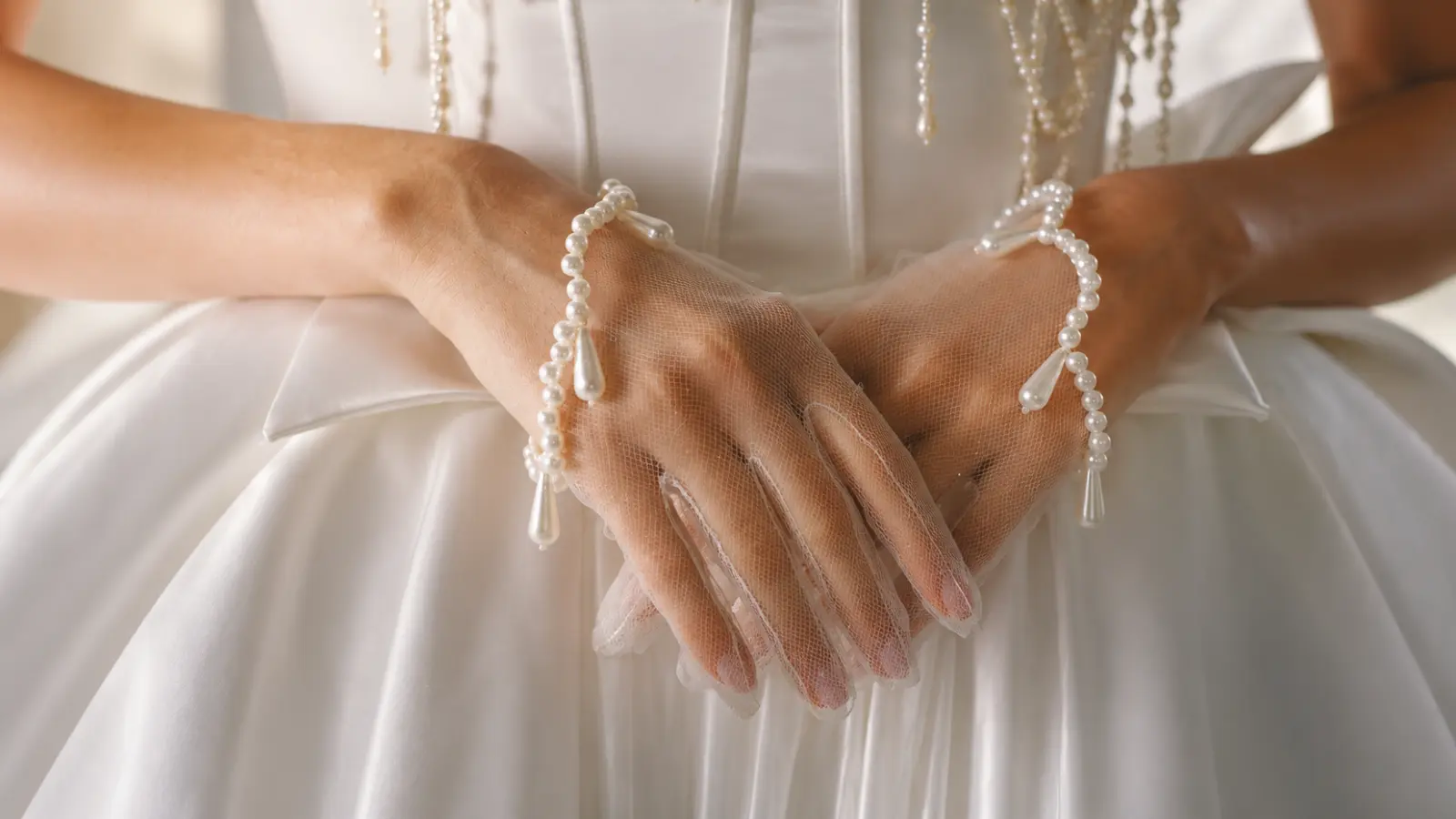
Choosing gloves for a wedding dress is less about following a rule and more about understanding what your gown already provides. The right gloves should add something the dress does not already have — whether that is structure, softness, drama, or a more finished feeling.
- For Minimal Wedding Dresses
Simple gowns usually have the most room for expressive gloves. Sheer, pearl, lace, or long satin styles can become the detail that gives a minimal dress its personality.
- For Detailed Wedding Dresses
Highly embellished gowns usually work best with quieter gloves. A simple sheer or smooth fabric keeps the look balanced without adding another competing element.
- For Romantic Wedding Dresses
Lace, tulle, and delicate glove styles usually complement romantic gowns because they continue the softness already present in the dress.
- For Modern Wedding Dresses
Modern gowns can handle more unexpected glove choices, including sheer, sculptural, fingerless wedding gloves, or other statement designs.
Wedding Dress With Gloves and a Veil
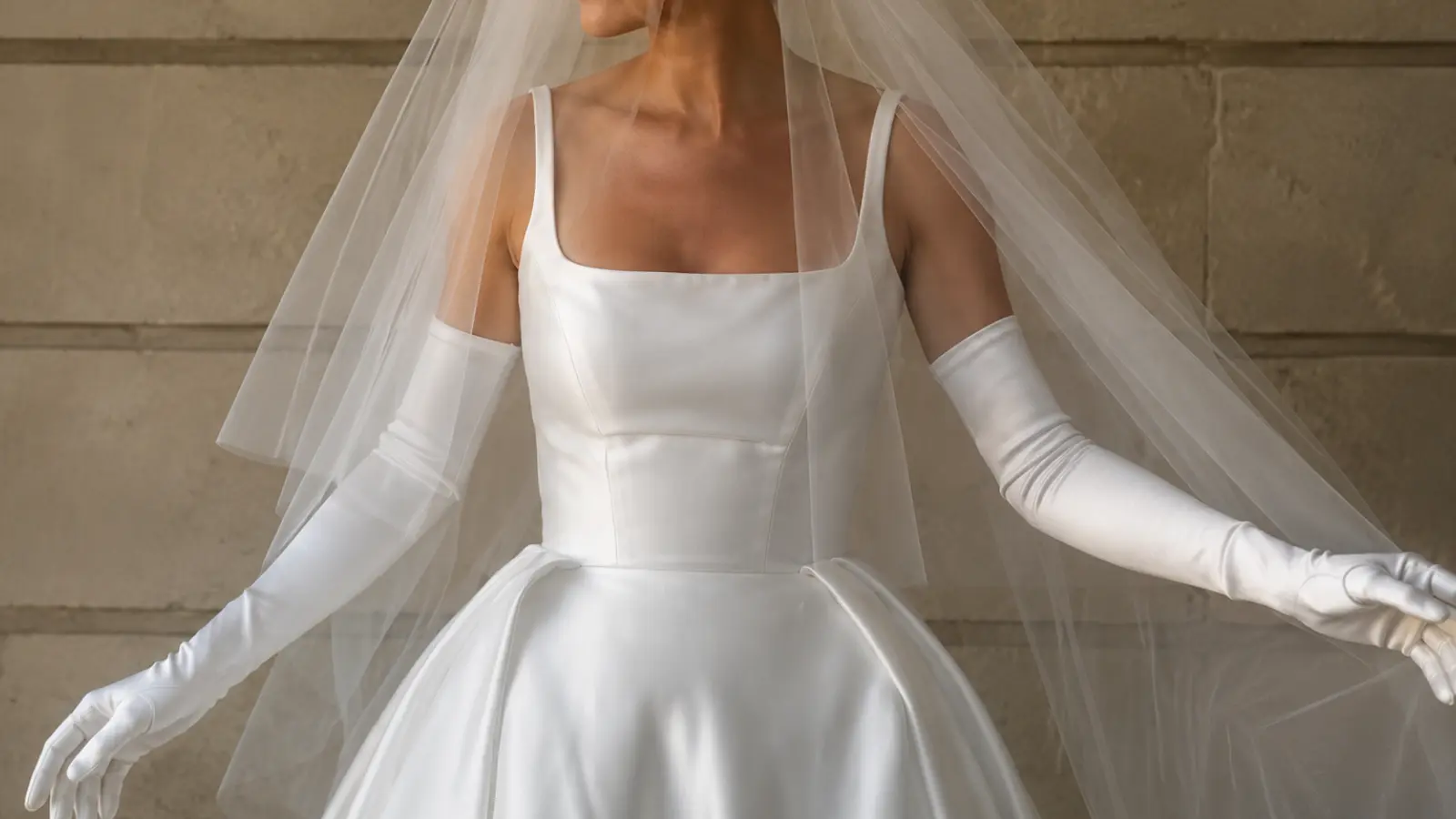
Adding a veil to a gloves-and-dress combination means managing three major visual elements at once. That’s not inherently a problem but it requires a clear sense of hierarchy. One element leads. The others support.
In most cases, the gown leads. The veil and gloves should each be chosen in relation to the dress rather than to each other. When both are selected to complement the gown, they tend to complement each other naturally.
Long veil with long gloves
This is the most formal combination and the one that requires the most confidence to carry. A cathedral-length veil and opera gloves belong to the same scale of drama — both accessories are significant, both command attention. What makes it work is that they don’t occupy the same visual space. The veil drapes behind; the gloves define the arms and hands in front. When the gown is the clear anchor, the combination reads as grand rather than excessive.
Short or simple veil with gloves
A blusher, shoulder, or elbow-length veil with a simple plain edge pairs more easily with gloves because neither accessory carries enough visual weight to overwhelm. This combination works across most gown styles and allows gloves to be the more expressive element if desired.
Heavily detailed veil with gloves
A veil with wide lace trim, embroidered edges, or beading is already a statement. Pairing it with embellished or ornate gloves usually creates too much texture at once. In this case, a clean satin or sheer glove — something that complements without competing — tends to integrate more naturally into the full look.
Jewelry and gloves
Gloves change jewelry logic. When your hands and wrists are covered, a bracelet disappears beneath the fabric. A ring worn over a glove reads as intentional and formal; one worn under reads as practical. The accessories that gain importance when gloves are added are those that remain visible: earrings and necklace. Scaling back on one of those — or choosing simpler styles — generally keeps the look from feeling overdressed.
When Gloves Improve a Bridal Look
There are situations where gloves don’t just add an element — they genuinely complete something that felt unresolved without them.
A sleeveless gown with a very simple neckline can sometimes feel slightly underdressed for a formal setting. Gloves — particularly in a fabric that matches or complements the gown — add formality without requiring a different dress. The look becomes more complete.
A minimal gown that feels like it’s missing a finishing touch often responds well to gloves, where adding a necklace or different earrings wouldn’t quite resolve the feeling. The glove gives the look direction and intentionality in a way that jewelry doesn’t always provide.
Brides who want their photographs to feel like portraits — structured, editorial, and specific to a moment — often find that gloves contribute significantly to that quality. They give the hands and arms definition and purpose, particularly in the detail shots and ceremony photographs where the arms are most visible.
When Gloves May Not Be the Best Choice
There are also situations where gloves add complication rather than cohesion — and it’s worth naming them directly.
A dress with long or structured sleeves already handles the arm. Adding a glove underneath or extending past the sleeve creates layering that reads as accidental rather than styled. The sleeve is the element; the glove has nowhere useful to go.
A gown with very heavy embellishment across the entire dress — from bodice to hem — often doesn’t need more detail at the hands and wrists. The look is already full. A glove in that context is one element too many.
If you genuinely dislike the feeling of fabric on your hands, or if you know from experience that gloves make you feel uncomfortable or restricted, the aesthetic benefit doesn’t outweigh what it costs in how you feel wearing them. A bride who is visibly uncomfortable in an accessory is more noticeable in photographs than any styling choice would be.
Casual and outdoor settings — a beach ceremony, a backyard wedding, or a relaxed venue — require more attention to styling because very formal gloves may not always match the overall mood. Not because gloves are wrong for those settings in principle, but because the overall look has to be cohesive. A very formal accessory in a very informal setting can feel like it belongs to a different event.
How Wedding Gloves Photograph
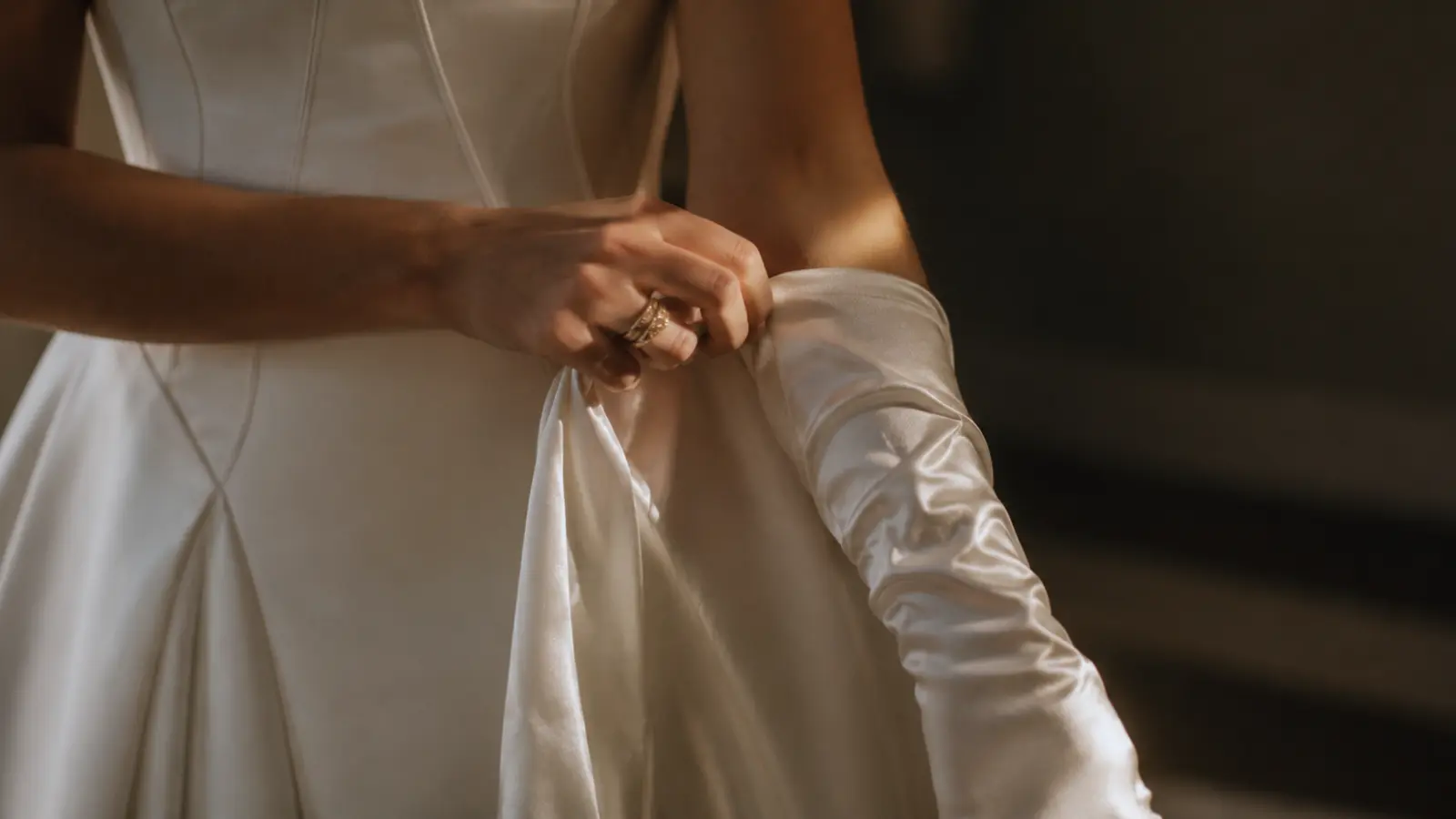
Gloves perform well in photographs when the pairing is right — and this is one of the strongest arguments for choosing them. The camera responds well to the structure, texture, and visual completeness that gloves add to a bridal look.
Full-length portraits
In a full-length portrait, gloves give the arms and hands definition and direction. Without them, arms at rest can appear slightly disconnected from the gown — particularly on a sleeveless dress in a formal setting. Gloves draw a visual line from shoulder to fingertip that ties the silhouette together and gives the photograph a composed, complete quality.
Close-up and detail shots
Detail photographs — hands holding a bouquet, the ring exchange, hands clasped together — are where gloves become most visible. A well-chosen glove in these shots adds texture and elegance that elevates what would otherwise be a simple image of hands. The fabric drapes, the edge of the glove frames the ring or the fingers, and the overall image reads as more intentional. This is also where tone mismatches are most visible: if the glove is a different shade than the dress, close-up detail shots make it apparent.
Ceremony portraits
During the ceremony — particularly at the altar — gloves are visible to guests and to the photographer from a distance. Their silhouette matters as much as their detail at this range. A long glove creates a clean, uninterrupted vertical line alongside the gown; a short glove accents the hand without extending the arm’s visual reach. Both work, but they create meaningfully different photographs at ceremony distance.
What photographs reveal
Photographs expose several things that feel subtle in person: tone mismatches between glove and gown appear more distinct in natural light; a glove that fits poorly — bunching at the wrist, gaping at the upper arm — is visible in images in a way that’s easier to overlook in a mirror; and a glove that competes with other elements rather than supporting them creates a slightly unfocused quality in portraits where no single element reads as the clear statement.
Before your wedding day, take test photographs in the full look — gown, gloves, veil, jewelry — in natural daylight. The camera shows you things the mirror doesn’t.
Mistakes to Avoid
Choosing a glove length that conflicts with your sleeve
An elbow-length glove worn alongside a three-quarter sleeve creates a visual pile-up at the arm. A wrist-length glove worn under a fitted long sleeve becomes invisible and pointless. Let the sleeve structure determine what lengths are actually available to you before evaluating options.
Adding gloves to an already-full look
If your gown has extensive embellishment, your veil has ornate trim, and your earrings are already statement pieces, gloves become the element that tips the look from deliberate into overworked. Gloves need visual room to be noticed. A look with no quiet space doesn’t give them that room.
Fitting them only in the store
Gloves that fit perfectly during a five-minute try-on may feel different after two hours of wear. Try them on for a longer period before the wedding day. Hold your bouquet, shake hands, adjust your grip — understand how they feel in motion, not just at rest. A glove that feels slightly restrictive in the store will feel significantly more so halfway through your ceremony.
Skipping the natural-light check
The tone difference between a bright white glove and an ivory gown is not always obvious under boutique lighting. It becomes clear in photographs taken in natural light. Before finalizing any glove and gown pairing, see them together outdoors or near a window. What you see there is what your photographer will capture.
Treating gloves as an afterthought
Gloves chosen at the last moment — after the dress, the veil, the shoes, and the jewelry are all settled — often don’t integrate as cleanly as gloves chosen alongside those elements. They work best when they’re considered part of the look from early in the styling process, not added at the end to fill a gap.
Wedding Dress With Gloves Inspiration
Wedding dresses with gloves can create looks that feel classic, romantic, modern, or editorial depending on the gown style and glove design. Explore ideas for styling bridal gloves with strapless dresses, satin gowns, simple silhouettes, veils, and different wedding aesthetics.
The Glove That Belongs With the Dress
The right gloves are not the ones that look beautiful on their own. They are the ones that make the entire bridal look feel more complete. A glove should not compete with the dress, hide the details that make it special, or feel like an accessory added at the last moment.
When the length, fabric, color, and style all work together, gloves become part of the dress’s overall story. The question becomes less about noticing the gloves separately and more about seeing a bridal look where every detail feels connected.
Frequently asked questions (FAQ)
What wedding dresses look best with gloves?
Wedding gloves usually work best with dresses that give the accessory enough space to feel intentional. Strapless, sleeveless, off-the-shoulder, minimalist, and formal gowns are some of the easiest styles to pair with gloves because they create balance between the dress and the arms. The best combination depends less on the dress category and more on the gown’s neckline, fabric, and overall level of detail.
Can you wear gloves with a strapless wedding dress?
Yes. A strapless wedding dress is one of the most classic and balanced styles to wear with gloves. Because the shoulders and arms are uncovered, longer gloves such as elbow-length or opera gloves can create a smooth, elegant line. The key is choosing a glove fabric and style that matches the formality and structure of the dress.
Can you wear gloves with a wedding dress that has sleeves?
You can wear gloves with some wedding dresses that have sleeves, but the proportions need to be carefully balanced. Short sleeves, cap sleeves, or certain off-the-shoulder designs may work with the right glove length. Long sleeves usually do not need gloves because the sleeve already creates coverage and detail on the arm.
How do you match wedding gloves with a dress and veil?
Match wedding gloves with your dress and veil by deciding which element should be the main focus. A detailed gown or dramatic veil usually pairs better with simple gloves, while a minimalist dress can support more noticeable glove designs. The goal is creating a complete bridal look where the dress, gloves, veil, and jewelry feel connected instead of competing.
Do wedding dresses with gloves photograph well?
Wedding dresses with gloves can photograph beautifully when the styling is balanced. Gloves add definition to the arms, create elegant hand and bouquet photos, and can make a bridal look feel more complete. The most important details for photos are proper fit, matching color tones, and making sure the gloves complement the dress instead of distracting from it.
When should you not wear gloves with a wedding dress?
You may want to skip gloves if your wedding dress already has strong sleeve details, heavy embellishment, or multiple statement elements competing for attention. Gloves work best when they add something to the overall design. If they make the dress feel too busy or uncomfortable, the look may be stronger without them.