
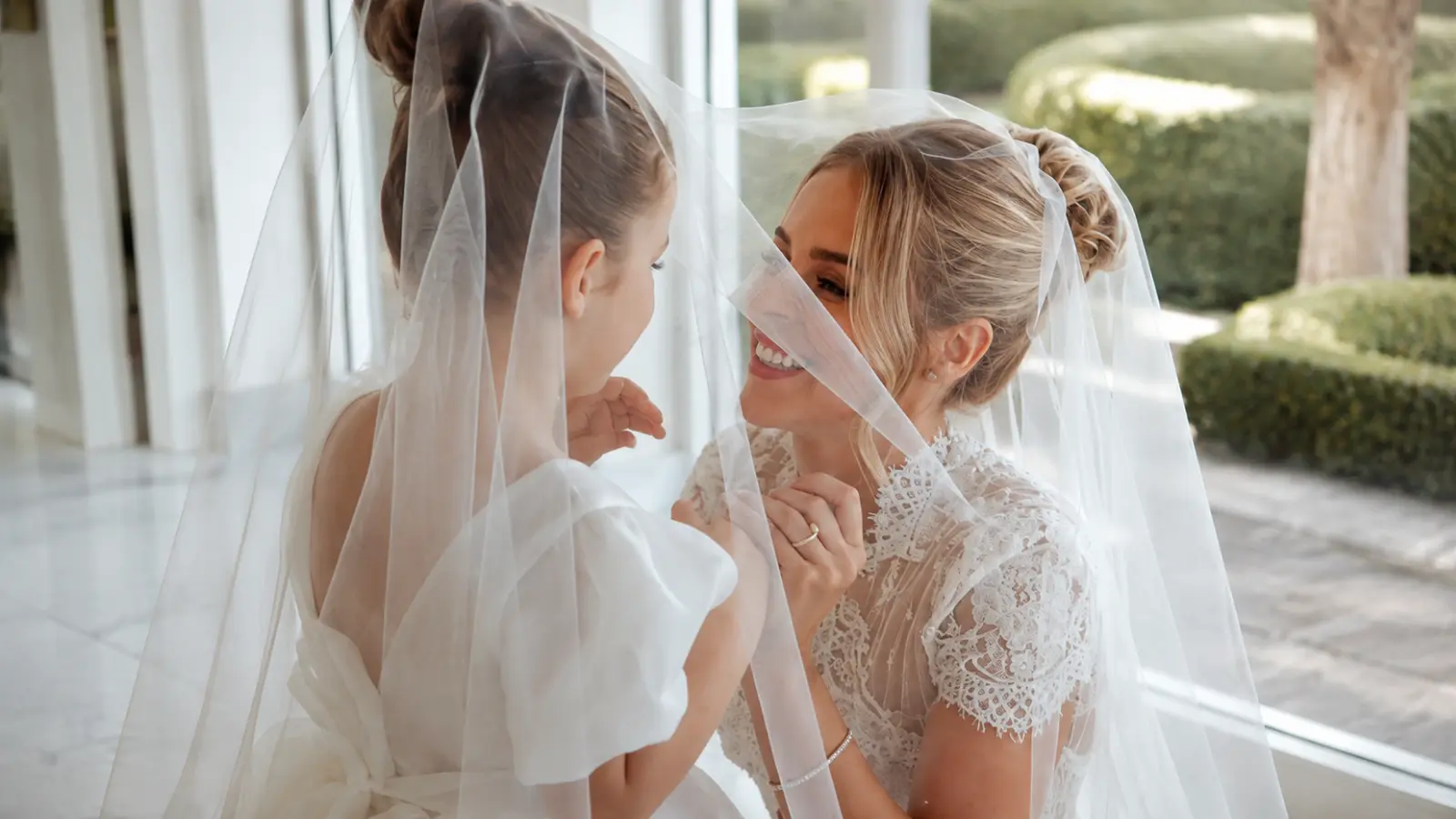
Should you invite kids to your wedding? The answer depends less on etiquette than on your venue, budget, guest list, family dynamics, and the kind of celebration you want. Some couples love the energy children bring, while others prefer an adults-only atmosphere.
What matters most is making the decision early, applying it consistently, and communicating it clearly. Inviting children is perfectly acceptable, and so is choosing an adults-only wedding. Problems usually start when the rule feels vague, uneven, or announced too late.
This guide explains how to decide whether to invite kids to your wedding, including when children fit naturally, when adults-only makes more sense, how to handle immediate family exceptions, destination weddings, budget limits, venue restrictions, and the etiquette around communicating your decision.
When It Makes Sense to Invite Children
Some weddings are naturally oriented around family in a way that makes including children feel right, not just logistically manageable. If your guest list is heavily made up of siblings, cousins, and close family friends with kids, an adults-only policy starts to feel more disruptive than practical — you’d effectively be asking a significant portion of your most important guests to choose between attending and arranging childcare on what may be a difficult day to find it.
Afternoon and early evening weddings lend themselves more naturally to children’s attendance. A ceremony at 3 p.m. with a reception that ends around 9 tends to fall within a range that young children can actually manage without completely falling apart. The later the reception runs — and the more formal the atmosphere — the harder the environment gets for young kids and the more their presence starts to affect the experience for adult guests around them.
Children also tend to integrate well into outdoor, casual, or backyard-style weddings where the structure is looser, the dress code is relaxed, and the general atmosphere is less about formality and more about gathering. In those settings, children running around, dancing early, and falling asleep in a chair during the toasts is part of the texture of the evening rather than a disruption to it.
If most of your close family and friends are parents, and particularly if the children involved are school-age rather than toddlers, including them often simplifies more than it complicates. Parents who know their kids are welcome tend to be more relaxed guests. And a wedding where families attend together has a different emotional quality — more multigenerational, more grounded — that some couples specifically want.
When an Adults-Only Wedding Makes Sense
An adults-only wedding is not a rejection of children or of the families they belong to. It’s a considered decision about the kind of event you want to create — and it’s one that most guests, including parents, understand and respect when it’s communicated well.
Formal evening receptions are the clearest case. A black-tie dinner that starts at 7 p.m. and runs until midnight is genuinely not an environment where young children thrive, and asking parents to manage overtired toddlers through that kind of event is not kind to anyone. In those situations, an adults-only policy is not only acceptable — it’s often quietly appreciated by parents who get a rare evening out.
Tight budgets and venue capacity limits are practical reasons that don’t require apology. Each child counts toward the per-head catering cost, often at a reduced but still real rate. If including all guests’ children means cutting people you genuinely want at your wedding, adults-only is a straightforward solution. The etiquette conversation here is simple: budget is a private matter, and you don’t owe anyone an explanation for the guest list you can actually afford.
Some venues are simply not well-suited to children — spaces with delicate interiors, limited bathroom facilities, no outdoor areas for movement, or layouts that don’t accommodate the natural chaos of young guests. A realistic assessment of your venue is as valid a reason as any other.
The one thing that turns an adults-only wedding from a neutral decision into a difficult one is poor communication. Telling a parent of a two-year-old that children aren’t invited six weeks before the wedding — especially if it’s a destination event or a Saturday evening where childcare is hard to find — is the source of most of the tension that surrounds this choice. The decision itself is fine. The timing and the clarity of the communication are what matter.
Immediate Family vs. All Guests’ Children
The most common middle-ground approach — and the one that causes the most confusion when it’s not handled carefully — is inviting immediate family children while asking other guests to arrange childcare. This is genuinely reasonable. Nieces, nephews, the couple’s own children, and sometimes close cousins occupy a different place in the family than the children of coworkers or college friends. Drawing that line is not unfair.
What makes it work is transparency. If your siblings’ children are invited and your college friends’ children are not, that needs to be clear — ideally in a direct conversation with close family before the invitations go out, so no one discovers the policy from a friend who compared invitation envelopes. Parents who feel like they received a lesser invitation than someone else at the same relationship level are reasonably going to want to know why.
The more specific your exception list becomes, the more carefully it needs to be managed. Inviting some cousins’ children but not others because of geography or family closeness is defensible, but it requires you to be ready to explain it — warmly, not defensively — if someone asks. Most people will accept an honest explanation. What they struggle with is the sense that they didn’t get the full picture.
Should You Invite Some Kids but Not Others?
This is where the etiquette conversation gets genuinely nuanced, because the answer depends entirely on which children and why. There’s a meaningful difference between a consistent, logical threshold — immediate family only, or children over a certain age only — and a list of individual exceptions that has no clear principle behind it.
A consistent rule holds up. If your policy is that children under five are not invited because your reception runs late and the venue isn’t toddler-friendly, that’s a rule that every parent can understand, even if they’d prefer a different answer. If your policy is that certain children are invited because you’re closer to their parents, that’s also defensible — but it requires more careful communication.
What creates real problems is a guest list where some parents received invitations that include their children and others didn’t, with no clear reason. In communities and families where guests know each other well, this kind of discrepancy tends to surface. When it does, it stops feeling like a logistical decision and starts feeling like a statement about whose family matters more. That’s the situation worth going to some lengths to avoid.
If you want to include your best friend’s children because you’re extremely close and those kids are part of your life, that’s a human choice. Just be prepared for the possibility that another guest notices and asks. Having a calm, honest answer ready — “We kept it to a very small group of children we see regularly” — is usually enough. What doesn’t work is pretending there’s no list when there clearly is one.
Local Weddings vs. Destination Weddings
The calculus around children changes significantly when travel is involved. A local wedding where a parent can hire their regular sitter for an evening is a manageable situation even with an adults-only policy. A destination wedding that requires flights, hotel rooms, and several days away from home is a much heavier ask — and the adults-only decision lands differently when it means parents either leave their children behind for a long trip or don’t attend at all.
Many couples with destination weddings land in one of two places. The first is making the event genuinely family-inclusive — inviting children, thinking about activities and meal options, and framing the trip as a family celebration. For a smaller, family-centered wedding, this can work beautifully. The second is communicating the adults-only policy very early in the process, often before the formal invitations go out, so that parents have the maximum amount of time to make arrangements. A six-month or nine-month notice for a destination wedding is not excessive — it’s considerate.
The situation that creates genuine difficulty is an adults-only destination wedding announced close to the date. Parents of young children, particularly those with infants or children who aren’t yet sleeping through the night, may simply not have the option of leaving for a multi-day trip. Giving them as much time as possible to figure out their options is the most respectful thing you can do, even if the answer for some of them is that they can’t come.
How Budget and Guest Count Factor In
Budget is one of the most practical and least-discussed reasons for a children’s policy, and there’s no reason to be apologetic about it. Per-head catering costs at a wedding add up quickly, and while children’s meals are typically less expensive than adult meals, they are not free. If your guest list is already at the edge of your venue’s capacity or your catering budget, each additional child is a real line item.
The math is straightforward: if a wedding has forty adult guests with young children and each brings one or two kids, the reception can grow by thirty to fifty people before anyone has been formally told yes. That’s not a small number, particularly at a venue with a fixed capacity or a caterer who charges by the head regardless of age.
Some couples approach this by setting a budget-based rule: immediate family children are included because those relationships take priority, and all other children are not. This is a completely defensible approach and one that most guests understand. You don’t need to explain the budget line to anyone — “we kept it to immediate family” is sufficient. What makes it work is applying it consistently so no one feels singled out.
Venue Restrictions and Practical Limits
Some venues take the decision out of your hands, at least partially. Historic properties, certain event spaces, and venues with specific liability requirements sometimes have restrictions on children — either blanket policies or rules around specific areas of the property. If you’re considering a venue early in your planning, it’s worth asking directly whether children are permitted and under what conditions before you fall in love with a space that won’t work for your guest list.
Beyond formal restrictions, some venues are simply not practical for young children regardless of policy. A space with no family restroom, no adjacent outdoor area, fragile décor at child level, or a layout that requires guests to navigate stairs or narrow corridors is going to be a harder environment for families with young kids — and that difficulty will affect both the children’s experience and the parents’ ability to enjoy the event.
If your venue presents real practical limitations for young children, that’s a legitimate reason to include in how you frame the adults-only decision to family members who might otherwise feel hurt. “The venue isn’t well-suited to young children and we didn’t want families to have a stressful evening” is an honest explanation that most parents will understand and accept.
Ceremony Only vs. Full Reception
One arrangement that some couples find useful is inviting children to the ceremony but keeping the reception adults-only. The idea is that families can be present for the meaningful, ceremonial part of the day without the couple needing to plan for children through a long dinner and evening reception.
This can work, but it requires very explicit communication. If parents arrive expecting a child-inclusive event and discover at the reception that the arrangement was different from what they understood, that is a frustrating situation — and one that reflects poorly on the planning, not on the parents. If you’re taking this route, the ceremony-only welcome for children needs to be communicated clearly on the invitation, the wedding website, or in a direct conversation with the families involved well before the wedding day.
It’s also worth being realistic about the logistics. After a ceremony, families need a plan: somewhere to go with tired children while parents attend the cocktail hour, a clear understanding of the timeline, and ideally some acknowledgment of what’s expected. A ceremony-only invitation that leaves parents with no plan for what happens next is only half a solution.
How to Be Consistent With Whatever You Decide
Consistency is the single most important factor in how well any children’s policy lands with your guests. A clear rule applied evenly across the guest list — even an unpopular one — is almost always received better than a set of individual exceptions that guests piece together by comparing notes.
Consistency means the same policy applies at the same level of relationship throughout the guest list. If your college roommate’s children are invited, your coworker’s children at the same level of friendship should be too, or you need a clear principle that explains the difference. If siblings’ children are invited, all siblings’ children at the same degree should be — not just the ones who live nearby or whose parents you’re closer to.
Before you finalize any decision about children, it’s worth walking through your full guest list with the policy in mind and asking whether it applies the way you intended. Inconsistencies that feel invisible at the planning stage have a way of becoming visible once invitations are out and guests start talking to each other.
How to Handle Exceptions
Even a well-thought-out children’s policy will sometimes run into edge cases — a guest who is also a nursing mother, a family whose regular childcare provider is unavailable, a close relative who genuinely cannot attend without bringing a child. These situations are real, and the way you handle them says something about the kind of couple you are.
The most important principle here is: if you make an exception, be prepared for the possibility that it becomes known. Word travels at weddings. If one guest brings a child under an exception while another was told no, the second guest may eventually find out — and they’ll remember how it felt. That doesn’t mean you can never make an exception. It means the exception needs to either be invisible or come with a genuinely clear explanation that would make sense to anyone who heard it.
For parents with a nursing infant, an adults-only policy can create a particularly difficult situation, especially when the baby cannot realistically be left for the length of the event. Some couples choose to make a private exception for nursing infants, while others keep the policy consistent and understand that the parent may not be able to attend. If this applies to someone on your guest list, a private, compassionate conversation is far better than leaving the family uncertain about what is permitted.
When a guest pushes back on the policy — expressing that they can’t come without their children, or that they’re hurt by the decision — the most useful response is warmth without reversal. Express genuine regret that they can’t make it work. Don’t apologize for the decision itself, and don’t change the rule for one person unless you’re prepared to extend the same change to everyone at the same level. A soft, honest conversation is better than a policy that bends under pressure and then feels unfair to everyone else.
How to Say No Kids Politely — The Short Version
The invitation envelope is the first signal. Using adults’ names only — “Mr. and Mrs. David and Rachel Kim” rather than “The Kim Family” — indicates that children are not included. This is a long-standing convention in American invitation etiquette that most guests recognize, even if they don’t always follow it without additional clarification.
Your wedding website is the right place to add explicit language. A brief, matter-of-fact statement — something like “Our reception will be an adults-only celebration” — is clear, respectful, and gives parents the information they need without requiring them to ask. Adding a line about appreciating their understanding, or acknowledging that arranging childcare can take time, is a small gesture that goes a long way.
For close family or friends with young children, a direct conversation before the invitations go out is the most considerate approach. Giving parents as much notice as possible — and doing it personally rather than through the invitation alone — communicates that you value the relationship even if the policy affects them. The complete guide to no-kids wedding wording covers specific phrasing for invitations, websites, and direct conversations, including how to handle pushback gracefully.
Should You Invite Kids to Your Wedding? Planning Inspiration
Explore practical wedding planning inspiration for deciding whether to invite children, from adults-only etiquette and family expectations to venue limits, budget considerations, destination weddings, and guest list consistency. Find thoughtful ideas for making a clear decision and communicating it respectfully.
Choose the Policy That Fits Your Wedding
There is no universal rule for whether children belong at a wedding. Some celebrations feel more complete with kids there, while others work better as adults-only events. The best choice is the one that fits your guest list, venue, budget, and overall atmosphere.
Make the decision early, apply it consistently, and communicate it clearly. Guests are far more likely to accept a policy they understand than one that feels vague or uneven.
Frequently asked questions (FAQ)
How do you decide whether to invite kids to your wedding?
Consider the style and timing of your wedding, how many guests have children, your venue, budget, capacity, and how difficult childcare would be for the families closest to you. Children often fit naturally into daytime or family-centered celebrations, while formal late-night receptions may work better as adults-only events. There is no universally correct choice; the best policy is one that fits your wedding and can be applied consistently.
Is it rude to not invite kids to a wedding?
No. An adults-only wedding is a legitimate choice, particularly for formal evening receptions, venues that are not well suited to young children, or celebrations with limited capacity. Etiquette problems usually arise from unclear communication, inconsistent exceptions, or giving parents too little time to arrange childcare—not from choosing an adults-only wedding itself.
Can you invite some children to your wedding but not others?
Yes, as long as there is a clear and reasonably consistent principle behind the distinction. Common approaches include inviting immediate family children only or using an age threshold. Individual exceptions are more likely to cause hurt feelings when guests cannot understand why one family’s children were included and another’s were not, so the simpler and more consistent the policy, the easier it is to communicate.
Does a destination wedding change whether you should invite kids?
Yes. An adults-only destination wedding may require parents to arrange childcare for several days rather than a single evening, on top of paying for travel and accommodations. Some couples therefore make destination weddings family-inclusive, while others keep them adults-only but communicate that decision many months in advance. The important factor is recognizing how much more planning the policy requires from parents who must travel.
What if a guest says they can’t attend because children aren’t invited?
Accept that some parents may genuinely be unable to attend and respond with understanding rather than pressure. Young babies, nursing, limited childcare, or multi-day travel can make an adults-only wedding impractical for some families. Avoid changing the rule for one guest unless you are comfortable making comparable exceptions for others, since inconsistent treatment is more likely to create conflict than the original policy.
Should children be invited to the ceremony but not the reception?
They can be, and this can work when the couple wants children included in the family-centered ceremony but prefers an adults-only evening reception. The arrangement needs to be communicated explicitly well in advance, and parents need a realistic childcare plan for the hours after the ceremony. Without those logistics, a ceremony-only invitation can create more difficulty for families than it solves.