
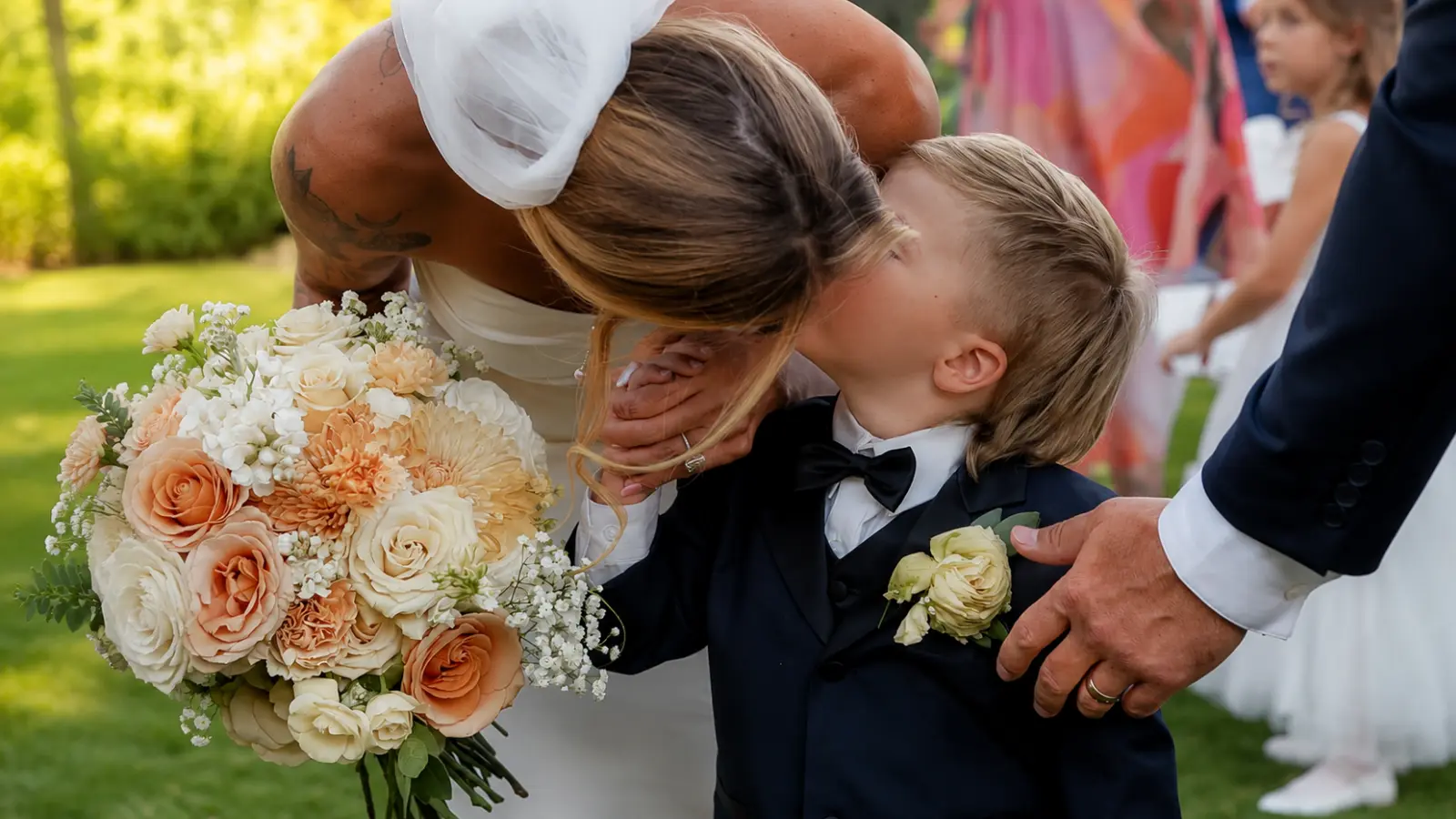
How to include your children in your wedding depends on their age, personality, comfort level, and how they feel about the day itself. For many families, the wedding marks more than a marriage—it also represents a meaningful change in the family, which can make a child’s involvement especially important.
The goal should be belonging, not performance. A short aisle walk, a family first look, a unity ritual, a private letter, or a simple role can feel far more meaningful than assigning a child something public or emotionally demanding that doesn’t fit who they are.
This guide explains meaningful ways to include your children in your wedding, from babies and young children to tweens and teens, including ceremony roles, family first looks, unity rituals, vows, private gifts, reception plans, childcare, blended family considerations, and what to do if a child doesn’t want to participate.
Why Including Your Children Matters
Children who are present at a parent’s wedding are witnessing a change in their family — even if they don’t have the words to name it that way. For young children, the ceremony is often more emotional experience than understood event. For older children and teens, it may carry complicated feelings: excitement about the new family alongside grief for what the family used to look like, or anxiety about what comes next. None of that is unusual, and none of it means the child shouldn’t be included. It means the inclusion needs to be thoughtful.
When children are included in a way that feels genuine — a moment in the ceremony that was designed with them in mind, a private conversation beforehand, a symbol that’s theirs to keep — they tend to come away from the wedding with a sense of belonging rather than displacement. That’s the real purpose of including children in this kind of ceremony. It’s not about the photos, though those matter too. It’s about the child feeling, in a way they can carry forward, that they were part of what began that day.
Babies and Toddlers
Very young children won’t remember the wedding, but that doesn’t mean their presence carries no meaning. A baby carried down the aisle by a grandparent, a parent, or the other partner is a visible part of the family picture. It communicates something to guests, to older siblings, and to the couple themselves about what this day represents. A toddler who toddles alongside an adult for a few steps of the aisle walk — even if it goes sideways quickly — tends to be one of the most genuine and remembered moments of the ceremony.
The practical reality with this age group is that their participation needs to be short, low-stakes, and backed by a plan. A toddler who is carried or gently guided for a brief moment and then settled into a seat with a familiar adult is a manageable, beautiful part of the day. A toddler who has been assigned to hold a sign at the front of the ceremony for twenty minutes is in an impossible position. Keep the involvement brief, have a trusted adult ready to take over immediately, and let the child’s natural behavior be part of the charm rather than something to manage against.
Young Children
Children between roughly four and eight are often the most naturally suited to a visible ceremony role. They’re old enough to understand simple instructions, young enough to carry out a sweet moment without self-consciousness, and at an age where inclusion in something important makes a real impression. This is the age group where a unity ceremony, a small reading, serving as a flower girl or ring bearer, or walking beside a parent during the processional tends to work beautifully — when the child has been prepared and genuinely wants to do it.
Preparation matters more than most couples realize. A child who has rehearsed a short walk, been told exactly what will happen and in what order, and knows who will be standing next to them at each moment is a very different participant from one who has only been told “you get to be in the wedding.” Walk through the plan with them at least once — ideally at the rehearsal, but a simple conversation at home counts. Give them the information they need to feel confident, not just excited.
It also helps to give children this age a concrete role they can hold onto — a job with a clear beginning and end. “You walk with me to the front, then sit with Grandma” is workable for a five-year-old. “Just be part of the ceremony” is not a role; it’s an expectation without shape, and children this age do better with shape.
Older Kids and Teens
Tweens and teenagers need to be consulted, not assigned. Asking a thirteen-year-old what role she’d feel comfortable with — and genuinely accepting her answer, including if that answer is a smaller role than you’d hoped — produces far better results than presenting her with a plan and expecting enthusiasm. Older children often have feelings about a parent’s remarriage that are more layered than younger children’s, and those feelings deserve space alongside the planning conversation.
That said, many older children and teens want to be meaningfully involved. A teen who serves as a junior bridesmaid or junior groomsman, delivers a short reading, stands beside a parent during the ceremony, or offers a toast at the reception often carries that experience as something significant. The difference is that it was chosen, not assigned. When teens feel like active participants rather than props in the wedding aesthetic, they tend to show up differently — more present, more emotionally open, more willing to let the day be what it is.
For tweens who are on the fence about a public role, a private letter, a piece of jewelry, or a quiet one-on-one moment before the ceremony can carry as much weight as any visible participation. The gesture of being seen and thought of specifically, by name, on the wedding day is what matters — not whether it happened in front of the guests.
Getting Ready and Family First Look
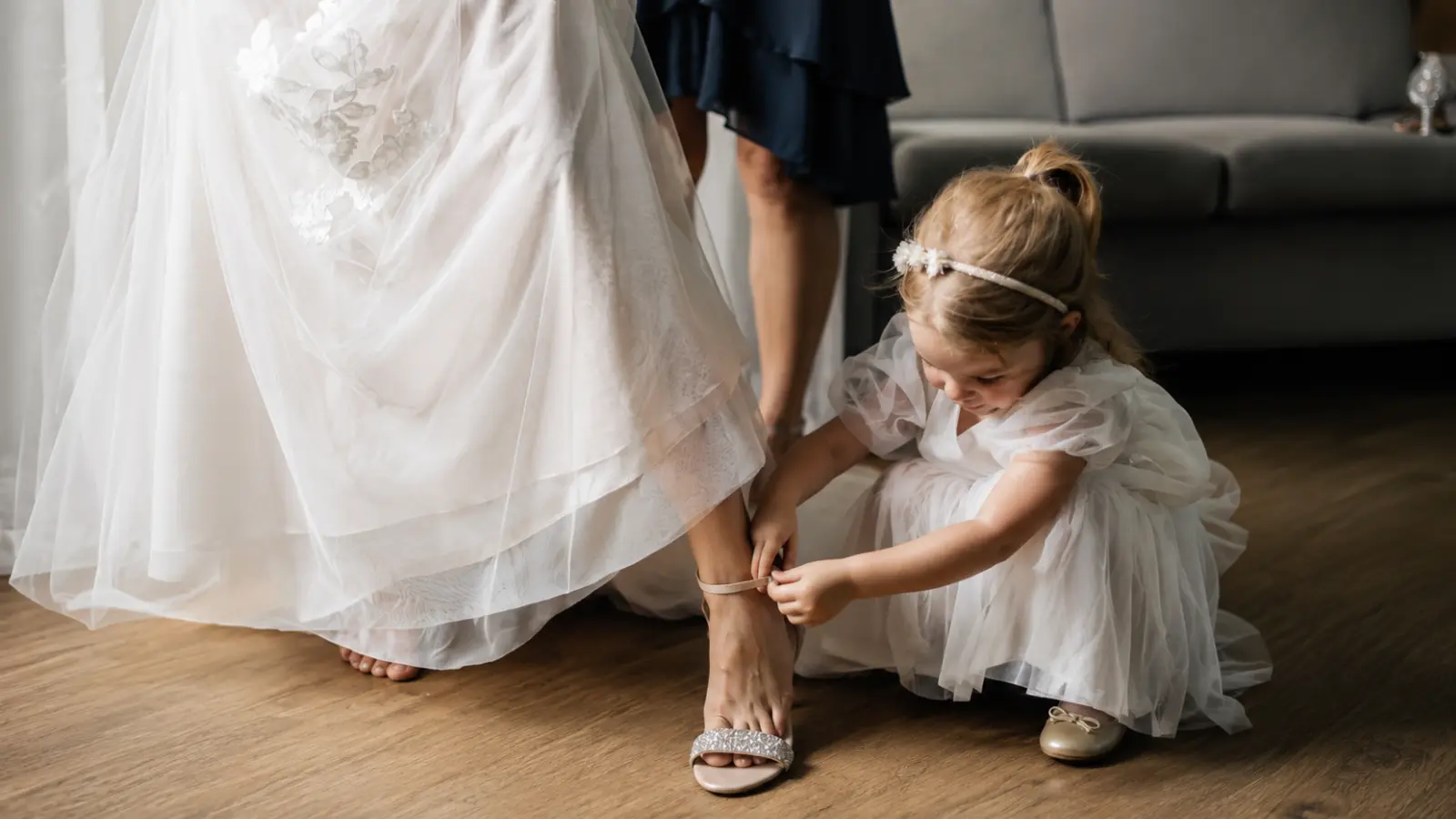
The hours before the ceremony are often where the most genuinely emotional moments happen — and they’re the moments that are easiest to include children in naturally, without any formality attached. Children who are part of the getting-ready process, even briefly, feel included in a way that doesn’t require a ceremony role.
A family first look is one of the most consistently meaningful additions for couples with children. This is a private moment before the ceremony where the couple sees each other — and often, where children are brought in to see their parent in wedding attire for the first time. The reaction of a seven-year-old seeing his mother in her dress, or a teenage daughter seeing her father in his suit, tends to be one of the most photographed and most remembered moments of the entire day. It’s also low-pressure: it happens in private, with only the photographer and the family present, before the public formality of the ceremony begins.
Getting-ready photos that include children are worth discussing with your photographer in advance. Even a brief window — fifteen or twenty minutes where children are brought into the suite for photos before being taken elsewhere — can produce images that feel like a complete family picture of the day, not just images of the couple.
Walking Down the Aisle Together
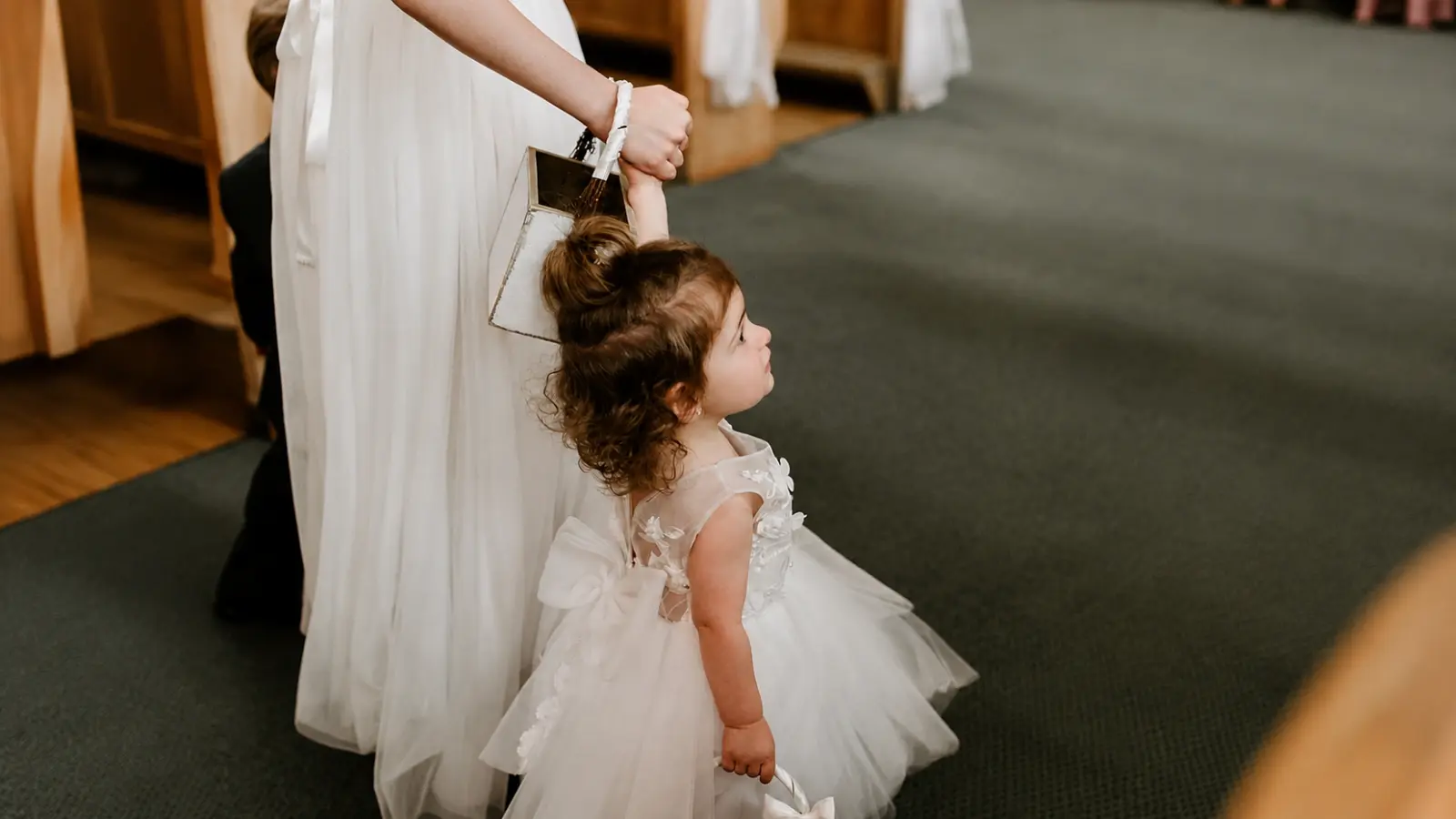
Walking the aisle as a family is one of the most visible ways to signal, to guests and to the children themselves, that this wedding is about more than a couple. There are several ways to approach it depending on the number of children, their ages, and the family’s comfort with the gesture.
Some couples walk the full aisle together as a family — both partners entering with all children present, perhaps holding hands or walking alongside. Others bring children in during a separate moment in the processional, before the couple’s entrance, so each has its own weight. In blended family ceremonies, some couples choose to have each parent walk in with their respective children, meeting at the altar as the two family halves coming together. There’s no single right version. What tends to work is whichever approach reflects how the family actually sees itself — not the one that looks most symmetrical from the back of the room.
For very young children, the aisle walk should include an adult escort who can take over gracefully if the child gets overwhelmed, distracted, or simply decides they’d rather be carried. Having that person positioned and ready is not a backup plan — it’s part of the plan.
Unity Ceremony With Children
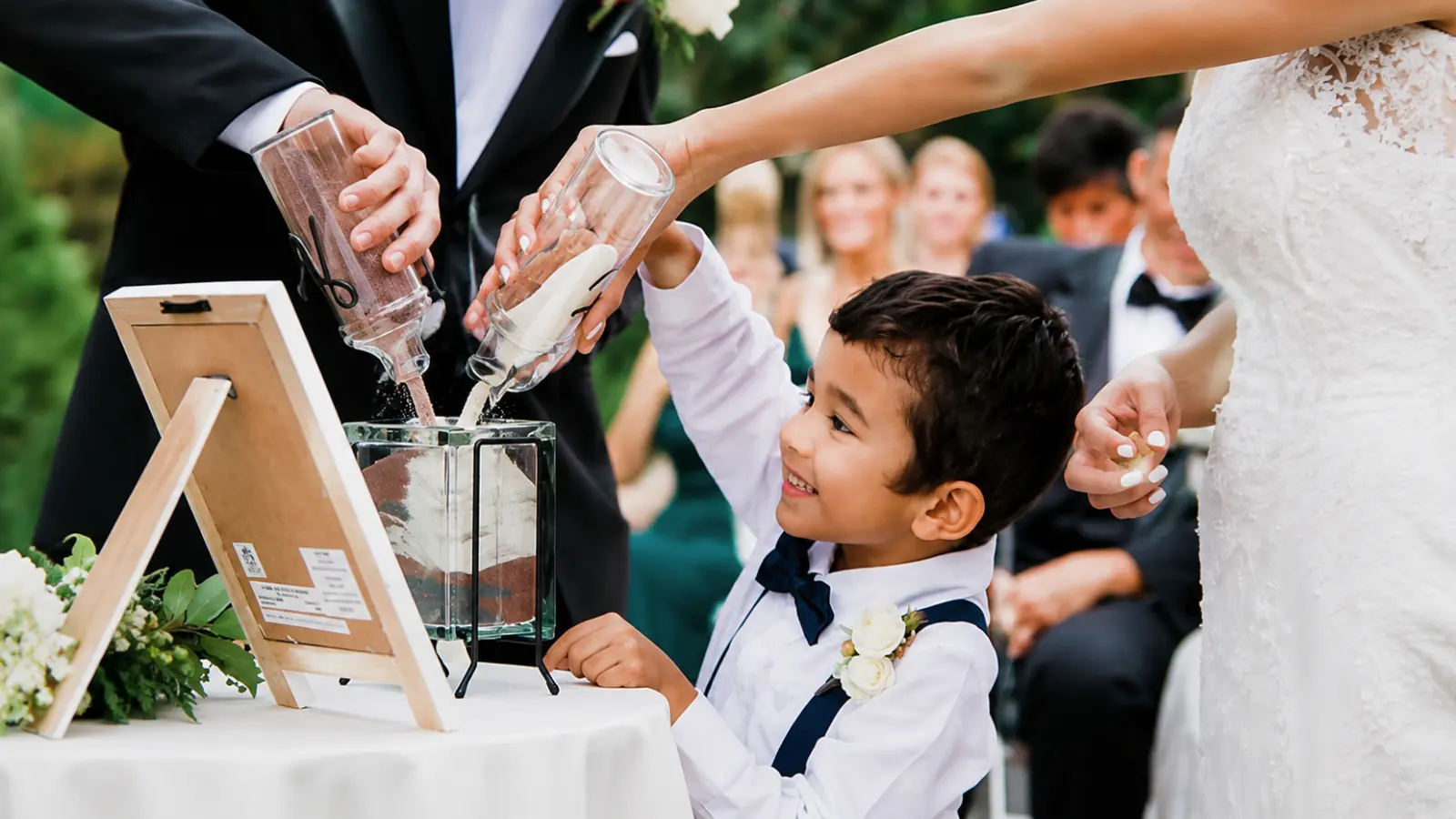
A unity ritual that includes children adds a distinct layer of meaning to the ceremony — it marks the formation of a family, not just a marriage. There are several formats that work well when children are involved, each with a slightly different feel depending on the family’s style and the children’s ages.
The most common options couples choose for family unity ceremonies include:
- Sand ceremony. Each person — both partners and each child — pours a different color of sand into a shared vessel. The mixed result is a visual symbol of the new family: individual colors that are now permanently part of the same whole. This works well for most ages and gives each child a concrete action to perform.
- Unity candle with children’s candles. Older children may hold or light their own candle before or alongside the couple’s unity candle lighting, while younger children can participate with adult assistance or a flameless alternative. The symbolism is straightforward enough for young children to grasp but carries genuine weight for older ones.
- Family medallion ceremony. A family medallion — a pendant with three intertwined circles representing the couple and the family — is presented to children during the ceremony. Some officiants build this into a specific moment in the service; it can also be a private exchange before or after.
- Hand-fasting or hand-tying that includes children. A ribbon or cord is tied around the hands of everyone present — the couple and the children — in a brief ritual of connection. This works especially well in ceremonies with an intimate guest count where the gesture feels personal rather than theatrical.
Whatever format you choose, brief your officiant well in advance. A unity ritual with children needs clear staging, clear timing, and an officiant who can guide the moment without making it feel long or awkward for anyone involved — especially the children themselves.
Vows or Promises to Children
Some couples choose to include a moment in the ceremony where they make a direct promise to their children — or to their stepchildren. Done well, this is one of the most moving parts of a family wedding. Done without care, it can put a child in an emotionally difficult position in a very public setting.
The most important thing about vows to children is that they should be simple, warm, and forward-looking. They should not be heavy with adult language about legal responsibility, complex family dynamics, or anything that requires the child to respond publicly in a way they may not be ready for. A promise to love, to be there, to make room — that’s the register that works. It should be something the child can receive, not something they need to process.
For younger children, the words are less important than the gesture. Being addressed specifically, by name, in a ceremony where everyone is watching, leaves an impression even if the exact phrasing fades. For teens, the content matters more — and it’s worth discussing with them in advance whether they’d like to be part of a public vow or whether they’d prefer that moment to be private. Some teens find a public promise deeply meaningful; others find it uncomfortable in ways they won’t be able to hide in the photographs. The answer to which it is for your child is almost always available if you ask before the wedding day.
Private Letters and Gifts
Not every meaningful moment needs to happen in front of the guests. For many children — particularly older ones — a private letter, a piece of jewelry, or a quiet conversation on the morning of the wedding carries more weight than any public gesture could. The privacy itself is part of what makes it feel real: this is between us, not a performance.
A handwritten letter to a child, given before the ceremony, tells them something specific — about who they are, what they mean to you, what you’re hoping for the family you’re building. It’s something they can keep, reread, and return to. Many children who receive this kind of letter on a parent’s wedding day describe it later as one of the things they hold onto most from that period of their life.
A piece of jewelry or a small token — a necklace, a bracelet, a watch — is another version of this. It’s tangible, wearable, present in the wedding photos even if no one in the room knows its significance. For blended family situations in particular, giving each child something that is specifically theirs, chosen specifically for them, acknowledges their individuality within the new family structure in a way that a shared unity ritual sometimes can’t.
Reception Roles and the Rest of the Day
The ceremony tends to hold most of the emotional weight when children are involved, but the reception offers its own opportunities — especially for older children and teens who might feel more comfortable in a less formal setting. A tween who wasn’t ready to do a reading during the ceremony might be perfectly happy to give a short toast at the reception. A teen who sat quietly through the ceremony might want to be on the dance floor with her parent for a family dance moment. These are worth leaving open rather than over-scheduling.
For younger children, the reception is often where the day starts to get long. The ceremony’s emotional arc is over, the novelty of being dressed up is wearing off, and the formal dinner service is not designed for a six-year-old’s energy level or attention span. Having a plan for this part of the day — a kids table with activities, a trusted adult who’s watching them, or a quiet space to decompress — means the children who were beautifully present during the ceremony aren’t melting down by the time the toasts begin. The kids table guide covers the logistics of that setup in more detail.
Who Takes Care of Them During the Reception?
This is the planning question couples most often defer until it becomes a problem on the wedding day. After the ceremony — after the photos, after the emotional unity ritual, after the moment where the children were at the center of something — someone needs to take over so the couple can actually be present at their own reception.
For young children, that means a specific person with a specific plan: who has them, where, and what the handoff looks like. This is not the moment to rely on a general assumption that “family will help.” Identify the person, tell them in advance, confirm the arrangement the week before. If you have multiple young children from a blended family situation, a wedding babysitter or childcare coordinator is often the cleaner solution — someone whose entire role is the children, so family members can also enjoy the evening.
Older children and teens can generally manage the reception with more independence, but they still benefit from knowing where they’re sitting, who their point person is if they need something, and when it’s okay to leave or wind down. The couple who thinks through these details before the day tends to actually enjoy their wedding night. The couple who figures it out in real time spends half of dinner coordinating logistics instead of celebrating.
Blended Family Considerations
A blended family wedding carries additional layers that don’t come up in every wedding planning guide — and that are worth thinking through deliberately rather than assuming they’ll resolve themselves in the warmth of the day.
Children in blended family situations may have a range of feelings about the wedding that don’t map neatly onto joy and excitement. A child who loves her future stepparent but still grieves the original family structure is not being difficult — she’s being honest. A teen who’s supportive of the marriage in principle but uncomfortable with a public unity ritual that asks him to perform emotions he hasn’t fully sorted out yet deserves to have that discomfort respected, not managed around.
The most consistently useful approach for blended family weddings is to prioritize individual conversations over unified planning. Talk to each child separately about what they’d like to do, what they’re comfortable with, and what would feel like too much. Let the answers be different for different children — because they will be. A ceremony that honors each child’s individual comfort level, rather than assigning everyone the same role for the sake of visual symmetry, tends to produce the most genuine moments and the smoothest day.
It’s also worth thinking about language. Vows or promises that use words like “your new family” or “now you have two dads” may feel freighted or inaccurate to a child whose family already feels complete in a different way. Words that are about addition rather than replacement — more love, more people who are there for you — tend to land better across a wider range of family situations.
What If a Child Is Shy or Resistant?
Some children, when it comes to it, don’t want to participate. They may have said yes during the planning conversations and then gotten cold feet. They may have never been fully on board and been waiting for permission to say so. They may be emotionally overwhelmed by the day in ways that aren’t visible until they’re standing at the back of the aisle.
The right response in all of these situations is the same: let them off the hook, without making it a moment. A child who is gently reassured that they don’t have to do anything they don’t want to, and then given a special seat or a quiet role that doesn’t require them to perform, will usually settle into the day in their own way. A child who is pushed past their comfort threshold — even gently, even lovingly — will not be present in the way you hoped. And neither the child nor the photos will reflect what you were trying to create.
Having a fallback plan is not pessimistic; it’s kind. Know in advance what the adjusted version looks like if a child decides they don’t want to walk the aisle, hold the flowers, or stand at the altar. The fallback can be as simple as a special seat in the front row and the knowledge that they were thought of specifically. That’s often enough.
Including Your Children in Your Wedding Inspiration
Discover meaningful ways to include your children in your wedding, from family first looks, aisle moments, unity ceremonies, readings, vows, private letters, and special gifts to thoughtful reception roles. Explore age-appropriate ideas for babies, young children, tweens, teens, and blended families that help every child feel genuinely included in the celebration.
Make the Moment Feel Right for Your Child
The most meaningful way to include your children in your wedding is the one that fits who they actually are. Some children will love walking the aisle or joining a unity ceremony, while others may prefer a private letter, a special gift, or simply being close to you during the day.
Ask what feels comfortable, keep expectations realistic, and leave room for them to change their mind. A child doesn’t need a dramatic role to feel included—they need to know that their place in the family and in the wedding was considered with care.
Frequently asked questions (FAQ)
How can you include your children in your wedding?
Include them in a way that fits their age, personality, and comfort level. Options can range from walking down the aisle or joining a unity ceremony to a family first look, private letter, reception toast, or special gift. The most meaningful role is usually one the child genuinely wants rather than one assigned for appearance.
What is a unity ceremony that includes children?
A family unity ceremony is a symbolic ritual that represents the formation of a family as well as the marriage. Children might pour sand into a shared vessel, participate in a unity candle, receive a family medallion, or join a hand-tying ritual. Choose a format that is simple, age-appropriate, and comfortable for everyone involved.
Should you make wedding vows or promises to your children?
You can, especially when the wedding marks the formation of a blended family, but the promises should be simple, sincere, and age-appropriate. Focus on love, belonging, and being there rather than complicated family language. With older children and teens, discuss a public promise beforehand because they may prefer a private letter or conversation instead.
How do you include children in a blended family wedding?
Talk to each child individually about what level of participation feels comfortable rather than assigning everyone the same role. A unity ritual, reading, private letter, or meaningful gift can all work. Use language that emphasizes adding love and connection rather than replacing an existing parent, relationship, or family structure.
What do you do with your children during the wedding reception?
For young children, decide in advance who will take over after the ceremony and where they will go when they become tired or overstimulated. This might be a trusted adult, wedding babysitter, or childcare coordinator. Older children and teens usually need less supervision but should still know their seating, plans, and point person.
What if your child doesn’t want to participate in the wedding?
Do not pressure them into a public role. Offer participation without expectation and have a simple backup plan, such as a special seat, private moment, letter, or meaningful gift. A child can still feel genuinely included without walking down the aisle, speaking during the ceremony, or participating in a public ritual.