

Children at weddings can bring some of the most joyful moments of the day, from kids taking over the dance floor to the couple’s own children appearing in meaningful family photos. But inviting children also changes the logistics, including seating, meals, entertainment, supervision, and ceremony expectations.
Planning well doesn’t mean turning your wedding into a children’s party. It means understanding which children will attend, what different age groups need, and which accommodations will help both kids and parents enjoy the celebration comfortably.
This guide explains how to plan for children at weddings, including whether to invite kids, adults-only options, age-specific needs, seating, meals, activities, childcare, ceremony and reception logistics, and ways to include your own children.
What It Actually Means to Have Children at a Wedding
When couples talk about having children at their wedding, they’re rarely talking about one thing. They might mean a handful of nieces and nephews at the reception, or a guest list where a third of the attendees are under twelve, or just the couple’s own kids from a previous relationship standing in the ceremony. Each of those scenarios requires a completely different level of planning — and treating them all the same is where most of the confusion starts.
Children at a wedding can mean babies who will need a quiet space to nurse or nap. Toddlers who are manageable in short stretches but will fall apart by 7 p.m. Kids between five and ten who can follow the event with some help and entertainment. Tweens who are old enough to sit through dinner but bored enough to need something to do. And teenagers who are mostly fine at an adult event but prefer not to be grouped with younger kids. These age groups have almost nothing in common in terms of what they need, how long they can last, and what kind of supervision is realistic.
The decisions you make about children — whether to invite them, how many, which ages, and how to support them once they’re there — ripple into nearly every other planning category: catering, seating, venue layout, timeline, vendor briefing, and guest communication. Understanding that early is what makes the rest of the planning manageable.
Should You Invite Children to Your Wedding?
This is genuinely a personal decision, and there is no right answer that works for every couple. What matters is that the decision is made intentionally, applied consistently, and communicated clearly — rather than left vague and sorted out under pressure when RSVPs start coming in.
A few questions help clarify the thinking:
- What is the overall tone and timing of the wedding? A formal evening reception at a downtown venue is a different environment from a backyard celebration at 4 p.m. The more formal and late the event, the harder it tends to be for young children — and the more disruptive their presence can feel to the overall atmosphere.
- What does the guest list actually look like? If most of your guests are parents of young children, an adults-only policy may effectively exclude a significant portion of people you want there. If children are a small minority of the overall group, including them is logistically simple. The ratio matters.
- What is the venue’s capacity and budget situation? Each child typically counts toward the per-head catering cost, even at a reduced rate. Venue capacity is fixed. If including children means leaving important adults off the list, that’s a real trade-off worth naming.
- Are there family expectations that need to be navigated? Some families have very strong feelings about children at weddings — either that they should be there or that they shouldn’t be separated from their parents for a full evening. Knowing where those expectations are before you send invitations helps you handle conversations before they become conflicts.
The most common middle-ground approach is to invite immediate family children — siblings’ kids, the couple’s own children — while asking other guests to arrange care. This keeps the event manageable while still honoring the closest family relationships. Whatever you decide, consistency matters: if one cousin’s children are invited, the policy should extend to all cousins’ children at the same level of closeness, or you will have a harder conversation on your hands.
Kids vs. Adults-Only Wedding: How to Decide
An adults-only wedding is a completely valid choice, and it does not require an apology or an elaborate explanation. What it requires is clear, early communication so that parents have time to arrange childcare without scrambling. A choice that is communicated early and respectfully is almost always received better than the same choice communicated last-minute or left ambiguous until guests have to ask.
Adults-only weddings tend to work especially well when the reception is late in the evening, the venue is not well-suited to children, the budget is tighter and each head count matters, or the couple simply envisions an atmosphere that is more suited to adult guests. None of these reasons requires defending. What couples sometimes underestimate is how much parents appreciate a clear, definitive answer — even if the answer is no — over a vague situation where they aren’t sure whether to bring their kids or not.
Kid-friendly weddings, on the other hand, tend to work well when the guest list includes many close family members with young children, the ceremony is in the afternoon, the venue has space for some flexibility, and the couple is willing to make small accommodations — simpler food options, a quieter corner of the venue, activity bags, or a dedicated sitter. These additions don’t require an enormous budget. They require forethought.
A partly kid-friendly approach is also an option — and more common than people realize. Some couples invite children for the ceremony and dinner but arrange on-site childcare for the later hours of the reception, allowing parents to enjoy the dancing while young children are supervised in a separate space. This requires more coordination, but it solves the real tension at the center of most wedding logistics: toddlers and late-night receptions simply don’t coexist well.
How to Decide Which Children Are Invited
Once you’ve decided to include some children — rather than all or none — the next question is where to draw the line. This is where most of the difficult conversations happen, and where a clear, consistent policy makes everything easier.
The most common approaches are:
- Immediate family only. Children of siblings and the couple’s own children are included; children of cousins, coworkers, or friends are not. This is the most common middle-ground and is generally understood without much explanation.
- A minimum age threshold. Children over a certain age — typically five, six, or eight — are included; babies and toddlers are not. This approach works well at formal or evening events where very young children struggle with the environment.
- All children of invited guests. If the guest list is family-heavy and the event is daytime or afternoon, including all children simplifies communication and avoids the awkwardness of inconsistent invitations.
- No children except the couple’s own. A middle path for couples who want their own kids present but prefer an otherwise adult atmosphere. This is a valid choice, but it needs to be communicated clearly and early to avoid hurt feelings.
Whatever threshold you choose, the rule that prevents most problems is this: apply it consistently across the entire guest list, at the same level of relationship. If one aunt’s children are invited, all aunts’ children at the same degree of closeness should be too. Exceptions feel like statements, and people notice.
How to Communicate the Invitation Clearly
The names on the invitation or envelope can help signal exactly who is invited. Naming only the invited adults indicates that the invitation is intended for them, while addressing it to the whole family can indicate that children are included. Because guests may not always interpret addressing conventions the same way, reinforce your children policy clearly on the wedding website and communicate directly with close family or friends when extra clarification may be helpful.
Beyond the envelope, a wedding website is the best place to address the children policy directly. A simple, matter-of-fact line — “Our reception will be an adults-only event” or “We welcome children of immediate family” — answers the question for guests before they need to reach out. Most guests check the wedding website before RSVPing, and a clear policy there saves you from fielding the same conversation ten times over.
For close family or friends who you know have young children and may need extra clarity, a direct, warm conversation is the kindest approach. Something simple: “We love your kids, and we want you to know early so you have plenty of time to arrange care.” That framing respects both the decision and the relationship. The dedicated no-kids wedding wording guide covers specific phrasing for invitations, websites, and direct conversations in detail.
Babies, Toddlers, Kids, Tweens, and Teens: Different Needs
One of the most common planning mistakes is treating “children at the wedding” as a single category. A six-month-old and a twelve-year-old have almost nothing in common in terms of what they need, how long they can manage, and what kind of support is realistic. Planning as if they’re interchangeable leads to situations where either the babies are expected to sit quietly through a three-hour reception or the tweens are handed coloring books meant for five-year-olds.
Here’s a realistic breakdown of what each age group needs:
| Age Group | What They Need | Realistic Limits |
|---|---|---|
| Babies (0–18 months) | A quiet space to nurse or nap, their regular feeding schedule, and a parent nearby at all times | Can leave suddenly; parents may need to step out often |
| Toddlers (18 months–3 years) | Familiar snacks, a soft place to sit, and close supervision; meltdowns are common after 7 p.m. | Most cannot manage long receptions; plan for an early exit |
| Young kids (4–7 years) | Simple activities, recognizable food, and a clear sense of what’s happening next | Can manage with support; activity bags and a patient adult help significantly |
| Older kids (8–12 years) | A kids table with peers, age-appropriate activities, and some autonomy | Generally manageable at the reception; may enjoy the dance floor |
| Tweens and teens (13+) | To be treated like near-adults; they do not want a kids table or a coloring book | Can manage the full reception; include them in the general seating |
The ages that tend to cause the most difficulty at weddings are toddlers and young children at evening receptions. Not because parents are doing anything wrong — but because the environment asks more of small children than they can reliably give. Planning with that reality in mind, rather than hoping for the best, is what makes the evening work for everyone.
Where Should Children Sit?
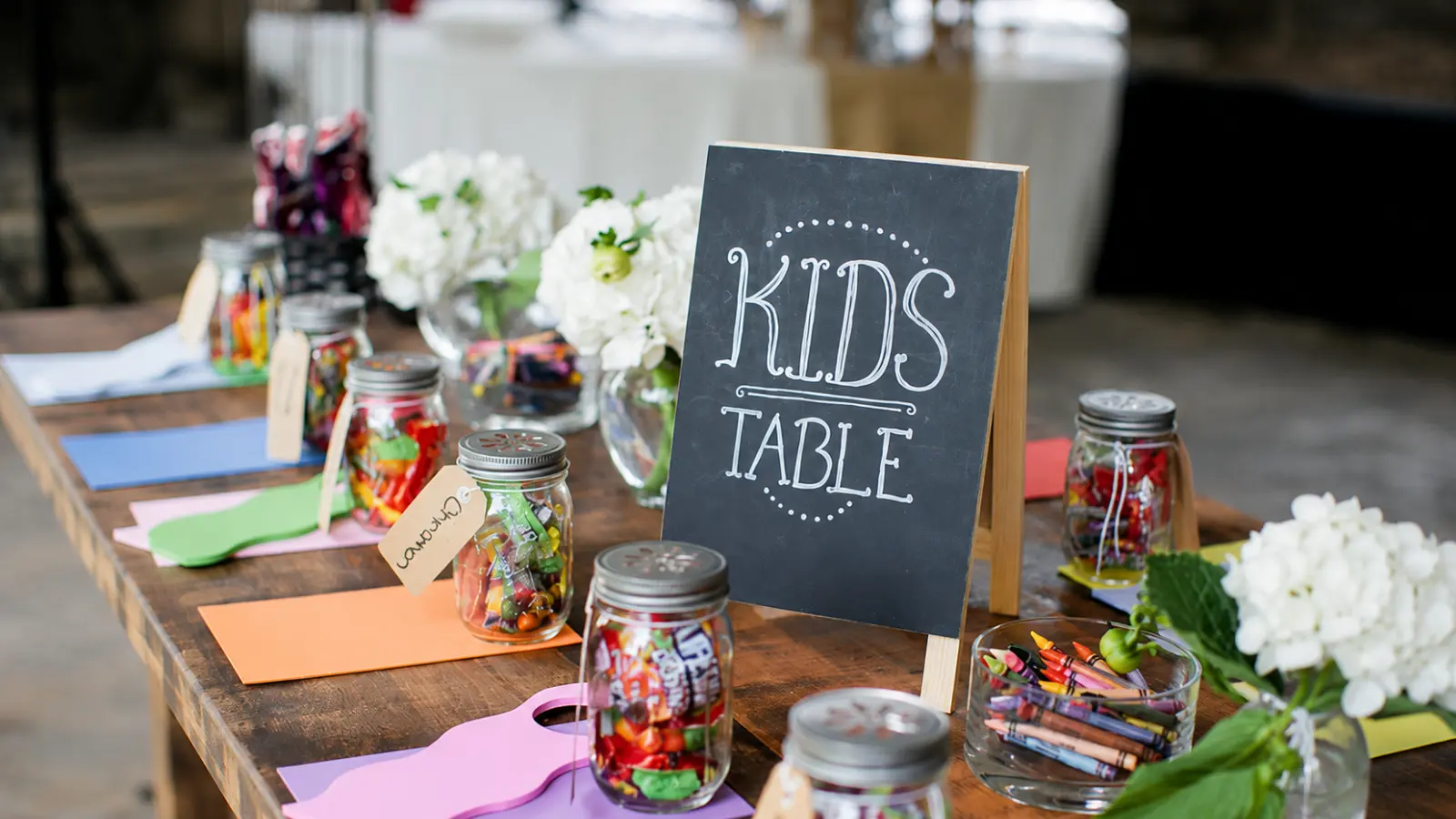
Seating children at a wedding reception is one of those details that sounds simple and isn’t. Where you seat kids affects how comfortable the parents feel, how manageable the kids are during dinner, and how much disruption there is during speeches. Getting it right requires thinking about age, family dynamics, and the physical layout of the room.
Babies and toddlers belong with their parents. There is no seating arrangement that changes that reality. A toddler cannot be seated independently at a kids table and expected to manage. Seat the parents at a table near a convenient exit — not in the center of the room, where slipping out discreetly is impossible — and give them space without making them feel isolated.
Children between roughly five and twelve are the group where a kids table can actually work, depending on the size of the group and whether there are enough children the same age to make it social rather than awkward. A kids table with two children in it is lonely. With five or six, it becomes its own small world, especially if there are activities and a nearby adult to check in. The kids table guide covers setup, placement, and what to put on the table in full detail.
Teenagers should almost always be seated with adults — either at a family table or, if there are enough of them, at a table together without being explicitly labeled a “kids table.” By thirteen or fourteen, most young people find it uncomfortable to be grouped with young children, and seating them there reads as dismissive. If you have several teens, giving them their own peer table — without the coloring books — is a thoughtful solution.
Should You Have a Kids Table?
A kids table can be one of the best ideas at a wedding or one of the most logistically frustrating, depending entirely on how it’s handled. When it works, it gives children a space that feels like theirs — age-appropriate, less formal, with activities and a bit more freedom than a standard adult table. When it doesn’t work, it becomes a babysitting zone that nobody was actually assigned to manage.
The kids table works best when the children are between about six and twelve, are at similar ages, and know each other or are comfortable with new people. It needs to be placed near parents’ tables, not across the room from them. It needs activities on the table — not just place settings — and it needs at least one adult nearby who is paying attention without hovering. A kids table that’s set up and then left entirely on its own for three hours is a recipe for restlessness.
What doesn’t work at a kids table: mixing toddlers with ten-year-olds, seating children who don’t know each other and have nothing to do, placing the table far from their parents, or using it as a catch-all for any guest under eighteen regardless of age or maturity. A teenager placed at a kids table with seven-year-olds will remember it. Probably not fondly.
If you have only one or two children attending, skip the kids table entirely. Seat them with their families at a regular table, give them something to do during dinner, and don’t make their seating more complicated than it needs to be.
Kids Meals and the Wedding Menu
Most professional caterers offer a children’s meal at a lower per-head rate than the adult menu, and flagging this in advance is one of the most useful things you can do for your catering conversation. The standard children’s meal at American weddings tends to include simple proteins like chicken tenders or pasta, a side of rice or vegetables, fruit, and juice or water. It’s recognizable food that most kids will actually eat, which matters more than it sounds when you’re trying to get through dinner service without a scene.
For toddlers, the planning gets more specific. Most toddlers eat on their own schedule and have textures and foods they will and won’t accept. It helps to let parents know in advance whether the venue can accommodate simple requests — plain pasta, steamed vegetables, soft bread — so they’re not trying to pick apart an adult entrée to feed a two-year-old. Some parents bring a small bag of familiar snacks regardless; many venues are fine with this, but it’s worth checking.
Babies who are still nursing or on formula don’t need a meal, but they do need access to a quiet, private space if a parent needs to feed them. If your venue has a bridal suite or a hospitality room, designate it as available to nursing parents during the reception. This small detail is one of the things parents with infants will remember most gratefully.
For the wedding cake and desserts, most children will eat whatever is served — though some caterers offer a simpler dessert option for younger kids. What to watch for: many wedding cakes and specialty desserts use liqueur, espresso, or other adult flavors. Worth knowing in advance if you have young children at the event.
Wedding Activities for Kids
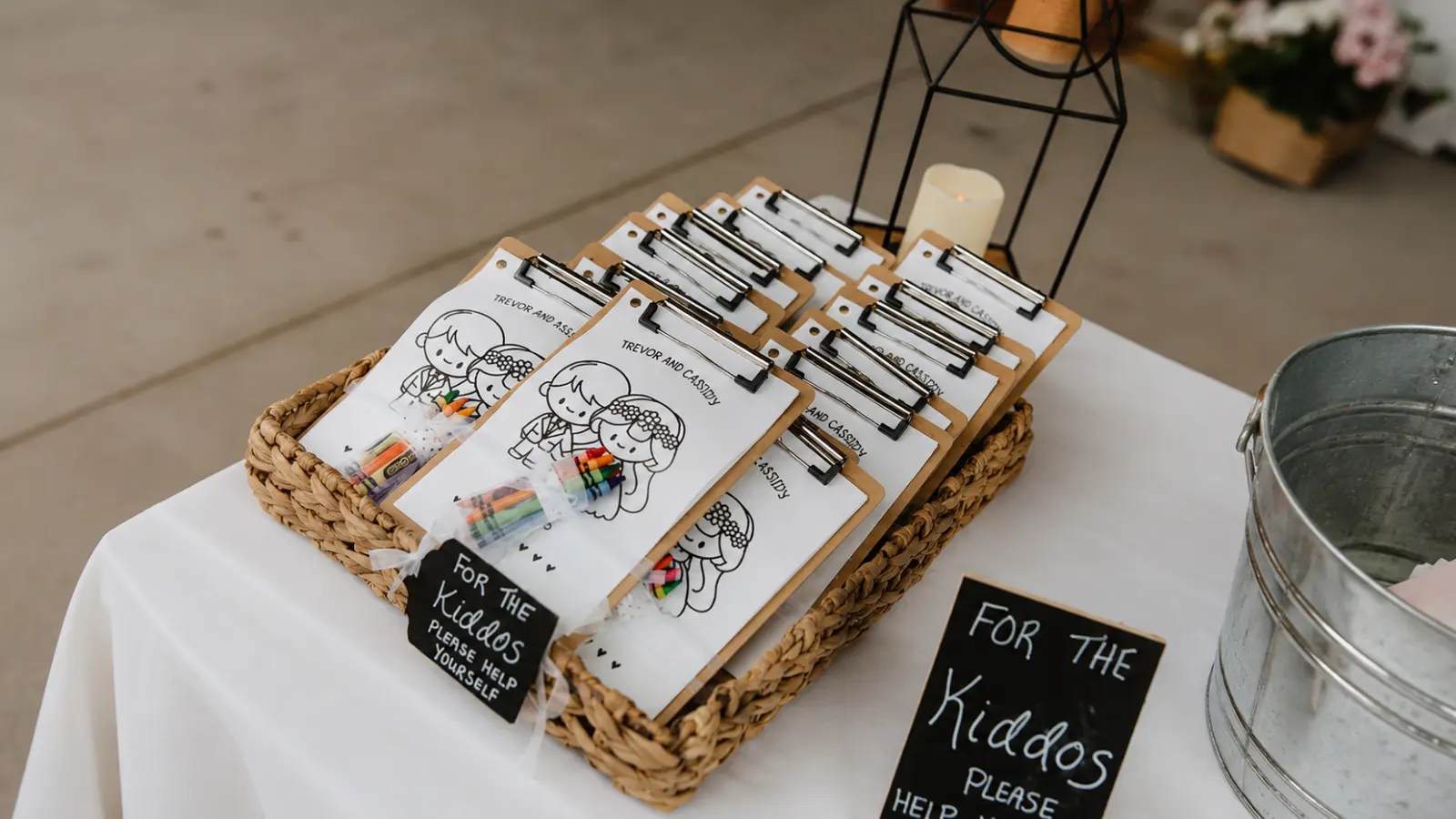
The practical goal of activities at a wedding is not to entertain children all evening. It’s to give them something quiet to do during the parts of the reception where they need to sit still and be relatively calm — specifically dinner service and the speeches. If a child has something to focus on in front of them, the parents can actually eat and listen. That’s the whole point.
The most reliable option is an activity bag placed at each child’s seat. A well-stocked bag for a six-to-ten-year-old might include a small coloring book or printed coloring pages with crayons or colored pencils, a sticker sheet, a simple puzzle, a small toy, and maybe a personalized item with their name on it. The key is that everything in the bag should be quiet — nothing that makes noise, nothing that requires a lot of space, and nothing that will cause a problem if it ends up on the floor. The complete guide to wedding activities for kids covers what to include by age group and how to put the bags together.
Activity Ideas by Age
What works for a five-year-old is not what works for a ten-year-old. Matching the activity to the age keeps children actually engaged rather than bored after three minutes.
- Ages 3–5: Sticker sheets, large crayons, simple coloring pages with thick lines, small plush toys, board books
- Ages 6–9: Activity books with puzzles and mazes, coloring pages with more detail, small LEGO sets, personalized notebooks, card games like Go Fish
- Ages 10–12: Word search or crossword booklets, drawing supplies, card games, friendship bracelet kits, small puzzle books
- Teens: Most teenagers don’t need an activity bag — they need to feel like adults, which means conversation, good food, and eventually the dance floor
One addition that works surprisingly well at receptions with several children: a kids’ corner or activity station set up in a quiet area of the venue, available after dinner. A table with art supplies, a simple game, or a few books gives older children somewhere to go when they’re done sitting still, without requiring a full separate room or hired supervision.
Do You Need a Wedding Babysitter?
Not every wedding needs a babysitter, but on-site childcare can be especially helpful when a reception runs into the evening or several young children will be attending. Parents can absolutely care for their own children, but managing young kids through a long reception while also participating as wedding guests can be demanding. A babysitter or on-site childcare coordinator can give families more flexibility and allow parents to enjoy more of the celebration.
There are two ways to approach this. The first is hiring a professional babysitter or childcare provider to be present at the venue, either circulating among families or stationed in a separate room designated for children. This works well for weddings with several young children and parents who are close friends or family of the couple — people you genuinely want to enjoy the reception, not spend it managing a toddler. The second approach is designating a trusted family member or friend to take on a semi-official childcare role — not as the babysitter for all children, but as someone who helps coordinate, steps in when parents need a break, and keeps an eye on the kids table during dinner.
For destination weddings, late-night receptions, or any event where children are attending but will need to leave before the evening ends, a dedicated sitter who can take children back to a hotel room or quiet space is one of the most practical logistics investments you can make. The wedding babysitter guide covers how to find and brief the right person, what to pay, and how to set up the arrangement with parents in advance.
Creating a Kids Room or Quiet Area

For weddings with a significant number of young children — or for receptions that run late into the evening — setting up a designated kids room or quiet area is one of the most thoughtful things you can do. It gives children somewhere to go when they’re past their limit, gives parents a place to bring a fussy toddler without disrupting the room, and generally reduces the ambient tension that comes from trying to contain energetic children in a formal dining space for hours on end.
The room doesn’t need to be elaborate. A hospitality suite, a separate salon, or even a hallway alcove with a few chairs and a table can work. The basics: a few soft surfaces or floor cushions, some age-appropriate activities or toys, a table with simple snacks and juice, and at least one adult assigned to the space during the hours it’s in use. That adult can be a hired sitter or a trusted family member who has agreed to take on the role — but someone needs to be specifically responsible for the space, not just available in theory.
If the venue has no separate room available, a quieter corner of the reception space — set slightly apart from the main tables, with a clear visual boundary — can serve a similar function. The goal is to give children and their parents an alternative to either sitting perfectly still at the adult table or leaving entirely.
Children During the Ceremony
The ceremony is typically the hardest part of a wedding day for young children, because it asks them to do the thing they are least suited for: sit quietly, without activities, in a formal setting, without moving around, for an extended period of time. A ceremony that runs twenty to twenty-five minutes is manageable for most children over five or six. A ceremony that runs forty-five minutes to an hour is genuinely difficult for young kids, and often for their parents too.
A few practical approaches help. For young children or babies, seating parents at the end of a row near the aisle — so they can slip out without climbing over guests — is a small detail that makes a real difference. If the ceremony venue has a lobby, anteroom, or outdoor space visible from inside, mentioning to parents in advance that they’re welcome to step out if needed removes the anxiety of not knowing whether it’s acceptable.
Some couples choose to include a brief note in the ceremony program or on the wedding website: something to the effect that parents with young children are welcome to step out as needed, and that the couple appreciates their presence. This is a gracious gesture that parents notice and remember. It also subtly sets a tone that the couple has thought about this — which reduces the likelihood of an anxious parent sitting rigidly through a baby’s escalating fussing rather than stepping outside.
For toddlers and babies, even the best-planned ceremony will sometimes involve noise or disruption. Building a very small amount of grace into that expectation — and communicating it to your officiant in advance — means that if it happens, it doesn’t feel like an emergency.
Children During Dinner and Speeches
Dinner and the speech portion of a reception are the moments where children who have been holding it together all day tend to hit their limit. The energy of cocktail hour has passed, the novelty of the venue has worn off, and now they’re being asked to sit through a meal and listen to adults give long toasts. For anyone under eight, this is a significant ask.
This is where the activity bags matter most. A child who has something in front of them — something quiet to do with their hands — is significantly easier to manage during dinner than a child who is simply waiting for the food to arrive and the speeches to end. Make sure the activity bags or table activities are in place before guests are seated, not handed out halfway through the entrée service.
Speeches are a particularly common flashpoint. A toast that runs five to seven minutes is one thing. A series of four or five toasts that collectively run forty-five minutes is another, and most children simply cannot manage that quietly. If you have young children at the reception, it’s worth having a direct conversation with your emcee or wedding planner about pacing the toasts and keeping the total time reasonable. A shorter, more focused toast program is better for most adult guests too — not just the kids.
Parents who know they have a toddler on the edge of a meltdown should feel empowered to step away during dinner without guilt. Seating arrangements that make that easy — aisle seats, tables near the exit — are a logistical kindness that most parents will quietly appreciate.
Children on the Dance Floor
Here’s something couples are often pleasantly surprised by: children on the dance floor are frequently one of the highlights of the reception. A six-year-old going all-in on a pop song, a toddler spinning in circles near the speakers, a nine-year-old who has apparently been waiting all evening to show everyone what they can do — these are the moments that end up in the wedding video and get talked about for years.
The practical notes: let children know early in the evening that the dance floor is a place they’re welcome, so they’re not hovering awkwardly near it for hours waiting for permission. Make sure they understand basic spatial awareness and that they’re sharing the floor with adults. For very young children, one parent is usually dancing nearby without it feeling like supervision.
The only situations that need managing are when children are running at full speed on a dance floor where adults are also moving, or when the combination of exhaustion and overstimulation late in the evening tips into tears and chaos. If children have a quiet area to retreat to when they hit that point — a room, a corner, somewhere their parents can take them down a notch — the dance floor portion of the evening tends to work beautifully for everyone.
What If the Couple Has Children?
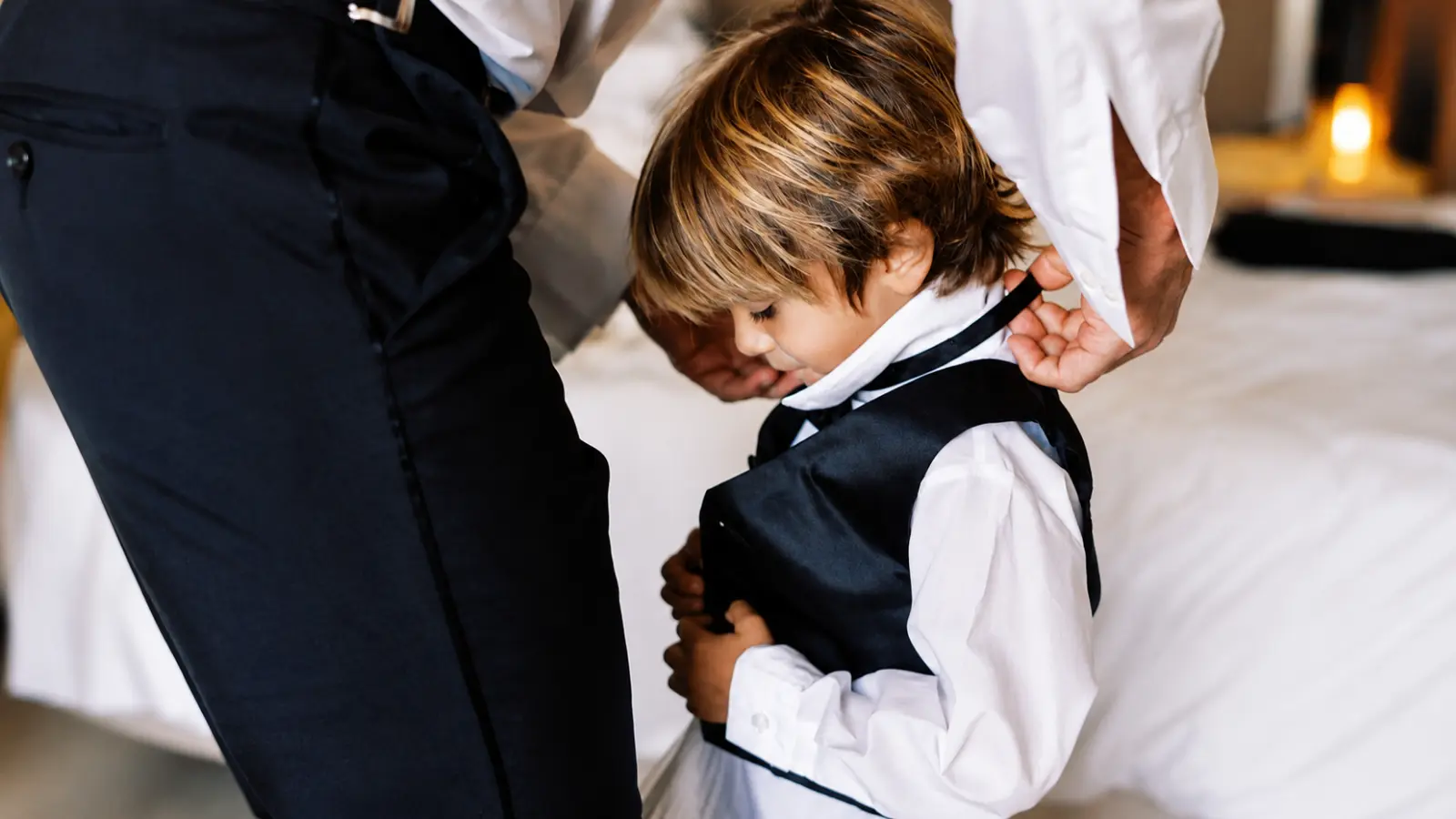
Children of the couple — whether from a previous relationship, a blended family, or from early in the current relationship — are a fundamentally different situation from children of guests. These are children for whom the wedding day is personally significant. It’s the day their parent is getting married. The planning for them needs to reflect that reality, not treat them as logistics to be managed.
The most important thing to establish early is what role, if any, the children will have in the ceremony. Some couples want their children standing with them at the altar, including as a flower girl or ring bearer. Some include a family unity ceremony — a candle lighting, a sand ceremony, a ring warming — that involves the children in a symbolic and meaningful way. Others prefer a clear separation between the wedding ceremony and the family celebration that happens afterward. All of these are valid, and none of them is the obvious right choice. What matters is that the couple has thought it through and that the children understand what to expect from the day.
Beyond the ceremony, children of the couple need a specific plan for the reception: who is responsible for them during dinner and dancing, when they go to bed if the reception runs late, and whether they have a trusted adult assigned to them so the couple can actually be present at their own wedding. If the couple’s children are young, having a dedicated sitter — not a family member who is also trying to enjoy the evening — is often the arrangement that works best for everyone. The full guide on how to include your children in your wedding covers ceremony roles, unity rituals, photos, and the logistics of the day in much more detail.
Common Mistakes to Avoid
Most of the problems that come up with children at weddings are predictable — and preventable. Here’s what to watch for when you’re planning:
- Leaving the children’s logistics until the last minute. Catering counts, seating charts, activity bags, and sitter arrangements all take more lead time than people expect. If children are attending, their logistics need to be part of the planning from the beginning, not an afterthought in the final week.
- Assuming parents will manage everything on their own. Parents are guests too. If you want them to enjoy the reception, give them the support they need — a kids table with activities, a sitter, a quiet room, or simply a seating assignment near the exit. Don’t invite children to the wedding and then leave the experience entirely to the parents to figure out.
- Not addressing the adults-only policy early enough. Parents of young children need advance notice to arrange care. Waiting until the invitations go out — especially for a destination wedding or a Saturday evening event that requires an overnight sitter — puts parents in a genuinely difficult position.
- Grouping all children together regardless of age. A kids table with a toddler, a seven-year-old, and a twelve-year-old serves none of them well. Age-appropriate seating and activities make the difference between a kids table that works and one that doesn’t.
- Seating parents far from the exit. Parents with young children will need to step out. Putting them in the center of the room, surrounded by other tables, makes every exit a disruption. A corner table or a seat near the aisle is a quiet gesture that parents will appreciate without ever having to say so.
- Expecting toddlers and babies to last through a long reception. Young children may become tired or overstimulated during evening events, especially as the reception continues later into the night. If toddlers or babies will attend and you hope their parents can stay for most of the celebration, a quiet space, flexible exit plan, or on-site childcare can make the evening much easier for everyone.
- Forgetting to brief the vendors. Your caterer needs to know how many children are attending and what they’re eating. Your photographer needs to know if there’s a kids table moment or a family portrait that includes children. Your DJ or band should know whether children are on the dance floor and whether any adjustments to volume or timing would help. Children at the wedding are a logistical detail that every vendor who works the event should know about in advance.
Children at Weddings Ideas & Inspiration
Discover beautiful and practical children at weddings inspiration, from kids tables, activity bags, quiet spaces, and kid-friendly reception ideas to ceremony details and meaningful ways to include your own children. Explore seating inspiration, kids meal ideas, entertainment, childcare solutions, and thoughtful planning ideas for creating a wedding where children and parents can enjoy the celebration comfortably.
The Best Plan Is the One That Works for Your Wedding
There is no single right way to handle children at weddings. You may welcome every child, invite only close family, arrange childcare for part of the reception, or choose an adults-only celebration. What matters is making the decision intentionally and communicating it clearly.
If children will attend, plan around their actual ages and needs. Thoughtful seating, familiar food, appropriate activities, quiet spaces, and reliable supervision can make the day easier for both kids and parents without making the wedding revolve around children.
Frequently asked questions (FAQ)
How do you plan a kid-friendly wedding?
Start by confirming how many children are attending and their ages, then plan around the needs of those specific age groups. Think through seating, children’s meals, quiet activities, ceremony exits, supervision, and somewhere tired young children can decompress. Evening receptions with several babies or toddlers may also benefit from on-site childcare. The goal is not to entertain children constantly, but to make the wedding manageable for both kids and their parents.
Should children be invited to a wedding?
There is no universal rule. Consider your guest list, venue, budget, wedding timing, and family priorities before deciding whether to invite all children, only close family children, children above a certain age, or none. Whatever policy you choose, apply it consistently across similar relationships and communicate it clearly and early so parents have enough time to plan.
Where should children sit at a wedding reception?
Babies and toddlers should generally sit with their parents, ideally somewhere that allows the family to step out easily if needed. Children around six to twelve may enjoy a kids table when several similarly aged children are attending and parents are seated nearby. Teenagers are usually more comfortable at regular adult tables or at their own peer table rather than being grouped with younger children.
How do you keep kids entertained at a wedding reception?
Focus activities on the parts of the reception when children need to sit quietly, especially dinner and speeches. Age-appropriate activity bags, coloring or puzzle books, quiet card games, and a kids table or activity corner can work well. Older children may need very little structured entertainment, while toddlers usually benefit more from supervision, familiar toys, and a quiet place to take a break.
Do you need a babysitter at a wedding?
Not every wedding needs one, but on-site childcare can be especially helpful for evening receptions, destination weddings, or celebrations with several babies and young children. A dedicated sitter gives parents the option to enjoy more of the reception once their children become tired or restless. If childcare is provided, responsibilities, location, hours, and expectations should be clear before the wedding day.
What should children eat at a wedding reception?
Simple, familiar foods are usually the easiest choice for younger children, and many caterers offer dedicated children’s meals at a lower price than adult entrées. Ask parents about allergies and dietary needs when collecting meal information. Babies and toddlers may have different feeding schedules or need food brought by their parents, so confirm what your venue allows in advance.
What is the best age for a kids table at a wedding?
A kids table generally works best for a group of children around six to twelve years old who can eat independently and are comfortable sitting away from their parents for part of the reception. Babies and toddlers should stay with their families, while teenagers usually prefer adult seating. If only one or two children are attending, a separate kids table is usually unnecessary.