
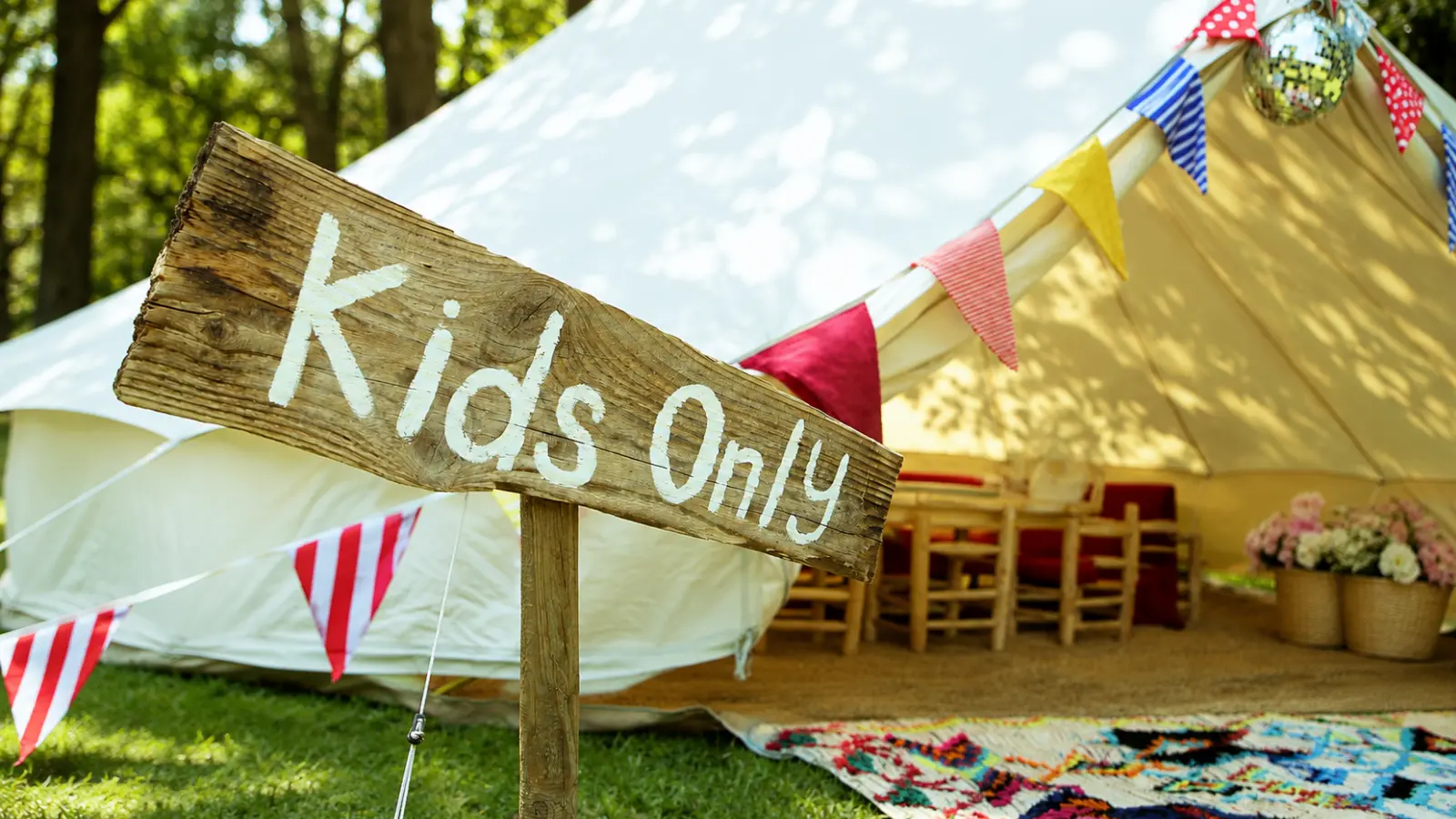
Wedding activities for kids don’t need to turn your reception into a children’s party. The best ideas simply give kids something age-appropriate to do during the moments that are hardest for them, especially the ceremony, dinner, speeches, and the wait before dancing begins.
The most useful activities are quiet, simple, easy to use without constant adult help, and appropriate for the child’s age. A coloring bag may work beautifully for a six-year-old, while a tween may prefer a photo challenge and a teenager may need nothing more than good seating and access to the dance floor.
This guide explains the best wedding activities for kids by age and reception moment, including activity bags, coloring, games, scavenger hunts, outdoor ideas, glow sticks, dance floor activities, and options for tweens and teens.
Quiet Activities for the Ceremony
The ceremony is often where children struggle most, because it asks them to be still and quiet in an unfamiliar space for an extended period. The right activity for this moment is something that occupies hands and attention without making any sound and without requiring the parent to help set it up or manage it while also trying to watch the wedding.
For toddlers and young children, the most practical option is a small quiet bag — separate from the activity bag at dinner — that a parent keeps with them in the pew or seat. A board book, a soft small toy, a silicone teething item for babies, or a simple sticker sheet are all things that can be handed over silently when a child starts to lose focus. The goal is to extend the window before a meltdown, not to entertain indefinitely.
For preschoolers and early school-age children, a simple coloring page with a few crayons in a small pouch works well. Keep it to one page and four or five colors — a large, elaborate setup in a ceremony seat creates more chaos than it prevents. The activity is a bridge, not a project.
One practical note worth passing on to parents in advance: seating them at the end of a row near the aisle means any necessary exit is quiet and quick. That matters more during the ceremony than almost any activity you can provide.
Dinner Table Activities and Activity Bags
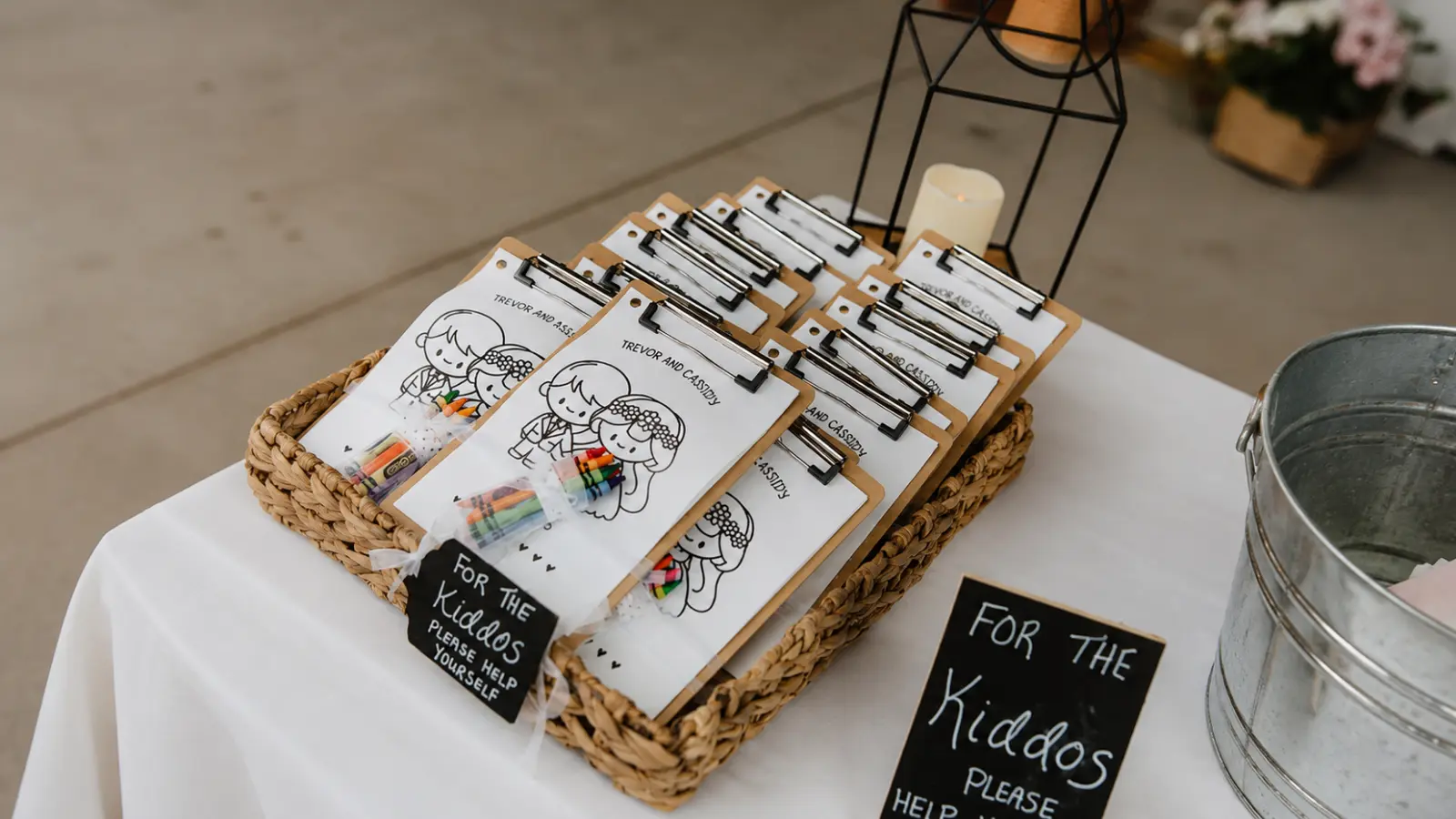
The dinner table is where activity bags earn their place. The stretch from guests being seated through the entrée service and into the toasts is typically the longest continuous stretch of sitting still that children face at a reception — and it’s also the moment when the novelty of the event has worn off and fatigue is starting to build. Something waiting at the seat when children sit down changes the dynamic immediately.
Activity bags work best when they’re placed at the seat before guests arrive, so the child discovers them rather than waiting for them to be distributed. A small drawstring bag, a kraft paper bag, or even a simple box works well. The contents don’t need to be elaborate — what matters is that everything inside is quiet, self-contained, and matched to the child’s age.
What to Put in a Wedding Activity Bag
The right contents depend on the age of the child, but a few items show up across almost every age group because they’re reliably useful and easy to source.
- A coloring book or printed coloring pages. Wedding-themed pages are widely available and add a personal touch, but any age-appropriate coloring content works. For younger children, large simple designs with thick outlines are easier to manage. For older kids, more detailed pages hold attention longer.
- Crayons or colored pencils. Crayons are more durable and spill-proof at a dinner table; colored pencils give older kids more control and feel less babyish. A small set of six to eight colors is plenty — more than that becomes disorganized quickly.
- A sticker sheet. Simple, satisfying, quiet, and appropriate for almost every age from two to ten. Wedding-themed stickers, nature stickers, or character stickers all work.
- A small activity or puzzle book. For children six and up, a compact book with mazes, word searches, crosswords, or simple logic puzzles extends engagement well past what a coloring book alone can do.
- A personalized touch. A tag with the child’s name, a small item in the wedding colors, or a simple note from the couple is a small addition that parents tend to save as a keepsake.
Keep the bag light. The temptation is to overfill it, but a child who dumps out twelve items onto a dinner table next to a centerpiece creates more disruption than one who has four good things to work through. Edit down to what will actually be used.
Coloring Books, Coloring Pages, and Drawing Supplies
Coloring is the most reliable dinner-table activity for children at weddings, and for good reason: it requires no explanation, no setup, no opponent, and no adult participation. A child with a coloring page and a set of crayons can occupy themselves quietly for fifteen to twenty minutes without any management — which is exactly the window that dinner service and the first toast or two tend to fill.
For younger children, printed pages with large, simple shapes and thick outlines are easiest to use. For children between six and ten, more detailed wedding-themed pages — a bride’s bouquet, a decorated cake, a pair of rings — hold attention longer and give them something they feel connected to the event. Printable options are widely available and easy to customize with the couple’s names or wedding date, which makes them feel intentional rather than generic.
Drawing supplies matter as much as the content. Crayons are more table-friendly than markers — they don’t bleed through paper onto tablecloths, the caps don’t get lost, and they’re more durable under the pressure a young child applies. If you’re including colored pencils for older children, a small sharpener tucked into the bag prevents the frustration of a broken tip derailing the whole activity.
One consideration worth knowing: if the wedding has white or light-colored tablecloths, it’s worth laying a small placemat or piece of cardstock under the coloring page. Crayon can transfer, and a stained tablecloth is an awkward conversation with the venue.
Simple Wedding Games for Kids
Games work well for the post-dinner portion of the reception, when children are less tired than they will be later but also less interested in sitting at a table. The right game for this moment is one that doesn’t require a lot of space, doesn’t make noise, and doesn’t need an adult to facilitate every turn.
Card games are one of the most reliably successful options for children between six and twelve. A standard deck of cards opens up Go Fish, War, Snap, and Crazy Eights — games that most children already know and can play independently with a sibling or another child at the table. A few card game sets specifically designed for kids are also compact enough to fit in an activity bag.
A wedding scavenger hunt is another option that works particularly well for school-age kids, especially at a venue where they can move around a little. A printed card with items to find or photograph — the couple’s initials somewhere in the décor, something blue, a flower from a centerpiece, someone wearing a bow tie — gives children a structured reason to explore without running or causing disruption. Keep the list short, six to eight items, and make sure every item is findable without leaving the reception space.
Simple dice games, travel-sized versions of classic games, and small jigsaw puzzles (under fifty pieces) round out what works at a table. The consistent principle is self-sufficiency: a game that requires an adult to explain rules or resolve disputes every few minutes isn’t actually giving parents a break.
Bubbles, Glow Sticks, and Fidget Toys
These three categories come up often in wedding planning conversations, and each one has a specific context where it works well — and a context where it becomes a problem.
Bubbles are a good outdoor activity during cocktail hour, particularly for preschoolers and young school-age children who want something to do during the period between the ceremony and the reception. Outside, on grass or a patio, bubbles can be a simple and engaging activity that requires very little setup. Inside, however, they’re a different calculation: bubble solution on a dance floor is a slip hazard, and bubbles near fabric, flowers, or formal clothing can leave residue. If you’re planning to include them, keep them to outdoor use only and communicate that to parents clearly.
Glow sticks can be a fun option for older children during the dance floor portion of the evening. If you include them, choose age-appropriate products from a reputable source, follow the manufacturer’s safety guidance, and distribute them when dancing begins rather than during dinner. They can add excitement to the dance floor without requiring a complicated setup.
Fidget toys and small sensory items can be useful additions to activity bags for younger children and for kids who get overwhelmed or anxious in loud, busy environments. A small silicone pop toy, a smooth stone, or a simple tangle toy can help a child self-regulate during a long event without requiring any attention from the adults around them. These aren’t decoration — for some children, they’re genuinely functional.
Outdoor Activities During Cocktail Hour
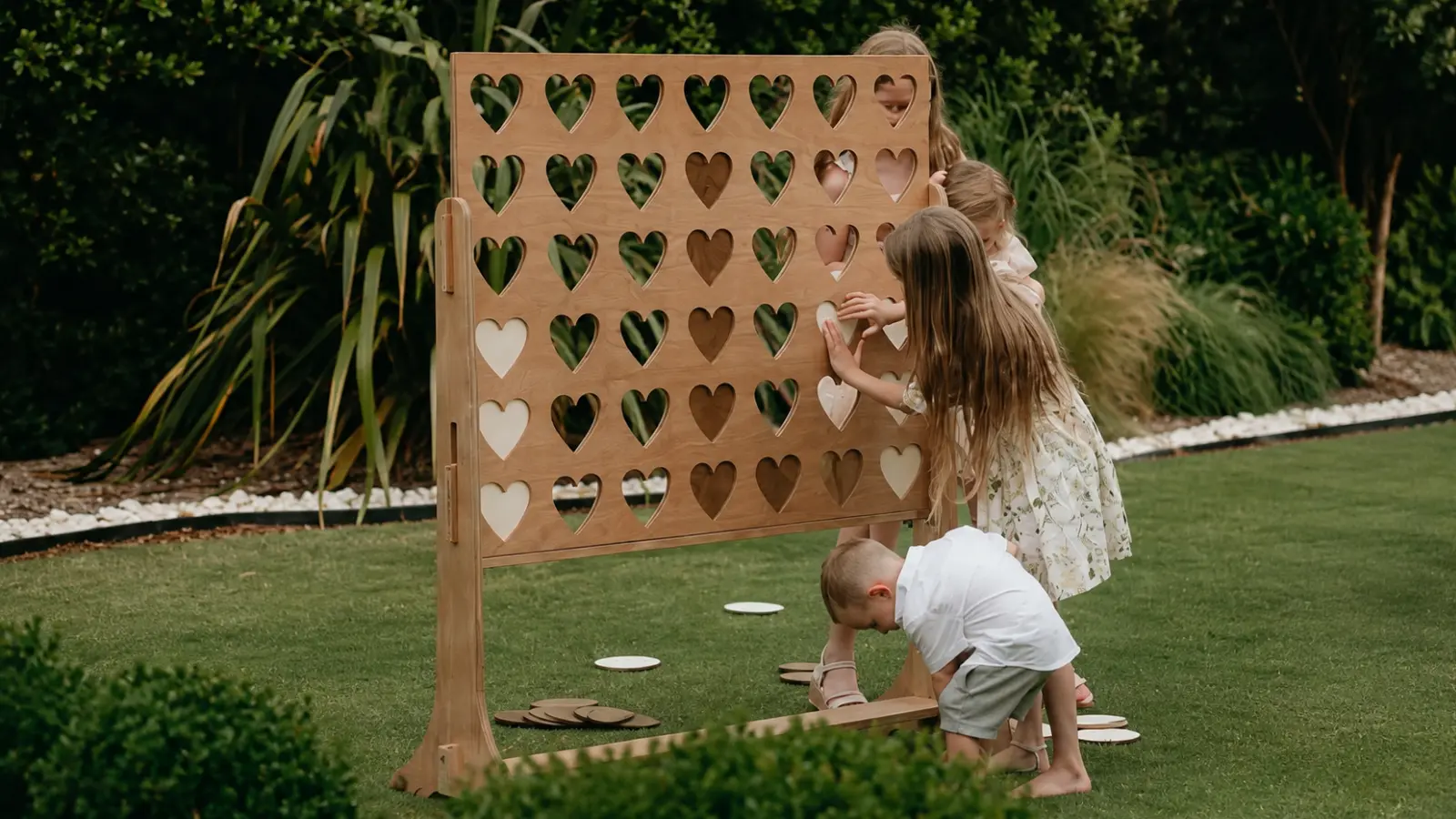
If the venue has an outdoor space accessible during cocktail hour, this is often the easiest window for children. The pressure of sitting still is off, there’s more room to move, and the environment is generally less formal than the reception room. A few simple outdoor activities can make this period the best part of the evening for families with young children.
Lawn games scaled to children — a ring toss, a bean bag game, or a simple ball — work well in open spaces. They’re easy to understand, appropriate for a range of ages, and give children a chance to burn energy in a way that can help them settle more comfortably once they sit down to dinner. If the venue has a garden or open lawn, even an unstructured “go play outside for a bit” with a couple of adults present is a more effective solution than trying to contain young children in a cocktail hour environment full of glasses and appetizer trays.
Bubbles, as noted earlier, also land best outside during cocktail hour. For very young children, simply being in a different environment — outdoors, with space to move — is itself the activity. The cocktail hour is one of the moments where supervised outdoor access is more useful than any specific item you could provide.
Dance Floor Ideas for Kids
Once dancing starts, most children under twelve don’t need a structured activity — they need permission and a little encouragement. Children on a dance floor are frequently one of the most joyful parts of a reception, and the main thing couples can do to support that is simply make clear, early in the evening, that the dance floor is a space children are welcome in.
For younger children who are hesitant, glow sticks or glow bracelets distributed at the start of dancing create an immediate draw. For children between six and ten, a dedicated “kids’ dance moment” where the DJ plays one song they know — something from a popular animated film, or a current song kids are familiar with — gives them a natural entry point before the dancing shifts to adult music.
A few practical notes: very young children on a crowded dance floor need a parent nearby, not because they can’t have fun but because the combination of movement, height differences, and limited spatial awareness can lead to collisions. The dance floor is also where overtired children tend to hit their limit most visibly. If a child is starting to melt down on the dance floor, a quiet exit to a calm space — the kids room, a chair near the parents, a familiar face away from the music — is better than pushing through.
Activities for Tweens and Teens
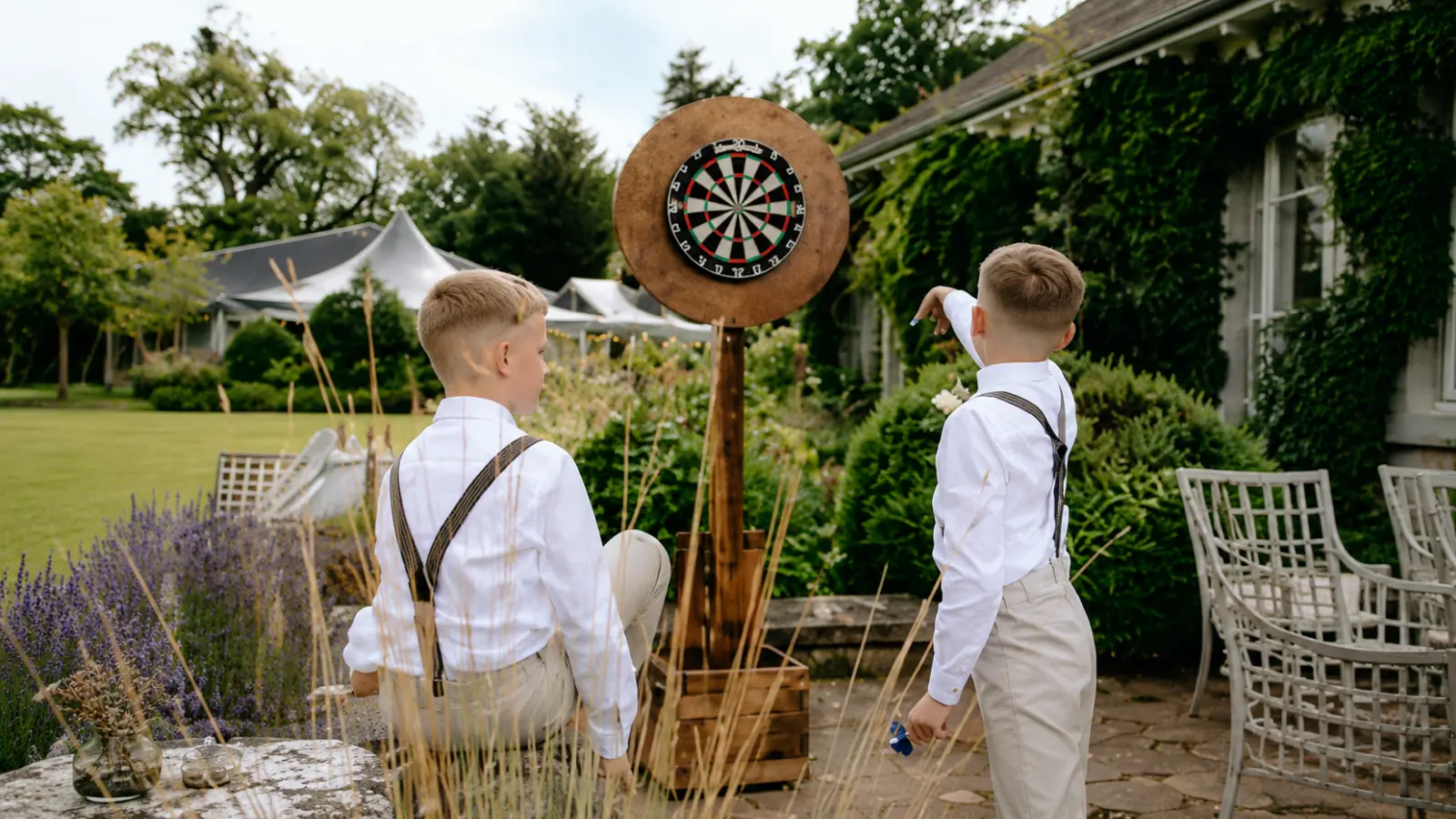
Tweens and teenagers are often the most overlooked age group in wedding activity planning, mostly because the assumption is that they can manage an adult event without support. That’s partially true — but it misses something important. A thirteen-year-old doesn’t need a coloring book, but they also don’t necessarily want to sit quietly at an adult dinner table for three hours with nothing to engage them. The right approach treats them close to adults while giving them something age-appropriate to anchor the experience.
A photo challenge card is one of the most effective options for this age group. A small printed card with a list of things to photograph at the wedding — the most creative centerpiece detail, the best dance move spotted, a candid moment, something that represents the couple — gives them a structured activity that also produces something they can share. Many tweens and teens engage with this enthusiastically because it involves their phone in a purposeful way rather than as an escape from boredom.
A dedicated seating arrangement with their peers matters more than any activity you can provide. A twelve-year-old seated between unfamiliar adults, with no one their own age nearby, will struggle regardless of what’s in front of them. If you have several teens attending, seating them together — not at a kids table, but at their own real table with good food and a clear sense that they’re included — is the single most useful thing you can do for that age group.
Other options that work for tweens and teens include a photo booth with fun props, a lounge area slightly away from the main reception that gives them a sense of their own space, and access to the dance floor without being directed to it. The goal is to make them feel like participants, not afterthoughts.
Activities to Avoid
Knowing what not to include is as useful as knowing what to choose. Some activities that seem like good ideas in planning create real problems at the reception.
- Anything messy. Paint, watercolors, slime, kinetic sand, Play-Doh, and glitter are all disasters waiting to happen at a formal event. The mess doesn’t stay on the table, and venues are not forgiving about it. Even markers can be a problem — they bleed through paper, stain tablecloths, and end up on formal clothing. Stick to crayons and colored pencils for anything involving drawing.
- Loud or electronic toys. A toy that makes sound during the toasts is not a small problem. Anything with buttons that produce music, sound effects, or speech is a genuine disruption risk. If electronics are being considered for older kids, headphone use only is the practical rule.
- Small parts for any table with young children or babies. LEGOs, small puzzle pieces, beads, and similar items become a safety hazard the moment a toddler is nearby. Age labels on activity bags exist for a reason.
- Activities that require constant adult setup or help. If the adult has to stop eating to help the child every few minutes, the activity isn’t giving parents a break — it’s adding a task, not replacing childcare. The best activities are self-explanatory and self-sustaining.
- Babyish content for tweens. A twelve-year-old who opens an activity bag and finds a coloring page with cartoon animals will not use it, and will remember the slight. Age-appropriate content signals that the couple thought about them specifically.
The common thread is this: the best wedding activities disappear into the background. They keep children occupied without requiring management, without creating cleanup, and without drawing attention. If an activity needs more than thirty seconds of explanation or leaves a mark on anything, it probably belongs somewhere other than a wedding reception.
Wedding Activities for Kids Inspiration
Discover fun and practical wedding activities for kids, from activity bags, coloring pages, sticker sheets, puzzles, and scavenger hunts to outdoor games, glow sticks, photo challenges, and dance floor ideas. Explore age-appropriate entertainment for toddlers, school-age children, tweens, and teens to help kids stay engaged throughout the wedding celebration.
Choose Activities That Fit the Child and the Moment
The best wedding activities for kids are not the most elaborate ones. A simple activity that matches the child’s age and the moment of the day will usually work better than a large setup that creates extra noise, mess, or supervision.
Plan quiet activities for the ceremony and dinner, more active options for cocktail hour and dancing, and avoid treating every child the same. When the entertainment is age-appropriate and easy to use, it supports the children without making them the center of the reception.
Frequently asked questions (FAQ)
What are the best wedding activities for kids?
The best activities depend on the child’s age and the moment of the wedding. Coloring pages, stickers, puzzles, and activity bags work well during dinner and speeches, while scavenger hunts, outdoor games, and dancing suit more active parts of the reception. Choose activities that are quiet, age-appropriate, self-contained, and require minimal adult help.
What should go in a wedding activity bag for kids?
Include a few quiet, age-appropriate items such as coloring pages, crayons or colored pencils, stickers, and a small puzzle or activity book. Toddlers may do better with board books or large stickers, while older children can handle more detailed puzzles. Keep the bag simple rather than filling it with items the child probably will not use.
What activities work for tweens and teens at a wedding?
Tweens and teens usually respond better to activities that do not feel designed for young children. Photo challenges, card games, a photo booth, a lounge area, dancing, and seating with people their own age can all work well. Avoid giving older kids the same coloring-based activity bags prepared for preschoolers or younger school-age children.
Are bubbles or glow sticks good ideas for kids at a wedding reception?
Yes, when used at the right time. Bubbles work best outdoors during cocktail hour or after the ceremony because bubble solution can make indoor floors slippery. Glow sticks are better saved for the dance floor and should come from a reliable source. Neither is particularly useful during dinner or speeches.
What activities should you avoid for kids at a wedding?
Avoid messy materials such as paint, slime, glitter, and markers that can stain, as well as loud toys during the ceremony or speeches. Small pieces are inappropriate around babies and toddlers. Activities that require constant adult assistance are also poor choices because they create more work for parents instead of helping children stay independently occupied.
Do wedding activities for kids replace a babysitter?
No. Activities can keep children occupied, but they do not replace adult supervision. Parents remain responsible for their children unless a separate childcare arrangement has been made. Weddings with several young children or late-night receptions may benefit from a dedicated babysitter or on-site childcare in addition to age-appropriate activities.