
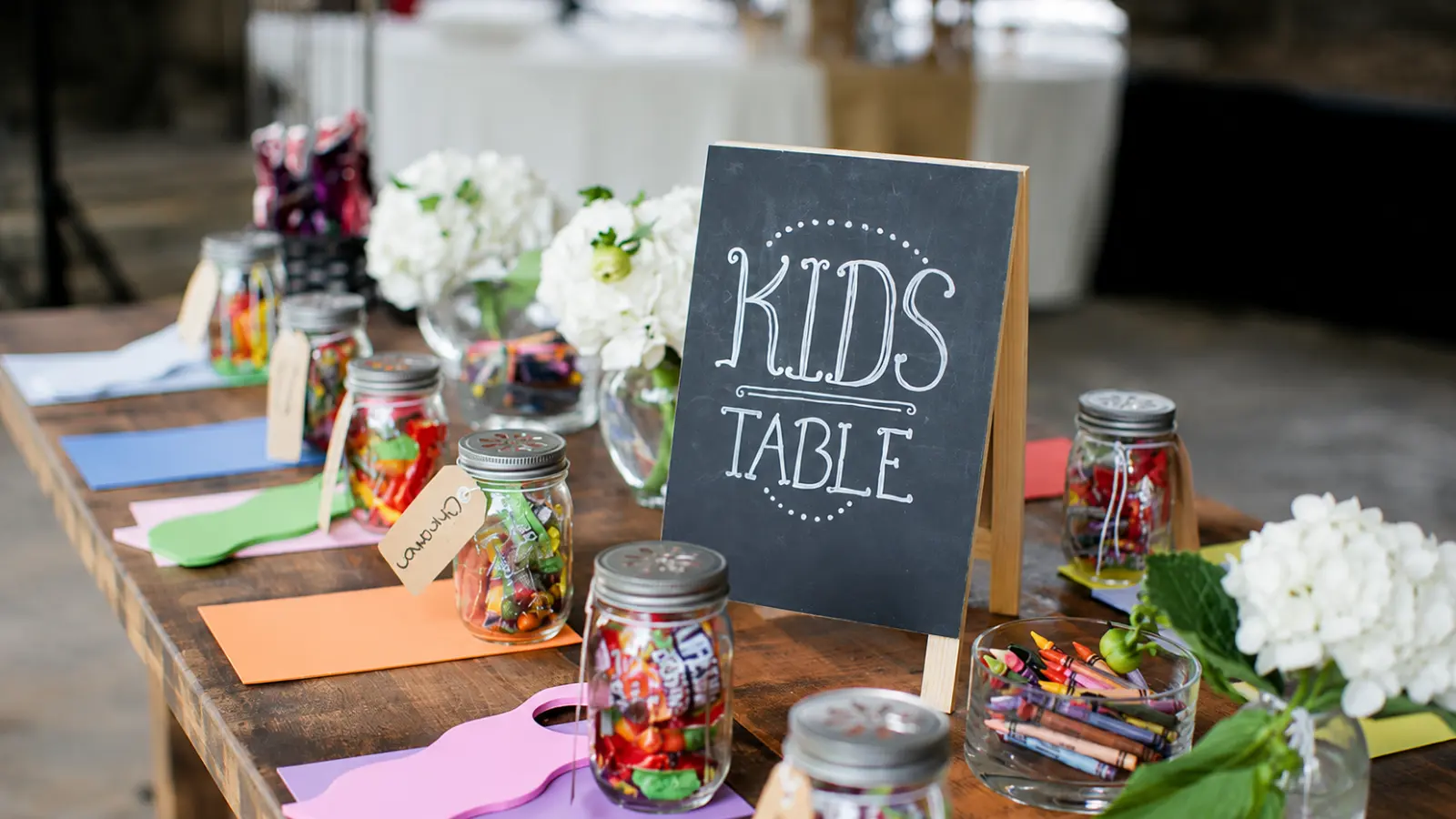
A kids table at a wedding can work beautifully for some children and be completely impractical for others. A group of school-age cousins may happily eat, color, and talk together, while toddlers still need parents close by and teenagers usually prefer not to be treated like young kids.
The key is matching the table to the actual children attending. Age, familiarity, supervision, food, activities, and placement all affect whether the setup gives kids a comfortable space or simply creates another problem for parents to manage.
This guide explains how to plan a kids table at a wedding, including the best ages, where children should sit, what to put on the table, kids meals, placement, supervision, siblings and cousins, and the mistakes that can make the setup harder instead of easier.
Should You Have a Kids Table at Your Wedding?
Not every wedding with children needs a designated kids table. Whether it makes sense depends on how many children are attending, how old they are, and whether they know each other. A wedding with two young cousins and a baby does not need a separate table — those children belong with their parents. A wedding with eight school-age kids from three different families? A kids table with activities and a clear adult nearby may be the arrangement that works best for everyone, parents included.
The kids table works when it gives children a space that’s genuinely suited to them — a lower-pressure seat, familiar activities, food they’ll actually eat, and company their own age. It stops working when it becomes a way of removing children from the room so adults don’t have to think about them. Parents will notice the difference, and so will the kids.
If you’re leaning toward a kids table, the right questions to ask are: Do these children know each other? Are they old enough to sit without direct parental supervision? Will there be an adult designated to check on them? If the answer to all three is yes, a kids table is a practical and thoughtful choice. If any answer is no, look closely at which parts of the setup need adjustment before committing to it.
What Age Works Best for a Kids Table?
Age is the factor that determines almost everything about whether a kids table will succeed. Children of different ages have fundamentally different needs during a long reception, and mixing age groups without a plan often means the setup doesn’t work well for any of them. Here’s how each group tends to experience the kids table — and what that means for your seating chart.
Toddlers and Young Children
Children under four generally do best seated with a parent, caregiver, or another responsible adult rather than at an independent kids table. Toddlers may need help eating, using the restroom, regulating emotions, or simply feeling secure in an unfamiliar environment. If very young children are included in a separate kids area, close and consistent adult supervision is essential.
Preschoolers, around four and five, are sometimes ready for a kids table if the environment is calm, the children know each other, and a parent or trusted adult is seated close enough to step in quickly. But this is the age group where parents know their own child best — some four-year-olds thrive independently, others need the security of a familiar adult at the same table. When in doubt, seat them with their parents and treat the kids table as optional.
School-Age Kids
Six to twelve is the sweet spot for a kids table at a wedding. Children in this age range are generally comfortable being away from their parents for a couple of hours, especially if they know the other kids at the table. They can follow instructions, manage their own food with minimal help, and engage with simple activities independently. They’re also old enough to understand expectations — stay seated during speeches, keep voices down during dinner — without needing constant reminders.
The important caveat here is familiarity. School-age kids who don’t know each other at all may be awkward or bored at a shared table, especially if the reception runs long. If the children attending are from different families who have never met, consider whether the kids table will actually be enjoyable for them — or whether they’d be more comfortable staying near their own parents.
Tweens and Teens
Eleven and twelve can go either way. A tween who knows the other kids at the table and has been asked whether she’d like to sit there will often be fine. A tween who was simply assigned to the kids table without input may spend the evening broadcasting her dissatisfaction, which is uncomfortable for everyone nearby.
Teenagers — thirteen and older — should be seated like young adults. Placing a fifteen-year-old at a kids table with a seven-year-old and a nine-year-old is a reliable way to make her feel dismissed, and she’s not wrong to feel that way. If teens are attending in numbers, consider a small table of peers close in age. If there are only one or two, seat them with a family table where there are adults they’re comfortable with. The kids table is not the right answer for this age group.
What to Put on a Kids Table
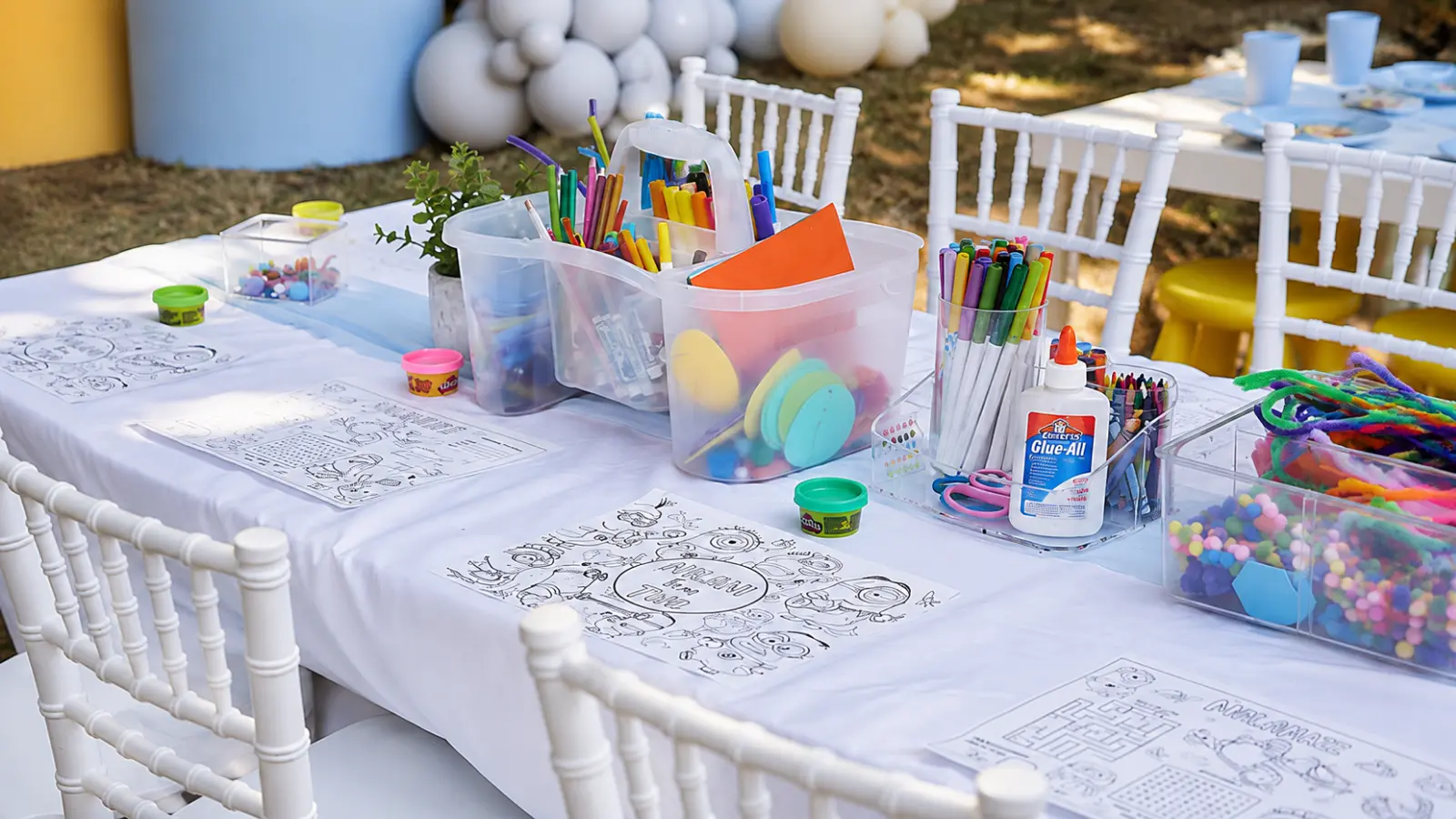
The activities on a kids table serve a specific purpose: quiet, independent engagement during the parts of the reception when children are expected to be seated and relatively still — dinner service, toasts, and the early portion of the evening. The goal is not to entertain them all night, but to give them something to do with their hands so they’re not restless during the moments that matter most.
Simple is almost always better than elaborate. Activities that require adult instruction, have small loose parts, or need supervision to work correctly are not the right choice for a kids table at a reception. These options tend to work reliably:
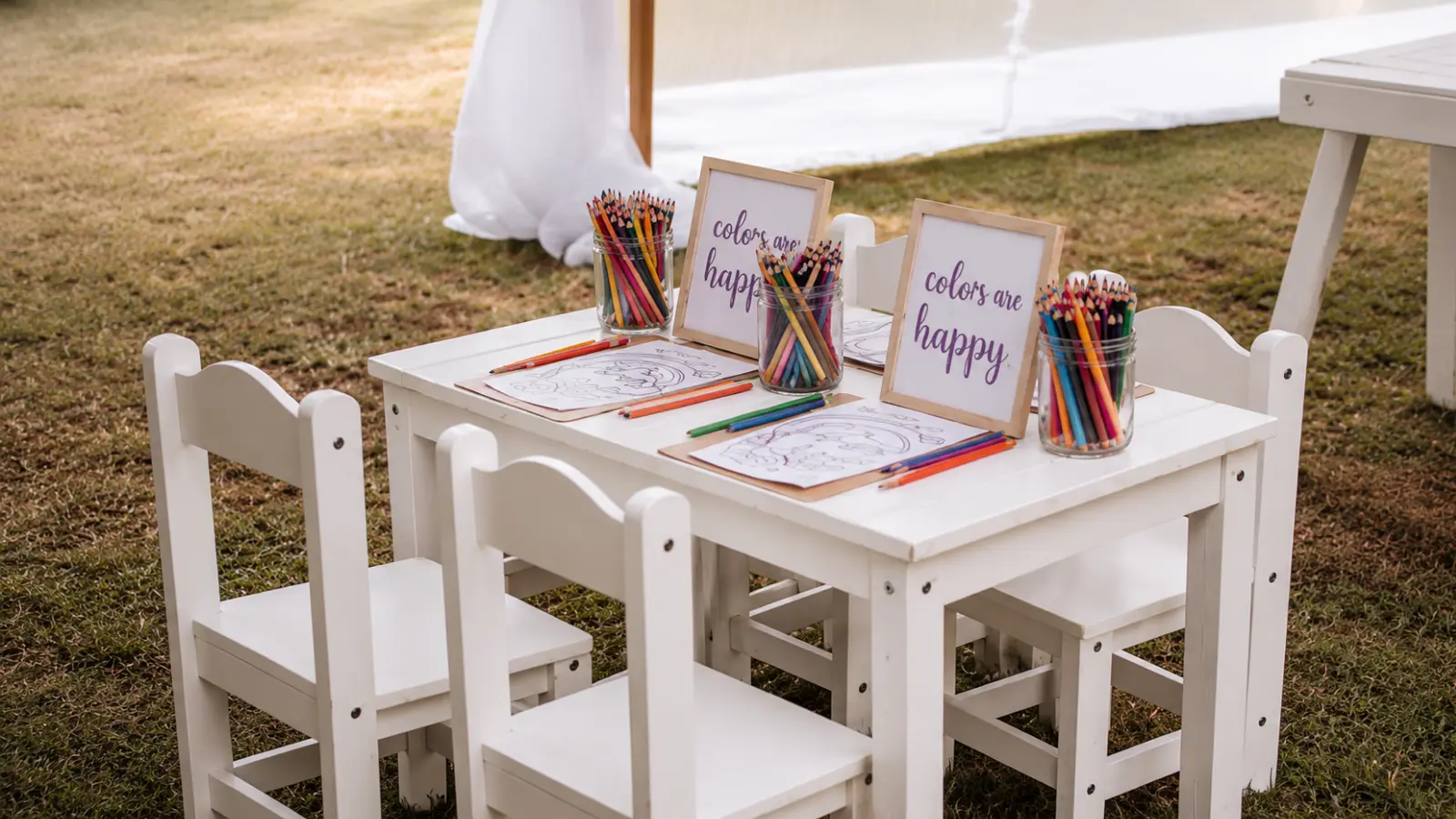
- Coloring sheets and crayons. Age-appropriate coloring pages — wedding themes, animals, simple patterns — keep children focused and quiet for stretches of fifteen to thirty minutes. Use thick crayons rather than markers if the table has a linen, and skip glitter or paint entirely.
- Sticker sheets and activity books. Sticker activities, dot-to-dot books, and simple mazes work well for the five-to-nine age range. They’re low-mess, self-contained, and genuinely engaging for this group.
- Small puzzles or quiet card games. For older kids at the table, a travel-size puzzle or a simple card game like Go Fish gives them something social to do once the coloring phase ends. Keep it simple and age-appropriate.
- Personalized activity packets. Some couples put together small packets for each child with their name on the cover — a few coloring pages, stickers, and a small activity. This is a nice personal touch and tends to get used because the child feels it was made for them specifically.
One thing worth noting: avoid activity kits with small pieces if any child at or near the table is under three. Choking hazards are not worth the setup, even if the toddler isn’t seated at the kids table — they wander. When in doubt, keep the activities paper-based and low-tech.
Kids Meals at the Table
Most caterers offer a children’s meal option at a reduced per-head cost, and it’s worth confirming this during your catering conversation. Simple, recognizable food — pasta with butter, grilled chicken, plain rice, fruit — works reliably across most age groups. Children at a wedding reception are often in an unfamiliar environment and may be more likely than usual to reject new foods, so plain and familiar is the practical choice.
A few things to coordinate with your caterer in advance:
- Confirm the exact number of children’s meals and their ages so portions are sized correctly.
- Flag any dietary needs, allergies, or restrictions for each child attending.
- Ask about timing — children’s meals can often be served slightly earlier than the adult entrées, which helps keep younger kids comfortable and reduces the wait.
- If any toddlers will be attending (even seated with parents), make sure soft-food options are available and that the catering team knows.
Cups with lids or spill-resistant options are worth requesting for the kids table if your venue allows it. Juice spills during dinner service are minor and very fixable, but they’re more fixable when they don’t land on a white tablecloth directly under a centerpiece.
Where to Place the Kids Table
Location matters more than most couples realize when they’re arranging the floor plan. A kids table that’s well-placed makes supervision easy, reduces disruptions, and lets parents relax at their own seats without craning their necks across the room. A kids table that’s buried in the center of the reception space, surrounded by other tables, makes every bathroom trip, every meltdown, and every check-in a disruption for the guests nearby.
The general principle: close enough for parents to see, with enough space that minor commotion doesn’t carry. Practical placement options that work in most venues include a corner of the room where the kids table forms its own defined zone, or a position along a wall adjacent to the parent tables. Avoid placing the kids table immediately next to the speakers, near the bar, or in the main path between the dance floor and the exit.
If your venue has a separate room or alcove and you have a sitter or childcare coordinator on-site, a kids area slightly removed from the main reception can work well for younger children — especially during speeches or later in the evening. This only functions if a responsible adult is there with them. A separate room without supervision is not a childcare solution; it’s a liability.
Supervision and Safety
The kids table needs an adult nearby. How formal that arrangement looks depends on the ages of the children and how many are seated there. For a table of three school-age cousins who know each other well and whose parents are at the next table, “nearby” might simply mean checking in every twenty minutes. For a kids table with five children ranging from five to ten, a designated adult — whether a family member, a hired babysitter, or a childcare coordinator — makes a meaningful difference.
A few practical notes on supervision:
- Avoid assigning one family member or guest to manage the kids table for the entire reception unless they have willingly agreed to that role. For older school-age children, parents seated nearby may be able to handle occasional check-ins. Younger children or larger groups may benefit from a dedicated babysitter or childcare coordinator so no wedding guest is unexpectedly responsible for childcare throughout the evening.
- A wedding babysitter or on-site childcare coordinator is the cleaner solution when children are younger or when the number of kids is large enough that parental check-ins won’t cover it. More detail on arranging that is in the wedding babysitter guide.
- Make sure the venue staff knows where the kids table is and that there are children in the room. Caterers, coordinators, and catering assistants who are aware of the kids table will move more carefully around it and check in proactively.
- Have a plan for when a child is done. Every child has a limit — an energy wall they hit where the evening stops working for them. Whether that means a parent takes them home, a sitter moves them to a quiet room, or they simply fall asleep in a corner is a family decision, but it should be a decision made in advance, not improvised at 9 p.m.
Safety also means thinking about the physical space around the kids table. Make sure it’s not near open flames (taper candles, for instance), directly adjacent to a busy server path, or positioned where chairs might be pulled out into foot traffic. Small practical details, easily overlooked during floor plan decisions, that are much easier to solve at the planning stage.
How to Seat Siblings and Cousins
The kids table works best when the children at it already have a relationship. Cousins who see each other regularly, siblings close in age, or friends from school are naturally going to manage a few hours together more comfortably than children who have never met. When you’re building the seating chart, think about the actual social dynamic of the children attending — not just their ages.
Siblings with a significant age gap can be tricky. A ten-year-old and a four-year-old sibling may have a close relationship, but their needs at a kids table are genuinely different. The ten-year-old wants to color and talk; the four-year-old may need to be fed, helped with a chair, or taken to the bathroom. Whether they sit together depends on whether a parent or sitter can bridge that gap — not just on whether they get along.
If you have children from multiple families who don’t know each other, consider how you can make introductions easier before the seating even begins. A simple activity already on the table when they arrive — a shared coloring sheet, a stack of sticker pages — gives children a social object to interact around, which is much easier than expecting them to introduce themselves to strangers and find common ground from scratch.
Mistakes to Avoid
Most kids table problems are predictable. These are the ones that come up most often and are entirely preventable with a bit of planning:
- Mixing ages that don’t belong together. A toddler, a nine-year-old, and a twelve-year-old at the same table serves none of them well. The age range determines what activities work, what food makes sense, and what supervision is needed. Try to keep the age spread at the kids table to roughly four to five years or less.
- Treating the kids table as a place to “put” children. Parents notice when the kids table is an afterthought — no activities, no thoughtful food, nowhere convenient for parents to check in. A kids table that functions as a real, considered part of the seating plan is a different experience than one that was added at the last minute because there weren’t enough seats at the adult tables.
- Not telling parents in advance. If you plan to seat children together separately, let parents know before the wedding. Some parents will be relieved; others may prefer to keep their child at the family table. Finding this out at the reception itself creates unnecessary tension.
- Leaving the activities until the last minute. Activity packets and coloring materials need to be assembled and placed before guests arrive. This is a detail that often gets pushed to the morning of the wedding and then forgotten entirely in the chaos of getting ready.
- Assuming the kids table will run itself. Children need at least one adult keeping an eye on them — not hovering, but present enough to handle a spill, a bathroom request, or an escalating disagreement before it becomes a disruption. Build that into the plan from the start.
The couples who get the kids table right are not the ones who spent the most on it — they’re the ones who thought it through early and communicated the plan clearly to the parents involved. That combination, more than any particular activity or decoration, is what makes the difference.
Kids Table at a Wedding Inspiration
Discover practical kids table at a wedding inspiration with age-appropriate seating ideas, coloring pages, activity packets, simple games, kids meals, table setup, and thoughtful reception details. Explore ideas for creating a comfortable space for school-age children while keeping parents nearby and making the wedding reception easier for everyone.
Is a Kids Table Right for Your Wedding?
A kids table works best when there are enough school-age children to make the table social, the activities match their ages, and parents or another responsible adult remain close enough to help when needed. It should make the reception easier for children and families, not simply move kids away from the adult tables.
If the children are too young, too far apart in age, or unfamiliar with one another, family seating may be the better choice. The right setup depends on the actual children attending, not on the idea that every wedding with kids needs a separate table.
Frequently asked questions (FAQ)
Should you have a kids table at a wedding?
A kids table works best when several school-age children are attending, especially if they already know each other and can sit independently. If only one or two children are attending, or most are babies and toddlers, seating them with their parents usually works better. Age, familiarity, and supervision matter more than simply having children on the guest list.
What age is appropriate for a kids table at a wedding?
School-age children around six to twelve are usually the best fit for a kids table, particularly when they know each other. Babies and toddlers should remain with their parents, while four- and five-year-olds may need closer supervision. Tweens can go either way, and teenagers generally prefer adult or peer seating.
What do you put on a kids table at a wedding?
Choose quiet, independent activities such as coloring pages, crayons, sticker sheets, activity books, and simple card games or puzzles. Keep everything age-appropriate and avoid messy materials or small pieces around younger children. The goal is to keep children comfortably occupied during dinner and speeches without requiring constant adult help.
Where should the kids table be placed at a wedding reception?
Place it close enough for parents to see and check on their children without putting the table in heavy foot traffic. A wall or corner near the parent tables often works well. Avoid locations beside speakers, the bar, open flames, or busy routes between the dance floor, tables, and exits.
Who should supervise the kids table at a wedding?
The level of supervision depends on the children’s ages and maturity. Older school-age children may only need parents seated nearby and regular check-ins, while younger or larger groups benefit from a wedding babysitter or childcare coordinator. Avoid assigning a family member who is also attending as a guest to supervise the table for the entire reception.
Should teens sit at the kids table at a wedding?
Generally, no. Teenagers usually feel more comfortable being seated like young adults rather than grouped with younger children. Seat them with adults they know, with cousins or friends close to their age, or at a small peer table if several teens are attending. Tweens around eleven or twelve may prefer either arrangement depending on the group.