
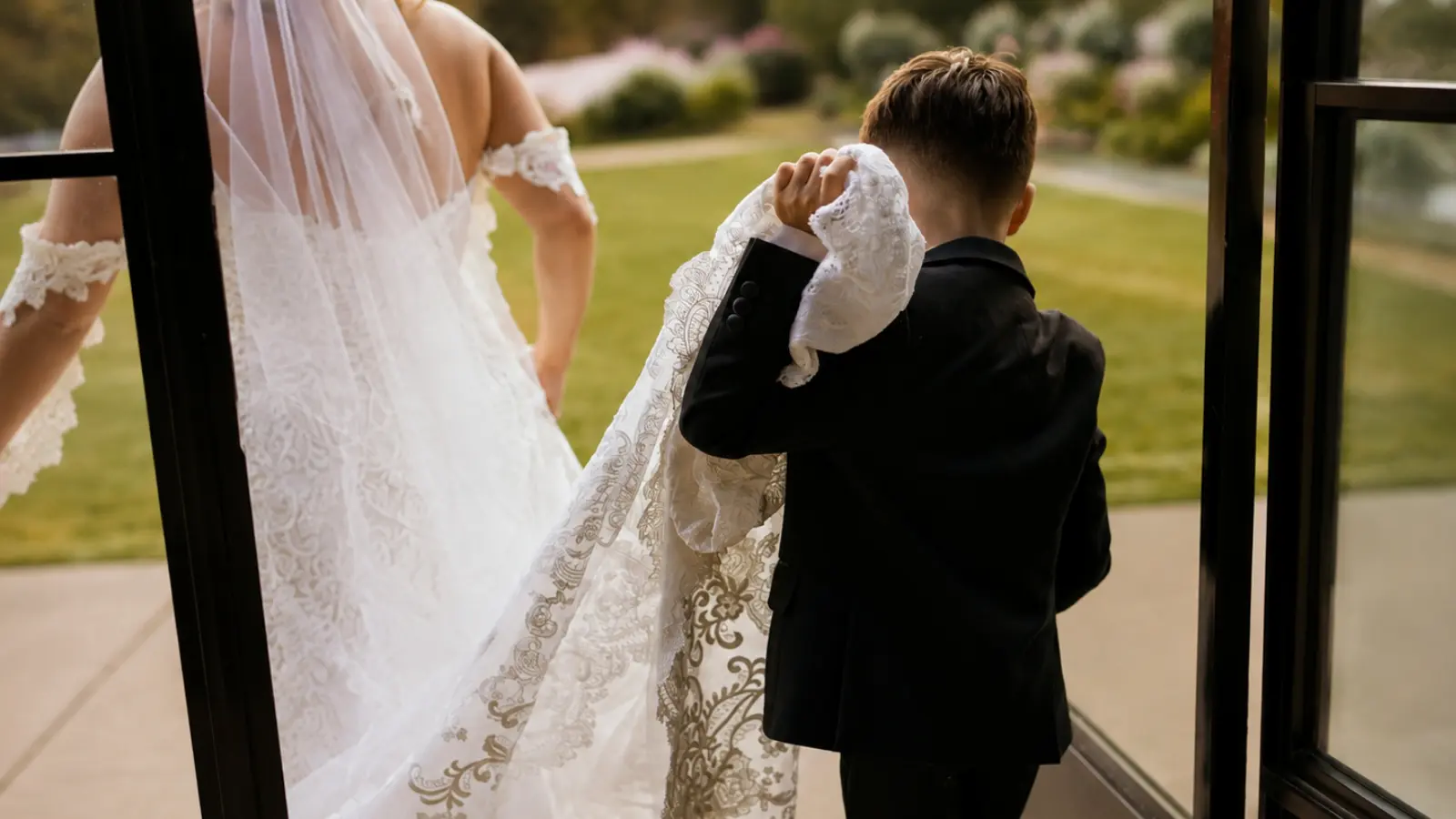
A page boy is a young wedding attendant who takes part in the processional and may carry the bride’s train, hold a ceremonial item, carry or represent the rings, or simply walk with the wedding party. The role is most closely associated with British and European wedding traditions.
In American weddings, a similar role is usually called the ring bearer. The two terms overlap considerably, although their traditions are not completely identical: historically, a page boy had a broader ceremonial role, while the ring bearer is specifically associated with the wedding rings.
This guide explains what a page boy is and how the role works, including duties, typical age, outfits, shoes, toddler options, carrying the rings, how page boys compare with ring bearers, and how to include the role naturally in an American wedding.
What Is a Page Boy?
The page boy is one of the oldest roles in the wedding party. The word “page” comes from the historical role of a young male attendant serving a noble household. In wedding tradition, page boys became associated with ceremonial duties such as accompanying the procession and helping with the bride’s train.
Today, the role has shed most of that original function. Wedding gowns still sometimes have trains, but modern fabrics and construction mean most brides manage them without a child’s help. What remained is the ceremonial presence: a young boy dressed formally, walking ahead of the bride, included in the processional as a member of the wedding party. His duties shifted from practical to symbolic, and the role became what it largely is now — a meaningful way to include a young male relative in a ceremony that otherwise has no natural place for him.
The page boy is most at home in British and European wedding tradition, where the role has clear etiquette and a defined place in the processional order. In American weddings, the same child — and the same general idea — goes by a different name.
Page Boy vs. Ring Bearer
The question couples ask most often about this role is whether a page boy and a ring bearer are the same thing. The honest answer is: in modern weddings, mostly yes. The roles overlap significantly in function — both are young boys who walk in the processional and have a small ceremonial job — but they come from different traditions and carry different expectations depending on where you look.
The table below lays out the key distinctions:
| Role | More Common In | What He Usually Does |
|---|---|---|
| Page Boy | UK and traditional European weddings | Walks in processional, may carry train, hold a sign, carry rings, or scatter petals |
| Ring Bearer | US weddings | Carries a pillow, box, or item symbolizing the wedding rings; walks ahead of the bride |
One distinction worth knowing is that the page boy role can be broader than the ring bearer role. A page boy might carry the train, carry or represent the rings, hold a sign, or simply walk in the processional, while a ring bearer is more specifically associated with the wedding rings. In American usage, the ring bearer is the standard term and encompasses all of that.
What Does a Page Boy Do?
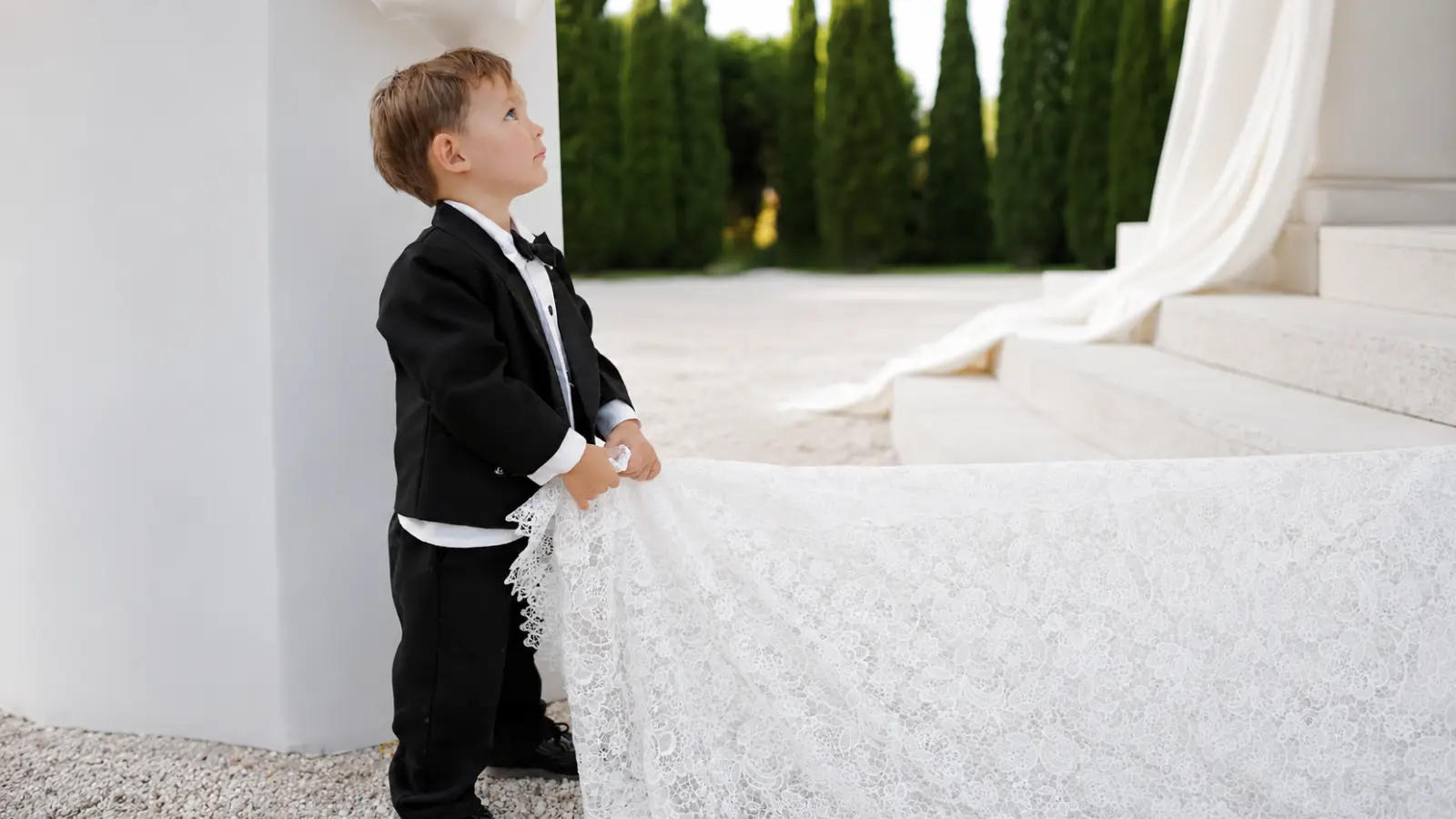
The page boy’s duties are ceremonial rather than logistical, which is appropriate given that most page boys are between three and eight years old. What he is actually asked to do on the wedding day should reflect both what the couple wants and what the child is realistically capable of.
The most common page boy duties are simple: he walks in the processional, usually just ahead of the bride, alongside the flower girl or as the last child to enter before her. He may carry a ring bearer pillow or box, hold a small wooden sign, or simply walk with his hands free. When he reaches the front, he either sits with his family or, for older and more confident children, stands near the wedding party for a portion of the ceremony.
In weddings where the bride has a long, structured train, a page boy may genuinely help carry it — though this is more common at formal British ceremonies than at American ones. Other variations include carrying a basket of petals (a job usually assigned to the flower girl, but sometimes shared), holding a lantern or candle at an evening ceremony, or carrying a “Here Comes the Bride” sign that has become popular in recent years. The specific job matters less than giving him something clear and manageable to do.
Page Boy Age
The typical age range for a page boy is three to eight years old, and the same logic applies here as it does to ring bearer age: children in that window can follow a simple instruction, walk independently, and understand that they have been given something important to do. Children under three can participate but generally need an adult alongside them, and the expectations for their performance should be adjusted accordingly.
At the older end — nine, ten, and above — many boys start to feel self-conscious in the page boy role. The small suit, the ceremonial pillow, and the position as the youngest person in the processional can feel awkward to a child who is old enough to be aware of how it looks. For those children, a junior groomsman role often fits better: the same ceremonial presence, with a slightly more grown-up frame around it.
The right age is ultimately less about the number and more about the specific child. A confident, outgoing six-year-old will handle the role differently than a shy five-year-old, and the preparation and support you offer should account for that difference.
Page Boys in American Weddings
American couples do use the term page boy, but it is not the dominant one. Most of the time, when an American bride is searching for how to include a young boy in her wedding party, she is looking for information about the ring bearer — and that is the term her vendors, wedding planner, and guests will recognize without explanation.
Page boy tends to appear in American wedding planning in a few specific situations: couples with British family connections who want to honor that tradition; brides who prefer the aesthetic of a more formal, European-style ceremony; and couples who have multiple young boys and want to use different titles to differentiate the roles. None of those are wrong reasons to use the term. It is simply worth knowing that in the American context, page boy is an understood but non-standard choice — and if you use it in correspondence with vendors, a brief note that it is your version of the ring bearer role will save confusion.
Can a Page Boy Carry the Rings?
Yes, though this decision should be driven by his age and reliability, not by the title you give him. For young children, decorative or replica rings are often the lower-risk choice, while the actual wedding rings remain with the best man or another trusted adult until they are needed. A three-year-old carrying real rings on a pillow down a long aisle is a tension most couples do not need on their wedding day.
For older children who are genuinely ready for the responsibility, carrying the real rings is fine — provided they are secured to the pillow with ribbon or thread, and a designated adult is tracking their location from the moment they are placed there. The meaningful moment is the walk, not whether the metal on the pillow is real. Guests will not know the difference, and the couple will be calmer for it.
What a Page Boy Wears
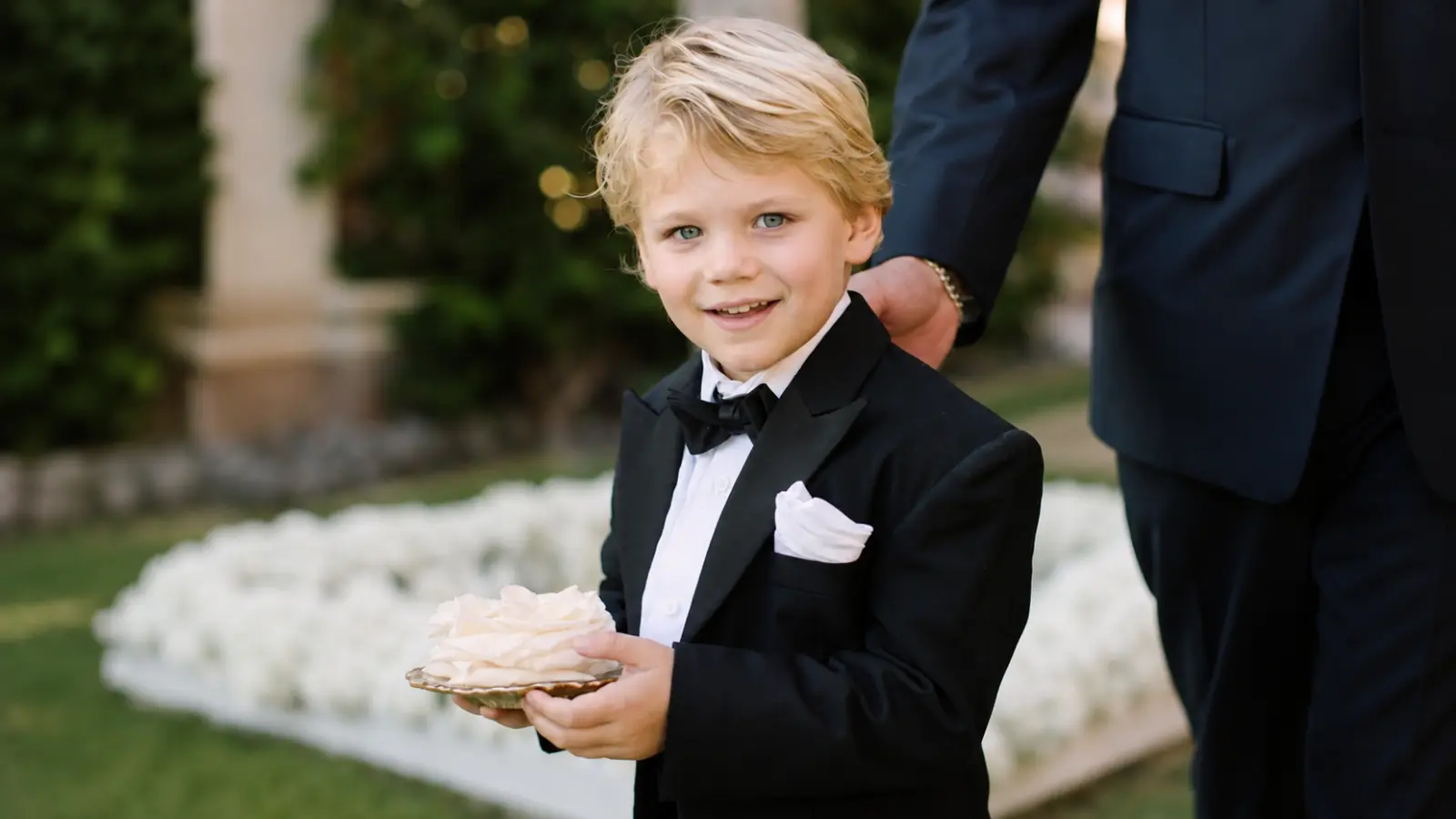
The general principle for dressing a page boy is that he should look like a smaller version of the wedding party — coordinated enough to clearly belong in the processional, without an outfit so formal or restrictive that he is miserable by the time the ceremony starts. That second part tends to get underweighted in the planning stages and overweighted on the actual day.
In practice, most page boys follow the same general principles as a ring bearer outfit: a suit or dressed-up separates in a color that complements the wedding palette. Common choices include navy, charcoal gray, ivory, and soft neutrals like sand or sage — whatever echoes the tone of the male wedding party without being a perfect match. A dress shirt with a tie or bow tie, dress pants or shorts depending on the formality and season, and dress shoes complete the look. The bow tie, in particular, is a reliable choice for younger children: it can be clip-on, it photographs well, and it avoids the neck-constriction problem that comes with a full necktie on a four-year-old.
Whatever he wears, he should wear it — or at least the shoes and the shirt — at least once before the wedding day. A child who has never worn dress shoes is a child who will spend the processional walk focused on how much his feet hurt.
Suits and Formal Options
For more formal weddings, a proper suit is the appropriate choice: a matching jacket and trousers, a dress shirt, and a tie or bow tie. The suit does not need to be a miniature version of the groomsmen’s exact outfit, but it should read as part of the same visual family. Navy suits pair well with gray or charcoal groomsmen; gray suits coordinate with charcoal or navy. Ivory and cream suits work well at garden, beach, and outdoor ceremonies.
A few things worth knowing about suits for young children:
- Linen suits are a practical option for outdoor or warm-weather ceremonies. They are cooler, more comfortable, and generally more forgiving on a child who is running around before the ceremony.
- Suspender sets — dress pants or shorts with suspenders and a button-down shirt — offer the look of a suit with more flexibility and ease of movement. They photograph well and are a popular choice for toddlers and younger children.
- Three-piece sets that include a vest add formality without requiring a full jacket on a warm day. The vest can be removed after the ceremony if the child is uncomfortable.
- Shorts suits are appropriate for daytime, outdoor, and beach ceremonies, and they work particularly well on younger children who find full-length trousers restrictive.
Wherever you shop — department stores carry boys’ suits in classic colors, specialty children’s formalwear shops offer more tailored options, and Etsy has a wide range of custom linen and heirloom-style sets — order with enough lead time to size correctly and make any alterations before the day. Children grow quickly, and a suit ordered four months out may not fit the same child three weeks before the wedding.
Shoes for a Page Boy
Shoes are where page boy outfit planning most often goes sideways. The temptation is to find something that matches the rest of the outfit perfectly; the practical priority is finding something the child will actually wear without protest for several hours.
For most children, the right shoe is a simple leather or leather-look oxford or loafer in black or brown. Black works with most formal suits; brown or tan reads well with lighter-colored and linen outfits. For toddlers and very young children, soft-soled dress shoes are a more comfortable option and are easier to walk in on uneven surfaces like grass or gravel. Avoid stiff, brand-new shoes worn for the first time on the wedding day — a child who is focused on his feet is a child who is not focused on walking down the aisle.
Breaking the shoes in with a few wears before the wedding, including one walk on the actual surface if possible, makes a meaningful difference.
Outfits for Toddler Page Boys
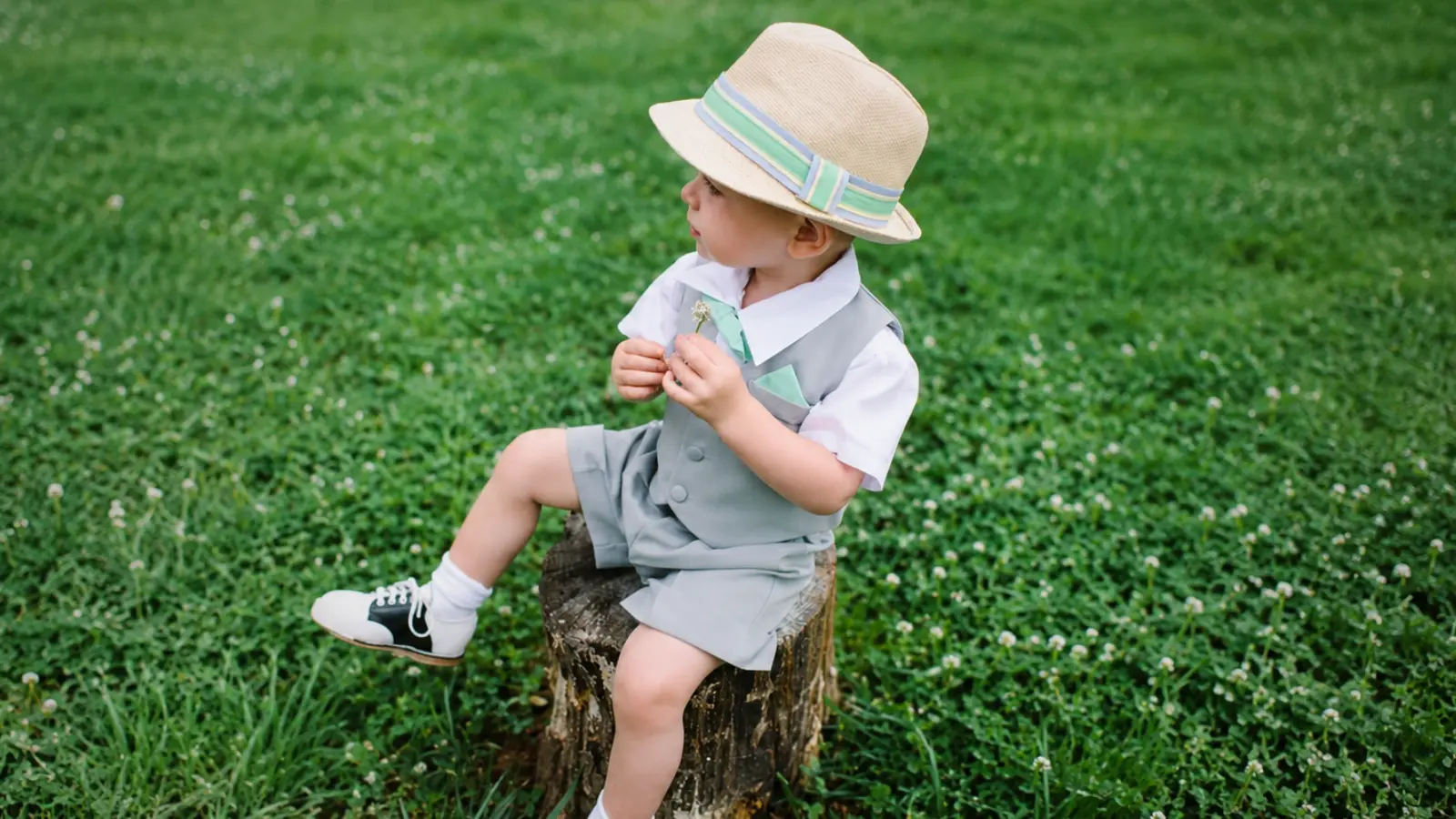
Dressing a toddler for a wedding requires a different set of priorities than dressing an older child. Comfort and ease of movement come before formality, not because toddlers do not look adorable in tiny suits (they do), but because a toddler who is uncomfortable will let everyone know about it at the most photogenic moment of the ceremony.
Options that work well for toddler page boys and ring bearers include cotton or linen suspender sets, soft-fabric rompers styled to look formal, and simple dress pants with a button-down shirt and bow tie. These give the polished look of a suit without the restrictions. For very young children — under eighteen months — a tuxedo-style romper with a clip-on bow tie is a practical choice that holds up through a long day and handles diaper changes without requiring a full costume change.
For toddlers specifically, it also helps to have a backup outfit on hand. Spills happen. A second shirt at minimum is a reasonable precaution that costs almost nothing in preparation and can save significant stress on the day.
How to Include a Page Boy Naturally
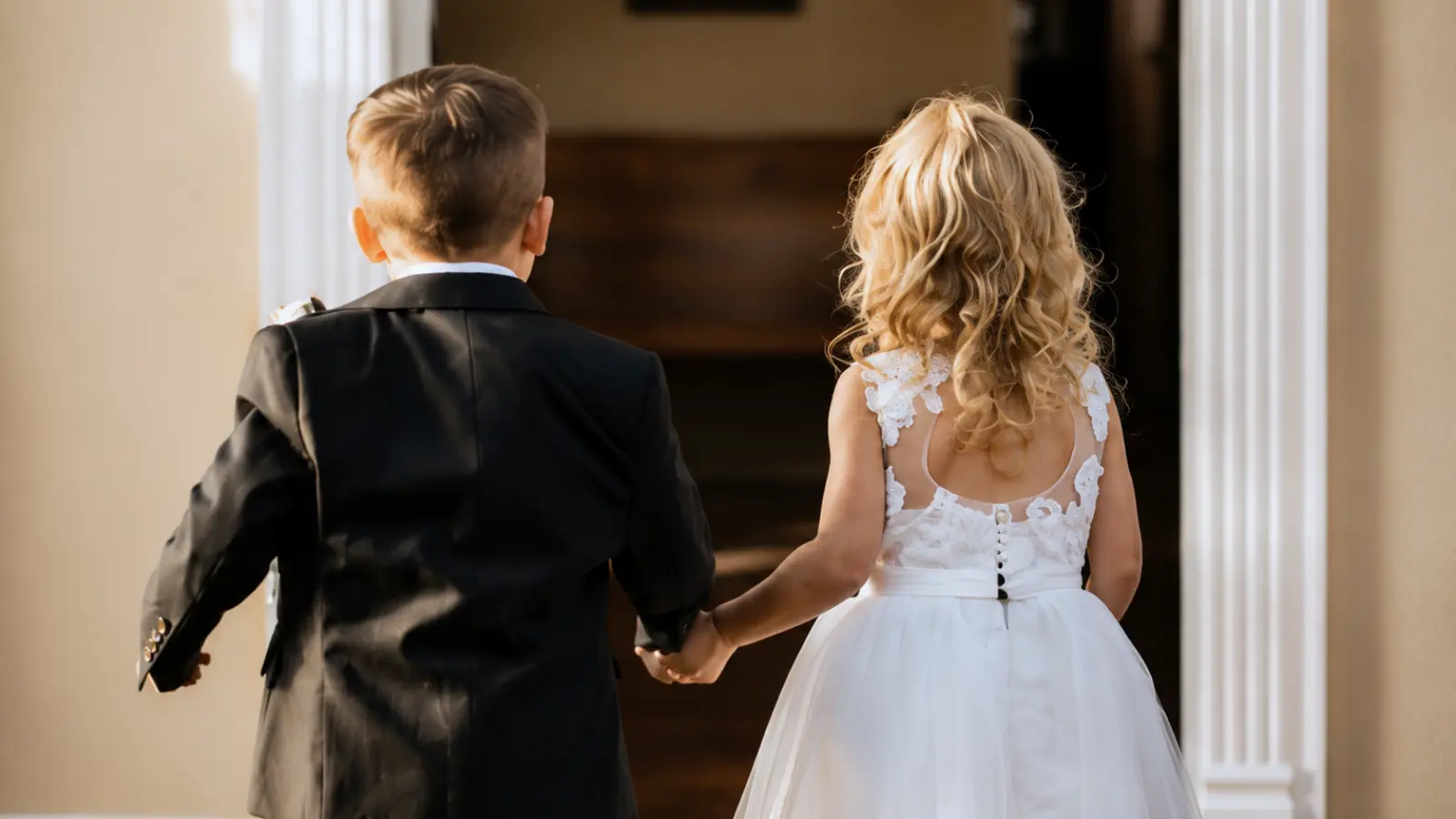
The page boy role works best when it is designed around the specific child, not built to fit a template. A confident seven-year-old who loves performing can handle walking alone and carrying a pillow; a shy four-year-old with a tendency to freeze in crowds needs different support. The mechanics of the role should follow from who the child actually is.
A few things that help regardless of age or temperament:
- Talk to his parents first. Before asking the child, confirm with his parents that they are on board, that they understand what the role involves, and that they can manage the logistics of the outfit and the rehearsal. This is the step most couples skip, and it causes most of the last-minute problems.
- Walk the aisle at the rehearsal. A child who has walked the space once, knows who he is walking toward, and understands where he is going afterward is categorically more prepared than one hearing about it for the first time when the music starts.
- Give him a specific person to walk toward. “Walk to Grandpa at the front” is more grounding than “walk to the altar.” A familiar face and a clear destination reduce the overwhelm of the moment significantly.
- Have a backup adult positioned and ready. Decide in advance who steps in quietly if the child hesitates, and make sure that person knows their role before the ceremony begins.
The couples who navigate this role most gracefully are the ones who planned the details carefully and then held the expectations loosely. Children are unpredictable in front of crowds, and the most memorable processional moments — the ones that get retold at every family gathering for years — are rarely the ones that went perfectly according to plan.
Page Boy Wedding Inspiration
Explore page boy ideas, outfits, suits, toddler looks, processional inspiration, and traditional ways to include a young boy in your wedding ceremony.
How Should a Page Boy Fit Into Your Wedding?
Whether you call him a page boy or a ring bearer, the best approach is to shape the role around the child rather than the title. Decide what he will do, choose an outfit he can comfortably wear, and make the processional simple enough for him to understand.
If you are planning an American wedding, ring bearer will usually be the more familiar term, while page boy can still make sense for couples drawing from British or European traditions. What matters most is giving the child a clear, manageable role that feels natural within your ceremony.
Frequently asked questions (FAQ)
What is a page boy at a wedding?
A page boy is a young male wedding attendant who walks in the processional and may carry the bride’s train, the rings, a sign, or another ceremonial item. The role is most associated with British and European wedding traditions. In American weddings, a similar child is usually called the ring bearer.
What is the difference between a page boy and a ring bearer?
The main difference is tradition and terminology. Page boy is the more common British and European term, while ring bearer is standard in American weddings. A page boy can have several ceremonial duties, including carrying the bride’s train, while a ring bearer is more specifically associated with carrying or representing the wedding rings.
What does a page boy do at a wedding?
A page boy usually walks near the end of the processional, often just before the bride or alongside the flower girl. He may carry the rings, a sign, or the bride’s train, or simply walk as part of the wedding party. The exact role should be simple and appropriate for the child’s age.
What age should a page boy be?
Most page boys are around three to eight years old. Children under three can still participate with an adult escort, while boys around nine or older may feel more comfortable as junior groomsmen. Temperament and confidence matter just as much as the child’s exact age.
What should a page boy wear?
A page boy typically wears a suit or dressy separates coordinated with the male wedding party. A dress shirt, trousers or tailored shorts, bow tie, and comfortable dress shoes can all work depending on the wedding’s formality. For toddlers and young children, prioritize soft fabrics, easy movement, and shoes they have already worn.
Do American weddings have page boys?
Yes, although the term is less common in the United States. American couples usually call the role ring bearer, and that is the term most vendors and guests will immediately recognize. Page boy still works, especially for couples with British roots or a more traditional European-style ceremony.