
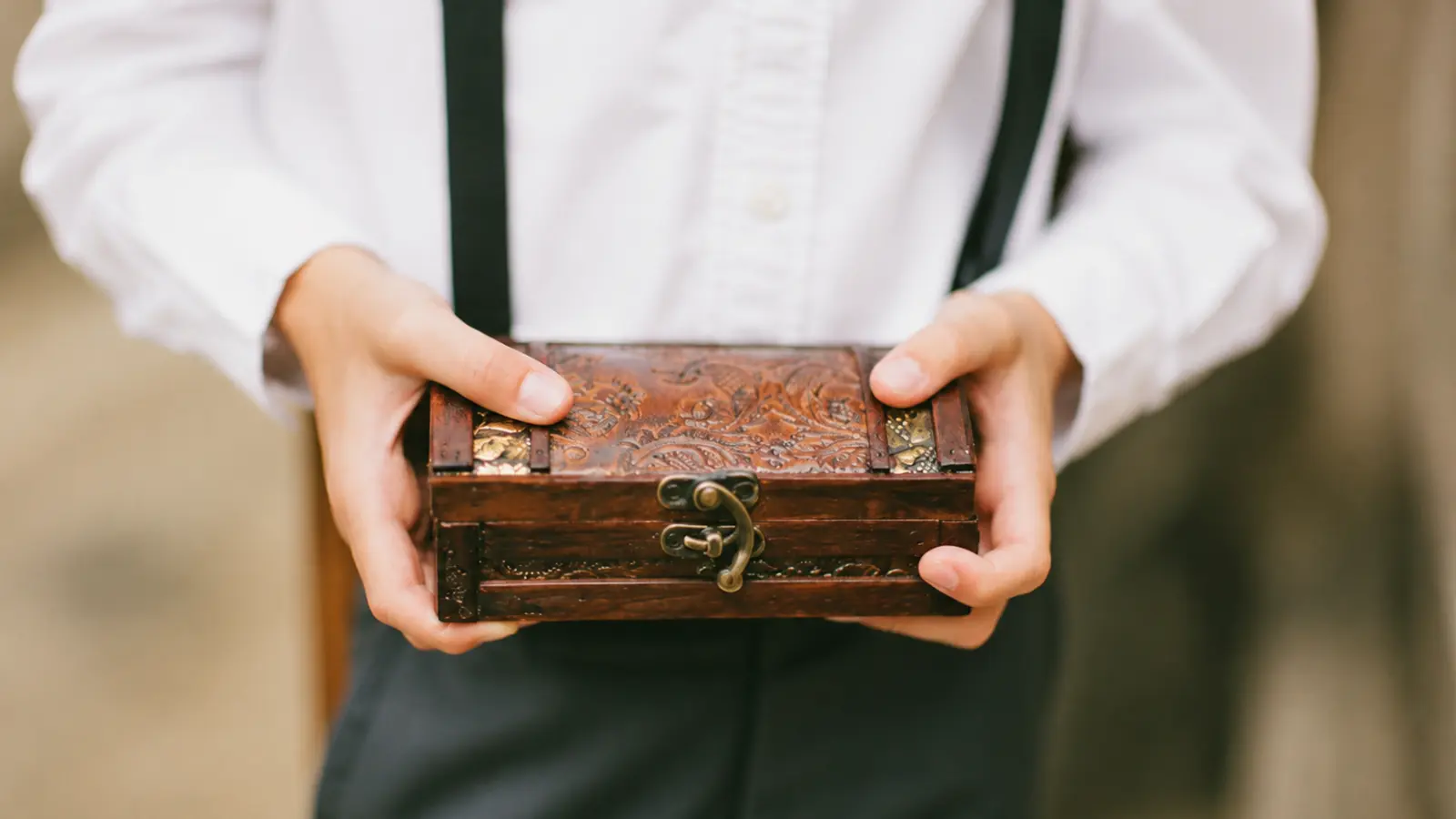
A ring bearer pillow and box are two of the most common ways to carry or represent the wedding rings during the processional, but neither option is required. The best choice depends on the child’s age, how the rings will be secured, and the style of the ceremony.
A traditional pillow can work beautifully for a classic wedding, while a small ring box may be easier for a child to hold and keep level. Signs, books, pouches, dishes, and other alternatives can also work when they fit the wedding and the way the ring bearer will actually participate.
This guide compares ring bearer pillow and box options, including sizing, ring security, real versus decorative rings, alternative carriers, wedding styles, age considerations, and the practical details that make each option easier to manage on the wedding day.
Does the Ring Bearer Have to Carry a Pillow?
No. The pillow is traditional, and for a traditional wedding it remains a natural, beautiful choice. But tradition is not obligation, and the pillow is one of the most commonly defaulted-to decisions in wedding planning — chosen not because it is the right fit for the wedding, but because it is the first thing that comes to mind.
A ring bearer box, a small wooden chest, a decorative sign, a hardcover book with a ring slot, a velvet pouch, a ring dish, or even a fully symbolic entry with no carrier at all can all serve the same purpose. The right choice depends on three things: how old the ring bearer is, whether the rings inside are real or decorative, and what look and feel fits the ceremony. A formal church wedding with a seven-year-old carrying a white satin pillow is exactly right. A casual outdoor ceremony with a toddler holding a miniature painted briefcase is also exactly right. The pillow is one answer, not the answer.
What follows is a breakdown of every major option — starting with the pillow — so the decision can be made deliberately rather than by default.
The Traditional Ring Bearer Pillow
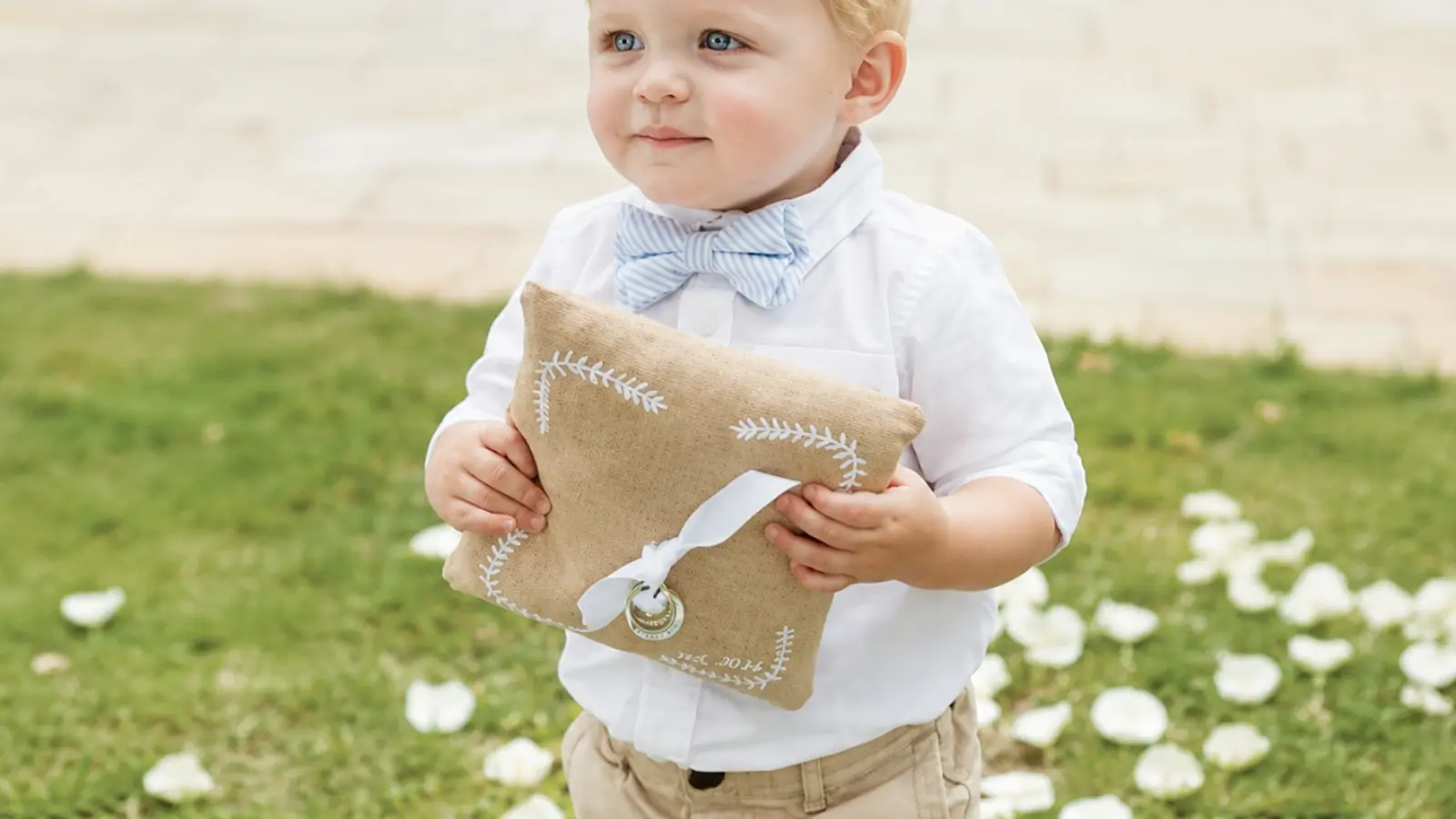
The ring bearer pillow has been a fixture of American wedding ceremonies for generations, and its staying power is not without reason. It is visually recognizable, easy to source in almost any color or fabric, and flexible enough to work across a wide range of wedding styles — from formal church ceremonies to outdoor garden weddings. When a guest sees a small boy walking down the aisle with a white pillow, the moment reads immediately.
Pillow materials vary more than the classic image suggests. Satin and silk are the most traditional and photograph well in formal lighting. Cotton and linen options have become popular for more relaxed or rustic ceremonies. Velvet adds texture and richness for fall and winter weddings. Personalized pillows — embroidered with the couple’s initials, wedding date, or a short phrase — are widely available and add a detail that can later become a keepsake.
The main practical limitation of the pillow is that it requires the child to walk with two hands held relatively level, which is more coordination than some young ring bearers can reliably manage under the pressure of a real ceremony. For a confident six-year-old, that is not a concern. For a three-year-old who is already managing the walk itself, a pillow that tilts and slides becomes one more variable in an already unpredictable situation.
How Big Should the Pillow Be?
The most practical size for most ring bearer pillows is somewhere between six and ten inches square. That range is large enough to look proportional in photographs — a very small pillow can disappear visually — and manageable enough for a child to hold with both hands without the rings shifting.
For toddlers and very young ring bearers, err toward the smaller end of that range. A lighter, smaller pillow is easier to carry and less likely to become an object of distraction. For older ring bearers carrying the real rings, a slightly larger pillow provides more surface area for secure fastening and photographs with more presence.
Avoid pillows that are very thick, heavily structured, or difficult to grip from below. A child who has to concentrate on holding an awkward object is a child who is not concentrating on walking. The pillow should feel natural in his hands at the rehearsal — if it does not, adjust before the ceremony day.
How to Secure the Rings
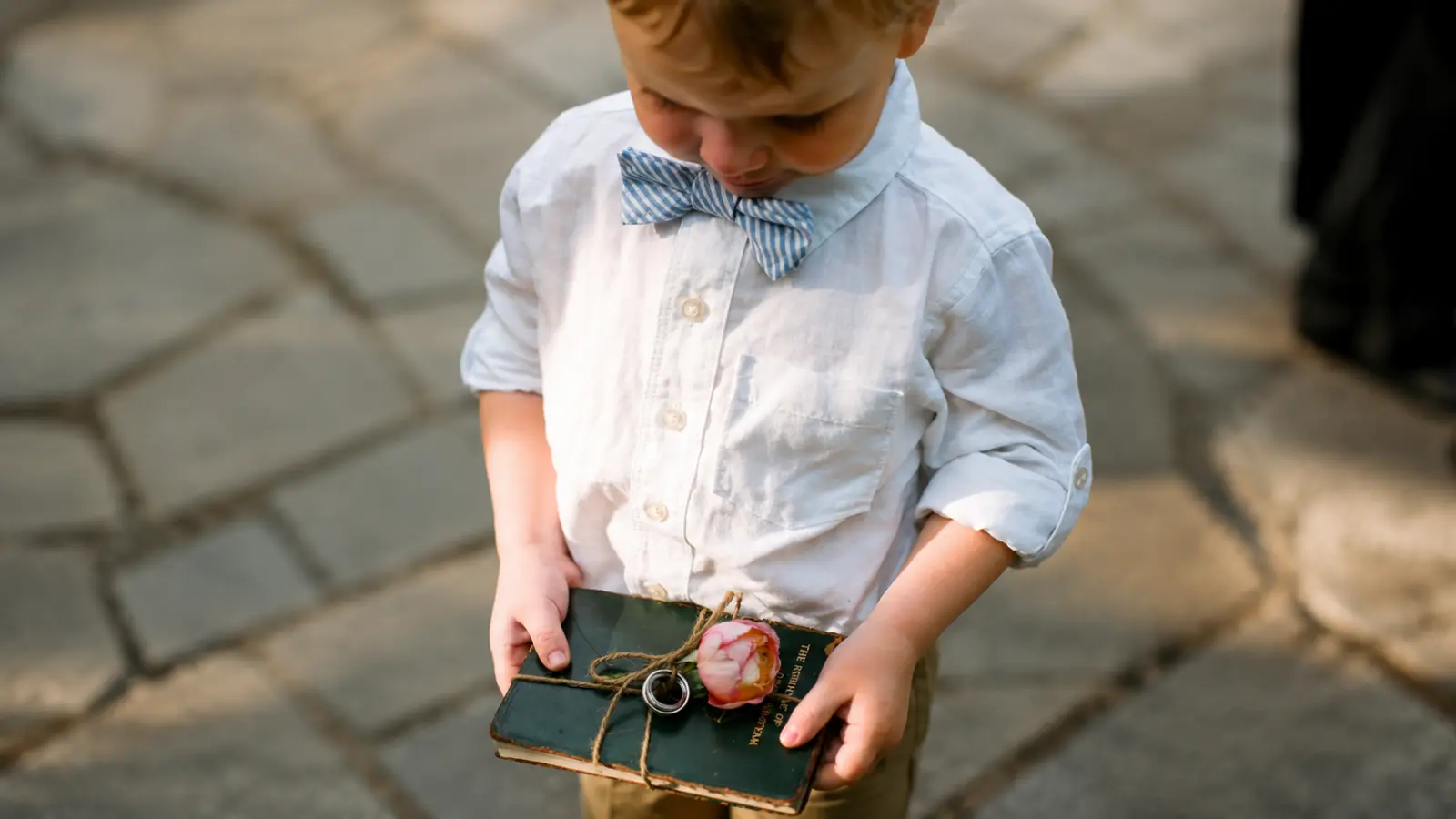
This is the detail that causes the most preventable problems, and it deserves more attention than it typically gets. Rings placed on top of a satin pillow without any fastening will move, tilt, and fall — satin is designed to be slippery, and a pillow carried by a child in motion is rarely perfectly horizontal. Whatever method is used, it should be tested before the rehearsal, not figured out on the day.
The most reliable approach is a ribbon or twine loop. A short loop of ribbon is sewn or attached at the center of the pillow, threaded through each ring, and tied in a simple bow. The bow should be tight enough that the rings stay in place during the walk, but loose enough that the officiant or best man can untie it at the altar without a prolonged pause. Test the bow with the actual rings — or rings of the same size — before the ceremony.
A few alternatives that also work well:
- Button and loop. A small fabric loop or elastic band attached to the pillow surface holds each ring individually. More secure than ribbon, and does not require tying at the altar if the rings are lifted out rather than untied.
- Hook or pin. A small decorative hook or pin can hold rings without ribbon if the pillow fabric and construction allow for it. Less common but effective when executed cleanly.
- Snap or magnetic closure. Some modern carriers use small snap or magnetic closures to keep a ring compartment or holder securely closed during the processional.
Whatever method is chosen, the person receiving the pillow at the altar — the best man, the officiant, or a designated adult — should understand the ring bearer duties involved in the handoff and know how the rings are secured and released. An improvised attempt to untie a knot in front of a full room during the ceremony is one of the more awkward pauses a wedding can produce.
Real Rings vs. Decorative Rings
Whether the ring bearer carries the actual wedding rings or decorative stand-ins is a decision worth making deliberately, because the right answer changes depending on the child’s age and the couple’s comfort with the associated risk.
For young ring bearers, decorative rings are often the lower-risk choice, with the real rings held by the best man or another trusted adult until they are needed. This is not a commentary on the child’s character — it is an honest accounting of what a young child can reliably manage. The real rings are small, valuable, and emotionally significant, and a dropped ring on a marble aisle, a beach, or a thick carpet with gaps can become a genuine logistical problem during the ceremony. Decorative rings look identical in photographs and on camera, and the moment at the altar is unchanged.
For an older, reliable ring bearer, carrying the real rings may be reasonable, provided they are securely fastened to the carrier and a designated adult keeps track of them before the processional. The child should be told clearly what he is carrying. At that age, the weight of the responsibility usually produces more care, not more anxiety.
When decorative rings are used, the best man presents the real rings to the officiant when the ceremony calls for them, and no explanation to guests is necessary. The ritual moment at the altar looks the same either way.
The Ring Bearer Box
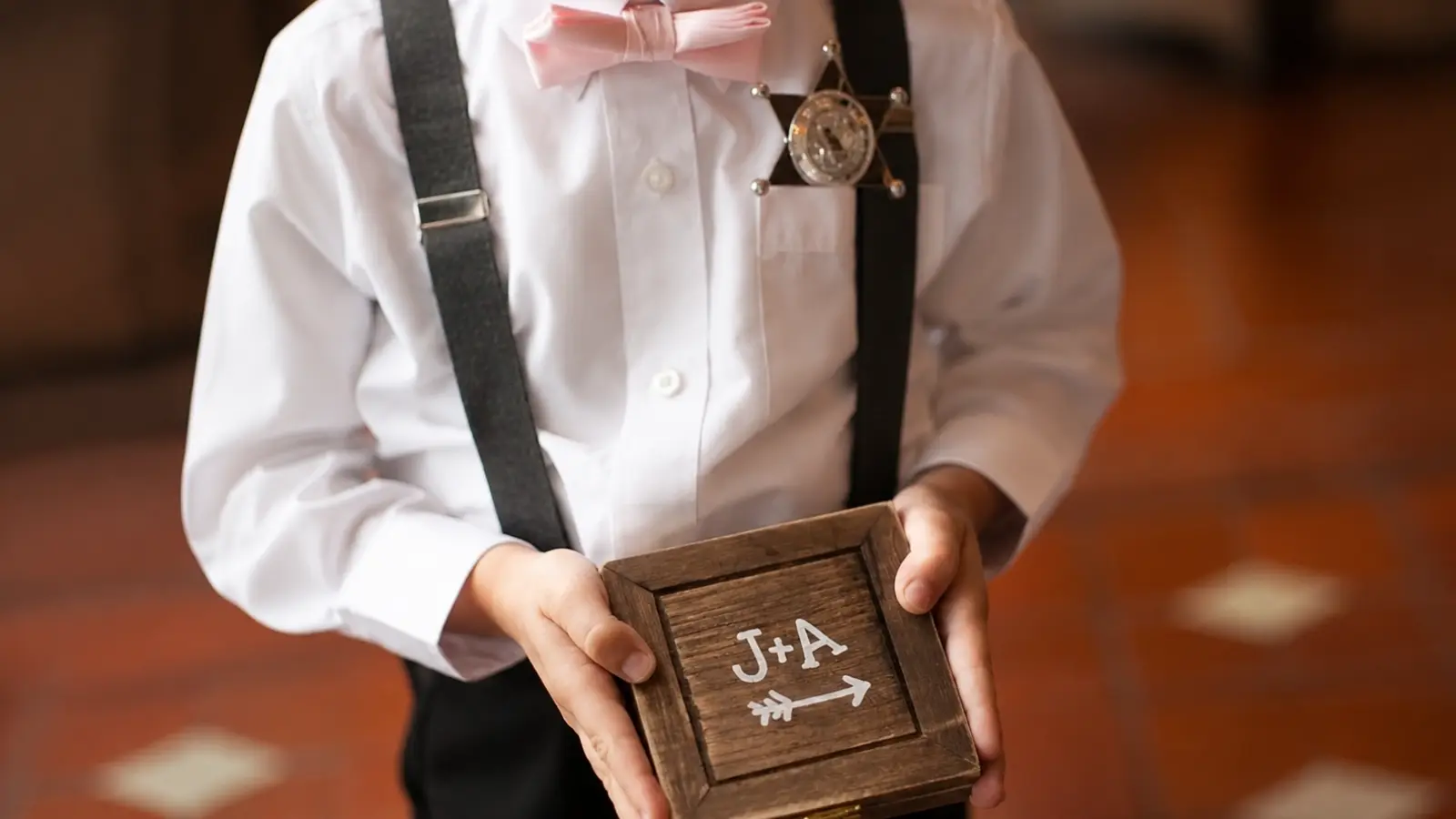
The ring bearer box has become one of the most popular alternatives to the traditional pillow, and for practical reasons. A box is easier for a child to hold — it has a defined grip, does not tilt the way a flat pillow does, and keeps the rings contained rather than exposed. The hinged lid also adds a small moment at the altar: the officiant or best man opens the box to retrieve the rings, which gives the handoff a slightly more ceremonial quality.
Box materials range widely. Wooden boxes — particularly light-stained or natural wood — are a strong choice for rustic, garden, and outdoor weddings. Painted or lacquered boxes work for classic and formal ceremonies. Acrylic or lucite boxes have a modern, minimal quality that suits contemporary wedding aesthetics. Fabric-covered or velvet-lined boxes can bridge the gap between the box format and the softness of the traditional pillow.
Personalization is easy and popular with boxes: initials, a wedding date, or a short phrase engraved or laser-cut into a wooden lid is a detail that reads as thoughtful rather than promotional. A personalized box can also function as a keepsake after the ceremony in a way that a pillow typically does not.
The interior of the box matters as much as the exterior. Rings should rest in a lined ring groove, a cushioned slot, or a fitted interior — not loose in an open cavity where they can slide or knock together. If the box being considered does not have a secure interior ring holder, a small piece of foam or felt cut to size can be added before the ceremony to keep the rings in place.
Other Alternatives Worth Considering
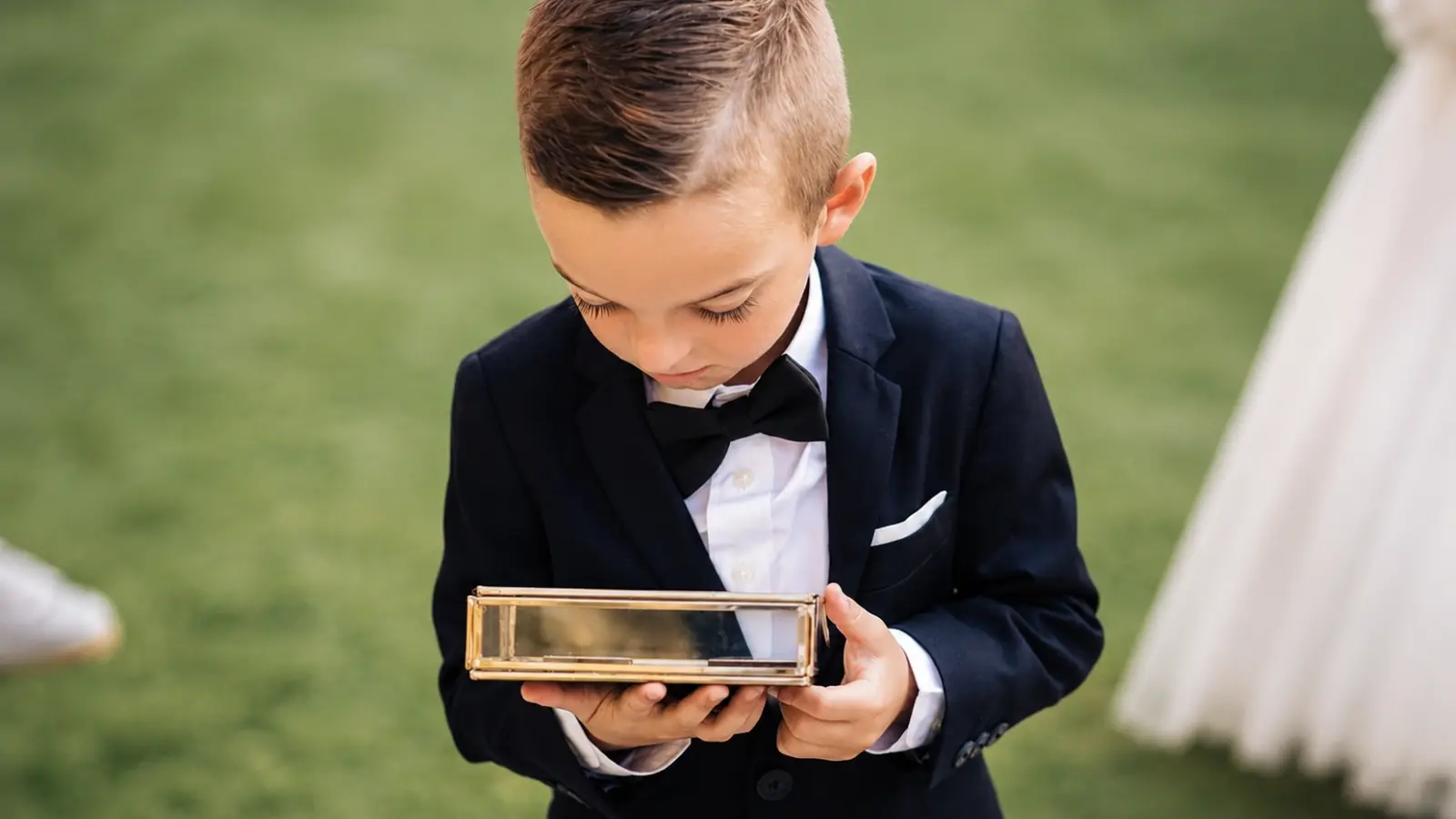
Beyond the pillow and the box, couples looking for creative ring bearer ideas have several other options worth considering when neither the traditional nor the modern standard feels right for the specific wedding.
A decorative sign is the most relaxed option and works best for informal and casual weddings where the overall tone supports some lightness. Signs reading “Here come the rings,” “Last chance to run,” or simply “The Rings” are the most common choices. The sign works well for very young ring bearers who would struggle with a pillow or box, and for ceremonies where the real rings are held separately by the best man. It is not the right choice for a formal or traditional ceremony, where a sign can feel more like a photo prop than a processional element.
A hardcover book with a ring slot falls between a box and a pillow in terms of formality. A hollowed or modified book — or a purpose-made book box — with a velvet or felt interior holding the rings looks elegant and photographs well. It works particularly well for literary-themed weddings or any ceremony where a slightly unexpected choice reads as personal rather than random.
A velvet or fabric pouch is a simple, understated option. The rings are placed inside, the pouch is tied, and the ring bearer carries it in his hands or has it attached to the pillow by a ribbon. It works best as a secondary carrier — a pillow with the pouch resting on top, for instance — rather than as a standalone object. A pouch on its own can read as underdeveloped in a formal ceremony context.
A miniature chest or trunk is a more playful variation on the box, with a slightly larger form factor and more personality. It suits nautical, rustic, or adventure-themed weddings and tends to photograph with a lot of presence. Because it is larger than a standard ring box, it works better for older ring bearers who can manage the grip.
A ring dish or tray — typically ceramic, wooden, or acrylic — can work in a processional when the ring bearer is older and reliable enough to carry something flat and open. It photographs beautifully and has a minimalist elegance, but the open surface requires rings to be secured the same way a pillow does. It is not recommended for young or toddler ring bearers for this reason.
Choosing by Wedding Style
The carrier should feel like it belongs to the wedding, not like a separate aesthetic decision. When the carrier is consistent with the rest of the ceremony’s visual language, it reads as intentional rather than assembled from different sources.
| Wedding Style | Carrier Options That Work Well |
|---|---|
| Formal / Church | White or ivory satin pillow, velvet pillow, lacquered box |
| Garden / Outdoor | Linen pillow, wooden box, book box, ring dish |
| Rustic / Barn | Natural wood box, small chest, fabric pouch on linen pillow |
| Beach / Coastal | Wooden box, miniature chest, ring dish (older child) |
| Modern / Minimal | Acrylic box, velvet pillow in a muted tone, lucite tray |
| Casual / Informal | Decorative sign, small pouch, any box that fits the aesthetic |
The table above is a starting point, not a constraint. Most carriers can work across styles when the materials and colors are chosen thoughtfully. A linen pillow at a formal ceremony reads more relaxed than a satin one; a lacquered box at a garden wedding reads more polished than a raw wood one. The carrier’s texture and finish usually matter more than the category it falls into.
Choosing by the Child’s Age
The ring bearer’s age is one of the strongest practical filters for choosing a carrier, and it is worth applying before aesthetic considerations. A carrier that is beautiful but impossible for the specific child to manage is not the right carrier, regardless of how well it photographs.
For babies and very young toddlers who are being carried or transported in a wagon, the carrier is largely decorative — it rests with the child rather than being actively held. In this case, a small pillow placed on a lap or wagon is often the easiest solution, since it does not require any coordination from the child. A box works equally well if it fits the setup.
For toddlers walking with a parent escort, a lightweight option that can be held in one hand is more practical than something that requires two. A small box with a handle, a pillow with a ribbon loop the child can grip, or a sign are all easier to manage than a flat pillow that requires both hands held level. The carrier the child can hold while also holding a parent’s hand is always the right carrier for this age.
For ring bearers between five and eight walking independently, the full range of options is available. A traditional pillow, a box, a book — any of these works when the child has practiced carrying it at the rehearsal and is comfortable with how it feels. This is the age range where the real rings become more reasonable to include, and where the carrier’s ring-securing mechanism matters most.
For older ring bearers, the carrier choice often follows the child’s own preference, which is worth asking. A nine- or ten-year-old who finds the pillow babyish but would happily carry a wooden engraved box is telling you something useful. For children at the older end of the ring bearer range, a carrier that feels more adult in its proportions and materials is often a better motivator than the traditional option.
What to Avoid
Most carrier problems are predictable, which means most of them are preventable. These are the choices that tend to cause trouble.
- Rings that are not secured. Rings resting on top of a satin surface without any fastening will slide. This is the single most common ring bearer carrier mistake, and it is entirely avoidable. Always secure the rings before the rehearsal.
- A carrier that is too large or heavy for the child. A pillow the size of a decorative throw pillow, or a box too heavy for a small child to hold with one hand, becomes a logistical obstacle during the walk. Size and weight should be tested with the actual child, not estimated.
- A carrier that has not been used in the rehearsal. A child who encounters his carrier for the first time on the ceremony day is a child who will spend the aisle walk adjusting to an unfamiliar object. Practice with the actual carrier, not a placeholder.
- Novelty carriers that prioritize humor over function. A miniature briefcase with “top secret” printed on it can be charming in a casual ceremony; in a formal one, it can feel jarring rather than endearing. The carrier should fit the wedding, not upstage it.
- Real rings on a carrier held by a toddler. For a very young child, decorative rings are usually the lower-risk choice, while the actual wedding rings remain with a trusted adult until they are needed.
The recurring theme across all of these is the same: test everything before the ceremony, with the actual child and the actual carrier, in conditions as close as possible to the real thing. What a carrier looks like on a website or in a photograph is much less useful information than how it behaves in a child’s hands at the rehearsal.
Ring Bearer Pillow & Box Inspiration
Explore ring bearer pillow and box ideas, from satin and velvet pillows to wooden boxes, books, signs, ring dishes, and modern alternatives for every wedding style.
What Should Your Ring Bearer Carry?
The best ring bearer carrier is the one that feels manageable for the child, secure enough for the rings, and naturally connected to the style of the ceremony. A traditional pillow can be perfect, but a box, book, sign, pouch, or other simple alternative may work just as well.
Choose the carrier after considering the child’s age, the wedding setting, and whether the real rings will actually be attached to it. When the item is easy to hold and the handoff is planned in advance, the processional becomes much simpler.
Frequently asked questions (FAQ)
Does the ring bearer have to carry a pillow?
No. A ring bearer pillow is traditional, but it is not required. A box, book, small chest, pouch, ring dish, sign, or another manageable carrier can work instead. Choose something the child can comfortably hold, that keeps or represents the rings safely, and that fits the style of the ceremony.
Should the ring bearer carry the real rings or fake ones?
For young children, decorative rings are usually the safer choice while the best man or another trusted adult keeps the real wedding rings. Older, reliable children may carry the real rings if they are securely fastened inside the carrier. The decision should depend on the child’s maturity and how securely the rings can be held.
How do you secure rings to a ring bearer pillow?
Use a ribbon or twine loop attached to the pillow, thread it through the rings, and tie a secure bow that the officiant or best man can easily release. Never leave rings loose on a smooth pillow surface. Test the fastening before the rehearsal and make sure the person receiving the pillow knows how to remove the rings.
How big should a ring bearer pillow be?
A ring bearer pillow between six and ten inches square works well for most children. Choose the smaller end of that range for toddlers and young ring bearers so the pillow stays light and easy to manage. Avoid oversized, thick, or awkward pillows that require the child to concentrate on carrying them rather than walking.
What is a ring bearer box?
A ring bearer box is a small decorative container used instead of a traditional pillow. It may be made from wood, acrylic, velvet, or another material and should have a lined slot or groove that keeps the rings secure. Boxes can be easier for children to hold because the rings remain enclosed rather than exposed on a flat surface.
What can a ring bearer carry instead of a pillow?
Alternatives include a ring box, small wooden chest, book with a ring compartment, fabric pouch, ring dish, tray, or decorative sign. The best choice depends on the child’s age and the wedding style. If the carrier cannot safely hold rings, such as a sign, keep the real rings with a trusted adult instead.