
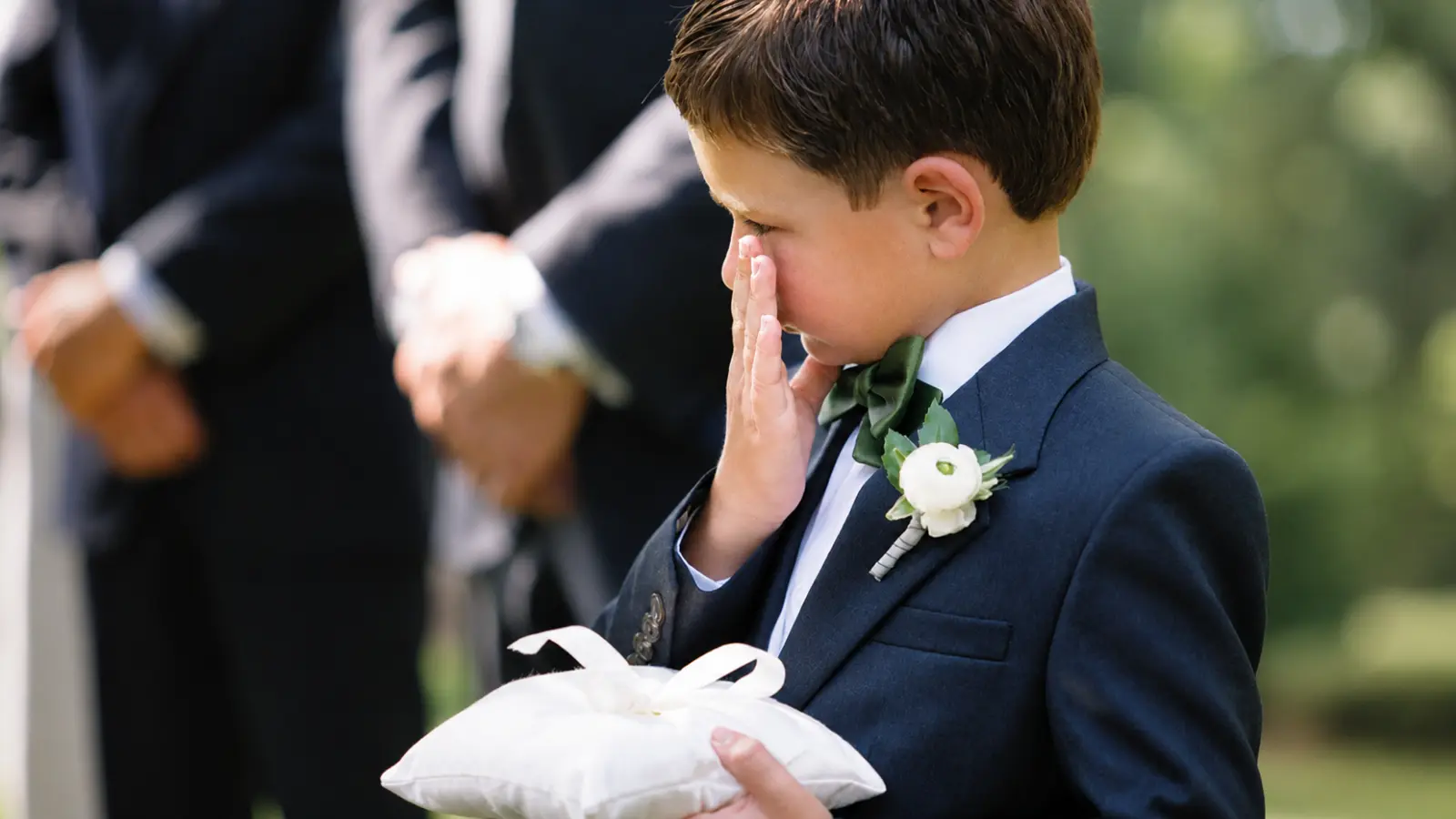
Ring bearer duties are intentionally simple. His main job is to walk down the aisle, carry a ring pillow, box, or another agreed item, deliver it to the designated person at the front, and then enjoy the rest of the ceremony.
Most of the planning happens before the wedding. Parents, the couple, and the coordinator decide what he will carry, when he walks, who receives the rings, and what happens if he needs help during the processional.
This guide explains ring bearer duties before and during the wedding, including rehearsal, processional order, what he carries, whether he should hold the real rings, who receives them, where he goes after the aisle walk, and how to prepare a simple backup plan.
What He Does Before the Wedding
Most of the ring bearer’s responsibilities before the wedding day are the parents’ responsibilities, not the child’s. The couple selects the outfit, arranges what he will carry, and decides the processional logistics. The parents handle the fitting, the trial wear, and the preparation conversations. The child’s job before the wedding is essentially to exist comfortably in his role and show up at the rehearsal knowing something is expected of him.
What the child himself benefits from before the wedding: knowing he has been asked to do something important, having a basic picture of what the day will look like, and wearing his outfit — including his shoes — at least once before the ceremony so nothing is unfamiliar or uncomfortable when it matters. A child in new dress shoes on a formal marble floor who has never worn those shoes before is one of the more preventable processional problems couples encounter.
Beyond that, the preparation is deliberately light. Toddlers and young children do not retain detailed briefings given weeks in advance. The most effective preparation happens shortly before the wedding, ideally during the rehearsal if one is planned.
What He Does at the Rehearsal
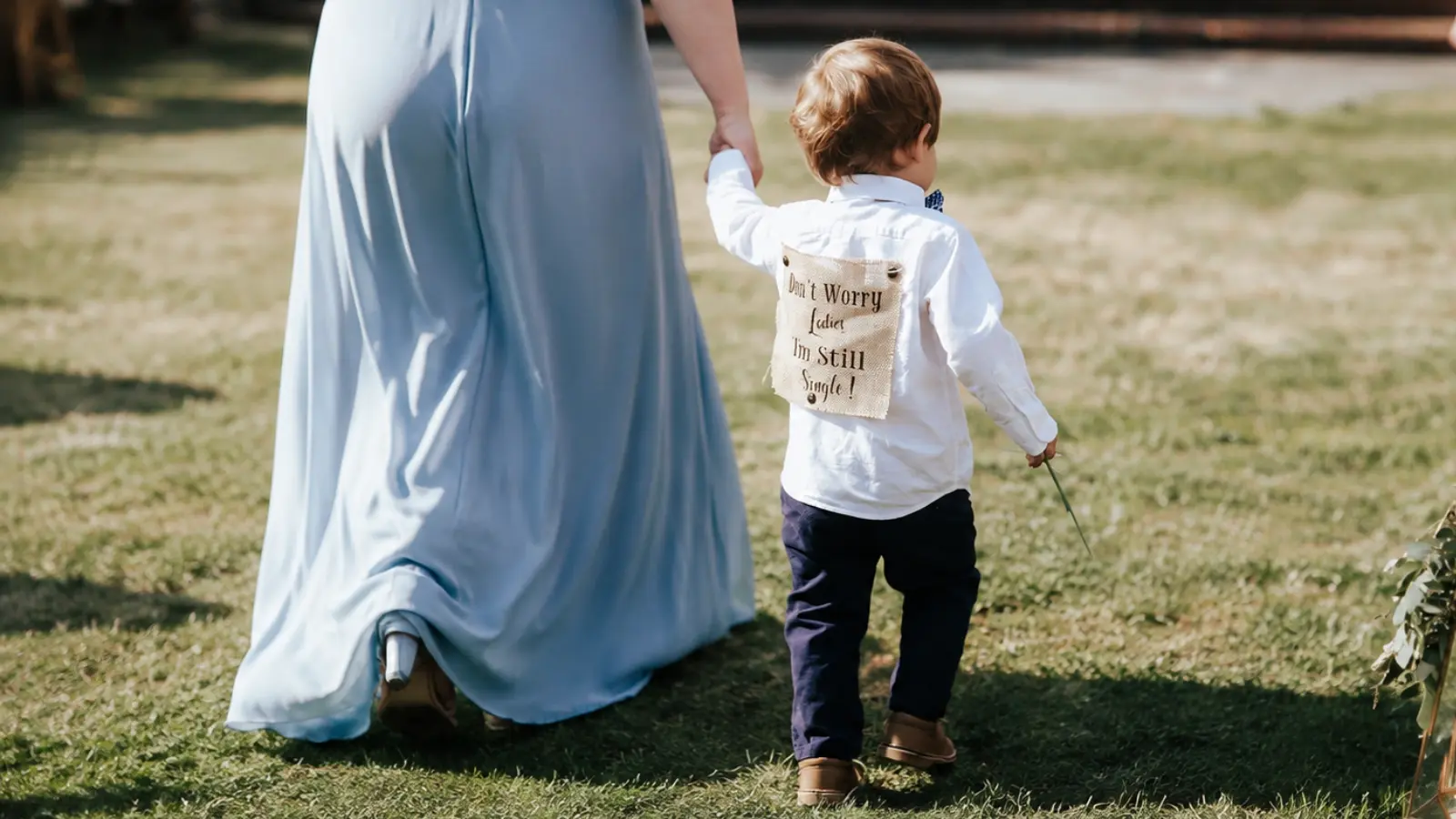
The rehearsal is where the ring bearer learns everything that actually matters for the day. Walking through the processional before the wedding — ideally at the venue if possible, with whoever is walking alongside him, and with the item he will be carrying — does more to build confidence and reduce anxiety than any number of at-home practice sessions.
At the rehearsal, the child should walk through his full processional at least once: where he starts, how he walks, where he goes when he reaches the front, and who receives the pillow or box. If there is a flower girl, they should run through the entrance together so neither child is surprised by the other’s presence or timing. The adult who will step in if things go wrong should also be identified and briefed during the rehearsal, not after.
Keep the rehearsal instruction simple and specific. “You start here, you walk when I tell you, and when you get to the front you give the pillow to Uncle Mark” is a complete briefing for most young ring bearers. Children in the three-to-seven range respond to concrete, single-task instructions and a familiar face to walk toward. Anything more elaborate tends to add anxiety rather than confidence.
When Does the Ring Bearer Walk Down the Aisle?
The ring bearer walks near the end of the processional — after the bridesmaids and maid of honor, and before the bride. In one common American processional order, he is one of the last to enter, which means his walk signals to the guests that the bride is about to appear. That positioning is intentional: he builds anticipation rather than being buried in the middle of the procession.
Where he falls in relation to the flower girl depends on the couple’s preference. He can walk before her, after her, or side by side with her. Some couples prefer a brief pause between the ring bearer and the flower girl so each child gets a moment; others send them in together, which often helps younger or shyer children who do better with a companion for the walk. Either arrangement works — what matters is that the order is clear before the ceremony begins and both children have practiced it.
The gap between the ring bearer reaching the front and the bride beginning her entrance should be brief but intentional: long enough for him to deliver the rings and be guided to his seat, but not so long that the momentum of the processional stalls. The transition should be brief so the processional continues naturally without unnecessary delay.
What Does He Carry?
The most traditional option is a ring pillow — a small decorative cushion with the rings or ring replicas tied or placed on top. It is the image most people picture when they think of a ring bearer, and it works well across most wedding styles when chosen in proportion to the child’s size and the venue’s formality.
Alternatives are equally valid and sometimes more practical. A small wooden or acrylic box with a hinged lid, a decorative lantern, a shadow box, or a small sign (“Here come the rings” is a popular choice in more casual weddings) all work depending on the wedding’s tone and the child’s age. Very young children often do better with something lightweight and easy to grip than with a traditional pillow that requires some coordination to carry level while walking.
Whatever he carries, the item should be sized and weighted appropriately for the child, and he should have practiced carrying it during the rehearsal. An unfamiliar object in a child’s hands during a high-pressure moment is exactly where fumbles happen. The ring bearer pillow and box covers the full range of options and how to choose between them.
Should the Ring Bearer Carry the Real Rings?
This is one of the most common questions couples ask when planning the ring bearer role, and the answer depends on several factors: the child’s age, his temperament, the distance from the back of the aisle to the altar, how the rings are secured, and how comfortable the couple is with that level of risk on their wedding day.
For young children, replica or decorative rings are usually the simpler and lower-risk choice. The actual wedding rings can remain with the best man or maid of honor until they are needed. The reasoning is practical. Real rings are small, they are not always securely fastened, and a dropped ring on a church aisle, an outdoor lawn, or a wood floor with gaps is a genuine logistical problem during a ceremony. A five-year-old cannot be held reliably responsible for two items that cost thousands of dollars and carry enormous emotional significance, no matter how careful he is.
For an older, reliable child who has practiced the walk, carrying the real rings may be reasonable, especially when they are securely fastened to the pillow or box. The couple’s comfort level matters here too: some couples feel strongly about the real rings being part of the moment; others find the replica approach gives them significant peace of mind without changing anything the guests experience.
When replica rings are used, the best man typically holds the real rings from the start of the ceremony and presents them when the officiant calls for them. This is the standard arrangement in many ceremonies and requires no explanation to guests — the moment at the altar looks identical either way.
One practical note: if real rings are going on the pillow, fasten them securely. Rings that are simply laid on top of a satin pillow will slide. Ribbon or twine loops that hold the rings in place, with a bow the officiant or best man can untie at the altar, are the most reliable approach. Test the tie before the rehearsal.
Who Does the Ring Bearer Give the Rings To?
The handoff at the altar should be choreographed before the ceremony, not improvised when a young child is standing at the front of the room waiting for direction. Decide in advance who receives the pillow or box, make sure that person knows to step forward when the moment comes, and tell the child exactly who he is walking toward.
The most common arrangements are: he hands the pillow to the best man as he reaches the front; he gives it directly to the officiant; or a designated adult near the altar steps forward to take it, and the child is then guided to his seat. All three work. What creates the awkward pause is when no one has a clear role and the child reaches the front to find three adults looking at each other while he stands there holding a pillow.
For very young children, having a parent positioned near the front of the aisle — ready to receive the child and the pillow together — is often the cleanest solution. It removes the handoff question entirely, keeps the child from wandering, and gets him seated quickly and calmly.
Walking Alone, With a Parent, or With Another Child
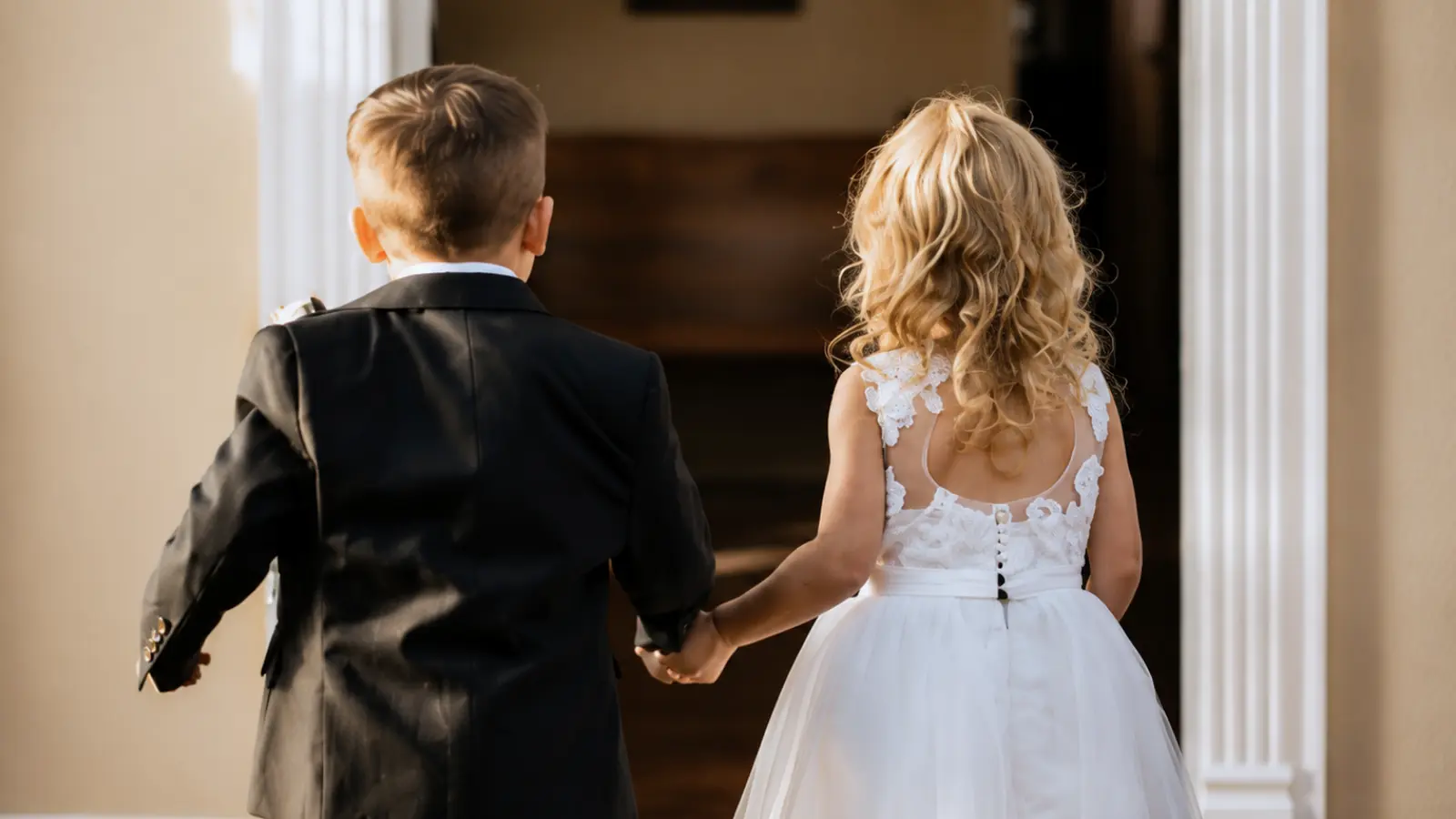
Whether the ring bearer walks alone, with an adult, or alongside another child depends almost entirely on ring bearer age, temperament, and confidence. There is no single right answer, and the most important factor is what will make the walk go smoothly for this specific child.
Walking alone works well for confident children who have practiced the walk and know exactly where they are going. A child who walks the aisle independently, with good posture and a real awareness of the moment, can produce one of the most charming processional sequences a wedding offers.
Walking with a parent or trusted adult is the right choice for toddlers, very young children, or any child who is shy, anxious, or unpredictable in new environments. An adult escort does not diminish the moment — it often adds to it, especially if the adult and child have a visible warmth between them. Position the escort on the side and slightly behind so the child remains the visual focus of the walk.
Walking alongside the flower girl or another ring bearer works well for children who do better with a companion than with an adult at their side. Two children walking together often settle each other’s nerves, and the pair tends to produce a more natural, relaxed walk than either child might manage alone. Make sure both children know the arrangement before the ceremony and have practiced the paired walk at the rehearsal.
What Happens When He Reaches the Front?
This is the moment that most needs to be rehearsed and least often is. What the ring bearer does when he reaches the front — who he hands the pillow to, where he stands, how long he waits, who guides him to his seat — should be planned in advance and walked through at the rehearsal. A child who knows exactly what to do when he gets to the front will move through it cleanly. A child who doesn’t know will stand there looking for direction while the ceremony pauses.
The sequence at the front is typically: he reaches the altar area, he hands the pillow or box to the designated adult, and he is then guided to his seat by a parent, usher, or the same adult. The handoff should be completed smoothly so the ceremony continues naturally. If the child will be sitting with family rather than standing at the altar, his parent should be positioned close enough to receive him quickly and naturally so the transition is seamless.
Does He Stand With the Groomsmen or Sit With Family?
For most ring bearers — and especially for children under eight — sitting with family after the processional is the right call. A wedding ceremony can run twenty minutes to an hour or longer, and asking a young child to stand still at the altar for the full duration is an invitation to visible restlessness during the vows. The meaningful part of the ring bearer’s role is the processional walk and the ring delivery. Everything after that is presence, and it is presence that young children cannot sustain reliably in a formal setting.
Sitting with a parent right after the processional keeps the child comfortable, keeps the ceremony focused, and eliminates one of the most common sources of distraction during the vows: a small boy in a suit who has run out of things to do and is beginning to explore his options at the front of the room.
For older ring bearers who are genuinely mature enough to stand still and pay attention, joining the groomsmen for the ceremony can work well and often something the child will want to do. The decision should always be based on the specific child in front of you, not on what the role is traditionally supposed to look like.
How to Explain the Role to a Child
The explanation should be short, concrete, and tied to something the child can picture. Children respond to what they will actually be doing, not to a description of ceremonial significance.
For toddlers and children under five, one sentence is enough: “You carry this pillow down the aisle and give it to Uncle James at the front.” That is a complete briefing. More than that introduces more things to remember and more opportunities for the child to get anxious about getting it right.
For children between five and eight, a slightly fuller picture is useful: “You walk after the bridesmaids, before I come in. You carry the pillow like this, you walk toward Grandpa at the front, and then you give it to him and go sit with Mom.” Specific, visual, tied to people he knows.
For older children, more context works well. They appreciate being treated as capable participants: “You walk after the bridesmaids, you’ll hear the music change and that’s your cue. Carry the pillow level, walk slowly, and hand it to the best man when you get to the front.” Older children can absorb a full explanation of the processional sequence and benefit from understanding what happens around their role, not just within it.
At any age, the most useful framing is that he gets to do something important — not that he has to perform something correctly. Children who are excited about their role consistently do better than children who feel pressure to get it right.
What If He Freezes, Cries, or Refuses?
It happens. A child who was completely cooperative at the rehearsal can stop dead at the top of the aisle when the music starts and two hundred people turn to look at him. This is not a failure of preparation — it is a child encountering the real thing, which is always different from the rehearsal version. The best preparation for this moment is having a plan for it before it happens.
A few things that help when a child hesitates or freezes:
- Give him a specific face to walk toward. “Look at Uncle Mark at the front” is more grounding than “walk to the altar.” A familiar face and a clear destination reduce the overwhelming quality of the moment.
- Don’t intervene too quickly. A child who hesitates for five or ten seconds often finds his footing and keeps going. Give him a beat before stepping in — he may surprise you.
- Have the rescue adult ready to move without hesitation. If he genuinely stops, the designated adult should move out calmly, take his hand, and complete the walk with him as if that was always the plan. No apology to the guests, no dramatic moment — just a calm adult and a child walking to the front together.
If he refuses to walk at all, a parent carrying him down the aisle or guiding him to his seat from the side is a workable outcome. The moment still happens; it just looks slightly different than planned. Guests find these moments endearing far more often than they find them disruptive, and the ceremony moves on.
Backup Plan
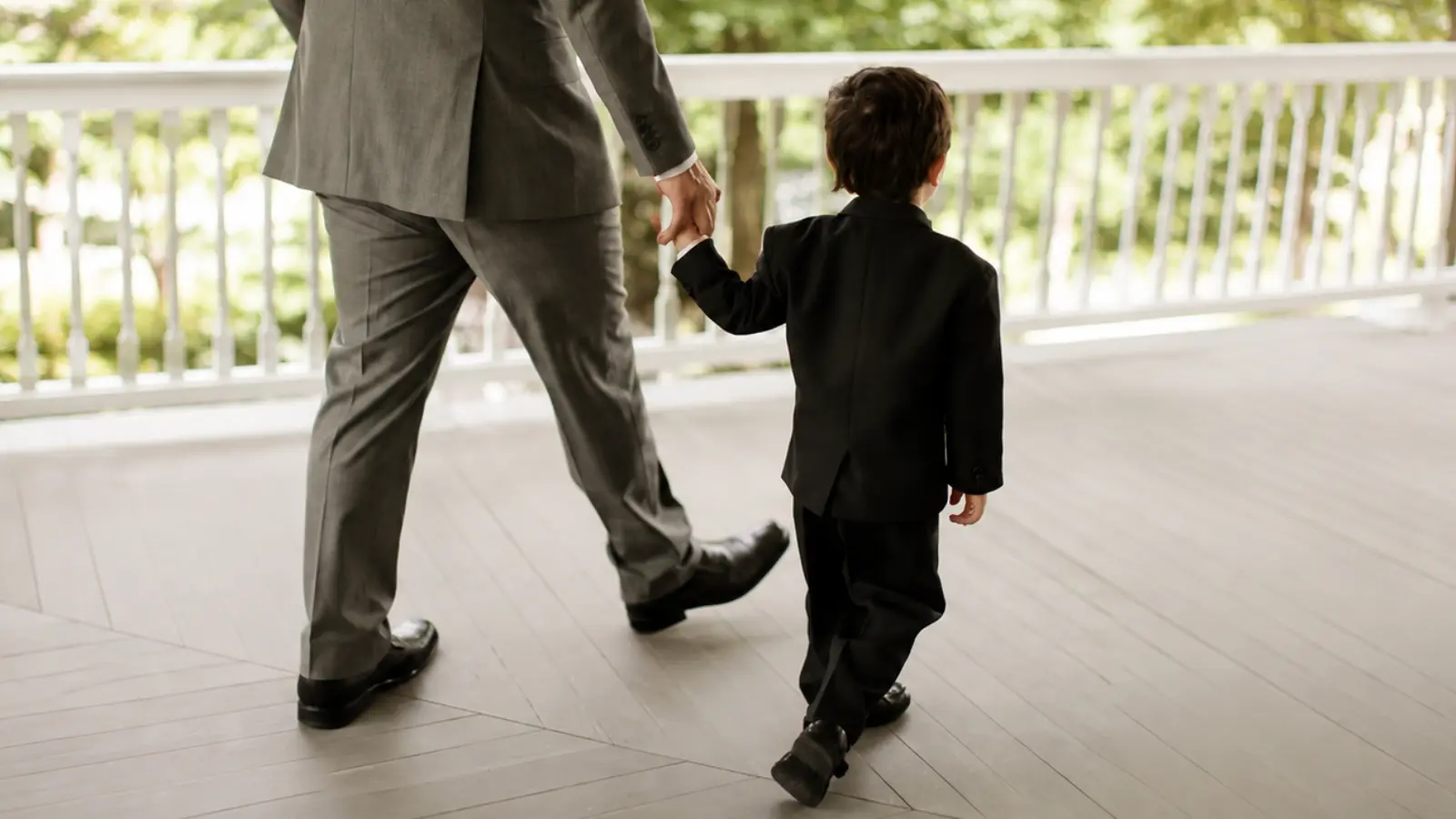
Every ring bearer plan should include a backup, not because something is likely to go wrong, but because having one settled in advance keeps the day calm if it does. The backup should be known to the child’s parent, to whoever is coordinating the processional, and ideally to the officiant.
The structure is simple: one designated person, one clear response. The designated person is whoever steps in if the child needs help — a parent positioned at the back of the aisle, a bridesmaid at the front, or a coordinator standing just off to the side. This person should know their role before the ceremony starts, not after the child has been standing at the top of the aisle for thirty seconds while everyone figures out what to do.
The clear response is what that person does: steps out calmly, takes the child’s hand, completes the walk, and guides him to his seat. No announcement, no apologetic look at the guests, no drawn-out moment. The calmer and more matter-of-fact the rescue is, the faster the ceremony returns to its own rhythm.
Having this plan in place is simply good logistics — it lets the child’s parent relax, lets the couple focus on the moment rather than monitoring a small child, and ensures that whatever happens at the top of that aisle has a clear, predetermined resolution.
Ring Bearer Ideas & Wedding Inspiration
Explore ring bearer ideas, outfit inspiration, ring pillows, ring boxes, processional moments, and creative ways to include children in your wedding ceremony while planning a role that feels natural and memorable.
Keep the Ring Bearer Role Simple
The ring bearer’s responsibilities are intentionally small, and that’s exactly what makes the role meaningful. A simple walk, a clear destination, and realistic expectations usually create a smoother ceremony than adding extra tasks or unnecessary pressure.
Prepare the logistics before the wedding, explain the role in a way the child can understand, and have a calm backup plan ready if needed. When the experience is built around the child rather than perfection, the ring bearer naturally becomes one of the most memorable parts of the ceremony.
Frequently asked questions (FAQ)
What does a ring bearer do during the ceremony?
The ring bearer walks near the end of the processional carrying a ring pillow, box, or another decorative item representing the wedding rings. After reaching the front, he gives it to the designated adult and usually sits with his family. His main responsibilities are the walk and the handoff rather than remaining at the altar throughout the ceremony.
Should the ring bearer carry the real rings?
Usually not if the child is young. Most couples place replica rings on the pillow while the best man keeps the real wedding rings until they are needed. Older, reliable children may carry the real rings if they are securely fastened and an adult supervises the handoff.
Who does the ring bearer give the rings to?
The ring bearer usually hands the pillow or box to the best man, officiant, or another adult chosen by the couple. Decide this before the ceremony and practice it during the rehearsal so the child knows exactly who to walk toward and no one hesitates during the handoff.
When does the ring bearer walk down the aisle?
The ring bearer normally walks near the end of the processional after the bridesmaids and before or alongside the flower girl. His entrance signals that the bride is about to enter. Whatever order you choose, rehearse it in advance so the timing feels natural on the wedding day.
Does the ring bearer stand with the groomsmen during the ceremony?
Most young ring bearers sit with their family after completing the processional because standing through an entire ceremony can be difficult for children. Older ring bearers who are comfortable standing still may remain with the wedding party, but the decision should always depend on the individual child.
What if the ring bearer freezes or cries during the processional?
Plan for it before the wedding. A designated adult should calmly step in, take the child’s hand if needed, and complete the walk together without drawing attention to the situation. Most guests find these moments charming, and having a simple backup plan keeps the ceremony moving naturally.