
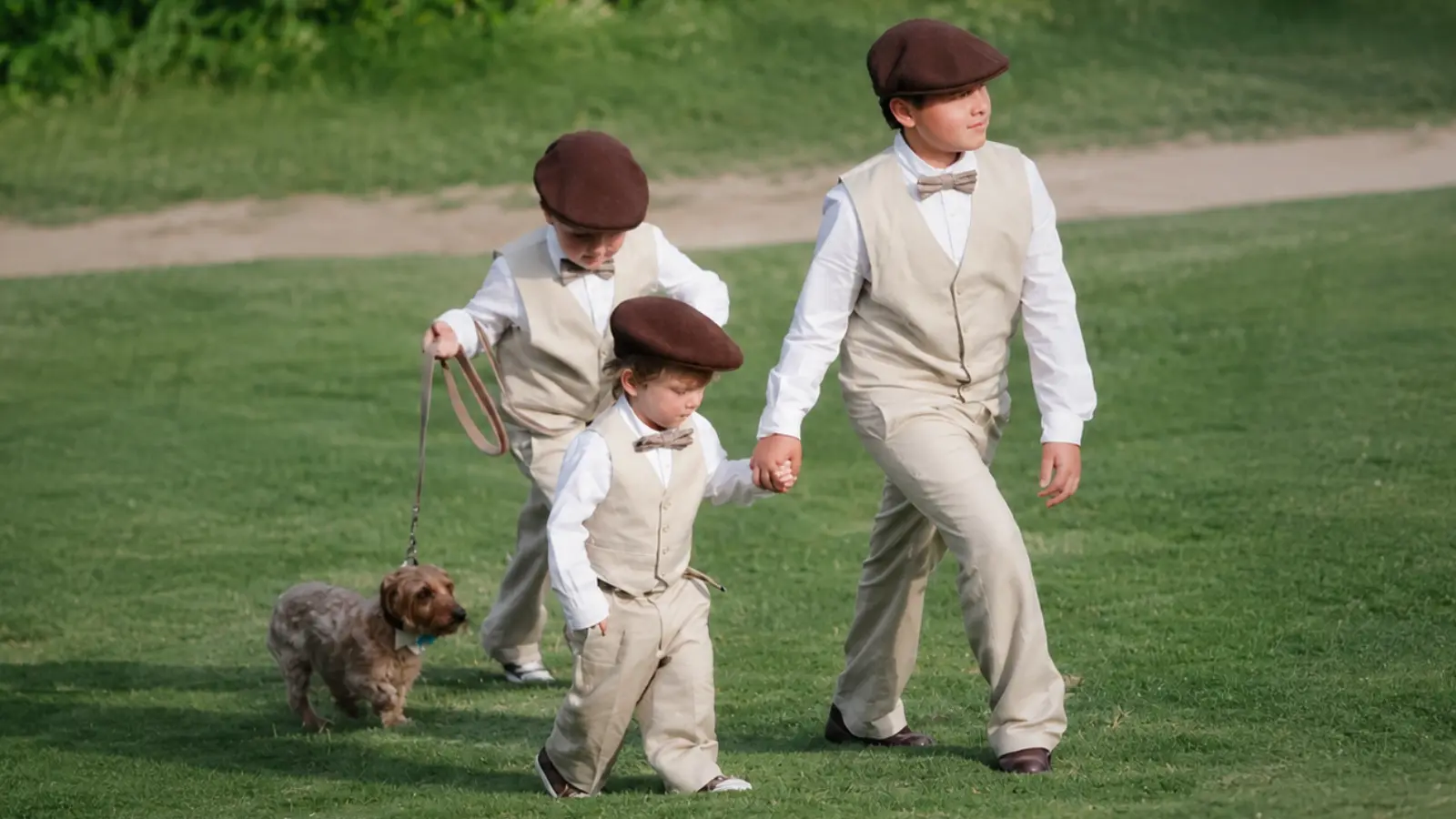
Ring bearer age can affect almost every part of the role, from whether a child walks alone to what he carries and how much support he may need during the processional. While young children are traditionally chosen, there is no single age that determines whether someone can be a ring bearer.
Ages three to eight are commonly associated with the role, but that range is better treated as a reference than a rule. A toddler may participate successfully with a parent nearby, while an older child may enjoy the traditional role or prefer being included as a junior groomsman.
This guide explains ring bearer age at every stage, including babies, toddlers, children ages three to eight, older ring bearers, the junior groomsman option, shy children, wagon ideas, and how to adjust the role and backup plan to the individual child.
The Common Ring Bearer Age Range
Three to eight is a commonly associated range, but children within it vary considerably in maturity, confidence, and independence. The role itself can remain simple: walk a short distance and hand something to someone. They are also young enough that the role reads as naturally sweet rather than performed, which is what makes the ring bearer moment work in the first place.
That said, three to eight is a wide range, and a six-year-old and a three-year-old are very different children in terms of what you can reasonably expect from them. The sections below treat each stage separately, because the planning decisions — how much to rehearse, whether to use real rings, whether a parent walks alongside — change meaningfully from one age to the next.
What stays constant across all of them is this: the simpler the role, the better it tends to go. The ring bearer’s job is to walk a short distance and hand something to someone. Every additional expectation layered on top of that is an additional thing that can go sideways.
What to Expect at Every Age
Age gives you a starting point for expectations, but temperament is what actually determines how a child will do on the day. A confident four-year-old can walk the aisle more smoothly than a nervous seven-year-old. A toddler who adores the bride will often do better than an older child who was given the role without being asked. The table above offers a framework; the sections below give you the fuller picture for each stage so you can read your specific child against it.
Baby and Infant Ring Bearers
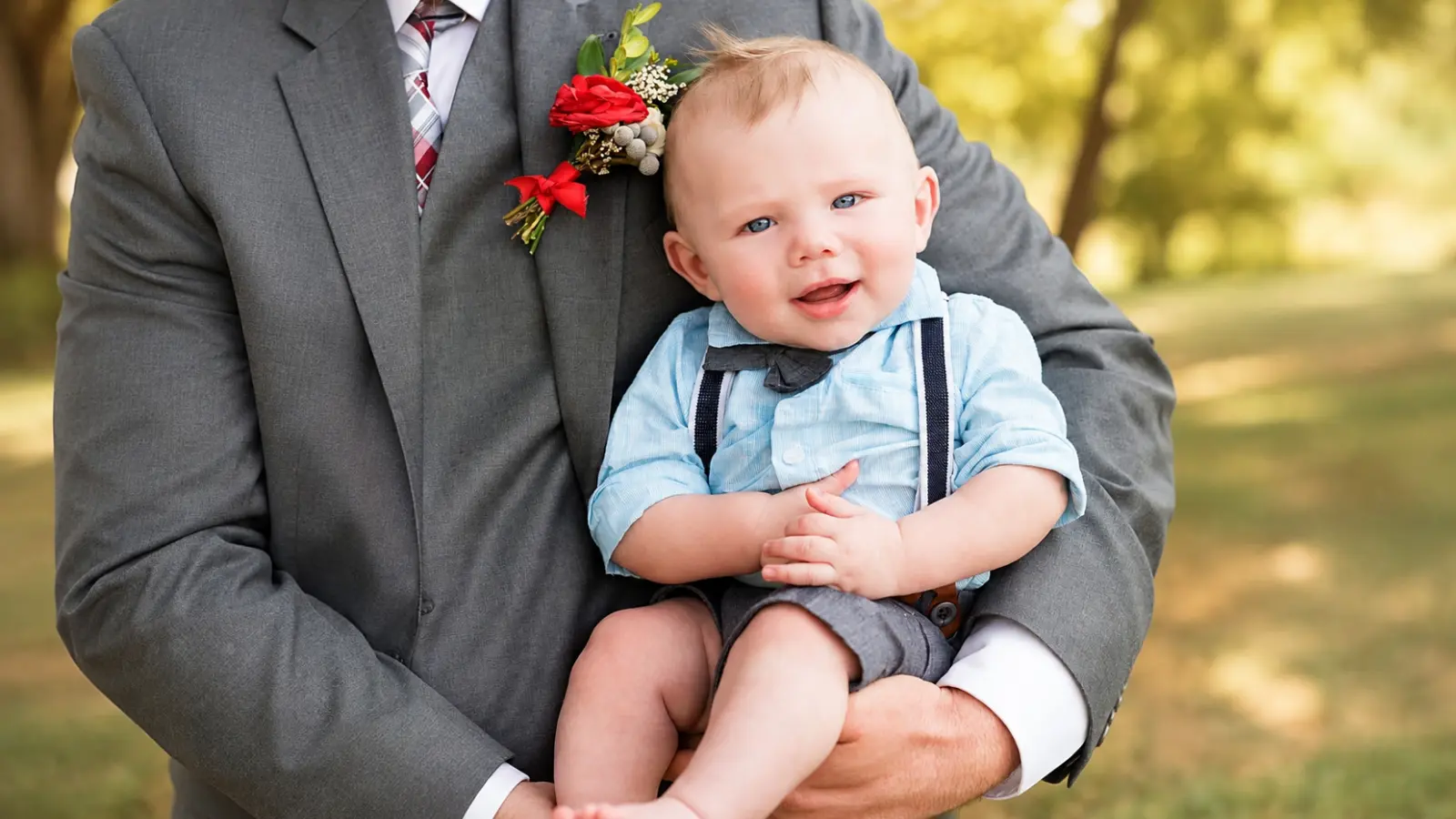
A baby or infant does not need to walk independently, hold a pillow, or complete a handoff to participate as a ring bearer. The role for a baby or infant is simply to be present in the processional, and that presence alone is usually enough to produce the kind of moment guests remember. The logistics shift entirely to the adult accompanying him.
The most common approach is a parent or close family member carrying the baby down the aisle, either with the pillow resting on top of a blanket or tucked into the carrier. A decorated wagon is the other option and tends to photograph beautifully, especially if the baby is sitting up on his own. What he carries and how he moves matters less than the fact that he is there, recognizable, and comfortable.
The single most important thing to plan for with a baby ring bearer is what happens if he is not comfortable. An overtired, overstimulated, or hungry baby in a formal ceremony setting with unfamiliar sounds and faces is a situation that resolves itself very quickly and very loudly. Have a plan for who steps in with the baby, where they go, and what happens to the rings he was technically carrying. If the real rings are involved, keep them with the best man instead — the baby does not need the added responsibility.
The Toddler Ring Bearer (Ages 1–2)
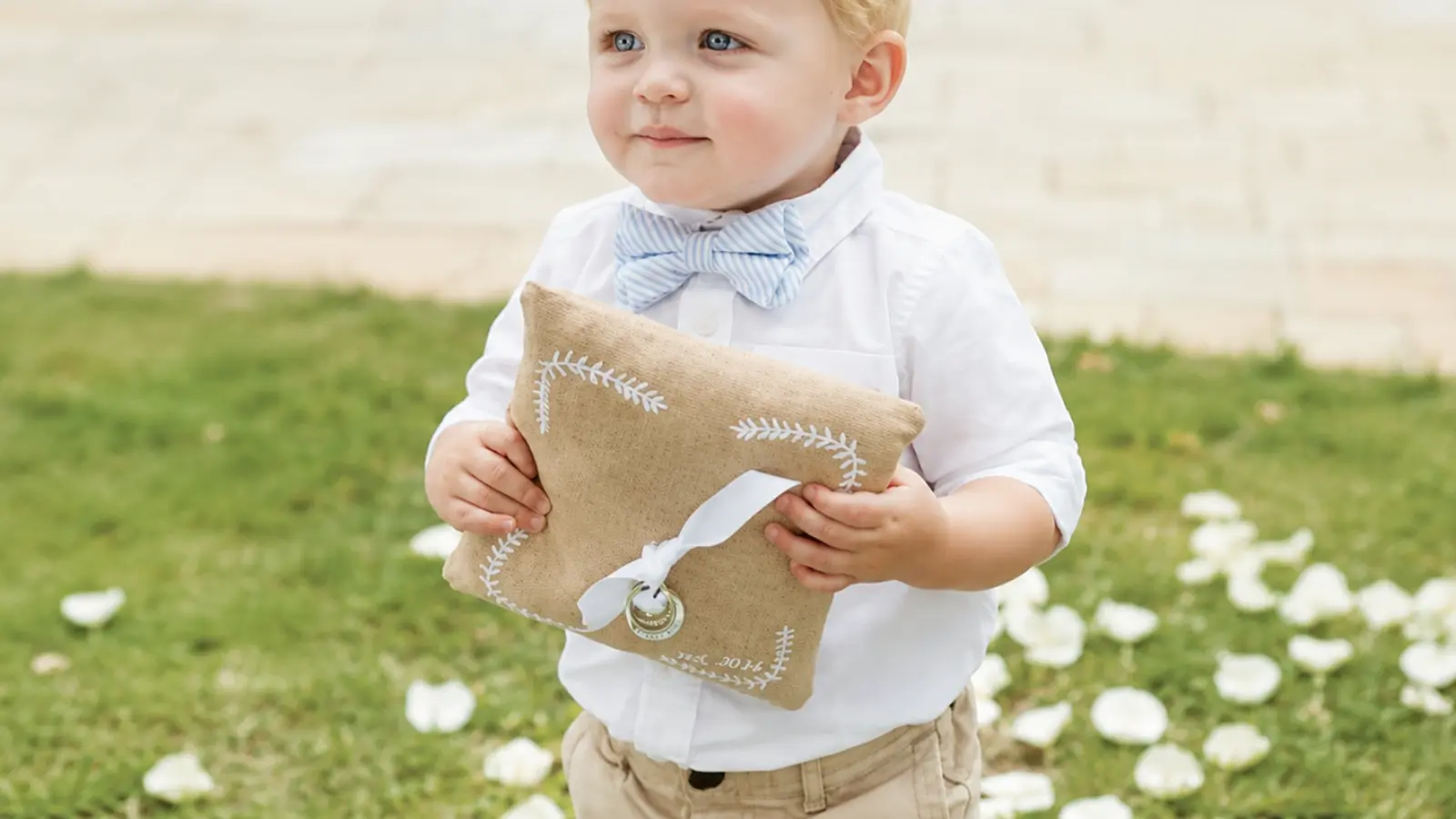
Toddlers are unpredictable in ways that are both their greatest charm and their greatest logistical challenge. A two-year-old who walked the aisle perfectly at the rehearsal on Friday may decide on Saturday that sitting down in the middle of the processional is the more interesting option. This is not a failure — it is a toddler being a toddler — but it is worth planning for.
The toddler ring bearer works best with a parent or trusted adult walking alongside him the entire way. Not following behind at a distance, but walking next to him, holding his hand, and completing the walk together. This gives the child an anchor, keeps the processional moving, and removes the pressure of a solo performance from a child who cannot reliably manage one. The adult escort is not a concession; it is simply the age-appropriate version of the role.
- Keep the pillow simple and light. A heavy or awkward prop at this age becomes something to wrestle with, drop, or wave around. A small, flat pillow he can hold with one hand is easier to manage than something elaborate.
- Skip the real rings. For a toddler, replica rings or a decorative pillow are usually the simpler and lower-risk choice. Keep the actual wedding rings with a trusted adult until they are needed.
- Don’t expect him to stand at the altar. After he reaches the front, guide him directly to a seat with a parent. Standing at the altar for the length of a ceremony is not a realistic expectation for a one- or two-year-old.
- Rehearse the walk, not the performance. Walk the actual aisle with him at the rehearsal so the space feels familiar. Don’t try to choreograph expression, pace, or posture — just help him know where he is going and who he is going toward.
Toddler ring bearer moments have a way of becoming the story couples tell for years, precisely because they are unscripted. A two-year-old who stops to wave at grandma, sits down to examine something on the floor, or decides to run the last ten feet is not ruining the moment — he is creating one. The couples who enjoy this the most are the ones who planned thoughtfully and then held the outcome loosely.
Ages 3 to 5: The Sweet Spot
Three to five is where the ring bearer role starts to feel like what people picture when they imagine it. Children in this range can follow a straightforward instruction, walk in a direction with purpose, and understand — at least in the rehearsal — that they have a job to do. They are also still young enough that the role reads as genuinely charming rather than self-conscious.
That said, three to five is still an age that benefits from simplicity and support. A child in this range should know exactly one or two things: when to start walking and where to go when he gets to the front. Too many instructions — walk slowly, hold the pillow level, don’t look at your shoes, smile at the photographer — become noise that a young child cannot process under the pressure of a real ceremony. Give him one destination and one face to walk toward.
A parent standing just off the aisle or at the front of the room gives a three- or four-year-old an enormous amount of confidence. Even if the parent does not walk alongside the child, being visible and in a known location makes the walk feel less overwhelming. For children who are shy or prone to freezing in new situations, having that familiar face at the end of the aisle is often what gets them there.
Real rings at this age are still a judgment call. For a younger or less reliable child, replicas are usually the lower-risk choice. A mature child who has practiced carefully may be able to carry real rings if they are securely fastened to a ring bearer pillow or box. The risk is low probability but high consequence — and the moment is just as meaningful with decorative rings.
Ages 6 to 8: Greater Independence
Many children between six and eight can manage the ring bearer role with greater independence. Depending on the child, this may mean walking without a parent, following a few simple instructions, and completing the handoff with less support.
For a reliable child in this age range, carrying the real rings may be reasonable if they are securely fastened to the pillow or box and a designated adult keeps track of them before the processional. The decision should depend on the individual child and the couple’s comfort level.
Children in this range often benefit from being treated as capable rather than being over-managed. Keep the instructions clear and the practice simple instead of rehearsing every second of the processional. The goal is confidence, not choreography.
Older Ring Bearers and the Junior Groomsman Option
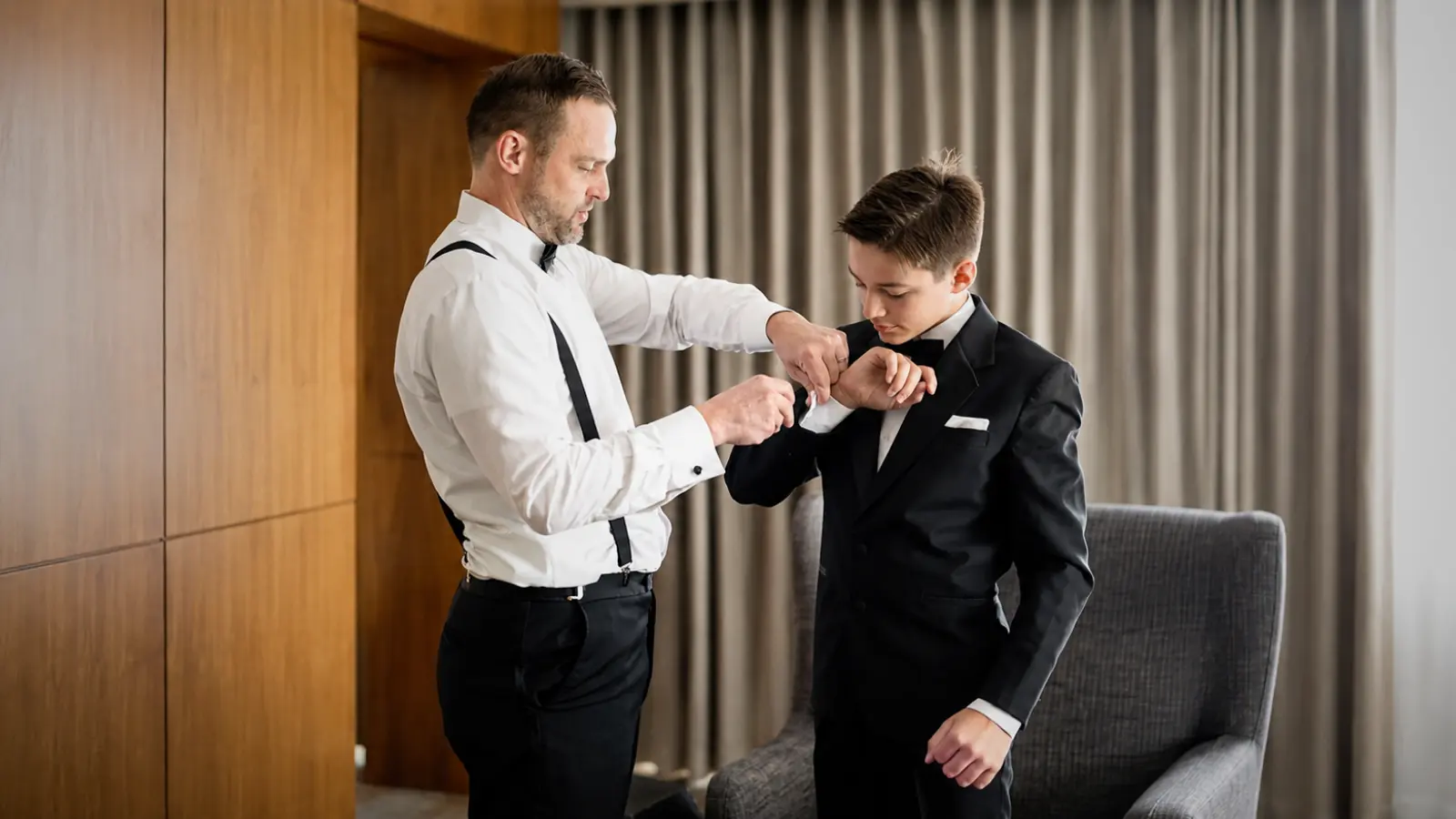
As children get older, some may begin to feel that the traditional ring bearer role is too young for them. This can be especially relevant for preteens who would feel more comfortable participating alongside the groomsmen.
The junior groomsman role exists precisely for this window. A junior groomsman walks in the processional with the groomsmen rather than separately as a child, stands at the altar for some or all of the ceremony, and wears a coordinating outfit that feels age-appropriate rather than miniaturized. The role carries the same ceremonial significance without the elements that feel childish at nine, ten, or eleven.
The transition point between ring bearer and junior groomsman is not a fixed age — it is a read of the specific child. Some eight-year-olds carry the ring bearer role with total ease and no self-consciousness whatsoever. Some nine-year-olds would rather not be there at all unless they get to stand with the groomsmen. Talk to the child, and to his parents, before assigning the role. A child who chooses his role — or at least understands it — almost always does it better than one who was simply placed into it.
What About a Shy or Anxious Child?
Shyness is not a disqualifier for the ring bearer role, but it does require a different approach to preparation. A reserved child who is surprised by the scale of a ceremony — the crowd, the music, the direction of every eye in the room — is likely to freeze. A reserved child who has walked the aisle once, knows exactly where he is going, knows who is waiting for him at the front, and has a trusted adult nearby as a safety net has a much better chance of getting there.
The adjustments that help shy children most are also the simplest ones. Walk alongside him rather than sending him alone. Give him one specific person to walk toward — not “the front,” but “Aunt Sarah standing by the first row.” Keep the rehearsal low-pressure and focused on familiarity rather than performance. And have the backup adult in place before the ceremony begins, not as an improvised response after the child has already stopped.
What rarely helps a shy child is pressure, repetitive reassurance that it will be fine, or a very public coaching session in the moments before he walks. Calm and matter-of-fact is the register that tends to work. The child takes his cue from the adults around him; if they are relaxed, he has an easier time being relaxed too.
The Wagon Option
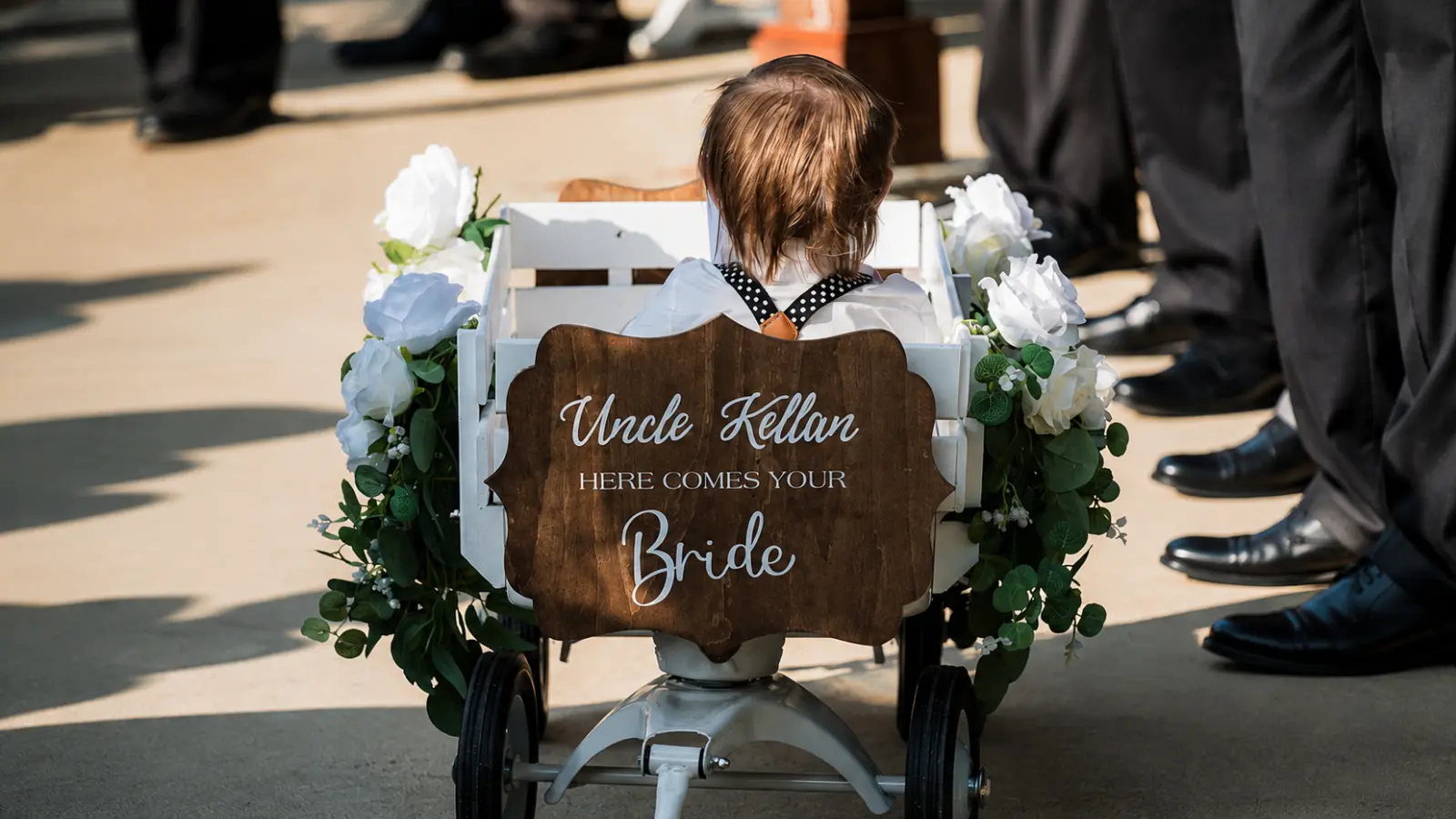
A decorated wagon is a genuinely practical solution for very young ring bearers — typically babies, infants, or toddlers who are not walking steadily enough to make the aisle walk work on their own. It also works for situations where two or more young children are participating and walking side by side feels complicated to coordinate.
The wagon works best when it is simple and styled to fit the wedding rather than overly decorated. A clean wooden wagon with ribbon or a small floral arrangement reads elegantly; a heavily themed wagon can veer into novelty. An adult pulls the wagon — this person should be someone comfortable with a small crowd watching them, since they will be part of the processional moment whether they want to be or not.
Practically, test the wagon on the actual surface before the ceremony. Wagons that move smoothly on hardwood can be surprisingly difficult to pull on thick carpet, and a wagon that catches or tips during the processional is a problem no amount of decoration can fix. One rehearsal pull-through on the real surface is worth more than any amount of planning on paper.
Backup Plan by Age
Every ring bearer plan benefits from a backup — not because something will go wrong, but because knowing what happens if it does allows everyone to be relaxed rather than watchful. The backup looks slightly different depending on the child’s age.
- Baby or infant: The designated adult carrying or pulling the wagon continues with the child to his seat immediately if he becomes upset. Real rings are with the best man, not on the wagon.
- Toddler: A parent is positioned at the back of the aisle, ready to step in and walk alongside the child at the first sign of hesitation. No waiting to see if he recovers — act early and calmly.
- Ages 3–5: One adult is designated to step out quietly if the child freezes, take his hand, and complete the walk together. This person is positioned where the child can see them before the processional begins.
- Ages 6–8: A familiar face at the front of the aisle — someone the child is walking toward — is usually enough. If he hesitates, a quiet cue from that person is typically what gets him moving again.
- Older child: An older ring bearer who freezes usually does so from self-consciousness rather than fear. A low-key verbal cue from a nearby adult is less disruptive than a dramatic intervention. If it is a recurring concern, consider whether the junior groomsman role would reduce the pressure entirely.
The backup plan should be known to the child’s parent, to whoever is managing the processional, and — if there is one — to the wedding coordinator. A plan that lives only in the couple’s heads is not a plan; it is a hope.
Ring Bearer Ideas for Every Age
Explore ring bearer inspiration for babies, toddlers, and older children, including aisle ideas, outfits, wagons, ring pillows, and creative ways to include children in your wedding ceremony.
Choose the Role Around the Child, Not the Number
There is no single perfect ring bearer age. Age can help set realistic expectations, but personality, comfort, and interest in participating matter just as much when deciding how the role should work.
Choose the child first, then adapt the processional, what he carries, whether he walks alone, and where he goes afterward to what he can comfortably manage. The best ring bearer experience is one designed around the child you actually have rather than a fixed idea of how the role should look.
Frequently asked questions (FAQ)
How old should a ring bearer be?
Most ring bearers are between three and eight years old, but maturity and temperament matter more than a strict age range. Children under three often need an adult to walk with them, while boys around nine and older may feel more comfortable in a junior groomsman role.
Can a baby or infant be a ring bearer?
Yes. A baby can participate as a ring bearer even though he cannot walk or carry the rings independently. A parent can carry him down the aisle, or he can ride in a decorated wagon. Keep the real wedding rings with a trusted adult and focus on making the processional comfortable for the baby.
Can a toddler be a ring bearer?
Yes, but adjust the role to the child’s age. A toddler can walk alongside a parent or trusted adult and carry a lightweight pillow with replica rings. After reaching the front, he should usually sit with family rather than remain at the altar. The goal is a simple, supported walk rather than a perfect performance.
What age is too old to be a ring bearer?
There is no strict cutoff, but around age nine or older some boys may begin to feel that the traditional ring bearer role is too young for them. In that case, a junior groomsman role can provide the same sense of inclusion in a way that feels more age-appropriate.
What is the difference between a ring bearer and a junior groomsman?
A ring bearer is usually a younger child whose main job is walking in the processional with the rings or a decorative substitute. A junior groomsman is typically an older boy who walks with the groomsmen and may stand with the wedding party during the ceremony, giving him a more age-appropriate role.
Should a shy child be a ring bearer?
Yes, if the role is adapted to make him comfortable. A shy ring bearer can walk with a trusted adult, practice the aisle beforehand, and have a familiar person waiting at the front. Keep the role simple and have a backup adult ready to help if he becomes overwhelmed or does not want to continue.