
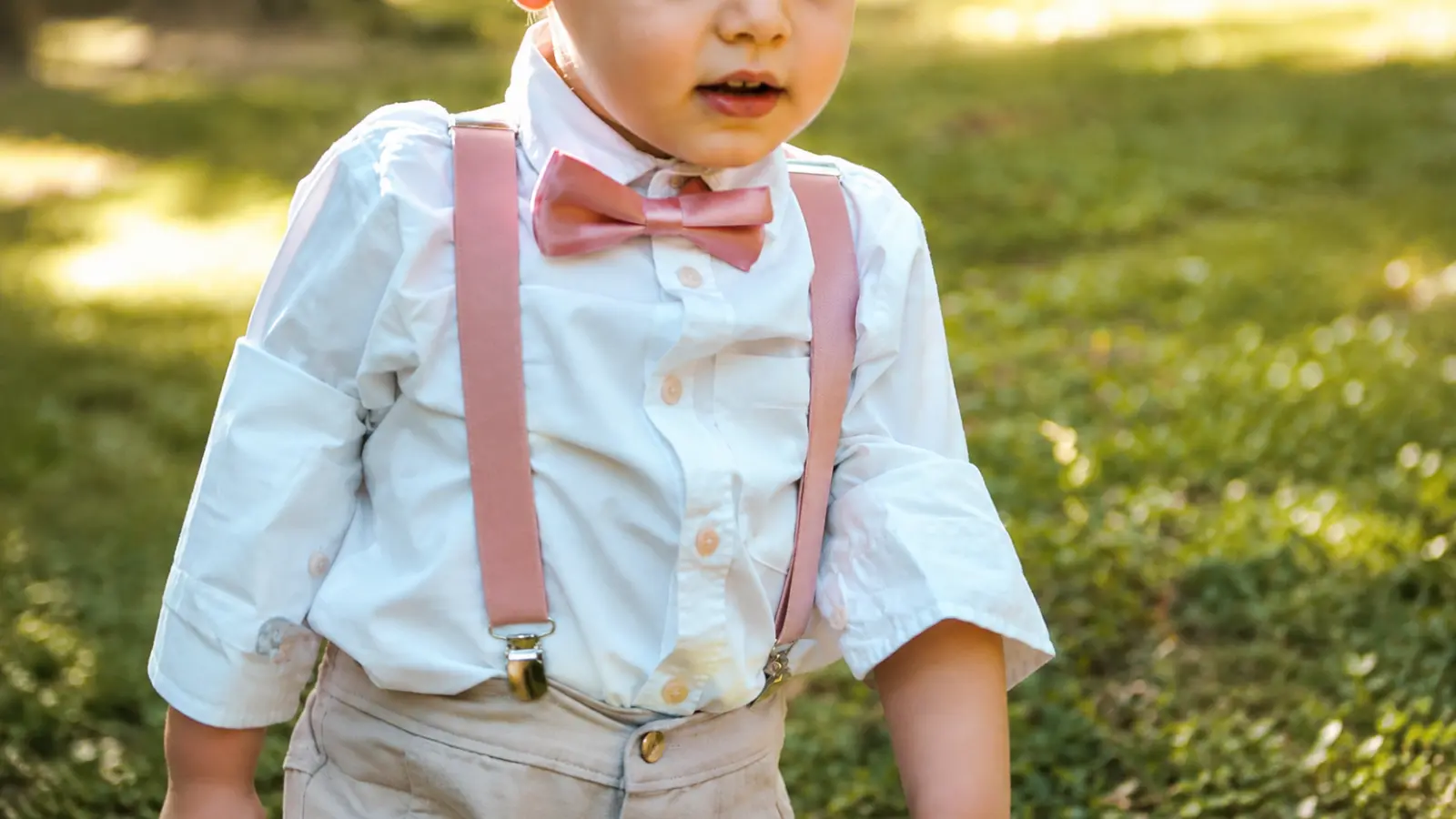
A ring bearer outfit should look polished enough for the wedding while still allowing a child to walk, sit, eat, and move comfortably throughout the day. The best look balances formality with fit rather than simply recreating the groom’s outfit in a smaller size.
Wedding style, venue, season, and ring bearer age all affect the choice. A tuxedo may suit a black-tie ceremony, while suspenders, dress shorts, or a lightweight suit may make more sense for a garden, beach, or summer wedding.
This guide explains how to choose a ring bearer outfit, including suits, tuxedos, shirts, pants, shorts, suspenders, bow ties, shoes, boutonnieres, toddler attire, seasonal options, and how to coordinate the look with the groom and groomsmen.
Suit vs. Tuxedo: How to Choose
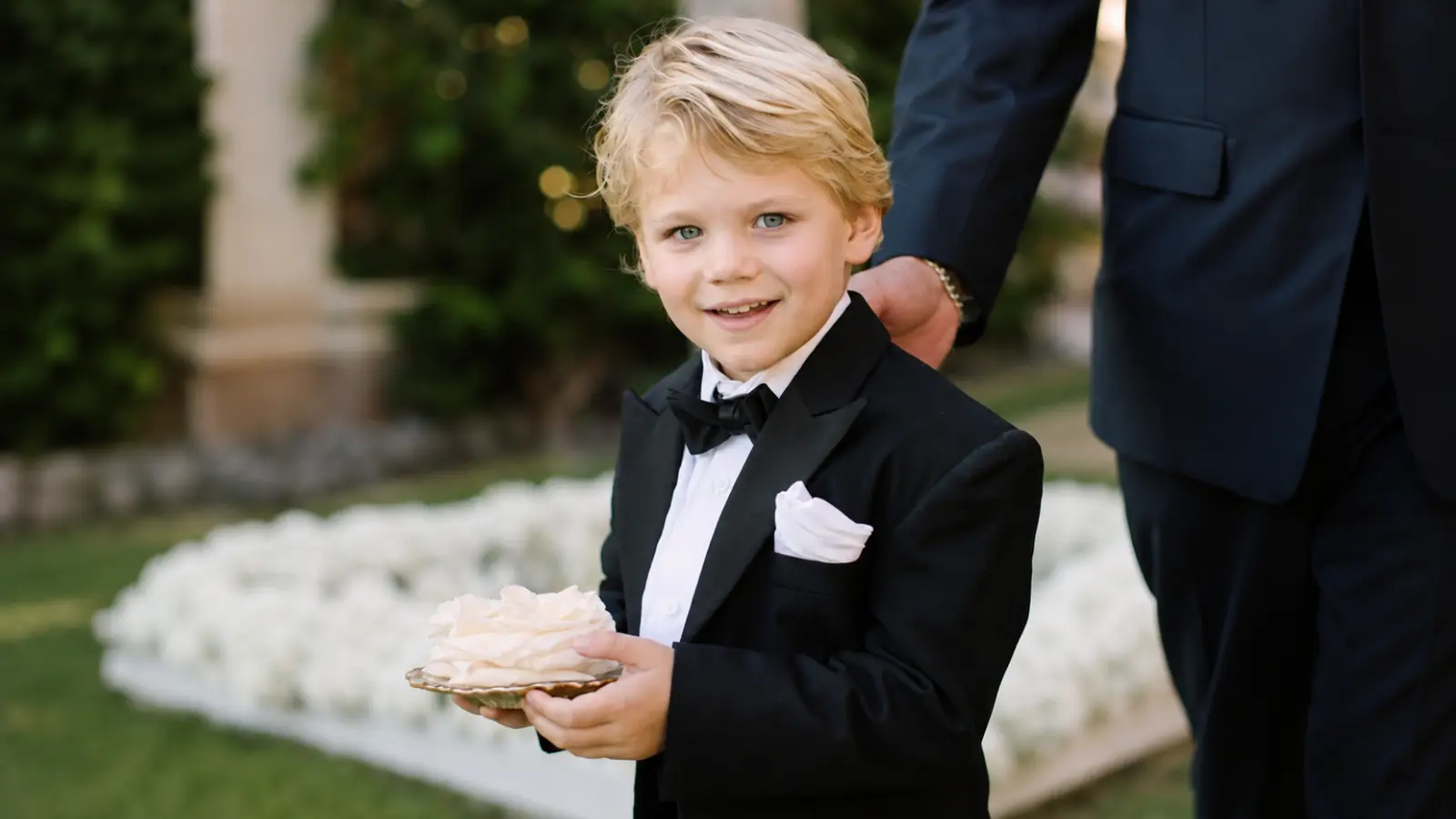
The formality of the wedding is the clearest guide here. A tuxedo — with its satin lapels, formal trousers, and black-tie associations — belongs at black-tie and very formal ceremonies. A suit, in navy, gray, charcoal, or a seasonal fabric, works well for most other weddings from semi-formal to casual-elegant. For young children, the practical distinction between the two often matters less than the fit and construction of the specific garment, since a beautifully tailored navy suit can read just as formal as a tuxedo when the overall look is put together well.
What tends to go wrong with the tuxedo choice for young ring bearers is not the style itself but the execution: adult-proportion lapels scaled down to a child-sized jacket, a stiff shirt with studs that a five-year-old cannot fasten comfortably, and a waistband that does not account for the way a small child’s torso actually sits. If the wedding calls for a tuxedo look, choosing a well-cut suit in black or deep navy with a white dress shirt and a bow tie often achieves the same visual result with considerably more comfort and flexibility.
The short version: match the groom’s level of formality, not necessarily his exact garment. A ring bearer who looks coordinated with the wedding party without being dressed in a miniaturized adult outfit will almost always look better on the day than one who is wearing a scaled replica he cannot move in.
The Key Pieces: Shirt, Pants, Jacket, and Accessories
A ring bearer outfit is typically built from four elements: a dress shirt, trousers or dress shorts, a jacket or vest, and one or two accessories. Each of these can be adjusted to the wedding’s style, the child’s age, and the season — and none of them is mandatory in every combination. A very young ring bearer in suspenders, dress pants, and a soft dress shirt without a jacket can look completely polished and intentional at the right kind of wedding.
The dress shirt is the foundation. A classic white or ivory button-front shirt works with almost anything, and a soft fabric — cotton poplin, cotton blend, or a brushed twill — is more comfortable against a child’s skin than a stiff formal shirt. Avoid heavy interfacing, very stiff collars, or shirts with non-functional buttons that require adult dexterity to fasten. The shirt should allow the child to turn his head and sit comfortably without the collar pulling.
Trousers should be well-fitted without being tight across the seat or thighs, with a waistband that can accommodate a child’s body proportions rather than an adult’s. Elastic waistbands at the back, a half-elastic construction, or adjustable interior tabs all make a significant difference in comfort over a long day. Avoid pleated styles that add bulk without benefit, and check that the length is correct — a child swimming in fabric at the ankle, or with trousers hemmed too short, loses the polished quality immediately.
A jacket is a classic finishing piece, but it is also optional depending on the setting and season. For outdoor summer weddings, a vest or a simple suspender-and-shirt combination is often more appropriate and more comfortable than a full jacket. For formal or church weddings, the jacket completes the look and provides a visual connection to the groomsmen’s attire. If a jacket is included, make sure the child has worn it at least once before the ceremony day — the weight and fit of a jacket can feel surprising to a young child who is not used to wearing one.
Suspenders and Bow Ties
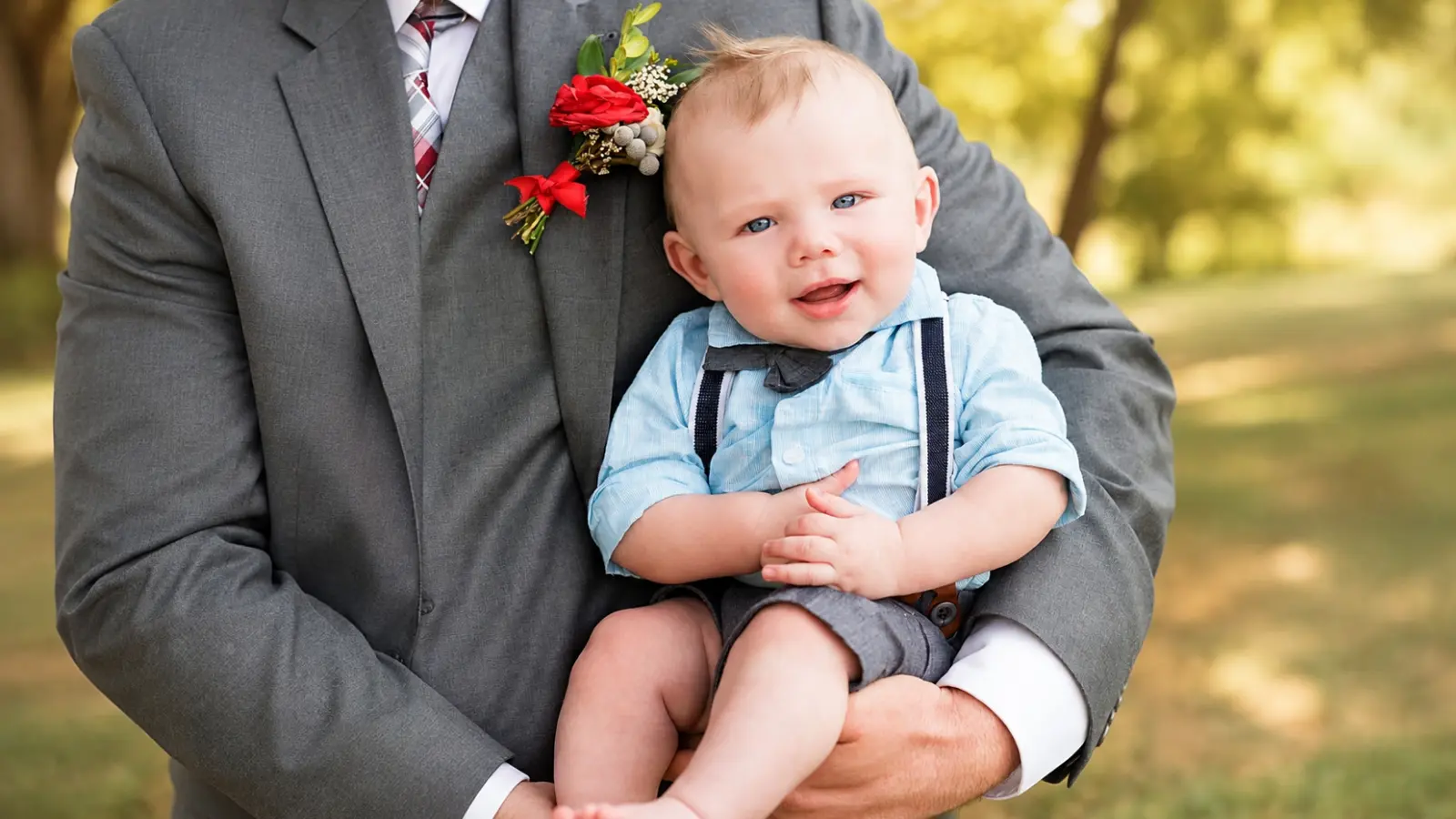
Suspenders are one of the most reliable ways to make a young ring bearer’s outfit look intentional and put-together without the rigidity of a full suit. They can help keep trousers securely in place, keep the shirt tucked through all the movement and sitting the ceremony requires, and add a visual detail that reads as charming on a child in a way that reads differently on an adult. For toddlers especially, suspenders are often more practical than a belted or buttoned waistband.
Choose suspenders in a fabric and color that coordinates with the overall palette — classic white or ivory works with nearly everything, while navy, gray, or a muted tone can pick up an accent from the bridesmaid dresses or floral arrangements. Clip-on suspenders are significantly easier for young children than button-on styles, which require the trousers to have interior buttons sewn at specific positions. For a child who will be wearing the outfit for several hours, the ease of clip-on fastenings is worth prioritizing over the technical correctness of the button-on version.
Bow ties follow the same principle. A self-tie bow tie in a child’s size is appropriate for older ring bearers who can tolerate a fitted collar; a pre-tied option in a softer fabric is more forgiving for younger children. The bow tie should be proportional to the child’s collar — a very large bow tie looks costume-like, and a very small one is difficult to see in photographs. If the child finds the bow tie irritating or keeps pulling at it during the rehearsal, that is a reliable signal it will not stay on through the ceremony. A simple collar button left open, or a light necktie in a softer fabric, can substitute without compromising the look.
Shorts vs. Pants
The shorts-versus-pants question comes up most often for toddlers and young ring bearers at outdoor, garden, beach, or summer weddings, and the answer is more straightforward than it sometimes feels: tailored dress shorts can look completely polished in the right context. The key word is tailored. Dress shorts in linen, cotton twill, or a fine wool blend, cut at or just above the knee and paired with a dress shirt and suspenders, read as intentional and wedding-appropriate. Athletic shorts, cargo shorts, or anything cut below the knee with a casual silhouette are a different matter entirely.
For children under six, shorts often look better than pants regardless of the season, because the proportions work more naturally with a small child’s body. A very young ring bearer in well-fitting dress shorts has a less stiff, more naturally sweet quality than the same child in full-length trousers that are difficult to size correctly for a small frame.
For formal church weddings or evening ceremonies, full-length trousers remain the more appropriate choice. When the setting is indoors, the formality level is high, or the groom and groomsmen are wearing full trousers, matching that silhouette connects the ring bearer visually to the wedding party in a way that shorts do not quite achieve.
What Makes a Ring Bearer Outfit Comfortable?
Comfort in a ring bearer outfit is not about lowering standards — it is about choosing the right version of a polished look. A child who is comfortable in his clothes is a child who is focused on his role, not on pulling at his collar or shifting his waistband every thirty seconds. These are the elements that matter most.
- Soft fabric. Natural fibers and soft blends — cotton, linen, a light wool-blend — breathe better and feel better against a child’s skin than heavily starched or synthetic fabrics. A shirt that scratches or a jacket lining that makes a child’s arms feel constrained will announce itself within the first twenty minutes.
- Correct size. Sizing up to allow for growth before the wedding day is one of the most common fit mistakes. An outfit that is too large looks sloppy and feels physically uncomfortable — sleeves that cover the hands, trousers that drag, a jacket that slides off the shoulders. Have him wear the actual outfit at a final fitting no more than two or three weeks before the wedding.
- No stiff collars. Stiff dress shirt collars on young children lead to a very predictable outcome: the child spends the entire ceremony trying to get his finger between the collar and his neck. Softer collar constructions, slightly relaxed fits, or a collar button left open under a bow tie are all reasonable adjustments that preserve the look without the discomfort.
- No tight waistband. A waistband that fits correctly when a child is standing will feel restrictive when he sits. Build in a little room, or choose a style with adjustable tabs or an elastic back panel. Suspenders can help keep trousers secure without requiring a belt.
- Weather-appropriate layers. A child who is too hot in a heavy wool jacket at an outdoor summer ceremony or too cold in a linen shirt at a winter church wedding is a child who cannot focus on anything else. Match the fabric weight to the setting and season, and plan for layers that can be added or removed without dismantling the look.
- Comfortable shoes. New dress shoes worn for the first time on the wedding day are a reliable source of problems. Have the child wear his shoes — fully laced, on the actual surfaces he will walk on — at least once before the ceremony. Socks matter too: thin dress socks can slip and bunch inside formal shoes in ways that become genuinely painful over a few hours.
- Easy bathroom access. This is the detail parents think of and couples sometimes do not. For very young ring bearers, make sure the outfit can be managed in a bathroom quickly and without help. Choose fastenings that are easy to manage, especially for toddlers who may need quick bathroom access.
- No outfit that makes the child feel trapped. If the child says it itches, it pulls, it’s too tight, or it feels funny — listen. A child who feels physically uncomfortable in his clothes will communicate that discomfort one way or another during the ceremony. The goal is an outfit he can forget he is wearing.
The single most useful thing a parent can do is have the child wear the complete outfit — shirt, pants or shorts, jacket, shoes, and accessories — for two to three hours before the wedding day. Any fit or comfort problem that exists will reveal itself during a trial wear, not during the ceremony itself.
Matching the Groom, Groomsmen, or Flower Girl
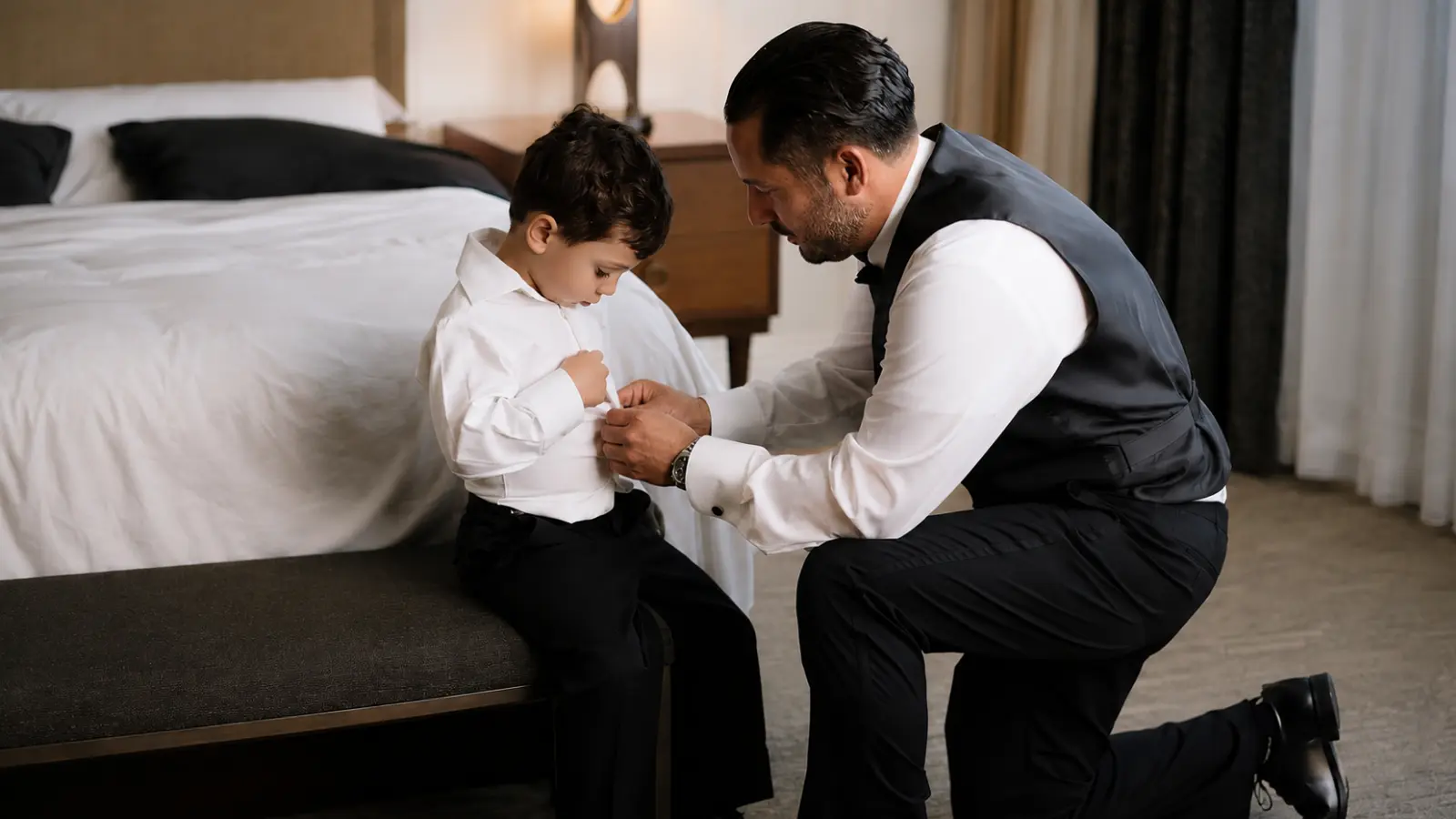
A coordinated look with the groomsmen is the most common approach, and it works because it visually places the ring bearer within the wedding party without requiring him to wear an adult outfit. Coordination typically means matching in color and general formality — navy suit paired with navy suits, gray with gray — rather than wearing an exact replica of the groomsmen’s garments. The ring bearer might wear the same shirt color with suspenders while the groomsmen wear full suits, or the same tie pattern in a bow tie rather than a long tie. These small distinctions acknowledge that he is a child, not a miniature adult.
Matching the groom exactly — same fabric, same cut, same accessories — is a choice some couples make when the ring bearer has a close relationship to the groom, such as a younger brother or nephew. It reads as intentional and personal rather than overdressed when the relationship is clearly communicated. For this look to succeed, the fit of both outfits needs to be correct; two people in the same outfit where one is ill-fitting draws attention to the disparity rather than the coordination.
Coordinating with the flower girl is a lighter touch that can tie the two processional children together visually. Matching a bow tie to the flower girl dress color, or choosing a pocket square in the same shade as her flowers, is usually enough to create the connection without over-coordinating. Identical color families rather than identical colors tend to look more natural in photographs.
Outfit by Wedding Setting
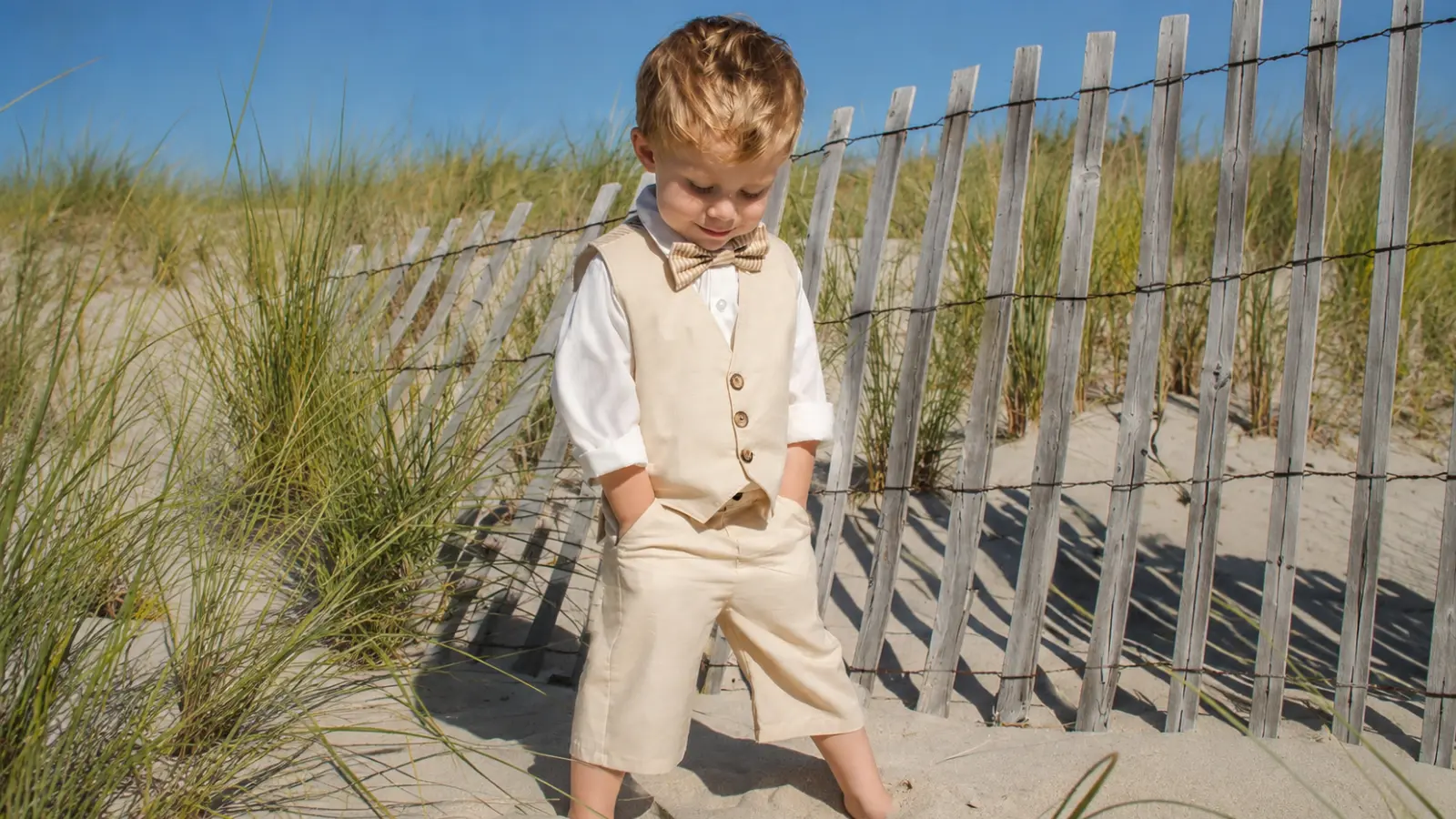
The venue and ceremony style should shape the outfit choice as much as the overall aesthetic does. What reads as polished at a beach wedding looks underdressed at a formal ballroom ceremony, and vice versa.
For formal church or ballroom weddings, a full suit or tuxedo with a dress shirt, bow tie, and dress shoes is the right range. Dark colors — navy, charcoal, black — are the most versatile and photograph well in formal settings with strong lighting. A jacket is expected at this level of formality.
For garden and outdoor estate weddings, the range widens considerably. Lighter suit colors — cream, light gray, pale blue — work well in natural daylight and against the greenery. Linen blends are appropriate and practical. Suspenders with a dress shirt, with or without a jacket, are a strong option for this setting and age group.
For beach and waterfront weddings, lightweight linen in white, cream, or light neutrals is both practical and fitting for the setting. Dress shorts with suspenders are entirely appropriate and often preferable to full trousers on sand. Loafers or simple leather sandals rather than formal oxfords read correctly for the environment. Skip the tie entirely unless the couple’s dress code calls for it.
For casual and barn weddings, the same principles apply with a relaxed hand. A soft chambray shirt, dress pants or well-fitted jeans in a dark wash, and a simple pair of boots can work beautifully when it matches the overall wedding tone. The goal is always to look like the outfit was chosen for this wedding, not borrowed from a more formal one.
Outfit by Season
Season affects fabric weight, color palette, and the comfort calculus of the outfit more than any other single factor. A child in the wrong fabric for the conditions will not be comfortable, regardless of how polished the outfit looks on a hanger.
In summer, breathable natural fibers are essential. Cotton poplin, linen, or light cotton blends in the shirt; linen or light-weight cotton trousers or shorts; and a vest or lightweight jacket if a layer is needed. Lighter colors — warm whites, light gray, pale blue, cream — photograph well in natural summer light and feel appropriate for the season. Avoid heavy wool or synthetic blends that do not breathe.
In winter, heavier fabrics earn their place. A fine wool or wool-blend suit jacket over a dress shirt provides warmth without adding visual bulk. Darker palettes — charcoal, deep navy, forest green for a seasonal accent — work well and photograph cleanly against typical winter ceremony settings. Layering becomes important if the ceremony is in an older building that can be cold, or if there is any outdoor component.
In spring and fall, the range of options is widest. Transitional fabrics — a mid-weight cotton blend, a wool-cotton twill — work well in both directions. The color palette can pull from either the lighter spring range or the deeper autumn tones depending on the wedding’s overall direction.
Toddler and Baby Ring Bearer Outfits
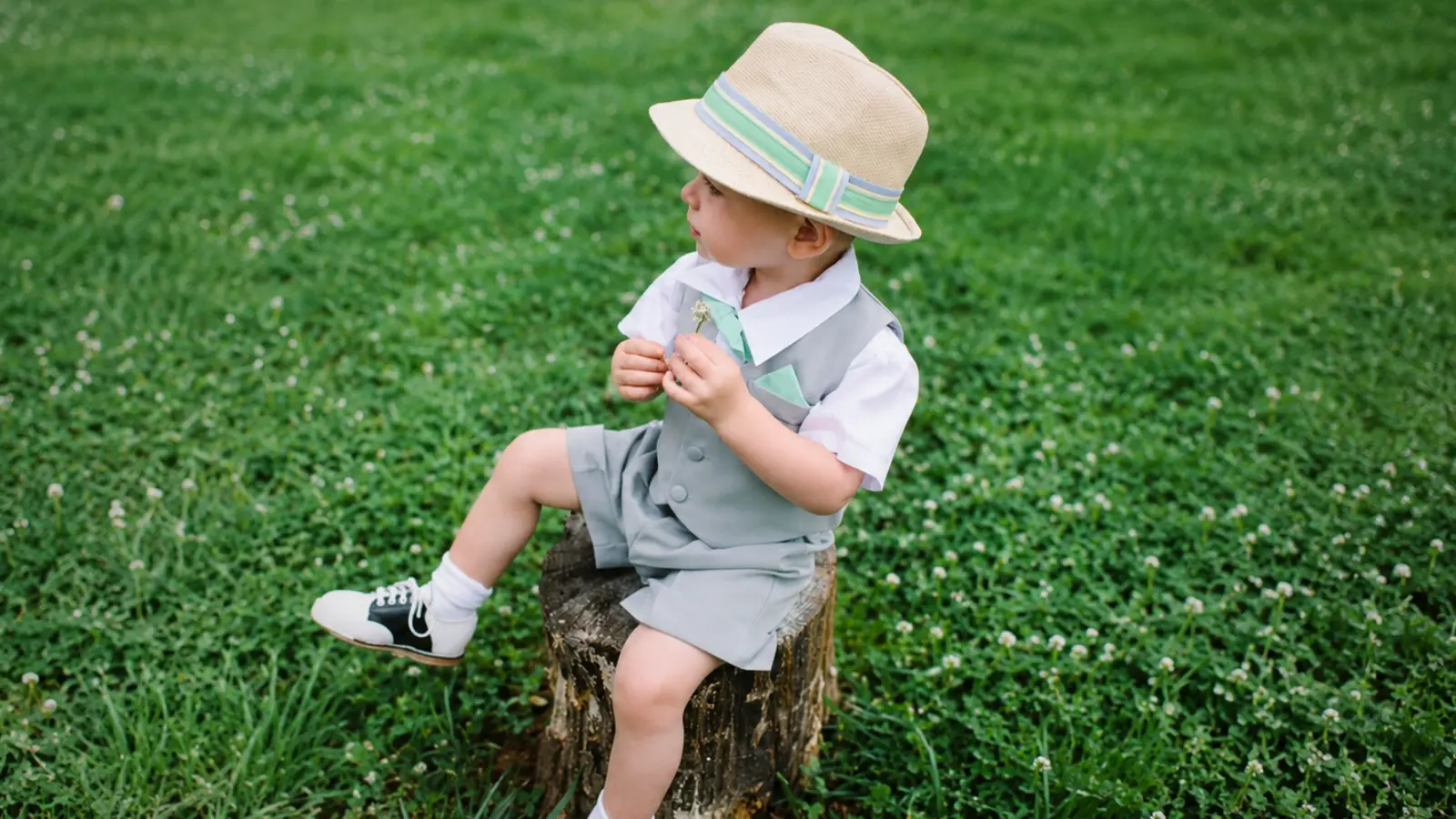
Very young ring bearers need an outfit strategy that accounts for practical realities alongside aesthetic ones. A baby or toddler will be held, carried, seated in a wagon, or walking with an escort — none of which requires the same range of movement as an older child walking independently, but all of which require an outfit that does not become a logistical problem.
For babies and infants, the outfit should be soft, easy to put on and take off, and appropriately formal for the wedding’s dress code without being restrictive. A simple white or ivory romper, a soft linen shirt and coordinating pants, or a properly fitted onesie with a bow tie attached are all workable options depending on the age and the venue. The photographs will be charming regardless of how formally the baby is dressed, because babies in wedding settings are inherently engaging.
For toddlers, the same principles that apply to older ring bearers apply here, but with a stronger emphasis on comfort and practicality. Elastic waistbands or suspenders, soft collar constructions, and shoes the child has actually worn before are especially important at this age. A toddler who is uncomfortable in his clothes will remove them if he can, or make his discomfort visible in ways that are difficult to manage during a ceremony.
Dress shorts with suspenders and a soft dress shirt is the silhouette that consistently works well for children under five. It is wedding-appropriate, age-appropriate, and comfortable in a way that full-length trousers with a tight waistband often is not.
Shoes
Classic dress shoes — leather or leather-look oxfords, loafers, or simple lace-ups in black, brown, or cream — work for most ring bearer outfits and most wedding settings. The style should coordinate with the formality of the outfit: a classic oxford with a formal suit reads correctly; a loafer with a linen shirt and suspenders at a garden wedding is equally appropriate.
The most important thing about the shoes is that they are not new on the wedding day. A child in stiff, unbroken shoes is a child focused entirely on his feet rather than on his processional walk. Have him wear the shoes for at least two or three hours before the ceremony — around the house, to a sibling’s event, anywhere — so they feel familiar. Socks should also be tested with the shoes: thin dress socks can slip and bunch inside formal shoes in ways that a child will not ignore.
For beach and outdoor weddings, loafers without socks, simple leather sandals, or even bare feet (for very young children in an informal beach ceremony) are all workable alternatives. The goal is always that the child can walk, sit, and move without thinking about his feet.
Does the Ring Bearer Need a Boutonniere?
A boutonniere is a finishing touch, not a requirement. It makes the most sense when the ring bearer is wearing a full jacket with a lapel, the groomsmen are also wearing boutonnieres, and the floral design of the wedding includes them as a detail. In that context, skipping it on the ring bearer can make him look slightly unfinished by comparison.
When it is included, keep it proportional. An adult boutonniere on a small lapel looks out of scale; a single small bloom, a tight cluster of baby’s breath, or a simple sprig of greenery sized to a child’s lapel is the right approach. Make sure it is pinned securely — a boutonniere that flops or falls off during the processional is more distracting than not having one.
Skip it if the outfit does not have a lapel, if the child has indicated he finds it annoying, or if the floral budget and the overall look simply do not call for it. A ring bearer without a boutonniere at a wedding where the groomsmen are wearing them is not a mistake — it is a choice, and a reasonable one.
Outfit Choices That Photograph Well
Wedding photography tends to favor certain choices that are worth considering when the outfit is being assembled. None of these are requirements, but they are useful to know when choosing between two options that feel otherwise equal.
Solid colors and simple patterns hold up better in photographs than busy plaids or novelty prints, which can compete with the surrounding composition. Classic silhouettes — a well-fitted suit, clean trousers, a crisp dress shirt — read more timeless in photographs ten years from now than highly trend-specific pieces. Colors that coordinate with the wedding palette rather than contrasting with it integrate into the overall image more naturally.
Fit matters more in photographs than it does in person. An outfit that looks approximately right in the mirror has a way of revealing its imprecision clearly in a photograph — the too-long sleeve, the jacket that pulls across the shoulders, the trousers with a waistband gap in the back. A final fitting close to the wedding day and a few photographs taken in the full outfit before the ceremony can catch any issues while there is still time to address them.
Ring Bearer Outfit Inspiration
Explore ring bearer outfit ideas with suits, tuxedos, suspenders, bow ties, dress shorts, shoes, and wedding looks for formal, outdoor, beach, and seasonal celebrations.
How Do You Choose the Right Ring Bearer Outfit?
The best ring bearer outfit matches the wedding’s formality without making the child uncomfortable. Start with the venue and season, then choose clothing that fits securely, allows easy movement, and coordinates naturally with the groom or groomsmen.
Try the complete outfit before the wedding, including shoes and accessories, and simplify anything the child finds uncomfortable. A polished look works best when he can wear it without spending the ceremony adjusting or thinking about his clothes.
Frequently asked questions (FAQ)
What should a ring bearer wear to a wedding?
A ring bearer should wear an outfit that matches the wedding’s formality while remaining comfortable and age-appropriate. A suit, dress shirt with suspenders, vest, or tailored shorts can all work depending on the venue and season. Coordinate with the groom or groomsmen without forcing the child into an exact miniature version of their outfits.
Should the ring bearer match the groom or the groomsmen?
Either works, but coordination usually looks better than an exact match. Use similar colors, shirts, ties, or overall formality while choosing a child-friendly silhouette. For example, the ring bearer might wear suspenders and a bow tie in the same palette while the groomsmen wear full suits.
Should the ring bearer wear a suit or a tuxedo?
Use the wedding’s dress code as your guide. A tuxedo suits black-tie and very formal ceremonies, while a suit works for most other weddings. For young children, fit and comfort matter more than the label; a well-fitting suit can look just as polished without the stiffness of a traditional tuxedo.
Can a toddler ring bearer wear shorts instead of pants?
Yes. Tailored dress shorts with a soft shirt and suspenders can look polished and age-appropriate, especially for summer, garden, or outdoor weddings. For formal church or evening ceremonies, full-length trousers are usually the better choice. Whatever you choose, prioritize easy movement and comfort.
What shoes should a ring bearer wear?
Oxfords, loafers, or simple dress shoes work for most weddings, while lighter footwear can suit beach or outdoor settings. The most important rule is to break the shoes in before the wedding. A child should be able to walk comfortably without rubbing, slipping, or focusing on sore feet during the processional.
What should a ring bearer wear to a beach or outdoor wedding?
Choose lightweight, breathable pieces such as linen or cotton dress pants or shorts, a soft dress shirt, and suspenders instead of a heavy jacket. Loafers or simple sandals can work depending on the setting. The outfit should still look intentional while keeping the child comfortable in heat, sand, grass, or uneven ground.