
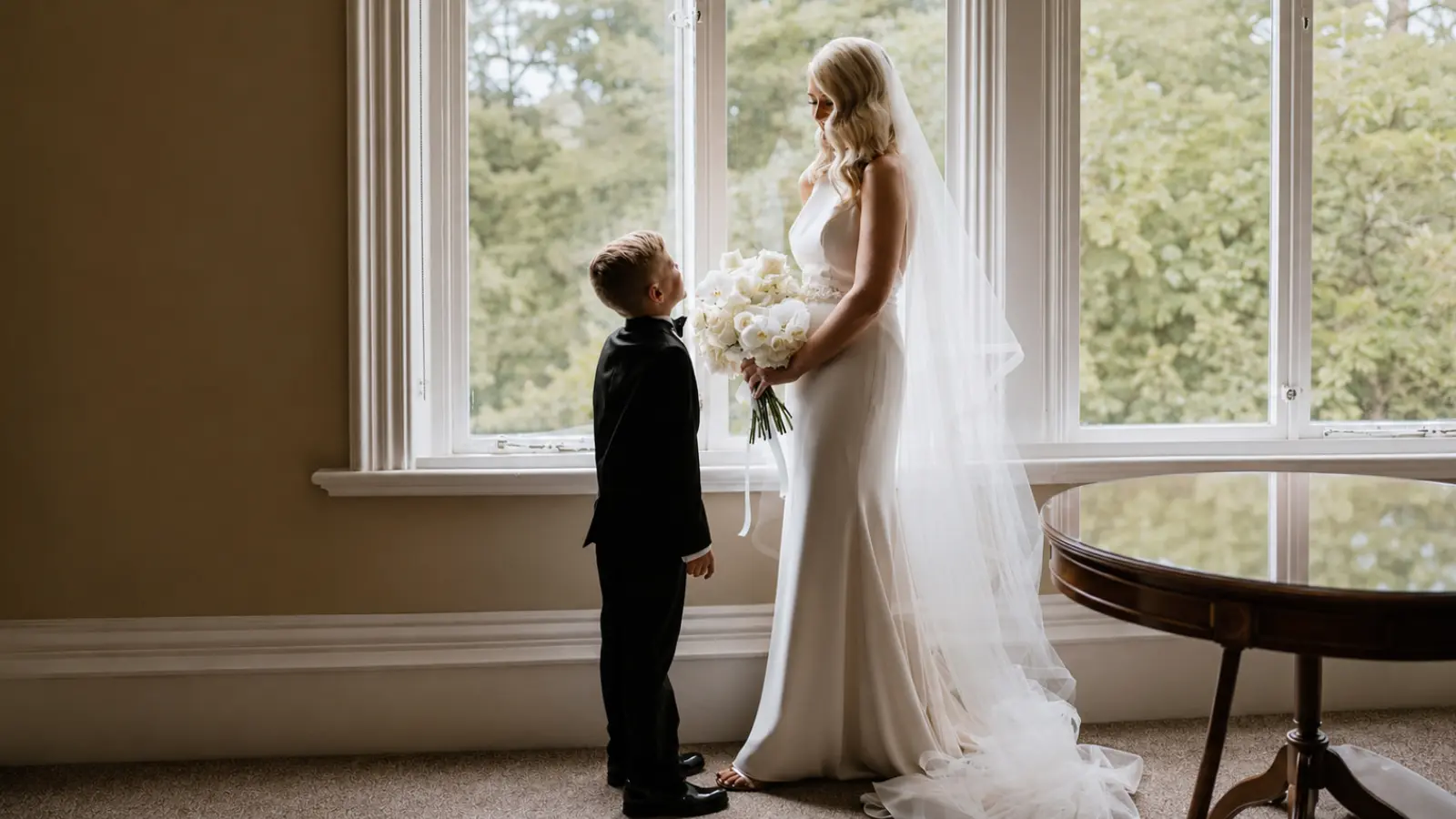
A junior groomsman is a younger member of the groom’s wedding party who participates in the ceremony without taking on all the responsibilities expected of an adult groomsman. The role can be a natural fit for a younger brother, nephew, stepson, or another important young person the couple wants to include.
Unlike a ring bearer, a junior groomsman usually participates more directly with the wedding party, whether by walking in the processional, standing with the groomsmen, joining photos, or helping with simple ceremony tasks. His exact responsibilities should reflect his age, comfort level, and relationship with the couple.
This guide explains the junior groomsman role from start to finish, including typical age, duties, attire, processional placement, how the role differs from a ring bearer, groomsman, and usher, plus proposal ideas, gifts, and ways to include him without unnecessary pressure.
What Is a Junior Groomsman?
A junior groomsman is a young male member of the wedding party who walks in the processional, participates in photos, and represents the groom’s side of the ceremony — but without the logistical and financial obligations that come with being an adult groomsman. The role is most often filled by a younger brother, nephew, stepson, or the child of a close family friend; someone the couple is genuinely close to and wants visibly included.
The title is not universally standardized, which means couples have some flexibility in how they define it. Some junior groomsmen stand at the altar for the full ceremony; others walk the aisle and then sit with their family. Some help pass out programs; others simply show up dressed well and walk. The common thread is that he is officially part of the groom’s side of the wedding party — and that his role is shaped around his age, not borrowed from an adult template.
Junior Groomsman Meaning: Where He Fits
The junior groomsman role exists because the wedding party structure, as traditionally organized, does not have a natural place for older children and young teens. Younger children have the ring bearer and page boy roles. Adults have groomsman and best man. That can leave older children and young teens in an in-between stage between the two roles.
The junior groomsman fills that gap deliberately. He is not a ring bearer with a different name, and he is not an adult groomsman with reduced expectations. He is his own role, designed for where he actually is developmentally. Understanding the progression helps clarify where he belongs:
| Role | Best Age | Main Function |
|---|---|---|
| Ring Bearer | Usually 3–8 | Walks with a ring pillow or symbolic item; sits with family after |
| Page Boy | Young child, similar to ring bearer | Traditional child attendant; may carry train, sign, or rings |
| Junior Groomsman | Older child or teen, roughly 9–15 | Walks in the processional with or near the wedding party; ceremonial presence |
| Groomsman | Adult | Full wedding party responsibilities: processional, ceremony, photos, bachelor party |
Seeing the four roles together shows where the junior groomsman can fit: it gives an older child or young teen a wedding-party role without treating him like either a young ring bearer or an adult groomsman.
Best Age for a Junior Groomsman
The junior groomsman role generally works best for boys between nine and fifteen. That range reflects the window between outgrowing the ring bearer role and being ready — practically and emotionally — for the full responsibilities of an adult groomsman. Within that span, there is a lot of variation, and the number matters less than the child in front of you.
A nine or ten-year-old junior groomsman is often enthusiastic and easy to work with. He takes cues well, understands that the role is important, and generally does not mind the suit. The challenge is attention span during a longer ceremony and the possibility of self-consciousness in front of a crowd. Preparation and a clear rehearsal walk help significantly.
A thirteen or fourteen-year-old may be more composed and camera-ready, but he may also be at the age where anything that feels performative or childish triggers resistance. For this age group, framing matters — he should be asked in a way that feels grown-up, given a role that reflects his age, and included in the processional alongside the adult groomsmen rather than treated as the youngest person in the party.
Junior Groomsman vs Ring Bearer
The two roles serve different children at different developmental stages, and they should not be treated as interchangeable. The ring bearer role is built around the limitations of a young child: it is brief, ceremonial, and designed so that even a four-year-old can succeed at it. The junior groomsman role is built around the capabilities of an older child: it expects more composure, more follow-through, and a more sustained presence in the wedding party.
The differences in practice look like this:
- Age: Ring bearer is typically three to eight; junior groomsman is typically nine and up.
- Function: The ring bearer carries a pillow or symbolic item and hands it off; the junior groomsman walks in the processional as a member of the party.
- Post-ceremony role: The ring bearer sits with his family after the walk; the junior groomsman may stand at the altar or remain near the wedding party for photos and parts of the reception.
- Attire: Ring bearers often wear bow ties and a more playful version of the wedding palette; junior groomsmen typically dress to coordinate closely with the adult groomsmen.
- Expectations: The ring bearer’s success is measured by walking the aisle without incident; the junior groomsman is expected to hold it together for a longer portion of the day.
The clearest sign that a boy has outgrown the ring bearer role is not age on a calendar — it is when carrying a pillow down an aisle starts to feel embarrassing to him. That shift is worth paying attention to.
When Is a Boy Too Old to Be a Ring Bearer?
There is no universal cutoff, but the transition usually becomes apparent somewhere around eight or nine years old. At that age, many boys develop a sharp awareness of how they look to others — and the ring bearer role, with its small suit, ceremonial pillow, and position as the youngest person in the processional, can start to feel childish in a way that makes them uncomfortable rather than proud.
The factors that matter beyond ring bearer age are the child’s own personality and how he talks about the role. A confident, unselfconscious nine-year-old who is genuinely excited about being a ring bearer should be a ring bearer. A nine-year-old who went quiet when you mentioned it and has been finding reasons not to talk about the wedding is telling you something. The junior groomsman role exists precisely for that second child.
It is also worth asking the child’s parents. They know better than anyone whether their son is the type to walk proudly down the aisle in a miniature suit or the type who will spend the week before the wedding dreading it. That conversation, held honestly, is the most reliable guide to which role fits.
Junior Groomsman vs Groomsman
The distinction here comes down to responsibility and expectation. An adult groomsman takes on real logistical obligations: he contributes to the bachelor party, typically covers his own suit or tuxedo rental, attends all required pre-wedding events, and in some cases delivers a toast. These are adult-sized commitments that require adult-sized resources and judgment.
The junior groomsman has none of that. His obligations are ceremonial: attend the rehearsal, show up on the wedding day dressed appropriately, walk in the processional, and be present for photos. He is not expected to contribute financially to anything, he does not attend bachelor parties, and no one is handing him a microphone at the reception dinner. He is included in the spirit of the role, not burdened with its logistics.
This distinction is important to communicate clearly — to him and to his parents. A family that agrees to have their twelve-year-old serve as a junior groomsman should understand from the start that the role asks only what is age-appropriate, and that the couple is responsible for making that experience as easy and enjoyable as possible.
Junior Groomsman vs Usher
The usher is a specific ceremonial role focused on guest logistics: greeting people as they arrive, escorting them to their seats, and distributing programs. It is a visible, social role that suits a confident, extroverted young person who enjoys interacting with guests more than standing quietly at the altar.
For a junior groomsman who is older and socially at ease — a fifteen-year-old who is comfortable making conversation with adults and guiding people to their seats — folding in some usher duties is a natural option. For a younger or more introverted child, the usher role on its own can be more pressure than the junior groomsman role, because it requires initiating conversation with strangers. In practice, many junior groomsmen do both: they walk in the processional as part of the wedding party and help hand out programs before the ceremony begins.
What Does a Junior Groomsman Do?
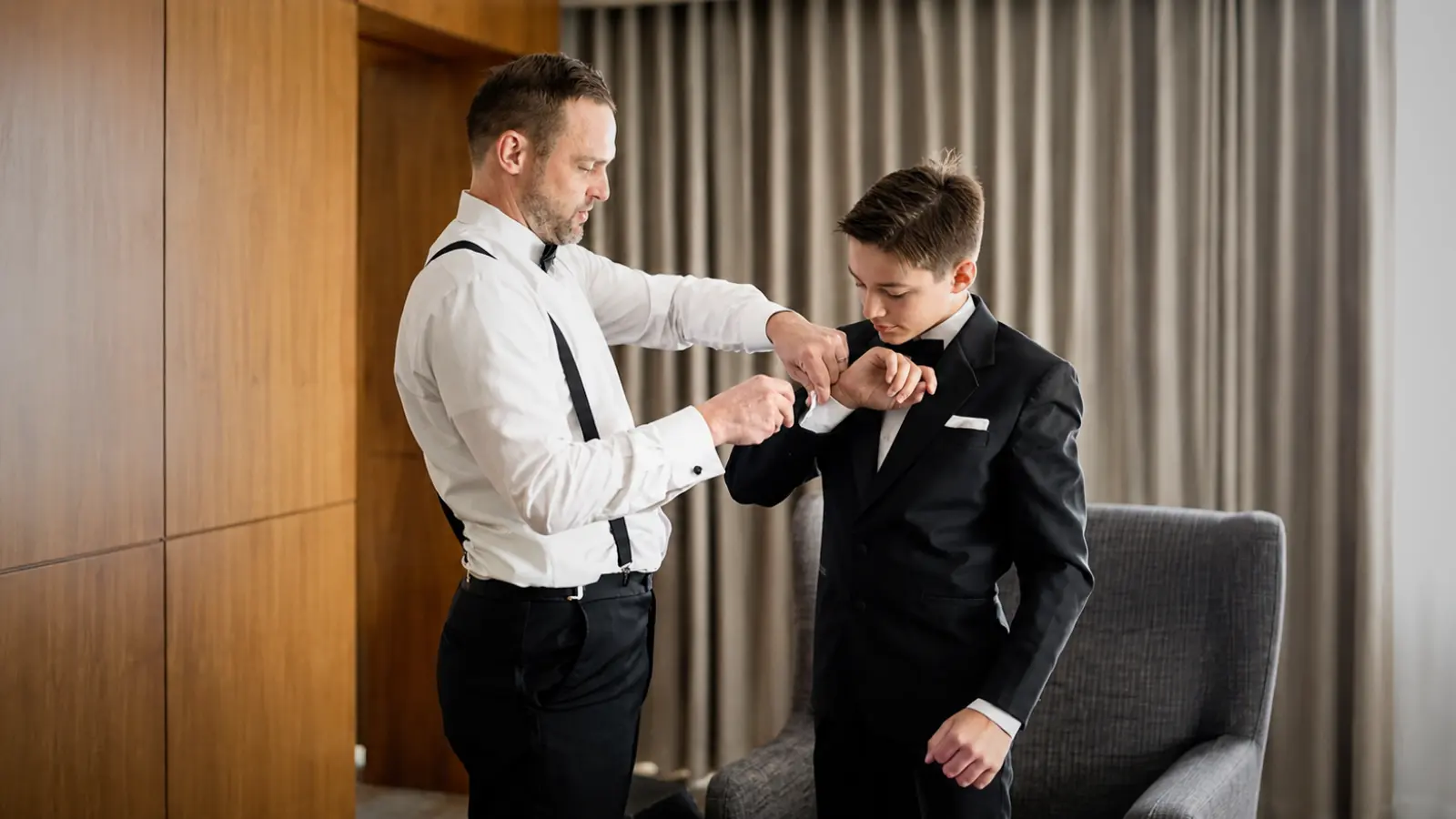
The junior groomsman’s responsibilities center on the ceremony, with some participation in surrounding events. What exactly he takes on depends on his age, his relationship to the couple, and how much involvement feels right for him. Here is what the role typically covers:
- Rehearsal: He attends the rehearsal, learns the processional order, practices his walk, and understands where he is going and who he is standing near during the ceremony. This is the most important preparation step, and it should not be treated as optional.
- Wedding day: He gets ready with or near the groom’s party, which for many boys is genuinely enjoyable — the getting-dressed moment, the photos before the ceremony, the sense of being part of something organized and important.
- Processional: He walks down the aisle as part of the wedding party, typically paired with a junior bridesmaid or walking alongside one of the adult groomsmen.
- Ceremony: Depending on the child and the ceremony length, he may stand at the altar with the wedding party or be seated with his family after the processional. Both are acceptable; the decision should be made based on his age and the ceremony’s length.
- Photos: He is included in wedding party photos, which typically takes place before or after the ceremony. This is often the part boys enjoy most — being part of the group, looking sharp, feeling recognized.
- Light tasks: Older junior groomsmen may help hand out programs, direct guests to their seats, or carry small items. These should be clearly explained in advance and chosen to match his comfort level.
The rehearsal dinner is another natural event to include him in — age-appropriately and without expectation of formal participation. His presence at these surrounding events deepens his connection to the wedding and reduces any nervousness about the day itself.
Does He Walk Down the Aisle?
Yes, walking in the processional is the defining moment of the junior groomsman role, and it is what distinguishes the role most clearly from simply attending the wedding as a guest. He enters with the wedding party, not after everyone else is seated.
In many American wedding processionals, a junior groomsman walks before or alongside the other groomsmen, depending on how the wedding party is arranged. If there is a junior bridesmaid, the two often walk together, which can be a natural pairing that helps both children feel more comfortable. If there is no junior bridesmaid, he may walk alongside an adult groomsman or enter as part of the groomsmen group.
The specific pairing and timing should be worked out at the rehearsal so that neither he nor the rest of the wedding party is improvising on the day. One walk-through on the actual aisle, at the actual pace, makes an observable difference in how comfortable he is when the music starts.
Does He Stand With the Groomsmen?
This is one of the more flexible aspects of the role, and the right answer depends on the child’s age and the length of the ceremony. For a mature thirteen or fourteen-year-old who is composed and genuinely comfortable, standing at the altar with the wedding party throughout the ceremony is appropriate and meaningful. For a ten-year-old at a forty-five-minute religious ceremony, it is probably too much to ask — and asking it sets both of you up for a difficult moment when he starts fidgeting during the vows.
A reasonable middle ground for younger junior groomsmen is to stand with the party for the first portion of the ceremony — through the processional and opening remarks — and then be seated with his family. This can be arranged quietly in advance and communicated to the officiant. Guests will not notice the transition, and the child will be more comfortable for the rest of the day. The meaningful part of the role is the walk and the presence; the standing is secondary to both.
Junior Groomsman Attire
The guiding principle for dressing a junior groomsman is that he should look like he belongs in the wedding party — not like a small copy of an adult groomsman, and not like a ring bearer with a longer tie. The goal is coordination with the adult party, adapted appropriately for his age and size.
Unlike a typical ring bearer outfit, most junior groomsmen wear a suit or formal separates in the same color family as the adult groomsmen. Navy, charcoal, gray, and ivory are common choices that work across most wedding aesthetics and are available in boys’ sizing. The suit does not need to match exactly — slight variations in cut, texture, or formality level are expected — but the overall visual should read as cohesive when the wedding party stands together in photos.
A few specific considerations by element:
- Suit vs. tuxedo: Follow the wedding’s formality. If the groomsmen are in tuxedos, the junior groomsman can wear one as well, or a formal black suit as a near-equivalent. If the groomsmen are in suits, the junior groomsman does the same.
- Tie vs. bow tie: This is a detail worth getting right. If the adult groomsmen are wearing neckties, the junior groomsman should wear one too — it signals that he is part of the adult side of the party, not the children’s section. If the wedding aesthetic skews more relaxed, a bow tie can work for a younger junior groomsman without looking out of place.
- Vest: A vest over a dress shirt is a practical option when the groomsmen’s suit jacket is not available in the junior groomsman’s size. It photographs well, reads as formal, and is often more comfortable for a child who is not used to wearing a full jacket.
- Shoes: Dress shoes in black or brown leather, depending on the suit color. They should be worn at least once before the wedding day — a child walking a long aisle in brand-new, stiff shoes is a recipe for visible discomfort in photos.
- Seasonal adjustments: For outdoor summer weddings, linen suits are a practical alternative that keeps the child comfortable without sacrificing the visual. For winter weddings, a heavier wool suit or a vest with a long-sleeve shirt are appropriate options.
Involve him in the suit shopping if possible. For an older boy, especially a teen, being included in the choice — even just selecting between two options — makes a difference in how he feels wearing it on the day.
Junior Groomsman and Junior Bridesmaid
When the wedding party includes both a junior groomsman and a junior bridesmaid, the natural instinct is to pair them for the processional walk — and it is usually the right call. Walking alongside someone their own age reduces the self-consciousness that comes with being the only young person in a line of adults, and it gives both children a clear point of reference during the ceremony.
The pairing does not require any family relationship between them. A junior groomsman who is the groom’s younger brother and a junior bridesmaid who is the bride’s cousin have never met before the rehearsal in many cases, and they still manage the walk together without issue. A brief introduction at the rehearsal — and a straightforward explanation of what the walk will look like — is all the preparation they typically need.
If the junior groomsman and junior bridesmaid are close in age and know each other well, the pairing can make both children genuinely more confident on the day. If there is a significant age gap or a known awkwardness between them, it is worth considering whether pairing them with an adult party member on their respective sides might work better.
How to Ask: Proposal Ideas
Asking a junior groomsman is different from asking an adult groomsman, and it is different again from asking a ring bearer. With an older child or teen, the ask should feel genuinely meaningful — not packaged as a kids’ activity, but not treated as a business conversation either. He is old enough to feel the weight of being chosen, and the proposal should reflect that.
Start with his parents. Before the child knows anything is coming, make sure his parents are aware of the role and what it involves — attire responsibilities, the rehearsal, which events he will be included in. This is especially important if the couple is responsible for covering any costs, which should be clarified up front.
Once the parents have said yes, a few approaches that tend to land well with older boys and teens:
- A card with a personal note. A handwritten or printed card that asks “Will you be my junior groomsman?” and includes a line about why he was chosen — something specific to him, not generic — is often the most meaningful approach. Older boys notice when the ask feels personal versus when it feels obligatory.
- A proposal box. A small box with the card, a fun item tied to his interests (a sports-themed gift, a book, a personalized tumbler), and possibly something he will wear on the wedding day creates a moment worth remembering. Keep it age-appropriate — a ring bearer proposal that works beautifully for a younger child may feel babyish to a thirteen-year-old.
- In person, directly. For a close family member — a younger brother, a stepson — asking in person without an elaborate package is often the most authentic approach. The conversation, held seriously and warmly, may mean more than any gift.
The timing should be similar to the rest of the wedding party: a few months to about a year before the wedding, with enough lead time for the family to plan logistics but not so far out that the excitement fades before the day arrives.
Junior Groomsman Gift Ideas
A thank-you gift after the wedding is appropriate and appreciated — both as recognition of the child’s participation and as something he will remember the role by. The key is calibrating to his actual age and interests, not to a generic template of what a groomsman gift looks like.
Adult groomsman gifts — engraved flasks, cigar sets, bottles of bourbon — are not appropriate for a thirteen-year-old. A scaled-down version of those things misses the point. The better approach is something that fits who he is and what he is into right now:
- Personalized sports gear. An engraved baseball, a custom jersey, a personalized football — sports-themed gifts work well for boys between nine and fifteen and feel genuinely personal when they carry his name or the wedding date.
- A watch. For a teen on the older end of the range, a simple dress watch is a gift that connects to the wedding-day experience of dressing up and feeling grown-up, and it is something he can actually wear.
- A book or journal. For a teen who reads or writes, a book in a series he follows or a quality journal with a brief note inside is a thoughtful choice that most boys in this age range will not expect — and that tends to stick with them.
- Experience-based gifts. A gift card to a restaurant he likes, tickets to a game, or a subscription to something he uses are practical, personal, and genuinely enjoyable in a way that an engraved money clip is not for a twelve-year-old.
- A personalized keepsake. A custom hanger engraved with his name and the wedding date, a framed photo from the ceremony with a brief note from the couple, or an engraved wooden box — these are understated but lasting, especially for a teen who is old enough to appreciate the sentiment.
A photo from the wedding, paired with a short note from the couple, often turns out to be the gift that means the most over time — even if it does not produce the biggest reaction in the moment.
How to Include Him Without Pressure
The junior groomsman role works best when it is genuinely adapted to the child — not when an adult version of the role is handed to a young person and he is expected to rise to it. Keeping the experience positive requires a few deliberate choices.
Explain the role clearly, early, and directly to him — not just to his parents. What will he wear? What does the walk look like? Who will he be standing near? Where does he go after the processional? These are the questions he will have, and answering them before the rehearsal reduces nervousness considerably. A child who knows what to expect walks the aisle differently than one who is figuring it out in real time.
Include him in the rehearsal dinner if the guest list allows it. The rehearsal itself is essential, but the dinner afterward is where he starts to feel like part of the group rather than a kid who was invited to an adult event. That sense of belonging is part of what makes the role meaningful for him.
Do not assign him responsibilities he is not ready for. Handing a ten-year-old a program to distribute sounds manageable until he is standing at the venue entrance trying to make conversation with two hundred adult guests. Match any tasks to his actual confidence level, and give him an adult nearby who can step in without making it a big deal.
What to Avoid
Most of the mistakes couples make with the junior groomsman role come from one of two directions: treating him like a ring bearer who outgrew the pillow, or treating him like a small adult groomsman who just happens to need a shorter inseam. Neither framing serves him well.
- Assigning adult-sized obligations. No financial contributions, no bachelor party, no toast expectations. The role is ceremonial. If he ends up doing more than that because he wants to, that is a bonus — not the baseline.
- Skipping the rehearsal conversation. He needs to know exactly what his role involves before he gets to the venue on the wedding day. A teen who is surprised by what is asked of him is a teen who either shuts down or visibly resists, neither of which is the processional moment you planned for.
- Dressing him in something uncomfortable. The suit matters less than whether he can move in it and has worn it before the day. An ill-fitting suit worn for the first time is uncomfortable for everyone who has to look at it.
- Pressuring him to be enthusiastic. Some boys, especially teenagers, are genuinely glad to be included but would never volunteer to show it. That is fine. He does not need to seem excited; he needs to show up, dress well, and walk. Everything else is optional.
- Leaving him without a clear contact person. He should know who to go to if something goes wrong — a parent nearby, a groomsman he knows, or a coordinator who has been briefed. A child left to figure things out alone at a wedding can spiral quickly.
The junior groomsman who feels respected, prepared, and genuinely included — rather than obligated or overlooked — is the one who walks that aisle like he belongs there. Because he does.
Junior Groomsman Ideas & Inspiration
Explore junior groomsman attire, suits, proposal ideas, gifts, processional inspiration, and thoughtful ways to include him in your wedding party.
How to Make the Junior Groomsman Role Work
A junior groomsman does not need the responsibilities of an adult groomsman to feel like a meaningful part of the wedding party. Give him a clear role, explain what to expect, choose comfortable attire, and decide how much of the ceremony he will participate in based on what works for him.
The title matters less than creating a role that feels appropriate and genuinely inclusive. When expectations are clear and flexible, a junior groomsman can participate alongside the wedding party without being treated either like a young ring bearer or an adult groomsman.
Frequently asked questions (FAQ)
What is a junior groomsman?
A junior groomsman is an older child or young teen who joins the groom’s side of the wedding party without taking on adult groomsman responsibilities. He usually walks in the processional, participates in wedding party photos, and may stand near the groomsmen during the ceremony. The role commonly fits boys around nine to fifteen.
What is the best age for a junior groomsman?
Most junior groomsmen are between nine and fifteen years old, although maturity matters more than a strict age cutoff. The role works well for boys who have outgrown being ring bearers but are not yet ready for the expectations of an adult groomsman. The child’s comfort with the role should guide the decision.
What is the difference between a junior groomsman and a ring bearer?
A ring bearer is usually a younger child with a brief ceremonial role, such as carrying a pillow or symbolic item down the aisle before sitting with family. A junior groomsman is older, walks as part of the wedding party, may stand during the ceremony, participates in photos, and can handle light age-appropriate responsibilities.
How is a junior groomsman different from an adult groomsman?
A junior groomsman participates ceremonially without the adult obligations expected of full groomsmen. He should not be responsible for bachelor parties, financial contributions, or formal speeches. His role usually includes the rehearsal, processional, ceremony, and photos, with any additional tasks kept simple and appropriate for his age.
Does a junior groomsman walk down the aisle?
Yes. Walking in the processional is one of the main parts of the role. He may walk with a junior bridesmaid, alongside an adult groomsman, or as part of the groomsmen group. The exact order should be practiced at the rehearsal so he knows where to walk and where to go afterward.
Does a junior groomsman wear the same suit as the groomsmen?
He should coordinate with the groomsmen, but an exact match is not always necessary. Use the same color family and level of formality while adapting the cut and details to his age and size. A vest, different jacket cut, or age-appropriate tie can keep the look cohesive without forcing an adult suit onto a younger body.