
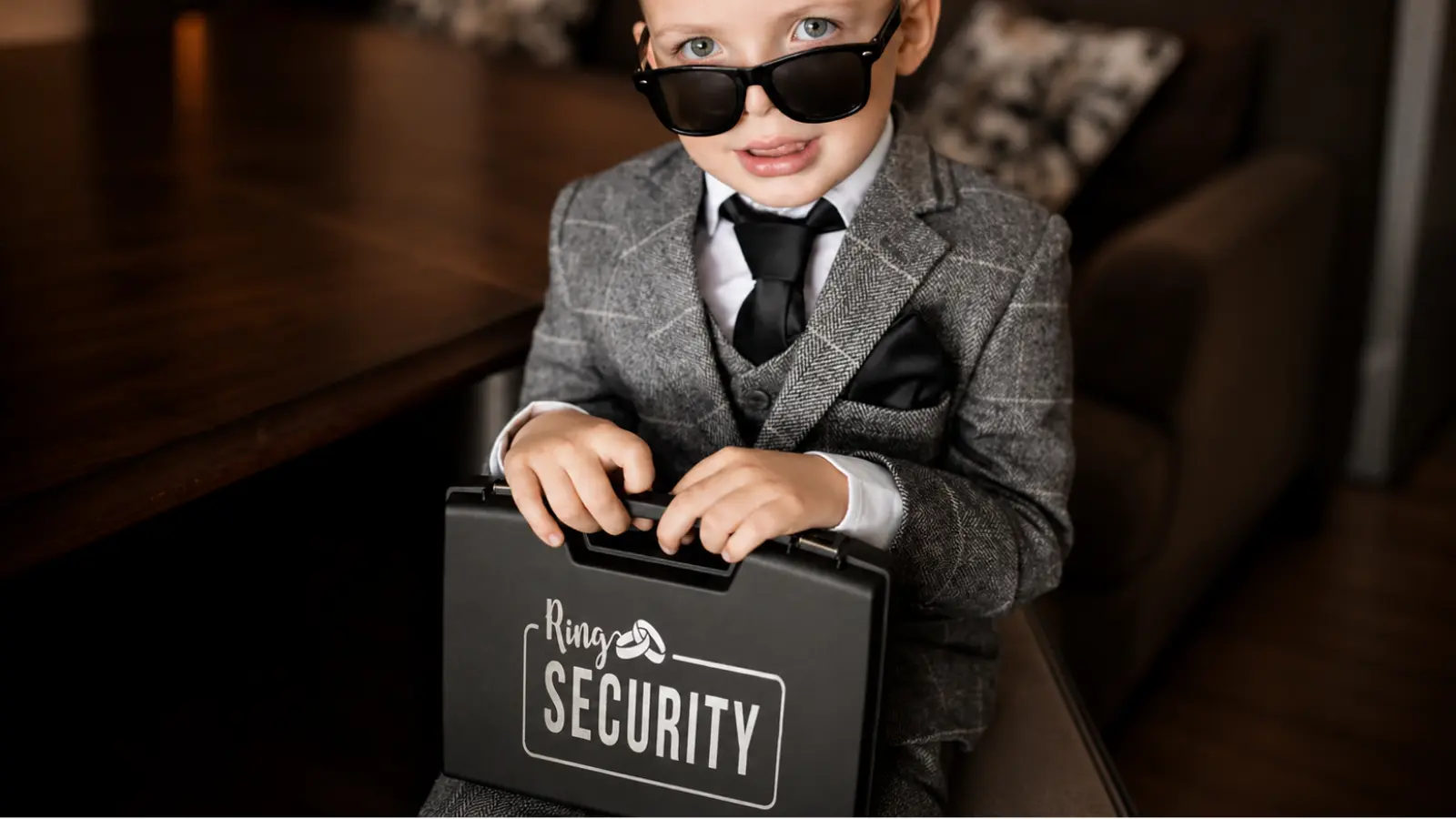
Ring bearer ideas can be traditional, playful, modern, or completely personal to your wedding. A classic pillow still works beautifully, but boxes, signs, wagons, paired entrances, pets, and other creative choices can make the processional feel more connected to the child and the celebration.
The best idea is not necessarily the most elaborate one. It should fit the ring bearer’s age and comfort level, make sense for the ceremony style, and be simple enough to work naturally when the processional actually begins.
This guide explores ring bearer ideas for different wedding styles, including classic pillows, personalized boxes, signs, ring security, wagons, multiple ring bearers, walking companions, girls, adults, pets, and practical tips for choosing an idea that fits your ceremony.
The Classic Pillow
The traditional ring bearer pillow is traditional for a reason: it is immediately recognizable, works across virtually every wedding style when chosen in the right material, and creates a clean, familiar processional moment. At a formal church ceremony or an elegant ballroom wedding, it is often still the right call — not because it is the default, but because it genuinely fits.
What makes the pillow idea work well is the detail in execution. A satin pillow with the rings tied with ribbon, in a size appropriate for the child carrying it, held by a child who has practiced the walk at least once — that is the version that photographs well and proceeds without incident. The most common problem with the classic pillow is not the concept itself but the rings left unsecured on a slippery surface, which is an entirely preventable issue. If the pillow is the choice, secure the rings with a ribbon loop before the rehearsal, not after.
The Ring Box or Personalized Case
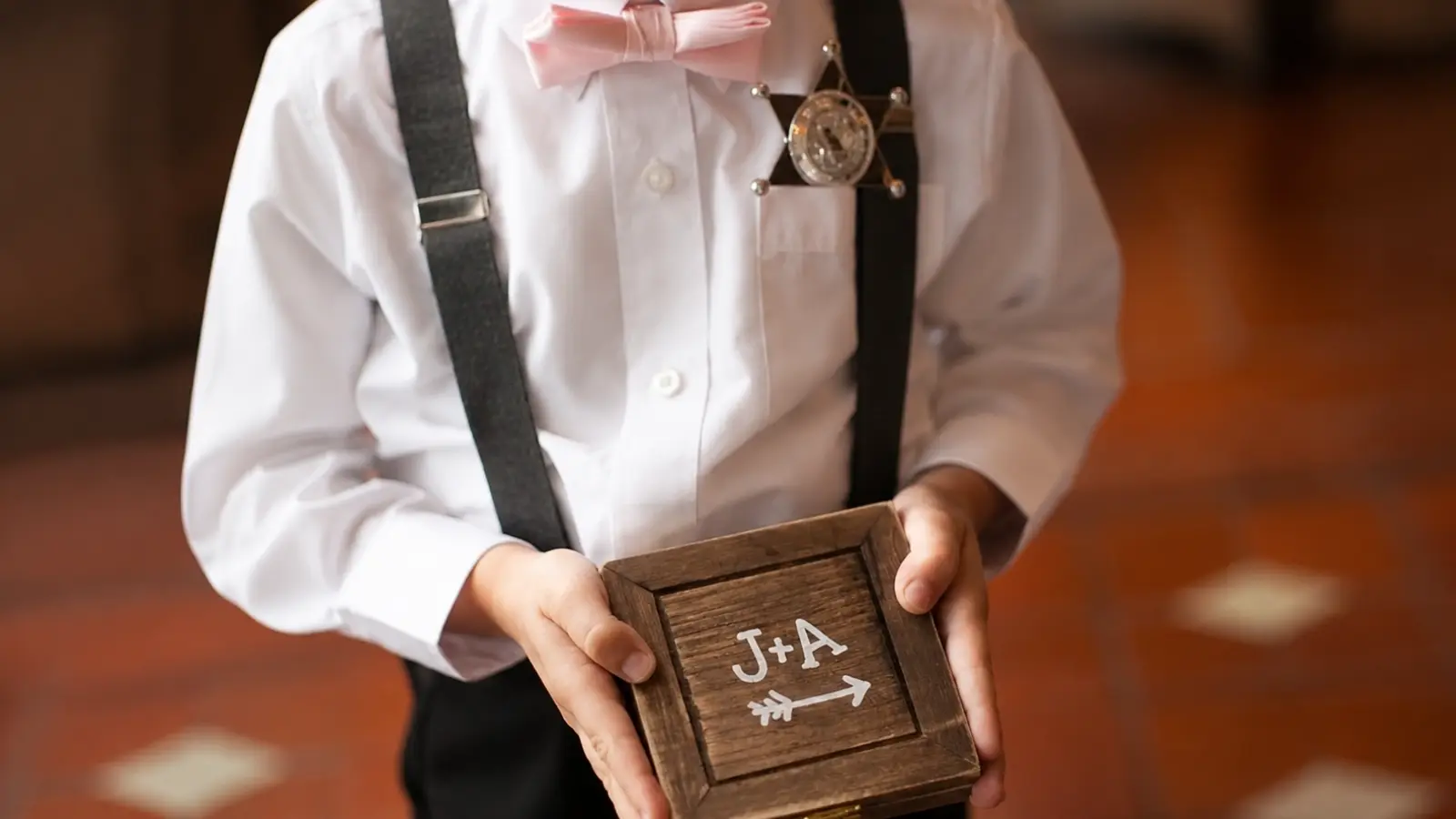
A ring box has become one of the most popular modern alternatives to the pillow, and the appeal is practical as much as aesthetic. A box is easier for a young child to hold than a flat pillow — it has defined edges, a natural grip, and keeps the rings contained inside rather than exposed on top. The moment when the officiant opens the lid at the altar also adds a small ceremonial beat that the pillow does not have.
Wooden boxes — raw, stained, or laser-engraved with the couple’s initials or wedding date — are a natural fit for garden, rustic, and outdoor weddings. Acrylic and lucite boxes suit modern, minimal ceremonies. Velvet-covered or fabric-lined boxes bridge the gap between the softness of the pillow and the structure of the box format. A personalized ring bearer box is also one of the easier items to keep as a keepsake after the wedding, which gives it a secondary value beyond the ceremony itself.
Whatever box is chosen, the interior should hold the rings securely — in a fitted ring groove or a lined slot — rather than leaving them loose in an open cavity. Test the interior with rings of the same size before the rehearsal.
The Ring Bearer Sign
A ring bearer sign is one of the most forgiving ideas for young children because it removes the ring-securing problem entirely. When a toddler or a very young ring bearer carries a sign, the actual wedding rings can stay with the best man or another trusted adult, while the child simply carries something light, flat, and easy to hold.
Sign wording falls into two broad camps: sweet and playful. “Here come the rings” works at any wedding regardless of tone and is readable at a distance without being too small or too wordy. Playful options like “Last chance to run,” “She said yes,” or “Don’t drop these” work well at casual and outdoor weddings where guests will appreciate the humor. At a formal church ceremony, a playful sign can feel slightly out of register with the surrounding solemnity, so the choice should match the overall mood.
Keep the sign short enough to read at a glance from a seated position fifteen feet away. Two short lines maximum; one is better. The child will be moving, which means the sign will be moving, and anything with more than a few words becomes difficult to read in the moment.
Ring Security
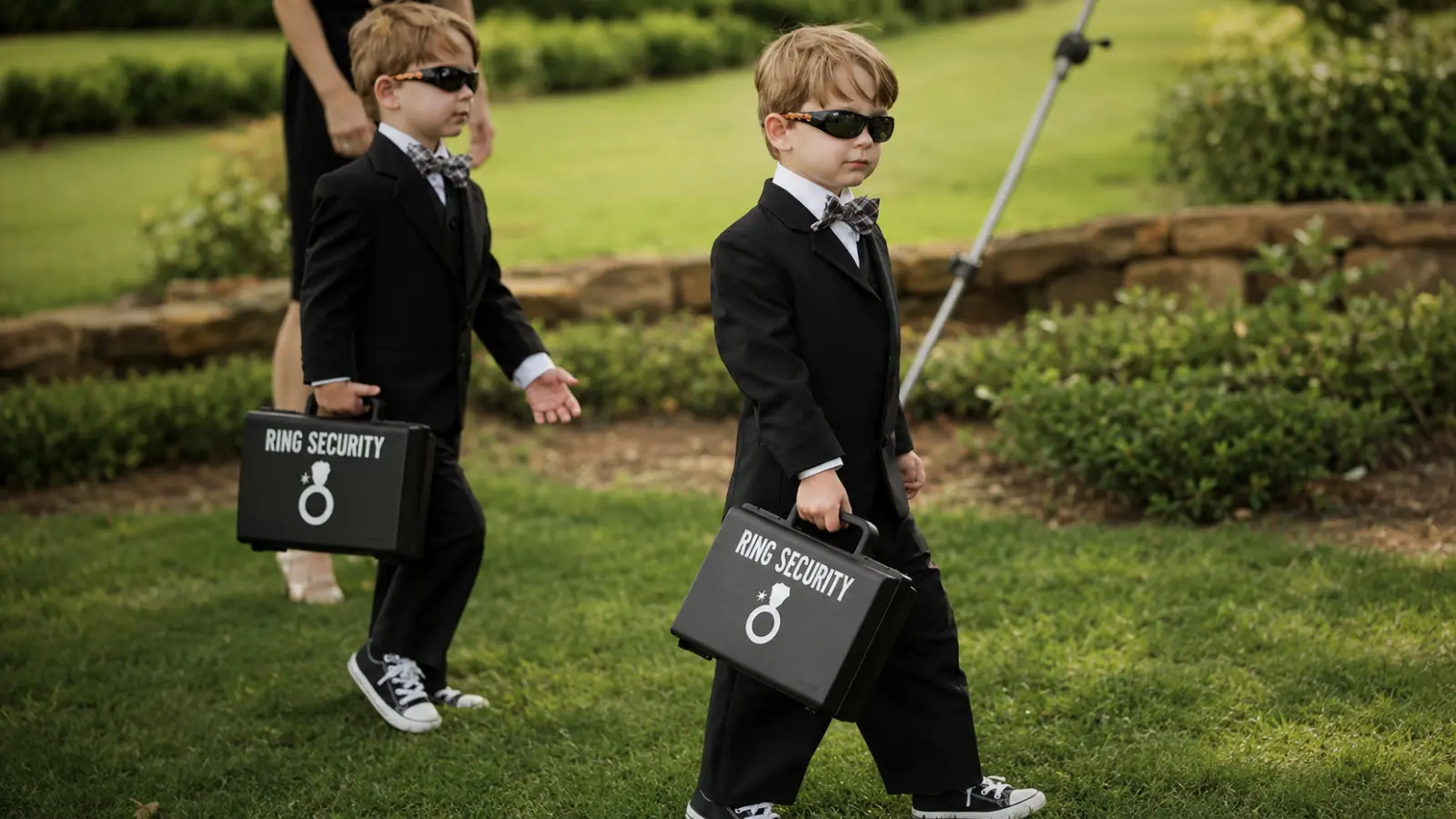
The ring security idea — where the ring bearer is styled as a small secret agent, typically carrying a miniature briefcase and sometimes wearing a tiny earpiece — has become one of the most shared ring bearer concepts in recent years, and for the right wedding, it earns every reaction it gets. A small boy in a suit, walking very seriously down the aisle with a briefcase labeled “Top Secret” or “Handle With Care,” reads as genuinely funny to guests who appreciate that kind of humor.
The concept works best at relaxed, outdoor, and casual weddings where the couple’s personality already leans playful. At formal or traditional ceremonies, the costume element can feel jarring against an otherwise elegant processional. The test is simple: if the idea makes the couple laugh out loud when they picture it, it probably fits their wedding. If it feels like something they are doing because they saw it online, it may not.
Practically, the rings in the briefcase should almost always be decorative replicas, with the real rings held by the best man. A child carrying a prop briefcase does not need the additional responsibility of the actual rings, and the moment at the altar works identically either way. Keep the briefcase sized appropriately for the child — an oversized prop can become difficult to carry down the full length of the aisle.
The Wagon Entrance
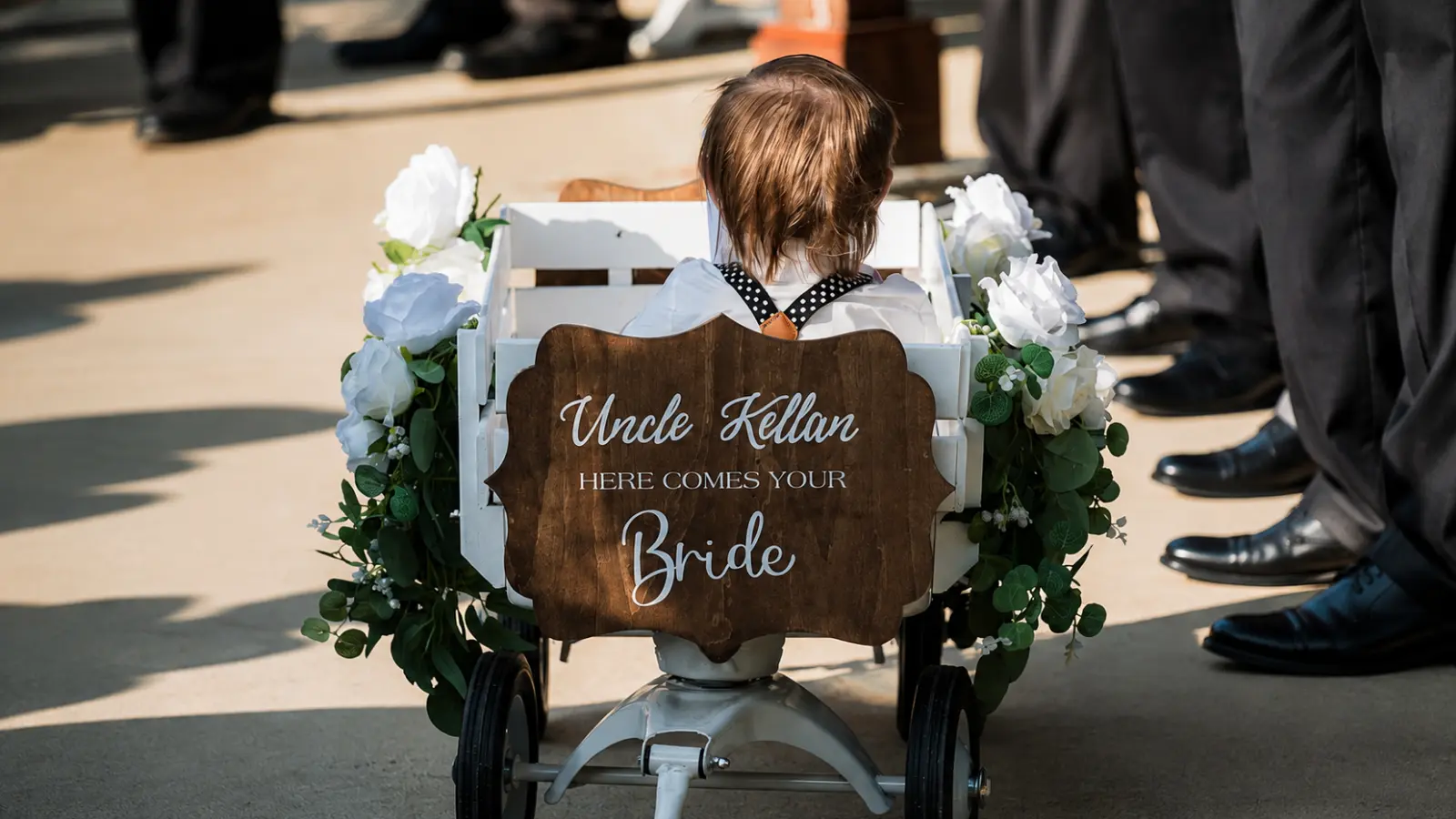
For babies, infants, and toddlers at younger ring bearer ages who cannot walk the aisle independently — or who can walk but are unlikely to do so in a straight line at a pace that matches the processional — a decorated wagon is a solution that photographs beautifully and removes the logistical pressure of an unsupported toddler walk.
The wagon works best when it is styled simply and cleanly. A light wood wagon with ribbon, a small floral arrangement, or a fabric drape in the wedding’s palette reads as intentional; a heavily decorated wagon can tip into novelty. The person pulling the wagon is part of the processional moment whether they want to be or not, so choose someone who is comfortable with a full room watching them walk slowly down an aisle.
One practical note that is easy to overlook: test the wagon on the actual ceremony surface before the day. A wagon that rolls smoothly on hardwood can be surprisingly resistant on thick carpet, and a wagon that catches or lists to one side during the processional is a problem that advance planning can entirely prevent. One rehearsal pull-through on the real surface is worth more than any amount of preparation elsewhere.
Two Ring Bearers
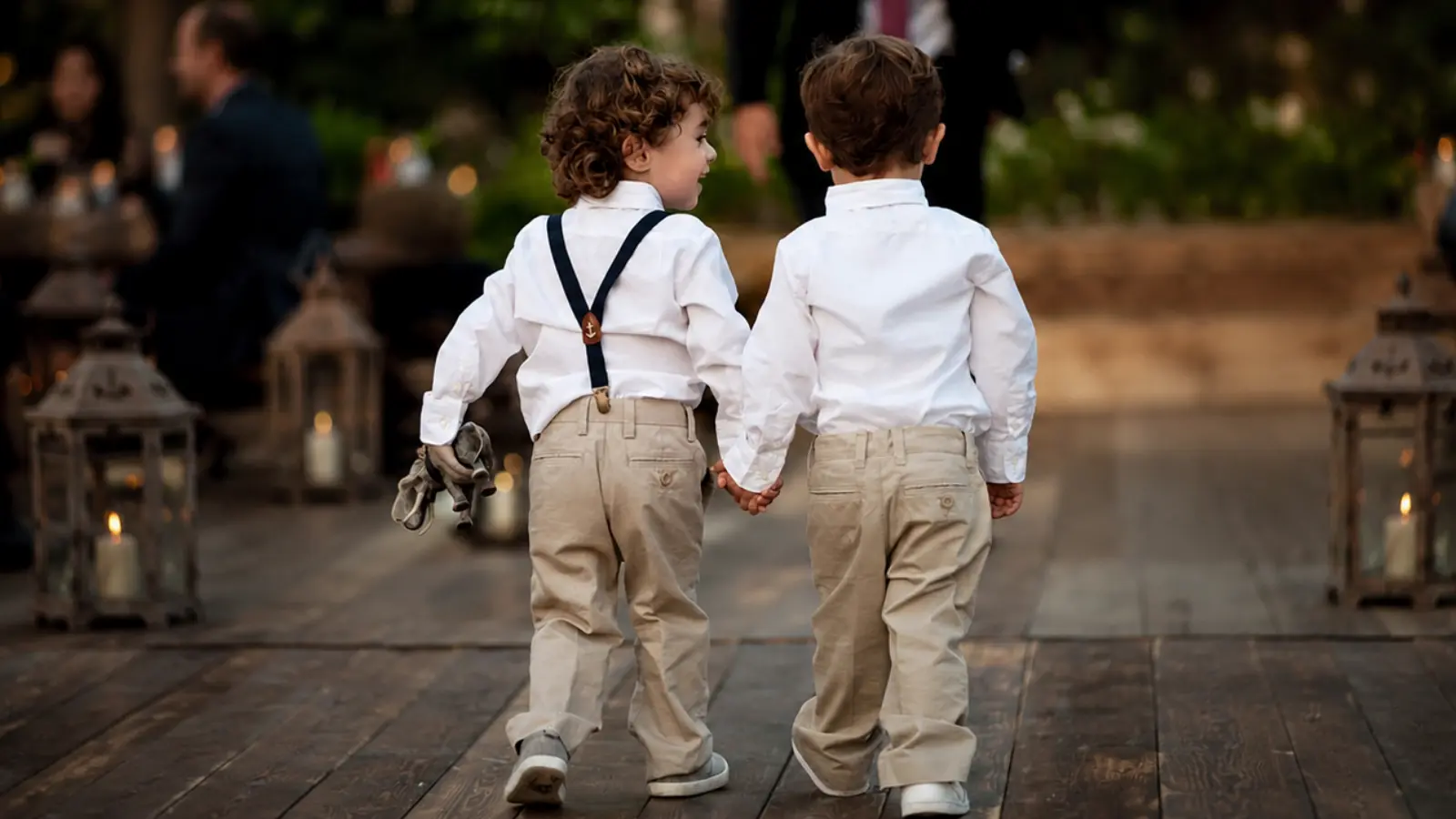
Having two ring bearers is a practical and often charming solution when two children are equally important to the couple — brothers, cousins, or close friends’ sons who are both natural choices and where selecting one over the other would create a family dynamic problem worth avoiding.
Walking together can help some children feel more comfortable than walking alone, particularly younger ring bearers who might hesitate on their own. A paired entrance can also create a relaxed, natural processional moment. Assigning each child a distinct role — one carries the pillow, one carries a sign or a small bouquet to complement the flower girl — gives both children something clear to do and prevents the kind of negotiation that can happen mid-aisle if both are carrying the same thing.
The arrangement should be practiced at the rehearsal, including who stands where, who hands what to whom at the front, and how the transition to their seats works. Practicing the walk together can help both children understand what to expect during the processional.
Walking With Someone
Who the ring bearer walks with — or whether he walks alone — is one of the most practical decisions in the ring bearer planning process, and it deserves more deliberate thought than it usually gets. The common assumption is that the ring bearer walks alone, but that is simply one option, and for younger or shyer children it is often not the best one.
Walking alongside the flower girl is the most natural pairing. The two children entering together creates a visual and ceremonial symmetry that reads as intentional rather than improvised, and having a companion for the walk tends to steady nervous children considerably. Some couples separate the two with a short pause between entrances to give each child a distinct moment; others prefer the warmth of a paired entrance. Both work when planned in advance.
Walking with a parent, a sibling, or a trusted family member is the right choice for toddlers and shy children at any age. An adult escort is not a concession — it is a thoughtful acknowledgment that the role should fit the child rather than the child fitting the role. Position the adult alongside the child rather than behind them, and the child remains the visual focus of the walk without being unsupported.
For siblings close in age who are both in the wedding party, entering together — one as ring bearer and one as junior groomsman or page boy — can be a meaningful detail that families appreciate and that looks natural rather than choreographed.
A Girl as Ring Bearer
A girl in the ring bearer role — sometimes called a ring girl or ring attendant — is entirely appropriate and has become increasingly common. There is no reason the role needs to belong to a boy, and several good reasons it sometimes should not: a girl who is too old for the flower girl role but not quite right for junior bridesmaid, a child whose connection to the couple makes her the obvious choice regardless of gender, or simply a girl who would find carrying a ring box more exciting than carrying flowers.
The outfit for a girl ring bearer tends to follow the wedding’s dress code in a way that parallels how the groomsmen’s attire is reflected in the ring bearer’s suit. A dress in the wedding palette, a small suit or formal separates, or a coordinated look with the flower girl’s dress are all workable approaches. The title can also shift with the child: ring bearer, ring girl, and ring attendant are all in use and all convey the same role without forcing a gendered label.
An Adult Ring Bearer
An adult ring bearer is less common but entirely workable when the role is assigned to someone with a genuine connection to the couple and not simply to fill a processional slot. A younger brother, a close friend who is not in the wedding party but whose presence in the processional would feel meaningful, or a family member who would enjoy a ceremonial role without the full groomsman commitment — these are all situations where an adult ring bearer can make sense.
An adult carrying a traditional pillow can feel slightly self-conscious depending on the person’s demeanor and the wedding’s tone. A ring box, a personalized case, or a clean, minimal carrier tends to land better for an adult than the childhood-coded pillow. The role should feel personal and intentional; if the reason for the assignment is not immediately clear to both the person being asked and the guests watching, it may be worth reconsidering whether the role is the right fit.
A Pet Ring Bearer
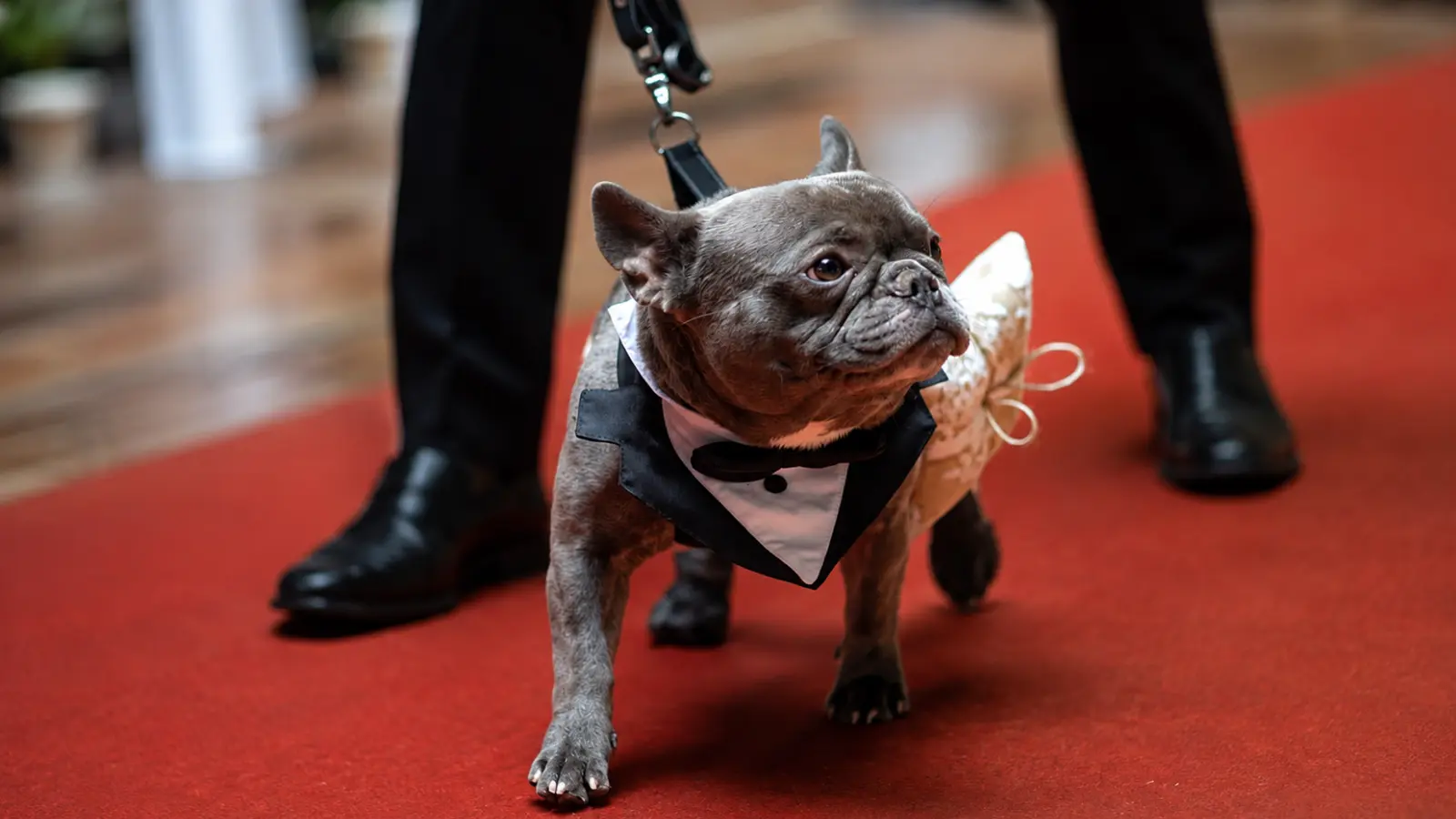
A dog as ring bearer is a widely loved idea and, when executed with adequate planning, one that genuinely works. The key word is planning. A pet in a ceremony setting is subject to variables that a child is not: the unfamiliar space, the crowd, the music, and the combination of people who may all want to reach out and interact during the walk. Getting those variables under control before the day is what separates a charming pet processional from a chaotic one.
The rings, if they appear to be on the dog’s collar or in a small pouch, should be decorative replicas. The real rings belong with the best man. A handler the dog knows well should walk alongside throughout the entire processional and ceremony period — not a guest who is willing to try, but someone the dog will reliably follow. The venue must explicitly allow animals and ideally should have been visited with the dog in advance so the space feels familiar rather than overwhelming.
If there is any genuine uncertainty about how the dog will behave with music, a crowd, or the physical constraints of a leash during a formal processional, other options for including the pet — in portraits, at the reception, in a designated area outside the ceremony space — are worth considering. The pet’s comfort is not secondary to the moment.
Other pets occasionally appear in wedding processionals, but dogs are by far the most common and the most reliably manageable. For any other animal, the planning considerations are similar but the unpredictability tends to be higher.
What to Avoid
Most ring bearer ideas that go wrong do so for the same handful of reasons, and most of them are predictable enough to plan around.
- Ideas that don’t match the wedding’s tone. A ring security briefcase at a black-tie ballroom ceremony, or a very formal pillow at a barefoot beach ceremony, creates a small visual and tonal mismatch that guests will notice even if they cannot articulate why. The ring bearer idea should feel like it belongs to this wedding, not imported from a different one.
- Humor that requires explanation. A funny sign or a playful concept that only lands if you know the couple’s inside joke will confuse most guests and produce a quieter reaction than expected. The best ring bearer humor is immediately legible to a room of people who may not know the couple well.
- Ideas that place too much pressure on a very young child. A toddler carrying the real rings in a miniature briefcase, being expected to walk the full aisle alone, and then stand at the altar — that is three things working against the child’s actual developmental stage. Each idea should be tested against what the specific child can realistically manage.
- Novelty that outlasts the moment. Some ring bearer ideas work beautifully for the processional walk and become awkward immediately afterward. A child in a full ring security costume sitting in the front row for a thirty-minute ceremony can feel slightly absurd by the time the vows begin. Consider how the idea looks and feels throughout the ceremony, not just in the sixty seconds of the aisle walk.
- Skipping the rehearsal for a nontraditional idea. The more creative the ring bearer idea, the more essential the rehearsal becomes. A wagon that has not been tested on the actual surface, a sign that was never carried by the actual child, or two ring bearers who have not practiced together are all avoidable sources of day-of complications.
The consistent thread is this: ring bearer ideas work best when they match the child, the wedding, and the couple’s actual personality — not when they are chosen because they looked charming in someone else’s ceremony photographs.
Ring Bearer Ideas & Inspiration
Explore cute, modern, funny, and unique ring bearer inspiration with pillows, signs, wagons, ring boxes, pets, paired entrances, and creative ceremony ideas.
Choose a Ring Bearer Idea That Fits Your Wedding
The best ring bearer idea is the one that feels natural for the child and belongs in the wedding around him. A classic pillow may be perfect for one ceremony, while a box, wagon, sign, paired entrance, or pet may make far more sense for another.
Start with the child, then consider the ceremony style and logistics before choosing the creative detail. When the idea is simple enough to work comfortably and personal enough to feel like your wedding, it doesn’t need to be elaborate to become memorable.
Frequently asked questions (FAQ)
What are some unique ring bearer ideas?
Unique ring bearer ideas include a personalized ring box, a playful ring security briefcase, a wagon entrance for a baby or toddler, two ring bearers walking together, a girl as ring bearer, or even a pet with a trusted handler. Choose an idea that fits the child’s age and the overall tone of the wedding.
What can a ring bearer carry instead of a pillow?
A ring bearer can carry a box, personalized case, decorative sign, miniature briefcase, book-style carrier, or another lightweight item that suits the ceremony. For very young children, choose something simple and easy to hold. If the carrier cannot safely hold the real rings, keep them with the best man instead.
What is a ring security ring bearer?
Ring security is a playful idea where the ring bearer is styled like a small security agent, often carrying a miniature briefcase marked for the rings. It works best at casual or lighthearted weddings. Keep the real rings with a trusted adult and avoid overdoing the costume if the rest of the ceremony is formal.
Can a girl be the ring bearer?
Yes. A girl can be the ring bearer, ring girl, or ring attendant just as naturally as a boy. She can carry a box, pillow, or sign depending on the wedding. The role should reflect the child’s relationship to the couple and what she would actually enjoy doing.
Can a pet be the ring bearer?
Yes, if the venue allows animals and the pet is comfortable with crowds, music, and unfamiliar surroundings. Use decorative rings rather than the real ones and have a trusted handler walk alongside. If the pet is anxious or unpredictable, another ceremony role may be a better choice.
Is it okay to have two ring bearers?
Yes. Two ring bearers can walk together and often help each other feel more comfortable. This also works well when two siblings or cousins are equally important to the couple. Give each child a clear role and practice the arrangement at the rehearsal so there is no confusion during the processional.