
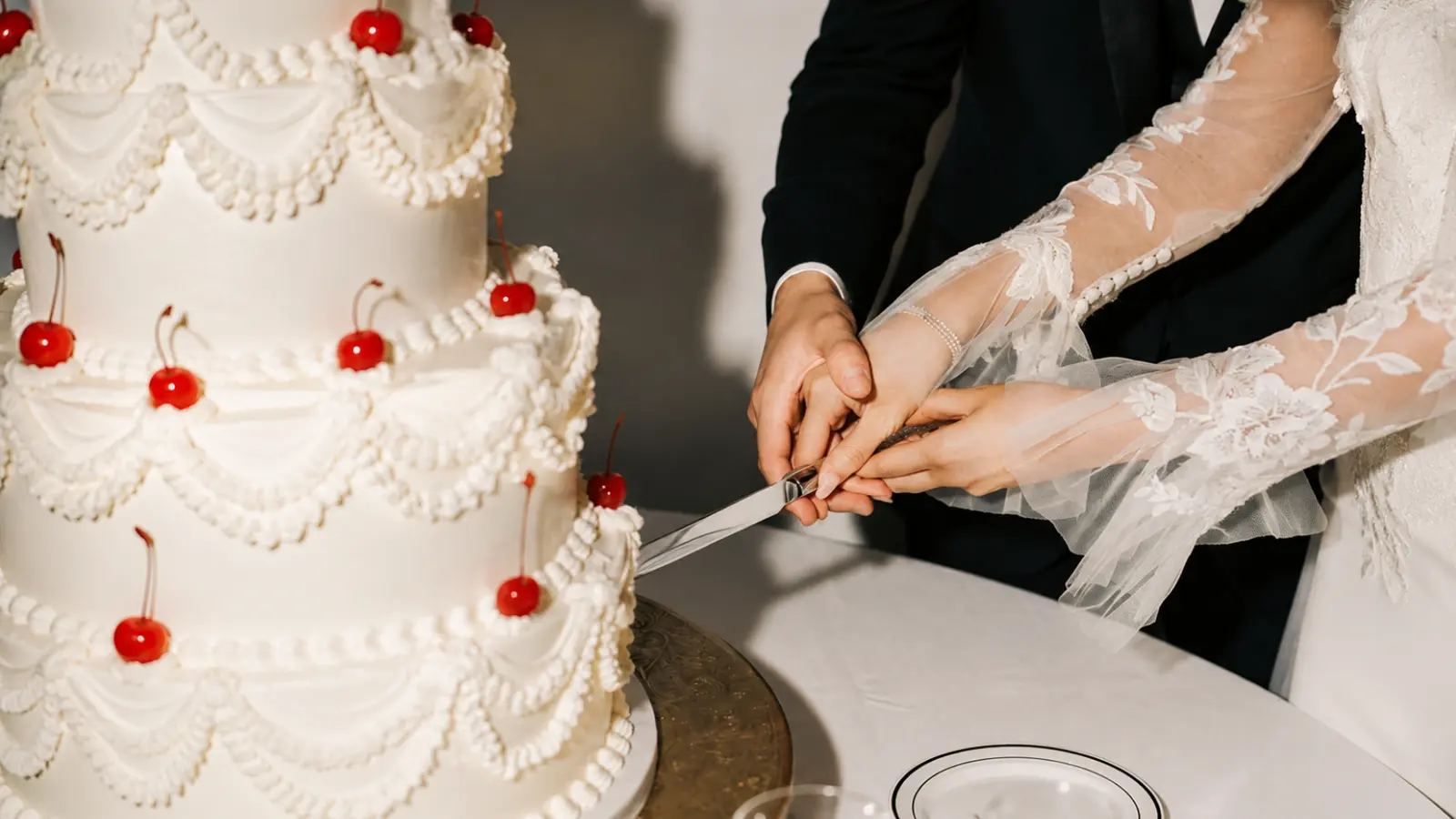
Wedding cake cutting is the reception tradition where the couple cuts the first slice of their wedding cake together, symbolizing partnership, celebration, and the beginning of sharing their married life. Although the moment usually lasts only a few minutes, it remains one of the most photographed and recognizable parts of a wedding reception.
Many couples assume the cake cutting is simple until they realize there are small details that affect the experience. Timing, where to cut, how to hold the knife, what song to play, how the cake is served, and how the moment is photographed can all influence how natural and memorable it feels.
This guide explains everything couples need to know about wedding cake cutting, including the meaning behind the tradition, when it should happen, how to cut the cake, cake cutting songs, photography tips, knife sets, and common mistakes to avoid during the reception.
What Does Cake Cutting Mean at a Wedding?
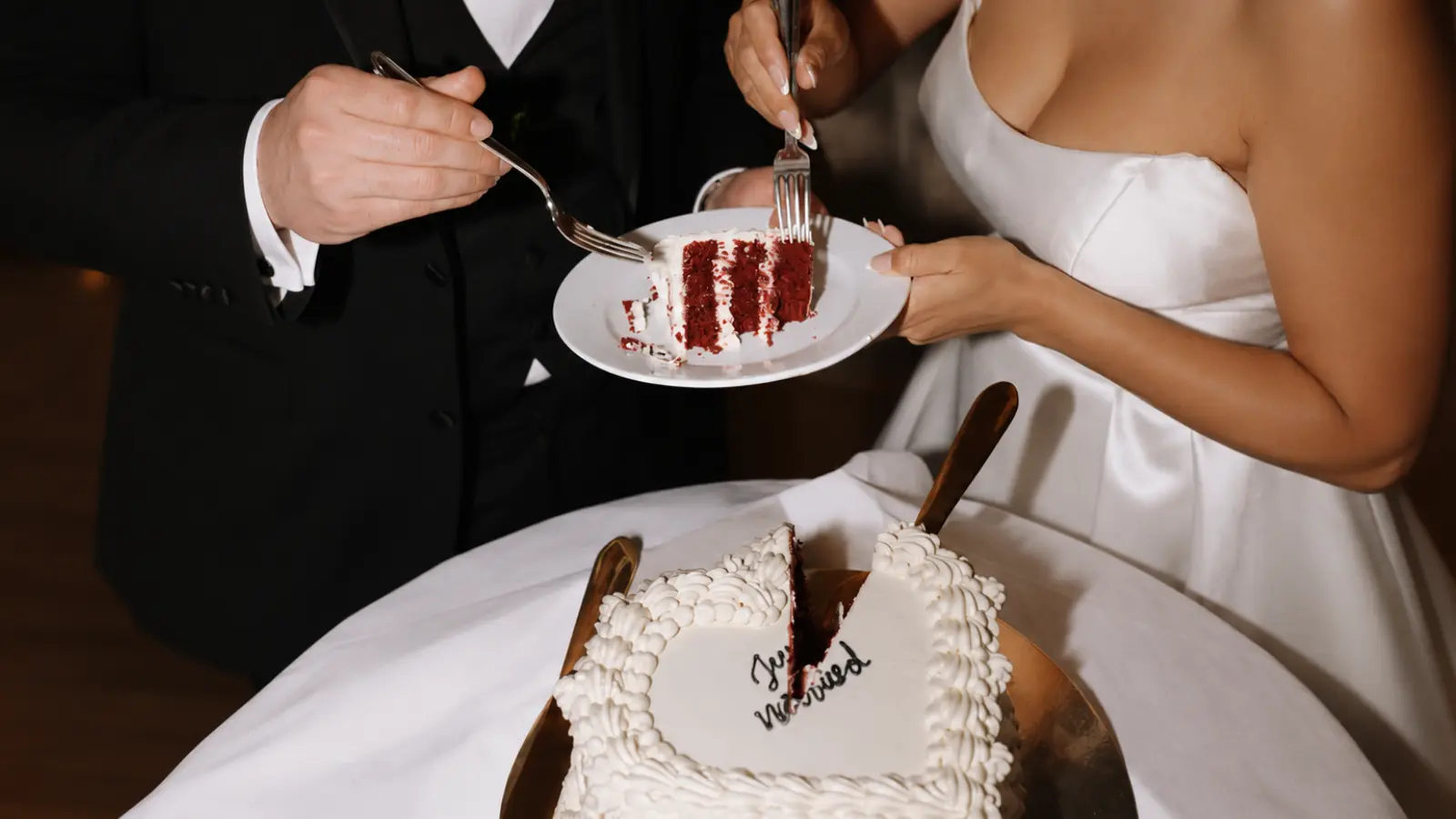
The wedding cake cutting is one of the most recognizable rituals in the American wedding reception — and one many couples do not fully understand. Most couples know they are supposed to do it. Fewer know what it is actually meant to represent.
The tradition is often connected to older wedding customs involving shared cakes, abundance, and celebration. Older wedding customs often used cakes or breads as symbols of abundance, fertility, prosperity, and shared celebration. Over time, those customs evolved into the more familiar tiered wedding cake and the modern ritual of cutting and sharing the first slice. The modern tiered wedding cake, including the classic look of three-tier wedding cakes, eventually became tied to the ritual of cutting and sharing.
In contemporary American weddings, the cake cutting carries two distinct symbolic meanings. The first is the act of sharing — cutting a single cake and giving the first piece to each other is a public demonstration of the couple’s commitment to provide for and nourish each other. The second is community — once the couple cuts the cake, it is served to guests, which marks the moment the celebration extends outward from the couple to everyone in the room.
The feeding-each-other element that follows the cut carries its own symbolism: it is often treated as a small gesture of care, tenderness, and partnership. Whether you find that symbolism meaningful or simply enjoy the ritual, understanding it changes how you approach the moment. It is not just a photo op. It is one of the few moments in the reception where the couple performs something together, for everyone watching.
For the full planning side of your wedding cake — costs, flavors, tiers, and what to ask at your tasting — see the complete wedding cake guide.
When Do You Cut the Wedding Cake?
Timing the cake cutting is easy to overlook during reception planning. Many couples schedule it too early, when the room has not fully settled into celebration mode. Others wait too long and end up cutting the cake after some guests have already left or the room has shifted fully into dancing.
A common framework for many American receptions is to cut the cake after dinner has begun and before the room has fully shifted into open dancing. This timing accomplishes several things at once. Guests have eaten, which means the sugar from the cake is welcome rather than premature. The formal elements of the reception — toasts, first dance, parent dances — are typically complete. And the room is in a relaxed, celebratory state that receives a ritual moment well.
How the cake cutting fits into the reception timeline
A common American wedding reception timeline might look something like this:
- 5:00 pm — Guests arrive, cocktail hour begins
- 6:00 pm — Grand entrance, first dance, parent dances
- 6:30 pm — Dinner service begins, toasts
- 7:30–8:00 pm — Cake cutting
- 8:00 pm — Open dancing begins
- 10:00 pm — Last dance, reception ends
Many couples and wedding coordinators schedule the cake cutting specifically to transition the room from dinner into dancing. The announcement brings everyone’s attention to the center of the room, the ritual happens, the song creates a mood shift, and then the DJ opens the dance floor. It functions as a natural hinge point in the evening.
Early cake cutting — when it works
Some couples choose to cut the cake before dinner, typically right after the grand entrance and first dance. This approach works when the venue or catering team needs to begin slicing the cake early to have it ready to serve during dinner. It also works for shorter receptions — a four-hour event may not have time to place the cake cutting at the traditional mid-dinner point. If you go this route, confirm with your caterer that service logistics require it, and brief your DJ so they build it into the opening program naturally.
Who announces the cake cutting
The DJ or MC usually announces the cake cutting, with the coordinator cueing the moment behind the scenes. The coordinator cues the DJ privately; the DJ announces it to the room. What the couple should not do is walk to the cake table unannounced and start cutting while guests are mid-conversation. The announcement gives everyone a moment to gather, put down their drinks, and orient toward the moment. Your photographer especially needs that thirty-second window to position themselves.
How to Cut a Wedding Cake
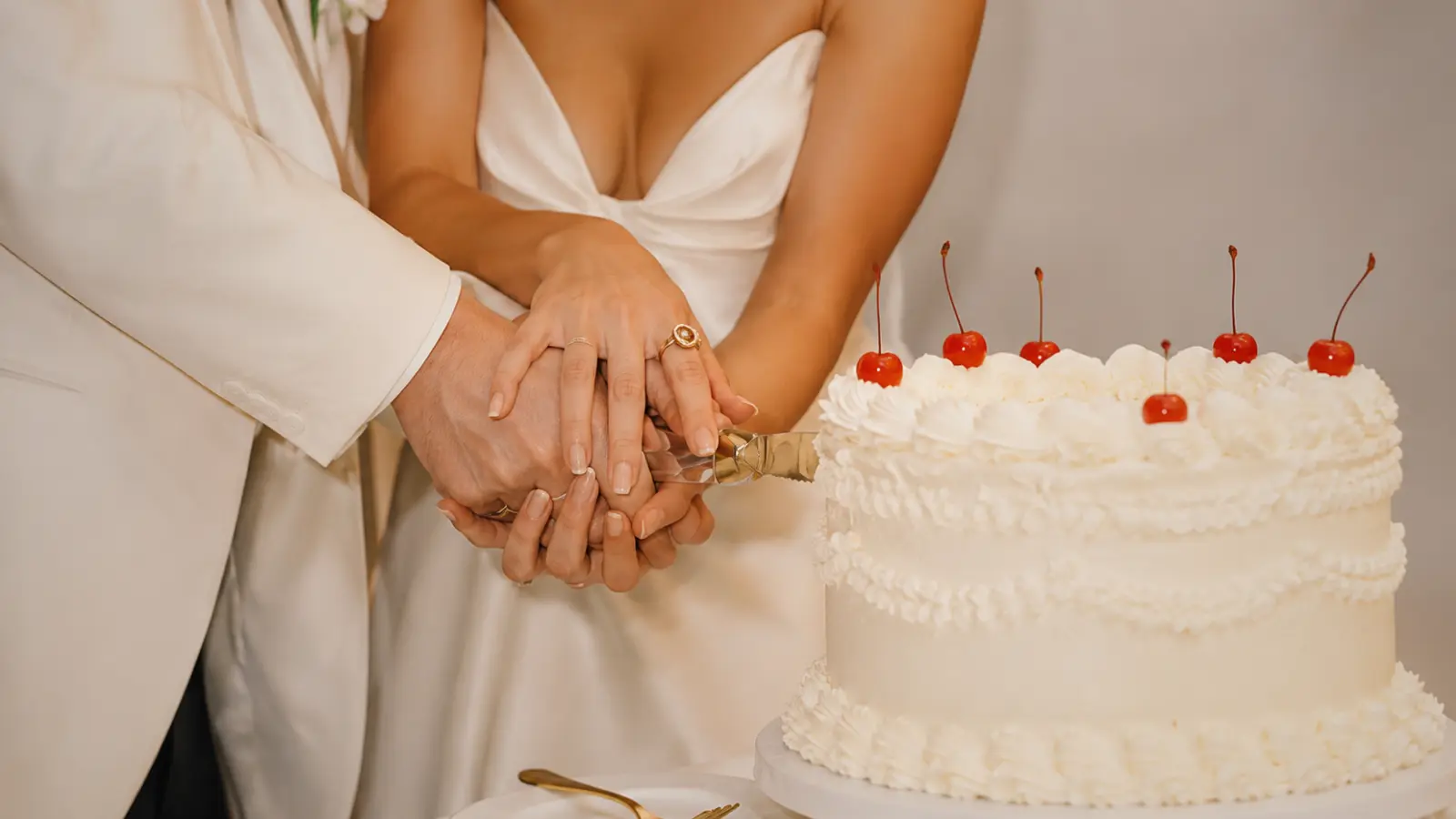
Most couples have never cut a tiered cake before their wedding day. The mechanics are not complicated, but there are a few things that go wrong consistently — and it is worth knowing the basic flow before doing it in front of guests and the photographer.
The correct hand position
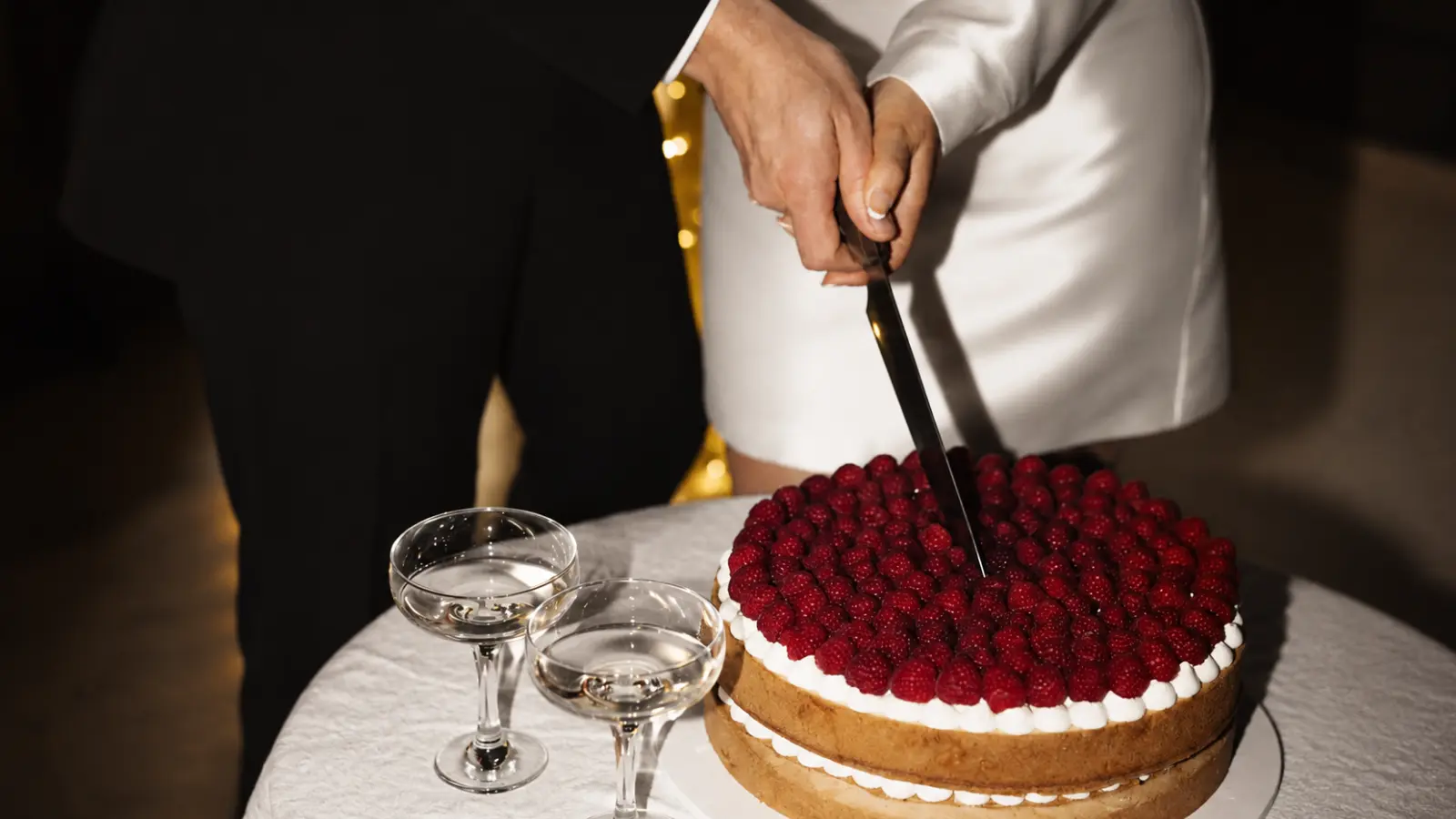
Both partners place one hand on the knife handle. In older tradition, one partner’s hand often went on the handle first and the other partner’s hand rested over it, but this is not a rule. Any couple can hold the knife in the way that feels natural, balanced, and comfortable. What matters is that both hands are visibly on the knife for the photograph, and that the grip is comfortable enough to actually cut.
Do not grip the knife too far down the handle — you will have less control over the cut. Do not grip it too close to the blade — the catering team will need to take over after the ceremonial cut, and a high grip makes the handoff awkward. A mid-handle grip, both hands, works reliably.
Where to cut on a tiered cake
The ceremonial cut usually happens on the bottom tier, at the front of the cake. This gives the couple an easy, visible place to cut and keeps the upper tiers and support structure undisturbed. Avoid cutting into an upper tier, because structural dowels or supports may be inside the cake and can make the cut awkward or unexpected.
Many bakers score a light line on the bottom tier to show the couple exactly where to cut. If yours does not, ask them to — or ask your venue coordinator to mark the spot in advance.
How deep to cut
The ceremonial cut does not need to produce a full slice. You are demonstrating the beginning of the cut — two to three inches deep is sufficient for the photograph. The catering team takes over the actual slicing afterward, so your job is the ceremonial cut and the feeding, not serving cake to the full guest list.
After the cut
Once the ceremonial cut is complete, step back slightly and let the catering or banquet team take the knife and begin slicing. Do not attempt to serve the cut pieces yourselves — this looks unscripted and can get complicated quickly. Your caterer has a system; trust it. Your job is to receive the two small pieces plated for you by the caterer, which is what you use for the feeding moment.
The Cake Feeding Tradition
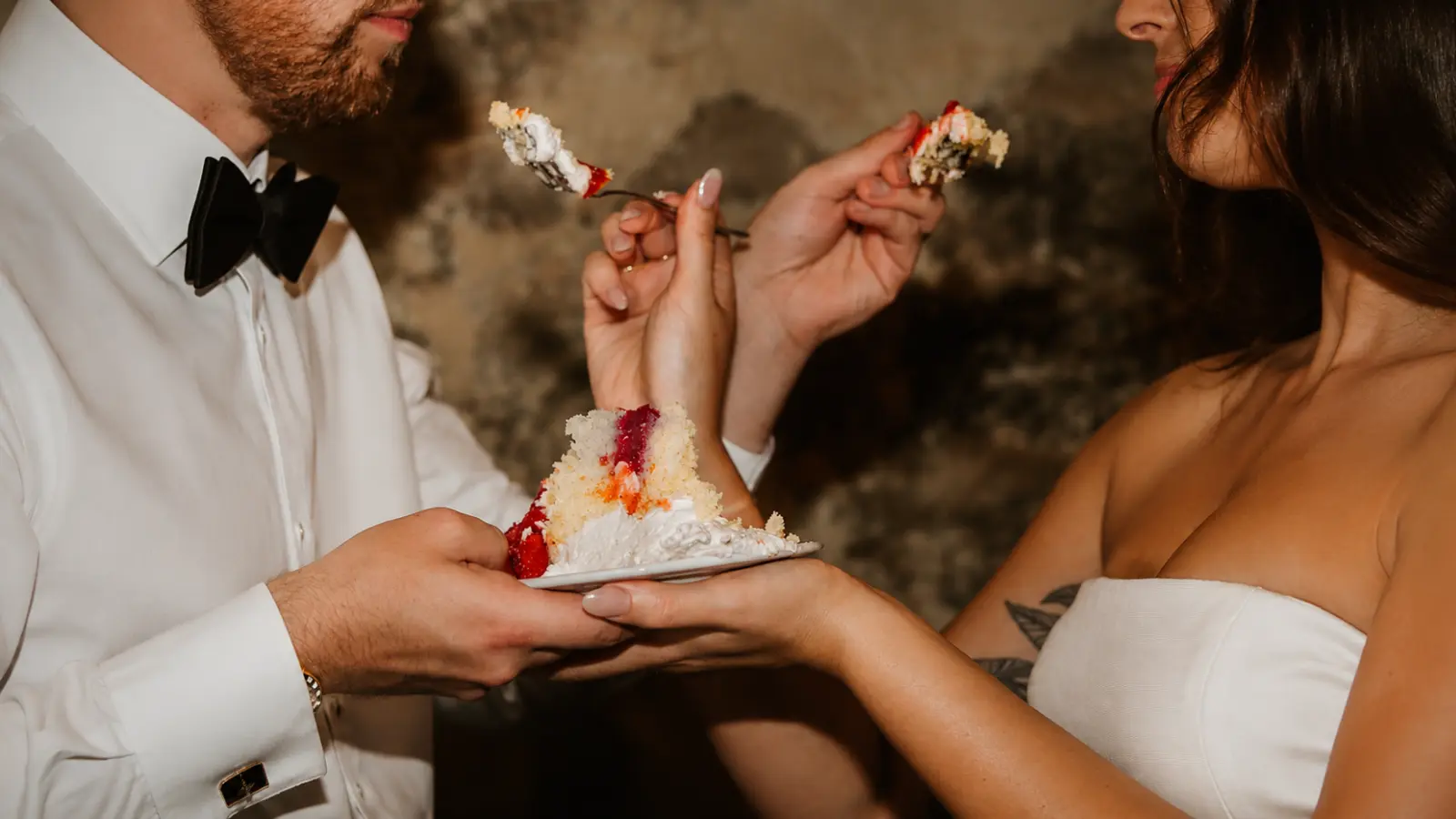
This is the moment many couples have strong opinions about in advance and then improvise entirely on the day. The feeding-each-other tradition — where each partner feeds the other a bite of cake — is one of the most photographed moments of the entire reception. It is also one of the moments most likely to feel awkward if there is no conversation about it beforehand.
Gentle or playful — decide in advance
There are two versions of the cake feeding moment, and they require completely different approaches. The gentle version is exactly what it sounds like — you carefully feed each other a small piece of cake, look at each other, and the moment is tender and photogenic. The playful version may involve a small cake-on-the-face moment, which can be funny when both partners genuinely want it and uncomfortable when they do not.
Many couples assume they are on the same page about which version they are doing. They are often not. Have this conversation specifically, before the wedding day. If one partner is expecting the gentle version and the other executes the playful version, the reaction in the photographs will be genuine — but not necessarily in the direction either of you wanted.
Neither approach is more correct than the other. The gentle version photographs more elegantly. The playful version can produce joyful, spontaneous photographs when it matches the couple’s personality. The choice is entirely about which one reflects your relationship.
Practical notes on the feeding moment
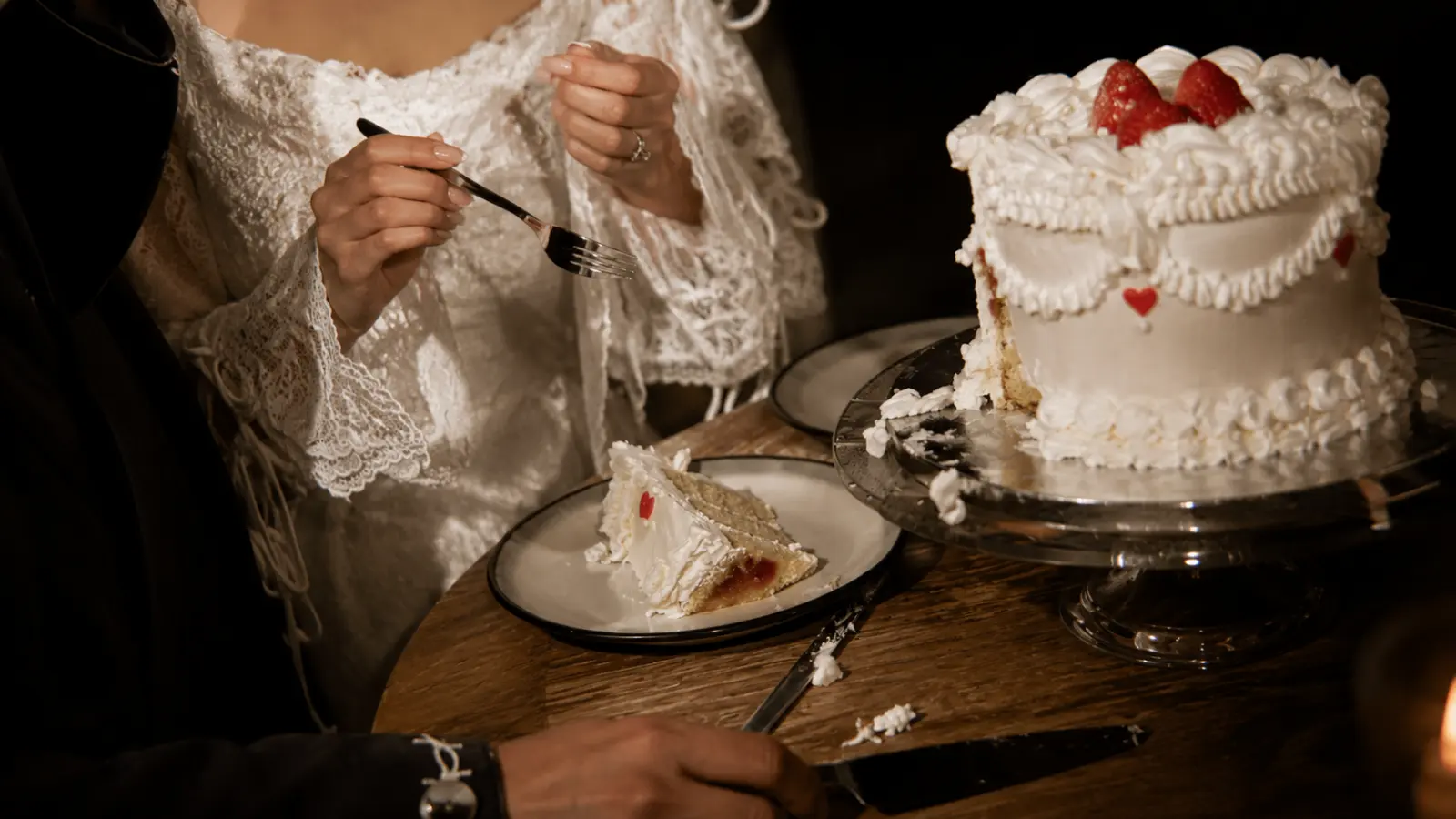
Use a fork, not your hands — most caterers will plate the ceremonial pieces with a dessert fork specifically for this moment. Keep the piece small — a bite-sized portion is easier for both partners and less likely to result in an accidental mess regardless of your intentions. And if you are wearing a significant amount of lipstick, factor that in before the moment arrives.
Wedding Cake Cutting Songs
The cake cutting song is easy to overlook during reception planning — many couples either choose a familiar song quickly or leave the decision to the DJ at the last minute.
The song plays for roughly 60 to 90 seconds in most receptions — just long enough for the announcement, the approach, the cut, the feeding, and the applause. Your DJ should fade it at the first chorus or the end of the first verse, depending on the song’s structure. You do not need a four-minute track to be complete; you need the right 90 seconds of it.
What makes a good cake cutting song
Three qualities matter. First, it needs to be recognizable within the first few seconds — the room should understand immediately what kind of moment this is. Second, it should match the tone you want: playful, romantic, or celebratory. Third, it should not overpower the moment — this is not the time for a song that demands full attention. Like other wedding songs, the song is the backdrop; the couple is the event.
Romantic cake cutting songs
- “How Sweet It Is (To Be Loved by You)” — James Taylor — warm, joyful, and familiar; works for many couples
- “Sugar” — Maroon 5 — a literal, upbeat choice that keeps the moment bright and playful
- “You Are the Best Thing” — Ray LaMontagne — soulful and warm; works for couples who want something less expected
- “Isn’t She Lovely” — Stevie Wonder — joyful and familiar; works particularly well when there is a strong emotional connection to the song
Playful cake cutting songs
- “Pour Some Sugar on Me” — Def Leppard — the most committed pun-as-wedding-song choice; works best for couples whose reception has been high-energy throughout
- “Birthday” — Katy Perry — fun, fast, and slightly irreverent; good for couples who want the cutting to feel like a party moment rather than a ceremony moment
- “I Want Candy” — Bow Wow Wow — distinctly playful; sets up the feeding moment as fun rather than tender
- “Can’t Help Falling in Love” — Elvis Presley — a romantic classic for couples who want the cake cutting to feel soft and sentimental rather than playful
More cake cutting song ideas
The full guide to cake cutting songs covers over 40 options organized by tone — sweet, funny, classic R&B, country, and unexpected picks — including songs that work specifically if you are planning the playful face-smash version versus the gentle feeding moment. If you have not chosen a song yet, that is the best place to start.
Cake Cutting Photo Tips
The cake cutting can produce some of the most beautiful reception photographs, but the moment photographs better when the couple knows the basic flow. A few specifics make a significant difference.
What your photographer needs from you
Brief your photographer before the reception on two things: where the cake table is positioned relative to the room’s lighting, and whether you are planning the gentle or the playful feeding version. Both of these change how they position themselves and where they direct their attention during the moment.
Most photographers want to capture three distinct beats: the approach to the cake, the actual cut, and details like wedding cake toppers before the feeding. Each of these requires a slightly different position. If you move too quickly between them — approach, cut, feed, done in fifteen seconds — the photographer may only get one clean shot. Slow down deliberately between each moment. The pause between the cut and the feeding is where some of the best photographs happen.
Positioning at the cake table
Stand slightly to the side of the cake and the wedding cake stand rather than directly behind it. If both partners stand directly behind the cake, one of you will be partially obscured in photographs taken from the front. An angled stance — one partner slightly forward, the other behind their shoulder — allows both faces to be visible and gives the photographer a cleaner composition.
Wedding cake table ideas should account for camera angle, so make sure the front of the cake faces a clean, useful photo direction rather than a wall, service door, or cluttered background. This sounds obvious, but it is frequently not considered during venue setup. Ask your coordinator or venue contact to confirm cake table orientation when they set the room.
The feeding photograph
The best feeding photographs happen when both partners are looking at each other rather than at the fork or the camera. Natural eye contact during the feeding produces a more genuine and more beautiful image than a posed smile toward the photographer. Let the moment be between you — your photographer will find the angle.
If you are planning the playful face-smash version, give your photographer a subtle cue — a look, a word, anything that tells them what is about to happen. A prepared photographer gets a better shot of a spontaneous moment than a surprised one.
Wedding Cake Knife and Server Set
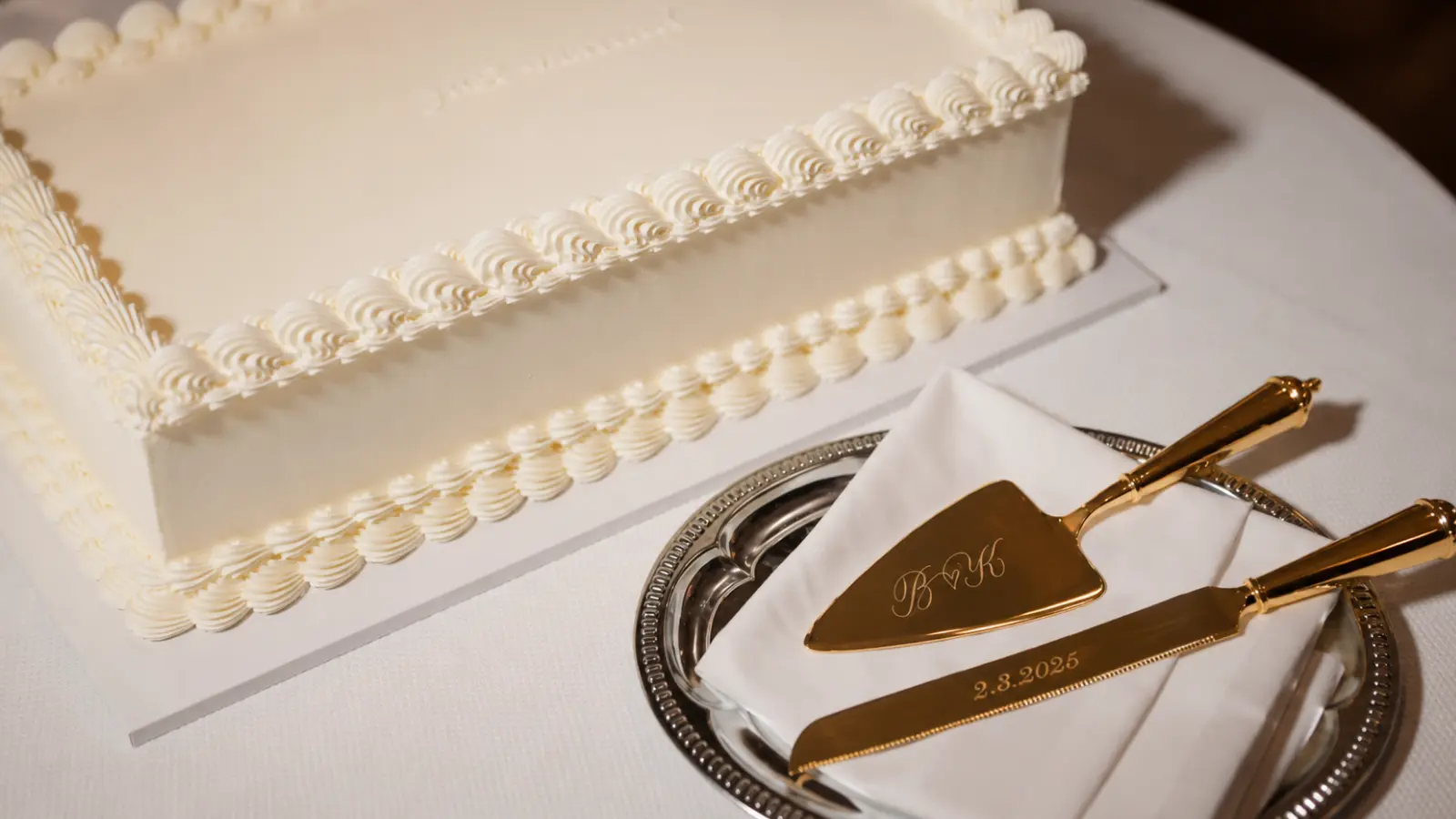
Many couples do not think about the cake knife and server set until late in the planning process. Most venues provide a standard knife and server — utilitarian, functional, and completely invisible in photographs. Whether that matters to you is a personal decision, but it is worth making intentionally rather than by default.
What is a cake cutting set
A wedding cake cutting set typically includes two pieces: a cake knife (sometimes called a cake server) and a server or pie server used to lift and plate the slices. For the ceremonial cut, the knife is the primary tool — the server is used by the catering team for actual slicing and plating after the ceremony is complete.
Couples who want a distinctive cake cutting set have three options: purchase one to keep, rent one through the venue or a rental company, or use a family heirloom. The family heirloom option carries its own significance and is worth asking about if either family has a tradition of passing a knife set through generations.
What to look for in a cake cutting set
Handle material: Wedding cake knife sets often have handles in silver plate, pearl, crystal, or natural wood. Silver plate is the most formally traditional. Pearl and crystal handles photograph beautifully but require careful handling. Wood handles are the most durable and work well for rustic or outdoor ceremonies.
Personalization: Many couples purchase a set that can be engraved with their names and wedding date. This adds sentimental value but requires lead time — engraving services often need extra lead time, especially during busy wedding seasons. Do not leave this to the last minute.
Weight and balance: This is the most overlooked consideration. A knife that is too lightweight feels insubstantial in the moment and is harder to use confidently for the photograph. A knife that is too heavy is awkward to control with both partners’ hands on it. If you are purchasing in person, hold it before you buy it. If you are purchasing online, read reviews specifically from couples who used it at their wedding.
Do you need to buy one
Not necessarily. Many couples borrow one from a family member, rent one from the venue’s rental catalog, or simply use what the venue provides and no one notices the difference in photographs. If the knife set is meaningful to you, treat it as a small styling choice within the overall wedding cake cost and reception budget. If it is not meaningful to you, spend that attention elsewhere.
Cake Cutting Mistakes to Avoid
These are the issues that most often make the cake cutting feel less smooth. Most are easy to prevent with a single conversation in advance.
Not telling the DJ when to play the song. The cake cutting song does not play automatically — your DJ needs a cue from the coordinator, which means the coordinator needs to know the song and the moment. If this chain of communication does not happen before the reception starts, you will either stand at the cake table in silence or the DJ will play something generic. Put the cake cutting song on the formal shot list and the DJ’s cue sheet.
Cutting into an upper tier. The upper tiers of a wedding cake are typically supported by dowels or hollow pillars, and cutting into them can cause unexpected structural problems — or at minimum, a knife that stops suddenly in front of your guests. Always cut into the bottom tier, at the front, where your baker or caterer has designated the ceremonial cut to happen.
Not agreeing on the feeding approach. The gentle-versus-playful conversation is one of the most important advance discussions about the cake cutting, and it is easy to skip. Have it explicitly. Do not assume.
Rushing through the moment. The cake cutting is ninety seconds of your wedding. It does not need to be hurried. Moving too quickly means your photographer misses key beats, your guests miss the moment, and you do not actually experience it. Slow down between the cut and the feeding. Let the moment breathe.
Standing directly behind the cake. Positioning both partners directly behind the cake hides one face in every photograph taken from the front of the room. Stand at a slight angle — both facing the room, one slightly forward — and the photographs will be significantly better.
Forgetting to eat the cake. This sounds like a joke, but it happens. The couple cuts the cake, feeds each other the two ceremonial pieces, and then spends the rest of the reception not eating any of the wedding cake flavors they spent months choosing. Have a full slice plated and brought to your table. You paid for it — eat it.
Not confirming the knife set. Confirm with your venue what they provide, and confirm separately with your caterer if catering is not in-house. Some venues assume the couple brings their own; some assume they provide one. Discovering this discrepancy the day of the wedding produces a scramble that is entirely avoidable.
Wedding Cake Cutting Inspiration Board
Before planning your cake cutting moment, it helps to see how poses, timing, knife sets, cake table styling, and photo angles can make the tradition feel natural and beautiful. Explore our wedding cake cutting inspiration board for cake cutting poses, romantic photo ideas, cake table setups, knife sets, reception moments, and inspiration for creating a picture-perfect celebration.
Final thoughts
The wedding cake cutting may only last a few minutes, but it represents one of the most intentional moments of the reception. When the timing, music, photography, and small details are planned ahead, the moment feels natural instead of rushed or awkward.
Whether you keep the tradition simple, make it playful, or create a quiet moment together, the goal is not just cutting a cake. It is creating a shared memory surrounded by the people celebrating with you — and making sure that moment feels like a true reflection of your wedding.
Frequently asked questions (FAQ)
Why do some wedding cake cutting moments feel awkward?
Most awkward cake cutting moments happen because couples treat it as something they will figure out in the moment. The best photos and reactions usually come from knowing the basic flow in advance — where to stand, when to pause, what the photographer needs, and how you want the feeding moment to feel.
What is the biggest mistake couples make during the cake cutting?
Rushing through it. Many couples cut the cake, feed each other, and walk away so quickly that guests barely experience the moment and photographers miss natural reactions. Slowing down for a few extra seconds often creates better memories than trying to make everything perfect.
Should the cake cutting feel romantic or fun?
Either can work. The best cake cutting moments match the couple’s actual personality rather than a version they think a wedding is supposed to have. Some couples love a sweet, emotional moment, while others create a playful memory that feels more like them.
Do guests actually care about the cake cutting tradition?
Guests usually care less about the tradition itself and more about being included in a shared moment. The cake cutting gives everyone a natural pause point during the reception, creates photos, and signals a transition in the celebration.
How do you make cake cutting photos look more natural?
Focus on each other instead of the camera. The strongest cake cutting photos usually come from small reactions — laughing, making eye contact, moving slowly, and letting the photographer capture the interaction instead of forcing a pose.
What do wedding planners pay attention to during the cake cutting?
Wedding planners usually focus on timing and coordination. They make sure the DJ is ready, the photographer is positioned, the cake table is prepared, and the couple has enough space so the moment feels effortless rather than interrupted.
When should you cut the wedding cake?
Most couples cut the wedding cake after dinner has begun and before open dancing is fully underway. The exact timing depends on the reception timeline, catering needs, photographer coverage, and whether cake cutting is being used as the transition from dinner into dancing.
How do you cut a wedding cake for photos?
For the ceremonial cut, stand slightly angled beside the cake, place both hands on the knife, and cut into the front of the bottom tier. Move slowly, pause after the cut, and let the photographer capture the moment before the caterer takes over the actual slicing.
Related Guides
- Wedding Cake Designs: Elegant, Modern, Floral and Unique Styles
- Wedding Cake Tasting: What to Expect, What to Ask and How to Choose
- How to Freeze Wedding Cake: Save the Top Tier the Right Way
- Grocery Store Wedding Cakes: Publix, Costco, Walmart & Sam’s Club Guide
- Classic Wedding Cake Flavors: Vanilla, Chocolate, Red Velvet & Classic Ideas