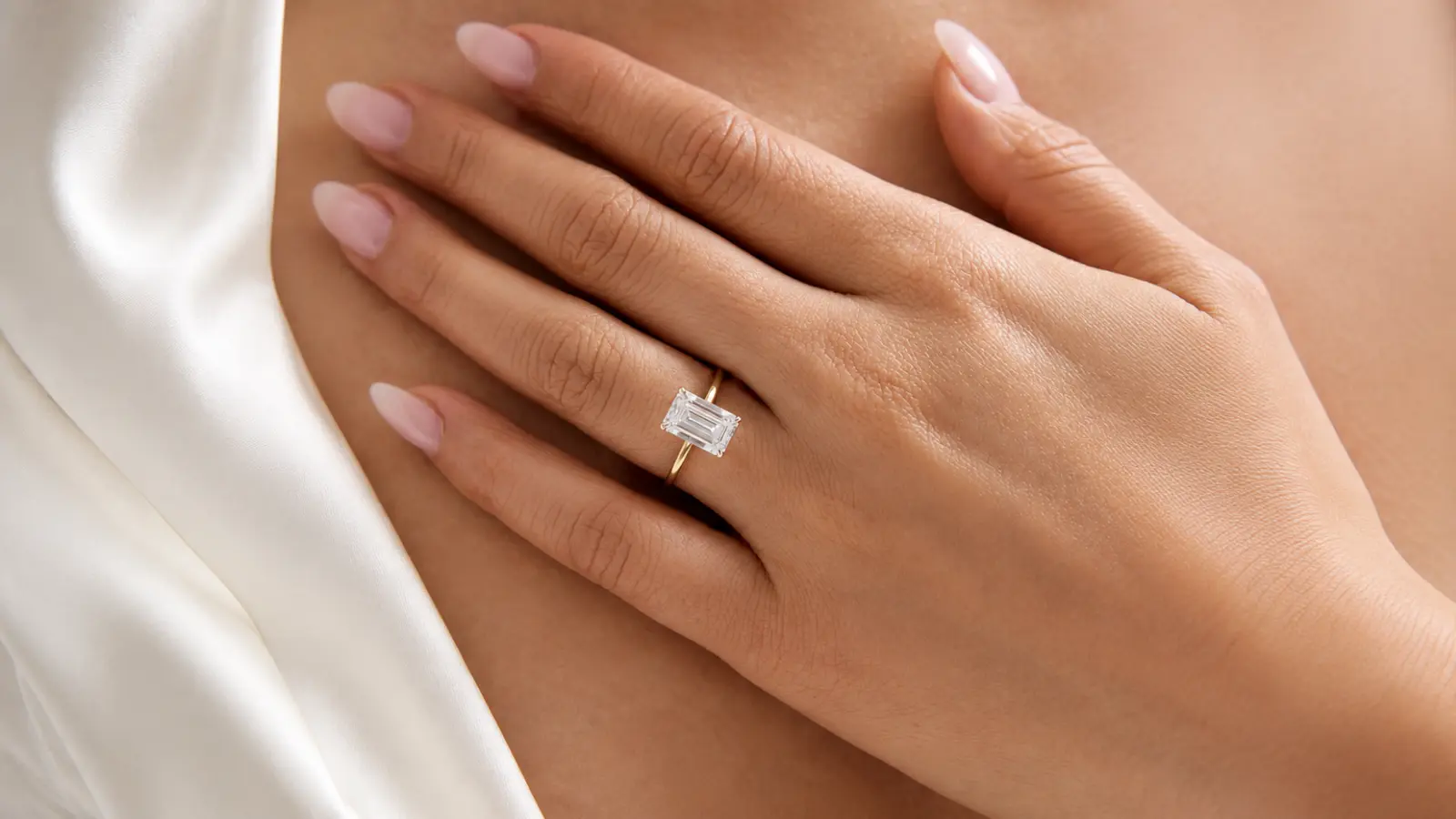
Wedding bands for emerald cut engagement rings are designed to complement the clean lines, rectangular shape, and step-cut facets that make emerald cut stones unique. Unlike many other diamond shapes, emerald cuts usually pair naturally with straight wedding bands because their structured geometry creates a balanced and intentional look.
Choosing the right wedding band is about more than finding a beautiful match. Baguette bands, simple metal bands, Art Deco designs, and carefully chosen diamond bands can either highlight the emerald cut’s architectural style or distract from the qualities that make this stone distinctive.
This guide explains everything about wedding bands for emerald cut engagement rings, including straight vs. contoured bands, baguette pairings, Art Deco styles, minimal bands, proportions, common mistakes, and how this pairing fits within different wedding rings and wedding bands.
Best Wedding Bands for Emerald Cut Rings
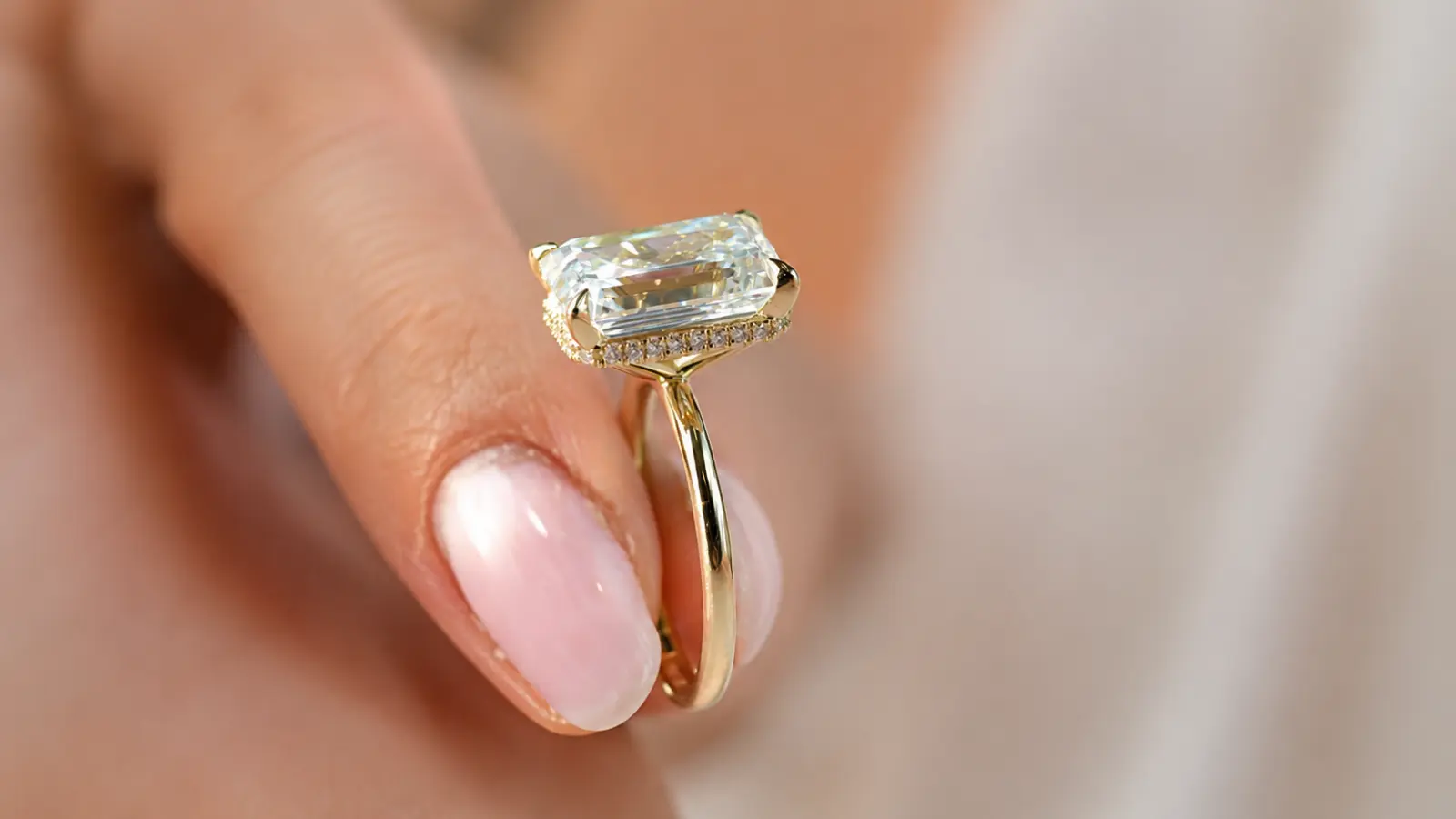
The emerald cut’s rectangular silhouette and step-cut faceting create a visual language that is unusually specific. The stone has strong horizontal lines, the parallel rows of its step facets, and a long, flat table that reflects light in broad flashes rather than the scattered sparkle of a brilliant cut. A wedding band that works with this aesthetic needs to share something with it: the same linearity, the same formality, the same preference for clarity over complexity.
The good news for anyone choosing a wedding band for an emerald cut ring is that the fit problem that complicates pear, oval, and marquise pairings simply does not arise here. Because emerald cut settings typically sit lower on the finger and have a relatively flat base, a straight-sided band can sit flush against them without leaving a visible gap. This is a meaningful practical advantage: it means the band selection is almost purely an aesthetic and proportional decision, rather than a fitting exercise.
The strongest options at a glance
A plain straight band in the same metal as the engagement ring is the most enduring pairing and the one that most jewelers and photographers point to as the cleanest result. It makes no visual argument of its own and allows the emerald cut’s architecture to dominate completely. A baguette band, set with small rectangular step-cut stones, is the strongest stone-set pairing, because the baguette’s faceting style belongs to the same family as the emerald cut and creates a sense of visual continuity across the stack. An Art Deco-inspired band with geometric detail or milgrain adds historical resonance that the emerald cut’s mid-century aesthetic naturally supports. A very slim pavé band can also work, with specific caveats around stone size and band width that are worth understanding before choosing.
Proportions matter more than style
Whatever band type you choose, proportion is the variable that most affects whether the result looks considered or accidental. Emerald cuts tend to be larger in surface area than many other diamond shapes at the same carat weight, the cut’s shallow depth pushes more of the stone’s mass to the surface, which is part of its visual appeal. A band that is too narrow will look unbalanced against a wide emerald cut’s setting; a band that is too wide risks becoming the dominant visual element and diminishing the stone. Most emerald cut wearers find that a band in the 2mm to 3mm range is the most versatile, with adjustments up or down depending on the specific stone’s dimensions. Bringing the engagement ring to the appointment and comparing bands physically against it is the most reliable way to assess this, photographs and measurements convey less than the rings held together in natural light.
Straight Bands vs. Contoured Bands
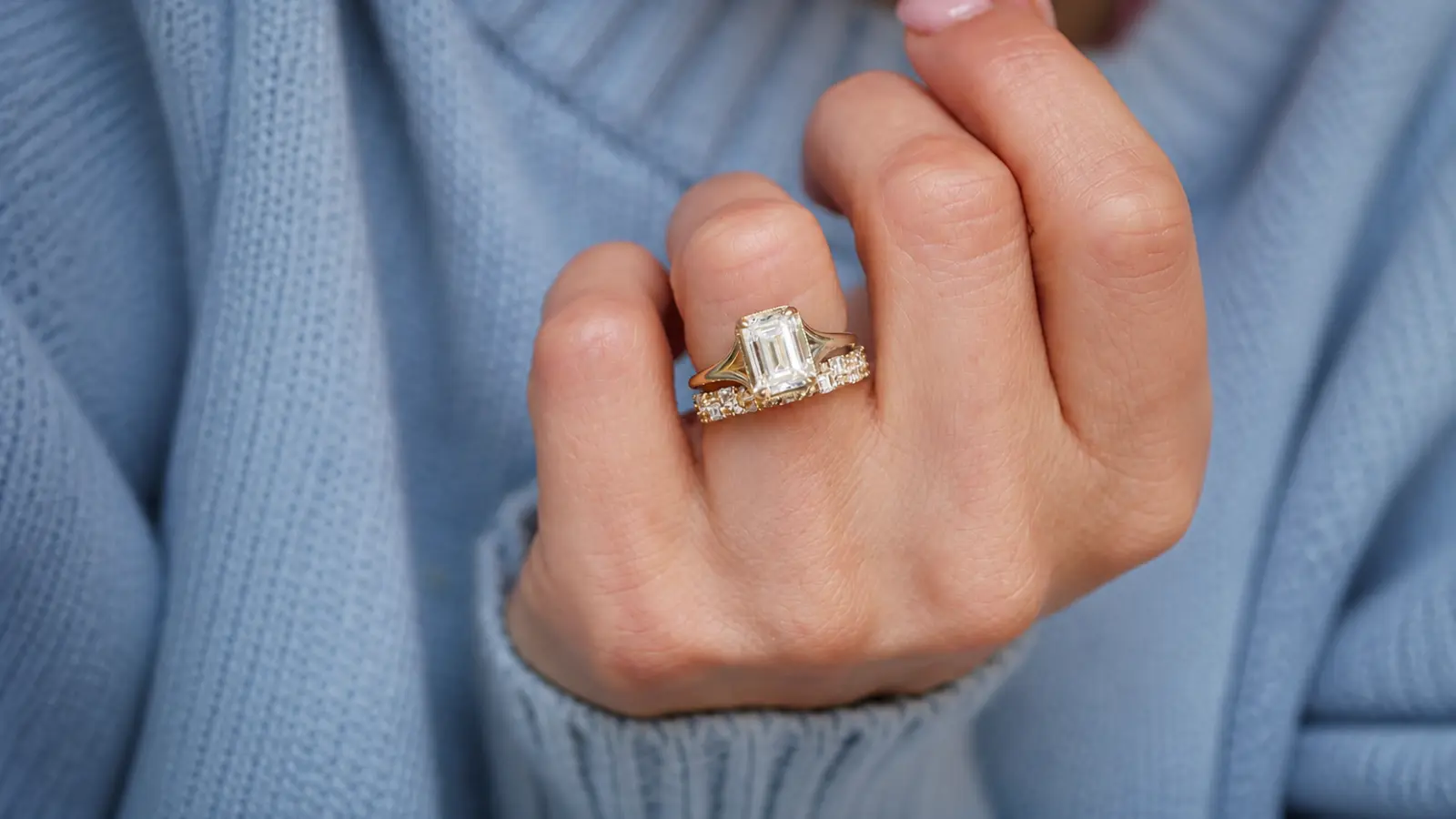
For most diamond shapes, the choice between a straight band and a contoured band is partly a fit decision, certain shapes require contoured bands because a straight band leaves a gap. For emerald cuts, this fit pressure largely disappears. The choice between straight and contoured becomes a purely aesthetic one, and for most emerald cut pairings, straight wins on both practical and visual grounds.
Why straight bands work so well
A straight band’s clean, uninterrupted line echoes the horizontal geometry of the emerald cut’s step facets. When you look at an emerald cut diamond closely, what you see is a series of parallel lines, the terraced rows of the step facets descending toward the culet. A straight band alongside this stone reinforces that linear quality and extends the sense of geometric order from the stone outward to the hand. It is one of the few cases in bridal jewelry where the simplest band is genuinely the most sophisticated one, not merely the safest choice.
Straight bands also have a practical advantage for emerald cut wearers who want flexibility. A straight band is a universal piece, it sits cleanly against the emerald cut setting, but it can also be worn alone, on the other hand, or alongside other rings without any visual dependency on the engagement ring. It is a band that fully functions as its own object, which matters for the substantial amount of time many people spend wearing only the wedding band.
When contoured bands come up, and whether they apply
Contoured bands, curved, chevron, or scalloped, are designed to solve the gap problem created by rounded or pointed stones like ovals, pears, and marquises. For emerald cuts, that problem rarely arises. There are edge cases: an emerald cut in an unusually high bezel setting, a vintage emerald cut with a prominent square frame, or an engagement ring with extended corner prongs that create a wider footprint than a standard setting. In these cases, a slight curve may help the band sit closer to the setting without visible separation. But these are exceptions. For the vast majority of emerald cut settings, a straight band fits cleanly and a contoured band solves a problem that does not exist, while introducing a curved line that conflicts with the stone’s architectural precision.
The one situation where a contoured band makes sense
Some emerald cut wearers choose a very gently curved band not for fit reasons but because they want a band that feels visually softer alongside a stone they find quite severe or imposing. This is a legitimate aesthetic preference rather than a practical necessity, and it can work when the curve is subtle enough not to read as a contradiction of the emerald cut’s lines. A jeweler can help distinguish between a curve that harmonizes and one that simply conflicts, bringing the engagement ring and trying several options side by side in person is the only reliable way to assess this.
Baguette Wedding Bands
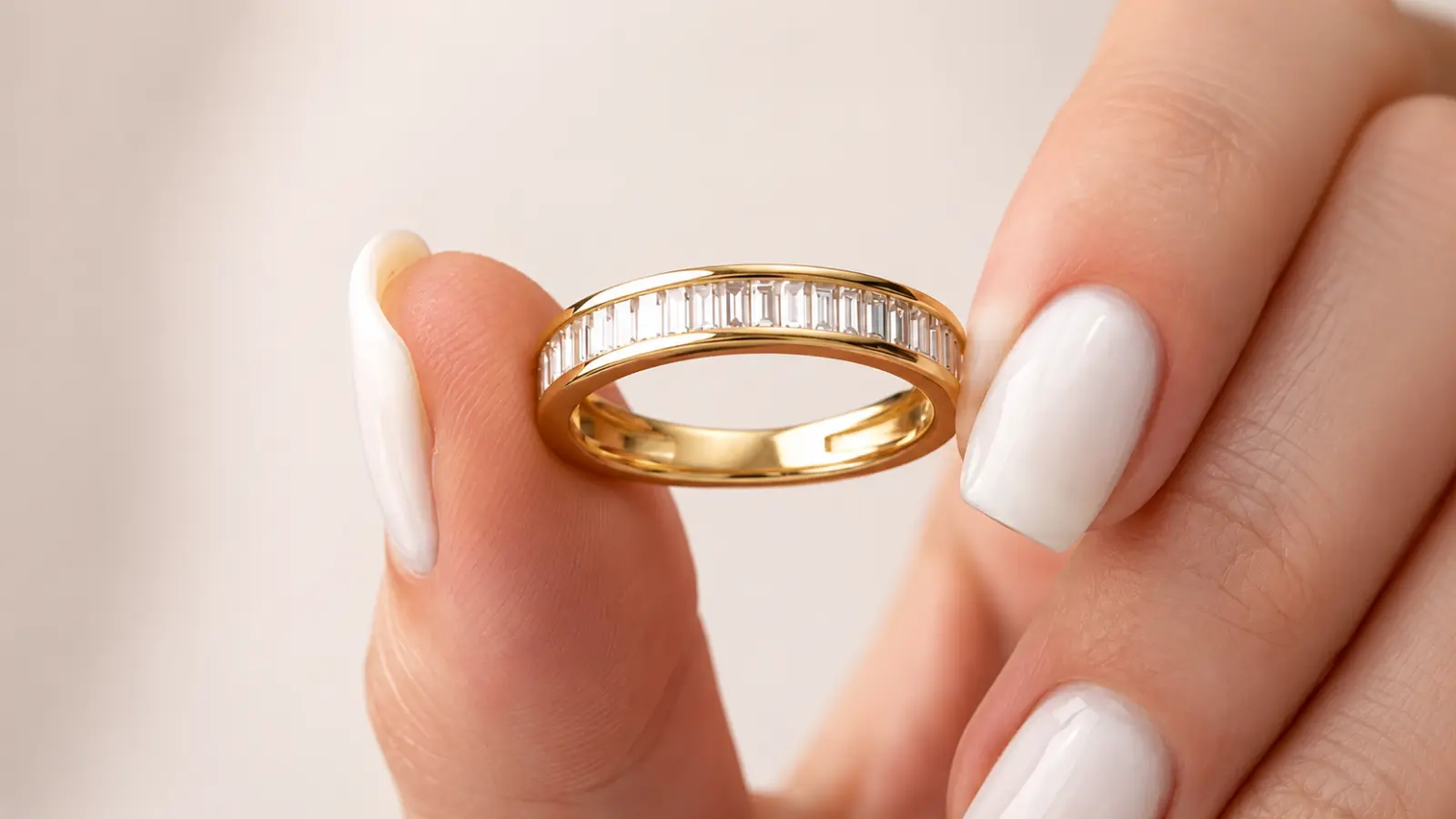
If the plain straight band is the most understated pairing for an emerald cut engagement ring, a baguette band is the most inherently harmonious one. The baguette is a step-cut stone, rectangular, flat-topped, and faceted in parallel rows rather than the triangular facets of a brilliant cut. This is the same family of cutting as the emerald cut. When a baguette band sits beside an emerald cut engagement ring, the visual logic is immediate: the stones share a cutting philosophy, and the stack reads as a unified design rather than a coincidental combination.
How baguette bands are set
Baguette bands are typically channel-set or bezel-set, which means the small rectangular stones are held between parallel walls of metal or individual bezels rather than by exposed prongs. Channel-setting in particular reinforces the clean, continuous line of the band, there are no interruptions to the row of stones, no raised settings, no texture beyond the stones themselves and the metal framing them. This makes a channel-set baguette band one of the most architecturally precise diamond wedding rings, which is exactly why the design pairs so well with an emerald cut.
Half-eternity vs. full-eternity baguette bands
Baguette bands are available in half-eternity (stones across the top and partway down the sides) and full-eternity (stones all the way around) configurations. A half-eternity baguette band is the more practical choice for most wearers, the underside of the band remains plain metal, which is more comfortable during daily wear and allows the band to be resized more easily than a full-eternity ring. A full-eternity baguette band makes a stronger visual statement, but its design can make wedding ring resizing impossible if your size changes, and some wearers find that the stones on the underside create discomfort during extended wear. For most people, the half-eternity version delivers nearly all of the visual effect with fewer practical trade-offs.
Baguette band width and proportion
Baguette bands tend to run slightly wider than plain bands at the same price point, because the stones require a minimum setting width to be cut and held properly. A standard baguette band typically starts at around 2mm and is most commonly found in the 2.5mm to 4mm range. Against a larger emerald cut, a stone of 1.5 carats or more, a 3mm to 4mm baguette band reads as a proportionate companion. Against a smaller or more elongated emerald cut, the same band can feel heavy. As with any band pairing, the engagement ring needs to be physically present when the baguette band is being evaluated.
Art Deco Pairings
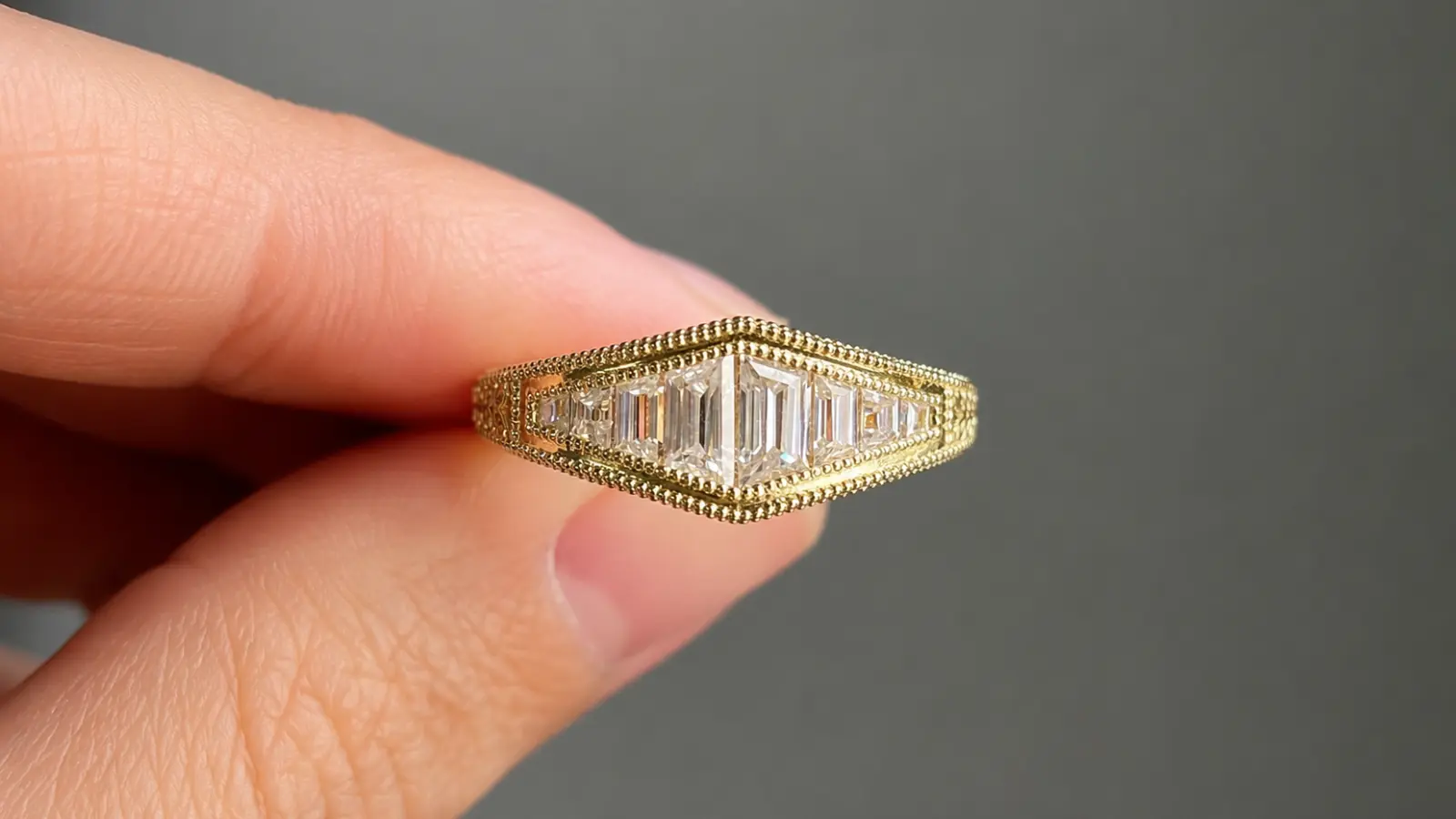
The emerald cut and Art Deco design are historically linked in a way that few other stone shapes can claim. The emerald cut’s modern form was refined during the 1920s and 1930s, the height of the Art Deco movement, and the aesthetic values of the two are nearly identical: geometric precision, symmetry, architectural line, and a preference for elegance over exuberance. Pairing an emerald cut engagement ring with an Art Deco-inspired wedding band is not a trend or a stylistic stretch. It is a historically coherent decision.
What makes a band Art Deco
Art Deco jewelry is characterized by geometric motifs, repeating patterns of lines, triangles, rectangles, and chevrons, as well as milgrain detailing (tiny beaded edges along the metal), filigree (delicate openwork metalwork), and a strong preference for platinum and white gold. Channel-set stones in geometric arrangements, engraved geometric patterns, and architectural proportions are all hallmarks of the style. A band that shares these qualities with an emerald cut can create the same architectural coherence found in Art Deco wedding rings, going beyond simple metal matching.
Milgrain bands
A milgrain band, one with a border of tiny beaded metal dots along its edges, is one of the most accessible Art Deco-inspired options and one of the most versatile. The milgrain detail adds texture and historical character to an otherwise simple band without introducing curves or organic elements that would conflict with the emerald cut’s geometry. A plain platinum band with milgrain edges alongside a platinum emerald cut solitaire is a pairing that has appeared in bridal jewelry since the 1920s for good reason: it works at every scale and never dates.
Engraved geometric bands
Bands with engraved geometric patterns, repeating rectangles, hatching, angular arabesques, carry an Art Deco character that pairs naturally with the emerald cut’s visual language. These bands have more surface detail than a plain or milgrain band, which means they require more care in proportion: the engraving should not be so dense or elaborate that it competes with the stone. An engraved band that reads from a normal viewing distance as a textured but still linear piece tends to complement the emerald cut well. One where the engraving demands the same attention as the stone does not.
Filigree bands
Filigree, openwork metalwork formed from fine twisted wire, is a more delicate Art Deco-adjacent option that pairs well with vintage or antique emerald cut settings. It introduces an ornate quality that contrasts with the emerald cut’s severity, which can work beautifully when the engagement ring itself has vintage character. Against a very modern or simply set emerald cut, the same filigree band may feel anachronistic. The pairing works best when the engagement ring’s setting already carries some period character, a square bezel, a distinctive vintage frame, or a setting with its own Art Deco detailing.
Minimal Bands for Emerald Cuts
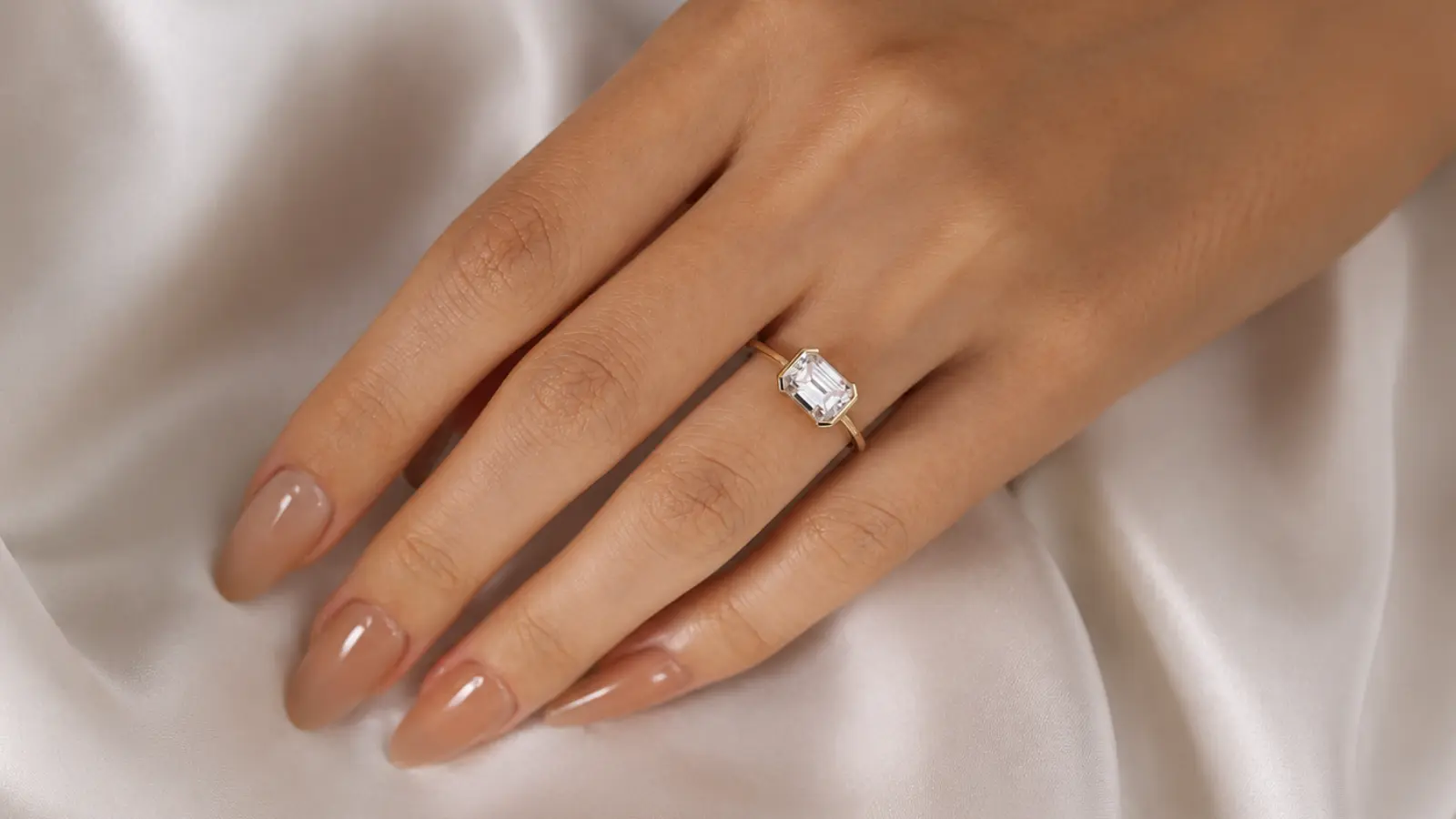
Among emerald cut wearers, the plain metal band, simple, unadorned, straight-sided, is one of the most photographed and most often recommended pairings, and it is not hard to understand why. The emerald cut’s step facets create a stone that is inherently complex in a quiet way: there is significant visual depth and movement inside the stone, particularly in high-quality diamonds where the hall-of-mirrors effect of the step facets is most pronounced. A plain band beside such a stone asks nothing of the viewer’s attention and gives everything to the stone.
Why simplicity works so well here
The contrast between a highly architectural stone and minimalist wedding rings can read as a deliberate aesthetic choice rather than a lack of imagination. It communicates confidence in the stone, an acknowledgment that the emerald cut does not need adornment to be interesting. In practice, it also means the ring combination photographs exceptionally cleanly, ages without any element falling out of style, and works across any dress code, setting, or stage of life without requiring adjustment.
Width and metal choices for a minimal band
A minimal band for an emerald cut engagement ring typically works best in the 1.5mm to 2.5mm range. Narrower than 1.5mm, the band can look insubstantial against the stone’s rectangular expanse, present but not fully registered. Wider than 2.5mm, a plain band starts to become visually significant in its own right, which may or may not be the goal. At 2mm, a plain band occupies exactly the right middle position for most emerald cut settings: noticed, but not competing.
Matching the metal of the engagement ring is the most coherent choice for a minimal band, a platinum band beside a platinum setting, a yellow gold band beside a yellow gold setting. This creates a unified look where the division between ring and band is visible only by proximity rather than by color or material contrast. Mixed metals can be intentional and beautiful, but they require more deliberate thought against the emerald cut’s formal aesthetic than a matched pair does.
The case for wearing a plain band alone
A functional advantage of a minimal band that is worth naming: it is a ring that works completely on its own. Many people who wear elaborate engagement rings remove them for activities, exercise, cooking, manual work, and wear only the wedding band during those periods. A minimal straight band has a completeness and simplicity that an ornate or heavily curved band sometimes lacks when worn without its companion ring. Choosing a band that works well both beside the emerald cut and entirely independent of it is a decision that rewards daily wear in a way that is easy to underestimate at the point of purchase.
What to Avoid
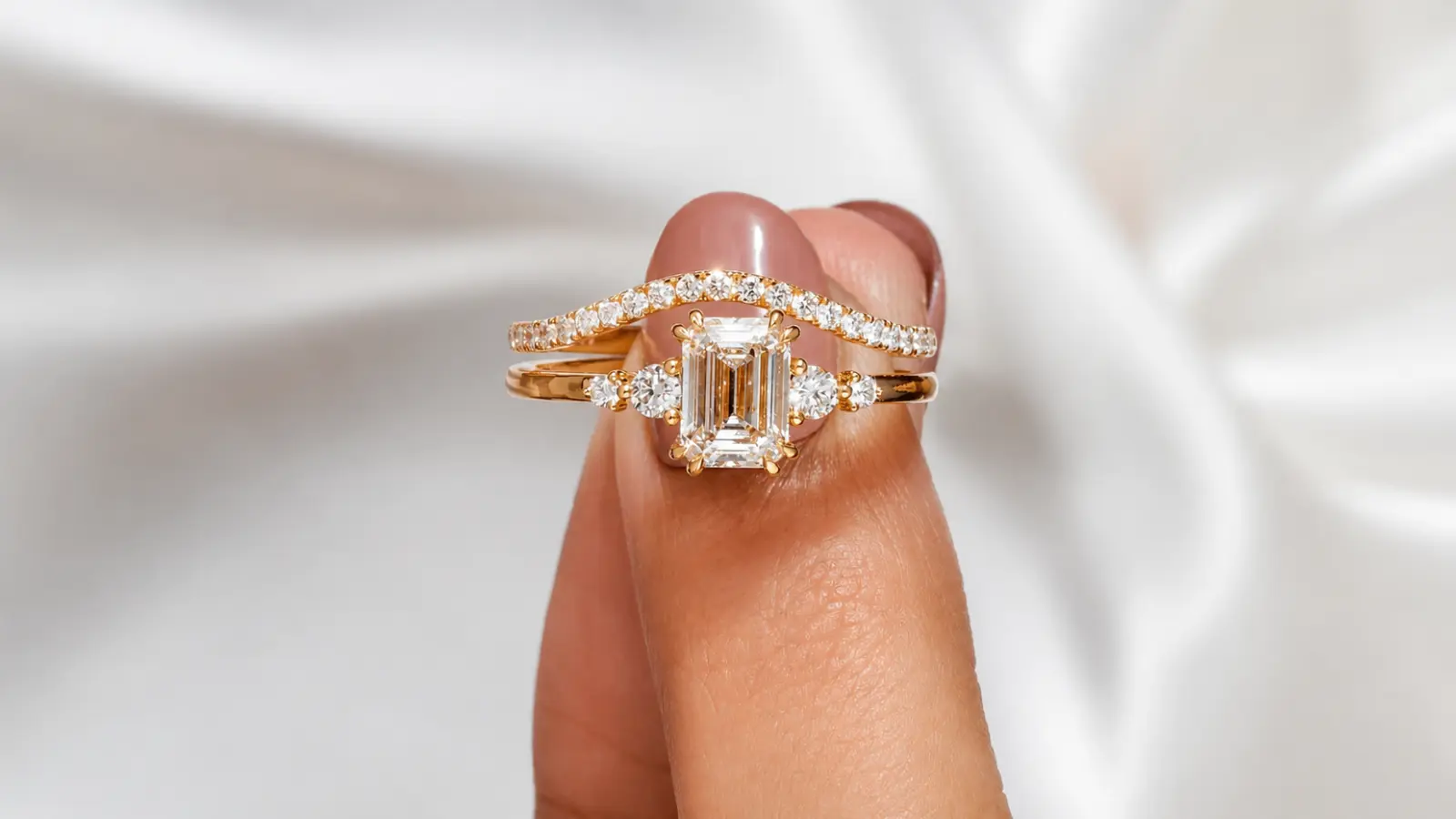
The emerald cut is a forgiving stone in many ways, its fit-friendly profile eliminates the gap problem that complicates so many other pairings, but it has a clear aesthetic that certain band choices work against rather than with. Most of the common mistakes in this category come from applying the same decision framework that works for brilliant-cut rings to a stone with fundamentally different visual logic.
Curved and chevron bands
These bands exist to solve a fit problem that the emerald cut does not have. Against an emerald cut, a curved or chevron band introduces a rounded or angular line that works against the stone’s horizontal geometry rather than supporting it. The mismatch is not always dramatic, a very subtle curve on a slim band may be barely noticeable, but it is almost always present, and it tends to become more apparent in photographs than in the hand. The general rule is straightforward: if the band’s silhouette introduces a line the emerald cut’s setting does not already contain, consider whether that line adds something intentional or simply adds noise.
Heavy or busy pavé bands
A pavé band set with very small brilliant-cut diamonds can look casually decorative against an emerald cut’s formal step-cut aesthetic. The scattered sparkle of micro-pavé is the visual opposite of the emerald cut’s broad, reflective flashes, and when the two sit side by side, neither quality is fully expressed. This does not mean pavé bands should never be worn with emerald cuts, a slim, refined pavé band in a matching metal can work well, but a wide or heavily set pavé band tends to create a visual conflict that is difficult to resolve through proportion alone.
Mismatched proportions
A band that is dramatically narrower or wider than what the emerald cut’s dimensions call for is one of the most common pairing mistakes and one of the easiest to avoid. A very narrow band beside a large emerald cut looks like an afterthought. A very wide band beside a smaller or more elongated stone becomes the dominant element and diminishes the stone. The band should feel like a companion to the engagement ring, not an appendage or an overshadowing presence. This proportion check cannot be done reliably from a screen, it requires the two rings together in hand.
Rose gold or yellow gold bands beside white settings without intention
Mixed metals can be a strong deliberate choice, but they require more thought against an emerald cut’s clean aesthetic than against a more casual stone shape. A warm gold band beside a cold platinum or white gold emerald cut setting can look striking when it is clearly a design decision, when the contrast is the point. It can also look like a mismatch when it is simply a result of not having considered the combination carefully. Before choosing a mixed-metal pairing for an emerald cut, it is worth looking at the two metals together in person, in the specific tones of the actual rings being considered, rather than inferring from photographs how they will read together.
Choosing a band without the engagement ring present
This applies to every engagement ring shape, but it is worth naming specifically here. The emerald cut’s proportional sensitivity, the way band width reads very differently against a small versus a large stone, makes the in-person fitting more important than it might seem for a shape with a clear preferred band style. A 3mm plain band may look proportionate on a display stand and feel overwhelming beside a narrow elongated emerald cut, or vice versa. Every assessment of fit and proportion for this pairing should be made with both rings in hand, under the same lighting and at the same viewing distance you would experience during everyday wear. For more on practical ring fitting and stacking decisions, see our how to wear wedding rings.
Emerald Cut Engagement Ring Wedding Band Inspiration
Wedding bands for emerald cut engagement rings can completely change the final look of your ring combination. Explore our inspiration board for straight bands, baguette designs, Art Deco styles, minimal bands, diamond pairings, and elegant emerald cut ring ideas.
Choosing a Wedding Band That Complements Your Emerald Cut Ring
The best wedding band for an emerald cut engagement ring is not the one that adds the most detail, sparkle, or decoration. It is the one that understands the clean lines, quiet elegance, and architectural beauty that made you choose an emerald cut in the first place.
Whether you choose a simple metal band, a baguette design, an Art Deco-inspired piece, or a subtle diamond band, the right pairing should feel balanced rather than competing. A wedding band does not need to change the character of your engagement ring — it should become the piece that completes it.
Frequently asked questions (FAQ)
What wedding band looks best with an emerald cut engagement ring?
The best wedding band for an emerald cut engagement ring is one that complements the stone’s clean lines and rectangular shape. Straight bands, simple metal bands, baguette diamond bands, and geometric designs often work especially well because they match the emerald cut’s structured appearance. The goal is to enhance the ring without competing with the stone’s elegant step-cut design.
Do emerald cut engagement rings need a curved wedding band?
No. Most emerald cut engagement rings do not need a curved wedding band because their straight, rectangular shape usually pairs naturally with straight bands. Unlike oval or pear-shaped rings, emerald cuts typically do not create the same fitting challenges. A straight wedding band often creates the cleanest and most balanced look.
Why do baguette wedding bands pair well with emerald cut rings?
Baguette wedding bands pair well with emerald cut rings because both share a similar geometric style. Baguette diamonds and emerald cuts are both step-cut shapes, meaning they create clean lines and broad flashes of light rather than intense sparkle. This creates a cohesive look where the wedding band and engagement ring feel intentionally designed together.
Should you choose a plain or diamond wedding band for an emerald cut ring?
Both plain and diamond wedding bands can work beautifully with emerald cut engagement rings. A plain band creates a timeless, minimal look that keeps attention on the center stone. A diamond band adds detail, but designs with baguettes or cleaner stone arrangements usually match the emerald cut’s sophisticated style better than overly busy designs.
What mistakes should you avoid when choosing a wedding band for an emerald cut ring?
Common mistakes include choosing a band that overwhelms the center stone, ignoring proportion, selecting a style that clashes with the emerald cut’s geometry, or focusing only on sparkle instead of balance. Emerald cuts have a very distinctive appearance, so the best wedding bands usually support the design rather than compete with it.
What width wedding band is best for an emerald cut engagement ring?
The best wedding band width depends on the size and proportions of the emerald cut stone. Many emerald cut rings pair well with bands around 2mm to 3mm because this range provides enough presence without overpowering the engagement ring. Larger stones may support wider bands, while smaller or more elongated emerald cuts often look better with a slimmer, balanced design.