A mantilla wedding veil is one of the most distinctive bridal veil styles, known for its elegant lace border, graceful draping, and timeless Spanish heritage. Unlike traditional veils that fall from a gathered comb, the mantilla frames the bride’s face and shoulders, creating a beautifully romantic silhouette.
Its unique construction makes hairstyle, dress selection, lace details, and placement especially important. When chosen thoughtfully, a mantilla becomes one of the most memorable elements of the entire bridal look.
This guide explains everything you need to know about mantilla wedding veils, including their history, lace types, styling, dress pairings, hairstyles, and practical tips for wearing one with confidence.
What a Mantilla Veil Is and How It’s Different
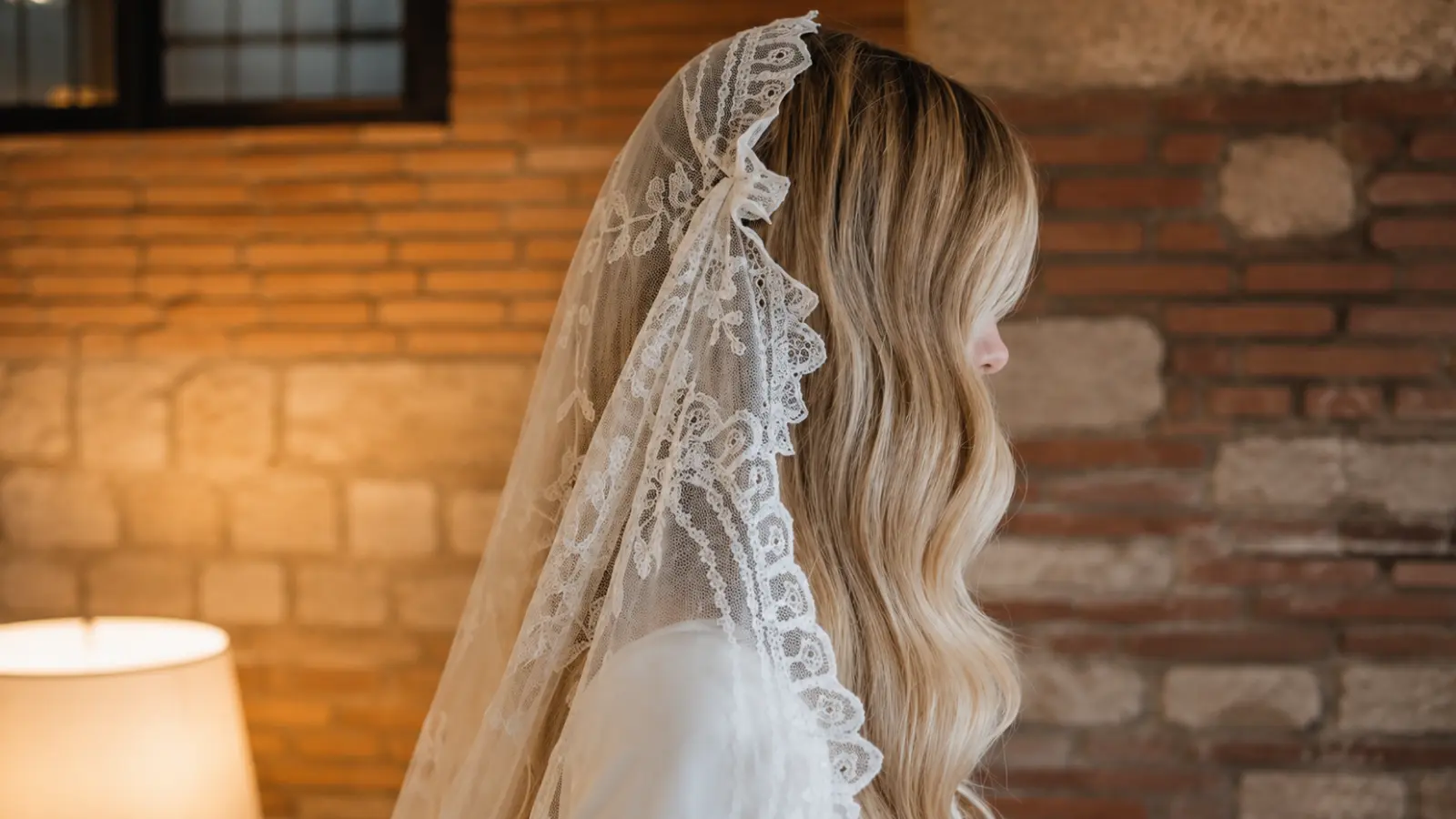
A mantilla veil is constructed differently from every other veil style. Where a standard veil is gathered at a single comb and falls behind the bride in a rectangular or semi-circular sweep, the mantilla is shaped as a full circle or oval and draped directly over the top of the head, allowing the lace edge to fall around the face, shoulders, and back in one continuous frame. There’s no gathering, no bunching, and often no visible comb — the attachment is hidden beneath the hair.
The result is a silhouette unlike anything else in bridal fashion. Rather than a veil that trails behind the bride, the mantilla wraps her. The lace edge frames the profile from front to back, which is why the style reads so differently in photographs: from the front, you see the bride’s face inside an oval of lace; from the back, you see the full fabric falling in a flat, uninterrupted sweep.
The fabric itself is typically lace — either a full lace construction or a tulle base with a substantial lace border. The lace does the visual work that the shape and movement do in a standard veil. At every length, the mantilla is defined by its edge, which is why the lace choice matters more here than in almost any other veil style.
Mantilla Veil vs. Regular Lace Wedding Veil
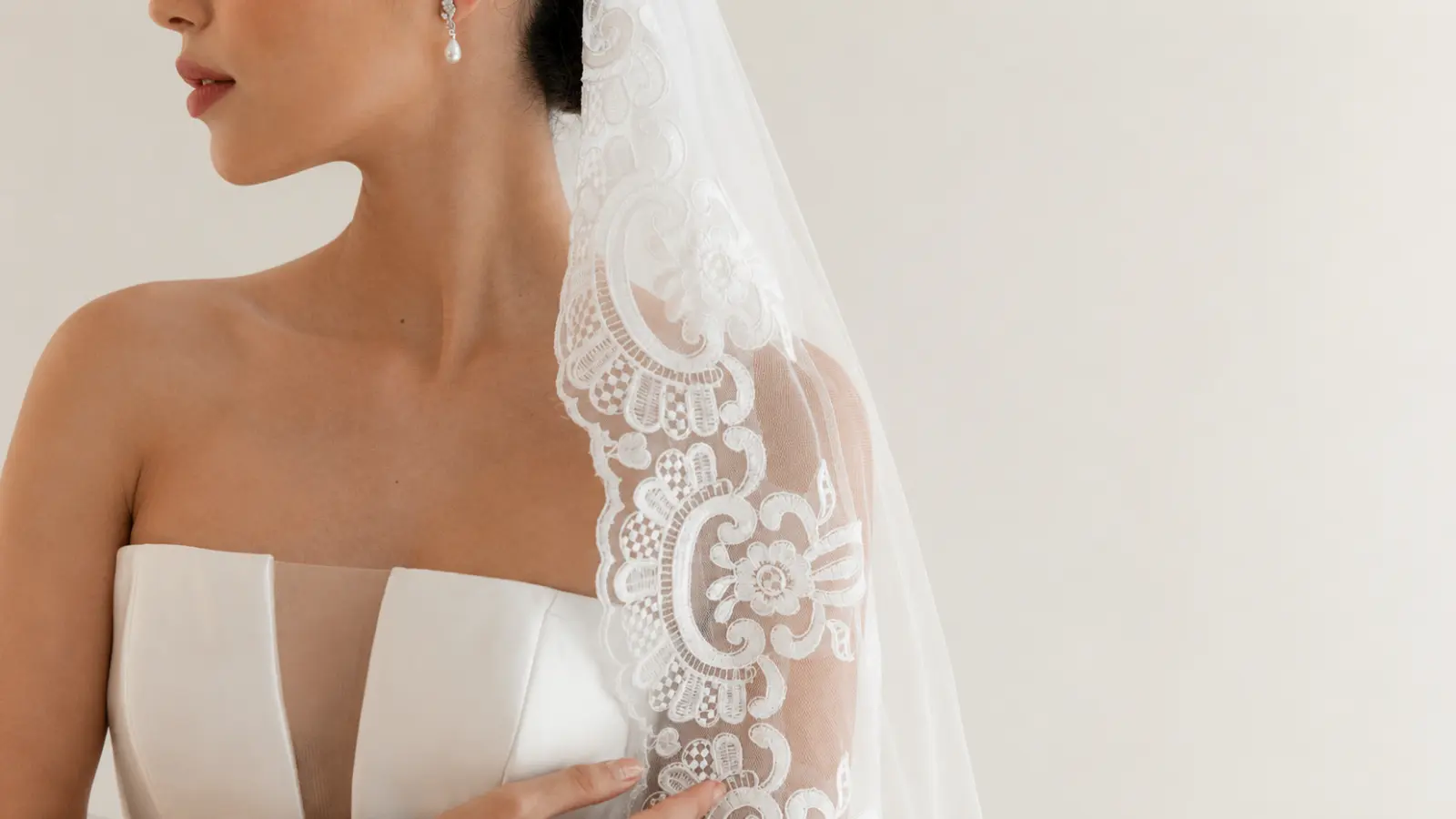
These two are frequently confused, and the confusion is understandable — both involve lace, and both are often described using the same adjective. But they are different objects that fall and photograph very differently.
| Mantilla Veil | Regular Lace Wedding Veil | |
|---|---|---|
| Shape | Circular or oval | Rectangular or semi-circular |
| Construction | All-lace or tulle with wide lace border; no gather | Tulle base with lace edge trim; gathered at comb |
| Attachment | Draped at the crown; secured with pins or hidden comb | Single gathered comb at the back of the head |
| How It Falls | Around the face, sides, and back | Behind the bride only |
| Silhouette Effect | Frames the entire profile | Creates a train or backdrop behind the bride |
| Lace Role | Central — lace IS the veil or its dominant element | Decorative — lace is a trim on a tulle base |
In practical terms: if you love lace but want the fabric movement and train effect of a traditional veil, a lace-edged tulle veil (covered in detail in the lace wedding veil) is the more versatile option. If you want the framing effect, the flat drape, and the cultural weight of the mantilla silhouette, the mantilla is the style you’re describing — and the two aren’t interchangeable.
Spanish Roots and Cultural Context
The mantilla has been part of Spanish dress for centuries, worn originally as a head covering for formal occasions, religious ceremonies, and social events. In Spain, the mantilla worn to bullfights, Holy Week processions, and formal court occasions became one of the country’s most recognizable cultural symbols — typically black lace over a tall decorative comb called a peineta. The bridal version is almost always white or ivory, without the high comb, and worn as a central element of the wedding look.
In the United States, the mantilla veil became a staple of Catholic and Hispanic bridal traditions and gradually expanded into broader American wedding fashion. Today, it’s worn by brides of all backgrounds who are drawn to its aesthetic — the lace framing, the historical depth, and the distinctly different silhouette it creates compared to every other veil option. You don’t need Spanish heritage or religious affiliation to choose a mantilla veil for your wedding. It functions fully as a bridal style in its own right.
Mantilla Wedding Veil vs. Catholic Mantilla
This is one of the more common sources of confusion in online searches, and it’s worth addressing directly: a bridal mantilla veil and a Catholic chapel mantilla are two different accessories.
A Catholic mantilla is a small, simple head covering — typically black, white, or ivory — worn by women during Mass as an act of modesty and reverence. It’s usually just large enough to cover the top and back of the head, with little or no decorative lace detail, and it is not designed around bridal aesthetics. Many Catholic women own and wear one regularly to church.
A bridal mantilla veil, by contrast, is a full-scale wedding accessory. It’s typically chapel or cathedral length, made of or trimmed with elaborate lace, and designed to be the visual centerpiece of the bridal silhouette. The two share a name and a cultural lineage, but they serve entirely different purposes and look quite different in person.
If you’re searching for what to wear as a head covering at a Catholic wedding ceremony — either as a guest or as a bride at a traditional Mass — the chapel mantilla used for Mass is a separate and much simpler item. This article is about the bridal version.
Mantilla Veil Lengths: Chapel and Cathedral
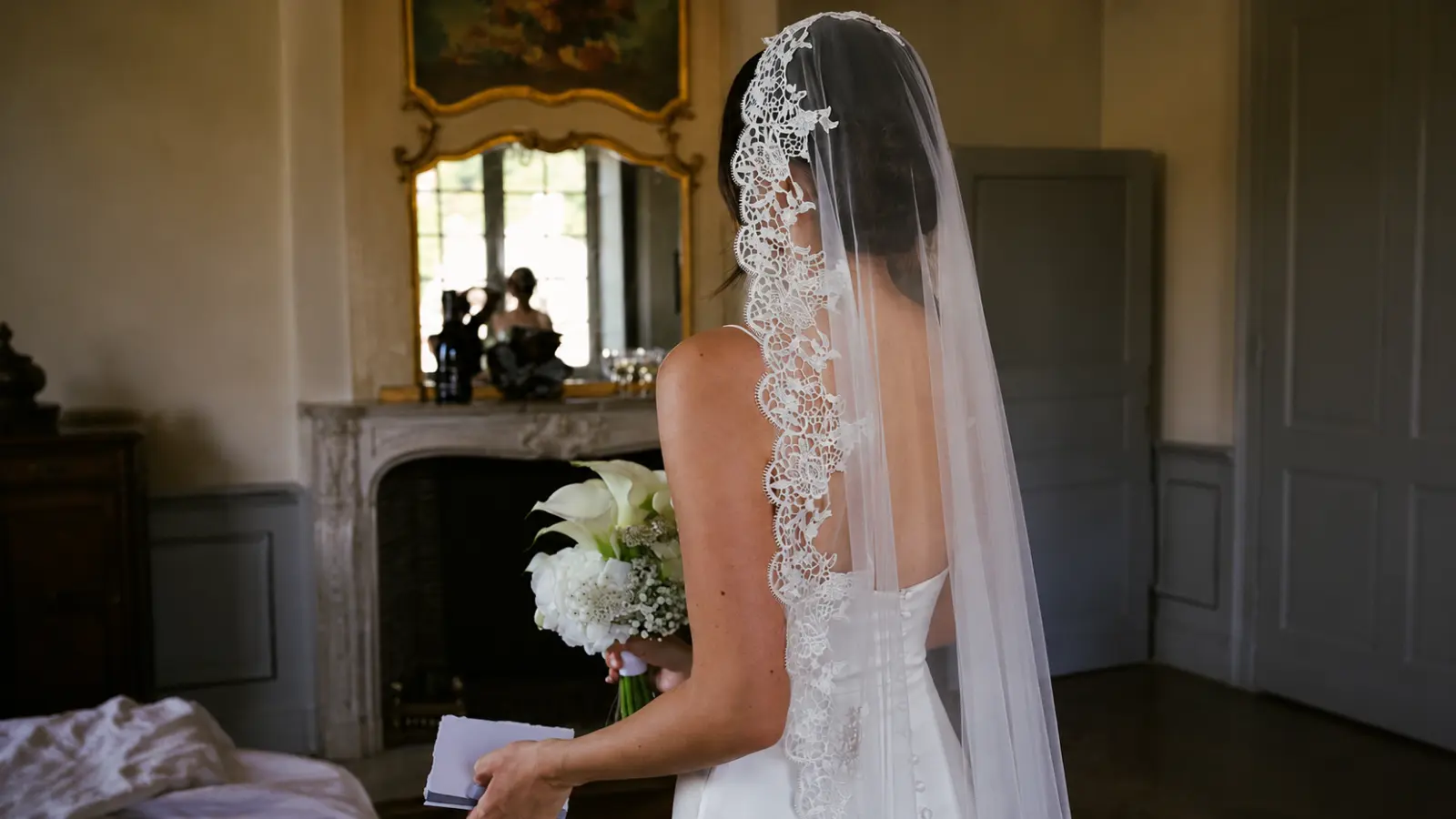
The mantilla comes in a range of lengths, and the choice affects both the drama of the look and the logistics of wearing it. Because the mantilla drapes from the crown rather than hanging from a comb, the length measurement refers to how far the fabric falls from the top of the head — which means a chapel mantilla and a chapel-length standard veil reach similar floor proximity, but the mantilla also wraps forward and to the sides.
Chapel-Length Mantilla
The most commonly worn bridal mantilla length. At chapel length, the veil reaches the floor and brushes just past the hem of the gown — substantial and formal without requiring the space or management of a longer train. It drapes around the shoulders and frames the body fully without overwhelming the dress silhouette. For most venue types and dress styles, this is the right starting point when exploring the mantilla style.
Cathedral Mantilla
At cathedral length, the mantilla extends several feet past the gown’s hem, creating a significant train that reads as one of the most dramatic bridal looks available. Because the fabric wraps the entire body rather than falling only behind, the effect at this length is considerably more enveloping than a cathedral-length standard veil. It requires a large venue, a long aisle, and a designated person to arrange the veil before the processional. The cathedral mantilla is the choice for a very formal, very intentional ceremony — it rewards brides who have thought through every detail of how the look will be managed.
Between the two, the chapel mantilla is typically the more practical and widely flattering option. The cathedral version is extraordinary when the setting and the plan support it, but comparing wedding veil lengths more broadly can help you decide which level of drama and practicality feels right.
Lace Types and Edge Styles
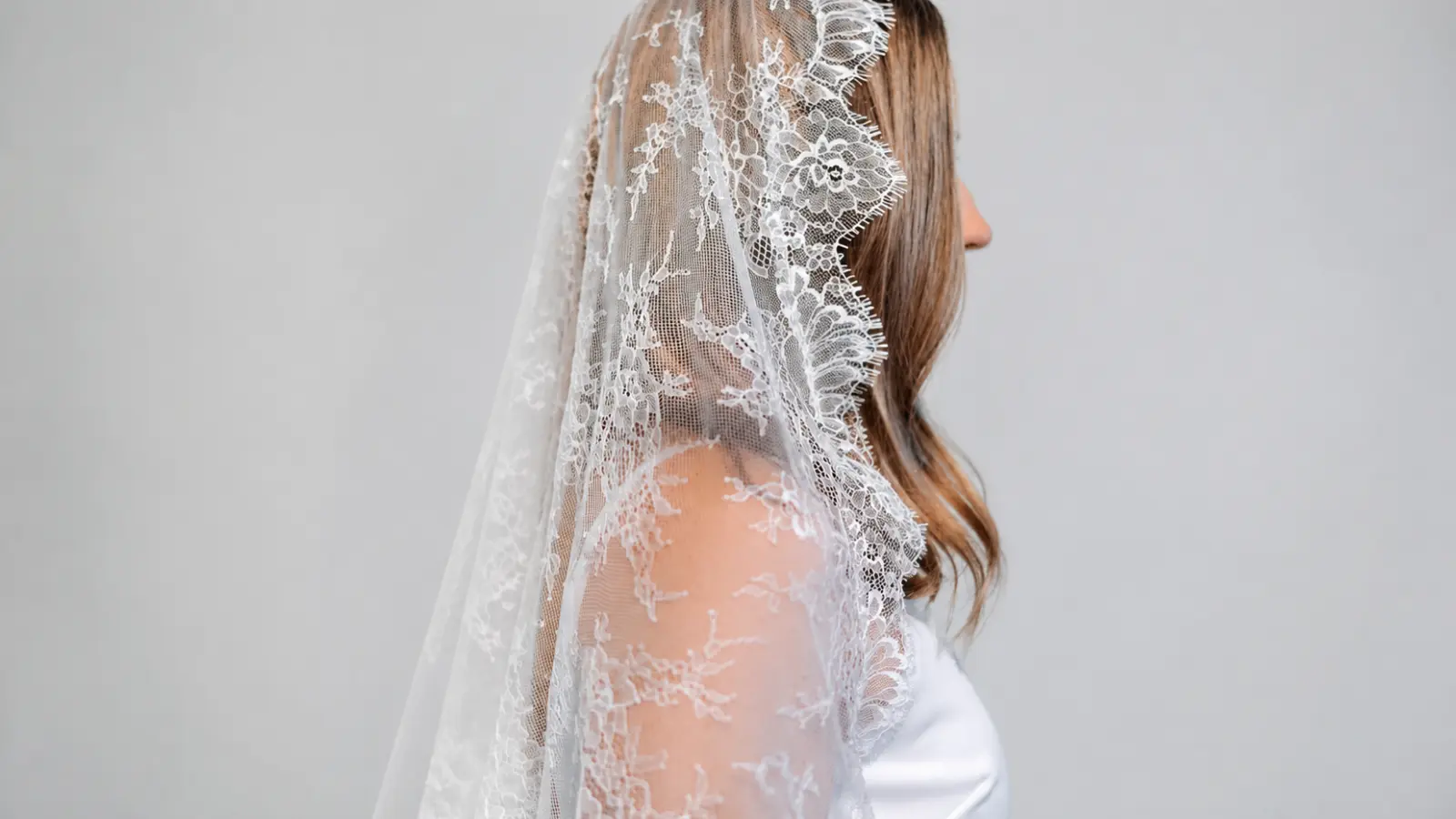
The lace on a mantilla veil does more visible work than on almost any other veil style. Because the edge falls around the face and frames the bride’s profile from every angle, its weight, scale, and pattern are part of the look in a way that a lace trim on a standard veil isn’t.
Chantilly Lace
The most common and widely available option. Chantilly has a delicate, lightweight structure with a fine floral or scrolling pattern and a soft feel. It photographs gracefully, doesn’t add significant weight to the veil, and works with a wide range of dress styles. For brides who want a classic mantilla without an overtly ornate effect, Chantilly is typically the right starting point.
Alencon Lace
A heavier, more sculptural lace with a characteristic corded outline around each floral motif. The cord gives the pattern definition and a slight raised texture that catches light differently than flat lace. Alencon reads as richer and more formal than Chantilly, and is often used on mantillas intended for very traditional or ceremonial settings. The additional weight is worth considering — at chapel or cathedral length, a heavy lace border adds noticeable weight that affects how the veil sits and whether it shifts throughout the day.
Spanish Lace and Re-embroidered Lace
These terms are used somewhat loosely in bridal retail, but they generally describe lace with a dense, elaborate pattern that’s been layered or reinforced for additional texture. Re-embroidered lace has threads added over the base lace pattern to create dimension and depth. This type of lace makes a strong visual statement and is best paired with simpler dress silhouettes where the mantilla is clearly the focal point of the look.
Whatever lace type you’re drawn to, ask to hold a sample of the actual veil fabric before deciding — not just the edge trim, but the full panel. Lace that looks delicate in a photograph can add surprising weight at chapel or cathedral length, and the drape will feel very different in person than on a hanger.
How to Wear a Mantilla Veil
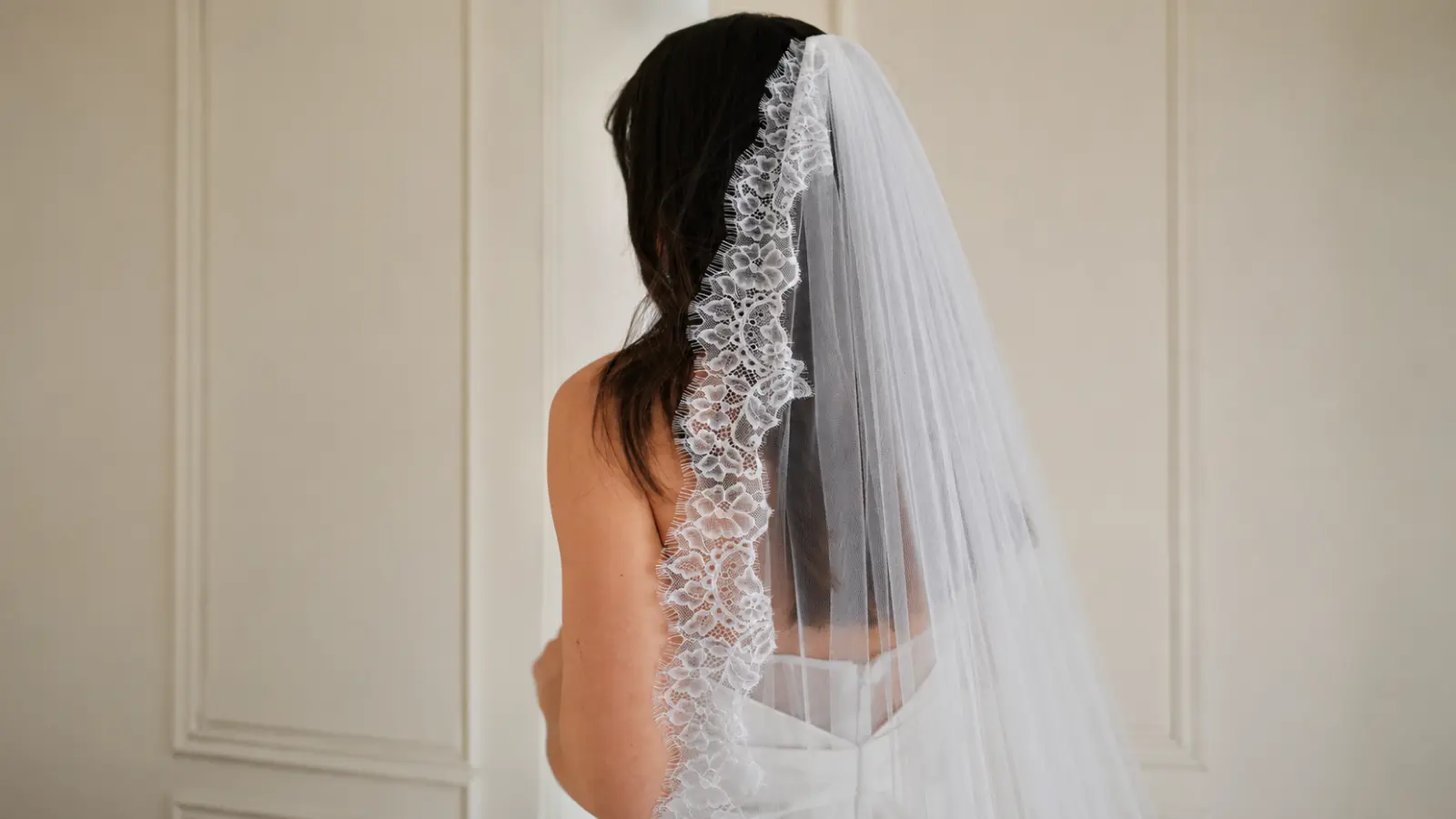
Wearing a mantilla well is largely a question of preparation — specifically, working with your hairstylist before the wedding day to test the attachment and the placement, rather than figuring it out for the first time on the morning of your ceremony.
Placement
The mantilla is placed at the crown of the head, centered from front to back, so that the lace edge falls evenly on both sides of the face. The placement point affects the framing effect significantly: too far forward and the veil crowds the face; too far back and it loses the mantilla’s characteristic frame. Most stylists place it at or just behind the natural hairline at the top of the head. Bring your veil to the hair trial — not a stand-in — so you can see the actual placement and adjust it before the wedding day.
Securing It
The mantilla’s drape construction means there’s no single gathered comb creating a strong attachment point. Instead, it’s typically held in place by a small built-in comb at the top, supplemented by hairpins placed at intervals around the attachment area. For heavier lace or longer lengths, additional pins along the sides help prevent the veil from shifting throughout the ceremony. The pins need to go through the veil and into the hair structure underneath — not just through the veil alone — so working with a stylist who has experience with mantilla veils is worth requesting specifically.
Tiaras and Other Headpieces
A mantilla veil and a tiara are a challenging combination. The mantilla lies flat against the head and wraps around it, which doesn’t leave clean space for a structured crown or headband to sit naturally. Most stylists advise choosing one or the other. If you want both the lace framing and a headpiece, a small decorative comb or a simple hairpin accent can work within the mantilla’s structure without competing with it.
For a broader look at hairstyle placement with different veil types, the how to wear a wedding veil covers attachment and positioning across styles.
Best Hairstyles for a Mantilla Veil
The mantilla veil is more dependent on hairstyle than almost any other bridal veil. Because it drapes from the crown without a rigid comb structure, the hair underneath directly affects how the veil sits, how it stays in place, and how the lace framing falls around the face. This is not a veil to pair with a hairstyle you decided on separately and then attached — the two need to be planned together.
| Hairstyle | Works With Mantilla? | Notes |
|---|---|---|
| Low chignon or bun | Very well | Creates a flat, stable crown surface; clean framing effect |
| Mid-height updo | Very well | Most common pairing; gives the veil a firm anchor point |
| Classic ballerina bun | Well, with care | High bun can push the veil forward; test placement at hair trial |
| Half-up, half-down (smooth top) | Can work | Top must be smooth and flat for clean drape; pins are essential |
| Soft waves, half-up | With difficulty | Texture at the crown makes even placement harder; test before deciding |
| Hair fully down, loose or curly | Challenging | Veil can shift into hair; lace frame loses definition; not recommended without a practice run |
The consistent theme: the more structured and flat the crown of the hairstyle, the better the mantilla behaves. If wearing your hair down is important to you, test the combination thoroughly at your hair trial with your actual veil — not a proxy — before committing. For more on pairing specific hairstyles with different veil styles, see the wedding hairstyles with veil.
Which Dresses Work Best
The mantilla veil makes a strong visual statement by itself, which means the dress pairing needs to be deliberate. This isn’t a veil that disappears into the look — the lace edge is present from every angle, at every moment of the ceremony. The dress either complements that presence or competes with it.
| Dress Style or Detail | Works With Mantilla? | Why |
|---|---|---|
| A-line with lace bodice or skirt | Excellent | Lace on lace reads as intentional and harmonious; the silhouette is proportional |
| Ballgown, modest detail | Excellent | Volume balances the mantilla’s presence; plain fabric lets the veil be the detail |
| Fit-and-flare with lace overlay | Very well | Echoes the lace construction; elongated silhouette works with the mantilla’s drape |
| Simple A-line, minimal detail | Well | The mantilla becomes the centerpiece; dress provides a clean backdrop |
| Heavily beaded or embroidered gown | With care | Two ornate elements can compete; a simpler lace edge on the mantilla usually resolves this |
| Sleek sheath or minimalist column | Possible, intentional | Creates a deliberate contrast; the veil becomes the sole ornate element — works if that’s the goal |
| Short or tea-length dress | Not typically | Proportions are difficult; a chapel mantilla overwhelms a short hem |
The most reliable pairing principle: if the dress has lace, the mantilla’s lace should echo it rather than duplicate it. The patterns don’t need to match exactly, but the weight and scale of the lace should read harmoniously — a delicate Chantilly mantilla with an Alencon-trimmed gown tends to look dissonant; a mantilla in the same lace family as the dress tends to read as designed. For a full breakdown of dress and veil pairings across all lengths and styles, see the wedding dress with veil.
When a Mantilla Veil May Not Be the Right Fit
The mantilla is one of those styles where the honest answer is that it’s right for some brides and genuinely not right for others — and that’s not a criticism of either the veil or the bride. Understanding where it tends to fall short helps you make a clearer decision.
The mantilla requires hair that works with it, not just hair worn with it. If you’ve always pictured yourself with loose, flowing waves and a casual, unstructured look, the mantilla is likely to feel at odds with that vision — and the logistics of keeping it in place through a ceremony will add stress that a simpler veil wouldn’t. If you’re committed to a very modern, architectural dress with no lace and clean, unornamented lines, the mantilla’s lace framing can feel like it belongs to a different aesthetic entirely. And if your venue is small or has low ceilings and limited natural light, the full visual impact of the mantilla — which relies partly on being seen from a distance — doesn’t land the same way it would in a larger, more open space.
None of this makes the mantilla a difficult veil. It makes it a specific one. The brides who love it tend to feel strongly about it before they’ve even tried it on; the ones who are uncertain usually find a different style that fits more naturally once they try both.
Common Mistakes to Avoid
The mantilla’s particular construction creates some specific pitfalls that brides wearing other veil styles don’t encounter. These are the ones most worth knowing in advance.
- Not testing the veil at the hair trial. This is the single most common and consequential mistake. The mantilla behaves differently depending on hair texture, volume, and structure — and assumptions made at the salon will not hold on the wedding day without a real test. Bring the actual veil (not a similar one, not a sample) to your hair trial and test the placement, the securing method, and how it holds over 30 to 45 minutes of movement.
- Choosing a lace weight that fights the dress. Lace is visible from every angle on a mantilla, which means mismatched lace weights between the veil and the dress are noticeable. If your dress has lightweight lace detail and you order a mantilla with a heavy, ornate border, the two will compete. Ask to compare fabric samples side by side before finalizing.
- Ignoring the placement angle. A mantilla placed too far forward crowds the face and eliminates the characteristic oval frame. Placed too far back, it loses its framing function entirely and reads as an ordinary veil. The right position is typically just behind the natural hairline, but this varies by face shape and hairstyle. Test it — don’t assume.
- Planning to add a tiara after the fact. If you’re considering both a mantilla and a tiara or crown, decide at the appointment rather than after. They’re difficult to combine, and the decision affects how the hair is styled. Knowing in advance is far easier than working around a decision made separately.
- Underestimating wind at outdoor ceremonies. The mantilla’s drape construction means it has less structural resistance to wind than a gathered veil. In outdoor settings, even a light breeze can shift it off-center or wrap the lace edge across the face. If your ceremony is outdoors, test the veil specifically in a breeze, ask about weighted options, and have extra pins on hand.
The thread through all of these is the same one that applies to cathedral veils, to heavy lace edging, to any bridal accessory with strong visual presence: planning and testing before the day is what separates a beautiful result from a stressful one.
Mantilla Wedding Veil Inspiration
Discover elegant mantilla wedding veil inspiration featuring timeless Spanish lace, romantic bridal hairstyles, cathedral and chapel lengths, and beautiful wedding dress pairings. Explore classic bridal looks, delicate lace details, and sophisticated styling ideas to find the perfect mantilla veil for your wedding day.
Is a Mantilla Wedding Veil Right for You?
A mantilla wedding veil is much more than a beautiful bridal accessory—it’s a style with remarkable history, unmistakable elegance, and a silhouette unlike any other. Its graceful lace framing creates a timeless look that continues to inspire brides around the world.
If you’re drawn to classic romance, intricate lace details, and a veil that becomes an integral part of your bridal look, a mantilla may be exactly what you’re looking for. With the right hairstyle, dress, and thoughtful planning, it becomes one of the most memorable details of your entire wedding day.
Frequently asked questions (FAQ)
Is a mantilla veil right for your wedding?
A mantilla veil may be right for you if you want a lace-framed bridal look, are comfortable making the veil a major visual element, and can coordinate it with your hairstyle and dress. It works especially well with structured updos, formal ceremonies, and gowns that either echo the lace or provide a clean backdrop. It may be less suitable if you want loose, voluminous hair, a very casual aesthetic, or minimal styling logistics.
What is a mantilla wedding veil?
A mantilla veil is a circular or oval veil made from lace or lace-trimmed tulle and draped directly over the head. Unlike a traditional gathered veil, it frames the face, shoulders, and body in one continuous lace edge. It is usually secured with pins or a small hidden comb and has Spanish and Catholic cultural roots.
What is the difference between a mantilla veil and a regular lace wedding veil?
A regular lace wedding veil is generally a gathered tulle veil with lace used as a border or decorative trim. A mantilla is circular or oval, lies flat over the head, and usually has no gathered attachment point. The mantilla frames the face and sides of the bride, while a regular lace veil mainly falls behind her.
What hairstyle works best with a mantilla veil?
Low buns, chignons, smooth mid-height updos, and structured half-up hairstyles work best because they provide a stable, even surface for the veil. Loose or highly voluminous hair can make the mantilla shift, sink into the hairstyle, or lose its symmetrical framing effect. Always test the actual veil during the hair trial.
How is a mantilla veil attached to the hair?
A mantilla is usually secured at the crown with hairpins, a small hidden comb, or both. Heavier lace and longer lengths may require additional side pins to keep the fabric centered. Because the veil is not gathered into one strong attachment point, the hairstyle underneath must provide enough structure to anchor it securely.
What wedding dresses look best with a mantilla veil?
Mantilla veils pair particularly well with A-line, ballgown, and fit-and-flare dresses. They work beautifully with lace gowns when the lace patterns complement rather than duplicate each other. Minimalist dresses can also work when the contrast is intentional and the veil becomes the main decorative element. Heavily beaded gowns may compete with an elaborate lace border.
What is the difference between a bridal mantilla veil and a Catholic mantilla?
A bridal mantilla is a full-length wedding veil designed as part of the bridal look, often in chapel or cathedral length. A Catholic mantilla is a smaller head covering worn during Mass as a devotional practice. They share cultural origins and a similar lace-draped form, but they differ greatly in size, purpose, and styling.