How to steam a wedding veil is one of the most common questions brides have after receiving their veil or taking it out of storage. Wrinkles are completely normal, but using the wrong method to remove them can permanently damage delicate bridal fabrics.
The safest approach depends on the material, the embellishments, and the type of veil you own. While many synthetic tulle veils can be steamed successfully at home, lace, silk tulle, pearls, and heavily embellished designs often require extra care or professional attention.
This guide explains everything you need to know about steaming a wedding veil, including safe steaming techniques, common mistakes to avoid, storage before the wedding, transportation tips, and when professional steaming is the better choice.
Steam vs. Iron: Why It Matters
Most brides’ first instinct when they see a creased veil is to reach for an iron. It is worth understanding why that instinct needs to be redirected — not because irons are always dangerous, but because the physics of how they work is exactly wrong for tulle.
Bridal illusion tulle is a synthetic net fabric. Its fibers are heat-sensitive in a concentrated way: the sustained, direct contact heat of an iron plate can melt, flatten, or permanently mark the mesh in seconds — even on what feels like a low setting. The problem is not heat itself; it is heat applied directly and without movement to a fabric that has no natural protection against it.
Steam works differently. It introduces moisture into the fiber, which relaxes the tension in the weave without direct contact, allowing creases to release gradually. A garment steamer delivers that moisture at a distance, giving you control over how much heat reaches the fabric at any moment. That distance is what makes it safe for tulle — and it is why the technique matters as much as the tool.
If you do not have a garment steamer and cannot access one, the safest low-risk alternative is the bathroom steam method covered later in this guide. An iron used incorrectly is not a safe substitute for a steamer on bridal fabrics.
Know Your Veil Before You Start
Not all veils respond to steam the same way. Before you pick up any tool, identify what your veil is made of and what embellishments it has. If you are not sure, check your receipt, the bridal boutique’s paperwork, or any tag still attached to the comb. For a full breakdown of how each fabric behaves, the wedding veil materials covers this in detail — what matters here is knowing which category yours falls into before you begin.
| Veil Type | Steam Safety | What to Know |
|---|---|---|
| Synthetic bridal illusion tulle (plain) | Generally safe at home | Hold steamer 6–8 inches away; keep moving; never touch the fabric with the head |
| Synthetic tulle with rolled or raw edge | Generally safe at home | Edge is finished and stable; focus passes on the body of the veil |
| Synthetic tulle with lace trim | Use caution; test first | Lace trim can distort with too much direct moisture; increase distance and use shorter passes |
| Silk tulle | Use caution; test first | More delicate than synthetic tulle; steam from greater distance; consider professional |
| Mantilla (all-over lace) | Professional recommended | Full lace veils have no tulle base to absorb moisture; lace structure can distort easily |
| Pearl or crystal embellishment | Use caution around embellishment | Moisture can loosen adhesive on glued embellishments; steam the tulle body and avoid direct steam on pearls |
| Beadwork or embroidery | Professional recommended | Beads and thread can react differently to moisture and heat than the base fabric; safest with a professional |
| Organza | Use caution; test first | Holds structure well but can water-spot; light steam from distance; press lightly if needed |
When in doubt about your fabric, treat the veil as if it falls into the more cautious category. The test-first principle — steaming a small, hidden section near the comb attachment before working the visible body of the veil — is the single most reliable safeguard regardless of which fabric you are working with.
How to Steam a Wedding Veil
For plain synthetic tulle and most mid-range veils with simple edge treatments, steaming at home is straightforward. The key is setup and patience — both of which cost nothing but make a real difference in the outcome.
What You Need
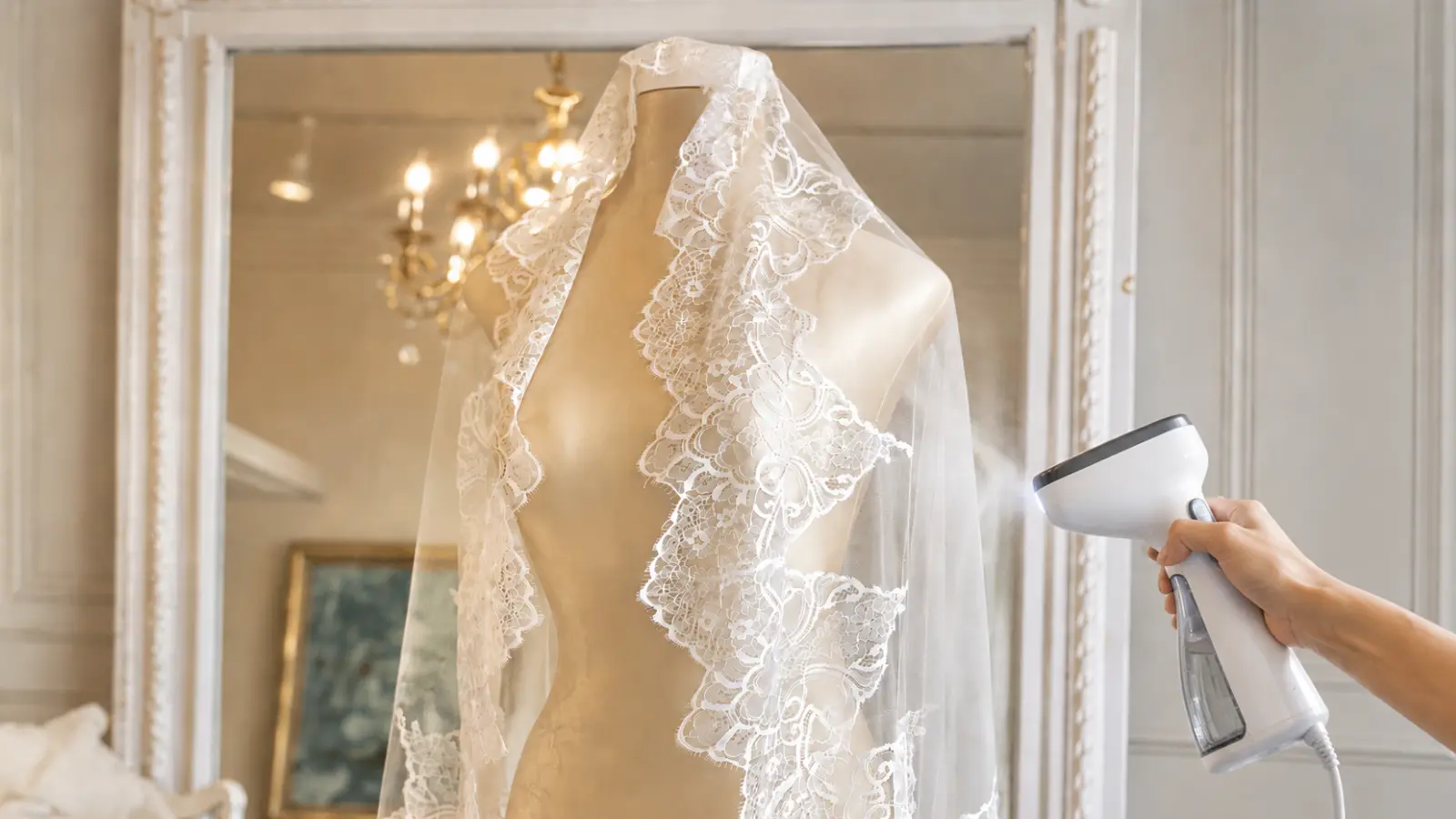
A handheld garment steamer is the right tool. A full-size standing steamer works too if you have one, though it requires more maneuvering. You will also need somewhere to hang the veil at full length while you work — a shower rod, a door frame, or a clothing rack all work well. Avoid wire hangers; use a padded or wide plastic hanger so the fabric does not develop a pressure mark at the attachment point.
Step by Step
Fill the steamer and allow it to heat fully before you begin. Starting with a steamer that is still warming up produces uneven, spitting moisture that can spot delicate fabric.
Hang the veil at full length in a clean space. If you are working in a room with furniture or floors that could be damaged by moisture, lay down a towel or move to a harder surface. Begin at the top of the veil, just below the comb, and work downward in slow, steady vertical passes. Keep the steamer head moving — do not hold it in one spot. Maintain a consistent distance of 6 to 8 inches between the steamer head and the fabric throughout.
As you work, the tulle will begin to relax visibly. Fold lines that looked sharp and set will soften within one or two passes. If a crease is stubborn, resist the impulse to move closer to the fabric. Instead, make two or three slow passes over the same area from the same distance and give the fiber time to respond between each one.
Once you have worked the full length, leave the veil hanging undisturbed for at least two hours before handling it. The fabric needs time to cool and for any residual moisture to evaporate before you touch, fold, or move it.
The Bathroom Steam Method
If you do not have access to a garment steamer, a hot shower can do some of the work — not as precisely, but reliably enough for veils with light creasing from shipping or folded storage.
Hang the veil in the bathroom on a padded hanger, away from the shower stream so it does not get wet. Run the shower on the hottest setting with the bathroom door and any windows closed. Leave the veil hanging in the steam for 20 to 30 minutes. The ambient moisture in the room will penetrate the tulle and relax lighter fold lines without any direct contact.
This method works best on plain synthetic tulle with mild creasing. It will not fully release deep fold lines from tight or long-term storage, and it is less effective on longer veils where the lower portion hangs too far from the steam source. After the shower, leave the veil hanging in the bathroom until the room has aired and the fabric is fully dry — typically another hour or two. Do not fold it while any moisture remains.
Stubborn Creases and Fold Lines
Some creases do not fully release with a single steaming session. This is most common with veils that were folded tightly for an extended time — either during shipping, in boutique storage, or at home in a box or bag. The fiber memory in synthetic tulle can be persistent, and a fold that has been set for weeks or months may need more than one pass to release completely.
If a crease persists after steaming, allow the veil to hang overnight and assess it again in the morning. Many lines that look stubborn immediately after steaming relax significantly with gravity and time. A second steaming session the following day will often finish the job that the first started.
For a crease that runs along a consistent fold line — particularly at the point where a veil was folded for packaging — try steaming from both sides of the fabric if the veil’s weight and your setup allow it. Working both faces of the fabric on a deep crease accelerates the release more than multiple passes on one side.
If the crease is still visible after two sessions and overnight hanging, or if it sits along an embellished edge where you are uncomfortable applying more steam, this is the point to bring in a professional. A bridal dry cleaner or seamstress who regularly handles veils has equipment that produces more controlled and penetrating steam than a home device, and the result will be cleaner than anything achievable with repeated at-home attempts.
When to Call a Professional
Professional steaming is the right choice in a few specific situations, and knowing them in advance saves both the veil and the anxiety of attempting something at home that is genuinely above the safe DIY threshold.
Take the veil to a professional if it has full lace construction (mantilla style), significant hand-sewn beadwork or embroidery, or if the fabric is silk tulle — all of which can be damaged by moisture applied without specialized equipment or technique. Also take it in if the veil is a family heirloom that has not been handled recently, as aged or previously stored fabric can be more fragile than it appears.
A practical note on timing: if your wedding is within a week, ask when you call or email. Many bridal dry cleaners and seamstresses can accommodate a rush steaming appointment, but turnaround time varies. Professional preparation can also become part of your overall wedding veil cost, especially when rush service or specialist care is required.
Timing Note: When to Steam
Steam the veil one to three days before the wedding, not the morning of the ceremony. This gives the fabric time to settle and any residual moisture to evaporate fully. A veil steamed hours before the ceremony may still hold a faint dampness that can transfer to your hair or dress. After steaming, hang it loosely in a clean space and leave it undisturbed until it is time to pack it for the venue.
Storing the Veil Before the Wedding

Once the veil is steamed and fully dry, how you store it in the days before the wedding determines whether that work holds. A steamed veil folded and put back in a box will simply re-crease. The goal is to keep it hanging, unfolded, in a clean environment until it leaves for the venue.
Hang the veil from a padded hanger in a room that is not being used for getting-ready activity — away from perfume, hairspray, makeup, and any products that could settle onto the fabric. If you are keeping it in a bedroom or closet, push other garments back so nothing rests against or presses into the veil. Tulle picks up scent easily, and it also picks up color if a darker fabric is in sustained contact with it.
Do not cover a hanging veil with a plastic dry-cleaning bag. Plastic traps moisture and, over extended contact, can affect the fabric. A loose cotton dust cover, or simply leaving it uncovered in a clean space, is preferable for the short pre-wedding window.
If the room where you are storing the veil gets direct afternoon sun, move it to a different location or close the curtains. These short-term precautions protect the veil before the ceremony; after the wedding, long-term preservation requires a different storage approach.
Transporting the Veil to the Venue
Getting a steamed veil from home to the venue without wrinkling it is a step many brides underplan. The veil goes into a bag at the last minute, arrives at the venue folded, and needs re-steaming on a morning that has no margin for it. A few minutes of forethought the day before prevents this entirely.
The right transport method depends on the wedding veil length. For shorter to mid-length veils — shoulder through fingertip — hanging in a bridal garment bag works well. Use a padded hanger, arrange the veil loosely inside the bag without any other garments pressing against it, and hang the bag rather than laying it flat during the drive if your vehicle allows for it.
For longer veils — chapel, cathedral, or royal length — a garment bag is often too short to accommodate the full length without folding. The alternative is to loosely roll the veil around a cardboard tube wrapped in acid-free tissue paper (or a clean, smooth towel in a pinch) and place it in a long, flat box or garment carrier. Rolling rather than folding distributes any residual stress across the fabric gradually rather than concentrating it at a fold line.
Assign one person to be specifically responsible for the veil during transport — separate from whoever is managing the dress. A veil left in the trunk, on a seat, or in the back of an SUV without someone tracking it has a predictable outcome. Designate the person the day before, not on the morning of the wedding.
What to Avoid
Most veil steaming mistakes follow a recognizable pattern. These are the ones that show up most consistently — and cost the most to fix.
- Pressing the steamer head directly against the fabric. Direct contact concentrates heat and moisture in a single point. The result is a different kind of mark than an iron — a flattened, wet impression that can distort the mesh permanently. Always maintain distance.
- Using a traditional iron on tulle without a pressing cloth. Synthetic tulle can melt or develop a glazed, flattened appearance under a hot iron plate in seconds. If an iron is the only option available, use the absolute lowest heat setting and always place a slightly damp pressing cloth between the iron and the fabric. Never iron lace, silk tulle, or any embellished section.
- Steaming the veil the morning of the wedding. Residual moisture takes time to evaporate, and a veil that is not fully dry can transfer dampness to your hair, your neckline, or your dress. Steam it one to three days before, not the day of.
- Hanging the veil near hairspray or perfume. Tulle absorbs airborne particles more readily than heavier fabrics. Storing or hanging the veil in a room where styling products are being used will leave residue on the fabric that you will not be able to remove before the ceremony.
- Folding the veil again after steaming. This negates the work. A steamed veil should hang until it is transported, not be folded back into a bag or box for storage convenience.
- Pulling or tugging at stubborn creases by hand. Bridal tulle does not respond to tension the way heavier fabrics do. Pulling a fold line manually can stretch the mesh out of shape, creating a distortion that is harder to correct than the original crease.
The common thread in most of these is impatience — the impulse to do more, closer, faster than the fabric can handle. Steam and time are what actually work. The veil needs less intervention than most brides expect, applied more carefully than most brides initially attempt.
Wedding Veil Preparation Inspiration
Discover wedding veil preparation inspiration featuring proper steaming techniques, wrinkle-free bridal veils, safe storage methods, transportation tips, and elegant bridal styling before the wedding day.
How Should You Prepare Your Wedding Veil?
Preparing your wedding veil properly is just as important as choosing the right style. By using the correct steaming method, handling the fabric gently, and storing it carefully before the ceremony, you can ensure your veil looks flawless without risking unnecessary damage.
Taking a little extra time a few days before the wedding helps prevent last-minute stress and protects one of the most delicate accessories you’ll wear. Whether you steam it yourself or trust a bridal professional, careful preparation allows your veil to look exactly as it was intended on your wedding day.
Frequently asked questions (FAQ)
What is the safest way to steam a wedding veil?
The safest method is to use a handheld garment steamer held about 6 to 8 inches away from the fabric while working in slow, continuous passes. Never let the steamer touch the veil directly, and always test a hidden area first if the veil contains delicate fabrics or embellishments.
Can you steam a wedding veil at home?
Yes. Most synthetic bridal illusion tulle veils can be safely steamed at home using a handheld garment steamer on a low or medium setting. Delicate fabrics such as silk tulle or heavily embellished veils may require professional care.
Can you iron a wedding veil?
Direct ironing is not recommended for bridal tulle because concentrated heat can permanently damage synthetic fibers. Steam is much safer, and if a steamer is unavailable, the bathroom steam method is generally a better alternative than using an iron.
How do you get wrinkles out of a wedding veil?
A garment steamer removes most wrinkles effectively. Light creases often disappear after hanging the veil in a steamy bathroom, while deeper fold lines may require multiple steaming sessions or professional treatment.
How far in advance should you steam a wedding veil?
One to three days before the wedding is ideal. This gives the fabric enough time to relax completely and ensures any remaining moisture evaporates before the ceremony.
How do you transport a wedding veil without wrinkling it again?
Hang shorter veils inside a garment bag using a padded hanger. Longer veils should be loosely rolled around a tube wrapped in acid-free tissue paper instead of being folded. Avoid compressing the veil during transport.
When should you have a wedding veil professionally steamed?
Professional steaming is recommended for silk tulle, mantilla veils, heirloom pieces, or veils with heavy lace, pearls, embroidery, or beadwork. These materials require extra care that home equipment may not provide safely.