Wedding cake toppers are decorative pieces placed on top of a wedding cake to add personality, style, or sentimental meaning to the final design. From classic bride and groom figurines to custom names, vintage pieces, funny designs, and modern minimalist options, the right topper helps complete the cake without overpowering it.
Although a cake topper is a small detail, it can meaningfully change how a wedding cake feels. The best choices are not simply the most decorative ones — they are the toppers that match the couple’s personality, the cake design, the venue style, and the overall feeling of the celebration. A meaningful topper can become more than decoration; it can become a keepsake from the wedding day.
In this guide, you’ll discover wedding cake topper ideas for every style, including classic figurines, personalized designs, funny toppers, vintage finds, floral options, and unique custom pieces. You’ll also learn how to choose the right size, when to use a topper, and when letting the cake design stand alone is the better choice.
Wedding Cake Topper Ideas
The topper category has expanded so much that a useful starting point is not only “which topper do I like,” but “which topper belongs on this specific cake at this specific wedding.” A topper that looks beautiful in isolation can look mismatched on the wrong cake — choosing it alongside the overall wedding cakes design helps prevent a modern acrylic monogram on a heavily ornamented fondant cake from competing rather than complementing.
A delicate porcelain figurine on a rustic naked cake creates a tonal disconnect. The pairing matters as much as the topper itself.
These are general planning ranges only. Final pricing depends on material, maker, customization level, shipping, lead time, and whether the topper is vintage, handmade, or mass-produced.
Topper categories at a glance
| Topper Style | Best Cake Match | Wedding Aesthetic | General Price Range |
|---|---|---|---|
| Acrylic initials / monogram | Smooth buttercream or fondant | Modern, minimalist, classic | $20–$60 |
| Porcelain bride & groom | Traditional tiered cake | Classic, formal, traditional | $30–$120 |
| Custom silhouette figurines | Any style | Any — most versatile category | $60–$200 |
| Dried or silk floral | Rustic, semi-naked, textured | Rustic, bohemian, garden | $25–$80 |
| Wire script (Mr & Mrs) | Smooth or lightly textured | Romantic, classic, garden | $15–$45 |
| Funny resin figurines | Any style | Casual, fun, informal | $25–$80 |
| Vintage original (antique) | Classic or romantic tiered | Vintage, romantic, nostalgic | $30–$300+ (depending on era and condition) |
| Pet figurines | Any style | Any — personal statement | $50–$180 |
| Fresh flower cluster | Any — minimal, clean | Garden, romantic, rustic | $15–$60 (coordinated with florist) |
| No topper | Elaborate or architectural cakes | Modern, minimalist, maximalist floral | $0 — intentional |
Classic Bride and Groom Toppers
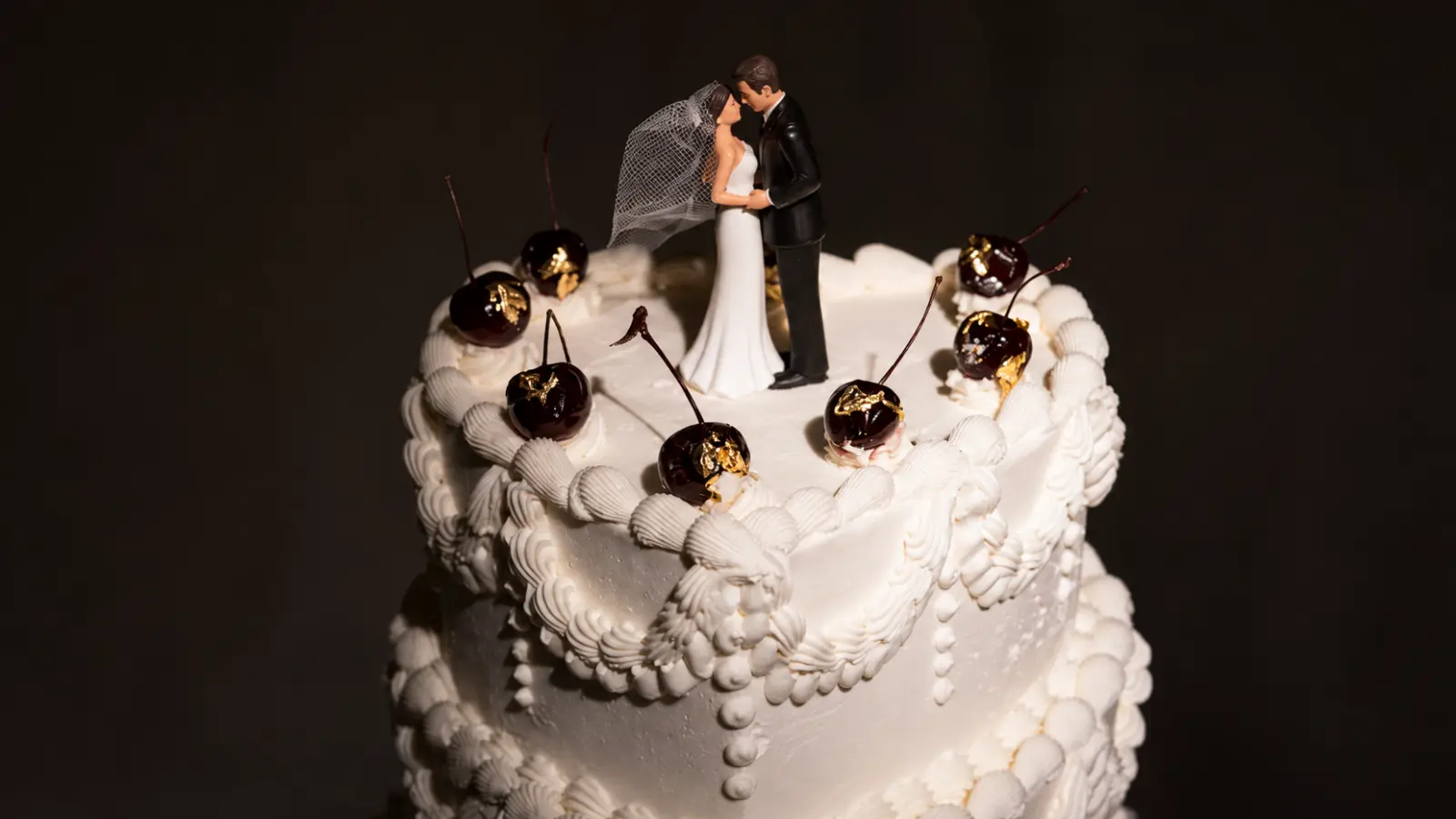
The classic bride-and-groom wedding cake topper has been present at American weddings since the early 20th century, which gives it a long-standing place in wedding cake tradition. The form is simple: two figures, one in a wedding dress and one in a suit or tuxedo, placed at the top of the cake as a representation of the couple whose marriage is being celebrated. The execution varies enormously across a century of production.
The porcelain figurine
The original classic. Porcelain bride-and-groom figurines — particularly ornate, hand-painted versions from earlier decades — often have a weight, texture, and detail that feels very different from many contemporary toppers. The craftsmanship in a high-quality porcelain topper is visible in photographs in a way that a resin or acrylic topper is not: the texture of the fabric, the expression on the faces, the fine detail of the veil or the boutonniere.
Contemporary porcelain toppers are still produced, but the quality varies significantly. The best current options are hand-painted rather than mass-produced, often from small artisanal makers or European manufacturers who have maintained traditional porcelain figurine production. Some lower-quality pieces may be resin labeled or styled as porcelain, so it is worth confirming the material if the topper is meant to become a keepsake.
Porcelain toppers work best at traditional and formal weddings with classic tiered cakes in smooth fondant or buttercream. They can look out of place on rustic, semi-naked, or heavily textured cakes where the formal figurine creates a tonal mismatch with the organic aesthetic.
Resin bride and groom figures
One of the most widely available versions of the classic topper in contemporary wedding retail. Resin figurines are lighter, more affordable, and more durable than porcelain — they are the option at most wedding supply stores, big-box retailers, and mass-market online wedding vendors. The quality ceiling for resin toppers is lower than for porcelain, but the floor is also more consistent: a mid-range resin topper is a safer choice than a poorly made porcelain one.
The main advantage of resin is the range of representation available. Contemporary resin toppers include same-sex couples (bride-and-bride, groom-and-groom), interracial couples, plus-size figurines, and couples in non-traditional wedding attire — a range that most vintage porcelain toppers do not cover. For couples who want a figurine-style topper that actually looks like them, resin is where the representation options are most developed.
Inclusive bride and groom toppers
One of the most meaningful expansions in the wedding topper market is the growth of inclusive options — toppers that represent same-sex couples, interracial couples, couples of different body types, and couples in non-binary or non-traditional wedding attire. These are now widely available from mainstream vendors as well as from independent makers on Etsy who specialize in custom representation.
For same-sex couples: bride-and-bride and groom-and-groom figurines are available in both resin figurine and custom silhouette formats across a wide price range. The custom silhouette category — laser-cut acrylic or wood figures in the approximate shape of the couple — is the most flexible for same-sex couples because the silhouette format is inherently less gendered than a figurine and can be customized to reflect the actual appearance and attire of both partners.
For couples who want figurine-style toppers that reflect their specific appearance: custom hand-sculpted clay or resin toppers, made by independent artists from reference photographs, can be one of the most accurate representation options. They usually require a longer lead time and a higher budget, but the result can feel much more specific to the couple than a generic approximation.
Personalized Wedding Cake Toppers
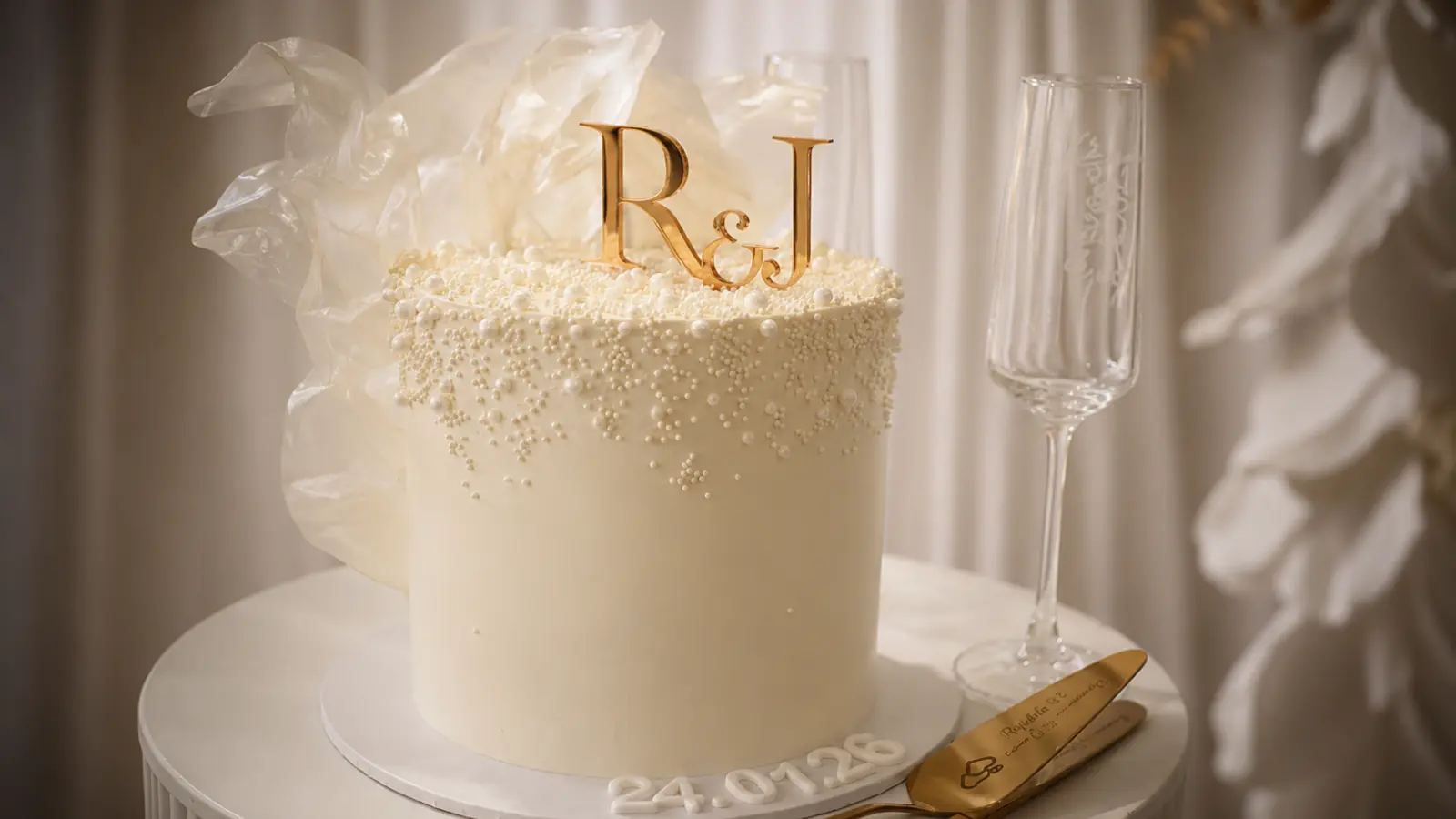
Personalized wedding cake toppers have become a major category because independent makers can now customize acrylic, wood, silhouette, and name toppers in a wide range of styles, materials, and price points. For many couples, a personalized topper feels more meaningful than a generic figurine because it places something specific to them at the top of the cake.
Custom acrylic and wood initials
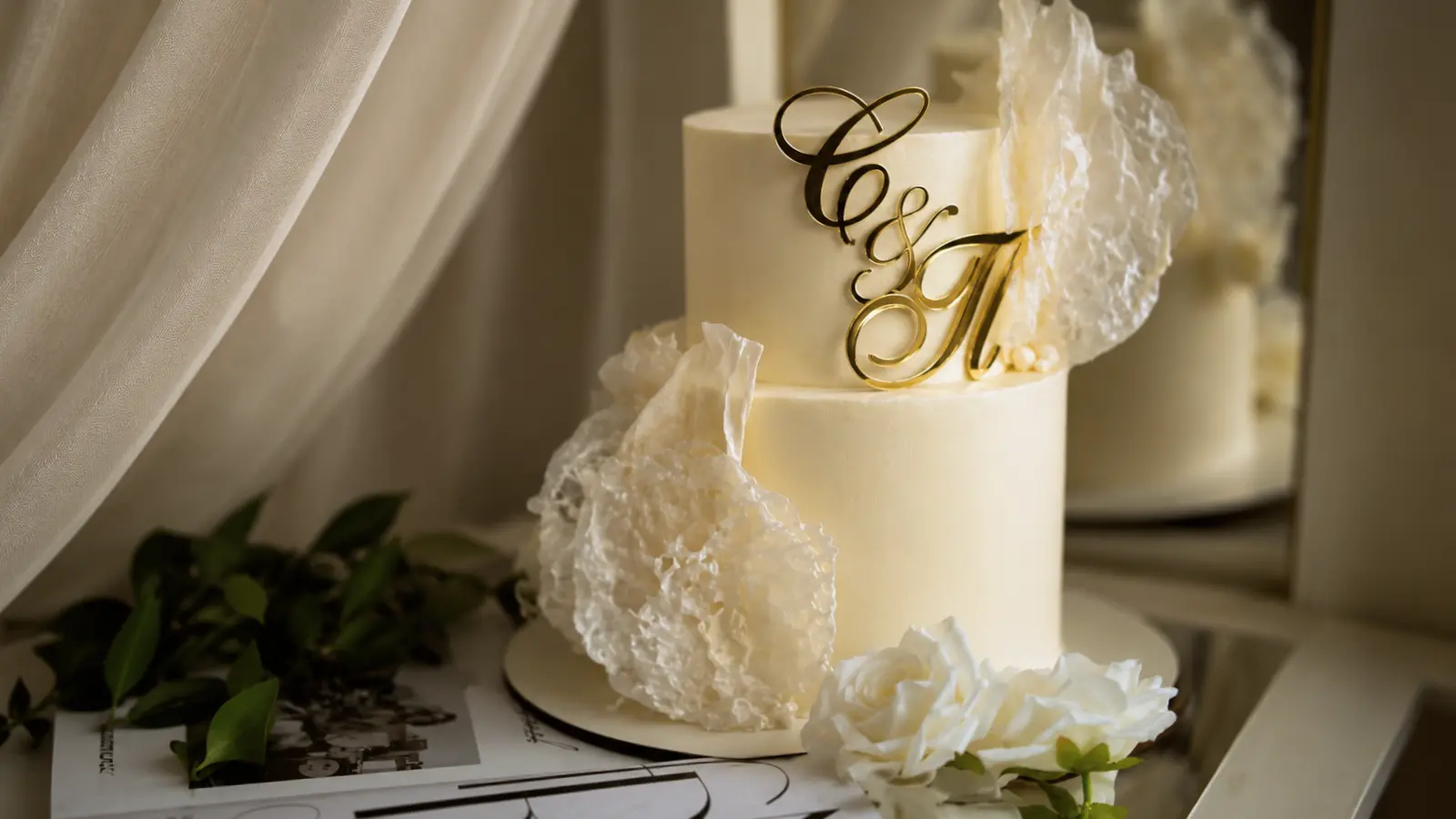
One of the most common personalized topper categories. A laser-cut acrylic or wood topper in the couple’s initials, last name, or a script phrase (“Forever,” “Always,” “Just Married”) can be ordered from many independent makers, with pricing and lead time depending on the material, size, customization and shipping. The customization options — font, color, size, whether it includes a date or a phrase alongside the initials — are extensive.
Acrylic toppers in gold mirror, rose gold, or champagne remain popular because they catch venue lighting elegantly and photograph well against both light and dark cake backgrounds. Matte white acrylic reads as clean and modern. Wood-finish laser-cut toppers work best on rustic wedding cakes and bohemian designs where the natural material echoes the aesthetic of the cake and the venue.
What many couples do not realize: the font choice matters enormously. A script font in gold acrylic reads as romantic and elegant. A bold sans-serif in the same material reads as modern and graphic. The font communicates the personality of the topper as much as the material does. Most Etsy makers offer multiple font options — review them all before ordering rather than accepting the default.
Custom silhouette toppers
Silhouette toppers are laser-cut figures in the approximate outline of the couple — their hairstyles, their posture, their general body shape — rather than detailed figurines with facial features and costume detail. The result is a topper that reads as representing the specific couple without requiring the labor-intensive hand-sculpting of a custom figurine. They are available in acrylic, wood, and other finishes, with pricing depending on the maker, size, material, and level of customization.
To order a custom silhouette topper, most makers require a photograph of the couple in approximate wedding attire — or at minimum, a description of their hair length, build, and the general silhouette of the dress and suit. The maker translates this into a file and cuts the topper to order. The result is not a portrait — the silhouette captures general shape rather than specific features — but it is recognizably “this couple” in a way that a generic figurine is not.
Custom hand-sculpted figurines
The most personalized option available — a miniature sculpture of the couple, made by hand from clay or resin by an independent artist, based on photographs. The level of detail varies by maker: the best custom figurine artists capture facial features, specific hairstyles, the design of the dress, and even distinctive accessories (a tattoo visible on the arm, a specific style of glasses). Pricing and lead time are usually higher than standard toppers because each figure is made individually, and popular artists may book well in advance.
Finding the right maker is the critical step. Look for: a portfolio of completed custom figurines (not just stock examples), reviews specifically mentioning the likeness quality, clear communication about the process and revision rounds, and a realistic timeline relative to your wedding date. Ordering a custom figurine too close to the wedding date can create unnecessary risk if the maker cannot accommodate rush work.
Toppers that tell a story
Some of the most memorable personalized toppers are not figurines of the couple at all — they are representations of something meaningful to the couple’s shared history. The place where they met, rendered in a miniature scene. Their shared hobby — a climbing rope, a surfboard, a pair of running shoes — in the place where figurines would normally stand. Their pet, given equal or greater prominence than the human figures. A phrase or date that is significant only to them, in a font that matches the invitation suite.
These toppers require more creative direction than ordering a standard option, but the result is a cake top that sparks genuine conversation at the reception — guests look at it and immediately understand something true about the couple. That communicative quality is difficult for a generic topper to achieve.
Funny Wedding Cake Toppers
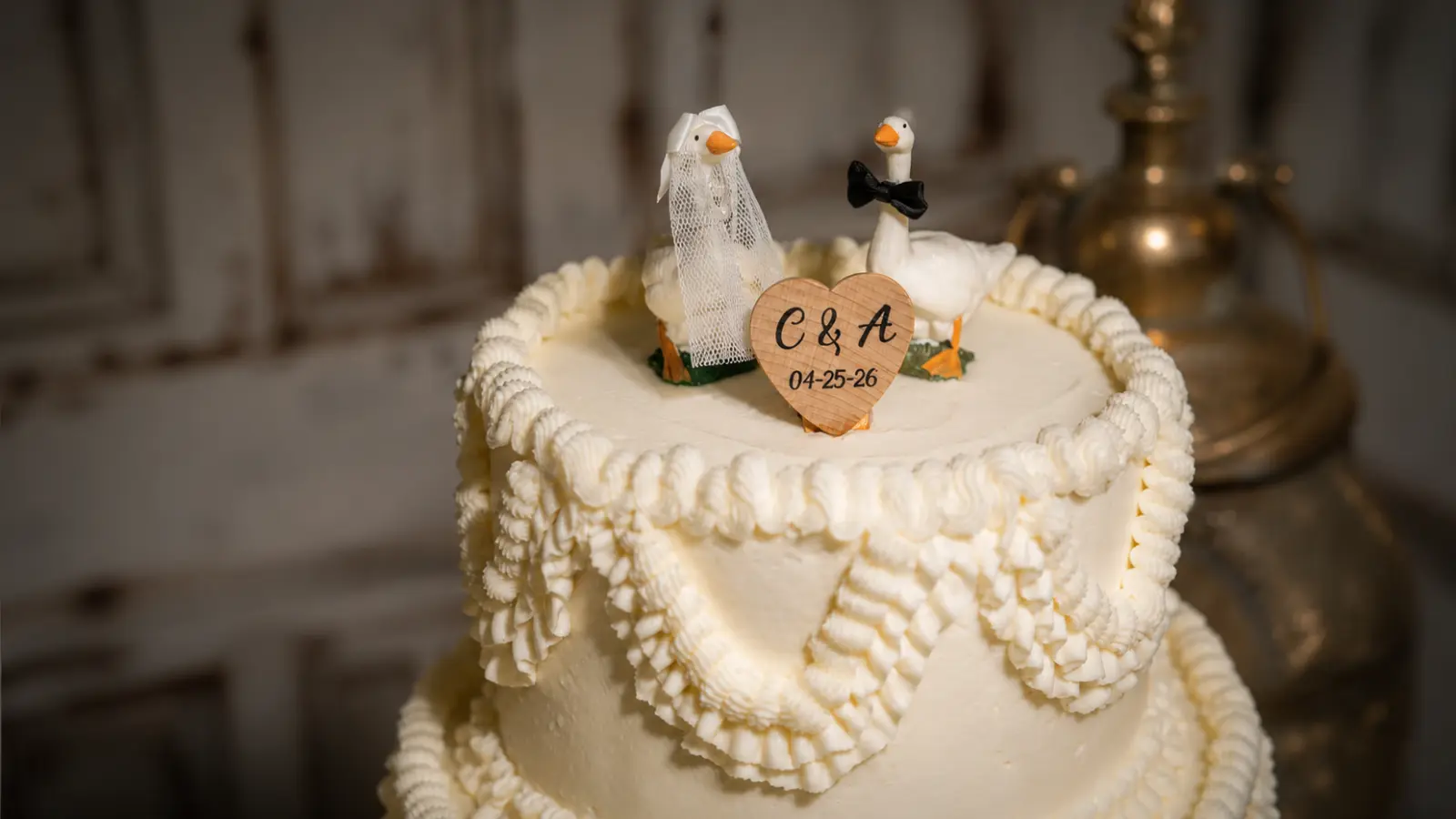
Funny wedding cake toppers work when they are specific and when the humor is genuinely the couple’s own rather than a generic gag that any wedding couple could use. The difference between a funny topper that lands and one that falls flat often comes down to specificity: a topper that references something true about the couple’s dynamic reads as charming and personal. A topper that uses a generic wedding humor premise — the reluctant groom, the domineering bride — reads as a recycled joke that tells guests nothing about the people whose wedding they are attending.
Funny topper categories that work
Hobby and interest toppers. One or both partners engaged in their defining passion — gaming, hiking, cooking, surfing, reading — while the other stands by them. The humor comes from recognition: guests who know the couple understand immediately that this is true, not just cute. A topper showing one partner mid-video-game with a headset while the other stands in wedding attire is funny because it is accurate. The same topper on a couple who does not play video games is just a random prop.
Pet-prominence toppers. A topper where the couple’s dog, cat, or other pet is given equal or greater prominence than the human figures — standing between them, being held by one partner, or frankly just being larger than both of them. These work because they communicate something real about how the couple relates to their pet (for many couples, the pet was the first “family”), and because they tend to produce a genuine reaction from guests who know the animal. A custom version with the actual pet’s breed and coloring is significantly more effective than a generic dog or cat figurine.
One partner’s obsession, elevated to ceremony. A miniature version of the thing one partner loves most — a sports team’s emblem, a specific car, a musical instrument — incorporated into the topper in a way that acknowledges its importance with affection. A groom standing next to a miniature motorcycle while the bride stands with her arms crossed. A bride holding a tiny book while the groom looks confused. These work because they are affectionate jokes rather than critical ones — the humor is about love for a specific quirk, not mockery of it.
Text-based funny toppers. A phrase that is an inside joke, a reference to something significant in the couple’s relationship, or a genuinely witty line that works in the context of a wedding. “Game Over” is one of the most overused text-based funny toppers, and it often feels less specific because it has appeared at so many weddings. A phrase that only makes sense to people who know the couple is far more effective than one that could appear at any wedding.
When funny toppers do not work
A funny topper can undercut the wedding if the humor is not shared by everyone involved. The groom who chooses a “she finally said yes” topper without knowing whether his partner finds it charming or condescending has made a risky choice. The couple who chooses a topper that plays on one partner’s expense rather than the couple’s shared dynamic may find that what reads as affectionate in private reads as pointed in front of family. Funny is best when both partners are in on the joke — not when one is the subject of it.
Vintage Wedding Cake Toppers
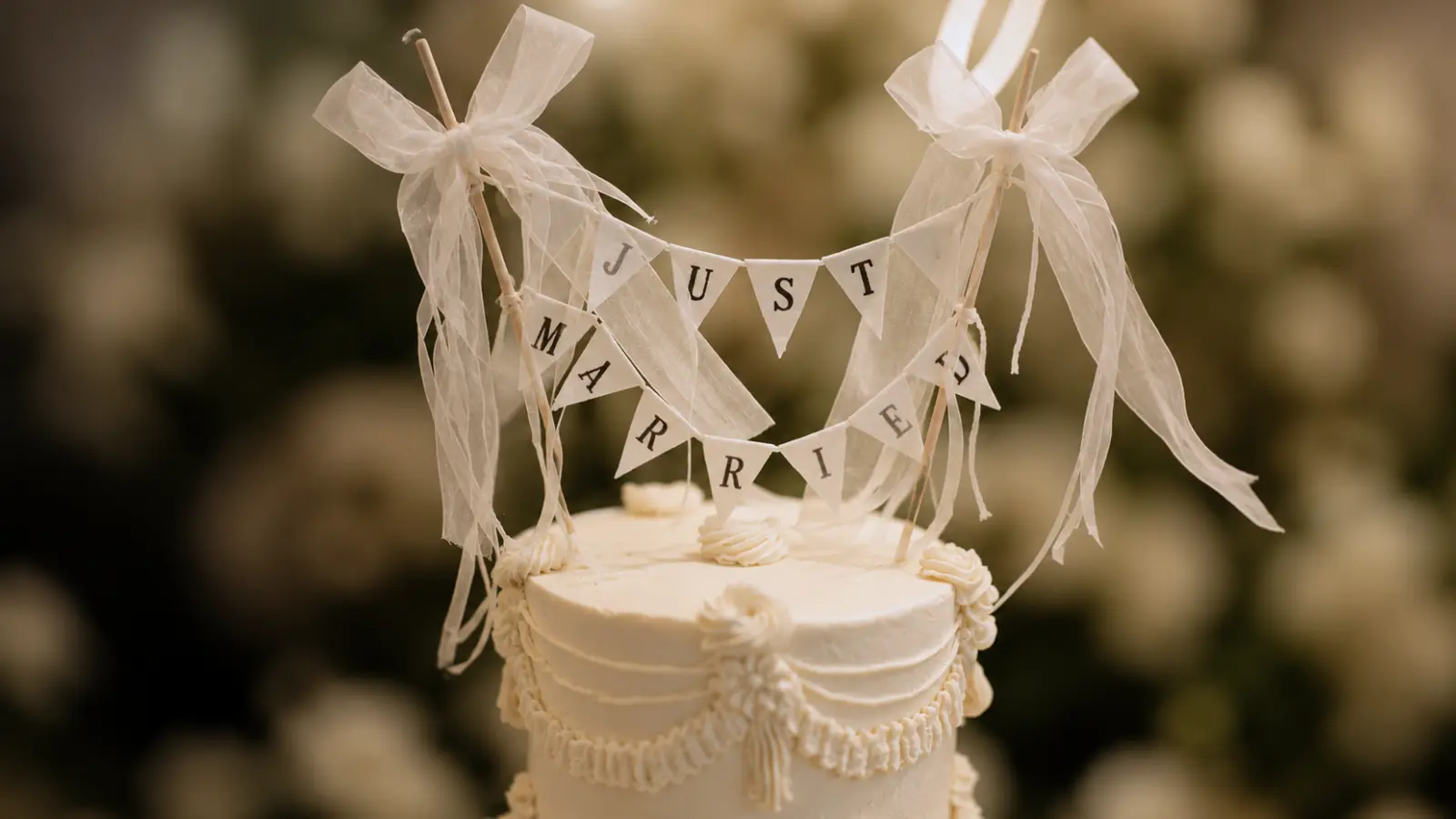
Vintage wedding cake toppers can be one of the most compelling details for vintage wedding cakes because they bring genuine age, patina, and history. An original bride-and-groom porcelain figurine from 1958, complete with the hand-painted detail and the slight patina of six decades, has a quality and authenticity that a contemporary reproduction cannot achieve — regardless of how skilled the reproduction maker is. Vintage toppers are objects with genuine history, and for many couples, that history is part of what makes them worth choosing.
What defines a vintage topper
True vintage wedding cake toppers are original older pieces, often from the early-to-late twentieth century, before mass-market resin toppers became the dominant retail option. The most sought-after vintage toppers are the ornate porcelain pairs of the 1940s through 1960s: highly detailed figures under glass bell jars, figures with elaborate fabric-and-lace dresses attached to porcelain bodies, and figures with the particular painting style of mid-century American and European porcelain manufacturers.
Earlier toppers — from the 1920s and 1930s — tend to be simpler in design but more rare. Later vintage pieces from the 1970s and early 1980s shift toward a more casual aesthetic that reflects the wedding culture of that era. All of them have in common: they were made before mass production homogenized the wedding topper market, and that singularity is visible in each one.
Where to find vintage toppers
Etsy is one of the main online marketplaces for vintage wedding cake toppers in the United States. Search “vintage wedding cake topper” and filter carefully to separate original pieces from reproductions. eBay carries a significant inventory, particularly of 1950s and 1960s pieces, where the selling market has established price points across conditions and styles. Estate sales and antique markets are the offline equivalent. The find rate is lower, but prices can be better, and discovering a meaningful vintage piece in person can become one of the more memorable parts of wedding planning.
A specific and meaningful source: family. A grandparent’s original wedding cake topper, passed down through the family, is one of the most emotionally resonant objects that can appear at a wedding. If the topper is from a marriage that has lasted decades, it carries the weight of that history in a way that nothing purchased can replicate. Ask before assuming — many families have these tucked away in boxes and never think to offer them.
Condition and restoration
Vintage toppers often show their age: minor chips, faded paint, missing accessories (a veil, a bouquet held in the bride’s hand, a boutonniere). For toppers with sentimental value — a family piece or a find that is otherwise perfect — minor restoration is possible by porcelain repair specialists or by careful touch-up with food-safe paint. For purely decorative vintage pieces purchased from a market, the patina of age is often part of the appeal rather than a problem to solve. A topper that is perfect and pristine does not look vintage — it looks new. The slight imperfections are what communicate genuine age.
Unique Wedding Cake Toppers
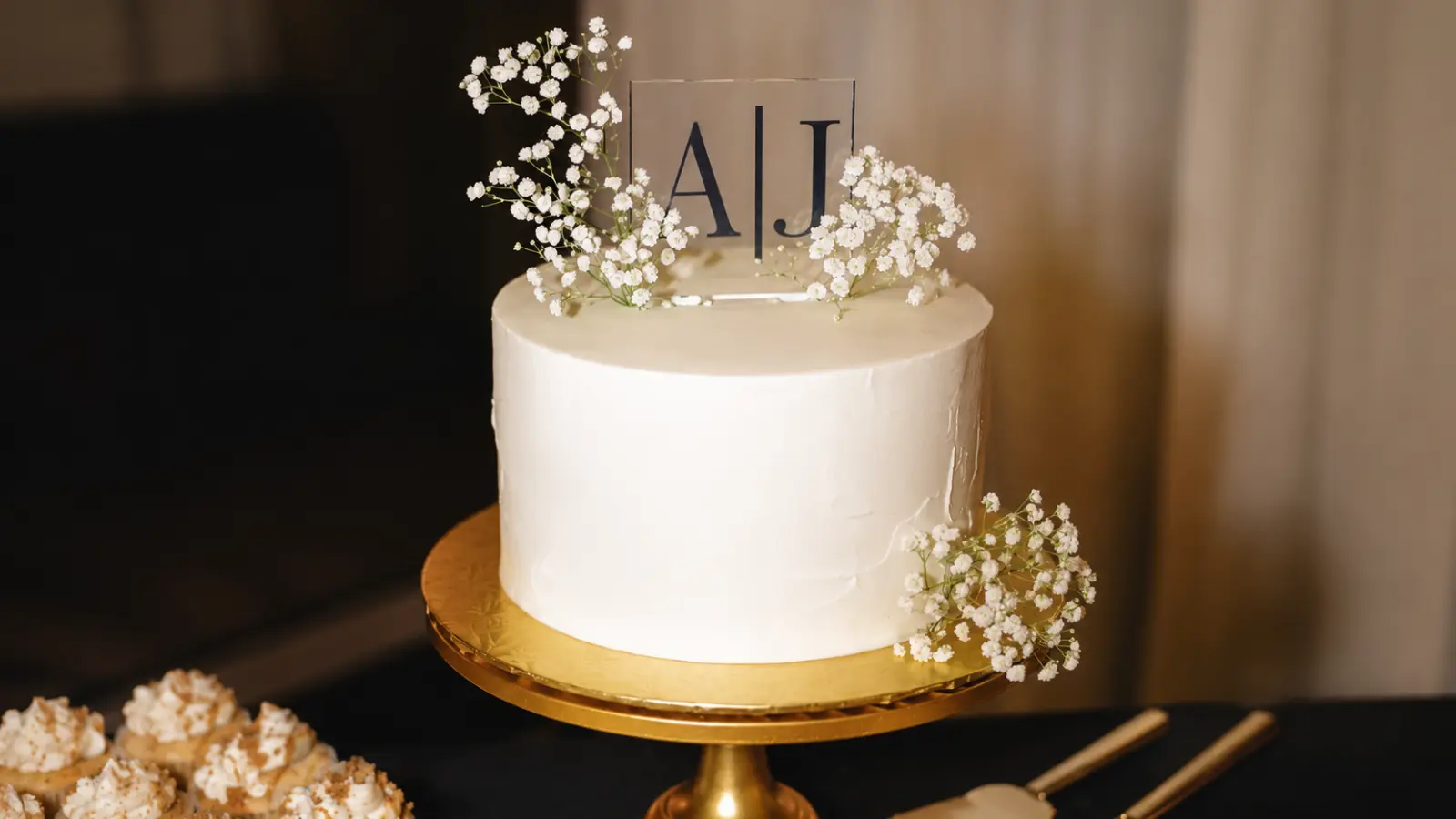
The unique topper category is where the most personal and most memorable choices live — toppers that do not fit neatly into the classic, funny, or vintage categories but that communicate something specific about the couple that a standard option cannot.
Botanical and floral toppers
A cluster of dried flowers, dried botanicals, or silk flowers arranged as a topper — either in a small vessel that sits atop the cake or in a picked arrangement placed with food-safe picks, wrapped stems, or another baker-approved barrier. Dried pampas grass, dried lavender, dried roses in blush and cream, and dried eucalyptus are common elements. This is a natural extension of the floral decoration already used on many floral wedding cakes, rustic designs, and garden-inspired styles — the same flowers that appear on the tiers extend into the top position as the topper, creating visual continuity across the entire cake.
Fresh flowers as a topper — a single large bloom or a small cluster — is the simplest and most widely available option because it can be sourced from the wedding florist on the day of the event. A single large garden rose, a dahlia, or a peony placed at the top of the cake is not technically a topper but can function as one. It creates a finished focal point when coordinated with the florist and placed by the baker using food-safe methods.
Destination and location toppers
A laser-cut representation of the place where the couple met, got engaged, or is getting married — the state of New York, the outline of Central Park, a silhouette of the Eiffel Tower, the shape of Lake Tahoe. These toppers are particularly effective at destination weddings, including beach wedding cakes and celebrations where the location itself is a significant part of the wedding story, but they also work at any wedding where a specific place has meaning in the couple’s relationship. Widely available on Etsy, typically in acrylic or wood, in the $25 to $60 range.
Occupation and shared identity toppers
A topper that reflects what the couple does — their shared profession, their shared passion, the thing that defines them as a unit. A topper with both figures in scrubs for a couple who met in medical school. A topper showing a teacher at a chalkboard beside a partner in formal attire. A musician and their instrument given the same prominence as the person. These toppers make a statement about identity rather than just appearance — they say “this is who we are” rather than “this is what we look like in wedding clothes.”
Pet toppers
For many American couples, their dog or cat is a genuine member of the family — sometimes more central to daily life than extended family members who appear at the wedding once a year. A custom pet topper — a figurine or silhouette in the exact breed and coloring of the couple’s animal — acknowledges that reality rather than pretending it does not exist. The most effective pet toppers include both the couple and the pet rather than replacing the couple with just the animal, though topper-with-only-the-dogs exists and is a legitimate choice for the right couple.
Custom pet toppers require a photograph of the specific animal and a maker who works in pet portraits. The level of detail ranges from approximate (the right breed, the right general color) to highly specific (the exact markings, the characteristic ear position, the specific shade of fur). Pricing and lead time depend on the maker, material, complexity of the animal, and whether the topper is custom-painted or hand-sculpted.
How to Choose the Right Topper Size
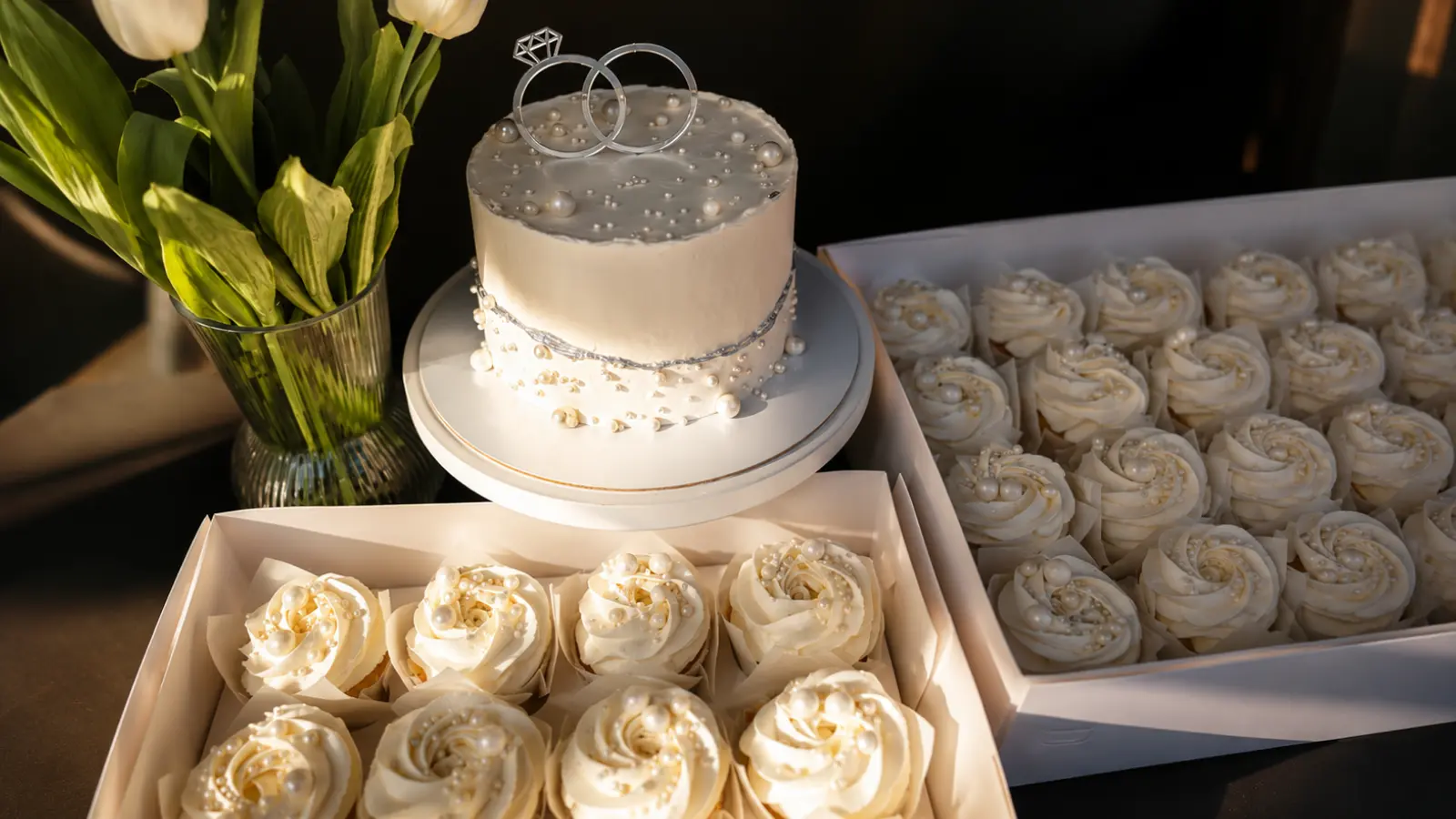
The proportion of the topper to the top tier of the cake is one of the most commonly overlooked details in topper selection — and one of the most visually consequential. A topper that is too large for the top tier looks precarious and dominates the cake in a way that reads as imbalanced. A topper that is too small disappears into the tier and becomes invisible in photographs from more than a few feet away.
The proportion rule
A helpful proportion rule is that the base of the topper — the width at the point where it meets the cake — should usually be at least 1 inch narrower than the top tier on each side. For a 6-inch top tier, the topper base should be no wider than 4 inches. For a 4-inch top tier (common on small wedding cakes or cupcake-style top cakes), the topper base should be no wider than 2 to 3 inches.
Height is a separate consideration from width. A topper can be tall without being wide — a wire script “Mr & Mrs” that rises 8 inches above the cake but has a narrow pick base works proportionally on a 6-inch tier. A wide figurine pair with a broad base that extends to the edge of a 6-inch tier looks crowded. Think of width and height as separate variables: width is the constraint, height is the visual statement.
Size guide by top tier diameter
| Top Tier Diameter | Max Topper Base Width | Recommended Topper Height | Notes |
|---|---|---|---|
| 4 inches | 2–3 inches | 4–6 inches | Very limited options — minimal or floral toppers work best |
| 6 inches (most common) | 4 inches max | 6–10 inches | Standard topper size range; most commercial toppers designed for this |
| 8 inches | 5–6 inches | 8–12 inches | More visual room; larger figurines or wider script toppers work well |
| 10 inches (large top tier) | 7–8 inches | 10–14 inches | Rare — usually on cakes with fewer tiers; topper needs height to read |
The photography test
Before finalizing a topper, hold it next to the top tier of a cake (or a same-diameter object) and photograph it from five feet away at eye level. This is roughly how your photographer will capture it. If the topper is invisible, it is too small. If it hangs over the edges of the tier or dominates the frame so much that the cake disappears, it is too large. The sweet spot is a topper that is clearly visible in a medium-distance photograph without competing with the cake design beneath it, the display, or the wedding cake stand.
Topper weight and stability
Heavier toppers — porcelain figurines, elaborate dried floral arrangements, multi-piece custom sculpted pairs — need more structural support in the top tier than lightweight acrylic or wire toppers. A well-constructed wedding cake from an experienced baker will have a dowel or support structure in the upper tier that can accept a heavier topper, but this needs to be communicated to the baker before the cake is made. Tell your baker the topper’s approximate weight, base width, and pick or stem configuration when you confirm the order. That gives the baker the information needed to prepare the top tier appropriately.
When to Skip the Topper
Not every wedding cake needs a topper. This sounds obvious when stated directly, but many couples add a topper by default — because it seems expected, because the cake looks bare without one, because everyone else has one — without asking whether it actually improves the specific cake they have chosen. Sometimes the honest answer is that it does not.
When the cake design is the focal point. An elaborate sugar flower arrangement cascading down a three-tier cake, a geometric fondant design with gold leaf accents, or an architectural cake with structural elements that define its visual identity — these cakes have a complete design that a topper interrupts rather than completes. Adding a figurine or an acrylic monogram on top of a cake whose design deliberately reaches its resolution in the top tier is like adding a frame to a painting that was not designed to be framed. The design already feels complete.
When no topper fits the aesthetic. A couple who cannot find a topper that matches the wedding aesthetic — that belongs to the same visual world as the cake, the venue, and the overall design — is better off without one than with a mismatch. A rustic naked cake with a highly formal porcelain topper, a modern minimalist cake with a kitschy resin figurine, a bohemian wildflower cake with a generic wire “Mr & Mrs” — none of these combinations improve the cake. The absence of a topper is a cleaner result than the presence of the wrong one.
When the top tier is very small. A 4-inch top tier limits the options so significantly that most available toppers look wrong — either too wide, too heavy, or too large in scale relative to the tier. A single fresh flower or a small cluster of greenery is often the more elegant finish for a very small top tier than any commercial topper.
When “no topper” is an intentional design statement. Some of the most photographically beautiful simple wedding cakes and contemporary wedding designs have no topper at all — the cake is finished with a precise spread of fresh flowers, a handful of greenery, or simply the frosting itself as the final design element. The absence reads as deliberate and considered rather than incomplete. For couples who want their cake to look genuinely editorial, “no topper” is often the choice that achieves it.
Wedding Cake Topper Inspiration Board
Choosing a wedding cake topper often starts with discovering the style that best matches your cake and celebration. Explore our wedding cake topper inspiration board for classic bride and groom figures, custom name toppers, vintage designs, floral details, acrylic styles, unique ideas, and beautiful examples to inspire your final cake design.
Final thoughts
A wedding cake topper is a small detail, but the right one can add personality, meaning, and a finished feeling to the entire cake design. The best choice is not always the most expensive or elaborate topper — it is the one that feels connected to the couple, the cake style, and the overall atmosphere of the wedding.
Whether you choose a classic figure, a custom design, a vintage piece, flowers, or no topper at all, the goal is the same: creating a cake that feels intentional. When every detail works together, the topper becomes more than decoration — it becomes part of the memory attached to the celebration.
Frequently asked questions (FAQ)
What makes a wedding cake topper look timeless instead of trendy?
A timeless topper usually reflects something meaningful about the couple rather than a temporary design trend. Simple materials, personal details, family pieces, and designs connected to the overall wedding style tend to age better than toppers chosen only because they are popular at the moment.
What is the biggest mistake couples make when choosing a cake topper?
Choosing a topper separately from the cake design. A topper may look beautiful online but feel disconnected once placed on the actual cake. The best toppers are selected with the cake shape, frosting style, flowers, venue, and overall wedding aesthetic in mind.
Should a wedding cake topper be personal or match the decor?
Ideally, it should do both. A topper is one of the few cake details that can represent the couple personally, but it still needs to belong visually. A meaningful topper that clashes with the cake design can feel accidental instead of intentional.
Are personalized cake toppers worth it?
They can be, especially when the personalization goes beyond simply adding names or a date. The most memorable custom toppers usually tell a small story about the couple — their relationship, pets, shared interests, family history, or something guests immediately recognize as uniquely theirs.
Can a cake topper make a simple wedding cake look more special?
Yes. The right topper can add height, personality, and a focal point to a simple cake. However, it works best when it enhances the existing design rather than trying to compensate for a cake style the couple does not actually love.
What do wedding designers notice first about a cake topper?
Designers usually notice whether the topper feels intentional. They look at proportion, placement, material, color, and whether the topper completes the cake’s story. A small detail that feels connected often creates more impact than a large topper chosen only to stand out.
What size should a wedding cake topper be?
A wedding cake topper should usually be narrower than the top tier of the cake so it looks balanced and stable. For a 6-inch top tier, a topper with a base around 4 inches or smaller often works well. The topper can be taller than it is wide, but the base should not crowd the edges of the cake.
Do wedding cakes need a topper?
No. Not every wedding cake needs a topper. Cakes with strong floral arrangements, architectural designs, elaborate sugar flowers, or minimalist finishes may look better without one. A topper should complete the cake, not interrupt a design that already feels finished.
Related Guides
- Wedding Cake Designs: Elegant, Modern, Floral and Unique Styles
- How to Choose a Wedding Cake Baker: Questions, Red Flags and What to Look For
- Wedding Cake Cutting: Meaning, Timing, Songs and What to Do
- Fall Wedding Cakes: Autumn Colors, Flavors and Designs
- Italian Wedding Cake: Millefoglie, Traditions and Elegant Ideas