Curved wedding bands are wedding rings designed with a shaped, contoured, or notched edge that allows them to fit closely around an engagement ring. Instead of leaving a visible gap between two rings, a curved wedding band follows the shape of the engagement ring setting so both pieces sit together more naturally.
Not every engagement ring needs a curved band. Some styles fit perfectly with a traditional straight wedding band, while others including certain halo rings, oval cuts, pear shapes, marquise stones, and higher settings often create a gap that a curved or contoured design can solve.
This guide explains everything about curved wedding bands, including when you need one, curved vs. straight designs, engagement ring compatibility, custom options, pros and cons, and how curved designs fit within different wedding rings and wedding bands.
What Is a Curved Wedding Band?
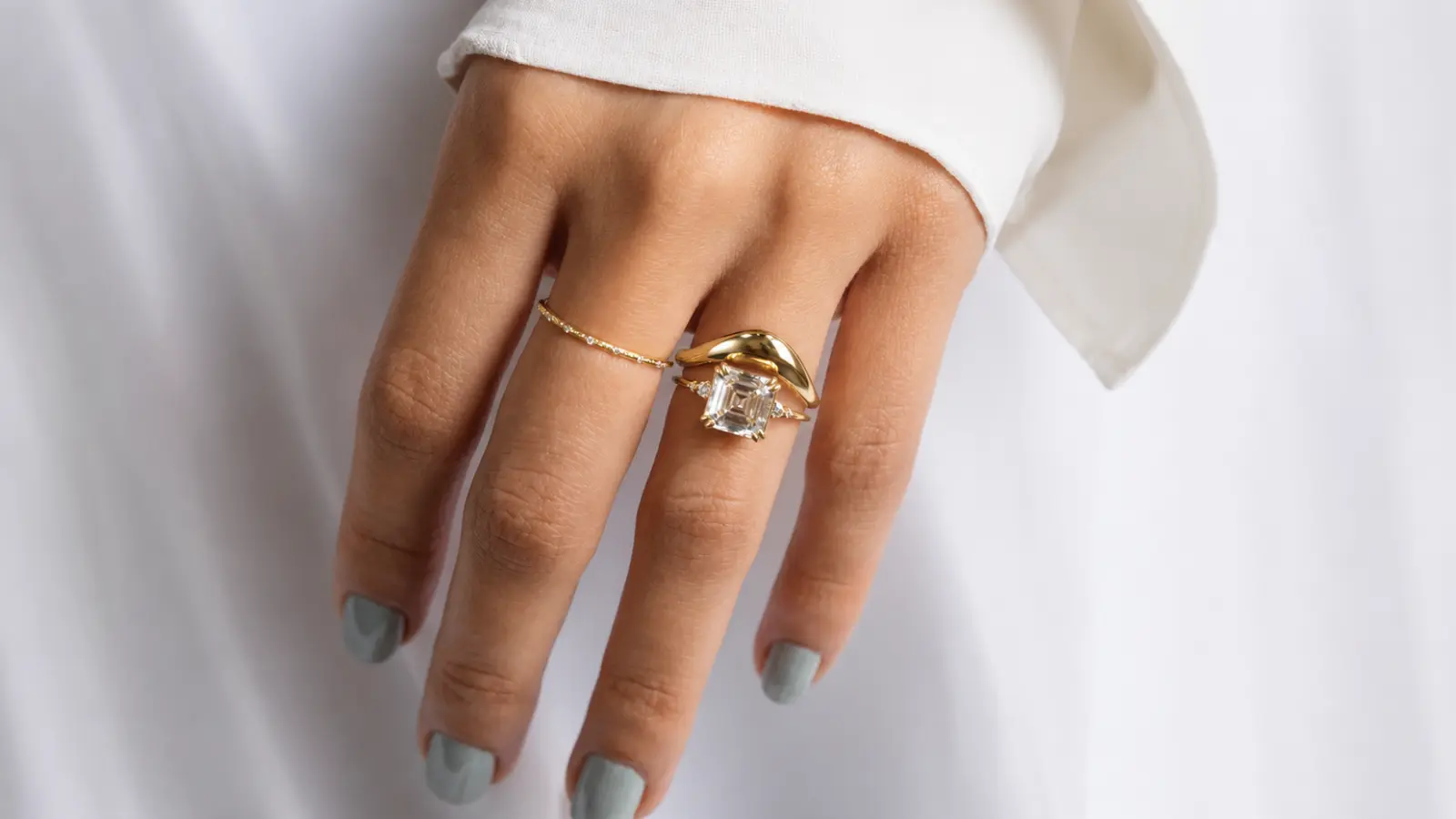
A curved wedding band is a ring shaped to accommodate the profile of a specific engagement ring rather than sitting as an independent, symmetrical circle. A standard wedding band, a straight band, is round: its inner and outer edges follow the same consistent curve all the way around. A curved wedding band breaks that symmetry deliberately. At the point where it sits alongside the engagement ring, its edge is cut, indented, arced, or angled to create a space that mirrors the engagement ring’s shape, letting the two rings meet cleanly instead of pressing against each other and separating.
The shape of that modification varies by design and by what it is accommodating. Some curved bands have a gentle arc, a smooth inward curve along one or both sides of the band that creates a wider, softer fit around a rounded or oval center stone. Others have a more angular notch, a V-shaped or chevron cutout specifically contoured to sit against a pointed setting like a marquise or pear. Others still are contoured more precisely, shaped to mirror the exact outer edge of a particular ring’s setting, including its prongs or halo frame.
The names this ring goes by
Curved, contoured, shaped, shadow, and notched are all terms used in the bridal jewelry market to describe variations of this concept, and the terminology is not perfectly consistent across jewelers. Most use curved and contoured interchangeably. A shadow band is a specific subtype: a very narrow curved band (typically 1.5mm to 2.5mm wide) designed to sit so closely alongside the engagement ring that it appears to trace its outline rather than stand beside it. A notched band has a more specific cutout, often a V or chevron, suited to rings where the center stone’s profile dips toward the finger at a point rather than curving outward gradually. All of them serve the same fundamental purpose: fitting the wedding ring cleanly to the engagement ring rather than leaving a gap.
How they are made
Ready-made curved bands are produced in standard arc depths suited to common engagement ring profiles, a gentle curve that works with a wide range of moderately raised settings. These are the bands sold in bridal collections as coordinating wedding band options alongside popular engagement ring styles. Custom curved bands are made to fit a specific ring: the engagement ring is measured, its profile recorded, and the band is produced to match those exact dimensions. The difference in fit between a well-matched ready-made band and a precisely custom-made one can be subtle or significant depending on how unusual or prominent the engagement ring’s setting is.
When Do You Need a Curved Band?
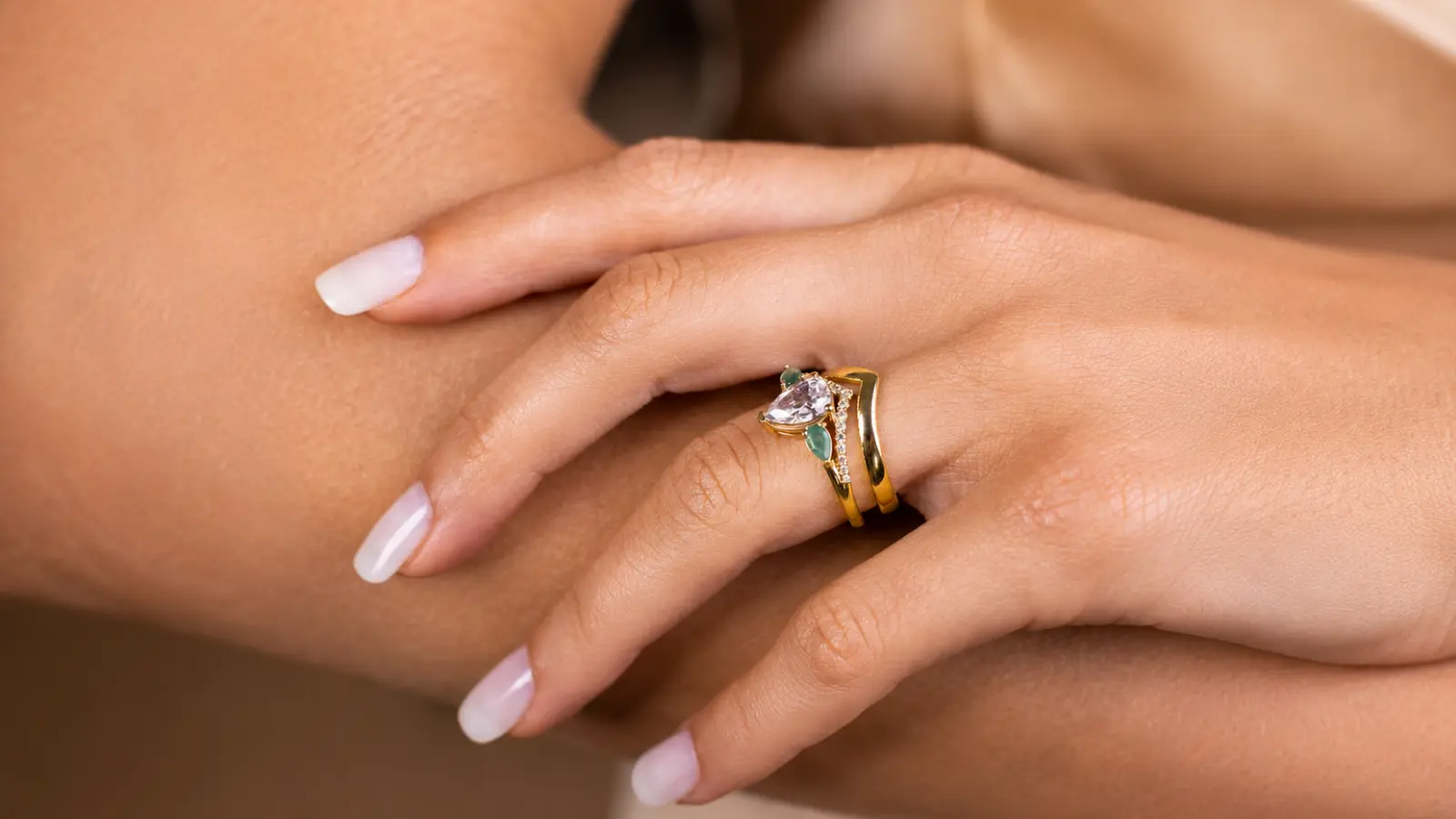
The gap question is ultimately a visual preference, not a structural requirement. A gap between a straight wedding band and a raised engagement ring setting does not damage either ring, affect the security of the stones, or create any physical problem, it is simply a space that some wearers want eliminated and others accept or do not notice. The decision of whether to choose a curved band comes down to whether that gap matters to the specific person who will wear the rings.
That said, certain engagement ring profiles make the gap significantly more visible, large enough that most wearers do notice it and find it difficult to overlook. Understanding which profiles create the most substantial gaps helps predict whether the curved band conversation is necessary before it begins.
When the gap is most visible
The gap is most significant when the engagement ring’s setting extends the furthest away from the finger at the point where the wedding band sits beside it. A cathedral-setting solitaire, where the shank sweeps upward to support a high-set center stone, creates a pronounced arch at its sides that a straight band cannot follow. The higher the cathedral, the wider the gap. A halo setting adds an additional layer of visual complexity: the halo frame surrounds the center stone and extends outward in all directions, which means the outer edge of the halo faces the wedding band directly and creates a gap equal to the depth of the frame itself.
In both cases, the gap is clearly visible from the top of the ring and tends to capture debris, dust, lotion, fabric fibers, in a way that a flush-fitting combination does not. Many wearers find this gap the first thing they notice in photographs of their rings, and it becomes a persistent minor irritant. A curved band eliminates it entirely.
When a straight band works fine
A straight band sits flush, or very nearly flush, against any engagement ring whose setting profile does not rise significantly away from the finger at the band’s contact point. Low-profile bezel settings, where the stone sits close to the finger and the bezel’s outer edge is nearly parallel to the shank, typically create no meaningful gap against a straight band. Tension-set rings, channel-set engagement rings, and most eternity-style engagement rings are similarly low-profile and sit cleanly beside straight bands.
Pavé or micro-pavé shanks, where the engagement ring’s shank itself is set with small diamonds, create a slightly different consideration: the stones on the shank’s side faces may raise the profile slightly, and the wedding band’s inner edge will press against those stones rather than bare metal. A curved band lifts the wedding band slightly away from the stones, reducing the risk of pressure on the pavé setting over years of daily wear. This is a practical durability consideration rather than a purely visual one, and it is worth discussing with the jeweler who made the engagement ring.
The finger-width effect
One factor that affects how visible a gap is: the width of the wedding band. A narrow wedding band (3mm or 4mm) alongside a raised setting creates a gap that most eyes process quickly and dismiss. A wider band (6mm or more) alongside the same setting creates a gap that spans more of the visible ring surface and is harder to overlook. Wearers with raised engagement ring settings who want to wear a wider wedding band have the most to gain from a curved option; those who prefer narrow wedding bands may find that a straight band creates an acceptable result even with a moderately raised setting.
For more on how band width and ring proportions interact in a wedding ring stack, the how to wear wedding rings covers the full range of stacking considerations.
Curved vs. Straight Wedding Bands
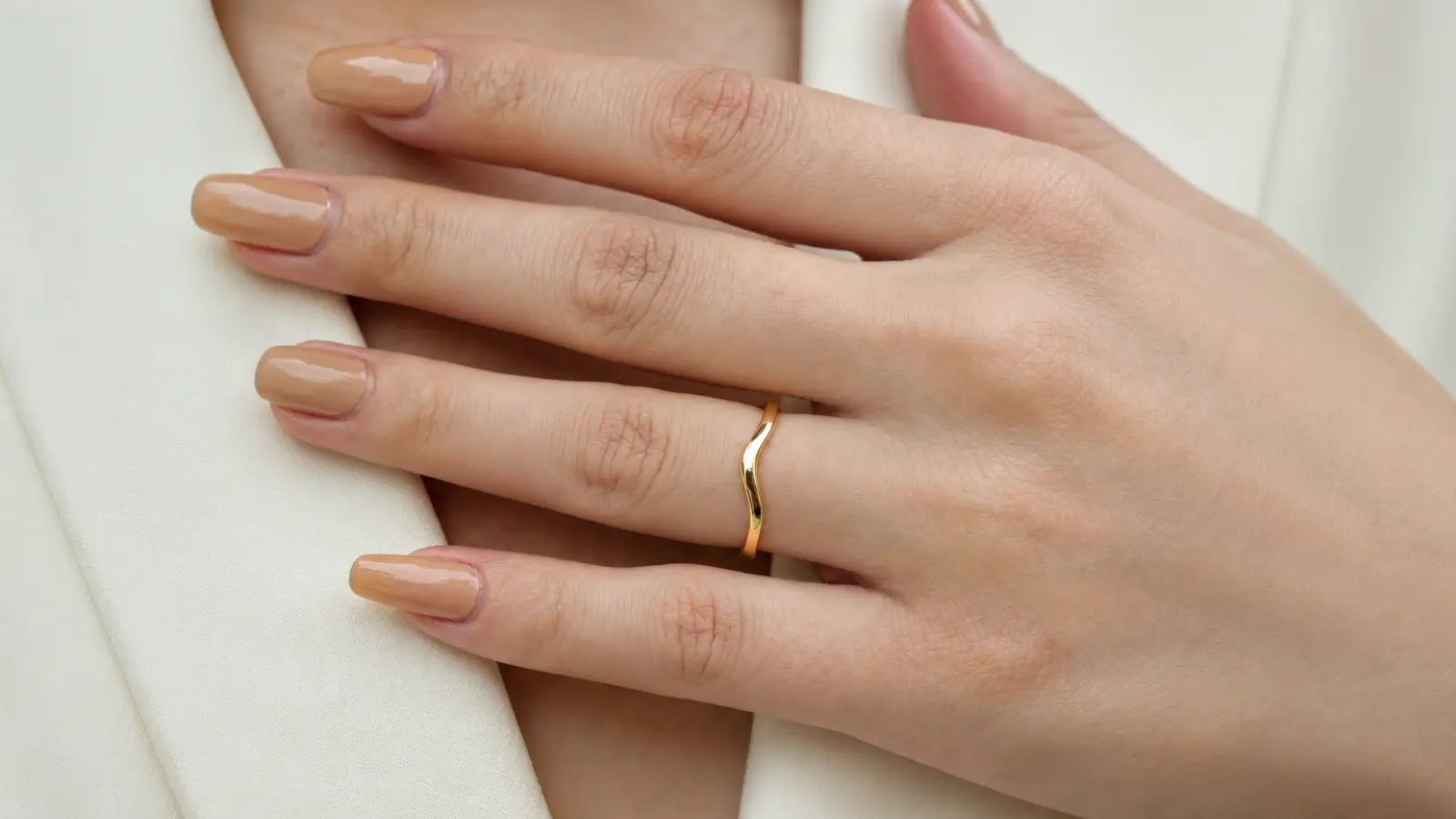
The choice between curved and straight is not simply about whether one fits better beside the engagement ring. There are real trade-offs between the two, in wearability, flexibility, comfort, future stackability, and the visual result, and those trade-offs are worth examining before the decision is made.
The case for curved
The primary argument for a curved band is the visual result: no gap, a clean silhouette, the two rings reading as a unified set rather than two separate rings sharing a finger. For wearers who care about the way their ring combination photographs, and for many people, the engagement ring and wedding band together are the most frequently photographed object in their daily life, the difference between flush and gapped is meaningful. A curved band also reduces the small friction between the wedding band and engagement ring’s setting that causes micro-wear over time where the two rings contact each other. This is a minor durability consideration, but it is real.
Curved bands also tend to feel more secure on the finger when they are well-fitted: the band’s shape locks it in relationship to the engagement ring, reducing the tendency for the two rings to rotate independently and create misalignment during the day.
The case for straight
A straight band is more flexible than a curved one in almost every respect. It can be worn independently of the engagement ring, during occasions where only the wedding band is worn, or during pregnancy when the engagement ring does not fit and the band is worn alone. It can be stacked beside other rings more easily, since its symmetrical shape fits cleanly against virtually any ring placed beside it. It also allows more flexibility for future wedding ring resizing, repairs, and eventual repurposing without design-specific complications. And it is almost always available at a lower price point than its curved equivalent in the same metal and width.
For wearers who plan to stack additional bands over time, a straight wedding band is significantly more versatile as the foundation of a growing collection. A curved band, by definition, has been shaped for one specific ring; adding rings around it introduces the same gap problem the curved band was purchased to solve, now in the opposite position.
The gap as a style decision
Some wearers choose a straight band alongside a raised engagement ring setting not because they fail to notice the gap, but because they actively prefer the visual separation. Two distinct rings, worn together but clearly independent, read differently from a matched set, less like a single piece of jewelry, more like two rings with their own identities that happen to share a finger. This is a legitimate aesthetic perspective, and the number of wearers who hold it is significant enough that it is worth naming as a real option rather than a compromise.
Best Engagement Rings for Curved Bands
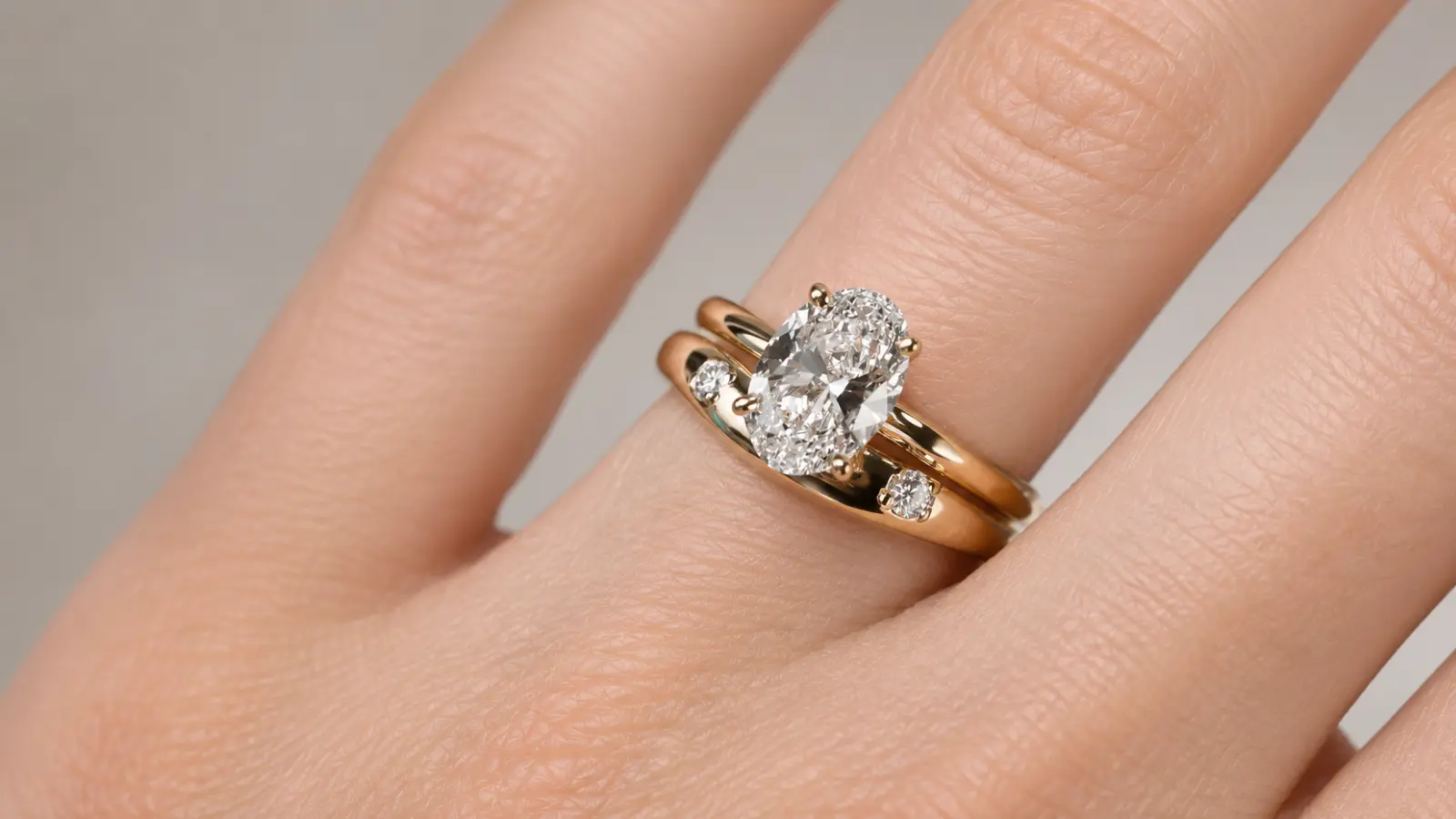
The engagement ring’s profile, specifically the shape of its center stone and the height and structure of its setting, is the primary predictor of how much a curved band will improve the visual result. The following ring types are those where the curved band benefit is most pronounced.
Halo settings
Halo settings are the most consistent candidate for a curved wedding band. The halo frame, a border of small stones surrounding the center stone, extends outward from the shank in all directions, including directly toward where the wedding band will sit. A straight band pressed against the outer edge of a halo creates a gap equal to the full depth of the halo frame, which is typically 1mm to 2.5mm but clearly visible from above. A curved band notched or arced to accommodate that frame sits flush against it instead, creating a clean line between the two rings.
Halo settings with round, cushion, oval, and radiant center stones are all strong candidates. Square and princess halo settings create a slightly different geometric challenge: the corners of the halo require the curved band’s notch to be more angular rather than softly arced, but the same principle applies.
Marquise cut engagement rings
The marquise cut creates the most specific fit challenge of any center stone shape. Its elongated form ends in two pronounced points at each end, and those points extend directly toward the sides of the shank, and directly toward the wedding band placed beside it. A straight band pressed against a marquise setting’s shank will either sit with the marquise’s point pressed into it (creating pressure on the prong and the band) or leave a visible gap as the band arcs away from the point. A curved or notched wedding band for a marquise engagement ring allows both rings to sit flat against the finger without conflict.
This is a case where the ring profile essentially requires some form of curved or contoured accommodation: the point-to-band interaction is not just a visual gap but a physical one that can affect the prong holding the stone’s point over time if a straight band exerts pressure against it repeatedly.
Pear-shaped engagement rings
A pear-shaped stone shares the marquise’s pointed end, though only at one end rather than two, and the same accommodation logic applies at that end. The rounded end of the pear shape is less demanding: it curves outward gradually, and a gently arced band can sit against it without significant gap. A curved band suited to a pear setting is typically shaped more at the pointed end than the rounded one, addressing where the fit problem is most acute.
Oval cut engagement rings
Oval cuts create a gentler version of the gap challenge than marquise or pear. The oval’s elongated outline curves outward from the shank without coming to a point, which means the gap it creates against a straight band is wider but less sharply defined. A gently curved band, a smooth inward arc rather than a notched V, typically resolves the fit well. Many ready-made curved bands are designed with the oval cut in mind, since it is one of the most popular center stone shapes in contemporary bridal rings.
Cathedral solitaires
A cathedral solitaire, where the shank sweeps upward in dramatic arching lines to support a high center stone, creates a gap against a straight band that varies with the height of the cathedral. Low cathedral settings may create a gap small enough that a narrow straight band reads acceptably beside them. Tall cathedral settings create gaps of 2mm or more that are difficult to overlook. Curved bands for cathedral solitaires are shaped to mirror the sweep of the cathedral itself, rising alongside it rather than diverging from it.
Round brilliant solitaires on standard settings
A round brilliant on a standard four or six-prong head on a relatively flat shank is the setting type that creates the least gap against a straight band, and the one where the choice between curved and straight is most genuinely optional. The profile is low enough that a straight band sits close to flush in most cases. A curved band improves the fit slightly; a well-chosen straight band is often indistinguishable from it in photographs. This is the engagement ring profile where personal preference and stackability concerns have the most weight in the curved-versus-straight decision.
Custom Curved Wedding Bands
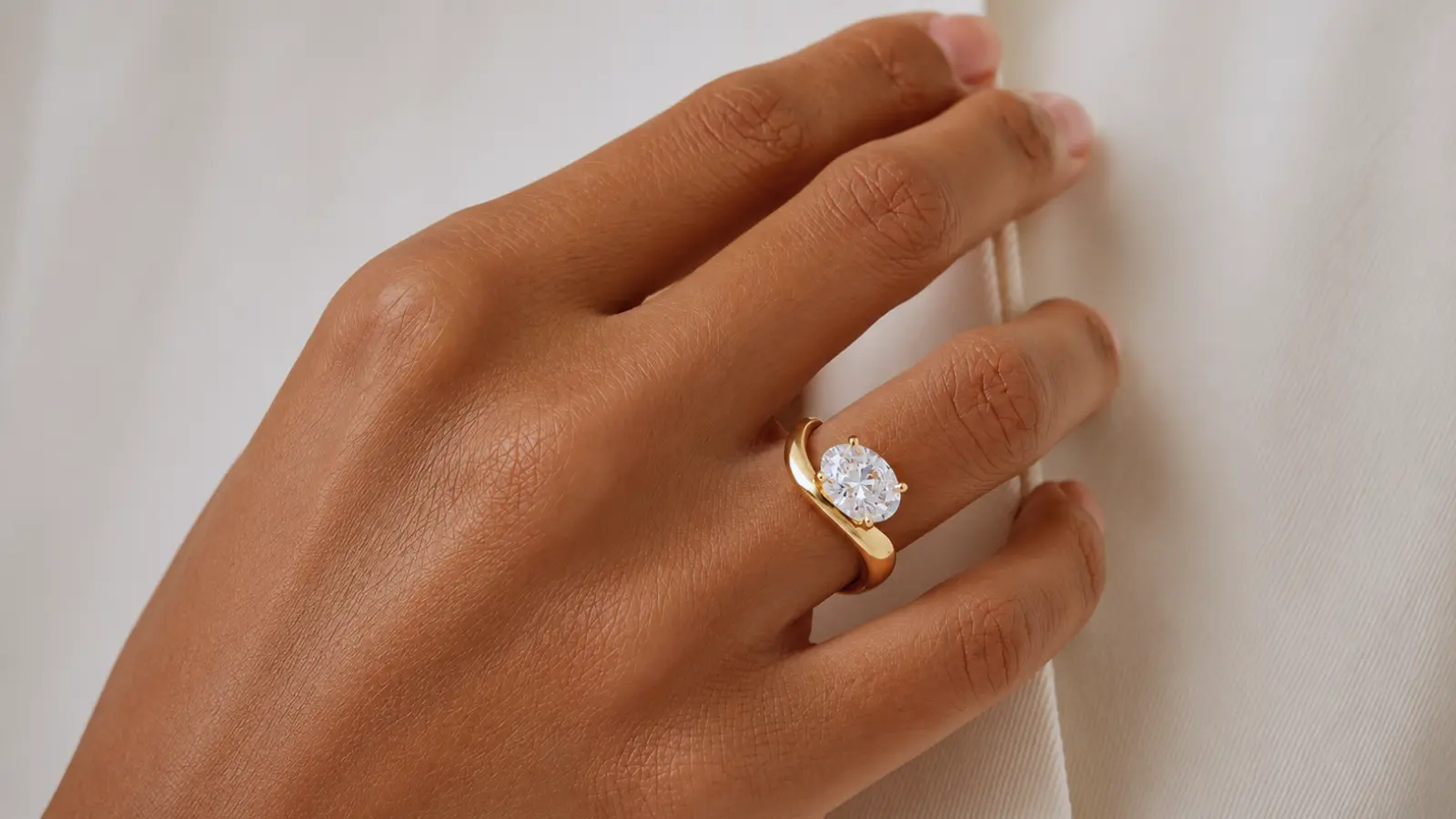
A custom curved wedding band is made specifically to match one engagement ring’s profile, shaped from that ring’s exact measurements rather than from a standard arc depth designed to approximate a range of common settings. The result is a fit that ready-made curved bands cannot consistently achieve, particularly for engagement rings with unusual setting heights, non-standard halo dimensions, or complex prong arrangements.
When custom is worth it
Custom curved bands are most clearly worth the additional cost and time when the engagement ring is itself custom-made or designer-specific, when its setting profile is unusual enough that standard curved band shapes do not fit well, or when the wearer has tried ready-made curved options against the ring and found them imperfect. Designer engagement rings, particularly those from jewelers who produce rings in distinctive, proprietary silhouettes, often need bands made to that specific design. The gap between a standard curved band and an unusual engagement ring can be as visible as the gap between a straight band and the same ring, if the curve depth is not right.
Buying both pieces from the same jeweler can make engagement ring and wedding band sets much easier to fit correctly. The jeweler has the ring’s specifications, can make the band in the same metal and finish, and guarantees that the design language will be consistent. For engagement rings purchased from large-scale online retailers or from designers who do not offer matched bands, a local jeweler with custom fabrication capability can usually produce a matching curved band from measurements taken in person.
What to bring to the custom consultation
The engagement ring itself is the most important thing to bring to any curved wedding band consultation, not a photograph, not the size, not the description, but the physical ring. A jeweler fitting a curved band needs to assess the actual height of the setting, the profile of the shank at the point of contact, and the specific dimensions of any halo or prong arrangement. These measurements cannot be reliably taken from a photograph and are difficult to communicate accurately through description. The physical ring is the reference document, and any reputable jeweler offering custom curved bands will require it in person before beginning work.
Timeline and cost expectations
Custom curved wedding bands typically take three to eight weeks from consultation to delivery, depending on the complexity of the design and the jeweler’s workload. For couples who decide on a custom band close to the wedding date, communicating this timeline clearly at the first appointment is essential. Cost premiums for custom curved bands over ready-made equivalents typically range from 20% to 50% above a comparable straight band in the same metal, though the range varies widely by jeweler, material, and complexity. Diamond-set custom curved bands cost more than plain metal equivalents by the same factors that affect any diamond band, stone quality, coverage, and setting style.
Ready-made curved bands: when they work
Ready-made curved bands from major bridal collections are engineered to fit common engagement ring profiles, a standard arc depth suited to the most widely purchased setting heights, in shapes designed around round, oval, and cushion center stones. For wearers whose engagement rings fall within that common range, a ready-made curved band will often fit well without any custom adjustment. The way to confirm this is the same as confirming any band’s fit: bring the engagement ring to the appointment and try the curved band against it in person. A ready-made band that sits cleanly against the engagement ring with no visible gap and no pressure points is a ready-made band that works.
Pros and Cons of Curved Wedding Bands
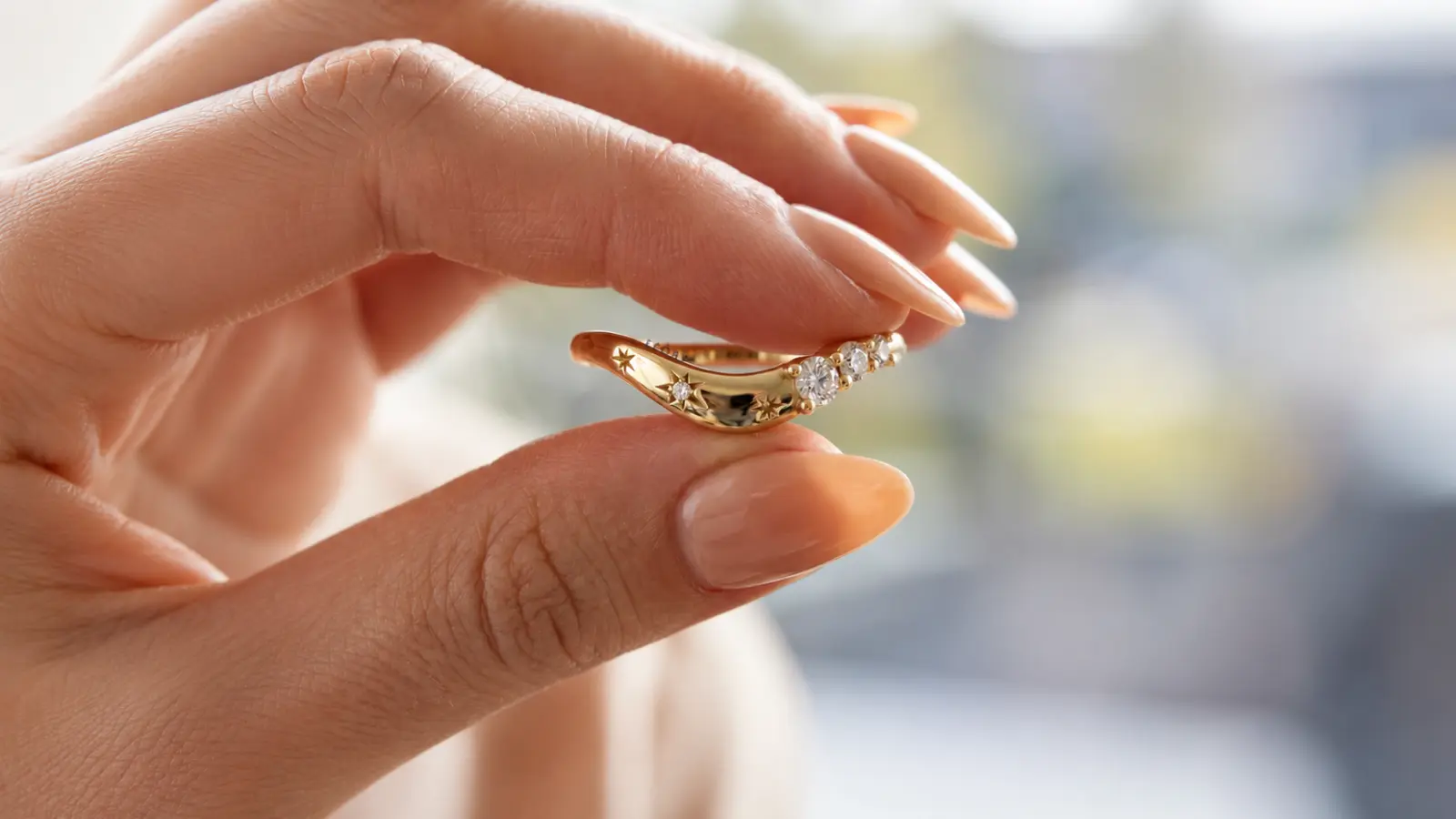
The curved wedding band is not the right choice for every wearer or every engagement ring, it solves a specific problem and introduces its own trade-offs in the process. Understanding both sides clearly makes the decision easier to make with confidence.
The advantages
The most obvious advantage is the one that explains the existence of curved bands: the visual result. A curved band that fits correctly eliminates the gap between the wedding band and the engagement ring, creating a flush combination that photographs cleanly and wears as a unified set. Many wearers find that this flush fit is the single most satisfying aspect of their ring combination: the two rings look designed to be together, which is exactly the intention.
A well-fitted curved band also creates less friction between the wedding band and the engagement ring’s setting over time. When a straight band presses against a raised prong head or halo frame repeatedly throughout daily wear, the contact points gradually wear against each other, a minor consideration in the short term, a more relevant one over decades. A curved band that clears the setting profile reduces that contact wear.
For marquise and pear center stones specifically, a curved band that accommodates the stone’s point eliminates a genuine physical pressure issue, the straight band pressing against a prong at the stone’s tip, rather than simply an aesthetic one. In this case, the curved band is not optional so much as practically advisable for the long-term security of the setting.
The trade-offs
A curved wedding band is designed for one ring. Unlike a straight band, which fits cleanly beside virtually any ring placed next to it, a curved band’s usefulness is specific: it works with the engagement ring it was made to fit, and it creates its own gap problem when placed beside anything else. For wearers who plan to build a ring stack over time, adding anniversary bands or additional pieces on either side of the engagement ring, a curved wedding band is a less flexible foundation than a straight one. The guide to stackable wedding rings covers how this decision affects future stacking options in detail.
A curved band is also more difficult to wear independently. There are occasions, pregnancy, when finger swelling makes the engagement ring unwearable; periods of physical work; travel where wearing the full ring combination is impractical, when wearing only the wedding band makes sense. A curved band worn alone looks incomplete by design: the concavity that makes it sit beautifully beside the engagement ring is visible and purposeful on one side of the ring and odd-looking in isolation. A straight band worn alone looks like a band.
Cost is a real factor: curved bands cost more than straight bands in equivalent materials, and custom curved bands cost more still. For couples working within a defined jewelry budget, that premium may redirect money that could go toward metal quality, stone detail, or another ring purchase.
Pros and cons at a glance
| Curved Wedding Band | Straight Wedding Band |
|---|---|
| Eliminates the gap between band and engagement ring | May leave a visible gap with raised or prominent settings |
| Reads as a matched, unified set | Reads as two independent rings worn together |
| Reduces contact wear between rings | May create friction against prongs or halo frame |
| Specifically suited to one engagement ring | Flexible, can be stacked beside other rings |
| Looks incomplete when worn alone | Wears comfortably as a standalone ring |
| Typically costs more than a straight equivalent | Generally less expensive in equivalent metal and width |
| Custom options available for precise fit | Universally available, easily resized and repaired |
The decision in practice
Most wearers who have a halo, marquise, pear, or high cathedral engagement ring find that the visual benefit of a curved band outweighs its trade-offs, particularly if they are not planning to build a large stack and do not frequently wear their wedding band without the engagement ring. Most wearers with lower-profile solitaires, bezel settings, or band-style engagement rings find that a straight band works cleanly enough that the curved option’s trade-offs outweigh its benefits.
The clearest guidance: bring the engagement ring to the jeweler and try both options against it. The visual difference will be immediately apparent, and most wearers know within minutes of looking at both combinations which one they prefer. No amount of description or photography replicates that experience as a decision-making tool.
Curved Wedding Band Inspiration
Curved wedding bands can completely change how an engagement ring and wedding band look together. Explore our inspiration board for contoured bands, shadow bands, chevron designs, diamond curved bands, and examples of wedding rings that sit perfectly together.
Choosing a Wedding Band That Fits Your Ring and Your Life
A curved wedding band is not about following a rule — it is about creating a ring combination that feels natural for the way you want to wear it. For some engagement rings, a curved design creates the seamless fit that makes both rings feel like they were always meant to be together.
For others, a straight band, a small gap, or a more flexible stacking option may be the better choice. The right wedding band is not only the one that fits your engagement ring beautifully — it is the one that fits your everyday life for years to come.
Frequently asked questions (FAQ)
Do I really need a curved wedding band?
You only need a curved wedding band if the space between your engagement ring and wedding band bothers you or affects how the rings sit together. Raised settings, halo designs, and elongated stones like pear, oval, and marquise cuts are more likely to create a visible gap. A curved band solves this by following the shape of the engagement ring, but choosing a straight band with a small gap is also a personal style choice.
Is it better to choose a curved or straight wedding band?
A curved wedding band is better if you want your rings to sit flush and look like a matched set. A straight wedding band is usually better if you want more flexibility, plan to stack additional rings, or want to wear your wedding band alone. Neither option is automatically better — the right choice depends on how you want to wear your rings long term.
What engagement rings look best with curved wedding bands?
Curved wedding bands work especially well with engagement rings that have shapes or settings extending beyond the band. Halo rings, cathedral settings, pear cuts, marquise cuts, and many oval engagement rings often pair beautifully with curved or contoured bands because the curve allows the wedding band to follow the ring’s silhouette.
What are the disadvantages of curved wedding bands?
The main disadvantage of a curved wedding band is that it is usually designed to match one specific engagement ring. This can make it harder to wear alone, pair with future rings, or create a different stack later. Custom curved bands may also cost more than simple straight bands because they require additional design and fitting work.
Should you get a custom curved wedding band?
A custom curved wedding band is usually worth considering if your engagement ring has an unusual shape, a unique setting, or if standard curved bands still leave a noticeable gap. Custom designs create the closest fit because they are made around your exact ring. For common engagement ring styles, a ready-made curved band may already provide the look you want.
What should you know before buying a curved wedding band?
Before buying a curved wedding band, try it with your actual engagement ring instead of choosing from photos alone. The size of the gap, setting height, stone shape, and future stacking plans all matter. A perfect-looking curved band today should also match the way you expect to wear your wedding jewelry years from now.