Wedding veil lengths can be surprisingly difficult to understand when you first start shopping. Terms like fingertip, chapel, cathedral, and royal sound straightforward, but the difference each length creates in your overall bridal look is much bigger than most brides expect.
The right veil length doesn’t depend only on measurements. Your dress silhouette, train, venue, hairstyle, height, and even your photographer all influence which length will look best on your wedding day.
This complete guide explains every standard wedding veil length with measurements, practical comparisons, styling advice, and expert tips to help you confidently choose the perfect wedding veil for your wedding.
Length vs. Style: The Distinction That Simplifies Everything
Before looking at individual lengths, it’s worth establishing one thing clearly: veil length and veil style are two separate decisions, and treating them as one is the source of most veil-shopping confusion.
Length answers the question: where does the veil fall? It’s a measurement — fingertips, floor, several feet of train. Style answers a different question: what does the veil look like? A single-tier drop, a two-tier with blusher, a mantilla, a birdcage. These two variables operate independently. A fingertip-length veil can be plain or lace-edged, single-tier or two-tier. A cathedral-length veil can be simple tulle or heavily embroidered.
Knowing that distinction makes appointments much more productive. You can walk in and say “I’d like a single-tier fingertip veil with a lace edge” rather than pointing at a photo and hoping the stylist reads it the same way. Style is covered in full in our wedding veil styles. This guide covers length only.
How Veil Lengths Are Measured
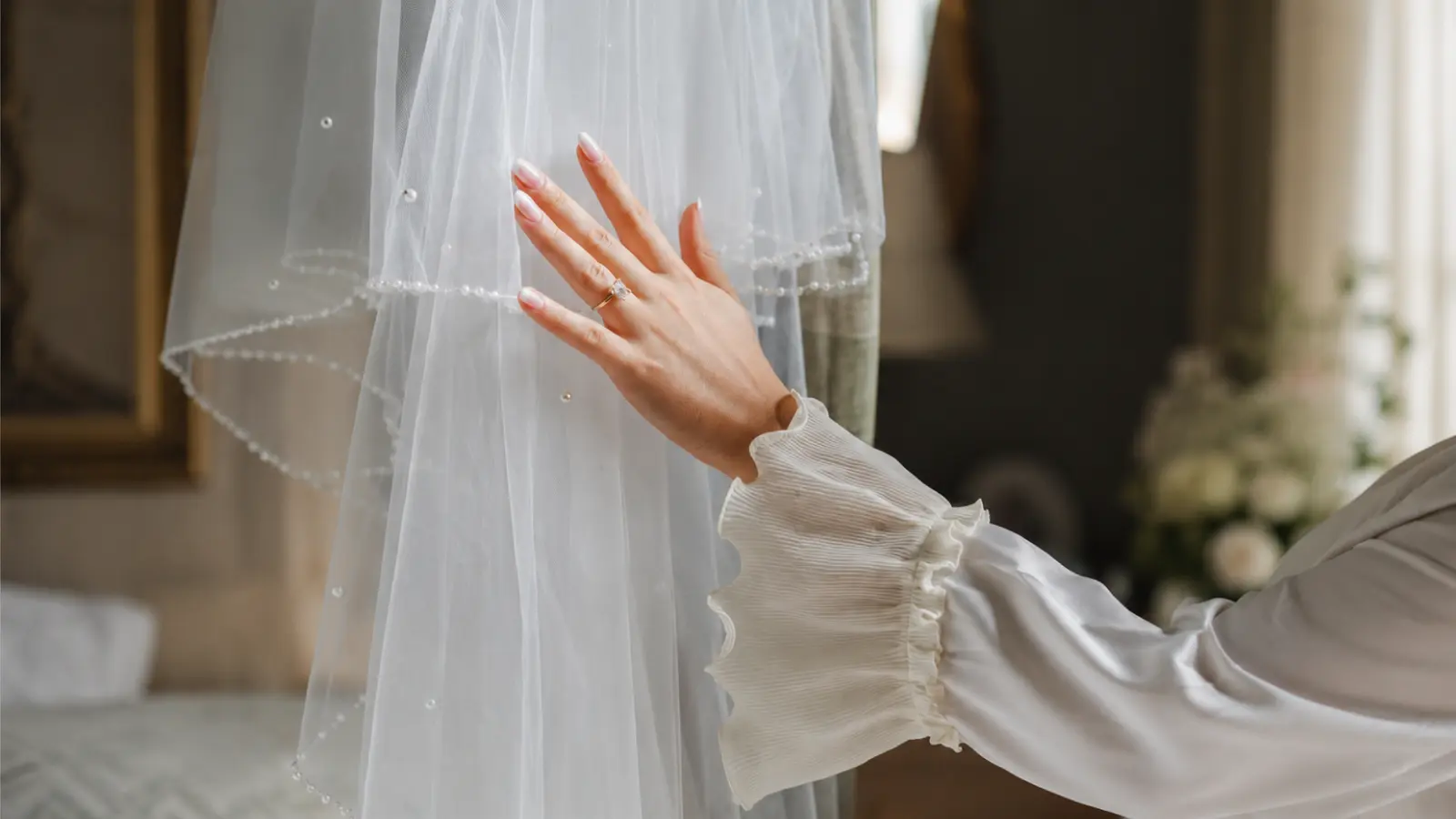
All veil measurements are taken from the comb or attachment point — typically at the crown or back of the head — straight down to where the fabric ends. The number you see on a product listing or in a salon is that vertical distance, measured in inches.
A few things affect how the measurement translates in real life. First, the measurement doesn’t account for the curve of the back: a veil measured at 90 inches straight down will appear slightly shorter on a bride with a pronounced spinal curve than on one standing very upright. Second, shoes matter more than most brides expect. A 3-inch heel raises the point where the veil attaches relative to the floor, effectively making any veil appear shorter than the same length on flat feet. Try veils on with your wedding shoes — or at minimum with a heel of the same height — so the length you see in the fitting room matches the length you’ll see on the day.
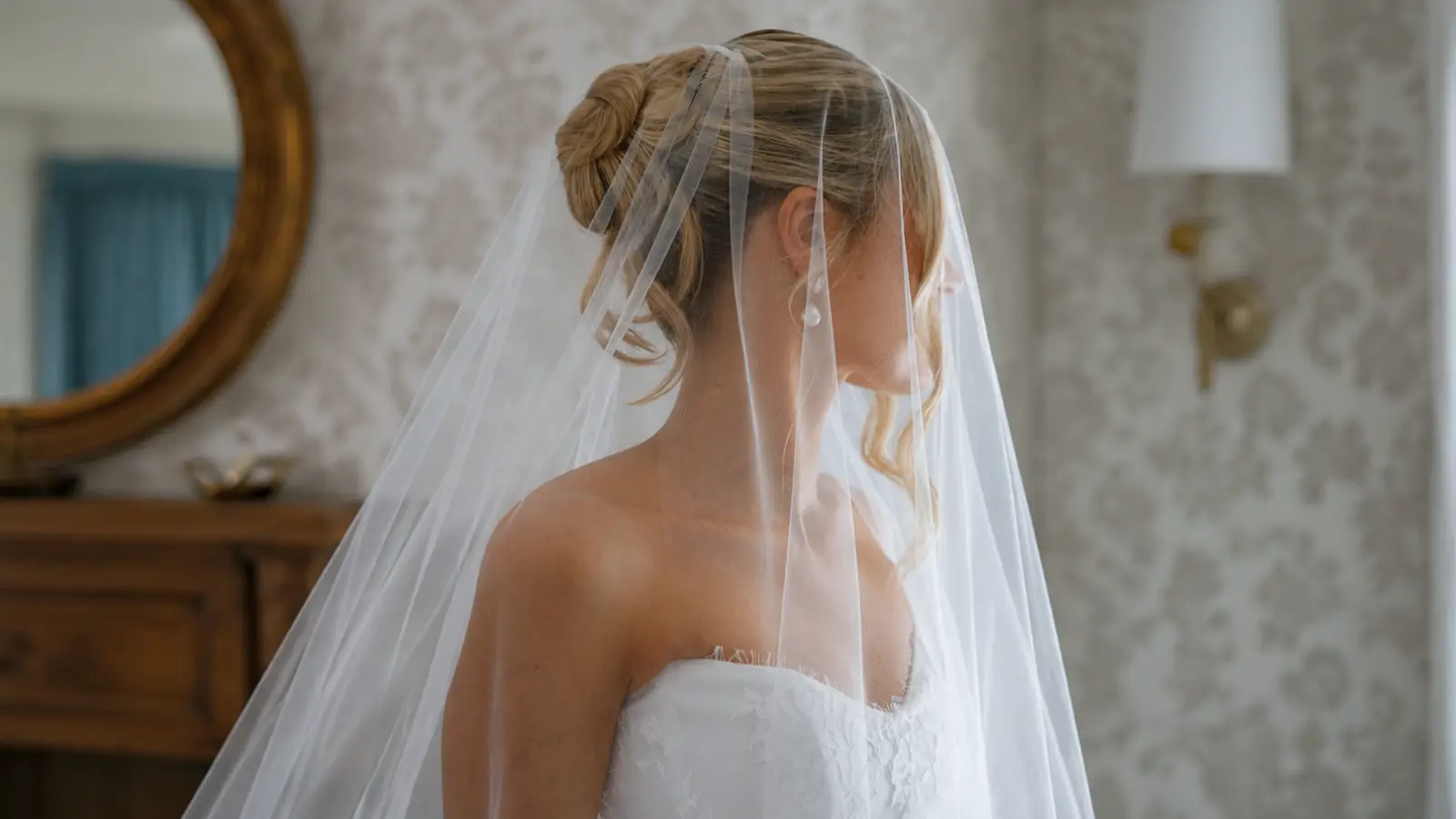
Third, where the comb sits on the head changes things. A veil attached at the very crown will fall higher and show more length; one placed lower toward the nape will appear shorter in front and add length at the back. Your stylist can adjust the comb position during the appointment to find what works best for your silhouette.
Wedding Veil Length Chart
The table below covers every standard veil length, with approximate measurements, where it falls on the body, and what it’s generally best suited for. These are industry-standard ranges; individual designers and salon inventories may vary slightly.
| Veil Length | Approximate Measurement | Where It Falls | General Best Use |
|---|---|---|---|
| Birdcage / Bandeau | 4–9 inches | Eyes to chin | Vintage, retro, elopements, tea-length dresses |
| Shoulder | 20 inches | At the shoulder | Modern, casual, or minimalist ceremonies; intricate bodices |
| Elbow | 25–30 inches | At the elbows | Classic and balanced; works with a wide range of silhouettes |
| Fingertip | 36–40 inches | At the fingertips | Most versatile length; suits nearly every dress and venue type |
| Waltz / Ballet / Knee | 50–60 inches | Knee to ankle | Graceful movement without full train; mid-formal ceremonies |
| Floor / Chapel | 85–95 inches | Sweeps the floor | Most popular floor-length option; formal but manageable |
| Cathedral | 108–120 inches | Extends 1–2 feet past the hem | Grand, traditional venues; creates a distinct train effect |
| Royal / Monarch | 144+ inches | Several feet of train | Very formal or ceremonial settings; requires significant space |
One thing this chart can’t convey is how different these lengths feel in motion. Short wedding veils move quickly and lightly; longer ones have weight and sweep. If you’re deciding between two lengths that are close to each other — fingertip versus waltz, or chapel versus cathedral — trying both in the salon is the only way to know which one feels right for how you want to move.
Every Length, Explained
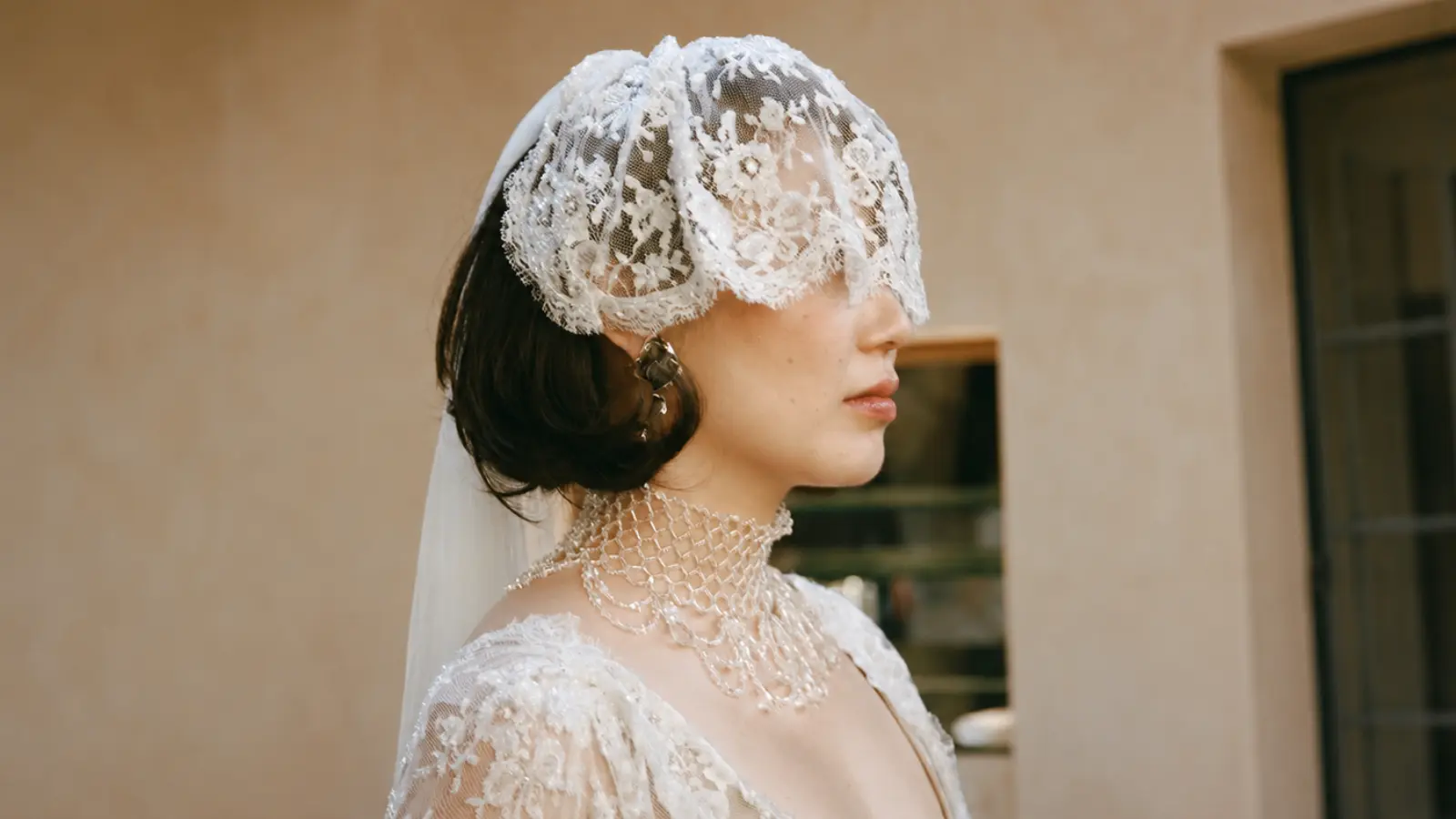
Measurements tell you where a veil falls. What they don’t tell you is what the veil actually does for a look — what it emphasizes, what it requires, and who it works best for. Here’s a more practical description of each length.
Birdcage and Bandeau (4–9 Inches)
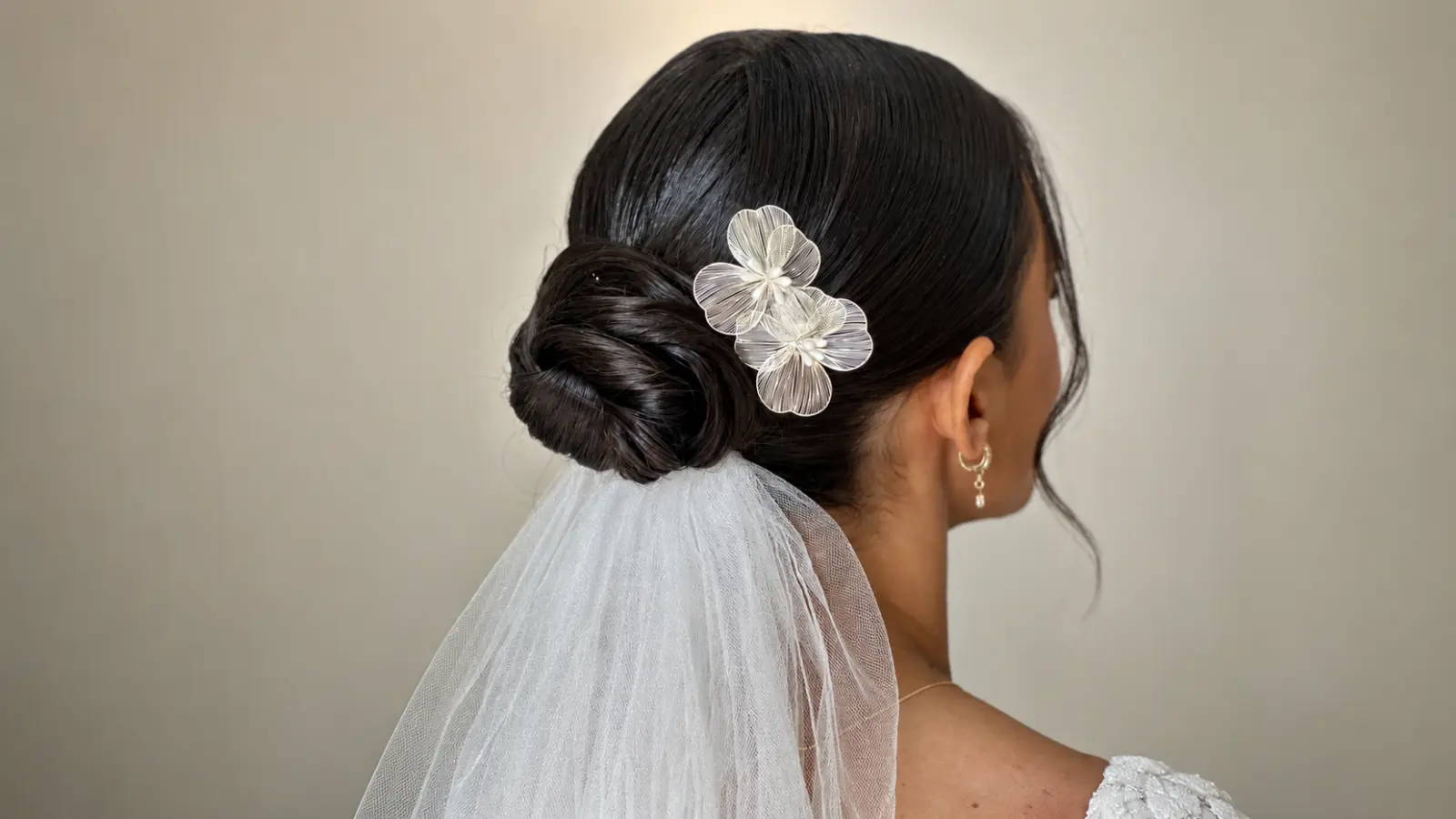
The birdcage occupies its own category because it functions differently from every other length. Made from wide-weave netting rather than traditional tulle, it frames the face rather than falling behind it. It’s a style as much as a length, strongly associated with vintage and retro aesthetics. It pairs best with tea-length dresses, bridal separates, and brides whose overall look leans into a specific era rather than a classic bridal vocabulary. This length won’t suit every wedding aesthetic, but for the right bride it’s one of the most distinctive choices available. For everything about this style, see our birdcage veil.
Shoulder Length (Around 20 Inches)
A shoulder-length veil ends at or just past the shoulder blades and offers a soft, abbreviated look that keeps visual weight near the head and neckline. It works particularly well when the back of the dress is a focal point — intricate buttons, open backs, structured boning — because the veil adds presence without covering the details. It can also work for casual or intimate ceremonies where a longer veil would feel out of proportion. The practical limitation: it’s a short enough length that it can get lost in loose, voluminous hair, so it reads best with an updo or hair pulled away from the shoulders.
Elbow Length (25–30 Inches)
The elbow length is a genuine all-rounder. It falls at a flattering point on most body types, creates enough visual presence to register in photos, and is short enough to be practical throughout the day. It doesn’t require as much management as longer styles and is less likely to create problems outdoors. For brides who want a veil with some presence — more than shoulder, less than a train — this is a solid default. It also works well as the back layer of a two-tier veil when the blusher is the priority style element rather than the overall length.
Fingertip Length (36–40 Inches)
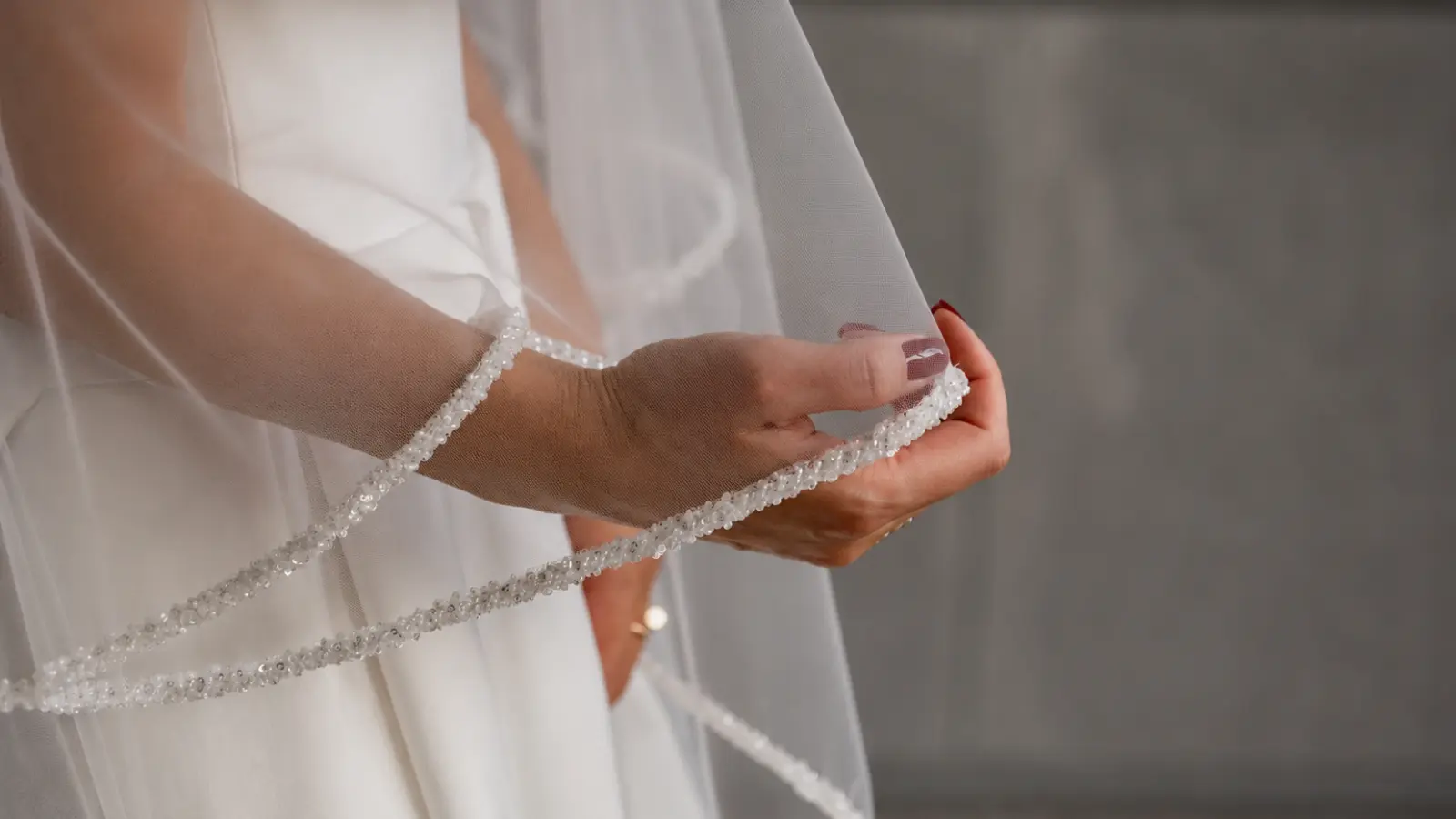
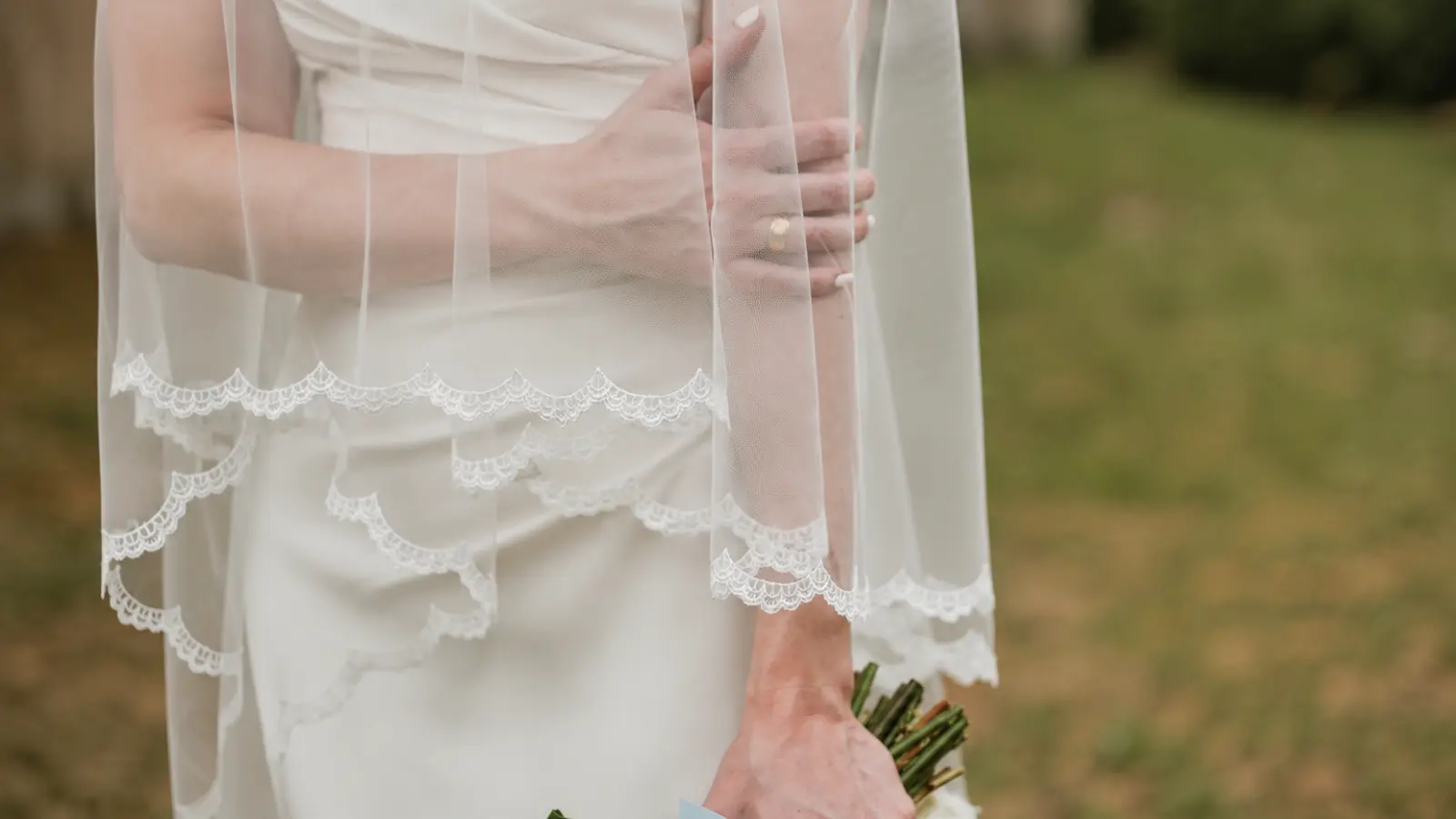
A fingertip wedding veil is the most versatile length in the standard bridal range, and for most brides it’s the right place to start. The veil falls at or just below the fingertips when arms hang naturally at the sides, which means it clears most dress hemlines and drapes cleanly without creating a train effect. It works with ballgowns, A-lines, sheaths, and mermaid silhouettes. It’s long enough to move beautifully in photos and short enough to be manageable all day. If you’re uncertain about length and want one option that’s unlikely to be wrong, this is it.
Waltz / Ballet Length (50–60 Inches)
The waltz or ballet length falls somewhere between the knee and ankle — below the typical dress hemline, but not touching the floor. It creates graceful movement without the management demands of a floor-sweeping veil. This length is particularly effective with A-line and trumpet silhouettes, where it adds flow and drama without disappearing into a full skirt. It’s a slightly less common choice than fingertip or chapel, which gives it a quietly distinctive quality at formal-but-not-traditional ceremonies.
Floor / Chapel Length (85–95 Inches)
A chapel length wedding veil is the most popular floor-length option for American brides, and with good reason. It sweeps the floor with a gentle train effect, creates a formal and romantic silhouette, and is long enough to have real presence in a processional without being as logistically demanding as cathedral. It works in most formal venues and pairs well with almost every dress silhouette. The one consideration: how it interacts with your dress train. A veil that ends mid-train tends to look visually awkward; chapel length usually works best when the veil extends slightly past the dress’s hem, or when the dress has no train at all.
Cathedral Length (108–120 Inches)
The cathedral veil extends one to two feet past the hem of the gown and creates a visible train behind the bride that is distinct from the dress itself. It’s the most dramatic length regularly worn at American weddings, and it photographs with genuine impact — wide-angle aisle shots and outdoor portraits show cathedral length in a way that shorter veils don’t read the same way. It also requires more planning than any shorter length: you’ll need a venue with enough aisle or outdoor space for it to lay flat, someone positioned to arrange it before the processional, and a plan for managing it after the ceremony. For a full guide on wearing and styling this length, see our cathedral wedding veil.
Royal / Monarch Length (144+ Inches)
The royal or monarch veil starts at around 144 inches and can extend significantly further. It’s rare outside of very formal religious ceremonies, ceremonial weddings, or brides specifically drawn to the grand tradition of a long train. At this length, the veil becomes as much a logistical event as an aesthetic choice: it requires a very long aisle, careful floor management, and a team who knows exactly how to move it. It also typically requires a dress with a complementary or no train, since two very long trains competing behind the bride tends to create visual confusion rather than drama. For most brides, cathedral length delivers the same dramatic effect with significantly less logistical overhead.
Chapel vs. Cathedral: The Comparison Brides Ask Most
The chapel versus cathedral question is one of the most common in veil shopping, and the confusion makes sense — both are floor-length, both are formal, and in salon photos they can look similar. The practical difference comes down to how far past the dress hem each one extends, and what that requires from the venue and the day.
A chapel veil at 85–95 inches sweeps the floor and creates a soft, elegant train that sits close to the dress or extends just slightly beyond it. It reads as formal and romantic without dramatically changing the silhouette behind the bride. Most formal venues — churches, estate venues, hotel ballrooms — can accommodate chapel length without any special planning. It’s manageable enough that many brides wear it through cocktail hour before removing it.
A cathedral veil at 108–120 inches creates a separate, visible train that extends well past the gown. The effect behind the bride is different: the veil becomes a distinct visual element rather than a soft extension of the dress. It requires an aisle of sufficient length to lay flat, someone to bustle or carry it after the ceremony, and more deliberate management than chapel. The payoff in photos — particularly the shot of the bride walking away down the aisle — is significant for brides who want it.
The honest question to ask is whether your venue actually supports what cathedral length requires. A cathedral veil in a venue with a short aisle or a small ceremony room doesn’t deliver the effect it’s known for and becomes a management problem instead. Chapel length in the same venue reads beautifully without the same demands.
Cathedral vs. Royal: Understanding the Longest Options
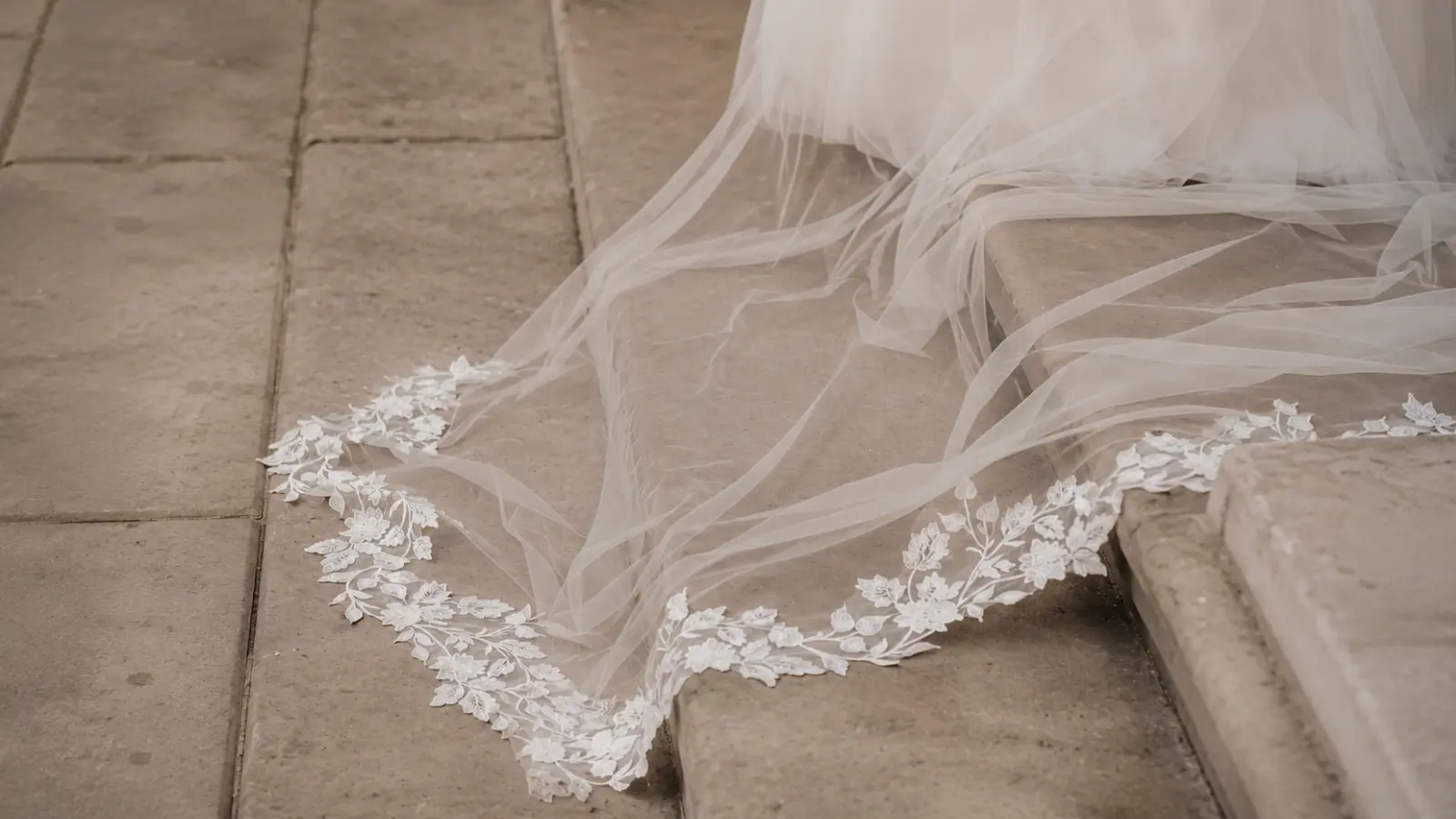
Cathedral and royal lengths are sometimes treated as interchangeable, but they’re meaningfully different in scale and in what they demand of the bride and the setting.
Cathedral (108–120 inches) is dramatic but achievable at many formal venues with appropriate planning. Royal or monarch length begins at 144 inches and can extend to 180 inches or more — which puts several feet of fabric on the floor behind the bride. Where a cathedral veil requires a long aisle, a royal veil requires an exceptionally long one. Where a cathedral veil needs one person to arrange it, a royal veil often benefits from two.
The royal length is most at home in a setting that genuinely warrants it: a very large cathedral, a formal estate with a grand hall, or a ceremony space with 80 or more feet of walking distance. Used in a setting that doesn’t support it, the fabric bunches, can’t lay flat, and the intended effect is lost entirely.
For most brides drawn to dramatic length, cathedral delivers the visual impact with a more realistic set of logistics. Royal length is worth considering only when the setting and the vision genuinely call for it.
Choosing by Dress Silhouette and Train
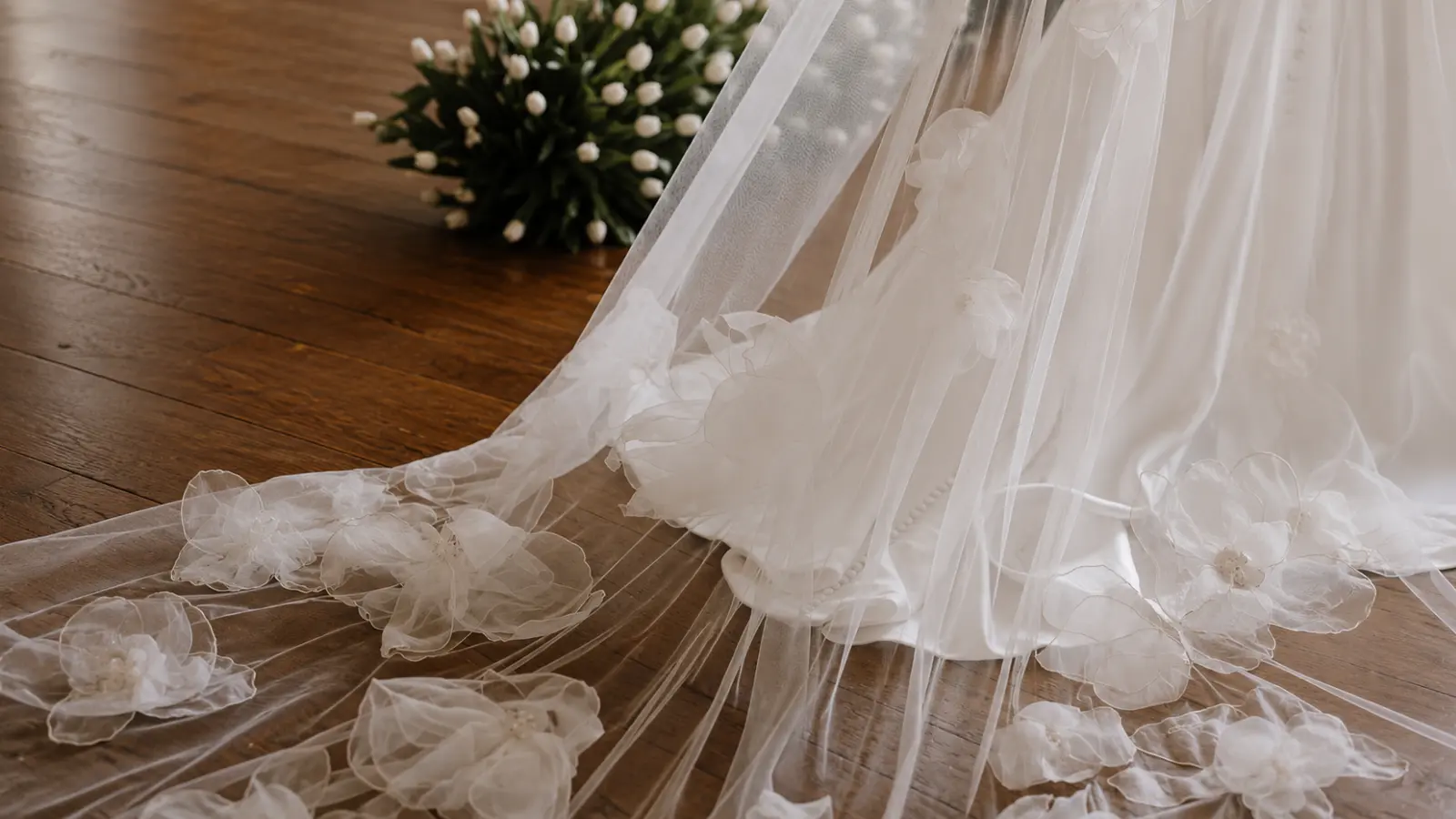
Length and dress silhouette interact in a few important ways. The main principle is proportion: the veil’s scale should feel like it belongs with the dress, not like it was chosen separately and placed on top. A second principle, easy to overlook, is the veil’s relationship to the dress train. A veil that ends in the middle of a train creates a visual stutter — two layers of fabric at different lengths competing for attention. The cleanest pairings are either a veil that extends noticeably past the train, or one that falls at a distinctly different and shorter length.
| Dress Silhouette / Train | Length That Works Well | What to Keep in Mind |
|---|---|---|
| Ballgown, no train | Fingertip, chapel, cathedral | Volume needs proportional length; short veils can read as underdressed against a full skirt |
| Ballgown with cathedral train | Cathedral or royal; or very short (elbow, birdcage) | Avoid lengths that end mid-train; go longer than the train or clearly shorter |
| A-line, sweep or chapel train | Fingertip, waltz, chapel, or cathedral | The most forgiving silhouette; most lengths work well |
| Sheath or column dress | Fingertip or chapel | Clean, uninterrupted length complements a sleek silhouette; avoid very full veils |
| Mermaid or trumpet, with train | Cathedral; or elbow for modern contrast | Cathedral echoes the drama of the silhouette; very mid-range lengths can look unresolved |
| Short or tea-length dress | Birdcage, shoulder, or elbow | Keep the scale proportional; floor-length veils on short dresses typically look out of balance |
| Dress with a long cathedral train | Cathedral or longer; or fingertip and below | If the veil isn’t longer than the train, keep it clearly shorter to avoid visual competition |
These are starting points built on visual logic, not restrictions. Finding the right wedding dress with veil combination still comes down to how the two look together, so if a pairing speaks to you and you’ve seen it work in reference images, try it in the salon before ruling it out.
Choosing by Venue and Ceremony Setting
Venue is the other major variable in length decisions, and it’s one brides often underestimate until they’re at the appointment. The same veil that photographs magnificently in a grand cathedral can become difficult to manage in a smaller space, and the same veil that looks proportionate in a small chapel can simply disappear in a large hall.
The most practical way to think about this: scale the veil to the ceremony space, not just to the dress. A long aisle rewards long lengths. A short aisle or informal outdoor ceremony rewards shorter ones. Here’s how that breaks down by setting type.
For large churches and cathedrals, chapel, cathedral, and royal lengths all have room to work. The aisle length is usually sufficient, the ceremony has the formality to support drama, and photographers are positioned to capture the full effect. This is the setting cathedral length was designed for.
For estate venues and hotel ballrooms, chapel and cathedral are both natural choices. The space typically has formality without the architectural constraints of a religious setting. Cathedral length works well here if the aisle or entrance walk is long enough.
For outdoor ceremonies — gardens, vineyards, beaches, fingertip and elbow lengths are the most practical. Wind affects longer veils more dramatically, and uneven terrain makes managing a trailing veil more complicated. Chapel length can work outdoors with planning; cathedral and royal lengths introduce real logistical challenges on grass or sand.
For intimate or non-traditional settings — a restaurant, a small gallery, a courthouse — shorter lengths read proportionately and allow the detail work of the veil to register up close, rather than being obscured by a long train. Elbow, fingertip, and shoulder lengths are all strong choices here.
How Length Reads in Photography
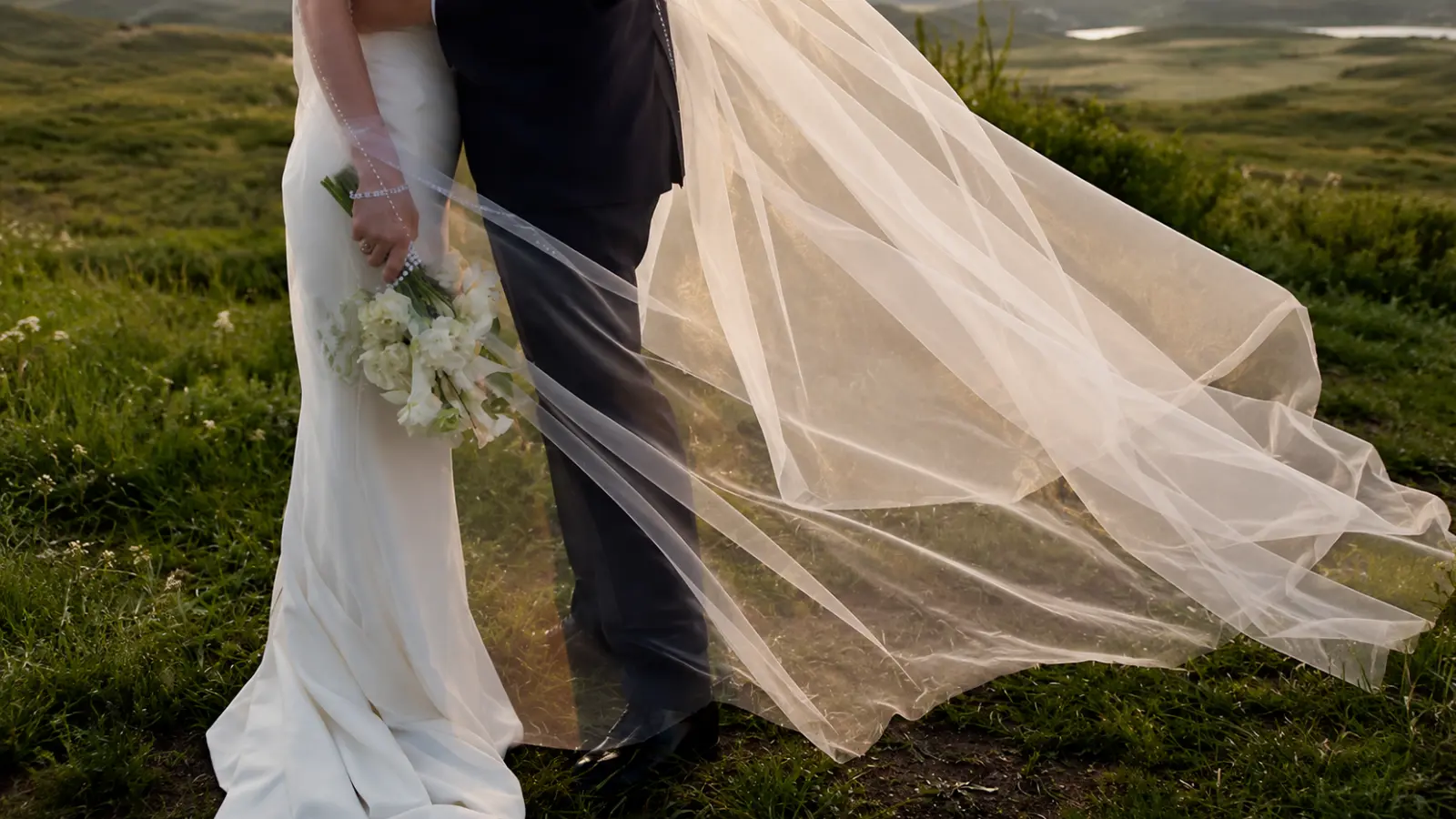
The fitting room is not where you’ll see the veil that matters most — it’s in photos. And photographs behave differently from mirrors in ways that genuinely affect which length to choose.
Short veils — shoulder and elbow — can partly disappear in wide-angle shots, particularly if the background has visual complexity or the fabric is very sheer. At close range they read beautifully, but at the distances used for processional shots and venue photography, they may not register with the presence they had in person. If your photographer plans to capture the full aisle walk from a distance, a longer veil will show more definitively.
Fingertip length is the sweet spot for photography at most venues. It has enough fabric presence to read clearly from a distance, creates movement in motion shots and outdoor portraits, and doesn’t require specific positioning the way very long veils do. Most wedding photography conventions are built around this length range.
Chapel and cathedral lengths photograph with particular impact in two specific shots: the rear aisle portrait (bride walking away from the camera) and any image taken from above. If your photographer shoots from balconies, stairs, or elevated angles, longer veils create an arresting composition that shorter ones simply don’t.
One detail that doesn’t show in measurements but shows clearly in photos: the weight and drape of the fabric. A chapel-length veil in silk tulle photographs more softly and luminously than the same length in standard bridal tulle, which can appear slightly flat under certain lighting conditions. If photography is a priority, it’s worth discussing fabric options alongside length during your appointment.
Length and Height: What to Know
Veil length is measured from the attachment point, not from the floor, which means the same numeric length can land at different places on different brides depending on height and where the comb sits. There are a few practical things to keep in mind here.
For petite brides, standard fingertip length may fall closer to the knee than the fingertips, effectively reading more like a waltz length. If the measurement is important to you — you want the veil to hit precisely at the fingertips, or to graze the floor — mention this during the appointment so the stylist can adjust the comb position or suggest a slightly longer or shorter option.
For taller brides, the same effect works in the opposite direction: a fingertip veil may fall shorter relative to the overall silhouette than it would on a shorter bride. Chapel lengths often look proportionately better on taller frames, where there’s more vertical space for the fabric to occupy.
The honest guidance: treat measurements as approximate landmarks, not guarantees. Try the veil on with your shoes, stand as you’ll stand on the day (upright, not slouched), and assess the fall from there. The number on the tag is a starting point, not the final answer.
Common Length Mistakes to Avoid
A few consistent patterns show up when brides are choosing veil lengths. Most are easy to sidestep once you know to watch for them.
- Choosing a length before knowing your dress train. The interaction between veil length and dress train is one of the most common sources of an awkward final look. If your dress has a sweep, chapel, or cathedral train, know that measurement before your veil appointment. A veil that ends mid-train looks visually unresolved.
- Deciding based only on the mirror, not motion. Walk in the veil during your appointment. Turn around. Walk away from the mirror and look back at photos your stylist or a friend takes on a phone. A veil that looks beautiful when you’re standing still may move differently — better or worse — when you’re actually in motion.
- Ignoring the venue aisle length. If you’re considering cathedral or royal length, confirm the approximate aisle length with your venue coordinator before committing. A 90-inch aisle will not show a cathedral veil the way a 120-foot nave will.
- Trying veils without your wedding shoes. A 3-inch heel changes where any length lands relative to the floor. What reads as floor-length at flat feet may be a few inches short with heels. Bring your shoes — or something of the same heel height — to the appointment.
- Letting the length overshadow the practical plan. The most dramatic length is not the best length if there’s no workable plan for managing it through the ceremony, portraits, and early reception. Decide before the day who is responsible for the veil after it comes off, where it will be stored, and how it will be handled.
The thread in all of these is the same: length decisions are most useful when they account for the full day, not just the processional moment. A beautiful veil that’s difficult to manage is a different kind of problem than a slightly shorter one you can enjoy wearing for hours.
Wedding Veil Length Inspiration
Discover beautiful wedding veil length ideas for every bridal style, from fingertip and chapel veils to dramatic cathedral and royal lengths. Explore elegant inspiration, real bridal looks, and expert styling ideas to find the perfect veil for your dress, venue, hairstyle, and wedding vision.
Choose the Wedding Veil Length That Completes Your Look
The perfect wedding veil length isn’t simply the longest or the most dramatic—it’s the one that complements your dress, fits your venue, and makes you feel confident from the moment you walk down the aisle. Whether you choose a timeless fingertip veil, an elegant chapel length, or a breathtaking cathedral veil, the right length should enhance your bridal look rather than compete with it.
Now that you understand how every wedding veil length differs, you’ll be able to compare your options with confidence and walk into your bridal appointment knowing exactly what to ask for. That clarity makes choosing your veil far easier—and much more enjoyable.
Frequently asked questions (FAQ)
How do you choose the right wedding veil length?
Choose your veil length by considering your dress silhouette and train, the size and setting of the ceremony venue, your height, your wedding shoes, and how much fabric you want to manage during the day. Fingertip length is the most versatile starting point, chapel offers a formal floor-sweeping effect, and cathedral creates a distinct train that requires more space and planning. The right length should feel proportional to both the gown and the ceremony setting.
What is the most popular wedding veil length?
Fingertip length, usually around 36 to 40 inches, is one of the most popular and versatile choices because it works with most dress silhouettes and venues. It creates visible movement without becoming difficult to manage. Among floor-length options, chapel length is especially popular because it provides a formal, romantic appearance without the logistical demands of a cathedral veil.
What is the difference between a chapel veil and a cathedral veil?
A chapel veil usually measures around 85 to 95 inches and reaches the floor or extends slightly beyond the gown. A cathedral veil typically measures 108 to 120 inches and creates a separate train behind the bride. Chapel length works in most formal venues, while cathedral length requires more aisle space, careful arrangement before the processional, and a plan for handling it afterward.
What is the difference between a cathedral veil and a royal veil?
A cathedral veil generally measures 108 to 120 inches and extends one or two feet beyond the dress. A royal or monarch veil starts at approximately 144 inches and may be considerably longer. Royal veils require exceptional aisle space, careful handling, and a venue large enough for the fabric to spread fully. For most brides seeking dramatic length, cathedral is the more manageable choice.
How do you measure for a wedding veil?
Measure from the intended comb or attachment point at the crown or back of the head straight down to where you want the veil to end. Wear shoes with the same heel height as your wedding shoes because height changes where the fabric reaches. Comb placement, posture, and individual designer measurements can also affect the final result, so use the listed length as a guide rather than a guarantee.
Should a wedding veil be longer than the dress train?
A long veil usually looks most intentional when it extends clearly beyond the dress train. When the veil ends in the middle of the train, the two layers can compete visually. Another good option is choosing a veil that is distinctly shorter, such as fingertip or elbow length. The cleanest result usually comes from making the difference between the veil and train lengths deliberate.
What veil length works best for an outdoor wedding?
Elbow and fingertip lengths are usually the most practical for outdoor ceremonies because they are easier to manage on grass, sand, and uneven ground. They are also less affected by wind than chapel, cathedral, or royal veils. Chapel length can work outdoors with preparation, but longer options require careful consideration of weather, terrain, and assistance.