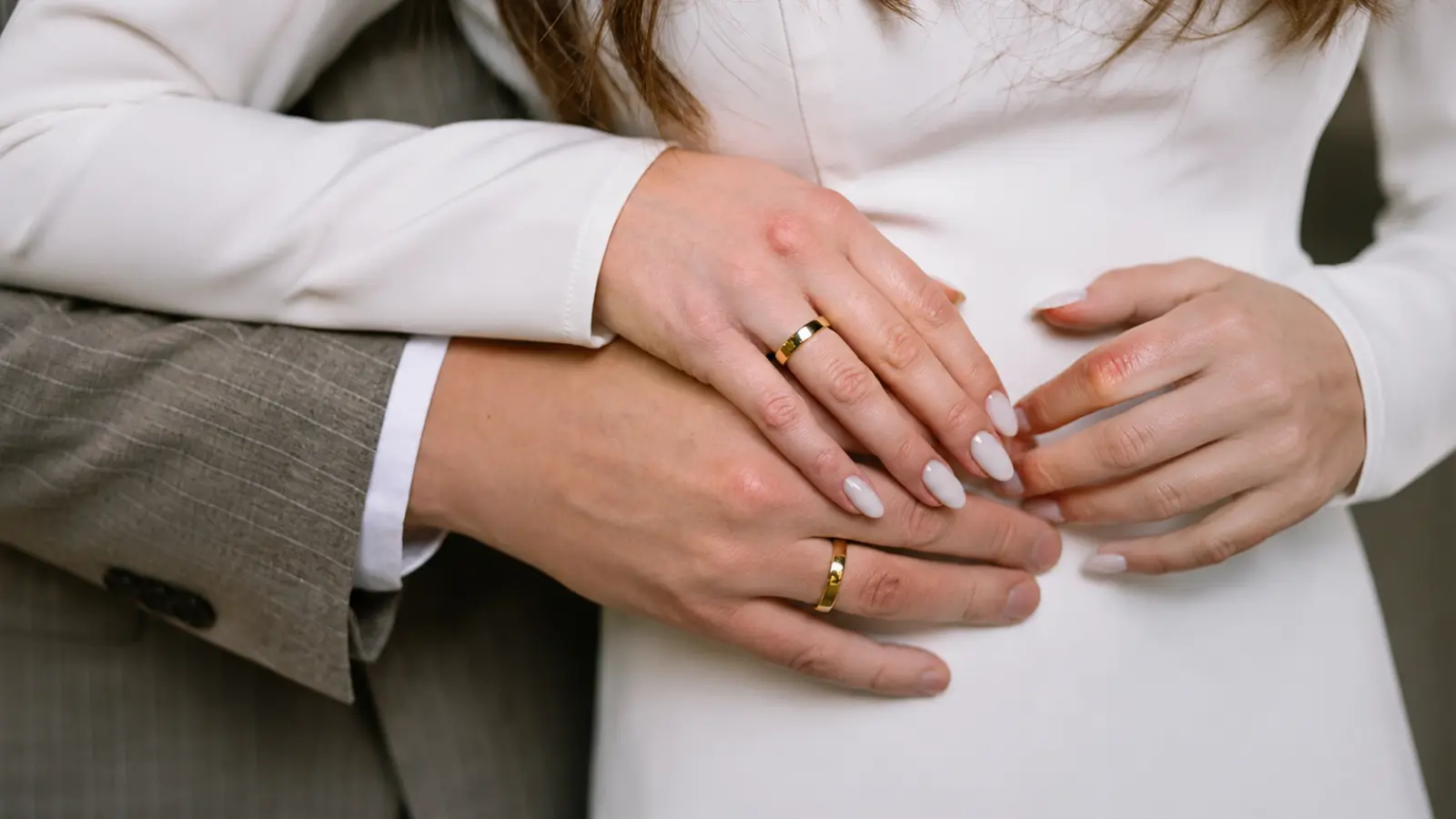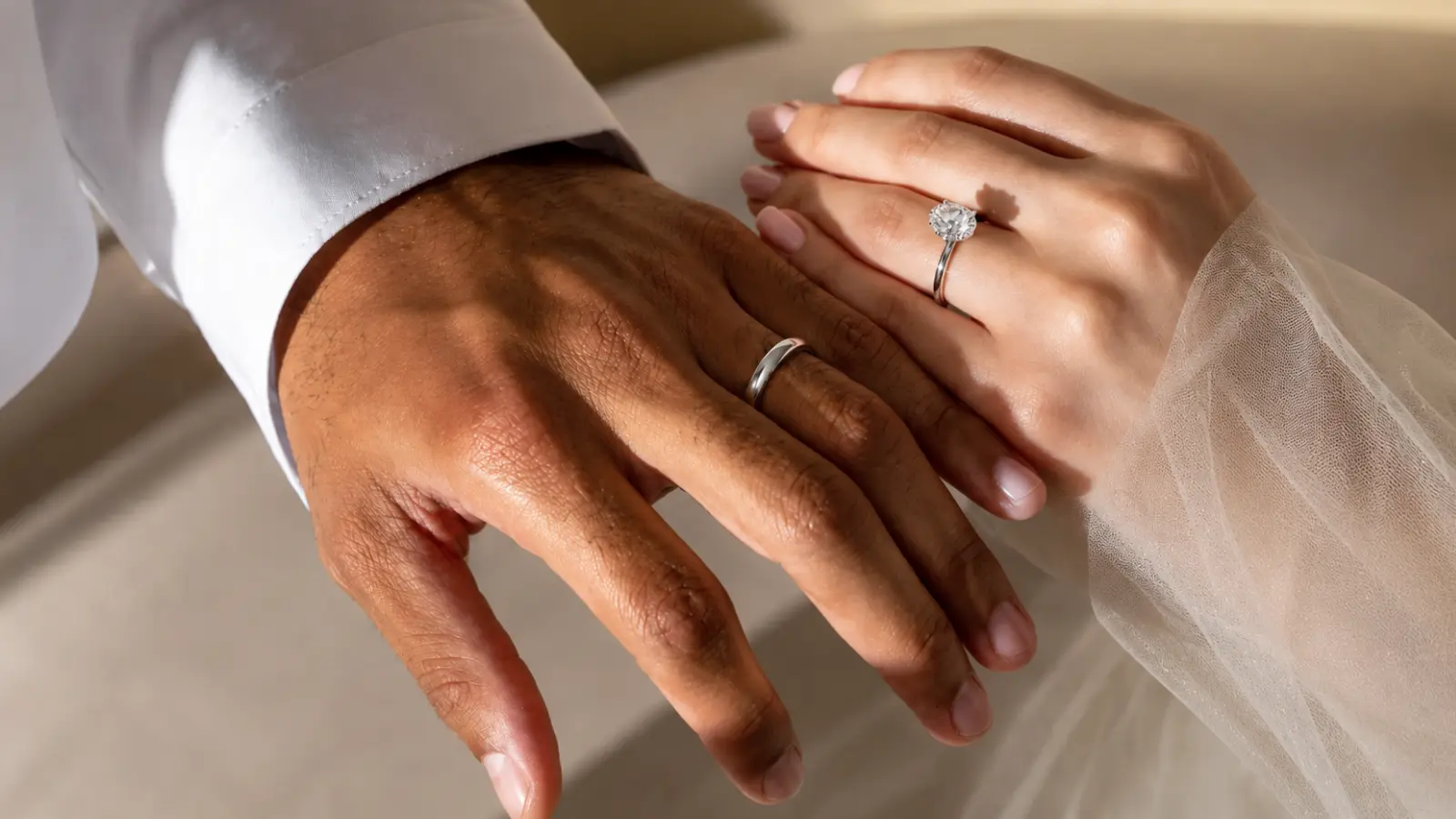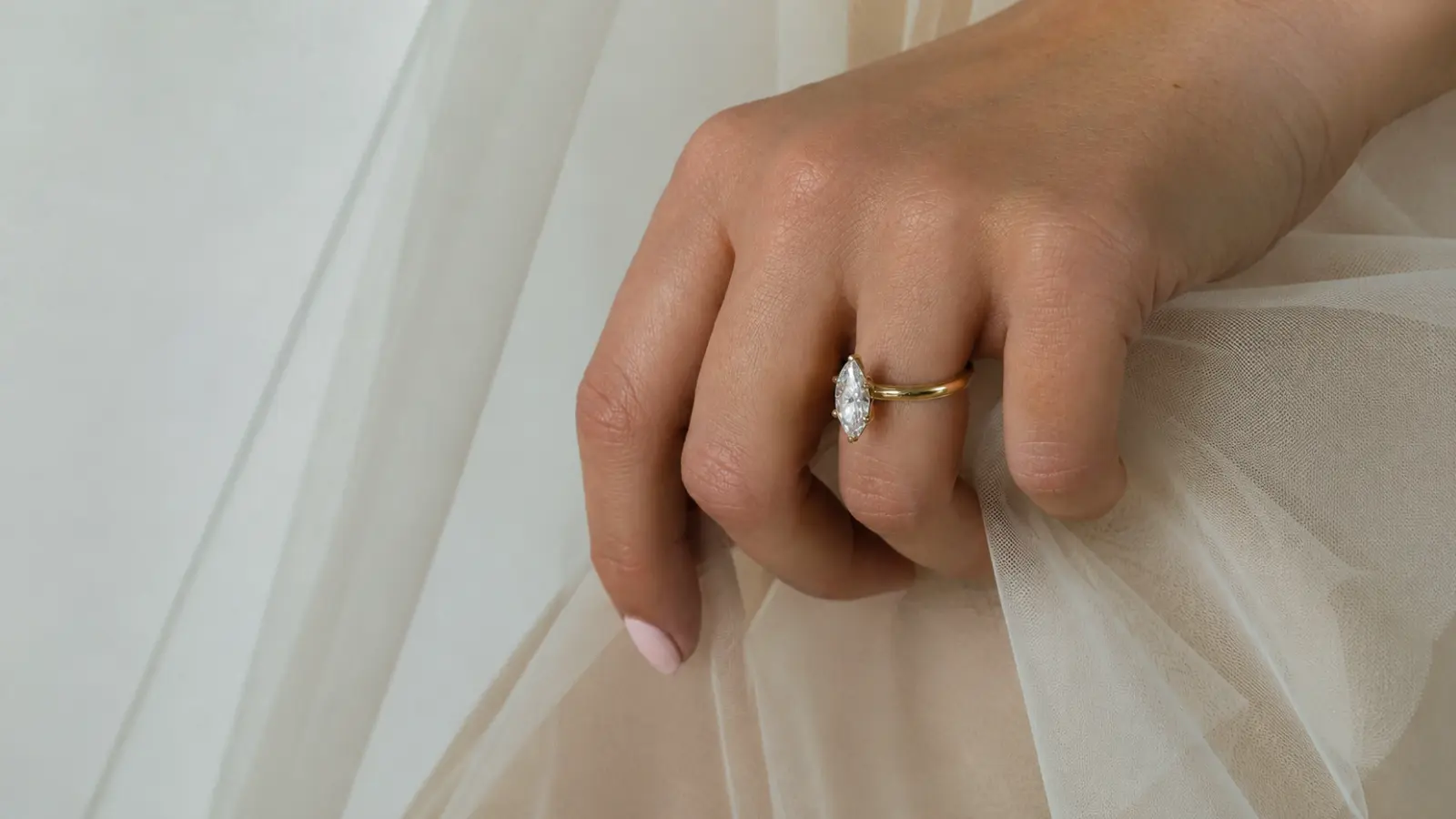
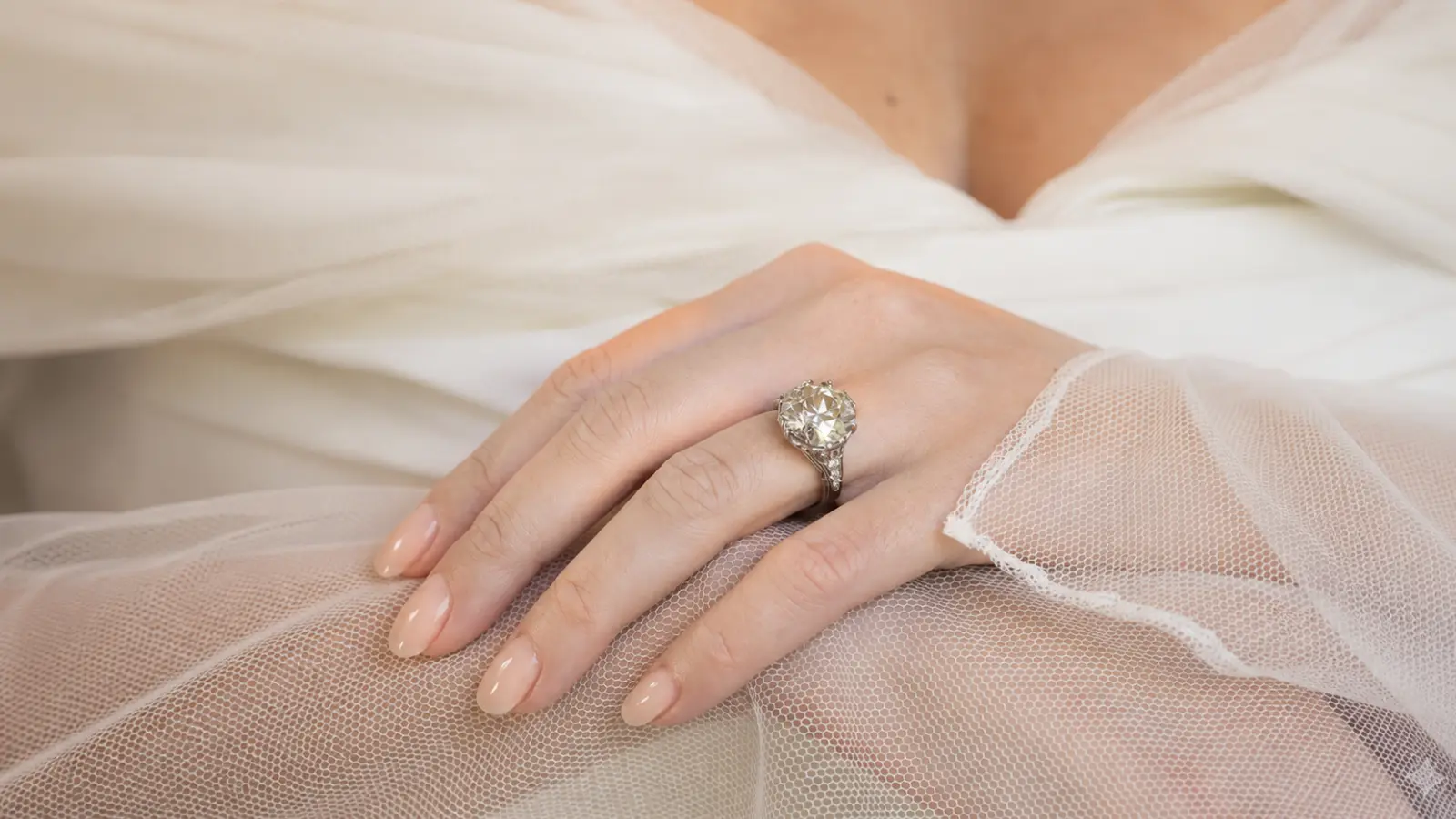
Vintage wedding rings are wedding rings from previous jewelry eras, typically including styles from the 1920s through the 1980s, known for their historical designs, craftsmanship, and distinctive details that reflect the period in which they were created. Unlike vintage-inspired rings, true vintage pieces carry an existing history, previous ownership, and characteristics connected to their original era.
A vintage wedding ring is one of the few pieces of jewelry that arrives with a story already attached. Choosing one is about more than selecting an older design — it means understanding the craftsmanship, condition, materials, and history behind a ring that existed before becoming part of your own story.
This guide explains vintage wedding rings, including Art Deco, Victorian, Edwardian, Retro, and Mid-Century styles, the difference between vintage, antique, and estate jewelry, what to check before buying, resizing considerations, and how these designs fit within the wider world of wedding rings and wedding bands.
Vintage vs. Antique Wedding Rings
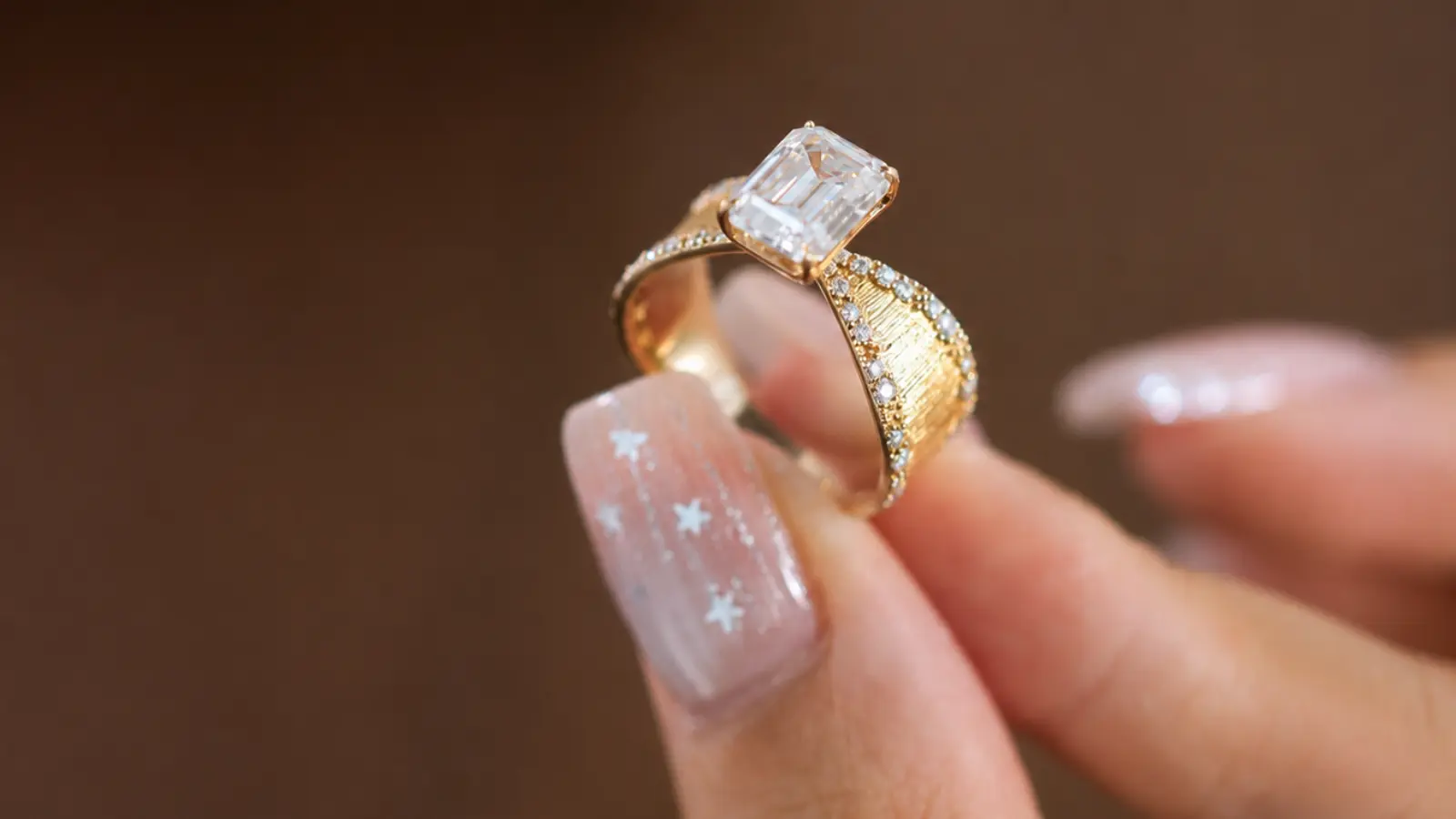
The terms vintage, antique, and estate are used inconsistently enough in jewelry retail that understanding what each one means, and what each one does not guarantee, matters before you begin shopping seriously.
Antique: Genuine Historical Age
Antique, in the jewelry trade, typically refers to pieces that are 100 or more years old. This places them in production before roughly the 1920s and covers Victorian jewelry (1837–1901), Edwardian jewelry (1901–1915), and the earliest Art Deco pieces. A ring described as antique has genuine historical age. That age can usually be verified through hallmarks, construction techniques, and the materials and settings used, which are period-specific in ways a skilled jeweler can read.
Vintage: A Wider, Looser Window
Vintage refers to pieces from roughly the 1920s through the 1980s, a range that encompasses Art Deco, the Retro era of the 1930s and 1940s, Mid-Century Modern design of the 1950s and 1960s, and the more varied aesthetics of the 1970s. The lower end of vintage is recent enough that some pieces described as vintage are simply second-hand rings from the not-too-distant past, which is a meaningful difference from a ring with genuine historical character.
Estate Jewelry: The Broader Category
Estate jewelry is the term most frequently used by jewelers and dealers to describe pre-owned pieces broadly, without regard to age. An estate ring may be an authentic Edwardian piece, a 1960s Mid-Century design, or a ring made five years ago that was sold and returned. The term originates from the practice of purchasing jewelry from estates, the accumulated possessions of deceased owners, but it has expanded to cover the secondary jewelry market generally.
Not every estate ring is vintage, and not every vintage ring comes from an estate. The term signals pre-owned; it does not signal a specific period or level of historical significance.
Vintage-Inspired: Aesthetics Without Provenance
Vintage-inspired describes a new ring designed with the visual language of a historical period, such as the geometric forms of Art Deco, the filigree delicacy of Edwardian work, or the organic naturalism of Victorian botanical motifs, but manufactured recently with contemporary materials and techniques. A vintage-inspired ring has no actual provenance, no wear history, and no documentation of period authenticity. What it offers instead is the aesthetic character of an older style with the practical advantages of a new piece, making it one of several approaches to unique wedding rings without the uncertainty of previous damage or repair.
For couples drawn to the look of a specific period but who want the security of a new purchase, vintage-inspired is a legitimate and often visually indistinguishable alternative to an actual vintage piece. For couples to whom historical authenticity matters, where the ring’s actual age and provenance are part of its meaning, the vintage-inspired ring is a different object, whatever it looks like.
Art Deco Wedding Rings (1920s–1935)
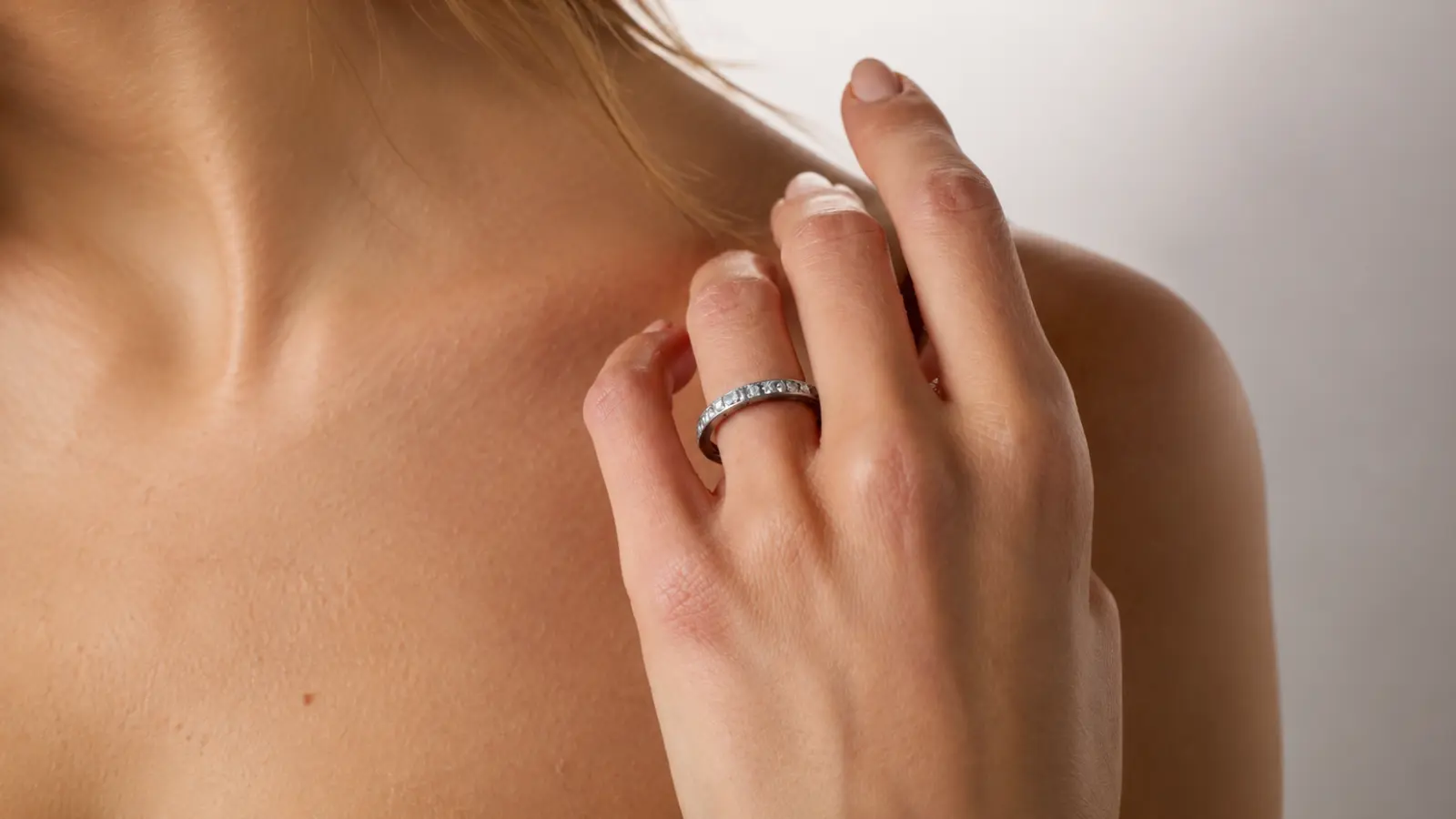
Art Deco is, by a significant margin, the most consistently requested vintage jewelry aesthetic, and the one most frequently referenced when couples describe wanting a ring that feels historical without feeling heavy or old-fashioned. The appeal is not difficult to understand. Art Deco rings have a visual precision and graphic quality that photographs exceptionally well, pairs naturally with contemporary minimalist aesthetics, and reads as sophisticated rather than merely antique.
The Art Deco period in jewelry spans roughly from the early 1920s to the mid-1930s, overlapping with the broader Art Deco movement in architecture, furniture, and graphic design. The defining characteristics in jewelry are geometric exactness, strong symmetry, high contrast between white metal and colorless or vivid stones, and a clear departure from the organic, curving forms of the Edwardian era that preceded it.
Defining Characteristics
Platinum became the dominant metal for fine Art Deco jewelry, partly because it allowed thinner prong settings and more delicate structural work than gold, and partly because its silvery-white color suited the era’s preference for high contrast between metal and stone. White diamonds set in platinum against a background of black onyx, midnight blue sapphires, or deep red rubies became one of the most recognizable visual motifs of the period.
Calibré-cut stones, small and precisely cut gemstones fitted together like puzzle pieces in geometric arrangements, appear frequently in Art Deco rings as accent elements around a larger center stone. Common motifs include chevrons, stepped pyramidal forms, fans, sunbursts, and the strongly horizontal and vertical lines characteristic of the architectural Art Deco aesthetic. Filigree work from this period tends to be finer and more geometric than Victorian or Edwardian filigree: open metalwork in precise angular patterns rather than the flowing organic forms of earlier eras.
Art Deco for Wedding Bands Specifically
Art Deco wedding bands often take the form of narrow platinum or white gold bands with channel-set or pavé stones in a geometric pattern, such as straight lines of diamonds, alternating diamonds and colored stones, or a central geometric motif repeated at intervals. The visual effect is distinctive without being elaborate: the pattern is precise and intentional, but the band itself is typically not wide or heavy.
These bands sit well alongside an engagement ring because their graphic quality reads clearly even at the narrow width a band requires, and they look natural alongside both contemporary solitaires and other vintage pieces.
Authenticity and Reproductions
Art Deco is the most widely reproduced vintage jewelry aesthetic, which means the market includes genuine period pieces, high-quality reproductions, and lower-quality pieces that borrow Art Deco visual vocabulary without the craftsmanship of the original period. Genuine Art Deco pieces will typically show evidence of hand-finishing, have hallmarks consistent with the period and country of origin, and be set in platinum or a period-appropriate gold alloy. When buying a piece described as Art Deco, asking a jeweler to assess the hallmarks and construction techniques, and to provide documentation of period authenticity if it is being sold as such, is a reasonable expectation.
Victorian Wedding Rings (1837–1901)
Victorian jewelry covers the longest span of any named era in Western jewelry history: sixty-four years of Queen Victoria’s reign, during which aesthetic fashions shifted significantly enough that the era is typically divided into three distinct periods. A ring described simply as Victorian may come from any of these periods and look quite different from a ring described the same way.
Early Victorian: The Romantic Period (1837–1855)
The early years of Victoria’s reign produced jewelry characterized by romantic naturalism: flowers, leaves, birds, serpents, and other organic motifs rendered in yellow gold. Colored gemstones were prominent, with turquoise, garnets, coral, seed pearls, and amethysts appearing frequently alongside diamonds.
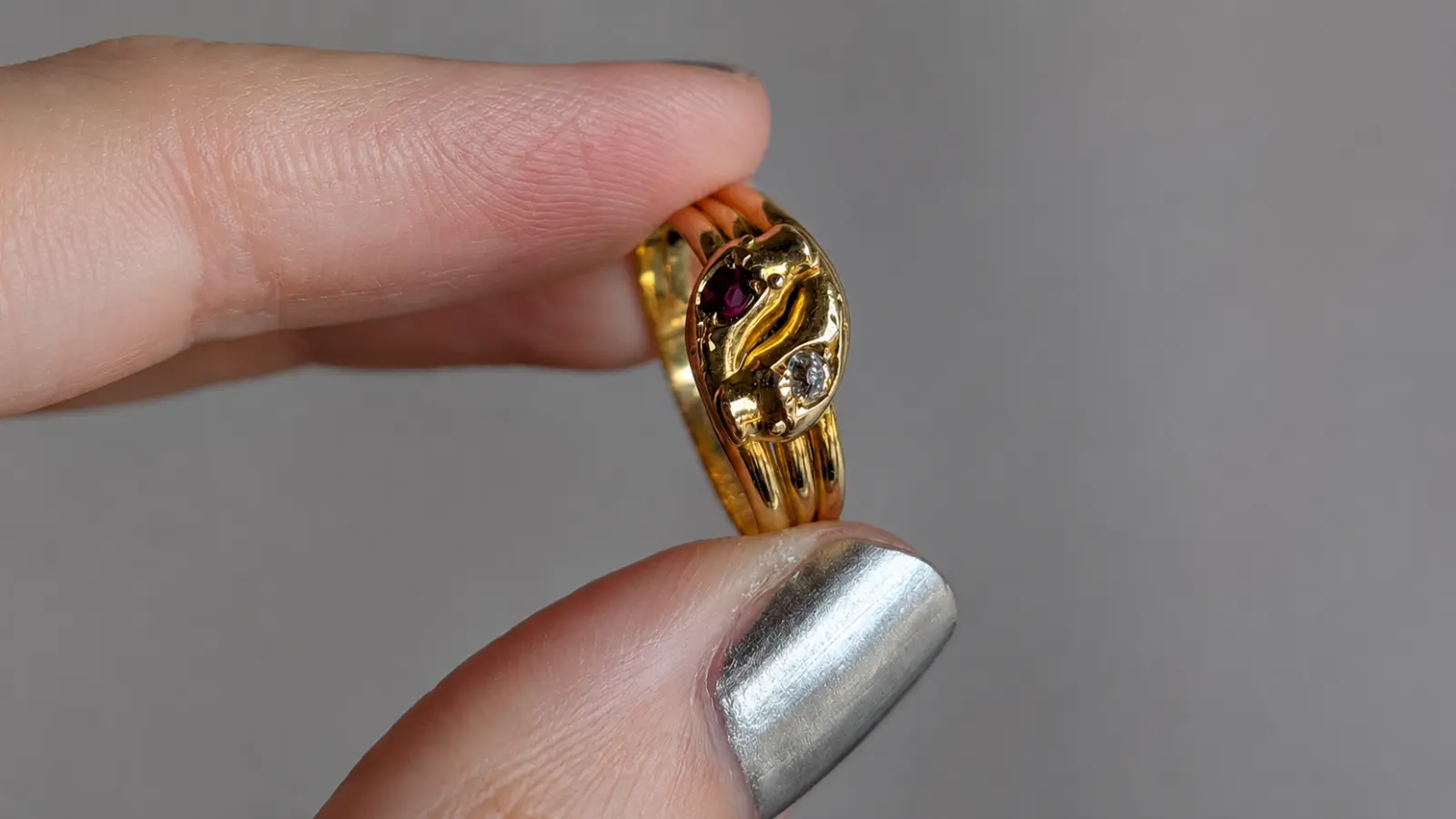
The serpent ring, a coiled snake with a gemstone set at the head representing eternal love, became one of the most recognized icons of the period. It was famously popularized when Prince Albert gave one to Queen Victoria herself as an engagement ring. Early Victorian pieces tend to have a warmth and sentimentality that the later periods of the era do not always share, designed to express feeling through natural symbolism and made with a delicacy the heavier forms of the Grand period replaced.
Mid-Victorian: The Grand Period (1856–1880)
The death of Prince Albert in 1861 initiated a prolonged period of mourning for Queen Victoria that influenced the aesthetic of British jewelry for decades. Mourning jewelry, pieces that incorporated black enamel, jet (a form of fossilized wood), and hair from the deceased, became formalized as a social practice. The Grand period’s jewelry tends to be heavier, darker, and more architecturally imposing than the Romantic period’s, with larger settings, bold sculptural forms, and a gravity the earlier era’s lightness did not have.
Not all mid-Victorian jewelry was mourning-oriented, but the period’s aesthetic sensibility ran toward the substantial and the formal rather than the romantic and the delicate. Archaeological Revival designs, pieces inspired by ancient Egyptian, Greek, Roman, and Etruscan jewelry, were fashionable during this period, making some mid-Victorian pieces look strikingly modern in their geometric reference to ancient forms.
Late Victorian: The Aesthetic Period (1880–1901)
The final two decades of the Victorian era brought a return to delicacy and a new influence from the Aesthetic Movement, which valued beauty and artistic refinement for their own sake. Japanese design motifs, including bamboo, fans, cranes, and chrysanthemums, appeared in jewelry as Japanese aesthetics spread through European art and design. Star motifs, crescent moons, and celestial forms became fashionable.
Diamonds increased in prominence as South African mines made them more available, and the engagement ring, as a distinct category separate from the wedding band, began to take the form most people would recognize today.
Wearing Victorian Rings Today
Victorian rings require the most deliberate approach to contemporary wearing of any vintage period, because the visual language of the era is the most distant from the present. A heavily ornate mid-Victorian piece with black enamel detailing and somber stones reads very differently in a contemporary context than it did in the 1860s.
The rings that tend to translate most naturally into contemporary wear are from the Romantic and Late Victorian periods: lighter, more floral, and less reliant on the heavy sculptural forms of the Grand era. An honest look at how a Victorian ring will work alongside other jewelry you actually wear daily is worth doing before the purchase.
Edwardian Wedding Rings (1901–1915)
Edwardian jewelry occupies a short but extraordinarily distinctive period, roughly the fifteen years following Queen Victoria’s death in 1901, and produces some of the most delicate and technically accomplished jewelry in Western history. The era is defined by a quality that no subsequent period quite replicated: a lace-like fineness in metalwork made possible by platinum, which had only recently become workable at the scale fine jewelry required, allowing structural forms so delicate they would have been impossible in gold.
The Defining Aesthetic
Edwardian jewelry reads as light, intricate, and extraordinarily refined. Milgrain edging, tiny beaded borders applied to the edge of metal settings, became a hallmark of the period and remains one of the most immediately recognizable Edwardian details. Filigree in platinum created open, lace-like patterns of remarkable precision. Garland and swag motifs, floral forms, ribbons and bows, and delicate foliate designs characterized the best work of the period.
Diamonds set in platinum, which allowed the metal to disappear into the background and the stones to read as floating, were the signature of high Edwardian jewelry. The overall visual effect is the softest and most romantic of all the named vintage jewelry periods. Edwardian rings tend to look like fine lace translated into precious metal and stone, delicate enough to seem almost impossibly fragile, and genuinely fragile enough that condition and structural integrity are particularly important when buying them.
Fragility as a Practical Consideration
The same qualities that make Edwardian rings visually exceptional make them demanding in practical terms. The platinum filigree that defines the finest pieces can be damaged by improper cleaning, by rough handling, and by jewelers unfamiliar with its specific requirements. Prongs on Edwardian pieces are typically fine and require more frequent inspection than heavier contemporary settings. The milgrain detail on edges can be lost if the ring is polished with equipment that removes surface detail. Any jeweler who works on an Edwardian piece needs specific experience with the period and its construction methods; a general repair shop may do more harm than good.
Edwardian Wedding Bands
Edwardian wedding bands are one of the more delicate historical wedding ring styles, typically using narrow platinum or gold bands with milgrain edging, small diamond accents, or fine engraved patterns. They look exceptionally good worn alongside either contemporary solitaire engagement rings or other Edwardian pieces, and their delicacy suits hands and fingers with a lighter build. The narrow width common to authentic Edwardian bands, often 2mm to 3mm, is a practical advantage for stacking alongside an engagement ring, since they tend to sit flush and unobtrusive beside a larger stone.
Retro and 1940s Wedding Rings
The Retro era in jewelry spans roughly from the mid-1930s through the late 1940s and reflects a world that had moved through the Depression and into the upheaval of World War II. The aesthetic shift from Art Deco is immediately visible: where Art Deco was precise, geometric, and cool, Retro jewelry is bold, architectural, and warm. Yellow gold returned to dominance after the platinum-dominated Art Deco period, partly because wartime restrictions on platinum limited its availability for civilian jewelry in the United States.
Characteristics of Retro Jewelry
Retro pieces tend to be larger and more three-dimensional than Art Deco pieces: scrolls, bows, stylized flowers, and bold sculptural forms that catch the light from multiple angles rather than relying on the flat graphic precision of Art Deco’s geometric patterns. Rose gold and yellow gold appear frequently, sometimes in combination.
Large synthetic stones, such as aquamarine, citrine, and pink tourmaline, were used extensively during wartime when certain natural stones were restricted or difficult to source. The overall effect is exuberant and glamorous. Retro jewelry has the quality of Hollywood jewelry from the same period, which is not a coincidence, since film was one of the dominant aesthetic influences on the era.
Wearing Retro Pieces
Retro jewelry tends to be more wearable in contemporary contexts than Victorian pieces because its boldness reads as intentional statement jewelry rather than as historical costuming. A large rose gold Retro ring with a central aquamarine sits comfortably alongside contemporary fashion in a way a heavy mid-Victorian mourning ring may not. The warmth of yellow and rose gold from this period also suits a wide range of skin tones, since the cool platinum of Art Deco can read as clinical rather than warm against some complexions.
1950s Wedding Ring Sets
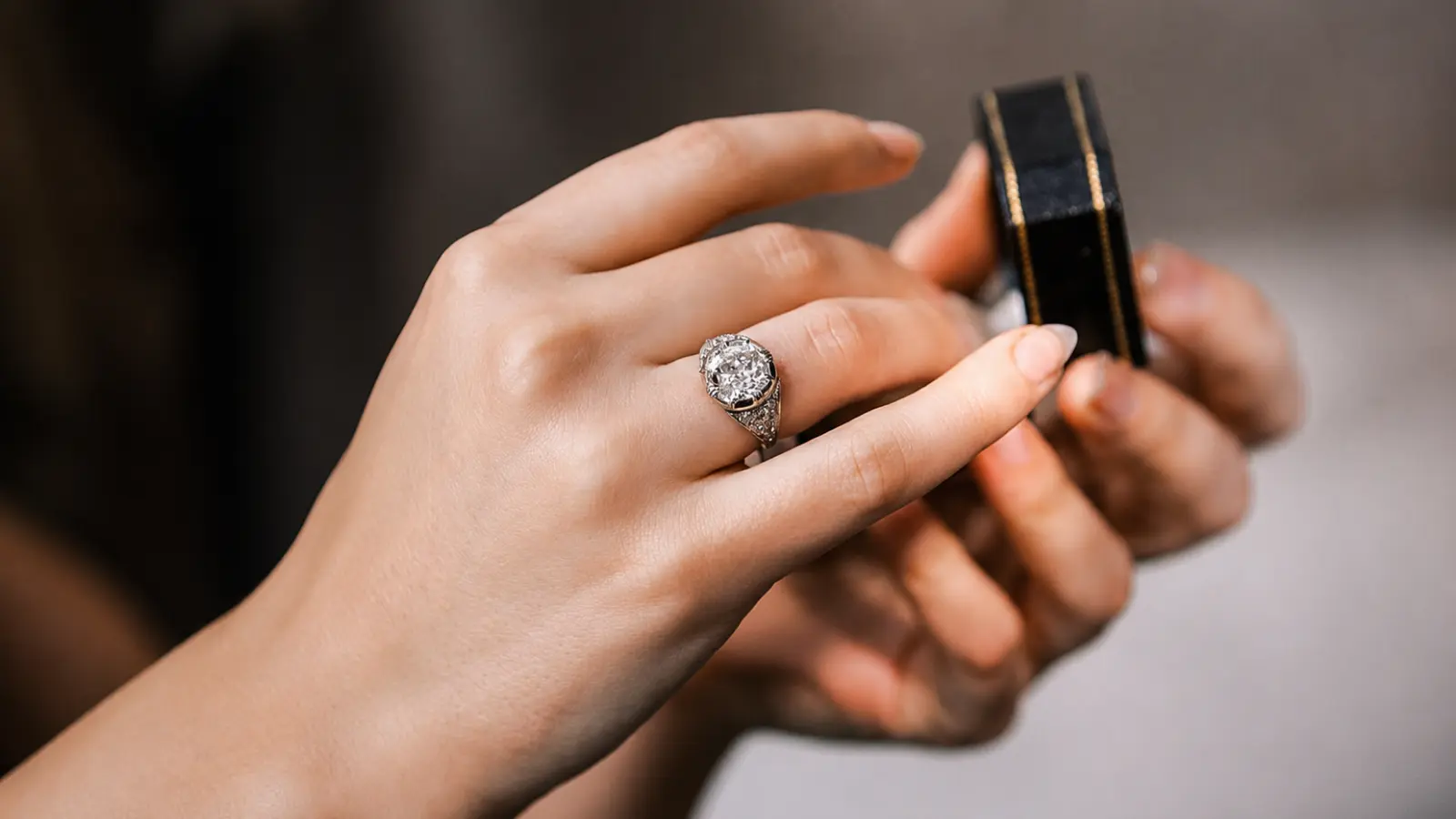
The 1950s represent one of the most accessible and practically wearable vintage eras for contemporary couples. Mid-Century jewelry has a clean, architectural quality, influenced by the modernist design philosophy of the period, that sits comfortably alongside contemporary aesthetics without requiring the wearer to commit to a fully period-specific look.
The matched wedding ring set, a coordinated engagement ring and wedding band designed to be worn together, became standard in American wedding culture during this period, largely through the marketing of diamond manufacturers and jewelry retailers who promoted the coordinated set as the aspirational ideal. Many 1950s estate rings are found in these matched configurations: an engagement ring with a small center diamond in a simple four- or six-prong setting alongside a coordinated band set with small accent diamonds in a consistent pattern.
The Aesthetic of Mid-Century Modern Jewelry
Mid-Century Modern design in jewelry emphasizes clean lines, architectural forms, and a restrained use of ornamentation. Yellow gold was the primary metal. Settings are typically clean and uncluttered, with less filigree and surface decoration than earlier periods, and less of the bold three-dimensional sculptural quality of Retro jewelry. The diamond solitaire in a simple prong setting became the defining engagement ring of this period and established the template most subsequent generations have taken as the classic engagement ring.
For wedding bands specifically, the 1950s produced what many jewelers describe as the easiest vintage bands to wear daily: proportioned for the typical hand, made in yellow gold that is relatively easy to maintain and resize, and designed to sit alongside an engagement ring without visual competition. A 1950s matched set, where the wedding band was designed to curve around or sit flush beside the engagement ring, is one of the more practical vintage configurations available, since the fit problem many vintage bands have alongside contemporary engagement rings was designed out from the beginning.
Condition and Availability
Because Mid-Century rings are more recent than Victorian or Edwardian pieces, they are generally more available in the estate market and in better condition on average than rings from earlier eras. The gold alloys of the period tend to be standard, typically 14k or 18k yellow gold, the settings are straightforward for contemporary jewelers to assess and repair, and resizing is more commonly possible than with rings that have full-circumference engraving or stone setting.
These practical advantages, combined with a clean aesthetic that needs little explanation in a contemporary context, make 1950s rings among the most accessible entry points into vintage jewelry for first-time vintage buyers.
What to Check Before Buying a Vintage Ring
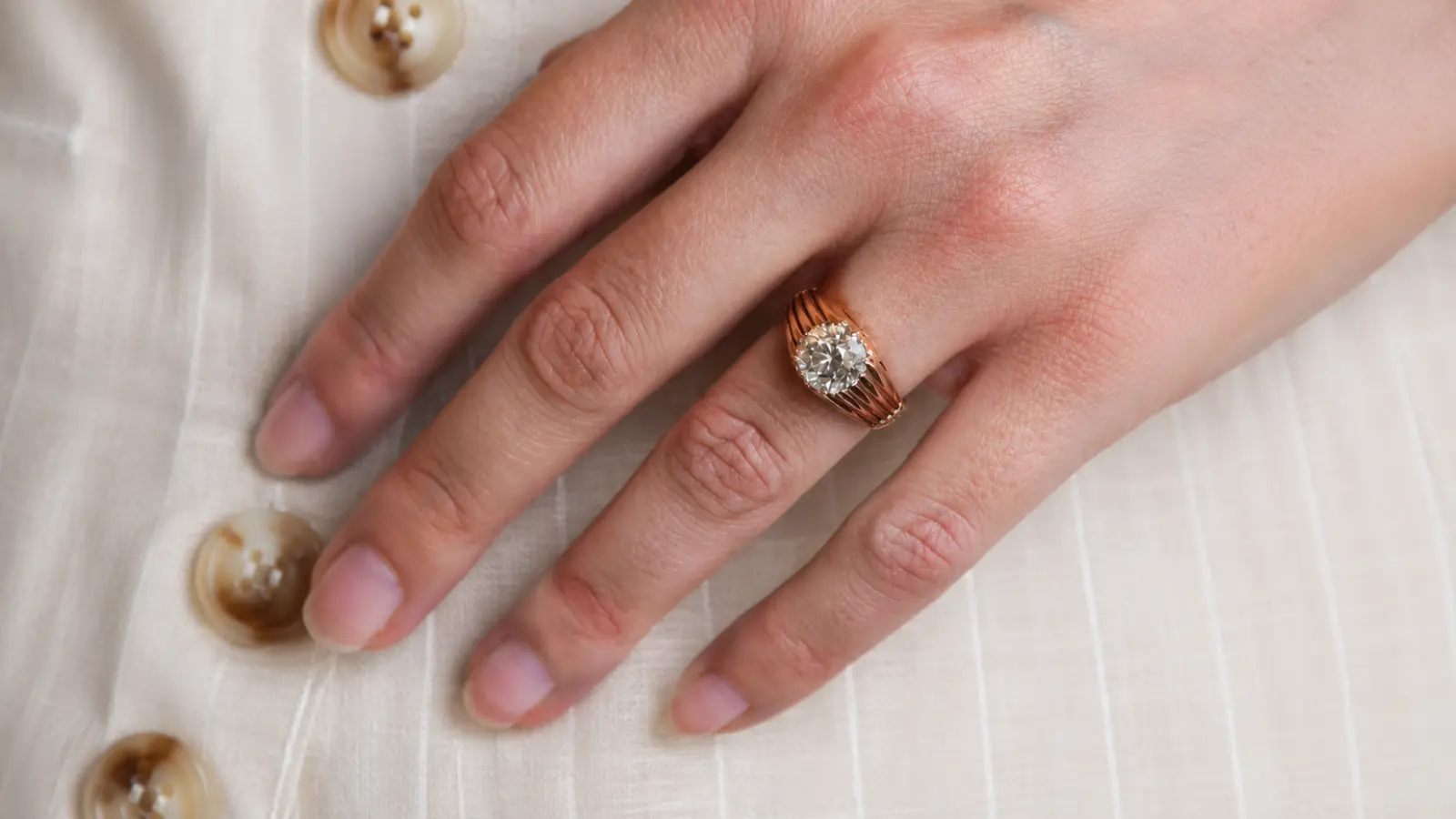
A vintage ring is not a new ring, and evaluating one before purchase requires attention to physical details that simply do not exist when buying new. The points below are where condition problems most commonly appear, and where the gap between an appealing ring and a practical one is most likely to show up.
Prong Condition
Prongs wear over decades of daily contact with clothing, surfaces, and other objects. Thin, worn, or bent prongs are among the most common structural problems in vintage rings, and one of the most consequential, because a stone held by worn prongs can loosen and fall out without warning. Inspect prongs under magnification if possible, or ask the seller for close-up photographs specifically of the prong tips.
Any prong that appears thin, bent inward, or visibly worn should be evaluated by a jeweler before the ring is worn. Retipping prongs, which means adding metal to build them back up, is a standard repair, but it is a cost worth factoring into the purchase price.
Shank Thickness
The shank is the part of the ring that wraps around the finger, the lower portion opposite the setting. Decades of daily wear thin the shank from the inside, where the ring contacts the skin, in a way that is not always visible from the outside. A shank that has worn very thin may crack or break with continued wear, and may not hold a resize safely. When evaluating a vintage ring, ask the seller about shank thickness at its thinnest point; a jeweler can measure this precisely. A shank that has worn to 0.5mm or less typically needs to be built up or replaced before the ring is worn regularly.
Stone Condition
Check each stone, center and accent, for chips, cracks, abrasions on the table (the flat top of the stone), and cloudiness that does not resolve with cleaning. Old-cut diamonds, the cutting styles used before modern brilliant cuts became standard, can be extremely beautiful, but they may also show damage that affects their appearance significantly. Colored stones should be checked for color stability and for any surface damage at the girdle, the edge of the stone where it meets the setting, which is the most vulnerable point for chipping.
Some surface haze in vintage diamonds comes from accumulated residue rather than damage and can be removed with professional cleaning. True cloudiness, from inclusions or internal structural damage, cannot. Asking specifically which is present, and having the stones cleaned before the final evaluation if possible, removes the ambiguity.
Hallmarks and Metal Verification
Most vintage rings made in the United Kingdom carry hallmarks stamped into the metal indicating the metal composition, the assay office that tested it, and the year of testing, a specific and reliable system that makes period dating and metal verification straightforward for UK pieces. American jewelry of the same period typically carries a karat mark (14K, 18K) and often a maker’s mark but not a date stamp. Pieces made in France, Italy, and other European countries follow their own hallmarking conventions.
If a ring is described as platinum, the hallmark should confirm it. Platinum has its own marking system, and a ring described as platinum that shows only gold karat marks or no marks at all warrants closer examination. A jeweler can test metal composition without relying solely on markings if any uncertainty exists.
Resizability
Before purchasing, determine whether the ring can be sized to your finger without compromising the design. Eternity bands, rings with stones set all the way around the circumference, typically cannot be resized without removing and repositioning stones, which adds significant cost. Rings with engraving, pattern work, or milgrain detail running continuously around the shank may show a visible interruption where the metal is cut and joined.
Rings in alternative metals, though unusual in true vintage pieces, may not be resizable at all. Most standard solitaire and simple band designs in gold or platinum can be resized within a range of one to two sizes without issue; larger adjustments require more significant work and assessment.
Seller Documentation and Return Policy
A reputable estate jeweler should be able to provide documentation that supports any claims made about the ring’s period, metal, and stone quality. For significant purchases, an independent appraisal by a certified gemologist, not the selling jeweler, is reasonable to request. A clear return policy that allows for a professional assessment after purchase gives you the option to have the ring independently evaluated before the sale is final. Any seller who objects to these requests is a reason for caution. Established estate jewelers with documented return policies and independent appraisal reports are the standard worth looking for.
Resizing Vintage Rings
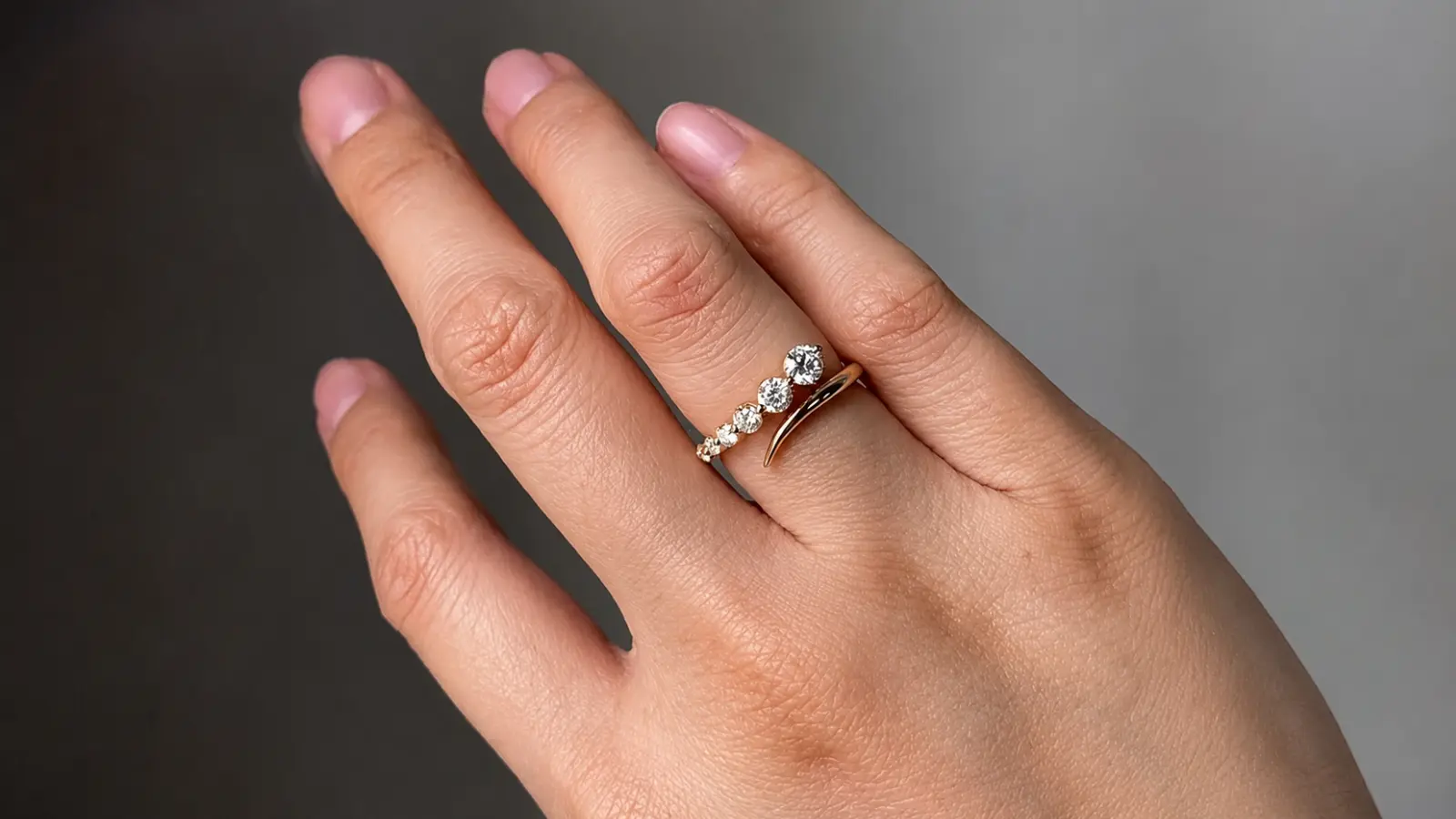
Resizing vintage rings is possible in many cases, but wedding ring resizing requires more care, specific expertise, and sometimes more cost with older pieces. A few general principles are consistent: gold rings are typically more readily resizable than platinum since gold flows more easily under heat, rings with simple shanks are more readily resizable than those with continuous stone setting or engraving, and small adjustments are less disruptive than large ones.
When Resizing Is Straightforward
A vintage ring with a plain shank, with no stones, no engraving, and no pattern work running around the circumference, in yellow gold or rose gold can typically be resized by most experienced jewelers with minimal complication. The shank is cut, expanded or contracted to the correct size, and soldered back together, with the join finished to blend with the surrounding metal. If the ring has already been resized previously, a jeweler can often see evidence of that earlier work at the shank join.
When Resizing Requires a Specialist
Edwardian filigree settings, Art Deco pieces with delicate openwork, and any ring with detailed surface work on the shank require a jeweler with specific experience in vintage metalwork. The heat involved in standard resizing can damage delicate structures, distort fine milgrain detail, or cause filigree elements to collapse if applied without the precision these pieces require. Finding a jeweler who works regularly with estate jewelry and can show examples of vintage resizing work is worth the additional effort for any piece with fine decorative detail.
When Resizing Is Not Recommended
Full eternity bands, with stones set around the complete circumference of the band, are not resizable in the conventional sense. Resizing requires removing stones from the section of the band that needs to be adjusted, resetting them in the newly sized section, and re-polishing the area. This is expensive and may affect the original stone placement in ways that alter the ring’s appearance.
For some very fine antique eternity bands, the recommended approach is to wear the ring as found, if it fits closely enough, or to have a new band made that replicates the design at the correct size. The original ring can then be kept as a collector’s piece or family heirloom rather than a daily-wear piece.
How to Avoid the Costume Look
The distinction between a vintage ring that looks like fine historical jewelry and one that reads as costume is real but not always immediately obvious at the point of purchase. A few factors make the difference consistently.
Condition Is the Primary Factor
A vintage ring in poor condition, with cloudy stones, worn or bent prongs, a thinned shank, or lost surface detail, reads as a piece that has been neglected rather than one that carries the dignified evidence of age. Fine vintage jewelry has a quality of intentional survival: it looks as though it was cared for, even as it shows the honest evidence of its age. A ring that has deteriorated beyond the point where care is evident is the ring that reads as a flea market find rather than a fine jewel, regardless of its actual origin. Condition is the first thing to assess and the last thing to compromise on.
Metal Verification Matters More Than It Seems
A ring described as platinum that turns out to be white gold, or a ring represented as 18k that tests as 10k, is not just a misrepresentation. It is a ring that will wear, look, and feel differently than expected, in ways that accumulate over years of daily wear. The visual quality of platinum, with its cool depth and resistance to surface yellowing, is part of what makes high Art Deco and Edwardian pieces look the way they do. A gold ring made in the same design looks different in ways that may or may not be immediately obvious but become clearer with time. Verifying the metal before purchasing is not paranoia; it is reasonable due diligence for a significant purchase.
Context and Coherence
A vintage ring worn as part of a coherent aesthetic can function as one of the most personal unique wedding rings, especially when it reflects the wearer’s broader style. A vintage ring worn as a single statement piece against a completely incompatible aesthetic backdrop can read as a costume element rather than a personal one. This is not an argument for dressing in period-appropriate clothes or maintaining rigid aesthetic consistency. It is an observation that a heavily ornate Victorian ring works differently on a hand that also wears other vintage or antique pieces than it does on a hand covered in very contemporary minimal jewelry and nothing else.
The vintage rings that tend to be most naturally wearable in contemporary contexts are Art Deco and Mid-Century Modern pieces, because their geometric and architectural qualities have remained visually current in a way that heavily romantic Victorian or even very delicate Edwardian pieces have not. This does not mean those earlier eras should be avoided; a wearer who genuinely connects with the aesthetic of a period will carry that ring naturally, in a way no amount of visual coordination can replicate. It means the question of how a specific ring will actually feel to wear day after day, in the life you actually lead, is worth asking honestly before the purchase is final.
Vintage Wedding Ring Inspiration
Vintage wedding rings capture the beauty of past jewelry eras through detailed craftsmanship, meaningful designs, and timeless styles. Explore our inspiration board for Art Deco rings, Victorian details, Edwardian designs, antique bands, vintage diamond rings, and classic wedding ring ideas.
Choosing a Vintage Wedding Ring With a Story
A vintage wedding ring is not simply an older version of a modern ring. It is a piece created in another time, shaped by the craftsmanship, design, and details of the era it came from before becoming part of a new chapter.
The right vintage ring is the one where history and personal connection meet. Whether you choose an Art Deco design, an Edwardian piece, a Victorian ring, or a vintage-inspired style, the most meaningful choice is the one that feels like it was waiting to become part of your own story.
Frequently asked questions (FAQ)
What is the difference between vintage, antique, and estate wedding rings?
Vintage wedding rings usually refer to older rings from past design periods, while antique wedding rings are typically considered pieces that are 100 years old or more. Estate jewelry simply means the ring was previously owned and does not always mean it is vintage or antique. Understanding the difference is important because age, history, condition, and value can vary significantly between these categories.
Are vintage wedding rings a good idea for everyday wear?
Yes, many vintage wedding rings can be worn every day, but condition matters more than age alone. A well-preserved vintage ring with secure stones, a strong shank, and a durable setting can last for many years. Before wearing one daily, it is important to have the ring inspected for worn prongs, thinning metal, loose stones, or previous repairs.
What vintage wedding ring era is the most popular?
Art Deco is one of the most popular vintage wedding ring styles because of its geometric designs, symmetry, and timeless appearance. Edwardian rings are loved for delicate details and filigree, Victorian rings often feature romantic and symbolic designs, and Mid-Century rings offer cleaner styles that easily fit modern tastes. The best era depends on which design language feels most natural to the wearer.
Can vintage wedding rings be resized?
Many vintage wedding rings can be resized, but it depends on the design and condition. Simple gold or platinum bands are usually easier to adjust, while eternity bands, detailed engraving, and delicate filigree can make resizing difficult or impossible without changing the original design. A jeweler experienced with vintage pieces should always evaluate the ring first.
What should you check before buying a vintage wedding ring?
Before buying a vintage wedding ring, check the prongs, stone condition, metal thickness, hallmarks, previous repairs, and whether the ring can be resized. It is also important to understand whether the piece is genuinely vintage or simply vintage-inspired. For valuable rings, documentation and an independent evaluation can help confirm what you are buying.
Is it better to buy a real vintage ring or a vintage-inspired ring?
The better choice depends on what matters most to you. A real vintage ring offers history, character, and details from the original era, but it may require more inspection and maintenance. A vintage-inspired ring gives a similar appearance with new materials, modern construction, and fewer concerns about previous wear. Both can be meaningful choices for different reasons.