
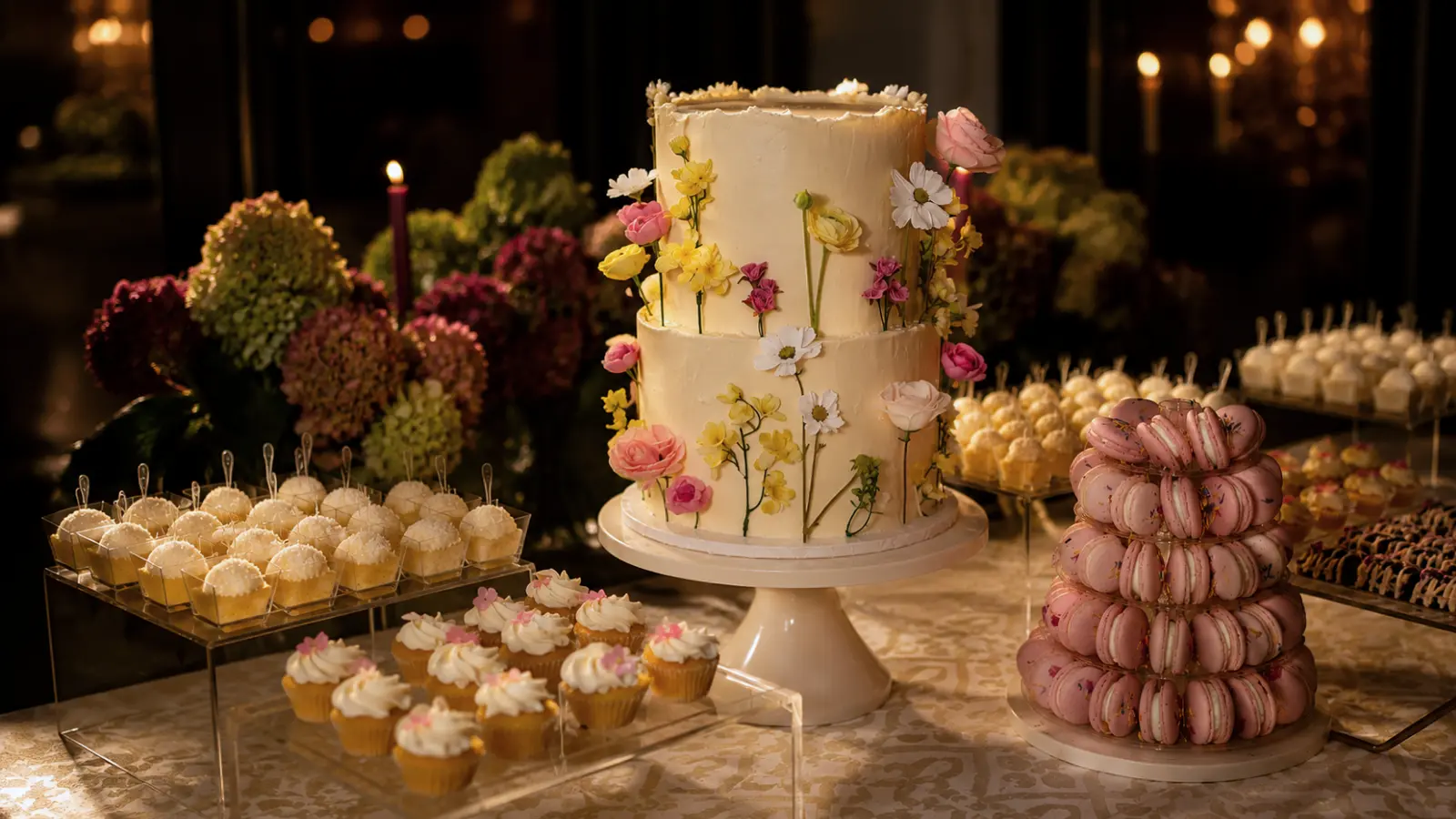
Wedding cake table ideas are design and styling choices used to display the wedding cake during the reception, combining elements like cake stands, flowers, linens, candles, backdrops, and lighting to create a beautiful focal point.
A wedding cake table is more than a place to hold dessert. It becomes part of the reception design, appears in detail photographs, creates the setting for the cake-cutting moment, and helps the cake feel connected to the overall wedding style.
The most beautiful cake displays are not always the most expensive or elaborate ones. The right combination of height, texture, lighting, flowers, and intentional details can make even a simple wedding cake table feel elegant and memorable.
This guide explores wedding cake table ideas for different styles, including simple displays, elegant decorations, floral arrangements, cake stands, backdrops, lighting tips, and everything needed to create a cake table that looks beautiful in person and in photos.
Wedding Cake Table Ideas
The cake table functions as a styled vignette within the reception space — a composed, curated display that exists for hours before the cake is cut and continues to be part of the visual environment of the room throughout the evening. Strong cake table designs treat the space the way an interior stylist would treat a composed shelf or a magazine editorial would treat a tabletop: every element placed with intention, nothing included without purpose, and the overall composition balanced in a way that reads clearly from across the room.
These ideas span the full range of wedding cakes and wedding aesthetics. What they share is that each one was planned as a whole — the cake, the stand, the table, the backdrop, and the lighting considered together rather than assembled from separate decisions.
The Marble Pedestal Moment
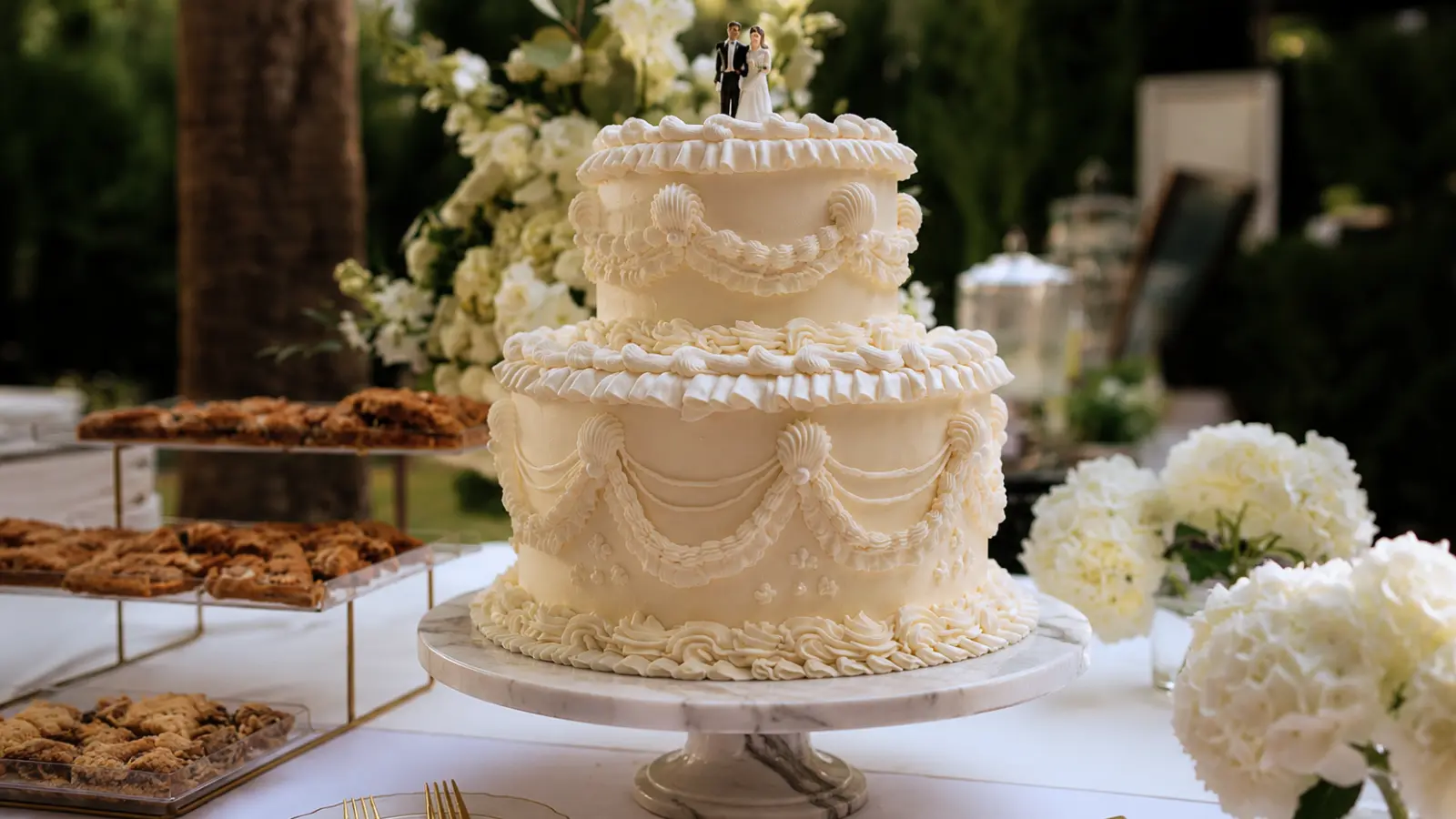
Modern · Quiet Luxury
A white or ivory cake on a tall marble pedestal stand, set on a floor-length white linen table. At the base of the pedestal: three or four stems of a single flower variety (garden roses, ranunculus, or white anemones), laid loosely rather than arranged formally. Behind the table: a simple white fabric panel or a section of the venue’s cleanest wall. Two tall white taper candles in slim brass holders flanking the stand at different heights. Nothing else.
This display can read as luxurious in photographs because every element is restrained and each one feels intentional on its own. The wedding cake stand does the heavy lifting — it elevates the cake to a height that gives it presence in a wide shot and frames it in close-up. The taper candles create warmth without visual complexity. The flowers at the base are organic detail that softens the geometry of the stand without disrupting the clean overall composition.
The Garden Table
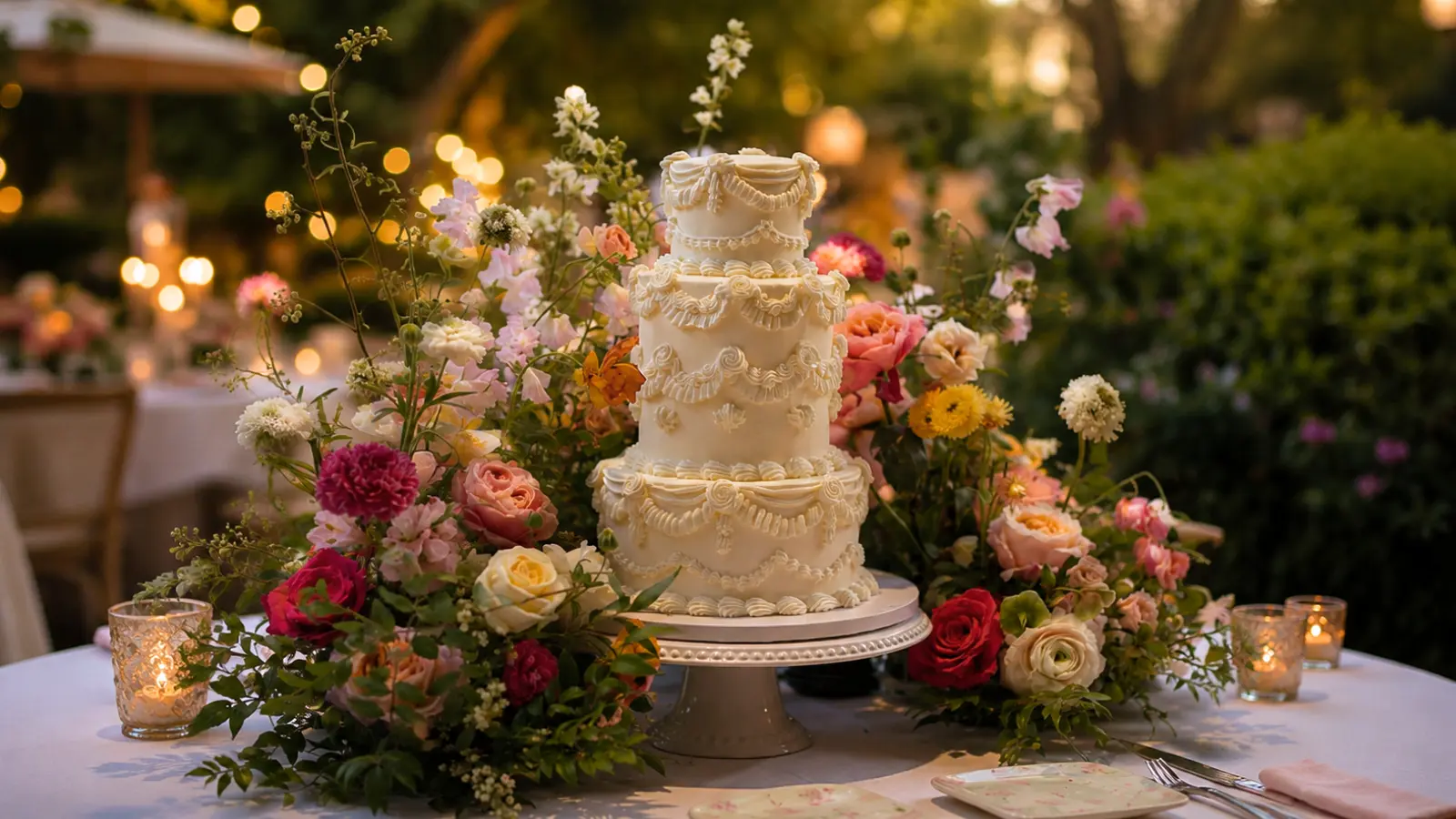
Romantic · Outdoor · Floral
A round or rectangular table covered in a linen or gauze tablecloth in cream or white, with the cake on a ceramic or white-washed wood stand. Similar to many floral wedding cakes, the table surface can include loose garden flowers — roses, ranunculus, sweet peas, herbs — arranged as if they fell naturally rather than were placed formally. Scattered votives at different heights around the arrangement. A low floral runner extending from the base of the stand across the table in both directions.
This style works best at outdoor ceremonies, garden receptions, and any venue with a romantic or botanical aesthetic. It is lush without being cluttered when the flowers are kept to one or two varieties rather than a mixed arrangement of many different blooms. The loose, casual quality of the styling requires more precision than it looks — random is different from considered, and the distinction is visible in photographs.
The Editorial Minimal
Contemporary · Clean
A long rectangular table with a white linen that falls to the floor. The cake on a clear acrylic or lucite pedestal in the center — the transparent stand makes the cake appear to float above the table surface. No florals on the table. No candles on the table. Nothing else on the table surface. Behind the table: a natural arch of greenery or a single floral installation. The table itself is negative space; the cake is the only object.
This approach requires confidence because the edit is so visible — when it works, it feels intentional and modern; when one element is weak, the table can look unfinished. The key variables are the linen (perfectly pressed, falling with no visible wrinkles), the stand (a high-quality transparent pedestal reads completely differently than an inexpensive one), and the backdrop (the installation behind needs to be strong enough to carry the entire visual). For contemporary venues and couples who love modern wedding cakes and minimalist aesthetics, this can be one of the strongest cake table approaches.
The Warm Candlelit Display
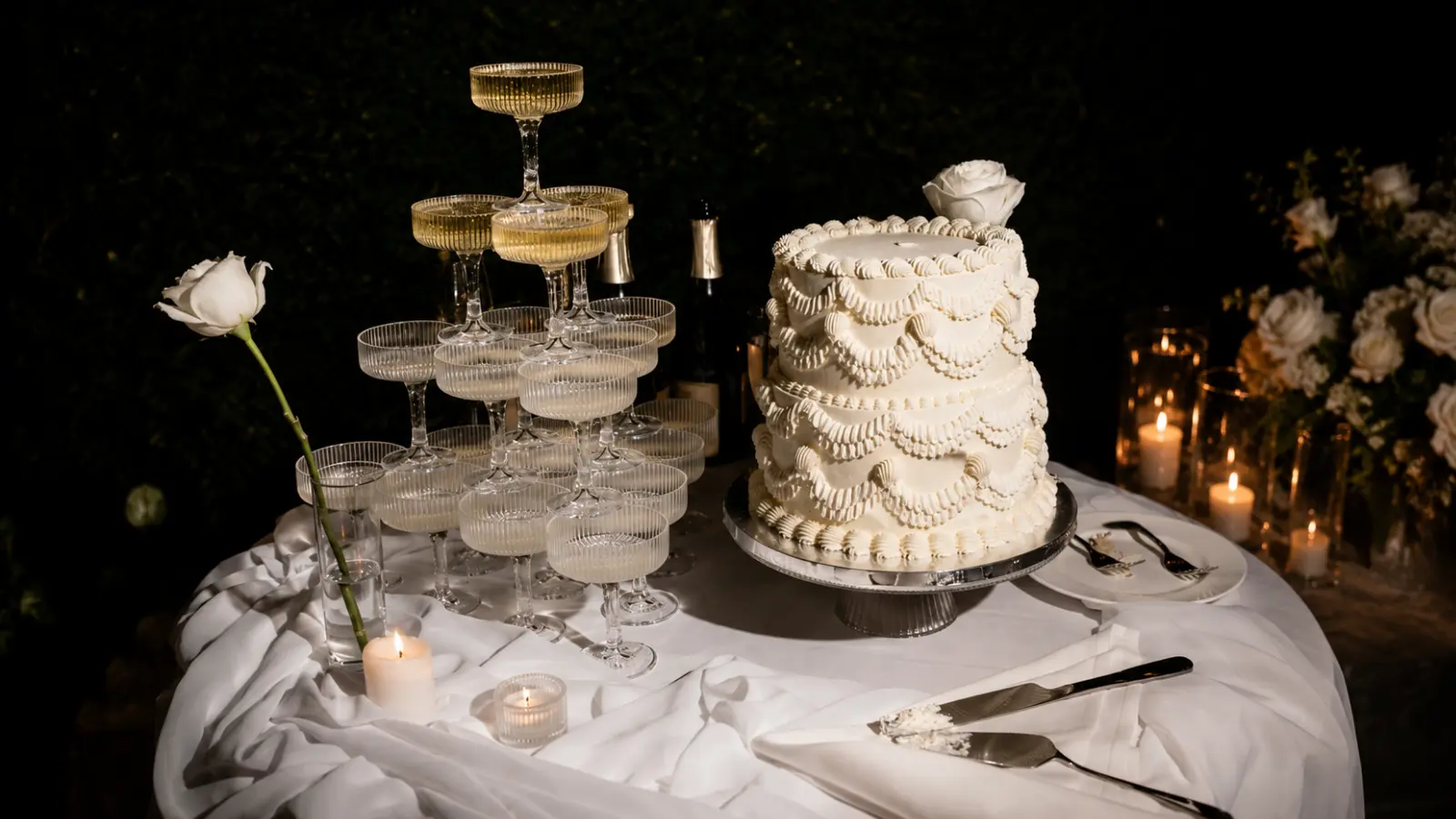
Romantic · Formal · Evening
A cake table styled primarily with candle height and warmth rather than flowers. A tall brass or gold candelabra on either side of the cake stand — three to five arms each, with white or ivory taper candles (flameless if the venue requires it). The table linen in ivory or champagne. The cake on a gold or brass-toned stand. Perhaps a small cluster of white or cream blooms at the base of the stand, but the candles are the primary decoration.
This display reads as especially formal and elegant — it suits black-tie receptions, evening weddings, hotel ballrooms, and venues where candlelight is already part of the ambient decor. The candelabras need to be tall enough to frame the cake without blocking it — a general rule is that the arm of the candelabra should be at or below the top of the cake, not above it, so the cake remains the visual center of the composition.
The Dessert Table Integration
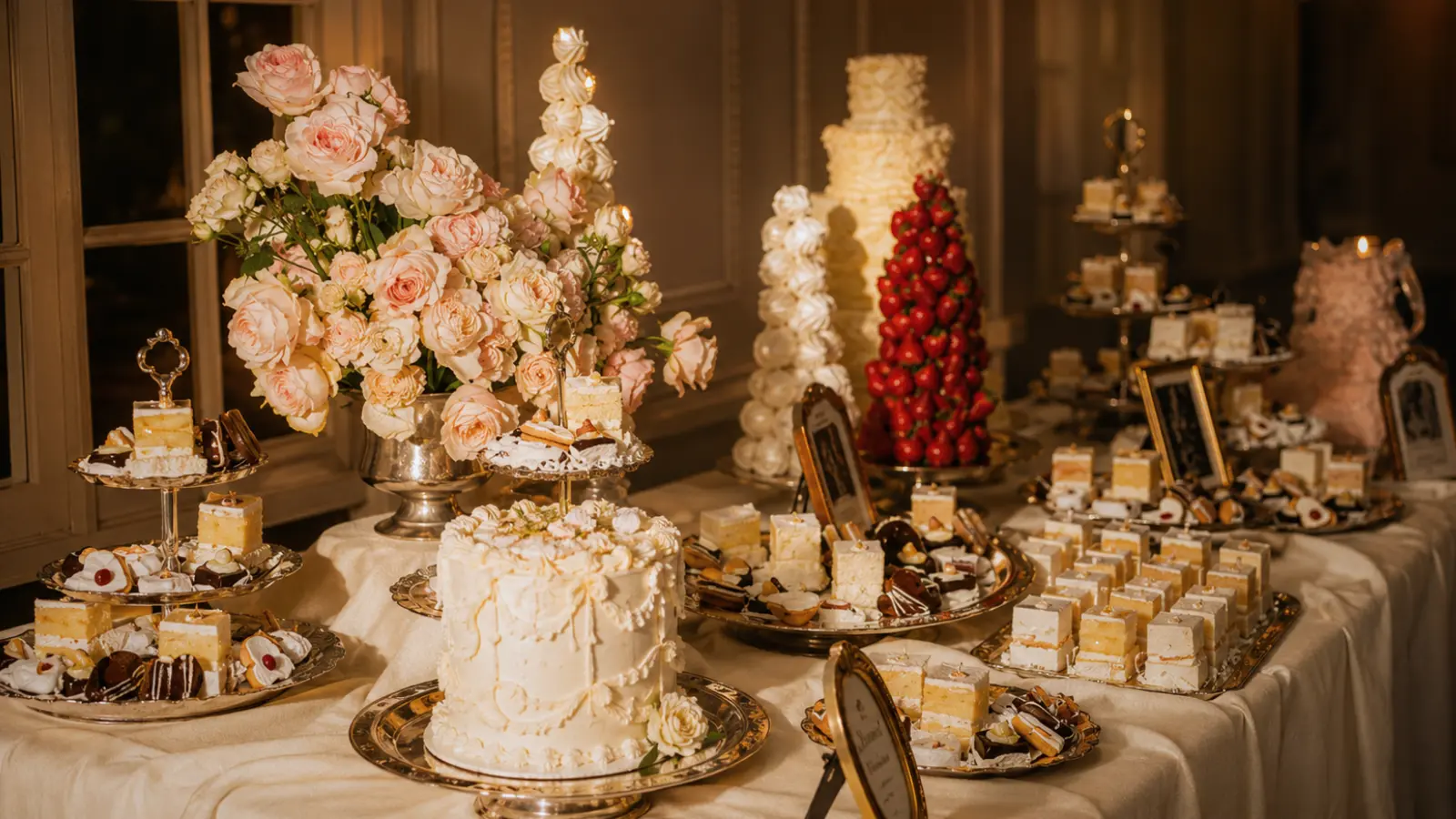
Abundant · Celebratory
The cake placed at the center of a longer dessert table — flanked by a curated selection of smaller desserts (macarons, petit fours, mini tarts, truffles, cookies) that extend the display in both directions. Among different wedding cake ideas, the cake remains the visual anchor: elevated on a stand, in the center, taller than every other element on the table. The desserts are arranged by type in groups of consistent height, with lower items at the edges. Varying-height stands and risers beneath platters create visual depth across the table.
The integrated dessert table requires more coordination than a standalone cake table — every element should be from a consistent aesthetic palette, the height transitions should be gradual rather than abrupt, and the signage (small cards labeling each item) should be consistent in font and style. When it works, this becomes one of the most visually abundant and celebratory cake table formats.
The Rustic Wood and Wildflower Table
Rustic · Organic · Outdoor
A wood slice, a barn door panel, or a raw-edge wood table as the surface. The cake on a wood or stone slab rather than a traditional stand. Wildflowers, dried botanicals, and loose greenery arranged at the base of the cake and extending across the wood surface. Small jar vases with single stems at varying heights. Twine-tied bunches of lavender or rosemary placed around the arrangement. Burlap or a textured linen as a partial table covering if the table is not decorative enough on its own.
This style is calibrated for barn weddings, vineyard ceremonies, outdoor mountain or forest weddings, and any celebration where the natural environment is part of the aesthetic. Like many rustic wedding cakes, the organic materials and loose arrangement create a visual warmth that is specific to this context — it looks intentional here and out of place in a hotel ballroom.
Simple Cake Table Decorations
Simple cake table decorations are not the same as no decoration. A cake table with no styling beyond the cake can read as overlooked rather than intentional. A simple cake table, especially when paired with simple wedding cakes, that has been thoughtfully edited — the right stand, the right linen, one element at the base — reads as deliberate and clean. The difference is that every element present was chosen; none were added as an afterthought.
Many couples think “simple” when they mean “less work” — and end up with a plain table that photographs without distinction. The couples whose simple cake tables read as elegant made two or three very deliberate decisions and committed to them completely. Simple requires as much thought as elaborate; it requires less execution.
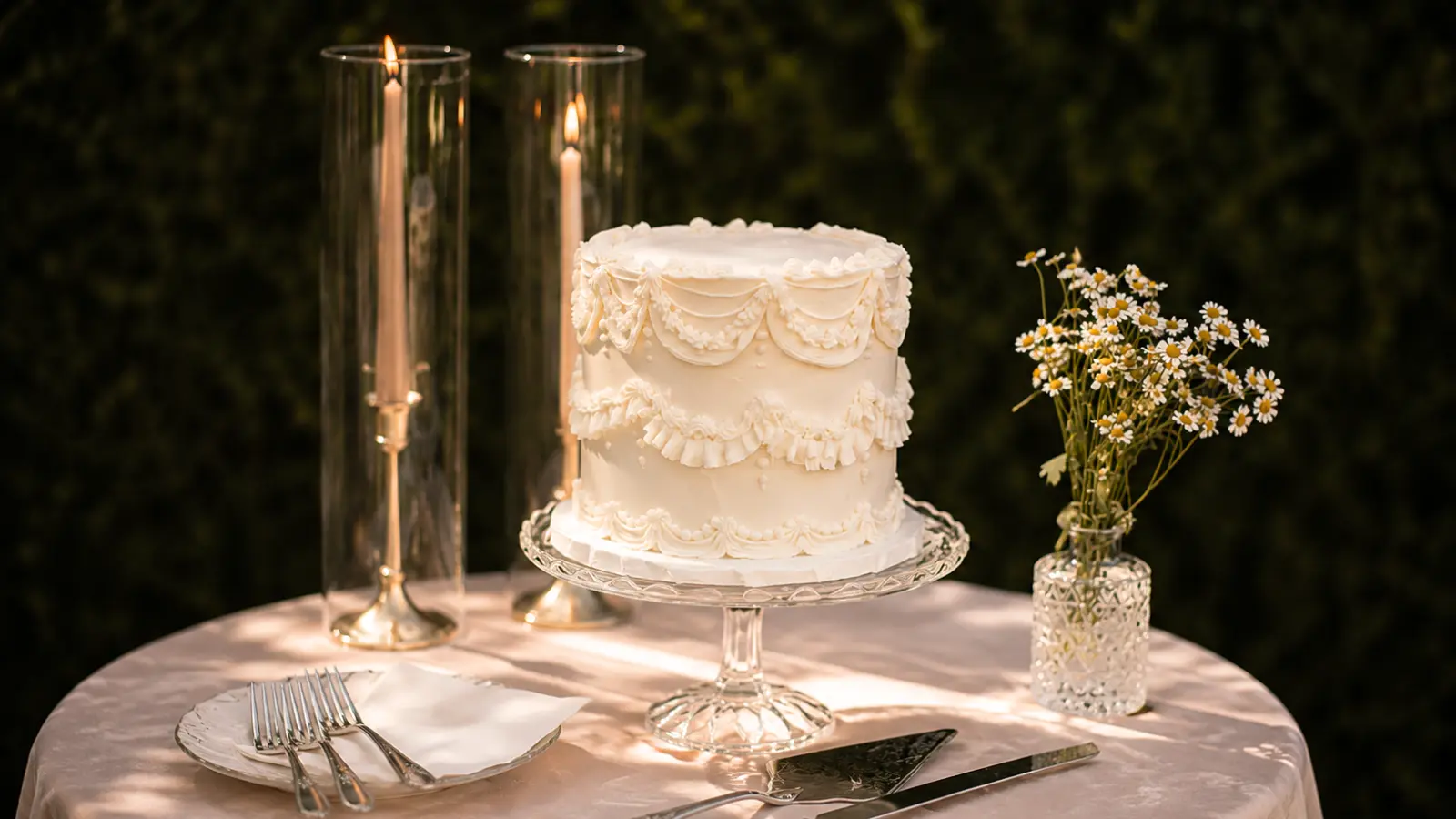
The Three-Element Rule for Simple Tables
A simple cake table that works often has three core elements beyond the cake itself: the stand, the linen, and one additional detail. That detail might be a small arrangement of flowers at the base of the stand, two candles flanking it, a trailing ribbon or fabric drape, or a meaningful object — a framed photograph, a small piece of art. Three elements is not a limit imposed by convention; it is the point at which simple becomes complete rather than either empty or cluttered.
| Element 1: Stand | Element 2: Linen | Element 3: One Detail |
|---|---|---|
| White ceramic pedestal | Floor-length white linen | Three stems of white roses at the base |
| Marble round stand | Ivory linen, floor-length | Two slim brass taper candle holders |
| Clear acrylic pedestal | White gauze or chiffon overlay | Single trailing eucalyptus stem |
| Wood slice slab | Linen runner, not full cloth | Loose wildflower cluster at base |
| Gold metal cake stand | Champagne or blush linen | Ring of votive candles around the base |
Greenery Only — No Flowers
Simple · Modern · Cost-Effective
A clean white or ivory cake on a stand, with a loose arrangement of greenery only at the base and sides of the stand — eucalyptus, ferns, olive branches, or a mix of soft-textured foliage. No flowers. The greenery adds organic warmth without the cost or visual complexity of fresh blooms. In photographs, it frames the cake without competing with it. This approach can be cost-effective and beautiful when the greenery is fresh, intentional, and placed with restraint.
Single Candle Arch
Simple · Elegant · Intimate
Two matching candlesticks or taper holders placed immediately on either side of the cake stand — not far to the sides, close enough that they flank the stand directly and create a natural arch of candlelight around the cake. Everything else removed. The effect is intimate and warm, particularly beautiful at evening receptions when the ambient lighting is lower. Use flameless candles if the venue requires it; the visual effect is nearly identical in photographs.
A Single Framed Detail
Simple · Personal
The cake on its stand, with one framed element placed flat on the table or propped against the stand: a small watercolor print of the couple’s monogram, a framed calligraphy quote, a small photograph, or a hand-lettered menu card for the dessert. The frame becomes the table’s personal detail — it gives guests something to notice when they approach the table and adds a layer of meaning without adding visual complexity. This works especially well at intimate weddings and elopement receptions where personalization is part of the overall aesthetic.
Elegant Wedding Cake Table Styling
Like elegant wedding cakes, elegant cake table styling is defined by restraint, quality, and precision — the same principles that define elegance in any design context. An elegant table has no accidental elements. Every detail was considered. The materials are high quality. The arrangement is balanced without being symmetrical. And there is a clarity to the overall composition that allows the eye to understand it immediately and appreciate it over time.
What consistently undermines elegant cake table styling is the accumulation of elements that individually seem fine but collectively create visual noise. A marble stand that reads as elegant. Two brass candle holders that read as elegant. A small cluster of garden roses that reads as elegant. A monogram sign that reads as elegant. A trailing ribbon that reads as elegant. All of those together read as too much — the elegance of each individual element cancels out in the competition for visual attention.
The Editing Rule
Once you have assembled your planned cake table display — either physically at a test run or on paper — remove one element. If the table still reads as complete without it, that element was not earning its place. If removing it creates a visible gap, it belongs. Elegant tables survive the subtraction test; cluttered ones don’t.
Draped Fabric Backdrop With Tall Pedestal
Elegant · Formal
A tall (12 to 16 inch) pedestal in marble or high-gloss white, set against a length of draped fabric behind the table — ivory silk, white chiffon, or a soft neutral linen falling in soft folds from a ceiling point or a draped frame. The fabric backdrop creates a soft, textured environment for the cake that photographs beautifully without the formality of a structured floral arch. The table linen should echo the backdrop fabric in color and texture where possible.
This is one of the most effective elegant displays for hotel ballrooms and formal indoor venues — the fabric brings softness to hard architectural surfaces and creates depth in photographs where the background might otherwise be a plain white or beige wall.
Candlelit Symmetry — Formal and Classic
Elegant · Classic · Formal
A fully symmetrical cake table: identical arrangements of flowers in identical vessels on either side of the cake stand, identical candles at identical heights, a perfectly centered linen. Symmetry is one of the clearest signals of formal elegance, and a symmetrically styled cake table reads as intentional and traditional in photographs. The discipline of perfect symmetry also prevents the accumulation of elements — once you have two of something, you cannot add a third without breaking the symmetry.
Monochromatic Palette — All White or All Ivory
Elegant · Quiet Luxury
The cake, stand, linen, flowers, and any additional elements all in the same color family — all white, or all ivory, or all cream. The monochromatic approach is a powerful tool in cake table styling because it removes color competition between elements and allows texture and form to become the visual interest. A white cake on a white pedestal on a white linen with white flowers reads as extraordinarily refined because the eye focuses on the shapes and surfaces rather than on navigating between different colors.
Floral Cake Table Ideas
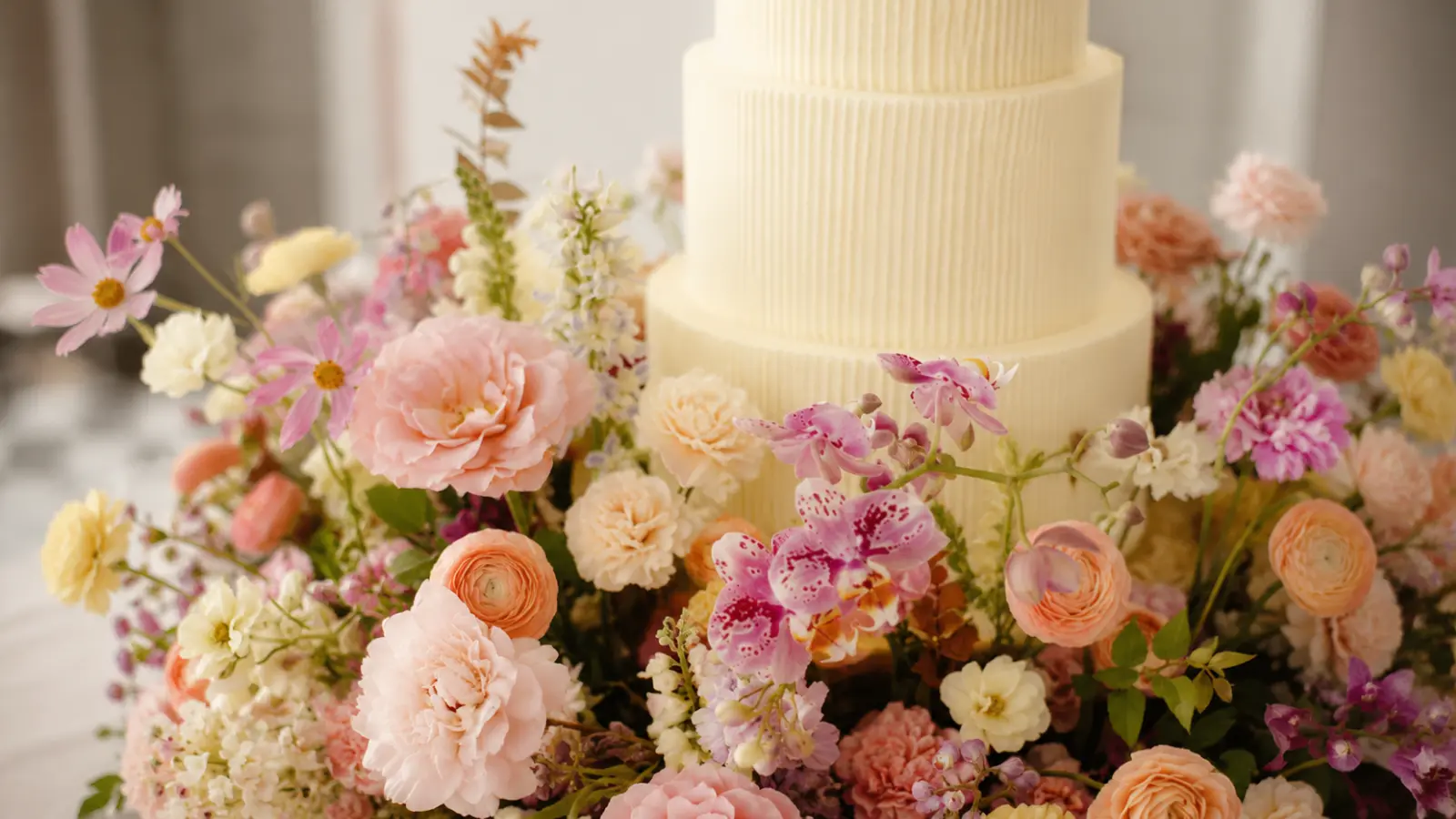
Flowers are one of the most common decorations on cake tables — and also one of the easiest elements to handle inconsistently between the cake, the table, and the rest of the reception decor. The most effective floral cake tables are ones where the flowers were sourced, selected, and placed in direct conversation with the wedding’s florals as a whole. The cake table flowers should look like they belong to the same arrangement palette as the ceremony arch and the centerpieces — not like they were ordered separately from a different vendor with different instructions.
Coordinate cake table flowers directly with your florist, not independently. Even if the couple plans to do their own cake table styling, the flowers should come from the same source as the rest of the florals to ensure consistency in color, variety, and freshness.
Floral Arch or Hoop Behind the Table
Floral · Statement Backdrop
A circular hoop or arch frame (usually 30 to 48 inches in diameter) covered in florals and greenery, positioned behind and slightly above the cake table as a backdrop for the display. The floral hoop frames the cake in photographs from every angle and creates a visual destination within the reception room that guests notice from across the space. It can be one of the most photogenic cake table configurations because it frames the cake clearly and adapts to many wedding aesthetics, from garden romantic to minimal and contemporary.
The hoop needs to be secured properly — either to the wall, to a free-standing frame, or to the table itself with appropriate support. A hoop that shifts during the reception interrupts the display and creates safety concerns if the cake is beneath it. Confirm the rigging plan with your florist or planner before the day.
Low Floral Runner Across the Table
Floral · Abundant · Romantic
A low arrangement of flowers extending horizontally across the table surface in both directions from the cake stand — essentially a garden-style floral runner that makes the entire table surface a garden rather than a platform. The cake stand rises above the runner, with the flowers gathered at its base and extending outward in both directions. This is a lush, romantic style that works beautifully at garden receptions, outdoor ceremonies, and weddings with a full, abundant floral aesthetic throughout.
The runner should be built at a consistent height — not too tall, or it blocks the cake in photographs taken from the side. A general guideline is that the runner height should be no more than one-quarter of the cake’s visible height, so the cake remains the dominant element of the composition.
Single Large Bloom Installation
Floral · Modern · Statement
One oversized floral element — a large loose arrangement in a single vessel, a sculptural floral form, or one large branch of blossom — placed to one side of the cake stand rather than centered or symmetrical. The asymmetric placement and the single oversized element create a composition that reads as contemporary and editorial rather than traditional. The flower is clearly a design decision, not a default decoration. Strong at modern venues and for couples whose overall aesthetic is contemporary and considered.
Hanging Flowers and Suspended Installations
Floral · Dramatic · High Impact
Flowers suspended above the cake table from the ceiling — loose bunches tied with ribbon, a cloud of pampas grass and dried botanicals, or a structured floral canopy that frames the cake from above. This approach requires venue cooperation (the rigging must be safe and venue-approved), a florist experienced with hanging installations, and a ceiling that provides accessible attachment points. When all three conditions are met, a suspended floral element above the cake table can create a visually dramatic and photographically distinctive display.
Suspended elements are particularly effective in barn venues, high-ceilinged industrial spaces, and outdoor settings with trees above the display area. In low-ceiling or hotel ballroom settings, the scale of the installation needs to be carefully calibrated so it frames the cake rather than overwhelming it.
Dried Botanical Display
Floral · Contemporary · Temperature-Stable
Dried pampas grass, dried cotton, preserved eucalyptus, dried lavender, and dried roses arranged at the base of the cake stand and across the table surface. Dried botanicals have a specific warmth and texture that fresh flowers don’t — they are inherently muted and architectural, which means they pair beautifully with contemporary cake designs and natural-material aesthetics. They are also temperature-stable (no wilting over a long reception), which makes them practical as well as beautiful for outdoor settings and summer celebrations.
Cake Stands and Linens
The cake stand and the table linen are the two foundational elements of every cake table, regardless of style or budget. Everything else — the flowers, the candles, the backdrop — is layered on top of these two decisions. Get them right and the rest of the styling is easier. Get them wrong and no amount of additional decoration recovers the display.
Cake Stands — What Changes the Most
The stand determines the cake’s visual height in the room, its relationship to every other element on the table, and how it reads in photographs taken from across the reception space. A cake that sits flat on the table surface appears low and static in wide-angle photographs. The same cake elevated on a 10-inch pedestal appears to float — it has visual presence in the room and a relationship to the human eye-line that makes it feel like a deliberate centerpiece.
| Stand Type | Height Added | Aesthetic | Best For |
|---|---|---|---|
| White ceramic pedestal | 6–10 inches | Classic, clean, universally appropriate | Any wedding style; the most reliably correct choice |
| Marble round pedestal | 8–14 inches | Contemporary, luxurious, editorial | Modern and quiet luxury aesthetics; hotel and gallery venues |
| Clear acrylic / lucite pedestal | 8–16 inches | Invisible, contemporary, glamorous | Modern cakes where the stand should disappear; the “floating” effect |
| Gold or brass metal stand | 4–8 inches | Warm, formal, glamorous | Evening receptions; warm-palette weddings; black-tie aesthetics |
| Silver or chrome stand | 4–8 inches | Cool, formal, traditional | Cool-palette weddings; classic and traditional aesthetics |
| Wood slice / natural slab | 1–3 inches | Organic, rustic, natural | Barn, outdoor, and rustic aesthetics; adds texture rather than height |
| Stacked books / decorative box | Variable | Personal, eclectic, narrative | Intimate and personality-driven celebrations |
Linens — The Foundation of the Table
The table linen is the first thing visible at the cake table and the background against which every other element reads. A wrinkled linen, a linen that doesn’t reach the floor, or a linen color that conflicts with the cake or the florals undermines the entire display before anyone looks at the cake.
Four rules for wedding cake table linens:
1. Floor-length always. A linen that shows the table legs beneath it reads as incomplete. The fabric should touch the floor on all visible sides. Order or rent a linen 30 to 36 inches longer than the table height measurement to achieve this.
2. Pressed before placement. Even a high-quality linen looks wrong with packing creases. Steam or iron before the event, and lay it smoothly rather than dragging it over the table edge.
3. Color within the palette. White and ivory are the most universally correct choices. A blush, champagne, sage, or other neutral linen can be beautiful if it is explicitly part of the wedding’s color palette — not a separate decision made independently.
4. Consider texture. A plain white polyester linen reads very differently from a white linen weave, a gauze overlay, a velvet for a winter wedding, or a silk charmeuse for a formal reception. The texture of the linen contributes to the overall tone of the display in photographs and in person.
Layering Linens
A double layer — a full floor-length base linen with a shorter runner or overlay on top — adds texture and depth to the table without adding decorative elements. Common combinations: a white linen base with a white gauze or chiffon overlay, a linen base with a sequin runner for evening receptions, or a plain base with a textured overlay in the same color. The layered approach is particularly effective for couples who want the table to feel rich without adding flowers or candles to the display.
Where to Place the Cake Table
The placement of the cake table within the reception room is a decision that affects photography, guest circulation, the dynamics of the cutting moment, and how visible the display is throughout the evening. It is also a decision that many couples leave to the venue coordinator without providing specific input — which is a missed opportunity, because the default placement is not always the best one.
The Key Placement Criteria
A well-placed cake table satisfies five criteria simultaneously: it is visible from the main seating area without guests having to turn significantly to see it; it is accessible for the cutting moment with room for the couple, the photographer, and several guests to gather; it has a background behind it that works for photographs (a beautiful wall, a window, a floral installation — not a service exit or an HVAC unit); it is in a location where ambient lighting or a dedicated spotlight can illuminate it effectively; and it is positioned so that guests naturally pass by or near it during the reception without it being in the path of service circulation.
| Placement Option | Advantages | Considerations |
|---|---|---|
| A focal wall — the most prominent architectural feature of the room | Strongest visual anchor; most guests see it immediately on arrival | May be competed for by other elements (band, head table); confirm priority with planner |
| A window or natural light source | Outstanding for daytime photography; soft natural light is the best cake lighting | Afternoon glare can be harsh; check sun position at the expected cutting time |
| An alcove or architectural niche | Creates a natural framing for the display; reduces foot traffic around the cake | May be too dark without supplemental lighting; ensure the space is wide enough for the cutting gathering |
| Center of the room on its own island table | Visible from all angles; works well in round-table reception layouts | Background in photographs is the room rather than a specific wall — design the display to stand on its own |
| Adjacent to the head table or sweetheart table | Logical proximity for the cutting moment; easy for photographer to capture both couple and cake | Risk of visual competition between the two tables; style them as a cohesive unit |
The Photographer’s Input
Ask your photographer where they prefer the cake table before confirming placement with the venue. This is one of the most underused conversations in wedding planning and one of the most valuable. Your photographer knows exactly which wall in your venue photographs well, which direction the light falls at the expected cutting time, and what background creates the cleanest frame for cake shots. Their input takes five minutes and can meaningfully change the quality of every photograph taken at the table throughout the evening.
Clearance Around the Table
The cake table needs at least 4 to 5 feet of clear space in front of it for the wedding cake cutting moment — enough room for the couple to stand side by side, the photographer to crouch or position at angle, and three to five guests to gather behind them. Confirm this clearance with your venue layout. Tables placed too close to a wall or in a tight corner create crowding at the cutting moment that shows in every photograph of that moment.
How to Make the Cake Table Photograph Well
A cake table that looks beautiful in the room does not automatically photograph well. The relationship between what the eye sees in three dimensions and what a camera captures in two is imperfect in specific, predictable ways — and designing for the camera is a slightly different exercise than designing for the room. The couples whose cake tables photograph exceptionally are the ones who thought about both.
The Four Photography Variables
Background. The most common photography mistake on a cake table is placing it in front of a background that reads as flat, dark, or visually confusing in photographs. A plain white wall photographs well but requires the styling on the table to carry the entire image. A textured or architectural wall adds depth and context. A floral backdrop provides both color and texture. A dark wall can create a dramatic effect but requires deliberate lighting to avoid the cake disappearing into the background.
Height. A cake with no elevation reads as a low element in a photograph — it competes with the table surface and the items around it rather than rising above them. Elevation from a stand creates a clear visual hierarchy: the cake is the highest point on the table, and the eye naturally goes there first. The taller the pedestal (within proportion), the more effectively the cake anchors the composition in wide-angle shots.
Lighting. A cake that is not specifically lit will be underexposed in most reception photographs, particularly at evening events where the ambient lighting is warm but low. A single uplighter pointed at the cake from below creates shadow that distorts the design. The best cake lighting is a pin spot or spotlight directed at the cake from above and slightly in front — it illuminates the surface evenly, creates a soft halo effect, and makes the cake the brightest point in any wide-angle frame.
Negative space. In a close-up cake shot, the elements immediately around the cake become the frame of the image. A cluttered table puts the cake in competition with its own styling in close-up photographs. Leave enough space around the base of the stand that the photographer can compose a shot where the cake is clearly the subject, with the flowers and candles providing context rather than competition.
The Detail Shot Setup — Planning for Close-Ups
Photography · Planning
Many wedding photographers take two types of cake photographs: a wide establishing shot that captures the full table in context, and a series of close-up detail shots of the cake surface, the decorations, and the cutting moment. The close-up detail shots benefit from having a few specific elements that photograph well at very close range — the texture of the frosting, a single beautiful bloom at the base, the sparkle of a candle reflection in a metallic stand, the couple’s monogram, plaque, or wedding cake topper.
Think about what the detail shots will capture before finalizing the table styling. A marble stand, a pearl detail on the cake, a single garden rose: each of these is a close-up shot. A cluttered table surface with many small elements is not a close-up shot — it is a pattern that reads as busy rather than beautiful at close range.
Cake Table Backdrops
The backdrop is the element that most transforms the visual impact of the cake table in photographs — because it determines what appears behind the cake in every image taken at the table, for the entire reception. A beautiful backdrop makes a simple cake table look spectacular. A plain or unflattering background limits what the photographer can achieve even with a beautiful cake and perfect styling.
Backdrop Options by Style
| Backdrop Type | Visual Effect | Best For | Practical Notes |
|---|---|---|---|
| Full floral wall | Lush, romantic, spectacular — the most photographed backdrop choice | Romantic and garden aesthetics; any wedding where florals are prominent throughout | High cost; usually rented from a florist or event designer; confirm installation requirements with venue |
| Fabric panel — silk, chiffon, or velvet | Soft, textured, elegant — adds warmth and depth without competing with the cake | Any style; particularly effective for contemporary and quiet luxury aesthetics | Can be DIY with fabric from a fabric store; requires a clean hanging or frame solution |
| Pampas grass and dried botanical panel | Warm, earthy, contemporary — especially suited to natural and modern wedding design | Contemporary, bohemian, and natural aesthetics; autumn and winter weddings | Temperature-stable; can be assembled in advance and transported flat |
| Greenery wall — boxwood or eucalyptus | Fresh, clean, garden-like — less saturated than a full floral wall | Garden, outdoor, and organic aesthetics; also works in contemporary settings | Often available as a rental panel; confirm freshness if used for all-day events in warm weather |
| Neon sign or illuminated letter | Contemporary, celebratory, personalized | Modern and non-traditional aesthetics; younger couples who want personality in the display | Requires power source; text should be legible and clearly chosen — not just trendy |
| A beautiful venue wall — brick, stone, wood paneling | Architectural, contextual, no additional cost | Venues with strong architectural character — barns, converted industrial spaces, historic buildings | The best backdrop at the right venue; requires no additional work and photographs with the most authenticity |
| Balloon arch or installation | Celebratory, whimsical, colorful | Casual, festive, or non-traditional weddings; receptions with a party-first aesthetic | Requires coordination with balloon artist; latex allergy consideration for some venues |
Lighting the Cake Table
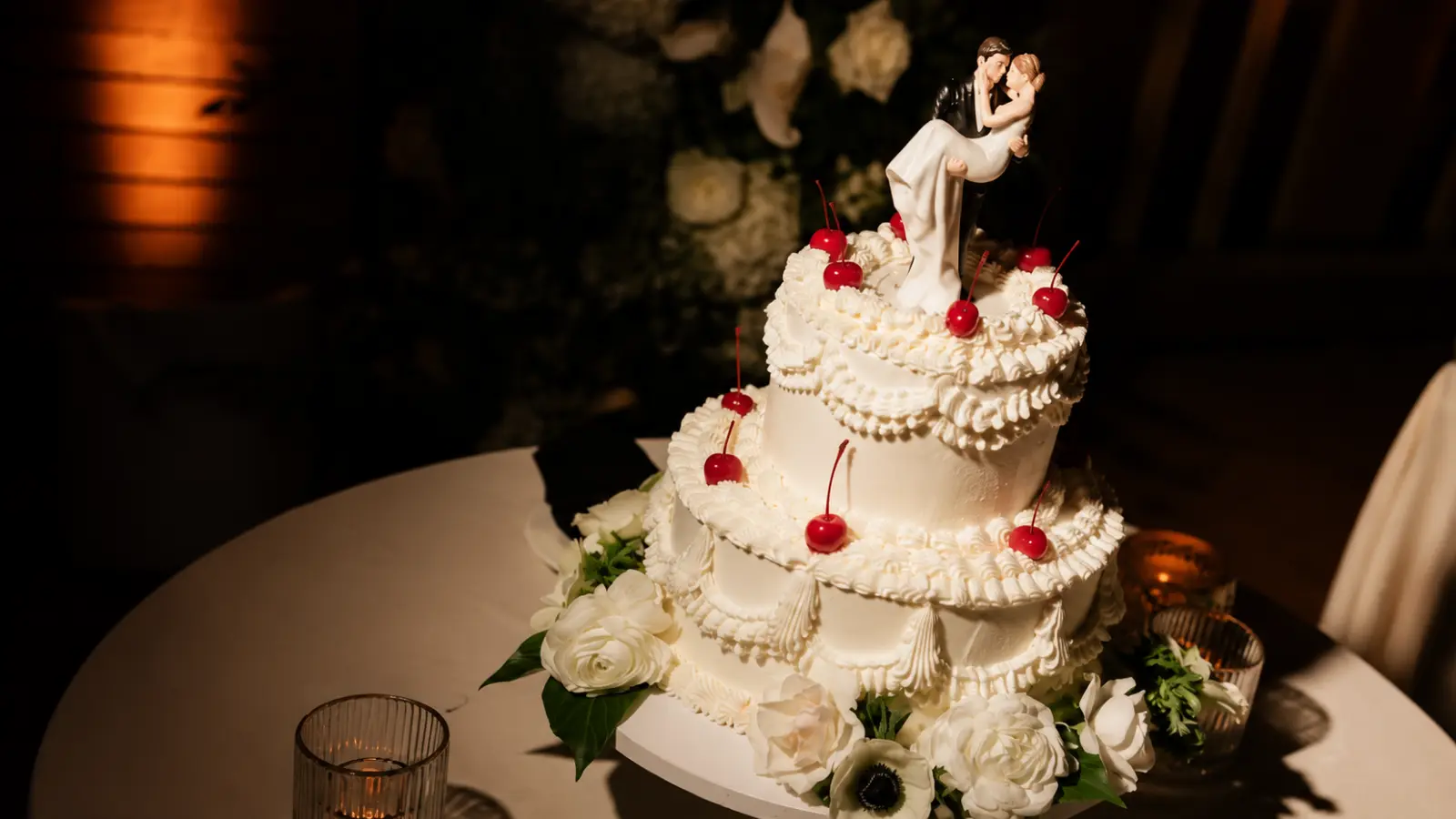
Lighting is one of the most underplanned elements of cake table styling, and it can make the difference between a cake table that photographs beautifully and one that falls flat in photos. Cake tables placed in areas with only ambient reception lighting — even well-lit receptions — often photograph with flatness and shadow that the in-person experience doesn’t reflect. A few specific lighting decisions change this significantly.
Types of Lighting for the Cake Table
Pin spot or spotlight. A narrow beam of light directed at the cake from above, usually installed by the venue’s lighting team or a lighting rental company. This is one of the most effective lighting additions for a cake table because it creates a pool of light centered on the cake and helps it stand out in wide-angle photographs of the room. Cost is typically modest when added to a venue lighting package, and the visual impact is disproportionate to the cost.
Uplighting behind the table. A wash of colored or warm white light from below or behind the table, creating a glow that illuminates the backdrop and the surrounding display. Uplighting does not directly illuminate the cake — it creates atmosphere around it. Most effective when combined with a pin spot rather than used alone.
String lights or fairy lights. Warm bulb string lights draped loosely around or behind the cake table create a soft, romantic atmosphere in photographs. They are not a substitute for directed cake lighting but work effectively as background warmth in evening photography. Particularly effective behind fabric or floral backdrops.
Candlelight. As noted in the quick reference: use flameless candles on the cake table itself. Real flames near frosting create heat that can cause the frosting to soften and the decoration to shift over a long reception. Flameless candles in quality holders photograph indistinguishably from real candles in most reception lighting conditions.
Natural light. For daytime and late-afternoon receptions, a cake table placed near a window with diffused natural light is the best-lit display available without any additional investment. North-facing windows provide the most even, shadow-free light throughout the day; south and west-facing windows can create harsh direct sun at certain times. Check the sun’s position at your expected cutting time and adjust placement accordingly.
Tell the Lighting Team Specifically
When working with a venue lighting coordinator or lighting rental company, ask specifically for a pin spot on the cake table. “We’d like the cake to be the brightest point in the room” is a clear brief they will understand immediately. If the venue does not offer this service, ask whether a simple directional light from a lighting rental or event supply company can be positioned above the table and plugged into a nearby outlet. The cost is often modest compared with the photographic impact.
Cake Table Styling Checklist
Before the Wedding Day
- Confirmed cake table placement with venue coordinator and photographer
- Verified the background behind the table placement and approved it for photography
- Ordered or rented the cake stand — confirmed it fits the cake diameter
- Ordered or confirmed floor-length linen in the correct color and texture
- Coordinated cake table flowers with the florist — consistent with overall wedding florals
- Confirmed lighting plan — pin spot, uplighting, or confirmed natural light is sufficient
- Decided on candle type (flameless near cake; real flame only in holders away from frosting)
- Confirmed backdrop installation logistics with venue — rigging, installation time, takedown
- Confirmed cake delivery time and refrigeration availability at venue if needed
- Briefed day-of coordinator or venue contact on exactly how the table should be set up
Day-Of Setup
- Linen pressed and laid floor-length on all visible sides
- Stand positioned at the correct point on the table — centered or as planned
- Backdrop installed and secured before any flowers or styling are added around it
- Flowers placed after the cake arrives — not before, as they need to frame the actual cake
- Candles positioned and tested (flameless on; real flames lit immediately before guests arrive)
- Cake placed on stand by baker or venue staff — not moved after placement if possible
- Pin spot or lighting adjusted to center on the cake after it is placed
- Final edit — remove any element that doesn’t contribute to the overall composition
- Photograph the table before guests arrive to confirm it reads well on camera
- Knife and server set placed on the table or in a designated location for the cutting moment
Wedding Cake Table Inspiration Board
Before choosing your final cake table design, it helps to see how different styles, colors, textures, and decorative details work together around the cake. Explore our wedding cake table inspiration board for elegant cake displays, floral arrangements, romantic backdrops, candles, cake stands, dessert tables, and styling ideas to help you create the perfect reception focal point.
Final thoughts
A beautiful wedding cake table is not created by adding as many decorations as possible. The strongest displays come from choosing details that support the cake — the right stand, thoughtful flowers, balanced lighting, and a setting that feels connected to the rest of the reception.
When every element works together, the cake table becomes more than a decorated surface. It becomes part of the wedding atmosphere, the background for meaningful photographs, and one of the small design moments guests remember long after the celebration ends.
Frequently asked questions (FAQ)
What makes a wedding cake table look professionally designed?
A professionally styled cake table usually comes down to balance, not the number of decorations. Designers focus on proportion, height, lighting, texture, and how every element works together. A simple cake with the right stand, backdrop, and styling often looks more intentional than a table filled with unrelated decorations.
Why do some wedding cake tables look better in photos than others?
Photography depends heavily on lighting, background, and visual separation. A cake placed against a clean backdrop, slightly elevated on a stand, and surrounded by carefully chosen details will usually photograph better than a beautiful cake placed in a busy or poorly lit area.
Should the cake table match the rest of the wedding decor?
Yes, but it does not need to copy every detail. The best cake tables feel connected to the overall wedding through color, flowers, materials, or style. A cake display should feel like a natural part of the reception design rather than a separate decorated corner.
What is the biggest mistake couples make when decorating a cake table?
Adding too many small decorations. Extra signs, props, flowers, candles, and accessories can make the table look busy and distract from the cake. A stronger approach is choosing fewer elements with more impact, especially a beautiful stand, quality linen, and good lighting.
What should you put on a wedding cake table?
A wedding cake table usually needs a cake stand, a floor-length linen, one or two intentional decorative details, and good lighting. Flowers, candles, a small framed sign, greenery, or a simple backdrop can all work, but the table should still keep the cake as the main focus.
Where should the wedding cake table be placed?
The wedding cake table should be placed somewhere visible, well-lit, easy to access for the cake-cutting moment, and positioned against a clean background for photos. Avoid service doors, cluttered corners, direct sun, or areas where guests and staff need to pass constantly.
Related Guides
- Affordable Wedding Cakes: How to Save Without Losing the Look
- Wedding Cake Alternatives: 12 Dessert Ideas Beyond Traditional Cake
- Cupcake Wedding Cakes: Display Ideas, Pros, Cons and How Many You Need
- One-Tier Wedding Cakes: Simple, Elegant Ideas for Small Weddings
- Vintage Wedding Cakes: Lambeth, Retro and Romantic Ideas for Every Style