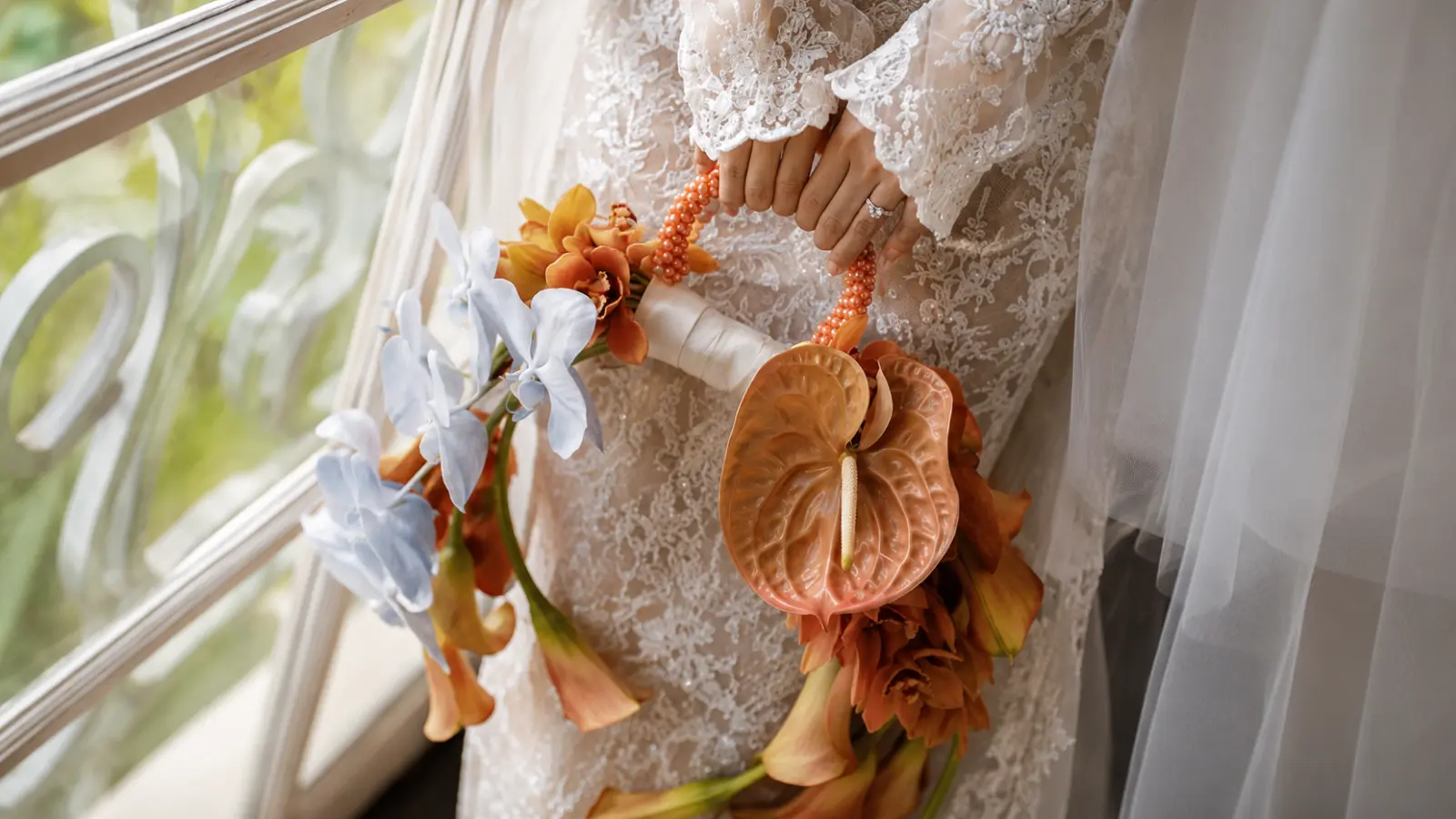
Unique wedding bouquets give brides the freedom to express their personality in ways that traditional fresh flowers sometimes can’t. Whether you choose a bouquet made from brooches, paper flowers, sola wood, crochet blooms, or a creative mix of floral and non-floral elements, an alternative bouquet can become one of the most meaningful details of your wedding day.
The best unique bouquets aren’t memorable simply because they’re different. They succeed because every material, color, and design choice reflects a clear purpose—whether that’s honoring family traditions, creating a keepsake that lasts forever, accommodating allergies, or matching a highly personal wedding aesthetic. When the concept is intentional, the bouquet feels authentic rather than unconventional for its own sake.
This guide explores unique wedding bouquets within the broader world of wedding bouquets, including brooch bouquets, paper flowers, wood flowers, crochet designs, non-floral alternatives, and practical advice.
Unique Wedding Bouquet Ideas
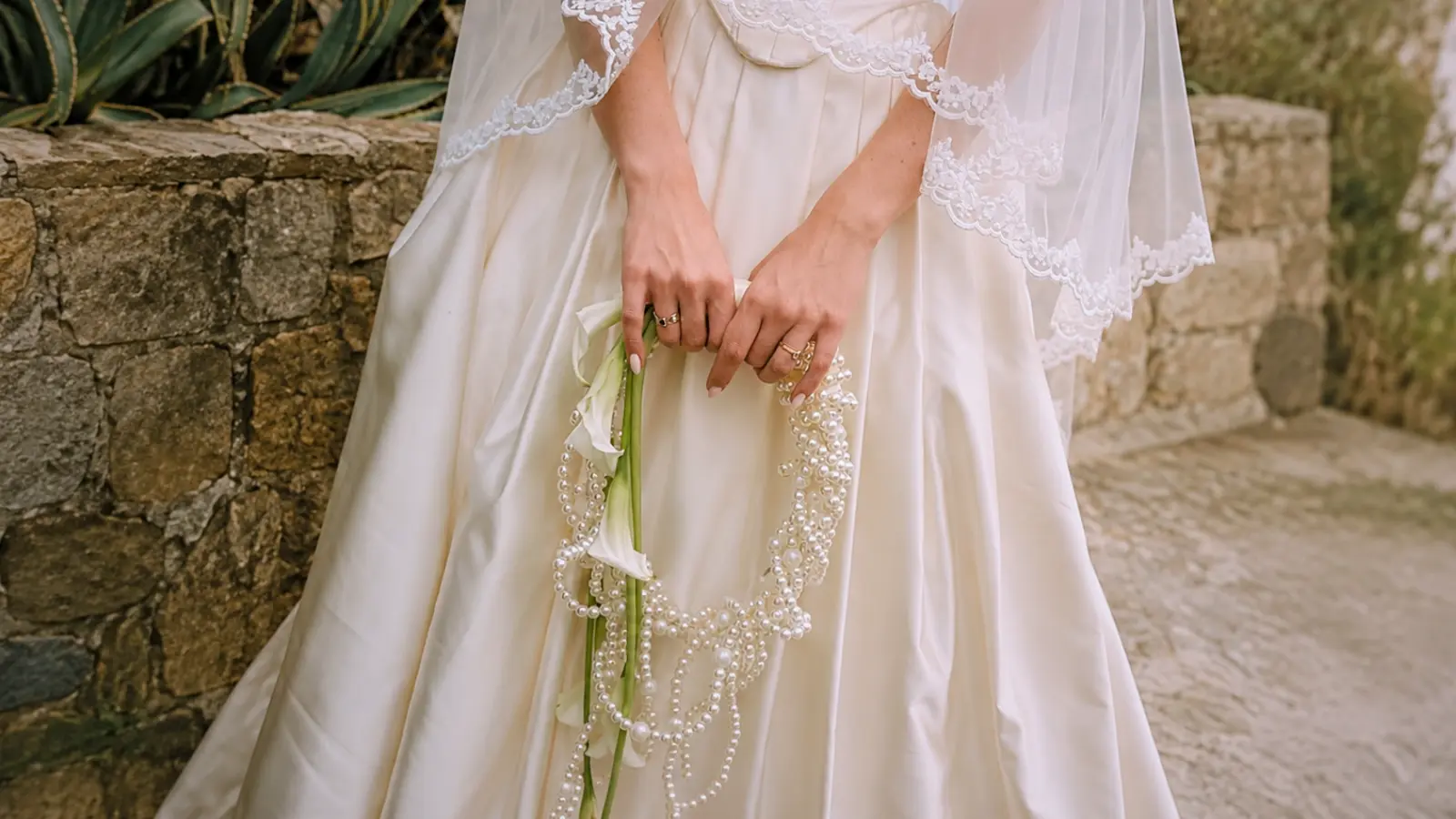
Nontraditional bouquets occupy a wide range, from the quietly unconventional — a single large feather fan, a structured cactus arrangement, a cascade of trailing ribbon — to the fully material-alternative, where no botanical element is present at all, similar to some wedding without a bouquet alternatives. What separates the options worth considering from the ones that tend to read as costume-y in photographs is whether the bouquet could hold its own beside a traditional fresh arrangement and still feel like it belongs in a wedding context, not in a craft fair display.
The designs that hold up most consistently across different wedding settings and photography styles:
Brooch and jewelry bouquets. A structured arrangement of vintage or inherited brooches, earrings, and pins wired onto stems and gathered into a traditional round. The appeal is almost entirely personal — these are bouquets built from family pieces, and that story is visible in the finished object in a way that no fresh arrangement can replicate.
High-quality paper flower designs. Italian crepe paper or mulberry paper blooms made at a level of craft that reads as floral rather than crafted. The best paper bouquets are indistinguishable from fresh flowers in photographs taken at ceremony distance, which is the relevant standard for a wedding bouquet.
Sola wood flower arrangements. Lightweight, dye-able blooms made from tapioca-plant wood that can be painted to any color, scented with essential oils, and assembled into arrangements that hold their shape permanently. Practical for high-heat or high-humidity ceremonies where fresh flowers would struggle.
Crochet flower bouquets. Fiber art blooms in cotton or wool, assembled and wired into traditional bouquet shapes. A niche choice that suits brides with a craft background or a meaningful connection to the medium — a grandmother’s yarn, a specific pattern that carries family history.
Mixed material designs. Fresh or dried flowers combined with a non-floral element — a few brooches pinned into a fresh bouquet, paper blooms alongside dried pampas, wood flowers interspersed with preserved eucalyptus. These hybrid approaches are often easier to style than fully alternative designs because the floral element anchors the composition to a recognizable bouquet context.
The common thread across all of these is that the material works when it’s chosen for a reason, not because it’s different. Brides who carry alternative bouquets well tend to be the ones who can say specifically why — and that reason shapes every other decision in the design.
Non-Floral Wedding Bouquets
Non-floral bouquets share one practical advantage that’s worth stating plainly: they don’t have a ceremony deadline. A fresh flower bouquet needs to be assembled within 24 to 48 hours of the ceremony, conditioned carefully, kept in water until the last possible moment, and managed through the temperature conditions of the venue. A non-floral bouquet can be finished two months before the wedding and placed on a shelf until the day. For brides managing complex logistics — destination ceremonies, multiple-location weddings, or simply a planning calendar that doesn’t have room for day-of floral coordination — that’s a meaningful practical argument.
Beyond timing, non-floral materials offer permanence. Every non-floral bouquet becomes a keepsake that requires no work to preserve a wedding bouquet afterward. That changes the calculus on cost somewhat: a brooch bouquet that costs significantly more than a fresh arrangement may still represent better value if the alternative is a $400 freeze-drying bill after the wedding.
The tradeoff between fresh and artificial wedding bouquets often comes down to fragrance and the visual quality of fresh botanicals. No paper flower perfectly replicates the way a garden rose catches afternoon light. No wood flower has the slight translucency of a ranunculus petal. For brides who care deeply about those qualities, non-floral options are genuinely a compromise. For brides who care more about the shape, color, and permanence of the arrangement, they’re often the more practical and personal choice.
Brooch Wedding Bouquets
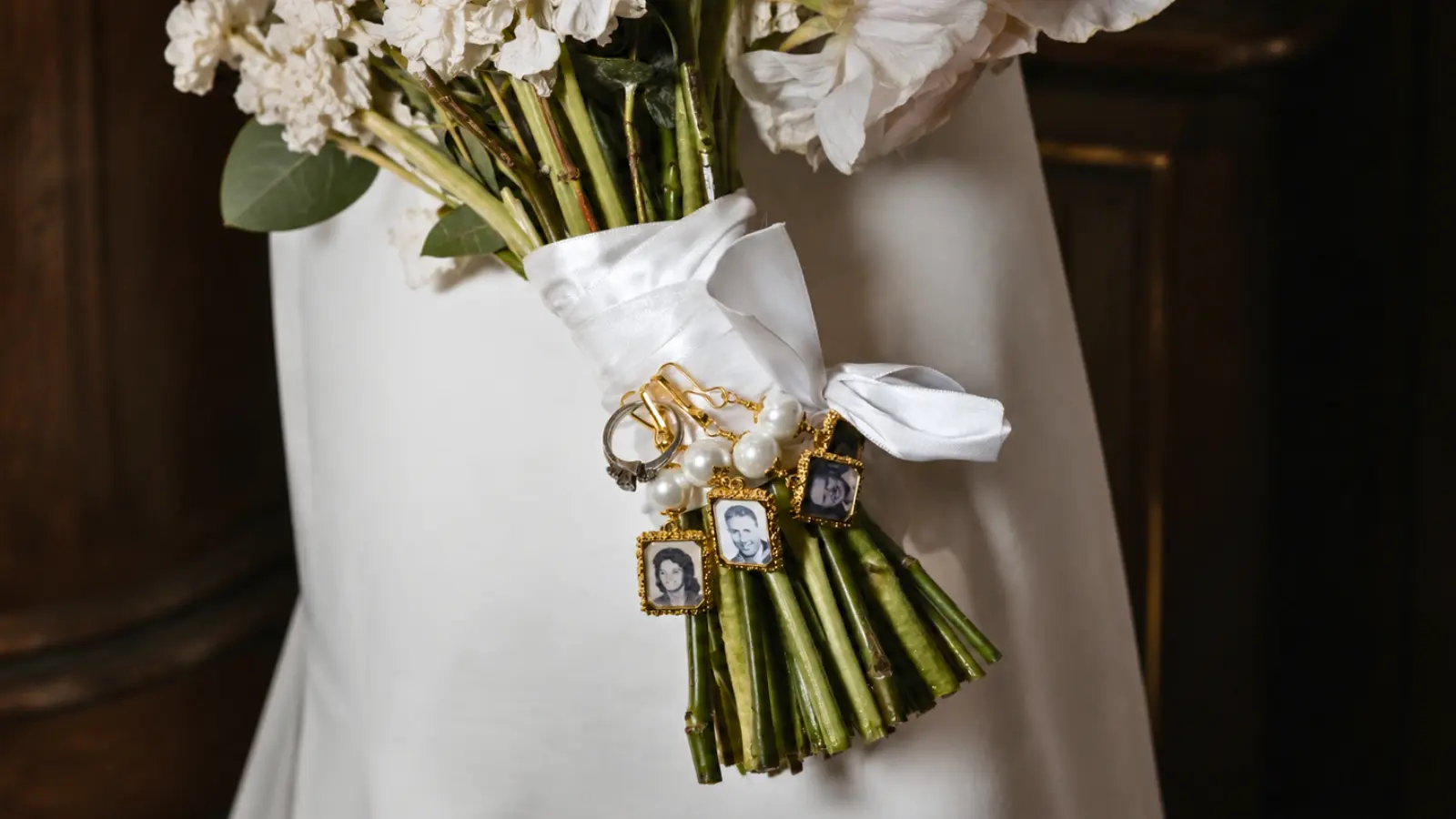
A brooch bouquet is one of the most personally weighted options in this category. The raw materials are typically inherited or collected pieces — a grandmother’s cameo, a mother’s costume jewelry pin, a great-aunt’s clip earring — and the bouquet becomes as much a portrait of family history as it is a bridal accessory. That specificity is what makes it worth considering, and it’s also what makes it unsuitable for brides who don’t have that kind of material or connection to draw from. A brooch bouquet assembled from thrift store finds can look beautiful, but it carries a different kind of meaning than one built from pieces that have been in the family for generations.
The construction is more involved than it looks. Each piece needs to be individually wired onto a floral stem or pick, then assembled into a round bouquet shape with the pieces layered to avoid visible gaps between the brooches. The weight of a full brooch bouquet — particularly one using heavier vintage pieces — can be significant; a large brooch arrangement can weigh noticeably more than a comparable fresh flower bouquet, which is worth factoring in for a long ceremony.
A few practical considerations specific to this type:
Start collecting early. Brooch bouquets typically require between 50 and 150 individual pieces depending on size, which takes time to gather from family, estate sales, and vintage markets. Starting the collection six to twelve months before the wedding is realistic for a full round bouquet.
Photograph the pieces before assembly. Once brooches are wired and assembled, they’re difficult to remove without damage. Documenting which pieces came from whom is worth doing before construction begins — particularly if the bouquet will be displayed after the wedding and the provenance of individual pieces matters.
Consider a partially-brooch design. A fresh flower bouquet with three or four meaningful brooches pinned into the handle or nestled among the blooms delivers the personal element without the full construction complexity. For brides who want the sentimental weight without committing to an entirely non-floral bouquet, this hybrid approach is often the most wearable result.
Paper Flower Wedding Bouquets
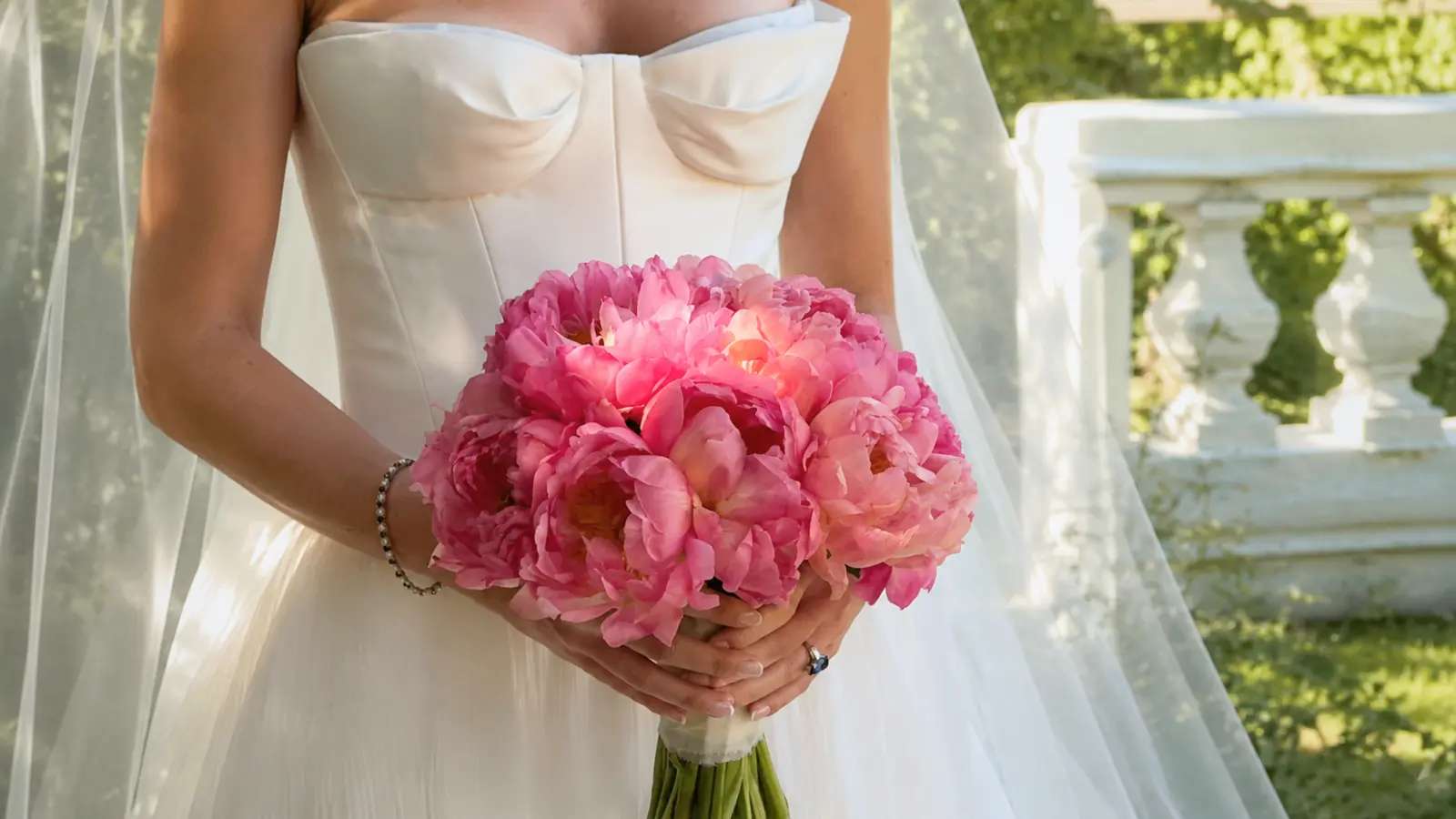
The quality range in paper flower bouquets is wide enough that “paper flowers” as a category doesn’t tell you much about what the finished result will look like. At one end, there are highly crafted arrangements made from Italian crepe paper, mulberry paper, or cotton rag paper, assembled by artisans who have spent years developing techniques that produce blooms with realistic petal shaping, natural color gradation, and the kind of textural detail that reads as botanical in photographs. At the other end, there are cardstock designs that read clearly as paper at any distance. The material is the same; the execution is not, and for a wedding bouquet specifically, execution is the thing that matters.
For brides considering this option, the most useful thing to look for in a maker’s portfolio is how the bouquet reads at ceremony distance — five to ten feet away — not how individual blooms look in a macro close-up. A paper rose that looks convincing at arm’s length is a genuinely useful wedding bouquet. One that requires close inspection to appreciate its craft is a beautiful object that may not function as well in ceremony photographs.
The papers worth knowing specifically:
Italian crepe paper. The most widely used material for high-quality paper flowers. It has a natural stretch that allows petals to be shaped and cupped realistically, and it takes paint and ink well, which enables color gradation that flat papers can’t achieve. Bouquets made from good Italian crepe paper photograph more closely to fresh flowers than any other paper type.
Mulberry paper. Slightly translucent with a natural fiber texture. Particularly effective for delicate blooms — sweet peas, poppies, anemones — where the translucency of the real petal is part of the flower’s character. Requires more careful handling than crepe paper but produces a lighter, more delicate result.
Book page and music sheet paper. A distinctly different aesthetic than realistic paper flowers — these arrangements lean into the fact that the material is paper rather than trying to replicate botanical accuracy. The look is whimsical and literary, and suits certain wedding aesthetics well. Worth considering separately from realistic paper flower designs rather than as a lesser version of the same thing.
Crochet Wedding Bouquets
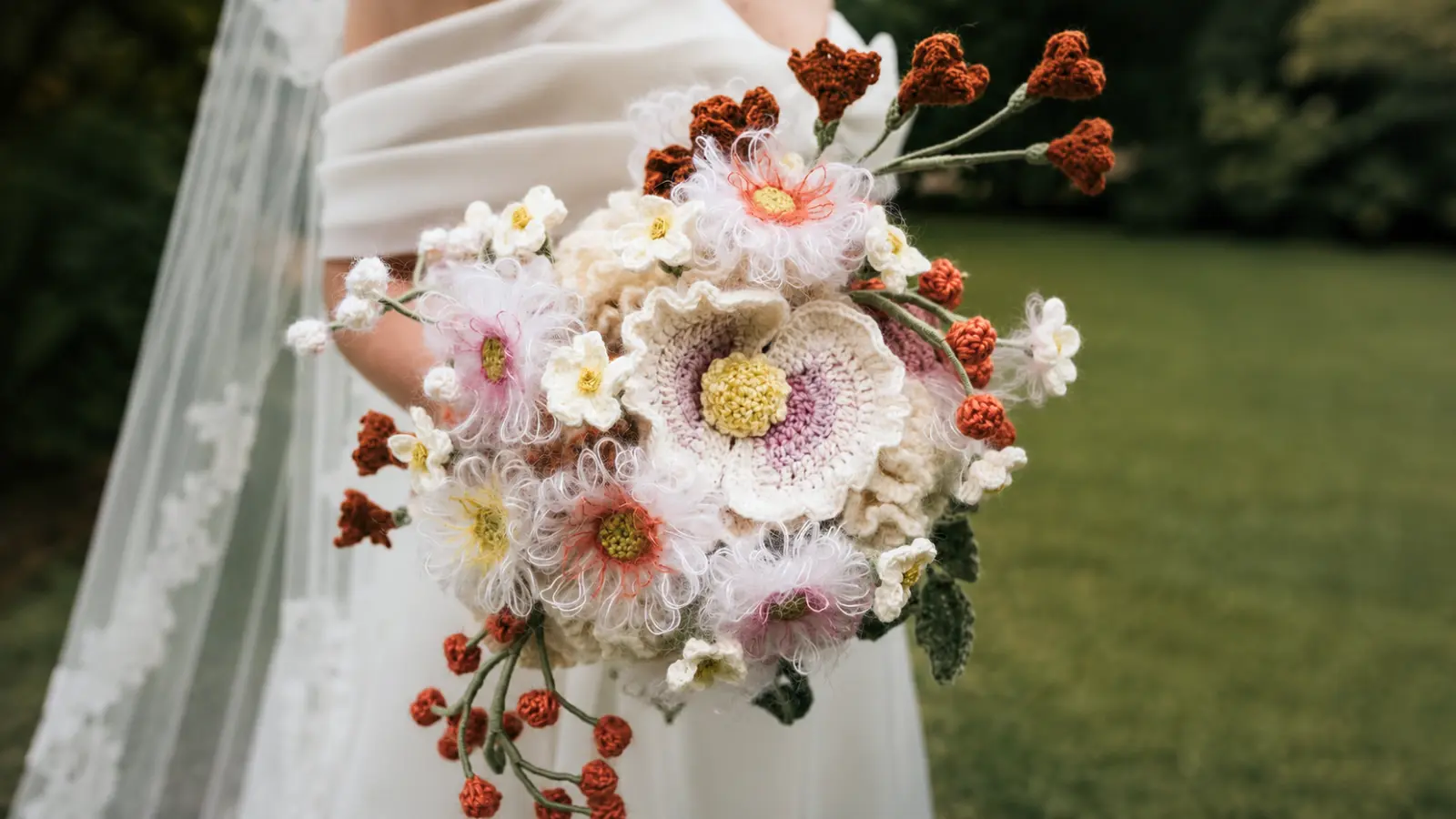
A crochet wedding bouquet is a niche choice — genuinely, not dismissively. The brides for whom it works are typically the ones who crochet themselves, who have a family connection to the craft, or who have a specific vision that happens to align with what fiber art can deliver. For that group, it’s a deeply personal option. For everyone else, it tends to read as craft project rather than bridal accessory, which is the honest reality of how it photographs in most wedding settings.
The cases where it works most naturally:
When the maker is meaningful. A bouquet crocheted by a grandmother, a mother, or a close friend carries the same kind of personal weight as a brooch bouquet assembled from family jewelry. The story of who made it is part of the object, and that comes through in photographs and in the way the bride carries it.
When the palette and construction are treated with the same seriousness as any other bouquet. Crochet bouquets that look right at a wedding are the ones where the yarn color was chosen to match the dress and the setting, where the flowers were assembled into a considered shape rather than gathered loosely, and where the handle wrap suits the overall aesthetic. The same editorial discipline that applies to a fresh flower bouquet applies here.
When the wedding aesthetic accommodates it. A relaxed outdoor ceremony, a garden setting, a wedding that already has a handmade or artisanal quality throughout the décor — these contexts absorb a crochet bouquet naturally. A formal ballroom or a cathedral ceremony may not.
Cotton yarn produces a cleaner, more structured bloom than wool, and holds its shape better when the bouquet is wired. Mercerized cotton has a slight sheen that reads better in photographs than matte yarns. For brides making their own, finishing the stems with floral wire before wrapping with floral tape gives the bouquet enough structure to hold a traditional grip without the blooms shifting during the ceremony.
Wood Flower Wedding Bouquets
Sola wood flowers are one of today’s most popular artificial wedding bouquets, occupying a middle ground between fully alternative and nearly botanical. The material — a thin, porous wood from the tapioca plant — is lightweight, takes dye readily, and can be shaped into realistic bloom forms that, once painted and assembled, are genuinely difficult to distinguish from dried flowers in photographs. They’re also odorless in their natural state, which makes them one of the more practical alternatives for brides with significant flower allergies.
The practical process is worth understanding before committing to this option. Sola flowers are sold primarily unfinished — undyed, in their natural cream-beige tone — and require dyeing or painting before they can be used in a color-matched bouquet. Dip-dyeing in diluted acrylic or fabric ink is the most common technique, and the results are good: the porous wood absorbs color evenly and can be layered for realistic petal gradation. The dyeing step adds time to the preparation process but also means the color can be matched precisely to a dress, a ribbon, or a specific floral reference in a way that ordering fresh flowers can’t guarantee.
Some specific advantages that are worth taking seriously rather than treating as secondary to the “real” option:
Heat and humidity resistance. Fresh flowers wilt faster in warm outdoor conditions. Wood flowers do not change at all regardless of temperature, which is a meaningful practical advantage for summer outdoor ceremonies or destination weddings in warm climates.
Scent customization. Sola wood absorbs essential oils readily, which means a wood flower bouquet can be scented to match a bride’s preference — rose, gardenia, jasmine, or any other fragrance — rather than depending on the natural scent of seasonal flowers. For brides who care about fragrance but not about fresh botanicals specifically, this is worth knowing.
Complete assembly in advance. A wood flower bouquet can be finished months before the wedding and requires no care in the interim. No conditioning, no water, no timing coordination on the day. The finished bouquet goes into a box and comes out on the morning of the wedding looking exactly as it did when it was assembled.
When to Choose an Alternative Bouquet
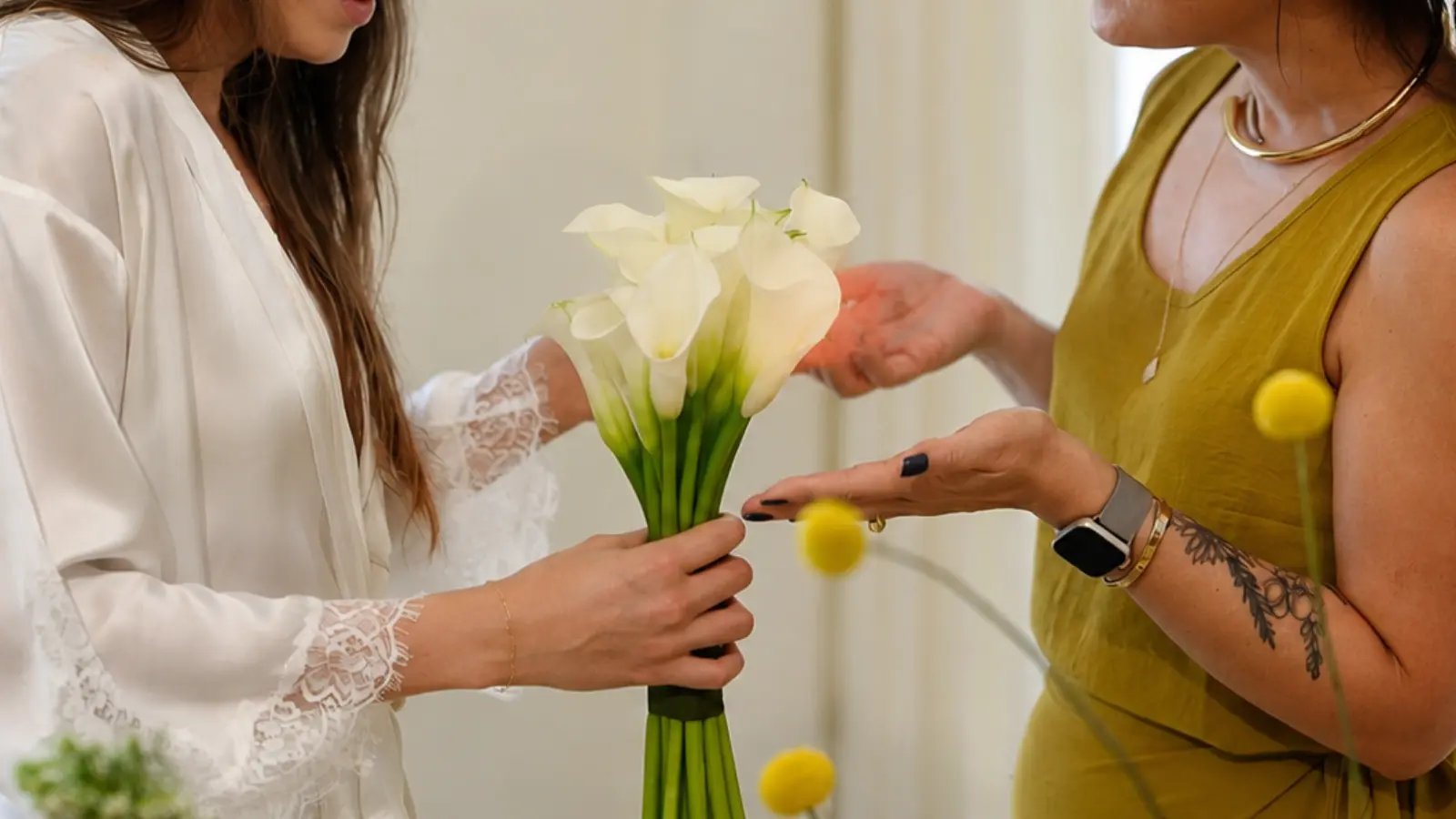
The decision to carry a non-floral or nontraditional bouquet is most straightforward when it’s driven by a specific, nameable reason rather than a general desire to do something different. The options in this guide each have a natural context where they’re the clearly right choice — and understanding those contexts makes the decision more confident and the result more coherent.
Practical reasons that make a clear case
Destination weddings with significant travel — particularly international flights — make fresh flowers logistically complicated. A wood flower or paper flower bouquet travels in carry-on luggage without any of the coordination that a fresh arrangement requires. Similarly, outdoor ceremonies in high heat or humidity favor materials that don’t wilt: wood flowers, brooch bouquets, and high-quality paper designs all hold their appearance regardless of temperature in a way that even well-conditioned fresh flowers don’t.
Flower allergies are another legitimate practical argument. Sola wood flowers and fabric or paper designs carry no pollen or fragrance unless deliberately added, which makes them a real option for brides with significant sensitivities rather than just a workaround.
Personal reasons that make a better bouquet
A brooch bouquet assembled from family jewelry is a more meaningful object than the average fresh flower arrangement, full stop. A crochet bouquet made by someone the bride loves carries a weight that no florist-sourced arrangement can replicate. A paper flower bouquet in a color that exactly matches the bride’s grandmother’s favorite rose — matched to a photograph rather than a florist’s available inventory — is a more precise expression of a personal vision than working within seasonal availability.
These are real reasons, and they produce real results. The test is whether the reason shapes the design, not whether the reason is practical or sentimental.
The questions worth answering before deciding
| Question | Why it matters |
|---|---|
| Does it fit the overall wedding aesthetic? | A brooch bouquet at a formal black-tie wedding reads differently than at a relaxed garden ceremony. The bouquet needs to fit the day, not just the bride. |
| How does it photograph at ceremony distance? | Most ceremony photos are taken from 10–20 feet. A bouquet that looks impressive in a macro close-up but reads as flat or unclear at distance isn’t serving its purpose. |
| How heavy is it to hold for several hours? | Brooch bouquets in particular can be surprisingly heavy. Holding anything uncomfortable for three hours of ceremony and reception affects how the bride looks in photographs, not just how she feels. |
| Is there a clear reason for this specific material? | The bouquets that work are the ones chosen deliberately, not the ones chosen because fresh flowers felt expected. If the reason is specific and genuine, the result usually is too. |
A non-floral bouquet that answers yes to all four is a better choice than a fresh arrangement chosen by default. The material is not the point. The intention behind it is.
Unique Wedding Bouquet Inspiration
Discover unique wedding bouquets featuring brooch bouquets, paper flowers, sola wood blooms, crochet bouquets, creative non-floral designs, and meaningful bridal inspiration for every wedding style.
The Most Memorable Bouquet Is the One That Tells Your Story
A unique wedding bouquet isn’t defined by unusual materials—it’s defined by intention. Whether you carry heirloom jewelry, handcrafted paper flowers, crochet blooms, or carefully dyed sola wood flowers, the most successful designs are the ones that reflect your personality and feel naturally connected to the rest of your wedding rather than standing apart from it.
Before choosing an alternative bouquet, focus on the reason behind the design. If the materials complement your style, photograph beautifully, and carry personal meaning, they’ll create far more lasting memories than simply following a trend. The result is a bouquet that becomes more than a beautiful accessory—it becomes a meaningful part of your wedding story for years to come.
Frequently asked questions (FAQ)
What makes a wedding bouquet feel unique without looking out of place?
A unique wedding bouquet feels intentional rather than unusual for its own sake. The most successful designs reflect the couple’s story, wedding style, or personal priorities while still complementing the dress, venue, and overall aesthetic. Whether it’s made with fresh flowers, brooches, paper, wood, or mixed materials, the bouquet should feel like a natural extension of the celebration rather than a separate statement piece.
What is a non-floral wedding bouquet?
A non-floral wedding bouquet replaces fresh or dried flowers with alternative materials such as brooches, paper flowers, fabric blooms, crochet flowers, sola wood flowers, feathers, or meaningful keepsakes. Although the materials are different, the bouquet serves the same purpose as a traditional bridal bouquet while offering greater durability and the possibility of becoming a lasting keepsake.
Are brooch bouquets still popular for weddings?
Yes, but today they are chosen more for their sentimental value than as a passing trend. Many brides create brooch bouquets using heirloom jewelry from parents, grandparents, or other family members, making the bouquet a meaningful part of the ceremony. Their emotional significance often outweighs any concern about changing bridal trends.
How long do paper and wood flower wedding bouquets last?
Both paper and sola wood bouquets can last for many years when stored away from moisture and prolonged direct sunlight. High-quality Italian crepe paper, mulberry paper, and professionally finished sola wood flowers retain their appearance remarkably well, allowing the bouquet to become a permanent keepsake without requiring preservation after the wedding.
Can you DIY an alternative wedding bouquet?
Yes. Paper flowers, sola wood flowers, crochet bouquets, and many mixed-material designs are excellent DIY projects because they can be completed weeks or even months before the wedding. Unlike fresh flowers, there is no concern about conditioning, hydration, or bloom timing, giving couples far more flexibility throughout the planning process.
How do you know if an alternative wedding bouquet is right for your wedding?
The best alternative bouquet should match the overall style of the wedding, photograph well, feel comfortable to carry, and have a clear personal or practical reason behind it. Whether the motivation is preserving a family heirloom, managing destination wedding logistics, accommodating flower allergies, or simply creating a lasting keepsake, the strongest designs are always guided by purpose rather than novelty.