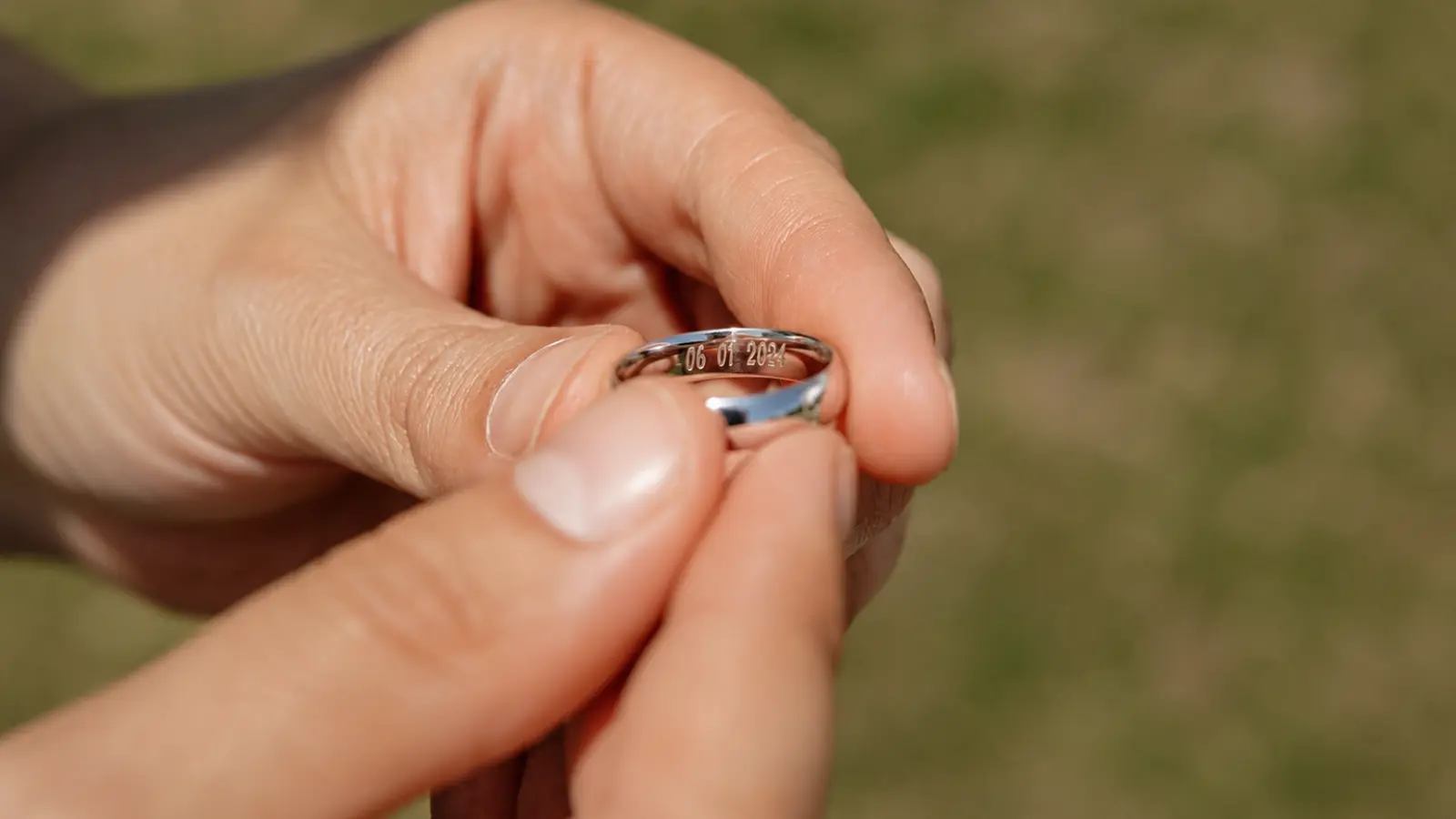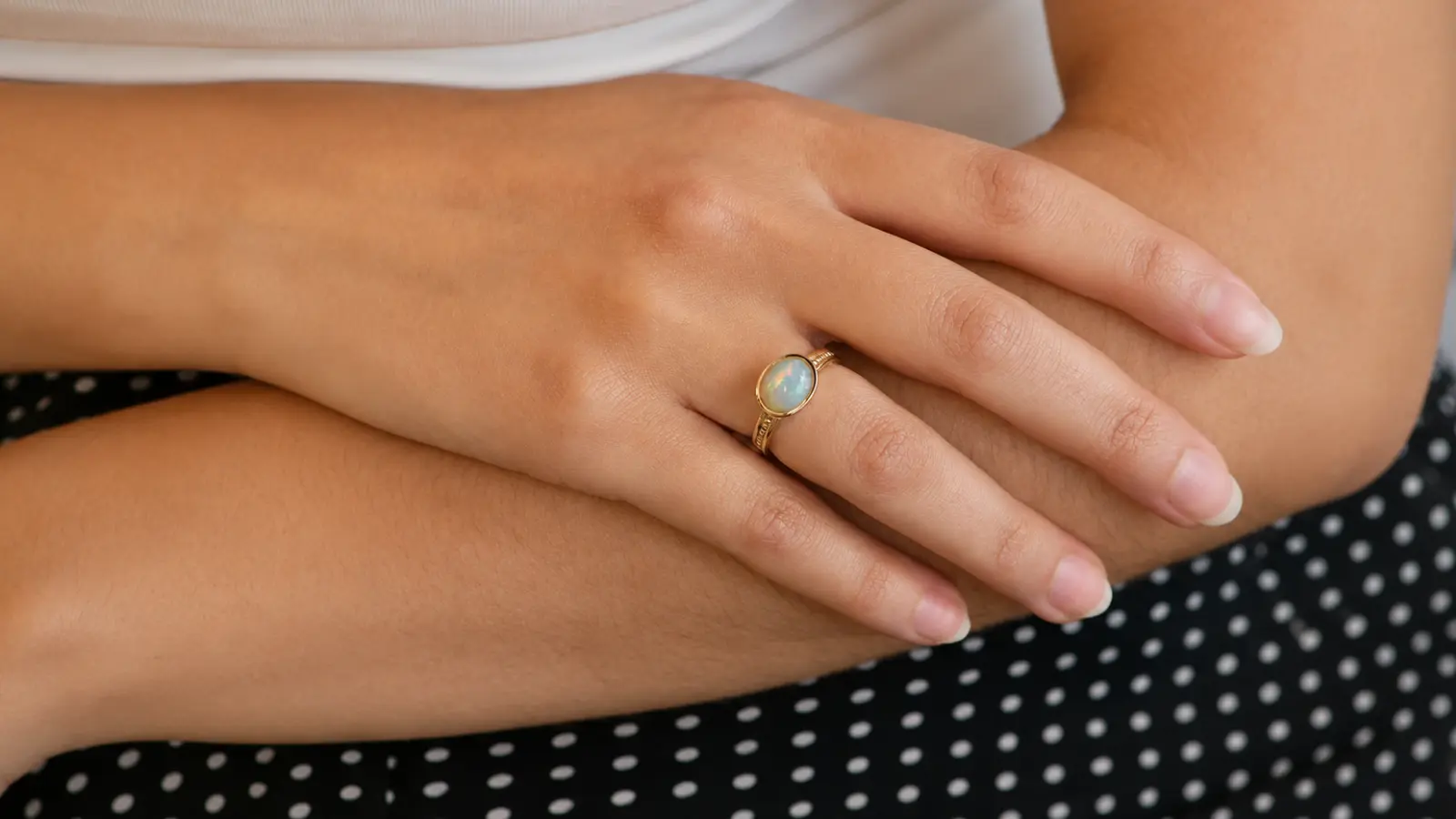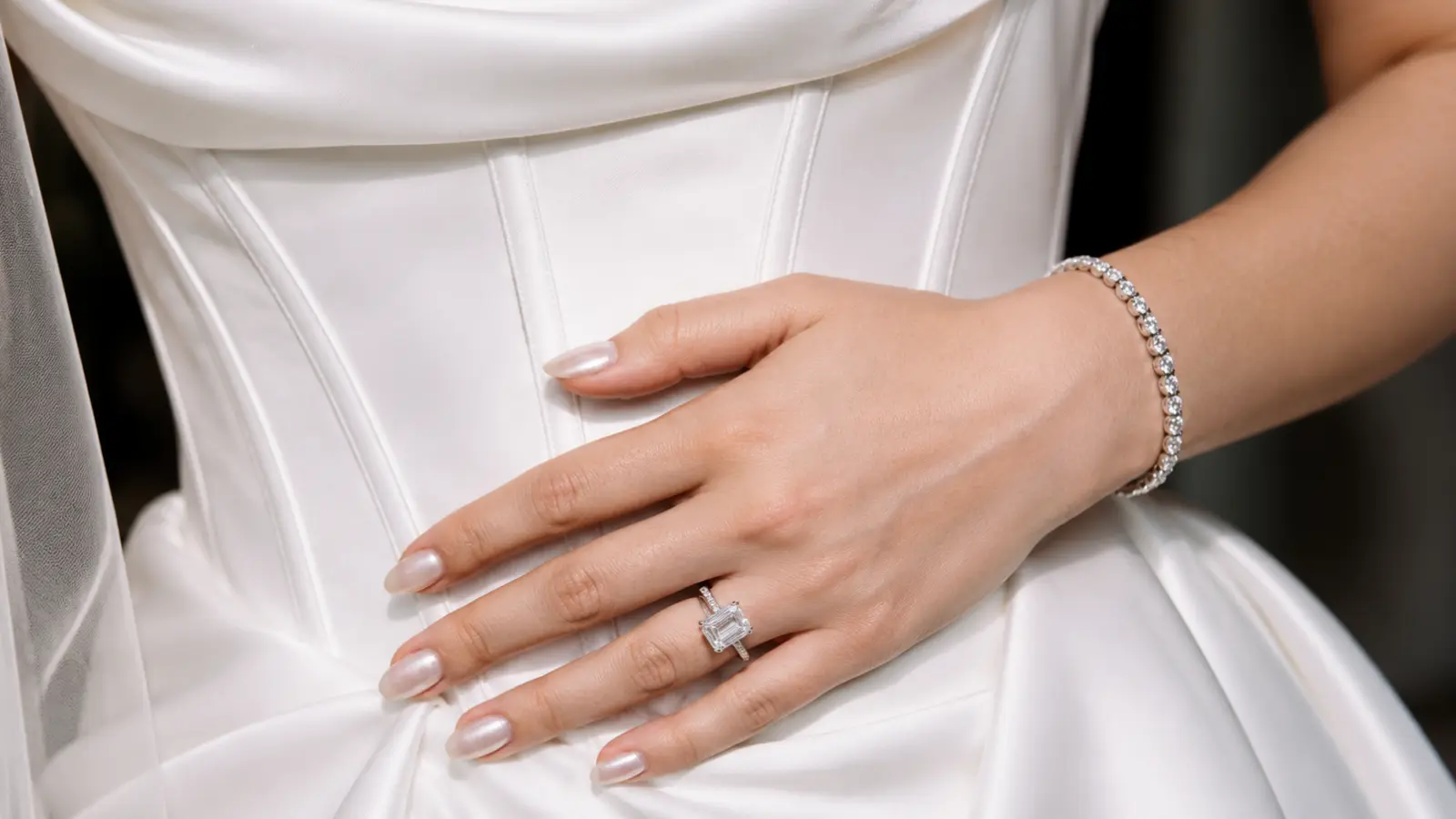
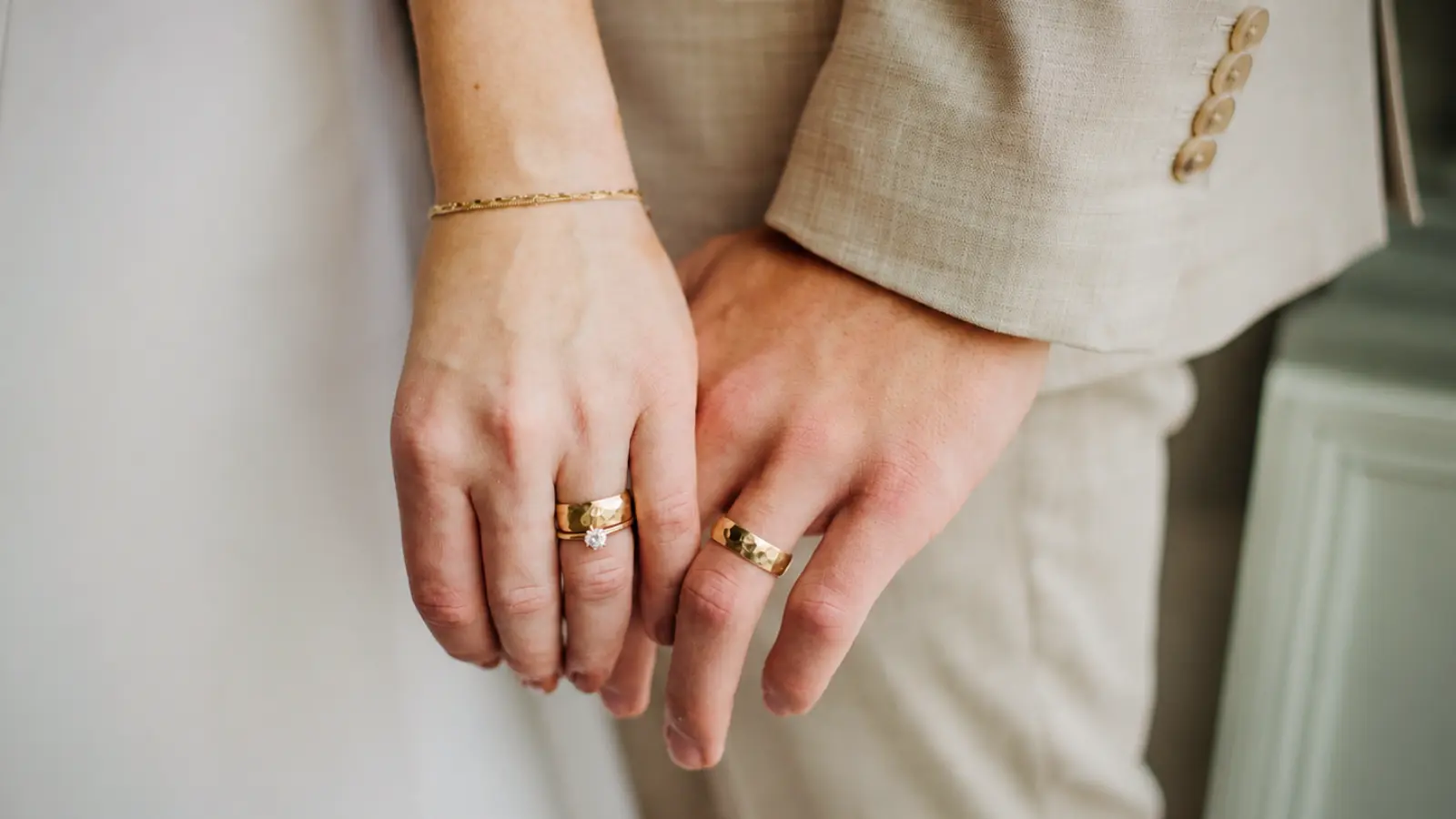
Yellow gold wedding rings are wedding rings made from gold alloys that preserve the naturally warm, classic color of gold while adding the durability needed for everyday wear. Available in options like 14k and 18k yellow gold, they remain one of the most recognizable and enduring choices for wedding jewelry.
Yellow gold is where the wedding ring tradition begins. Its appeal comes not only from history, but from a combination of warmth, versatility, and a distinctive appearance that feels equally at home in simple bands, vintage-inspired designs, diamond rings, and modern styles.
This guide explains yellow gold wedding rings, including 14k vs 18k yellow gold, styles for women and men, diamond settings, vintage designs, maintenance, and how to decide if yellow gold is the right choice among different wedding rings and wedding bands.
Why Yellow Gold Wedding Rings Are Timeless
The timelessness of yellow gold is not a marketing position — it is a material fact. Gold has been used in marriage jewelry across virtually every culture that had access to it, from ancient Egypt to Rome to medieval Europe. The association between gold and permanent commitment is not accidental: gold does not corrode, does not tarnish the way silver does, and does not change its essential character over time. It was the obvious metal for an object meant to last a lifetime.
What changed in the late twentieth century was fashion, not tradition. White gold — introduced in the 1920s as a more affordable alternative to platinum — gained traction in the 1990s and early 2000s as minimalism and silver-toned aesthetics dominated jewelry design. For a period, yellow gold felt old-fashioned in the way that anything associated with a previous generation tends to feel old-fashioned.
The return of yellow gold reflects something that happens with many materials: once the generation that initially rejected them is far enough removed, the associations shift. What felt dated now feels classic. What felt tied to parents’ jewelry now reads as heirloom. The same quality that made yellow gold unfashionable — its familiarity, its connection to the long tradition of the gold wedding band — is exactly what makes it appealing now.
What yellow gold offers that other metals do not
The color of yellow gold is unique. White gold and platinum are silvery; titanium and tungsten are gray; rose gold is pink. Yellow gold is the only wedding ring metal that is genuinely, unambiguously gold in color — warm, rich, and immediately recognizable as what it is. A yellow gold band on the finger reads as a wedding ring in a way that requires no interpretation.
Yellow gold also has a warmth against skin that cooler metals do not. Against warm, olive, and deep skin tones in particular, the metal complements the skin’s undertones rather than contrasting with them. The result is a ring that looks like it belongs on the hand rather than sitting on top of it.
And unlike white gold, yellow gold requires no ongoing treatment to maintain its color. White gold is plated with rhodium to achieve its bright silver appearance — a plating that wears off over time and needs to be reapplied every few years. Yellow gold’s color is intrinsic to the metal itself. It needs cleaning, and it develops a patina with wear, but it never needs replating. For a ring worn every day for decades, that maintenance simplicity is a real advantage.
For the full context of yellow gold within the broader gold category, see the gold wedding rings. For an overview of all metals and styles, see the complete wedding rings.
14k vs 18k Yellow Gold
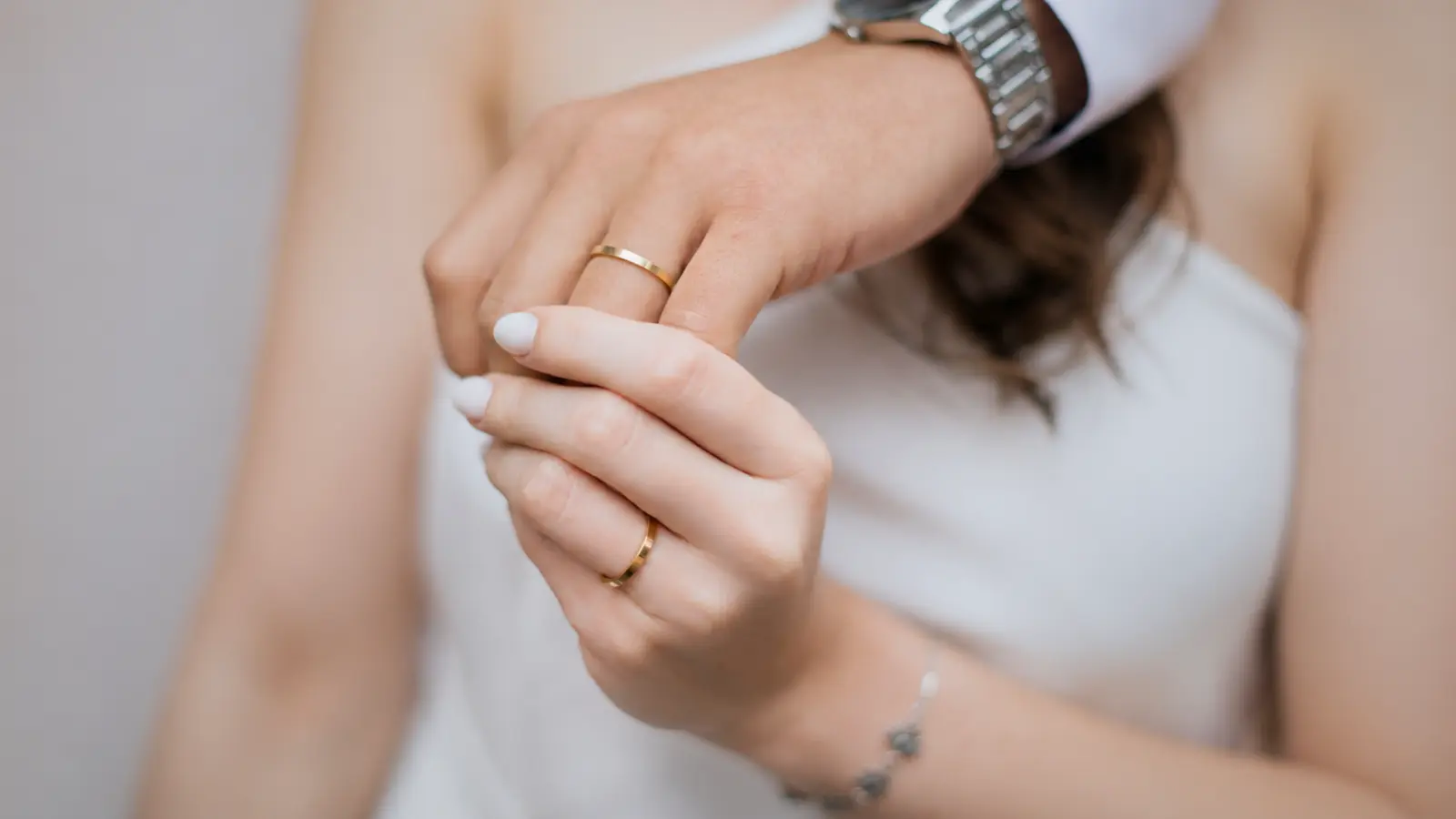
The karat of a yellow gold ring describes the proportion of pure gold in the alloy. Pure gold — 24 karat — is too soft for jewelry worn daily. To make it durable, gold is combined with other metals: copper, zinc, silver, and palladium in varying combinations. The resulting alloy is harder than pure gold, and its properties change depending on the proportion of gold in the mix. For most buyers, the decision comes down to two options: 14k and 18k.
| Property | 14k Yellow Gold | 18k Yellow Gold |
|---|---|---|
| Gold purity | 58.3% | 75% |
| Color intensity | Warm yellow, slightly muted | Rich, saturated yellow |
| Hardness | Harder — more scratch-resistant | Softer — scratches more easily |
| Durability for daily wear | Excellent | Very good |
| Skin sensitivity | Suitable for most; rare reactions possible | Lower alloy content — fewer reactions |
| Price | Lower | Higher (more pure gold) |
| Resizable | Yes | Yes |
| Patina over time | Develops slowly | Develops more visibly — sought after by many |
Who should choose 14k
14k yellow gold is the most practical choice for most people. It is harder than 18k, which means it holds its shape and surface better under the pressures of daily life — working with your hands, regular physical activity, frequent handwashing. It is also the more affordable option, which matters when the goal is a ring to wear every day for the rest of your life rather than one to display.
The color is warm and clearly yellow, if slightly less saturated than 18k. For people who are not certain how their hands interact with jewelry through a day of work, 14k is the lower-risk starting point — and for most wearers, the right long-term answer.
Who should choose 18k
18k yellow gold is for people who want the richest possible yellow color and are willing to accept slightly faster surface wear in exchange for it. The higher gold content produces a more vivid, more distinctly golden color — particularly visible when the two karats are compared side by side. 18k also has a lower proportion of alloy metals, which makes it a better choice for people with sensitive skin who may react to the copper or zinc in 14k formulations.
The patina that 18k develops over years of wear — a gentle dulling of the surface that gives it an antique quality — is something many people actively prefer to a freshly polished finish. If that lived-in character appeals to you, 18k gets you there more naturally.
What about 10k and 22k?
10k yellow gold (41.7% pure) is the most affordable option and the hardest, but its color is noticeably paler than 14k or 18k — less yellow, closer to brass-toned. It is a valid choice for budget-conscious buyers who want yellow gold but are not focused on color richness. 22k and higher karats (90%+ pure gold) are very soft and not typically recommended for rings worn daily, though they appear in some traditional Indian and Southeast Asian wedding jewelry where gold purity carries cultural significance.
Yellow Gold Wedding Rings for Women
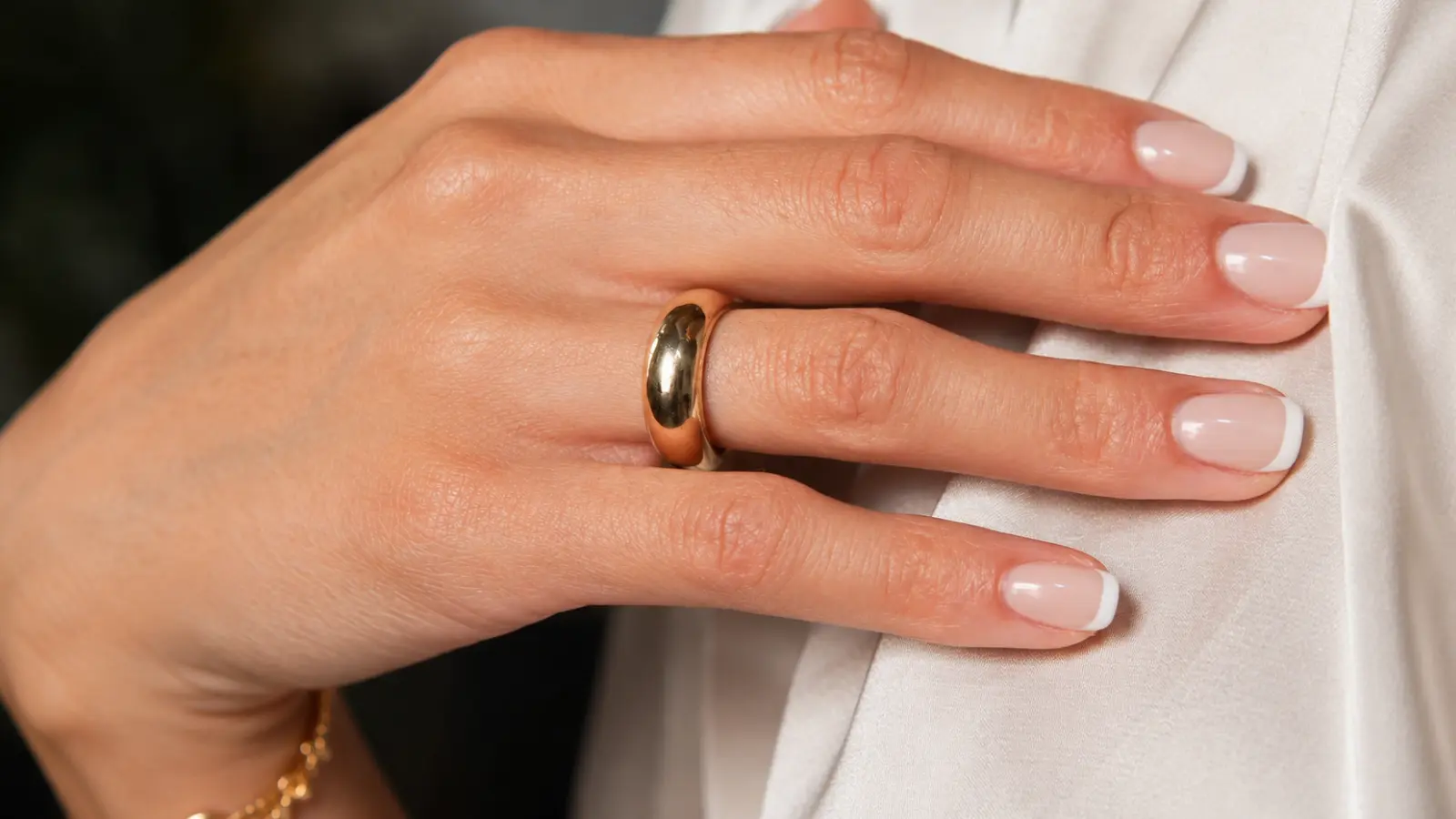
Yellow gold wedding rings for women have a range that no other metal quite matches — because yellow gold has been the default metal for women’s jewelry across so many periods and aesthetics, it has accumulated more design history than any other option. From a simple 2mm band to a fully diamond-pavé eternity ring, nearly every style of women’s wedding ring exists in yellow gold, and many of them were originally designed in yellow gold.
Simple bands
A plain yellow gold band is one of the most quietly elegant women’s wedding ring choices available. The simplicity does not diminish it — in many ways, the lack of ornamentation makes the material itself the statement. A well-made simple wedding ring in 14k or 18k yellow gold, in a width proportional to the wearer’s finger, functions as both jewelry and symbol without requiring any additional design to justify its presence.
Widths from 1.5mm to 3mm tend to be most flattering on narrower fingers; 3mm to 5mm works well across a broader range. The best way to find the right width is to try several options in person — what reads as proportional in a photograph can feel very different on the hand.
Pavé and diamond-set bands
Yellow gold with diamonds is one of the most popular women’s wedding ring combinations, and for good reason — the warmth of the metal and the brilliance of the stones produce a result that feels simultaneously vintage and current. Pavé settings, where small diamonds are set closely together across the surface of the band, are particularly suited to yellow gold: the prongs or beads that hold the stones are gold-toned, which gives the ring a warmer, more integrated look than the same pavé setting in white gold.
Stacking with an engagement ring
Yellow gold wedding bands stack naturally with yellow gold engagement rings — the metal match produces a cohesive look that requires no additional thought. Many people also choose a yellow gold wedding band to pair with a white gold or platinum engagement ring deliberately, finding that the metal contrast creates a layered, intentional look.
The practical consideration when mixing metals in a stack is wear rate: harder metals will wear against softer ones over time. A jeweler can advise on the specific metals involved and whether the combination will cause accelerated wear. For a broader guide to styles and decision frameworks for women’s rings, see wedding rings for women.
Yellow Gold Wedding Bands for Men
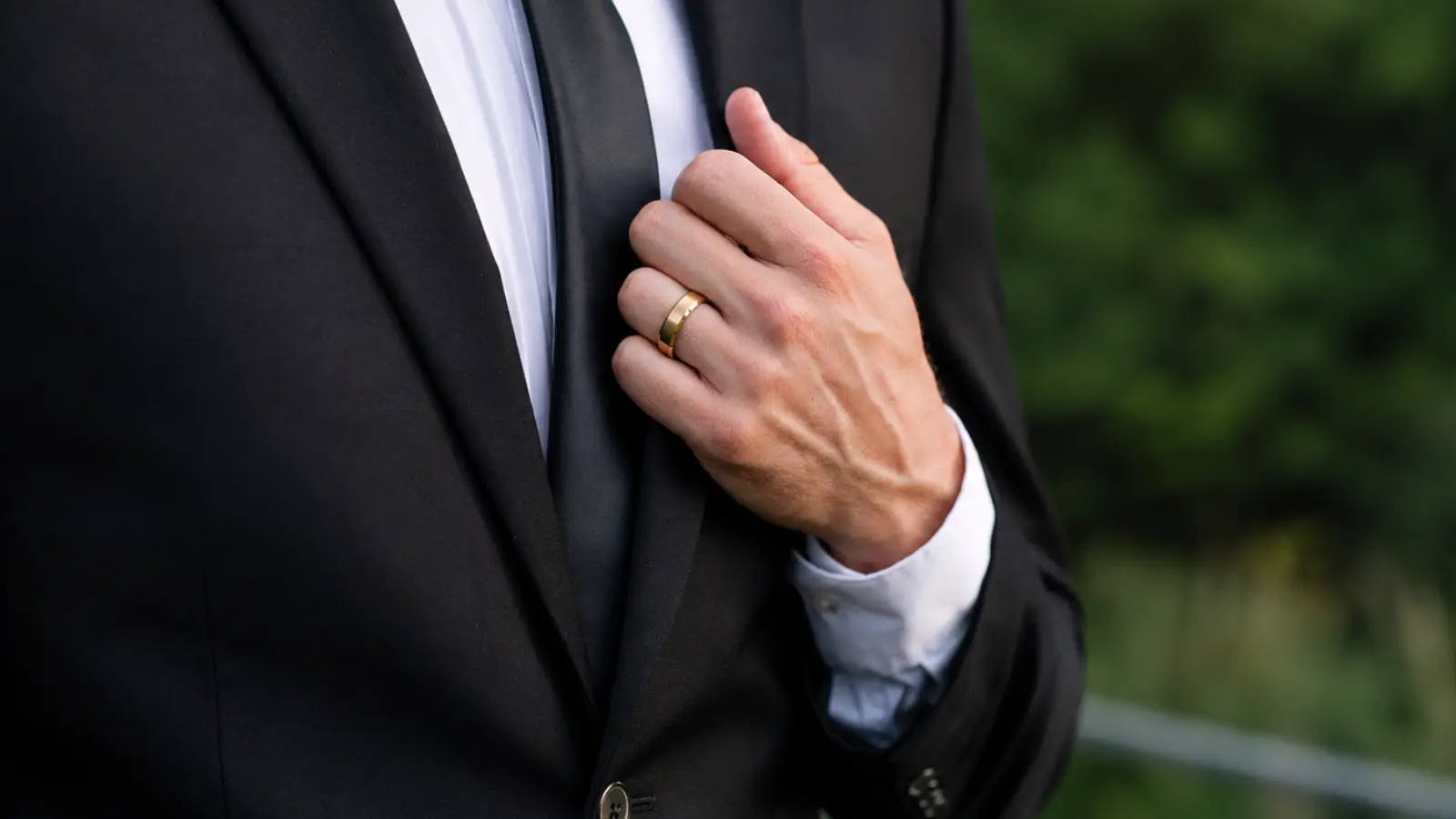
For much of American wedding history, a men’s wedding ring meant a yellow gold band. The plain yellow gold band — simple, unadorned, in a width somewhere between 4mm and 8mm — was the standard men’s wedding ring for most of the twentieth century, and it remains one of the most popular choices today. Its staying power is not incidental: a plain yellow gold band makes no statement about trend or fashion. It makes a statement about the marriage, which is precisely the point.
Width and profile
Men’s yellow gold wedding bands are typically wider than women’s, with 6mm and 8mm being the most common widths. The width should be proportional to the size of the hand — a very narrow band on a large hand can look lost, while a very wide band on a narrow finger can feel visually heavy. Most men find that 6mm hits the balance between visible presence and comfortable all-day wearability.
Profile matters as much as width. A flat profile band has clean, squared-off edges and a classic formal look. A comfort-fit band has a slightly domed interior that reduces contact between the ring and the finger, making it significantly more comfortable for people who are new to wearing rings. For a ring worn continuously, a comfort-fit interior is worth choosing even if the exterior design is flat.
Finish options
Yellow gold men’s wedding bands are available in a range of finishes that change the character of the ring without altering its fundamental nature. A high-polish finish is the most traditional and formal. A brushed or matte finish is less reflective, shows fingerprints less visibly, and tends to feel more low-key — which many men find more practical for daily wear. A hammered finish adds texture that breaks up the surface and gives the band a handmade quality.
Some men prefer a combination finish — brushed center with polished edges — that adds visual interest without departing from the classic band format. All of these options are available in 14k and 18k yellow gold.
Plain vs. set
The vast majority of men’s yellow gold wedding bands are plain — no stones, no openwork, no decorative elements beyond the finish. This is not a limitation; it is the nature of the classic men’s band, and for many men it is exactly the right choice. Men who want something with more visual interest can find bands with a channel-set row of small stones across the top, a contrasting metal inlay, or an engraved pattern on the surface. These additions work best when they are simple enough to read clearly at the scale of a band and durable enough to withstand daily wear without maintenance.
For more on men’s bands across all metals and styles, see men’s wedding bands.
Yellow Gold with Diamonds
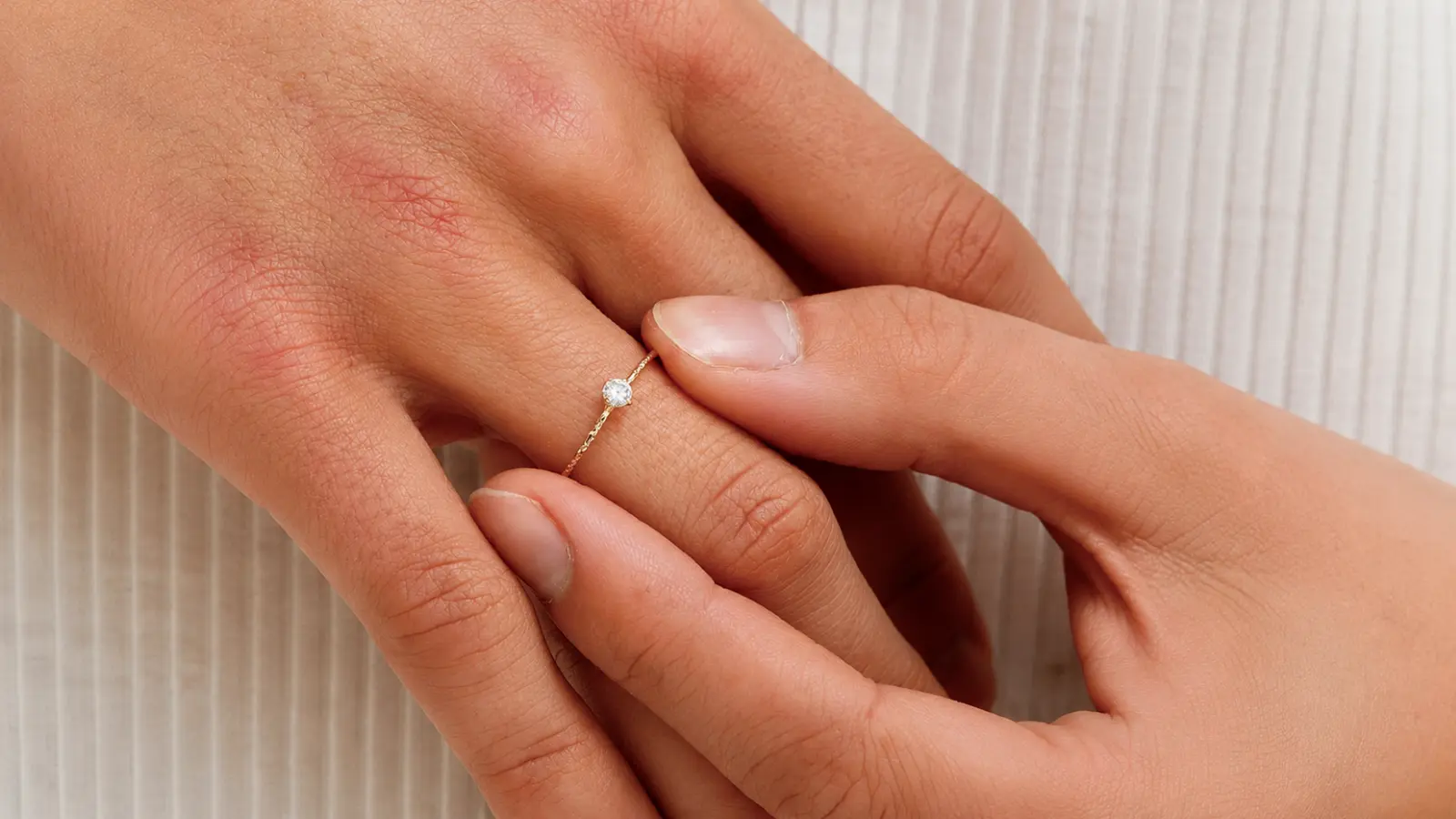
Yellow gold and diamonds have been worn together for centuries, and the combination remains one of the most consistent pairings in fine jewelry. Understanding how the metal interacts with the stones is worth knowing before choosing a yellow gold diamond wedding ring — because yellow gold does things to diamonds that other metals do not.
How yellow gold affects diamond appearance
Yellow gold reflects its color into diamonds. A diamond set in yellow gold will appear slightly warmer — more cream-toned — than the same diamond set in white gold or platinum. This is not a flaw; it is a characteristic. For couples who value the warm, antique quality of yellow gold with diamonds, this effect is exactly what they are looking for. For couples who want their diamonds to appear as bright white and colorless as possible, white gold or platinum settings will achieve that more effectively.
The effect is most visible in diamonds with lower color grades. A high-color diamond (D, E, F on the GIA scale) is white enough that the gold warmth is less noticeable; a near-colorless diamond (G, H, I) will pick up the gold reflection more clearly. This means that when setting diamonds in yellow gold, it is often possible to choose a slightly lower color grade without the difference being visible — which can allow more investment in cut and clarity instead.
Diamond shapes that work particularly well
Round brilliant diamonds are a natural pairing with yellow gold — the combination is the most traditional in fine jewelry and continues to look exactly right. Oval and cushion cuts also pair particularly well with yellow gold, as their vintage shapes complement the warmth of the metal. Emerald-cut and Asscher-cut diamonds can work beautifully in yellow gold settings when the setting design is clean and precise. Marquise, pear, and elongated shapes work in yellow gold but tend to be more dependent on the specific setting style.
Eternity rings and half-eternity bands
A diamond eternity ring — stones set all the way around the band — in yellow gold is one of the most consistently popular women’s wedding ring styles. The warmth of the yellow gold gives the ring an antique quality that the same style in white gold does not have. A half-eternity band, with stones on the top half of the ring only, is more practical for daily wear and can be resized more easily. Both styles work in 14k or 18k, with 18k particularly suited to eternity rings where the richer gold color provides better visual context for the stones.
For a full guide to diamond wedding band styles and setting types, see diamond wedding bands.
Vintage Appeal and Antique-Inspired Styles
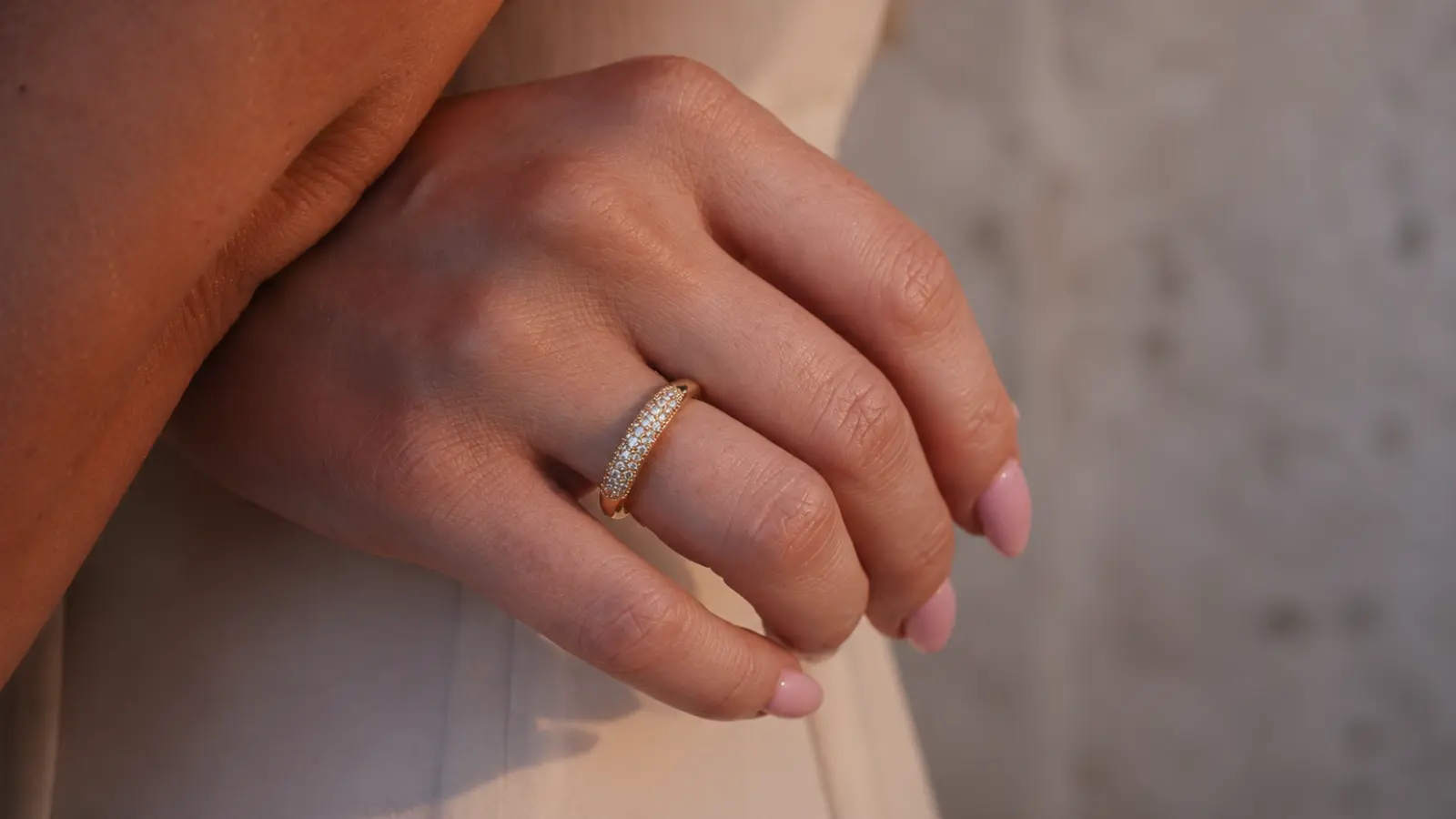
Yellow gold is the native metal of vintage jewelry. Virtually all jewelry from the Art Nouveau, Edwardian, Art Deco, and Retro periods was made in yellow gold, which means the design vocabulary of those eras — milgrain edging, filigree, hand-engraved surfaces, bezel settings, old European and rose-cut diamonds — is most authentic in yellow gold. A yellow gold design inspired by vintage wedding rings does not simply look old-fashioned; it works with the materials and techniques those periods actually used.
Milgrain
Milgrain is a decorative edging technique in which tiny beads of metal are applied along the border of the ring, creating a textured, organic edge. It is one of the most common details in Edwardian and Art Deco jewelry, and in yellow gold it produces a warmth and intricacy that looks authentically antique rather than artificially aged. Milgrain is subtle when used on a plain band and more visible when paired with engraving or stone settings — it scales well across both approaches.
Filigree and engraving
Filigree — delicate openwork created from twisted and soldered gold wire — is an intricate technique associated with Victorian and Edwardian jewelry. In yellow gold, filigree has a warmth and organic quality that makes even a simple band feel elaborate. Hand engraving on the surface produces a similar effect: patterns of flowers, vines, geometric motifs, or abstract designs that catch light differently depending on the angle.
Both techniques require skilled craftsmanship and are harder to find in mass-produced rings. Jewelers who specialize in estate or vintage-inspired pieces are the most reliable source, and the investment in quality craftsmanship is particularly visible in yellow gold, where the warmth of the metal amplifies every detail.
Matching vintage engagement rings
For anyone who has an antique or vintage engagement ring — particularly one from the early twentieth century — a yellow gold wedding band is often the most natural and historically coherent choice. Most antique engagement rings were made in yellow gold or yellow gold with platinum details, and matching the metal in the wedding band maintains the integrity of the ring as a jewelry object. If the engagement ring is platinum or white gold, a yellow gold band can still be worn as a deliberate contrast — but matching the existing metal is typically the most harmonious approach.
For more on distinctive and non-standard wedding ring styles, see unique wedding rings.
How to Care for Yellow Gold Rings
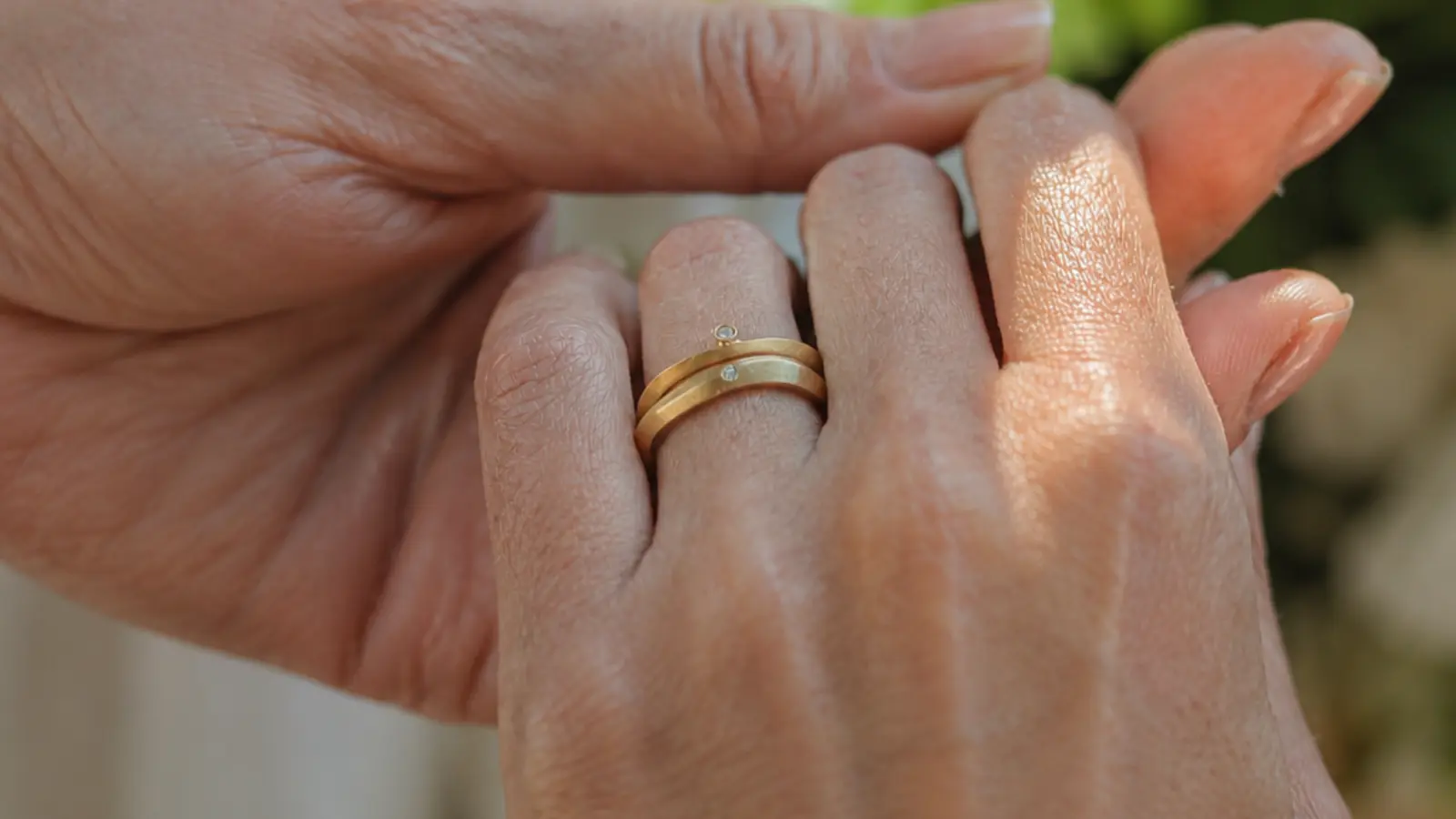
Yellow gold is one of the easier wedding ring metals to care for over the long term, primarily because it does not require rhodium replating the way white gold does. Its maintenance is straightforward — mostly cleaning and occasional professional inspection — but the specific habits that protect a yellow gold ring are worth understanding before you have been wearing it for a decade.
At-home cleaning
The most effective at-home cleaning method is also the simplest: warm water, a small amount of mild dish soap, and a soft-bristled brush — an old toothbrush is ideal. Soak the ring in the soapy water for a few minutes, scrub gently around all surfaces including the inside of the band, rinse thoroughly under clean running water, and dry with a soft cloth.
This is a safe way to clean a wedding ring at home, removing skin oils, hand lotion, soap residue, and debris that accumulate during daily wear — and is responsible for most of the dullness that people attribute to surface wear on the metal itself. Cleaning frequency depends on how the ring is worn: for someone who wears it continuously through cooking, gym use, and daily work, once a week is reasonable. For someone whose ring is exposed to fewer products and activities, once or twice a month maintains a clean surface.
What to avoid
Chlorine is the most significant chemical threat to yellow gold. Chlorinated swimming pools and hot tubs can weaken gold alloys over time, degrading the metal at a molecular level in a way that is not immediately visible but accumulates into brittleness and cracking. Remove yellow gold rings before swimming in chlorinated water. Bleach and other household cleaning products containing chlorine carry the same risk.
Abrasive cleaning products scratch the surface of yellow gold more quickly than normal daily wear. Avoid cleaning gold rings with baking soda pastes, toothpaste, or any product with grit. Hand lotion, sunscreen, and cosmetics do not damage gold, but they build up on the surface and inside settings over time — regular cleaning handles this without requiring avoidance of everyday products.
Professional care
A yellow gold wedding ring benefits from professional inspection and cleaning every one to two years. A jeweler can polish the ring to restore its surface (or preserve a deliberate patina if the wearer prefers it), inspect prongs and settings on diamond rings to ensure stones are secure, check for any developing stress points in the metal, and resize if the fit has changed.
This is particularly important for rings with stones. A loose prong is not visible during daily wear but becomes apparent during inspection — and a stone that falls out is far harder to recover than one that is re-tipped before it becomes a problem. Routine professional care is the easiest way to protect both the ring and the stones it holds.
The patina question
Yellow gold develops a patina over years of daily wear — a gentle, lived-in dulling of the surface that is different from the fresh-polished state the ring was in when new. Some people find this patina beautiful and prefer to preserve it; others prefer a consistently bright polish and have the ring polished at each professional cleaning. Both preferences are valid, and neither does lasting harm to the ring.
A jeweler can restore bright polish at any time. The patina, if removed, will develop again naturally with continued wear. For more on personalizing yellow gold rings through engraving, see wedding ring engraving.
Yellow Gold Wedding Ring Inspiration
Yellow gold wedding rings can range from simple classic bands to detailed vintage designs and diamond styles. Explore our inspiration board for 14k and 18k yellow gold rings, timeless wedding bands, pavé diamonds, antique-inspired details, and modern yellow gold ideas.
Choosing a Yellow Gold Wedding Ring That Lasts
A yellow gold wedding ring is not only a traditional choice — it is a ring designed to become part of everyday life. The warmth of the metal, the way it ages, and the styles it creates all contribute to a piece of jewelry that can feel personal for decades.
Whether you choose a simple 14k band, a rich 18k design, a diamond wedding ring, or a vintage-inspired style, the best yellow gold wedding ring is the one that matches both your personal style and the life you will build around it.
Frequently asked questions (FAQ)
Are yellow gold wedding rings still popular?
Yes. Yellow gold wedding rings remain one of the most popular and timeless choices. After years of white metals dominating bridal jewelry, yellow gold has become popular again because of its warm appearance, vintage influence, and classic wedding ring style. Many couples choose yellow gold because it feels traditional without feeling outdated.
What are the best yellow gold wedding rings?
The best yellow gold wedding rings depend on personal style and how the ring will be worn every day. Classic plain yellow gold bands, diamond bands, vintage-inspired rings, and simple 14k gold designs are all popular choices. The best option balances appearance, comfort, durability, and lifestyle.
Is 14k or 18k yellow gold better for a wedding ring?
Both are excellent options, but they serve different priorities. 14k yellow gold is usually better for everyday wear because it is harder, more durable, and more affordable. 18k yellow gold contains more pure gold and has a richer yellow color, but it is softer and can show wear more easily over time.
Are yellow gold wedding rings durable?
Yes. Yellow gold wedding rings are durable enough for everyday wear, especially in 14k gold. Like all gold jewelry, yellow gold can develop scratches over time, but it can also be polished and maintained for decades. The natural aging of gold is part of why many people appreciate it as a lifelong material.
Is yellow gold or white gold better for wedding rings?
Neither is better for everyone. Yellow gold has a warmer, more traditional appearance and does not require replating. White gold creates a cooler silver-toned look but usually needs rhodium replating over time to maintain its bright white finish. The right choice depends on style preference and maintenance expectations.
Do men wear yellow gold wedding bands?
Yes. Yellow gold is one of the most traditional choices for men’s wedding bands. Classic plain yellow gold bands remain popular because they are simple, recognizable, and timeless. Modern men’s yellow gold rings can also include brushed finishes, textures, diamonds, or wider profiles.