
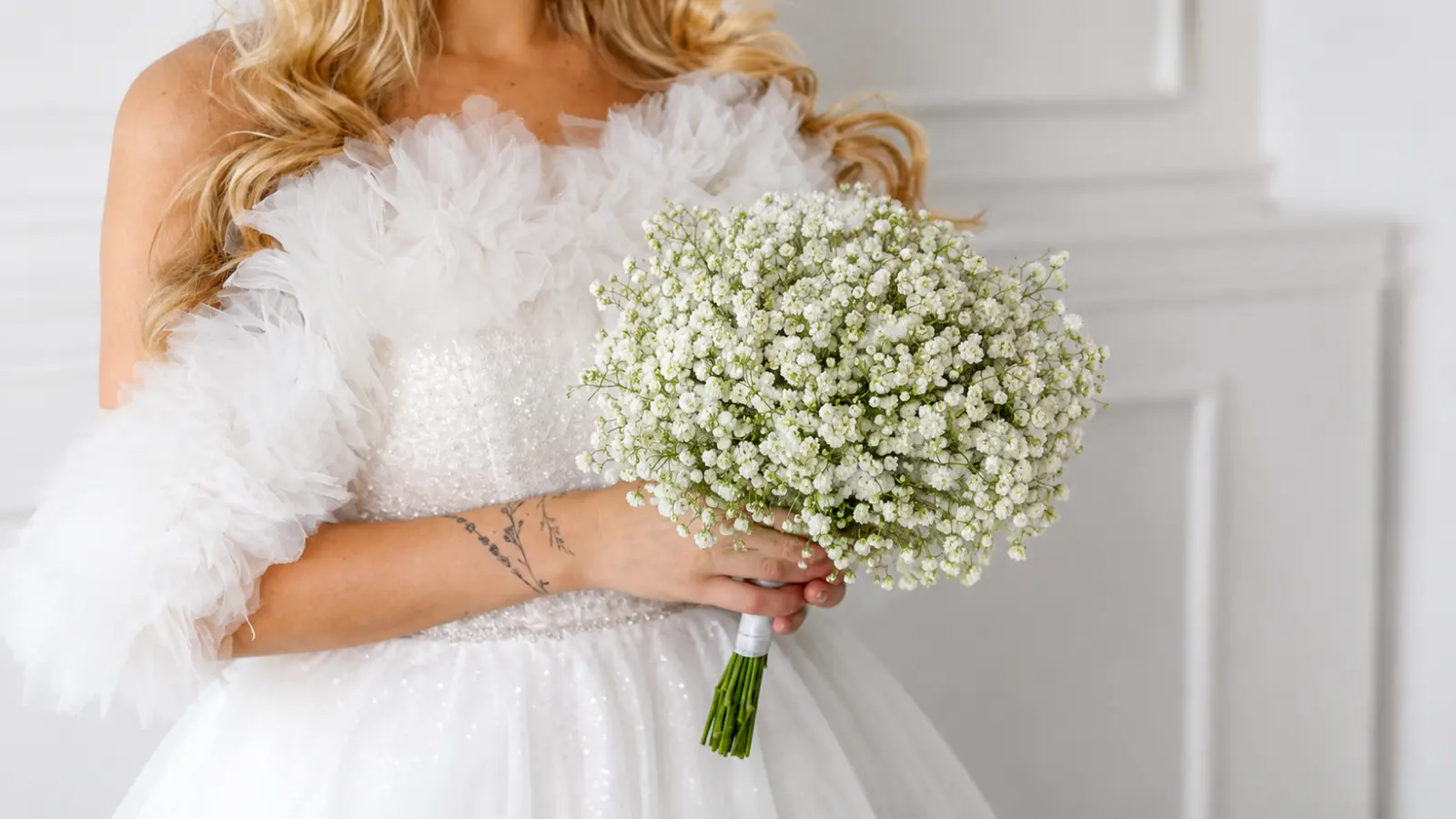
Baby’s breath wedding bouquets have become one of the most popular choices for brides who love soft, romantic, and effortlessly elegant flowers. Once known mainly as a filler flower, baby’s breath now creates beautiful standalone bouquets as well as delicate mixed arrangements that suit everything from minimalist ceremonies to rustic celebrations.
The difference between a bouquet that looks refined and one that looks unfinished comes down to thoughtful design. Bouquet density, flower pairings, ribbon choice, and overall styling all play an important role in transforming baby’s breath into a bouquet that feels intentional rather than simply budget-friendly.
This guide explores baby’s breath wedding bouquets as one delicate approach to choosing a wedding bouquet, including all baby’s breath designs, rose pairings, rustic bouquet ideas, bridesmaid bouquets, affordability, and practical styling tips for creating a design that looks timeless, romantic, and beautifully finished.
Baby’s Breath Wedding Bouquet Ideas
Baby’s breath is flexible in ways that more dominant flowers aren’t. It can be the entire arrangement or a supporting element, work in a tight round nosegay or a loose arm sheaf, and suit everything from a formal ballroom to a wildflower meadow ceremony. The range of what’s possible with it is wider than most brides expect going in.
All baby’s breath cloud bouquet is the most statement-forward option — a densely packed round arrangement built entirely from baby’s breath that reads as soft and airy at a distance and intricate up close. This has moved from niche to genuinely popular, particularly for minimalist and romantic aesthetics.
Baby’s breath with a single focal bloom is an editorial approach that plays on contrast. One large peony, garden rose, or dahlia at the center, surrounded by a full cloud of baby’s breath, creates a bouquet that photographs with a clean, intentional quality. The single bloom becomes the clear focal point; the baby’s breath provides the softness and scale.
Baby’s breath and rose mixed bouquet is the most traditional direction and still one of the strongest. When the proportions are right — roses as the primary flower, baby’s breath as the filling texture — the combination has a timeless quality that works across almost every wedding aesthetic.
Loose wildflower-style arrangement uses baby’s breath alongside lavender, small spray roses, greenery, and dried elements in a hand-tied bundle that looks gathered rather than constructed. This suits outdoor, rustic, and bohemian weddings and is one of the more achievable DIY styles available.
All Baby’s Breath Bouquets
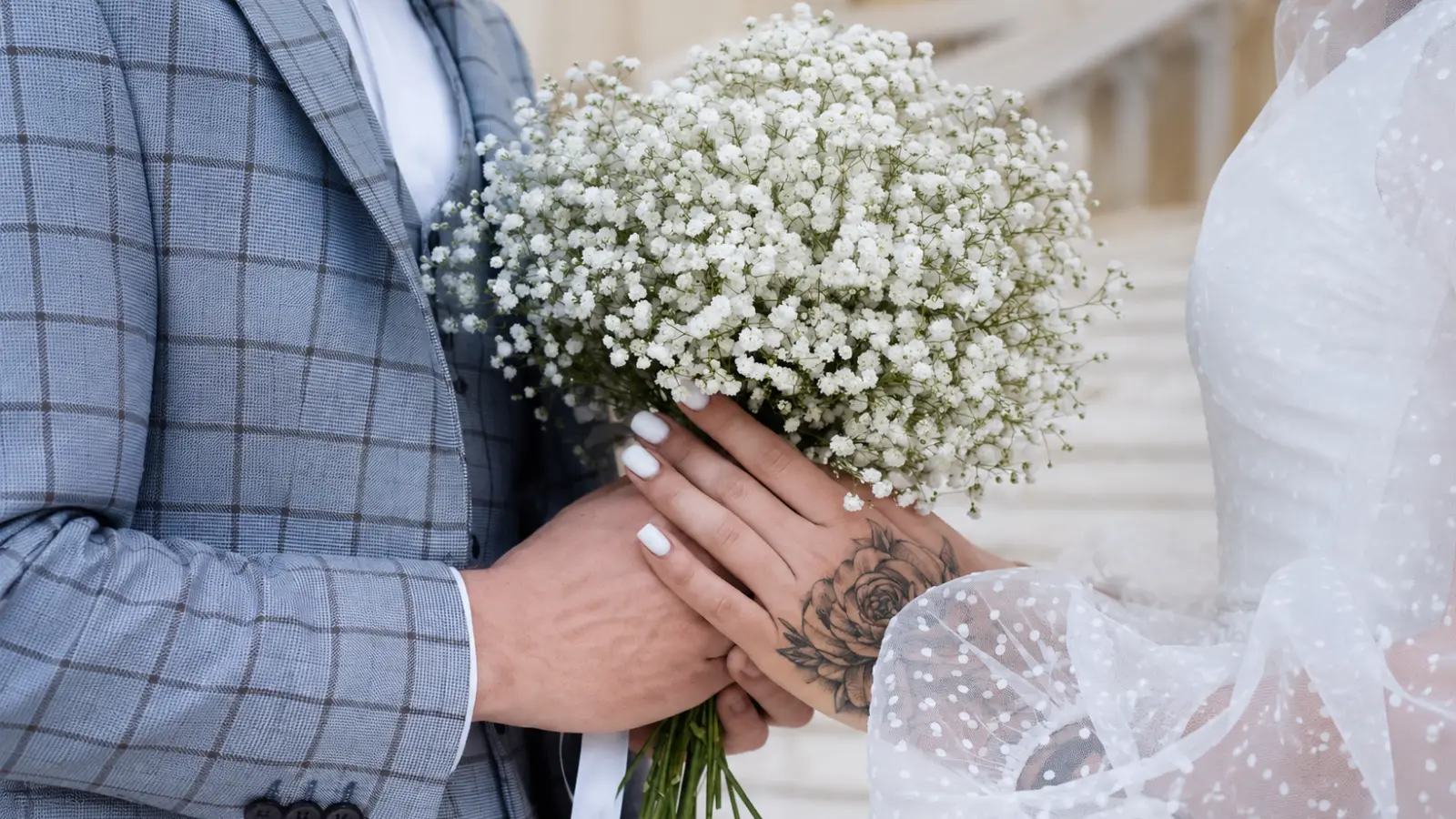
The all baby’s breath bouquet is the option that surprises people most — both how good it can look when it’s done well and how different it looks from a loosely assembled version of the same idea. The variable that separates the two is density, and it’s not a subtle difference.
A well-built all baby’s breath bouquet uses considerably more stems than most people expect. The effect of a full, rounded cloud comes from packing the stems tightly enough that there are no visible gaps between clusters — the surface reads as a continuous texture rather than scattered points of white. When you hold that kind of arrangement, it has real weight and substance. When baby’s breath is assembled loosely, the gaps make it look like the bouquet isn’t finished.
The shape works best as a round or slightly domed form rather than a loose hand-tied bundle. The natural branching structure of baby’s breath lends itself to a spherical silhouette, and a clean dome shape — held together with floral tape and finished with a ribbon — photographs with a softness that the more editorial shapes don’t quite achieve.
Color is worth thinking through, too. White baby’s breath is the most refined and versatile option and reads cleanly against almost any dress. Blush or pale pink baby’s breath adds warmth to softer palettes and works particularly well with blush or ivory gowns. Dyed varieties are available, but the color is often uneven and tends to read as artificial in photos — most florists steer away from them for bridal work.
The ribbon finish on an all baby’s breath bouquet matters more than it does with mixed arrangements. Because the flower itself is so soft and airy, the handle treatment is what grounds the design. Satin or velvet ribbon in white, ivory, blush, or a soft neutral wrapped cleanly and secured with pearl pins produces a finished look. Twine or jute can work for rustic aesthetics, but it shifts the register of the entire bouquet significantly.
Baby’s Breath and Rose Bouquets
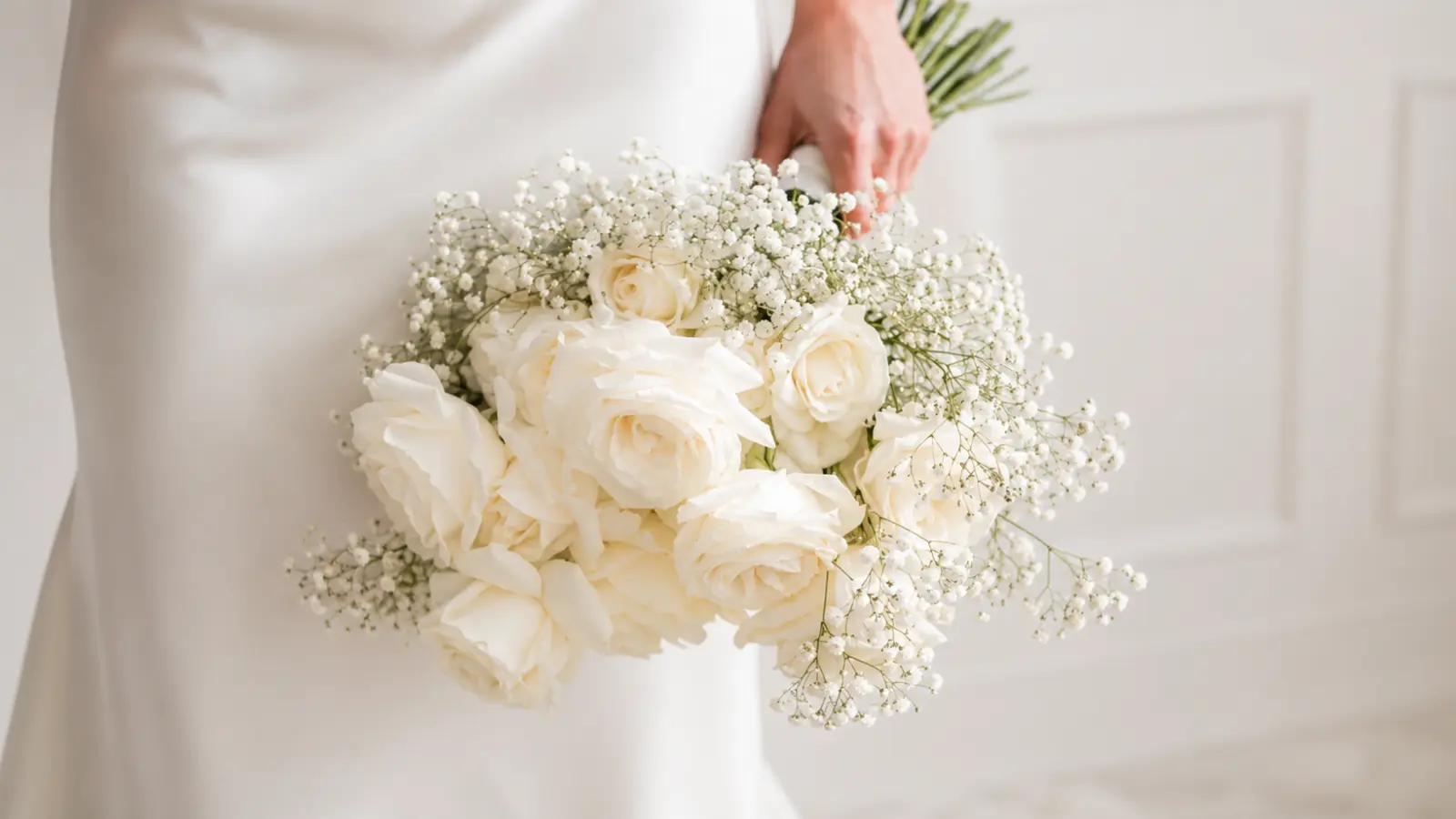
This is the combination that most people picture when they think of baby’s breath in a wedding bouquet — and for good reason. Roses and baby’s breath have a genuine visual logic together: the full, rounded petal structure of a rose and the delicate cloud texture of baby’s breath create contrast without competition. Neither flower overwhelms the other when the proportions are handled correctly.
The proportions are the part that matters most. The most common mistake with rose and baby’s breath arrangements is treating the two flowers as equals — roughly the same visual presence, distributed evenly through the bouquet. This tends to produce an arrangement that looks busy rather than balanced. The stronger approach is to let one flower lead clearly and let the other support it.
When roses lead — which is the more traditional approach — baby’s breath fills the spaces between blooms rather than competing with them for attention. The roses cluster at the center of the arrangement and the baby’s breath extends outward and between them, softening the edges and giving the bouquet a lighter quality than roses alone would have. Spray roses work particularly well in this format because their smaller scale bridges the size difference between the two flowers.
When baby’s breath leads — which is the more contemporary approach — a small number of roses (three to five, depending on bouquet size) serve as focal points within a larger cloud of baby’s breath. This is the single-focal-bloom idea scaled up slightly. It reads as more modern and less traditional than a rose-heavy arrangement, and it has a visual lightness that suits minimalist and romantic wedding aesthetics equally well.
| Rose Type | How It Pairs With Baby’s Breath | Best For |
|---|---|---|
| Garden roses | Lush contrast; ruffled petals against airy texture | Romantic, garden-inspired, spring weddings |
| Spray roses | Scale bridge; smaller blooms integrate naturally | Mixed bouquets, bridesmaid arrangements |
| Standard roses | Classic pairing; clean, formal quality | Traditional and formal ceremonies |
| Dried roses | Warm, textured, earthy contrast | Rustic, bohemian, fall weddings |
Color coordination is more forgiving than it seems. White baby’s breath works with almost any rose color, from deep red to the softest blush. If you’re working within a specific palette, the rose carries the color and the baby’s breath functions as the white or near-white neutral — which is exactly how it behaves in most successful arrangements.
Rustic Baby’s Breath Bouquets
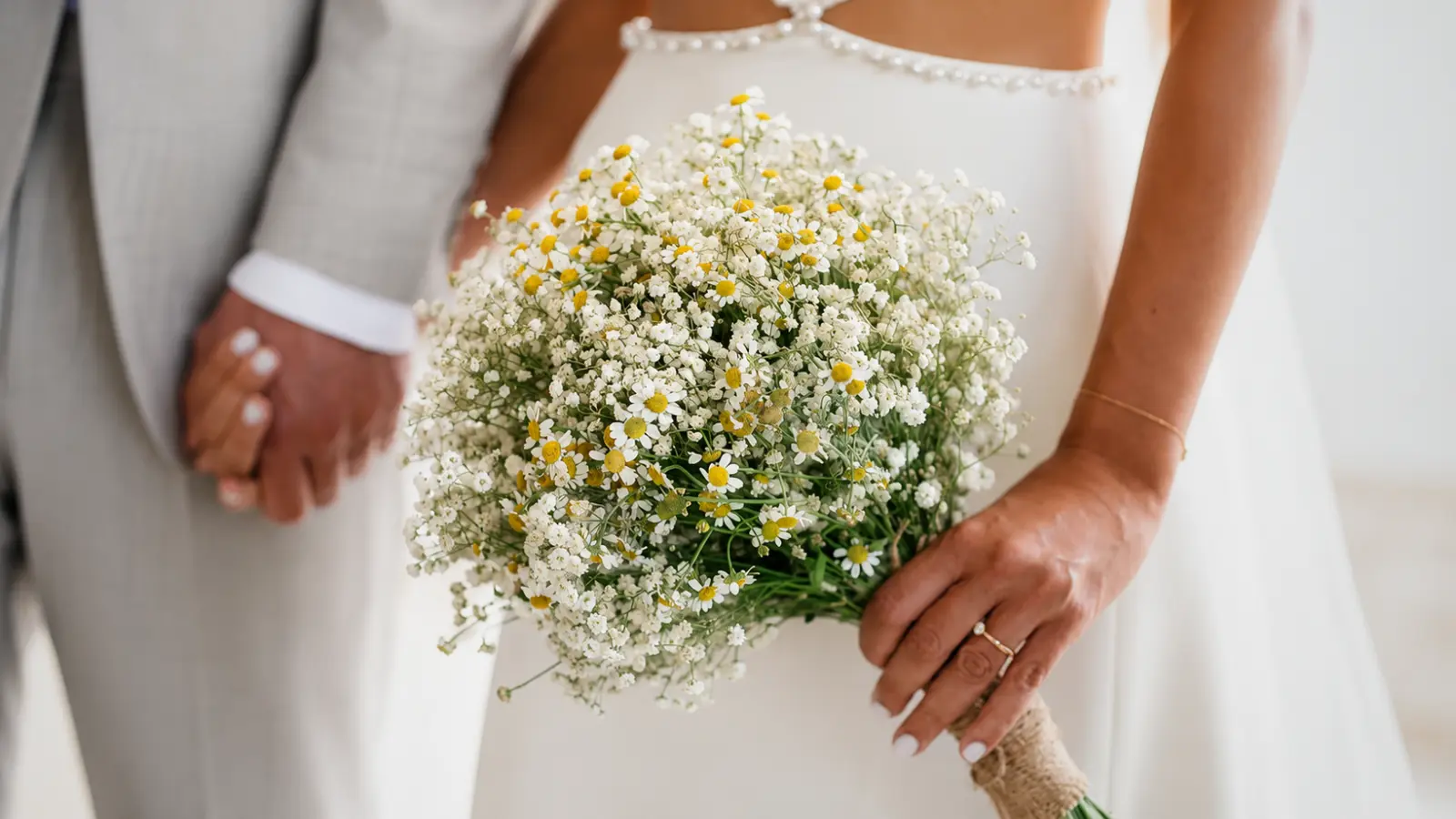
Baby’s breath is a natural fit for rustic wedding bouquets — its wildflower quality and association with open fields and informal gardens make it especially coherent for barn weddings, outdoor ceremonies, and relaxed settings.
Rustic baby’s breath bouquets tend to move away from the tight, domed shape of more formal arrangements toward something looser — a hand-tied bundle with visible stems, a slight asymmetry, and supporting elements that reinforce the informal aesthetic. Dried pampas grass, eucalyptus, lavender, dried wheat, and small wildflowers are all natural companions. The overall effect should feel gathered rather than constructed, even if the assembly itself is more deliberate than it looks.
The ribbon or wrap treatment shifts for this style. Rather than polished satin, natural twine, dried grasses, or a simple linen wrap suit the aesthetic better. That said, even in a rustic arrangement, the wrap needs to be clean and intentional — loosely tied twine that’s slipping or fraying reads as unfinished rather than relaxed.
Dried baby’s breath is worth considering for rustic weddings specifically. Baby’s breath dries extremely well, retaining its cloud-like structure and shifting slightly toward a warm cream rather than bright white. A bouquet made entirely or partially from dried baby’s breath has a warmth and texture that fresh flowers don’t have, and it doesn’t require any day-of water management. For couples who want a rustic dried-flower arrangement that also photographs well, baby’s breath is one of the most reliable flowers to build with.
Baby’s Breath Bridesmaid Bouquets
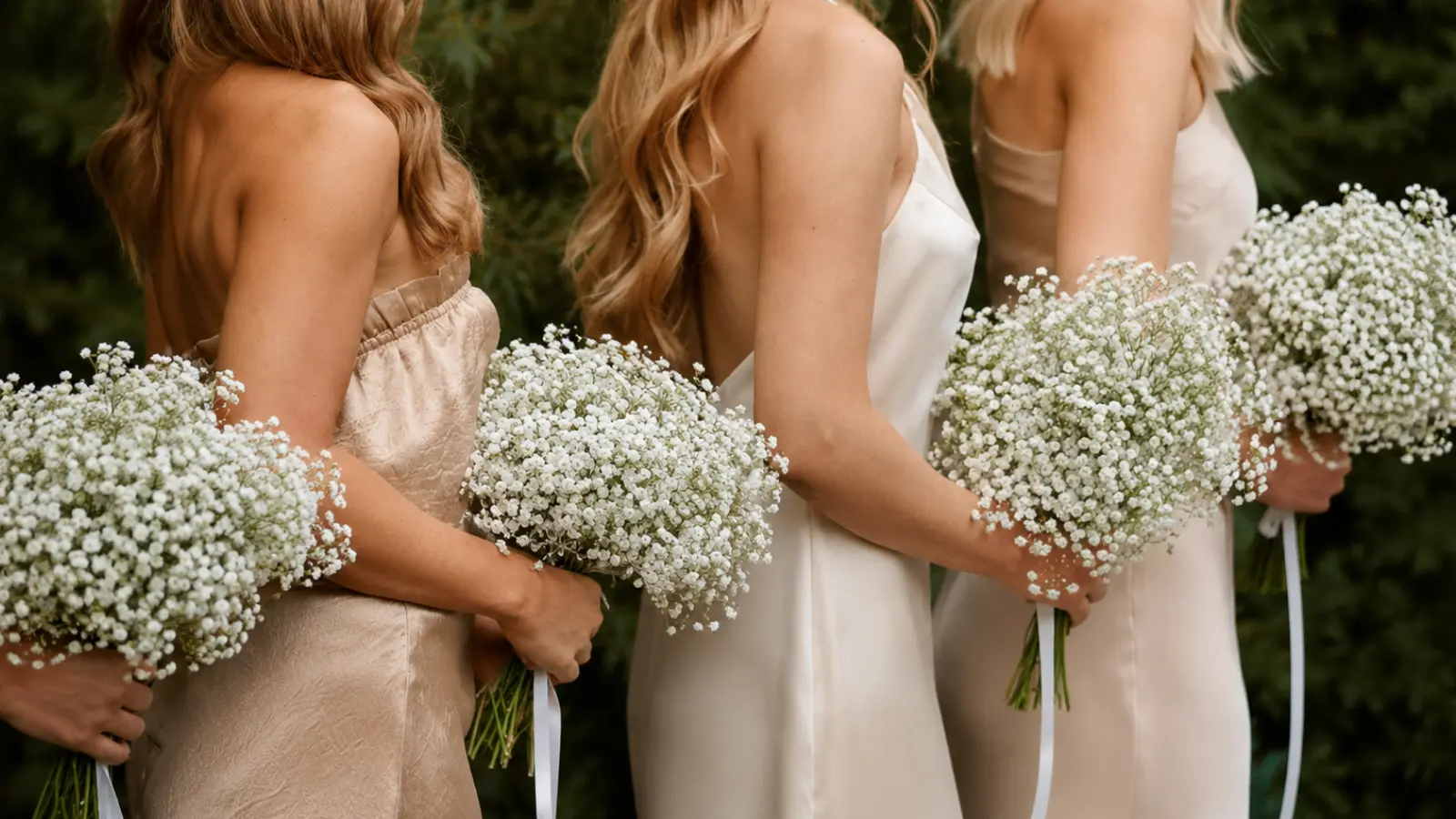
Baby’s breath is one of the most practical flowers for outfitting a full wedding party, and its practicality in this role is genuinely worth taking seriously — not as a budget compromise, but as a design choice that often produces more cohesive results than a mixed-flower bridesmaid arrangement at a higher cost.
The visual logic of baby’s breath bridesmaid bouquets works especially well when the bridal bouquet uses more complex or premium flowers. A bride carrying a lush garden rose and peony arrangement stands out clearly against a wedding party holding clean baby’s breath nosegays. The contrast reinforces the visual hierarchy rather than muddying it. This is the same principle that makes single-stem bridesmaid bouquets work — the simplicity of the party’s flowers emphasizes the abundance of the bridal bouquet.
For the bridesmaid bouquets themselves, a dense round nosegay is the format that reads best. Consistency across the party matters more than it does with the bridal bouquet, and a round form is easier to replicate across six or eight arrangements than a looser, more organic shape. Adding a simple blush or greenery accent to each nosegay — a few eucalyptus leaves, a single spray rose — keeps the arrangement from looking completely plain while maintaining the overall simplicity.
Cost is a real advantage here. Baby’s breath bridesmaid nosegays are typically a fraction of what mixed-flower arrangements cost, which can meaningfully reduce the overall wedding bouquet cost without a visible trade-off in photographs. For couples managing floral costs carefully, this is one of the more useful places to make a smart choice.
Is Baby’s Breath Affordable for Weddings?

Baby’s breath is one of the most affordable cut flowers in bridal florals, and unlike some flowers where “affordable” means seasonal limitations or sourcing challenges, baby’s breath is inexpensive and widely available year-round. It’s produced at scale, stocked by most wholesale suppliers and grocery store florists, and doesn’t require advance ordering or specialty sourcing for standard white varieties.
For a professionally made bridal bouquet built primarily on baby’s breath, a realistic planning range is $80 to $200 depending on size, density, and florist. That’s considerably lower than most rose or garden flower bouquets at comparable sizes. The labor involved in assembling a dense baby’s breath arrangement is not trivial — achieving the full cloud effect requires time and stem volume — but the material cost remains low.
For DIY brides, baby’s breath is one of the more achievable flowers to work with at home. It doesn’t bruise easily, the stems are manageable, and the round shape it naturally produces as you add stems is forgiving of minor construction imperfections. Buying in bunches from a wholesale supplier or warehouse club and assembling a week-of bouquet is a realistic approach, with conditioning the stems in water for 24 hours before assembly being the most important step.
One note on budget framing: “affordable” doesn’t mean the bouquet should look like it cost less than it did. The design choices around a baby’s breath bouquet — the ribbon finish, the density, the companion flowers if any — are what determine how the arrangement reads. Spending less on materials and investing in clean construction and presentation almost always produces better results than the reverse.
How to Make Baby’s Breath Look Elegant
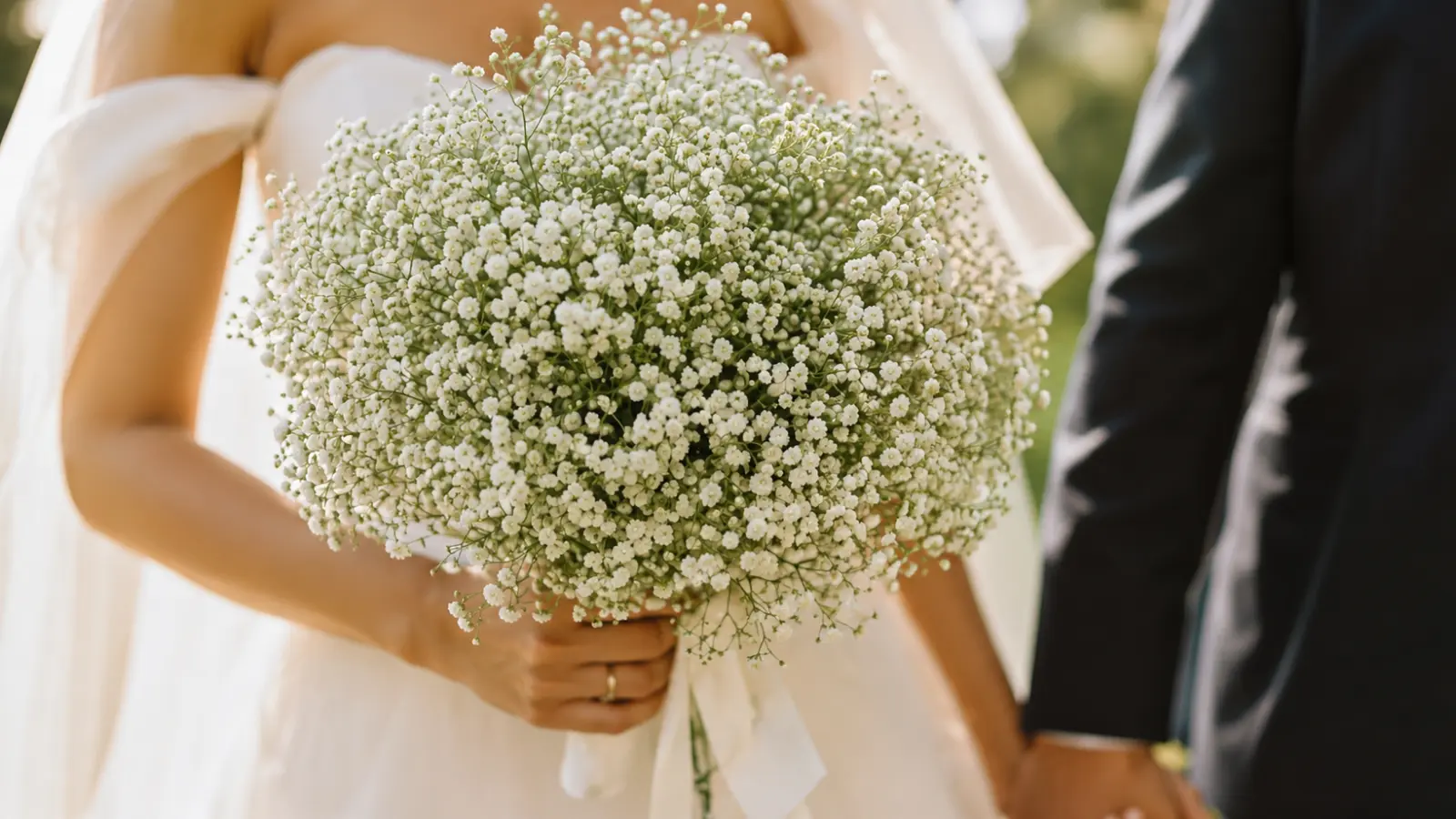
Baby’s breath looks intentional when every decision around it is intentional. The flower itself is neutral — it carries the aesthetic of what surrounds it and how it’s presented. These are the specific choices that move a baby’s breath bouquet from incidental to considered.
Build for Density
More stems than you think you need. The visual difference between a baby’s breath bouquet built from one bunch and one built from three is significant — the first reads as sparse and unfinished; the second reads as a full, airy cloud. If you’re working with a florist, ask them to build with real density. If you’re assembling yourself, buy more bunches than your estimate and trim the stems to varying lengths as you build the dome shape from the center outward.
Choose the Ribbon Deliberately
The handle treatment on a baby’s breath bouquet does more visual work than it does on a rose bouquet, where the flowers themselves carry the eye. Satin ribbon in white, ivory, blush, or dusty rose wrapped cleanly and pinned with pearl pins is the most elegant option. Velvet ribbon in forest green, deep navy, or charcoal reads as more editorial and works especially well against white baby’s breath. Avoid wide ribbon in bright colors — it competes with the softness of the flower rather than framing it.
Edit the Mix
When pairing baby’s breath with other flowers, resist the instinct to add more variety. One companion flower — or two at most — is nearly always more effective than three or four. The simplicity of baby’s breath as a primary element is what gives it character; crowding it with competing textures and colors dilutes that. A tight edit produces a more elegant result than a more abundant one.
Consider Blush Over White for Warmth
White baby’s breath is clean and versatile, but it can read as cool or clinical in certain lighting conditions — particularly in venues with warm, amber light. Blush baby’s breath, or a mix of white and blush, adds warmth that photographs more naturally in candlelit or golden-hour settings. It’s a minor adjustment with a noticeable effect in evening or indoor reception photos.
Baby’s Breath Wedding Bouquet Inspiration
Explore baby’s breath wedding bouquets featuring romantic all-white designs, elegant rose pairings, rustic bouquet ideas, bridesmaid inspiration, and timeless floral arrangements for every wedding style.
Baby’s Breath Is Beautiful When It’s Intentional
Baby’s breath proves that simplicity can be every bit as memorable as the most elaborate floral arrangement. When designed with the right density, thoughtful proportions, and careful finishing details, these tiny flowers create bouquets that feel soft, elegant, and unmistakably bridal rather than merely serving as filler.
The most successful baby’s breath bouquets embrace the flower’s natural character instead of trying to disguise it. Whether you choose an all baby’s breath design or pair it with roses, greenery, or other seasonal blooms, thoughtful styling will always make a greater difference than using more expensive flowers. With the right approach, baby’s breath creates one of the most timeless and romantic bouquets a bride can carry.
Frequently asked questions (FAQ)
Can baby’s breath be the main flower in a wedding bouquet?
Absolutely. Baby’s breath can create a beautiful bridal bouquet when it is intentionally designed as the main flower rather than used as filler. A dense, rounded arrangement with a clean ribbon wrap creates a soft cloud-like effect that feels romantic, elegant, and timeless. The key is using enough stems to build fullness and avoiding gaps that make the bouquet appear unfinished.
Does baby’s breath look cheap in a wedding bouquet?
Not at all when it is used with intention. Baby’s breath only looks inexpensive when it is scattered sparsely around other flowers without a clear design purpose. A full bouquet with thoughtful proportions, quality construction, and refined finishing details looks airy, sophisticated, and surprisingly luxurious despite its affordable price.
Is baby’s breath an affordable choice for a wedding bouquet?
Yes. Baby’s breath is one of the most budget-friendly wedding flowers available. Professionally designed bridal bouquets typically range from about $80 to $200 depending on bouquet size, florist, and bouquet density, making it possible to create a full, elegant bouquet without the cost of premium flowers such as peonies or garden roses.
What flowers pair best with baby’s breath?
Garden roses, spray roses, standard roses, ranunculus, peonies, lavender, eucalyptus, and wildflowers all pair beautifully with baby’s breath. The most successful arrangements allow one flower to remain the focal point while baby’s breath provides softness, texture, and movement rather than competing for attention.
Is baby’s breath a good choice for bridesmaid bouquets?
Yes. Baby’s breath creates cohesive, lightweight, and affordable bridesmaid bouquets that photograph beautifully in groups. Many couples pair simple baby’s breath bouquets for the bridal party with a more elaborate bouquet for the bride, creating natural visual hierarchy while keeping the overall floral budget under control.
How do you make baby’s breath look elegant?
Focus on density, simplicity, and clean finishing details. A tightly constructed bouquet with a restrained color palette, high-quality ribbon, and minimal companion flowers creates a much more refined result than an arrangement filled with too many competing textures. With baby’s breath, thoughtful editing is what creates elegance.