Emerald wedding rings are wedding rings that feature emerald gemstones, known for their rich green color, historical symbolism, and distinctive natural inclusions. Unlike harder gemstones such as diamond or sapphire, emerald offers a unique depth and character but requires more care and attention for everyday wear.
Choosing an emerald wedding ring is about balancing beauty with practicality. Emeralds have been treasured for centuries, but their natural internal characteristics mean couples should understand durability, protective settings, cleaning, and maintenance before choosing one as a lifelong ring.
This guide explains emerald wedding rings, including emerald meaning, durability, emerald vs emerald cut differences, diamond pairings, wedding band styles, proper care, and how emerald compares with other wedding rings and wedding bands for everyday wear.
Emerald Gemstone vs. Emerald Cut: The Difference That Matters
This distinction is the single most common source of confusion in the emerald ring category, and getting it wrong affects both the choice and the budget significantly. The terms describe two entirely separate things.
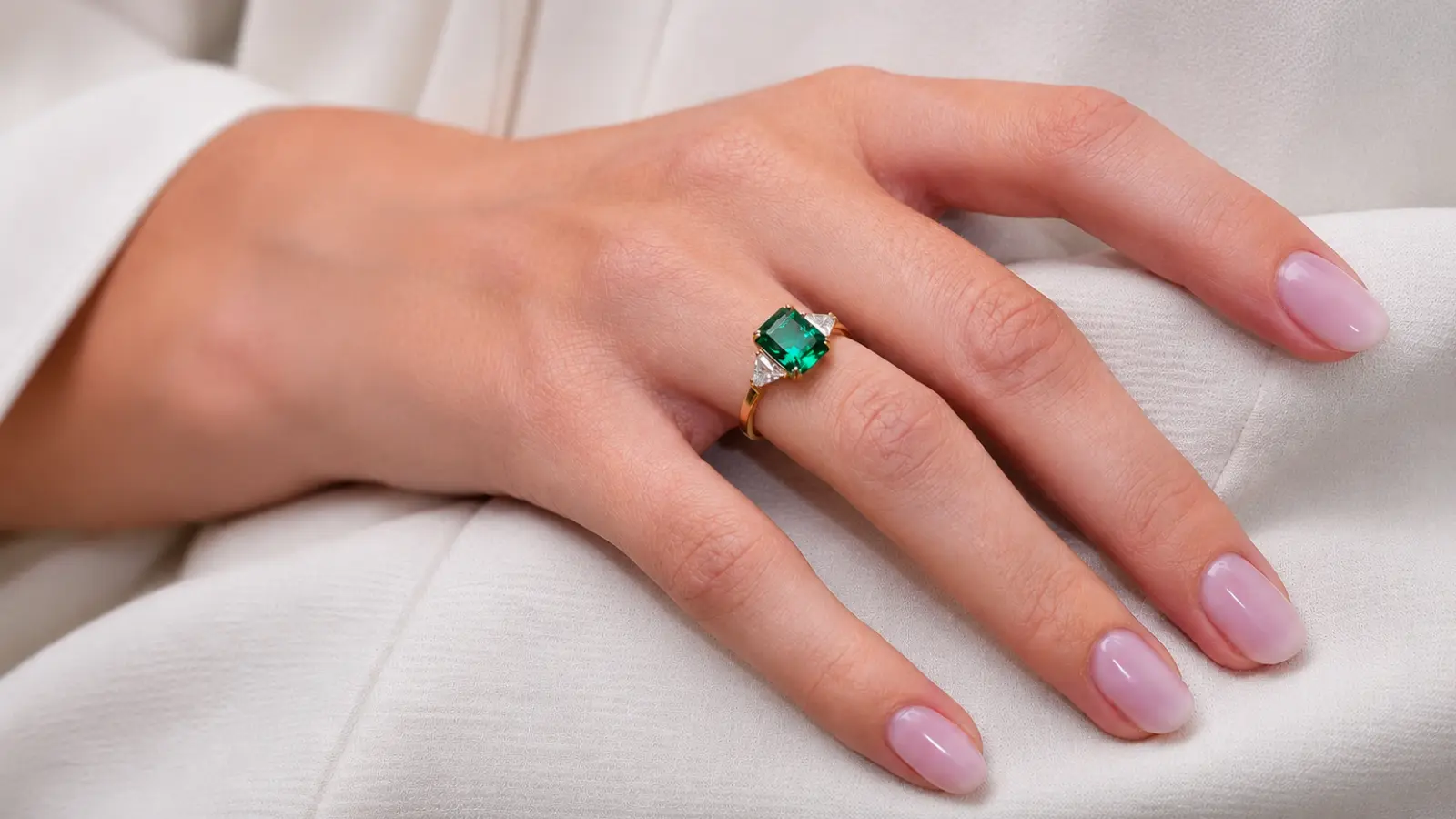
An emerald gemstone ring features an actual emerald, the deep green beryl mineral, as its center or accent stone. The emerald is a specific gemstone, valued for its color, associated with particular durability characteristics, and subject to the care requirements that define the stone. When someone asks whether emerald rings are durable, they are asking about the emerald gemstone.
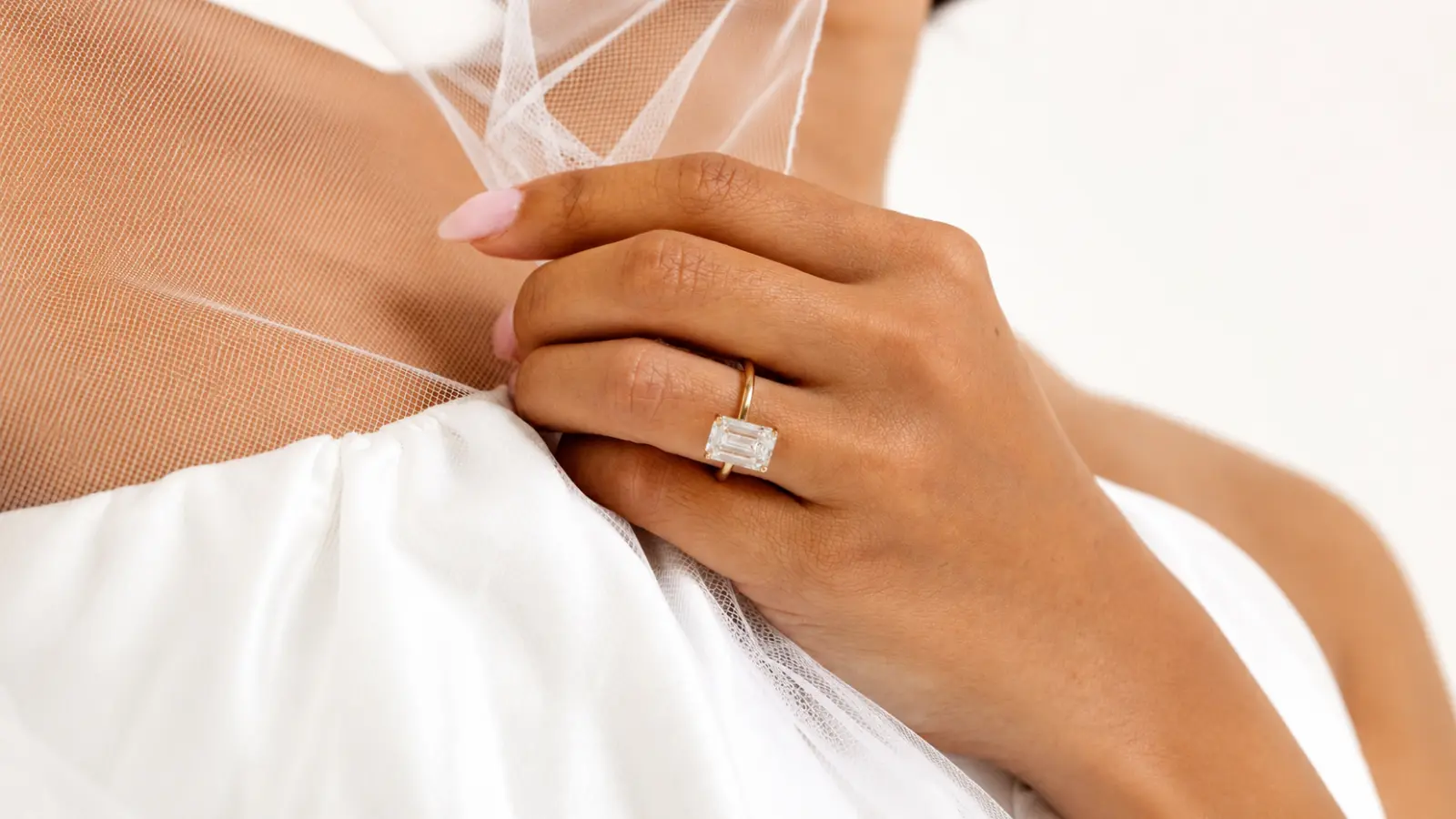
An emerald cut ring refers to the shape of the stone, a rectangular, step-cut style with truncated corners and parallel facets, originally developed for emerald stones in the early twentieth century. The emerald cut can be applied to any gemstone: diamond, moissanite, sapphire, morganite, aquamarine, or the emerald stone itself. A diamond in an emerald cut is one of the most popular contemporary choices for wedding rings. It has nothing to do with the emerald gemstone’s color or durability.
Why the Confusion Persists
The emerald cut was named after the stone it was designed to show best: the rectangular step facets suit the emerald’s inclusions and color depth more naturally than brilliant cuts do. Over time, the cutting style became widely adopted for other stones, but retained the name. Today, many emerald cut engagement rings contain diamonds rather than emerald gemstones. The name follows the cut, not the stone.
A ring can be both: an emerald gemstone in an emerald cut. It can also be neither, since a round brilliant diamond has nothing emerald about it. Understanding the distinction before shopping prevents a specific category of expensive confusion.
Are Emerald Wedding Rings Durable?
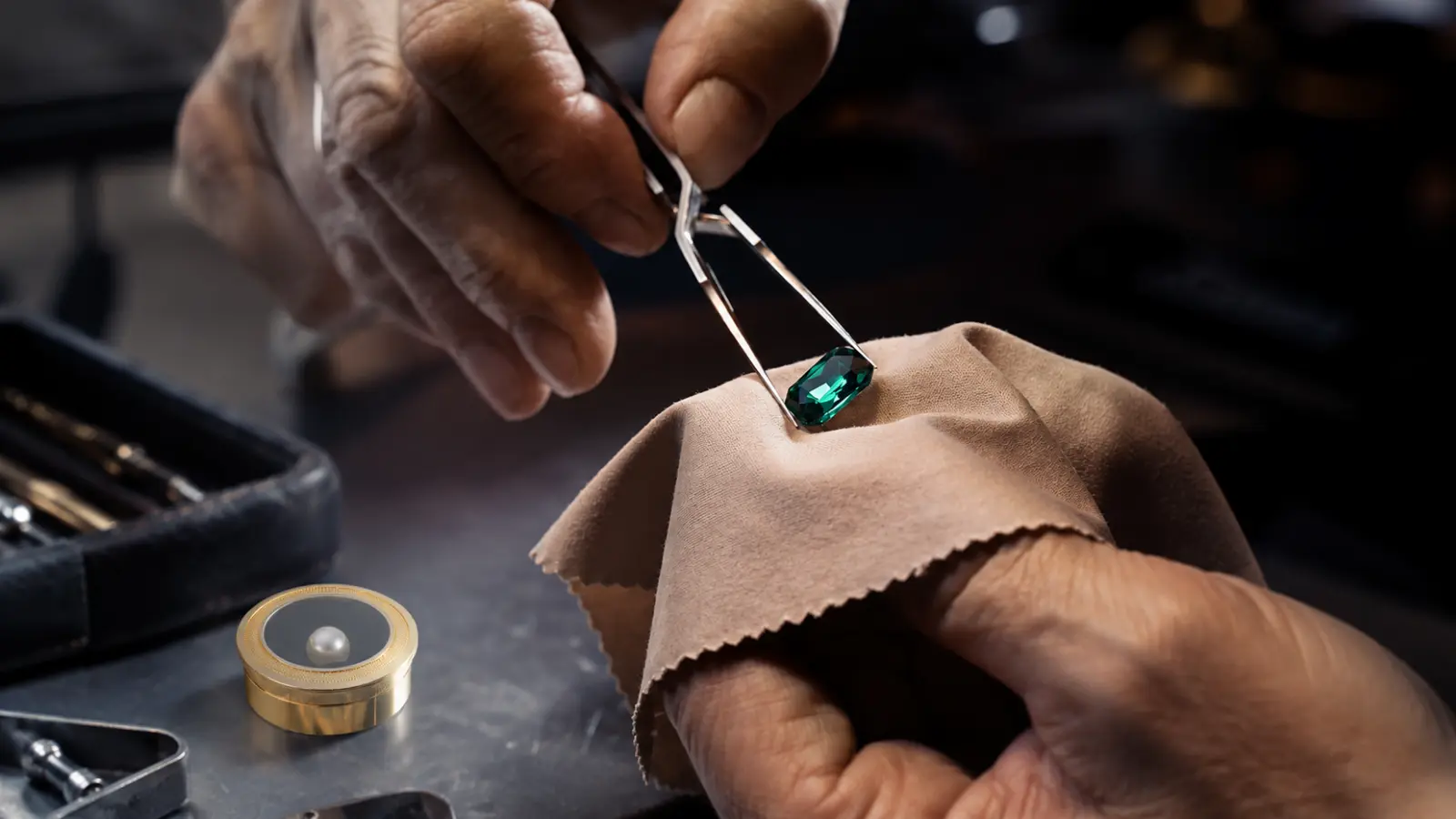
The honest answer is: durable enough, with conditions. The emerald falls between 7.5 and 8 on the Mohs hardness scale, a measure of how resistant a mineral is to surface scratching. For context: diamond is a 10, sapphire and ruby are 9, and quartz (which is present in household dust) is a 7. An emerald is harder than most everyday materials it will encounter. It will not scratch from normal daily contact with fabric, skin, or wood.
The more important vulnerability for emeralds is not hardness but toughness, and these are different properties. Toughness refers to how a stone resists chipping, cracking, and breaking under impact. Emeralds have a characteristic that makes their toughness significantly lower than their hardness suggests: nearly all natural emeralds contain internal inclusions, fractures, mineral traces, and growth marks, called jardin (French for garden, reflecting how they branch through the stone). These inclusions are not defects in the commercial sense; they are expected and accepted in the emerald trade. But they create internal stress points along which the stone can crack or chip if struck sharply.
What This Means in Practical Daily Wear
An emerald ring worn by someone who works primarily at a desk, removes the ring before exercise and housework, and brings it in for professional maintenance periodically can last for decades without significant damage. That same ring on the hand of someone who works with their hands, forgets to remove it, or regularly knocks it against hard surfaces is at meaningfully higher risk of visible damage over time.
This is not a reason to avoid emerald rings. It is a reason to choose them with accurate information about what daily wear looks like for you specifically. Some couples find the care requirement entirely manageable; others find it anxiety-inducing. Both responses are legitimate and useful data for the decision.
The Inclusions and Oil Treatment
Most natural emeralds are treated with oil or resin filling to improve the appearance of their inclusions, a practice that has been standard in the gem industry for centuries and is widely accepted at all price points. The treatment is not permanent: emerald oil can dry out over time or be dislodged by ultrasonic cleaning, steam, or prolonged exposure to chemicals. Professional re-oiling, available from most fine jewelers, restores the stone’s appearance. Knowing this in advance means knowing that the cost of maintaining an emerald ring is not zero.
Emerald and Diamond Wedding Rings
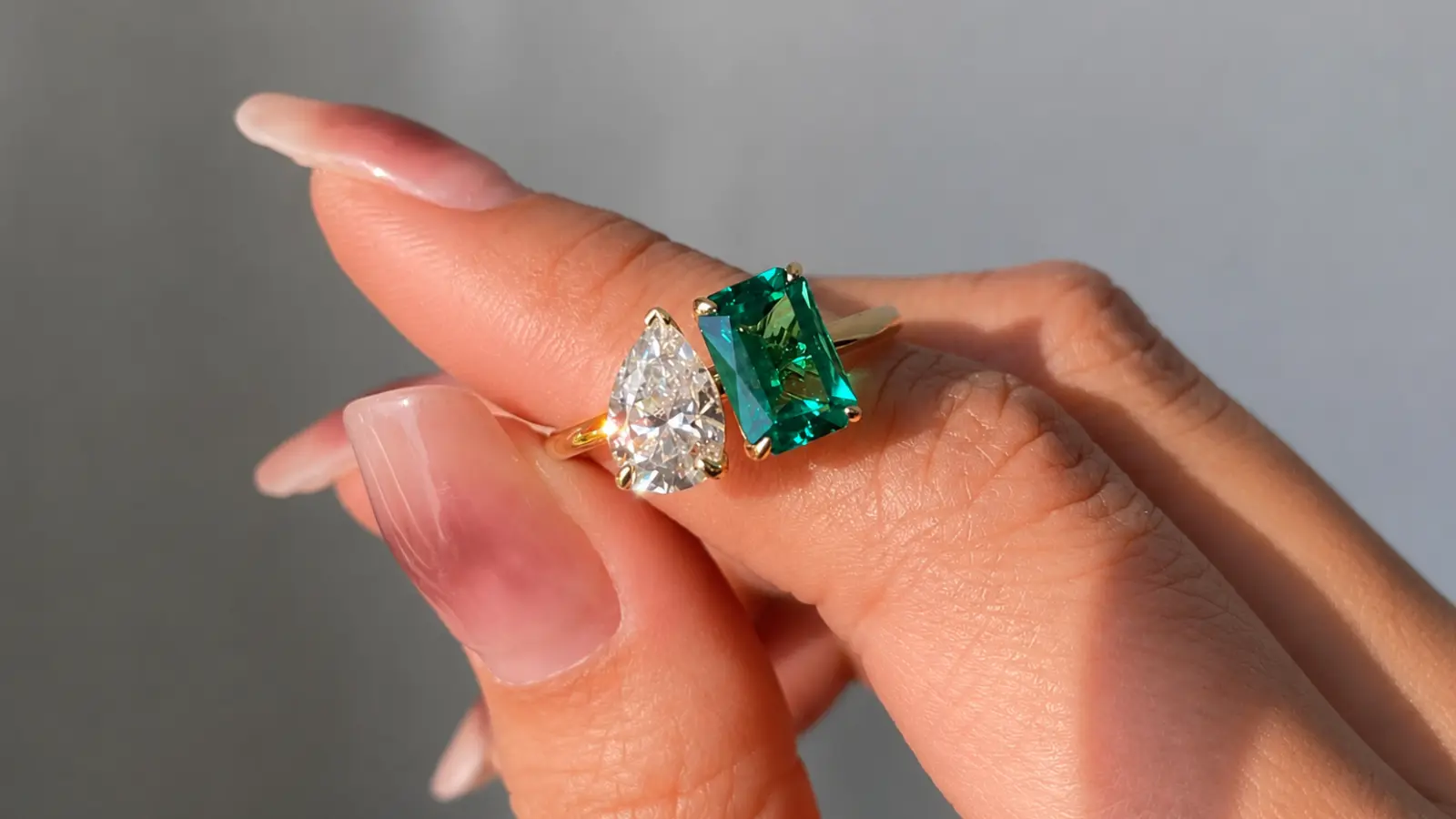
The pairing of emerald and diamond is one of the classic combinations in fine jewelry, and for good reason. The contrast created in diamond wedding rings with emerald accents is visually dramatic without being garish. Each stone enhances the other: the emerald’s color reads richer next to the white fire of diamonds, and the diamonds appear more brilliant against the green.
How Emerald and Diamond Are Typically Combined
The pairing shows up in a few recurring configurations, each striking a different balance between color and protection:
- Emerald center, diamond halo. A green emerald at the center surrounded by a ring of small diamonds is one of the most popular configurations. The halo serves two functions: it amplifies the visual size of the emerald and adds protection along its perimeter, keeping the stone’s vulnerable edges more shielded than a plain prong setting would.
- Emerald accents, diamond center. Some couples want the emerald’s color without the durability concern at the center. Using smaller emeralds as accent stones along the band, flanking a diamond center stone or set into the band itself, brings green into the design while keeping the most exposed position occupied by the harder stone.
- Alternating emerald and diamond band. A wedding band alternating emerald and diamond stones across its surface brings consistent color and sparkle without a single large emerald at risk in a raised setting. Stones in a channel-set band are also significantly more protected than those in a prong-set design.
Each configuration is a reasonable answer to the same underlying question: how much emerald, and in how exposed a position, feels right for the way the ring will actually be worn.
Metal Considerations for Emerald and Diamond Rings
Yellow gold is the traditional setting for emerald, and the pairing has centuries of precedent in fine jewelry: the warm gold tone complements the green without competing with it. White gold and platinum are also used, particularly when diamonds are the dominant element and the emerald appears as an accent. Rose gold creates a distinctive warm contrast with emerald that has grown in popularity alongside the broader rose gold jewelry trend.
For the metal setting itself, platinum offers the most secure and durable base for an emerald ring. Its rigidity and resistance to wear mean that prongs hold their position better over time, reducing the risk of an emerald becoming loose. See our platinum wedding rings and gold wedding rings for full metal comparisons.
Emerald Cut Wedding Rings
The emerald cut deserves its own discussion because, as established above, it is entirely independent of the emerald gemstone, and it has become one of the most sought-after cutting styles in contemporary wedding ring design.
The emerald cut is a step cut: rather than the triangular facets of brilliant cuts (which maximize light reflection), the emerald cut uses rectangular parallel facets arranged in steps. The visual effect is completely different from a brilliant. Instead of sparkle and fire, an emerald cut produces a deep, mirror-like optical effect, sometimes described as a “hall of mirrors,” that is calm, elegant, and substantially different from what most people picture when they think of a diamond ring.
Why the Emerald Cut Is Popular in Wedding Rings Right Now
The emerald cut reads as vintage and understated in a way that round brilliant cuts do not. Its rectangular geometry is architectural and clean; it suits minimalist and modern aesthetics as well as Art Deco inspired designs. It also tends to look larger face-up than a round stone of the same carat weight, because its shape distributes the surface area more efficiently. On the finger, an emerald cut elongates the hand in a way that many wearers find flattering.
The trade-off: because the emerald cut’s step facets are large and open, the stone’s interior is more visible than in a brilliant cut. Inclusions and color tints show more clearly in an emerald cut, which is why the cut traditionally demands higher clarity grades in diamond, and why it was originally developed for the emerald stone, whose inclusions are accepted rather than hidden. For diamond emerald cut rings, investing in clarity pays off more visibly than it does in brilliant cuts.
Emerald Cut in Stones Other Than Emerald or Diamond
Moissanite in an emerald cut has become a particularly popular choice. The stone scores 9.25 on the Mohs scale, produces exceptional brilliance even in step cuts, and costs dramatically less than a diamond of equivalent size. For couples who want the emerald cut’s aesthetic with maximum durability and budget efficiency, moissanite is worth serious consideration. Sapphire in an emerald cut is another strong option, bringing a 9 Mohs score and a range of color choices, including green sapphires for couples who want the color without the emerald stone’s limitations.
How to Care for Emerald Rings
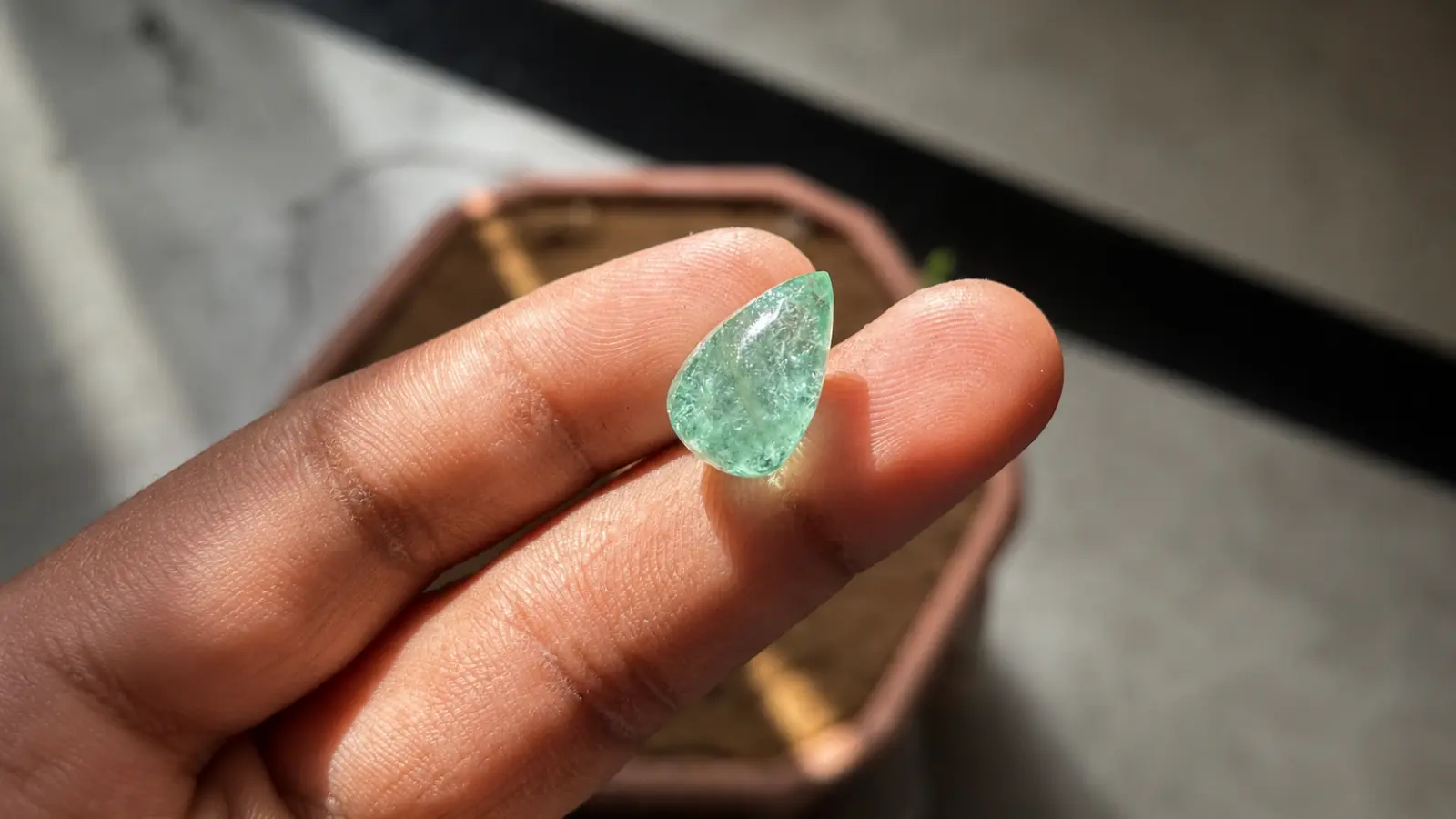
The care requirements for an emerald ring are specific and non-negotiable, meaning that following them consistently protects the stone, and ignoring them creates predictable, avoidable damage. This is not a complicated routine, but it does require intention.
What to Avoid
A few specific habits are responsible for most of the avoidable damage emerald rings suffer, and all of them are easy to plan around once you know about them:
- Ultrasonic cleaners. The vibrations from ultrasonic cleaning can worsen existing fractures in an emerald, propagating cracks through the stone’s jardin. Many jewelers offer ultrasonic cleaning as a standard service for rings brought in for maintenance; an emerald ring should be explicitly exempted. Tell the jeweler before handing it over.
- Steam cleaning. High-temperature steam can damage the oil or resin treatment inside an emerald’s fractures, causing the treatment to dry out and the stone’s appearance to deteriorate. Steam cleaning is safe for diamonds and most harder stones; it is not safe for emeralds.
- Harsh chemicals. Chlorine (swimming pools, hot tubs) and household cleaning chemicals can penetrate an emerald’s fractures and degrade its treatment. The ring should come off before any contact with these substances.
- Physical impact. Exercise, gardening, cooking with heavy pots, moving furniture; any activity that creates a real chance of striking the ring against a hard surface is a situation where the ring should not be on the hand.
None of this requires constant vigilance once it becomes habit. Most couples settle into a simple rhythm: rings off for the gym and the kitchen, rings on for everything else.
What to Do Instead
Clean an emerald ring with a soft brush (a clean toothbrush works well), mild dish soap, and lukewarm, not hot, water. Work gently around the stone, rinse thoroughly, and pat dry with a soft cloth. Do not soak the ring. This method is safe as often as needed and will not disturb the stone’s treatment.
Bring the ring to a jeweler once a year for inspection, checking that prongs are secure, the stone has not loosened, and the setting shows no signs of wear. Every two to three years, consider professional re-oiling, which restores the clarity-enhancing treatment and refreshes the stone’s appearance. The cost is modest and the difference is visible.
Storage
Emeralds are soft enough to be scratched by diamonds and other harder stones. Store an emerald ring in its own compartment or pouch, separate from diamond jewelry. A ring stored loose in a jewelry box with other pieces is a ring being slowly scratched by everything it touches.
Who Should Choose an Emerald Wedding Ring?
The question is not whether an emerald wedding ring is beautiful. It is. The question is whether it is right for the specific person who will wear it every day for decades. These are two different evaluations.
Emerald Tends to Work Well For
A handful of traits keep showing up in couples who end up happy with an emerald wedding ring years later:
- Someone whose daily life does not regularly put their hands in physical danger. Office work, creative work, and professional environments where the ring faces ordinary contact rather than impact or chemicals.
- Someone who genuinely loves the color green and finds that emerald’s particular shade, rich, slightly warm, and never quite cold or electric, is irreplaceable for them.
- Someone comfortable with a maintenance relationship with their jewelry: removing it for activities, cleaning it with care, and bringing it in periodically for professional attention.
- Someone drawn to the vintage quality the stone carries. Emeralds have been used in fine jewelry for thousands of years, and a ring with a real emerald center stone carries that history in a way no lab-created or alternative stone fully replicates.
None of these traits is rare on its own, but a couple who recognizes themselves in most of the list tends to enjoy emerald rather than worry over it.
Emerald Is a Harder Fit For
On the other side, a few situations make emerald a tougher recommendation, even for someone who loves how it looks:
- Someone who works with their hands physically. Medical professionals who scrub frequently, people in construction, agriculture, or food service, or anyone with regular chemical or impact exposure.
- Someone who knows they will forget to remove it before activities that put the stone at risk.
- Someone who wants a ring that requires no special attention and can be worn through everything without worry.
- Someone whose budget is tight and who would rather not plan for periodic maintenance costs.
- Someone whose primary attraction is the color green, rather than the emerald stone specifically, since durable green alternatives exist and deserve serious consideration.
If two or more of these sound familiar, it is worth reading the alternatives section below before falling in love with a specific emerald ring.
More Durable Alternatives for the Green Look
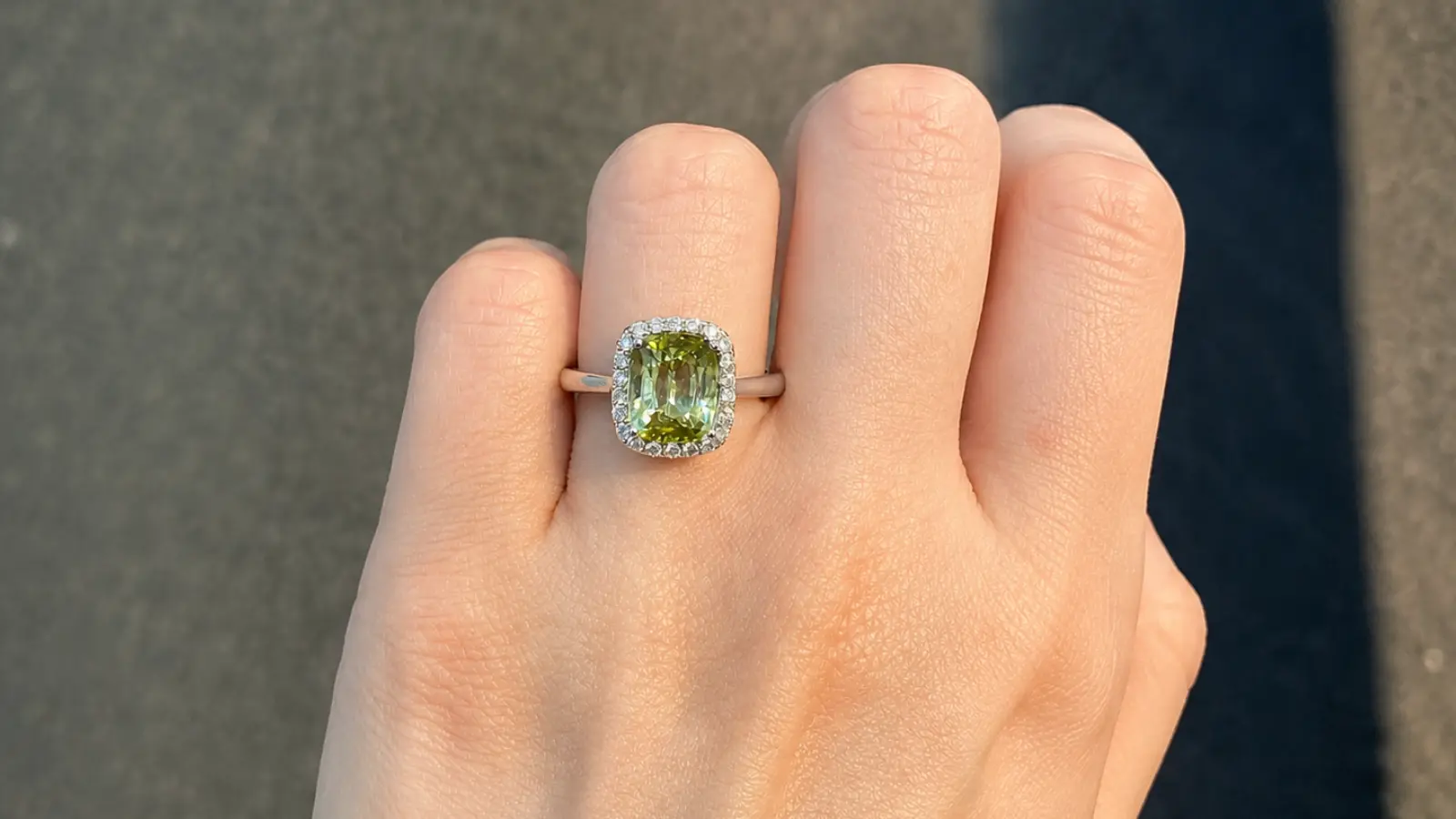
For couples who want green in their wedding ring without the emerald’s vulnerability, several alternatives offer comparable or superior color at higher hardness ratings and lower maintenance demands.
| Stone | Mohs Hardness | Green Tones | Key Advantage vs. Emerald |
|---|---|---|---|
| Green Sapphire | 9 | Teal to deep forest green | Near-diamond hardness, naturally eye-clean, no treatment required |
| Tsavorite Garnet | 6.5–7.5 | Vivid, rich green, often greener than emerald | Naturally eye-clean, not treated with oil, more vibrant color per carat |
| Green Tourmaline | 7–7.5 | Wide range, from mint to deep green | Widely available, good daily wear, strong color saturation |
| Lab-Created Emerald | 7.5–8 | Identical to natural emerald | Same hardness but often fewer inclusions, significantly lower cost |
| Green Moissanite | 9.25 | Lab-created green tones | Highest durability of any green option, most affordable at size |
Of these, green sapphire wedding rings are the closest substitute for someone who loves deep green and wants greater daily wear confidence. Tsavorite garnet is worth serious consideration for its color intensity: many jewelers and gemologists find tsavorite’s green more vivid and saturated than most natural emeralds at similar price points. Lab-created emerald offers the exact color and appearance of a natural emerald with typically fewer inclusions and significantly lower cost, while still carrying the same hardness and care requirements as its natural counterpart.
For couples who are open to alternatives, the unique wedding rings covers non-traditional stone choices more broadly.
Emerald Wedding Ring Inspiration
Emerald wedding rings are known for their rich green color, vintage beauty, and timeless elegance. Explore our inspiration board for emerald and diamond rings, gold settings, Art Deco designs, halo styles, emerald wedding bands, and unique green gemstone ideas.
Choosing an Emerald Wedding Ring With Confidence
An emerald wedding ring is not the easiest choice, but it can be one of the most meaningful. Its deep color, natural character, and history create a beauty that comes from more than perfection — it comes from choosing a stone with personality.
The right emerald ring belongs to someone who understands both what the gemstone offers and what it asks in return. When beauty, lifestyle, and care all align, an emerald wedding ring is not a compromise or a risk — it is a match.
Frequently asked questions (FAQ)
Are emerald wedding rings too fragile for everyday wear?
Emerald wedding rings can be worn every day, but they require more care than diamonds or sapphires. The main concern is not only hardness — emeralds are reasonably hard — but their natural inclusions, which can make them more vulnerable to chips from impact. Someone who removes their ring during physical activities and protects it from harsh conditions can enjoy an emerald wedding ring for decades.
Why do emerald rings need more care than other gemstones?
Emeralds need more care because most natural emeralds contain internal characteristics called inclusions, often described as “jardin.” These are part of what makes each emerald unique, but they can also create weaker points inside the stone. Many emeralds also receive clarity treatments, which means they should avoid ultrasonic cleaners, steam, and harsh chemicals.
What is the safest setting for an emerald wedding ring?
The safest emerald wedding ring settings are usually designs that protect the stone’s edges. Bezel settings surround the emerald with metal, while halo settings add another protective layer around the stone. Lower-profile designs are often better for everyday wear because they reduce the chance of the emerald hitting hard surfaces.
Is an emerald cut ring the same as an emerald ring?
No. An emerald ring and an emerald cut ring are two different things. An emerald ring contains the green emerald gemstone. An emerald cut describes a rectangular step-cut shape that can be used for many stones, including diamonds, sapphires, moissanite, or emeralds. A ring can have an emerald cut without containing any emerald at all.
Should you choose emerald or a more durable green gemstone?
It depends on what matters most to you. Emerald offers a unique deep green color, history, and character that many people find impossible to replace. However, green sapphire, tsavorite garnet, and some other green stones can offer greater durability or easier maintenance. The choice depends on whether you value emerald’s identity specifically or simply want a beautiful green wedding ring.
What should you know before buying an emerald wedding ring?
Before buying an emerald wedding ring, understand that it is a more intentional choice than many other gemstones. Consider your lifestyle, how often your hands face impact, whether you are comfortable removing the ring during certain activities, and whether you are willing to maintain the stone properly. Emerald is best for someone who loves its beauty enough to care for it.