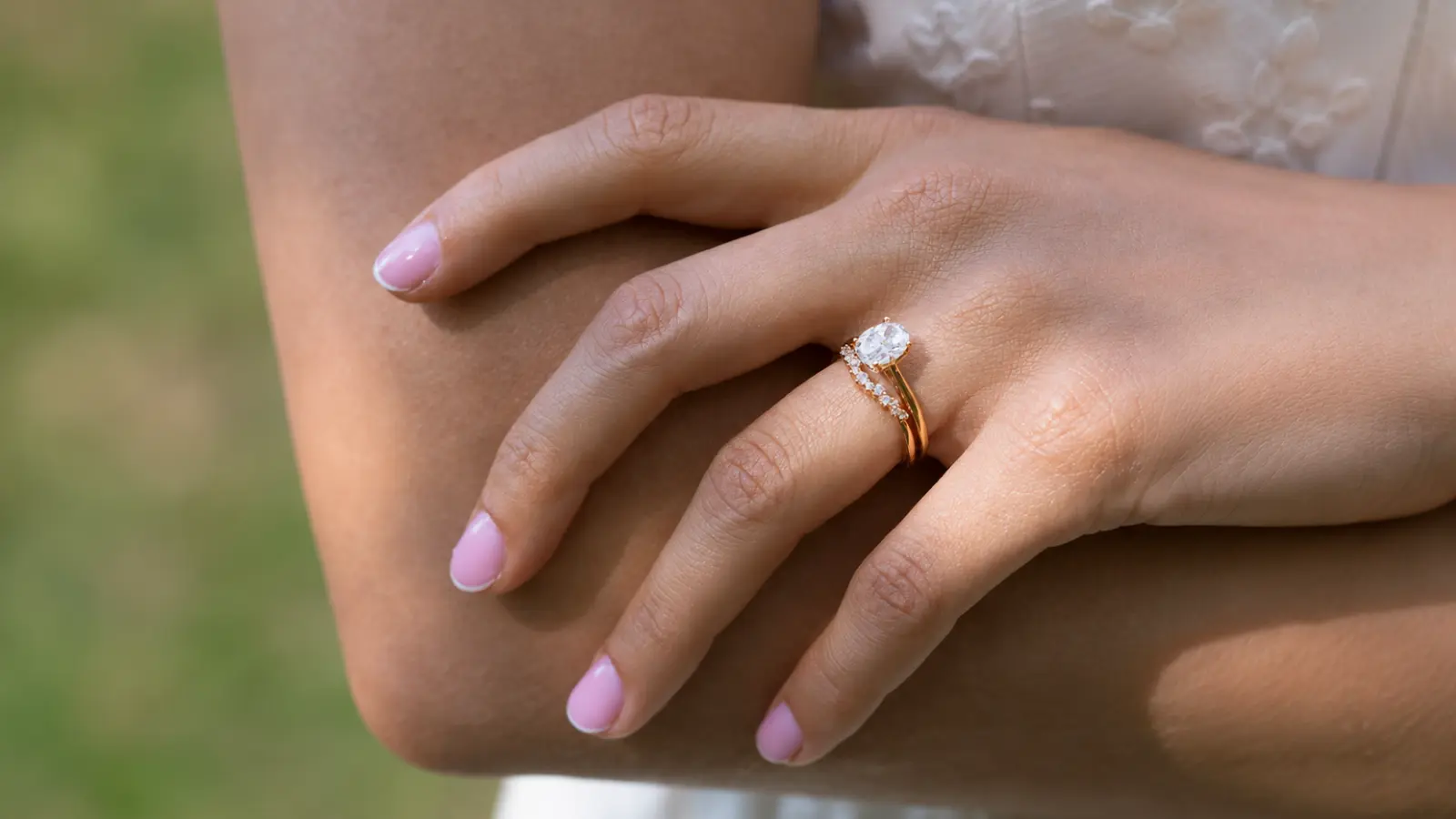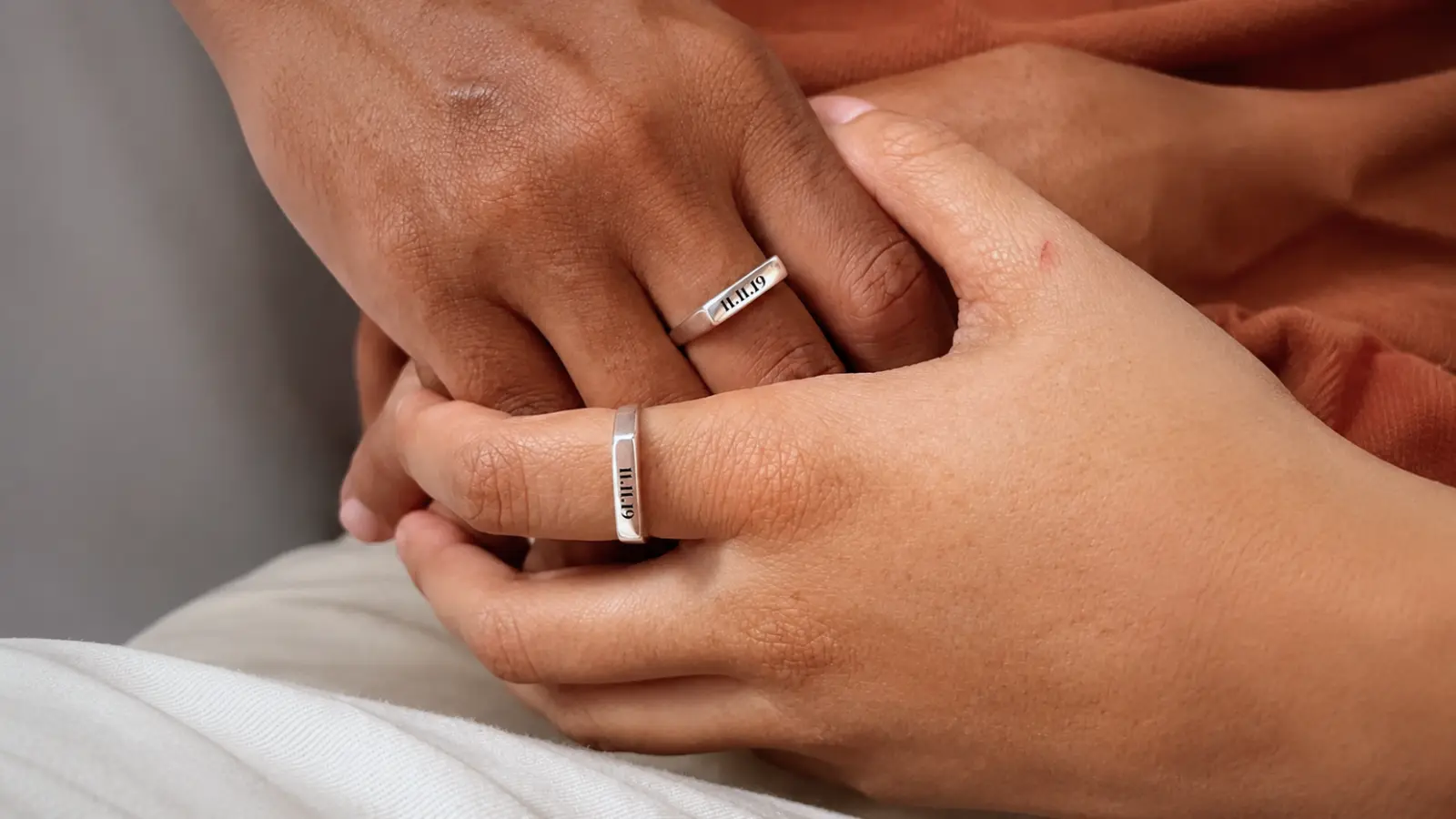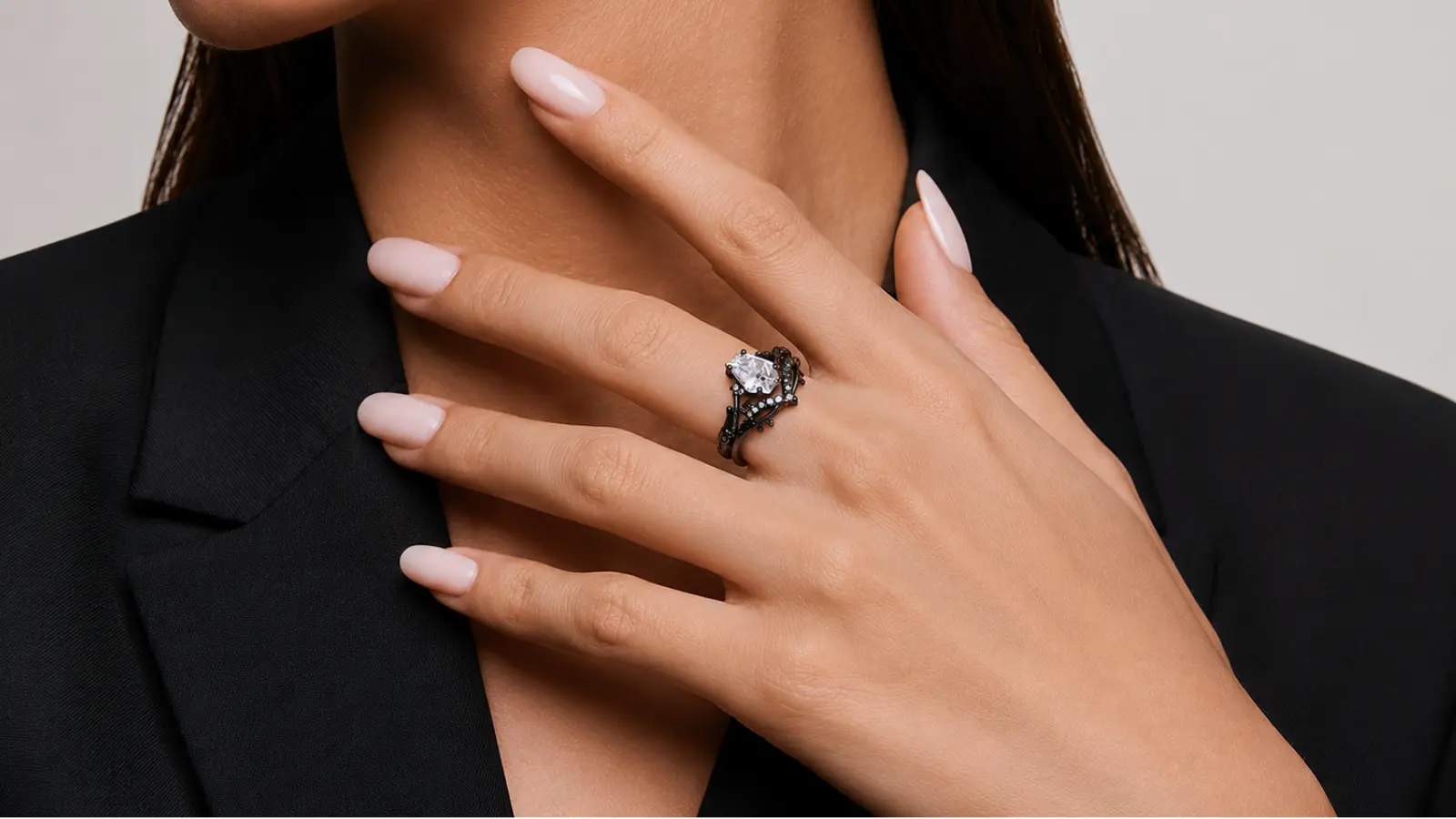
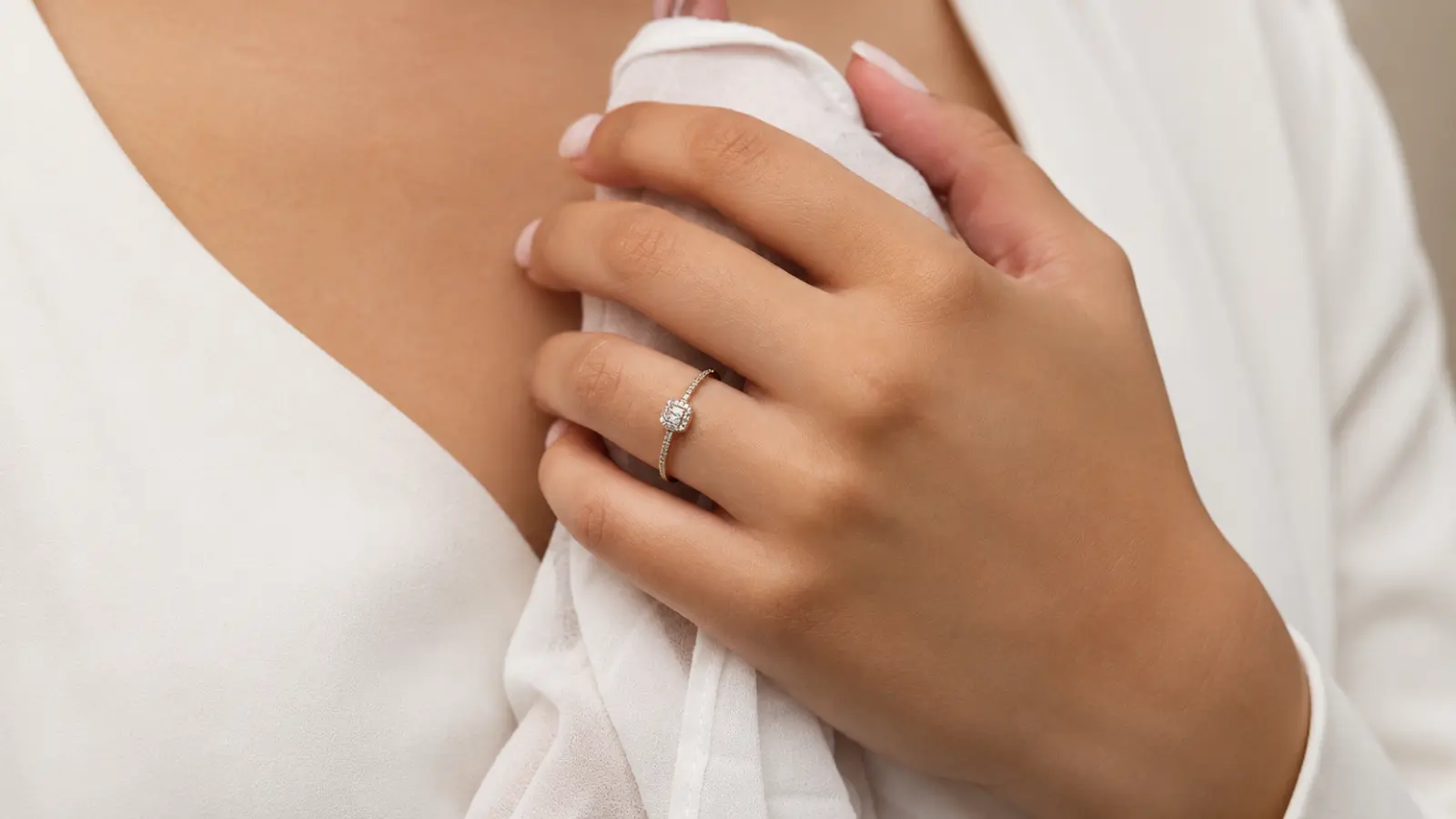
Minimalist wedding rings are wedding rings designed with intentional simplicity, using clean shapes, thin bands, subtle details, and carefully chosen materials instead of heavy decoration. These rings focus on proportion, comfort, craftsmanship, and everyday wear rather than size or visual complexity.
There is a particular kind of confidence in choosing a wedding ring that does not need to be the most noticeable piece in the room. A minimalist ring can feel meaningful because every detail that remains — the metal, finish, shape, or small personal element — has been chosen with purpose.
This guide explains minimalist wedding rings, including thin wedding bands, dainty designs, simple gold rings, subtle diamond styles, stacking ideas, everyday durability, and how minimalist designs fit within different wedding rings and wedding bands.
Minimalist Wedding Rings Explained
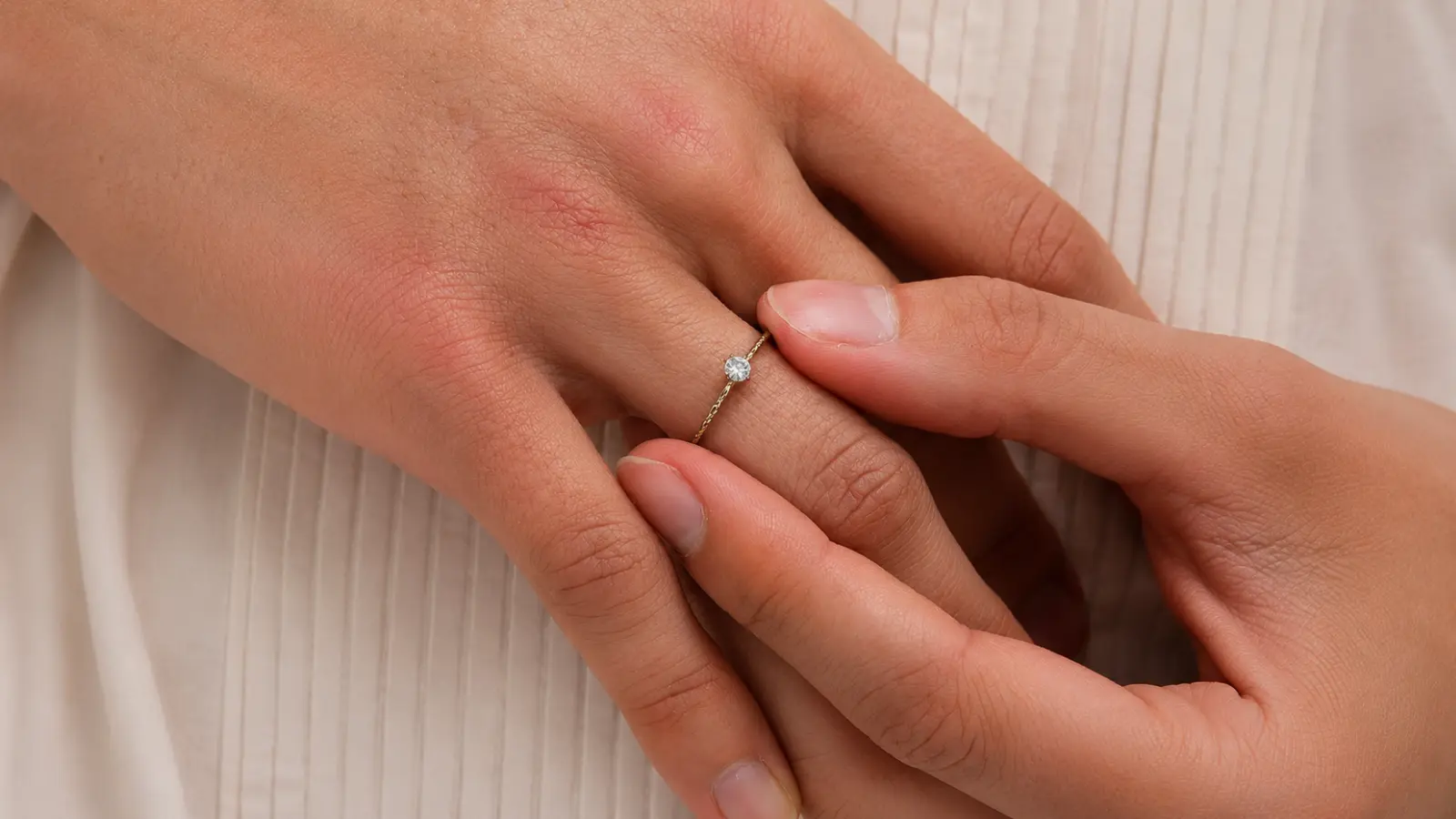
It’s worth separating minimalist from two ideas it often gets confused with: plain, and inexpensive. A minimalist ring is frequently plain, but plainness alone doesn’t make a ring minimalist. A wide, heavy, high-polish band with no stones is plain, but it isn’t necessarily minimalist in the way the term is used in design more broadly. And while minimalist rings can be more affordable than elaborate ones, they aren’t minimalist because they’re cheaper. In fact, because a minimalist design has so few elements, the quality of each one, the metal, the proportions, the finish, tends to matter more, not less, and can sometimes make a simple ring more expensive than a busier one made from lower-quality materials.
What actually defines minimalist design, in wedding rings as in any other context, is the deliberate reduction of a design to its essential elements, and the confidence that those essential elements, executed well, are enough. A thin band in beautifully finished platinum is minimalist not because nothing else was possible, but because the designer (or the person choosing it) decided that the band and the metal alone were sufficient, and that anything more would be additive rather than necessary.
This is closely related to, but distinct from, the broader modern design principles covered in our guide to modern wedding rings. Modern design often uses contrast, geometry, and mixed materials as deliberate elements. Minimalist design, by comparison, is more specifically about reduction: fewer elements, not necessarily different ones. A ring can be modern without being minimalist (a geometric, mixed-metal design with several deliberate elements) and minimalist without being especially modern (a simple round band in a traditional profile, just thinner and plainer than most). The two overlap often, but they’re answering slightly different questions: modern asks what kind of elements are used; minimalist asks how many.
Thin Wedding Bands
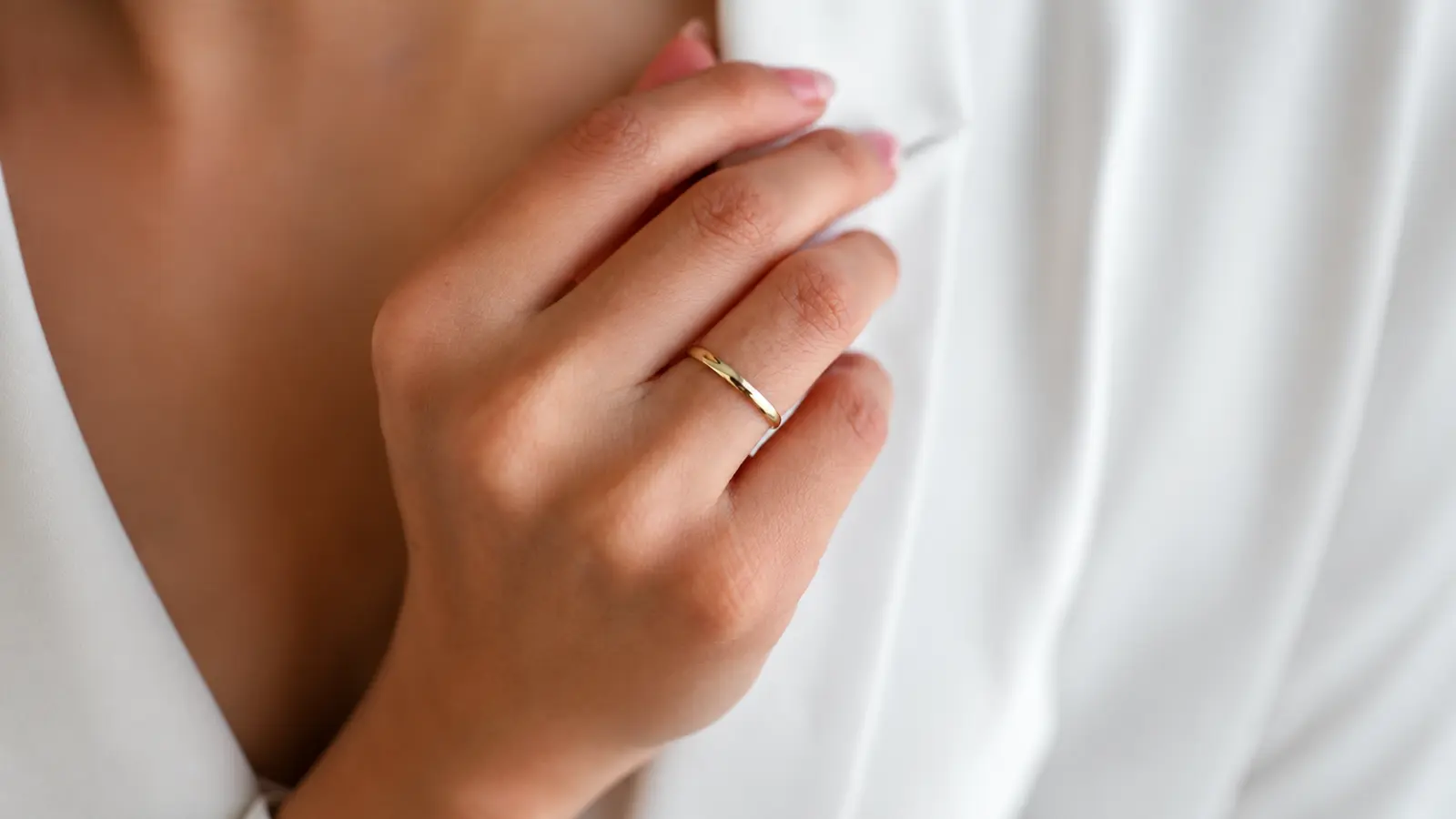
Thin bands, generally in the 1mm to 2mm range, are perhaps the most immediately recognizable minimalist style, and they’re worth understanding both in terms of how they look and how they actually perform over years of wear.
Visually, a thin band’s appeal is largely about what it doesn’t do: it doesn’t compete with anything else on the hand, whether that’s an engagement ring, other stacked rings, or simply the hand itself. A thin band tends to disappear into the overall look of the hand in a way a wider band doesn’t, which, for many people, is precisely the point. The ring is there, it’s meaningful, but it isn’t the first thing anyone notices.
In terms of durability, the width of a band is a separate question from how much metal is in the ring overall, since a band’s depth, the dimension from the front surface to the back, against the skin, can vary independently of its width. A thin band made with appropriate depth in a durable metal like platinum or 14k gold holds up to daily wear just as well as a wider band in the same metal. The metal itself isn’t weaker because the band is narrower.
What does change with thin bands is a short list of practical, everyday details worth knowing before you choose one:
- Easy to misplace when removed — there’s so little of it to notice on a counter, in a pocket, or by the sink
- Slightly harder to resize dramatically — a band with very little width has less metal to work with during a major resizing
- Best paired with a properly fitted depth — a thin, shallow band feels different on the hand than a thin band with real depth, even at the same width
None of this points to fragility. It simply means a thin band rewards a little bit of habit, like setting a small dish by the sink, more than a wider, more visually obvious ring would.
Thin bands are also, almost by definition, the foundation of most stacking arrangements. Their narrowness is what allows multiple stackable wedding rings to be worn together without the overall effect feeling heavy. For more on how stacking works in practice, including how to combine bands of different widths and finishes, see our guide to women’s wedding band styles.
Dainty Wedding Rings
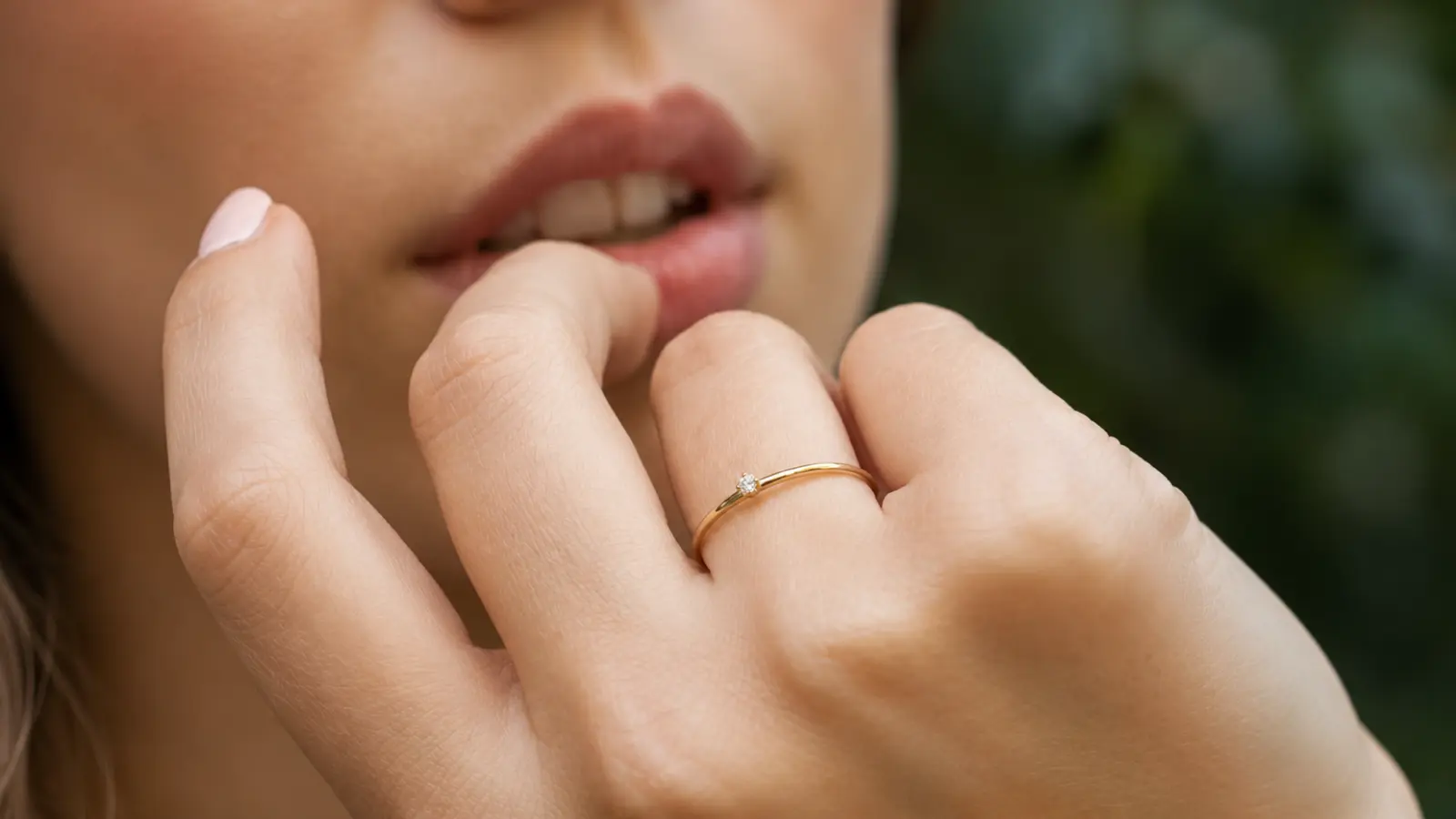
“Dainty” overlaps with “thin” but isn’t quite the same thing. Dainty describes an overall impression of delicacy that can come from width, but also from the scale of any stones, the fineness of any prongs or settings, and the overall proportions of the ring relative to the hand.
A dainty ring with a small diamond, for example, isn’t dainty just because the band is thin. It’s dainty because the stone is small relative to the band, the setting holding it is correspondingly fine and unobtrusive, and nothing about the ring’s proportions suggests it was scaled down from a larger design. A larger stone on a thin band, by contrast, can look almost the opposite of dainty: disproportionate, with the stone appearing to overwhelm the band beneath it.
The durability question that comes up most with dainty rings concerns settings rather than the band itself:
- Prong settings — a very small stone held by very fine prongs has, by definition, less metal holding it in place than a larger stone in a more substantial setting; this calls for slightly more frequent jeweler checks, not a different approach to wear
- Flush settings — the stone is set directly into the surface of the band with no raised prongs at all, which removes the prong durability question entirely while preserving the delicate look
- Bezel settings — a thin metal rim surrounds the stone instead of prongs, offering a bit more daily protection while still reading as understated
For most dainty rings with stones, a flush or bezel setting tends to be the lower-maintenance choice, while a fine prong setting offers a slightly more delicate look in exchange for a touch more upkeep. Neither is the wrong call; it’s simply a trade-off worth knowing before you choose.
Simple Gold Rings
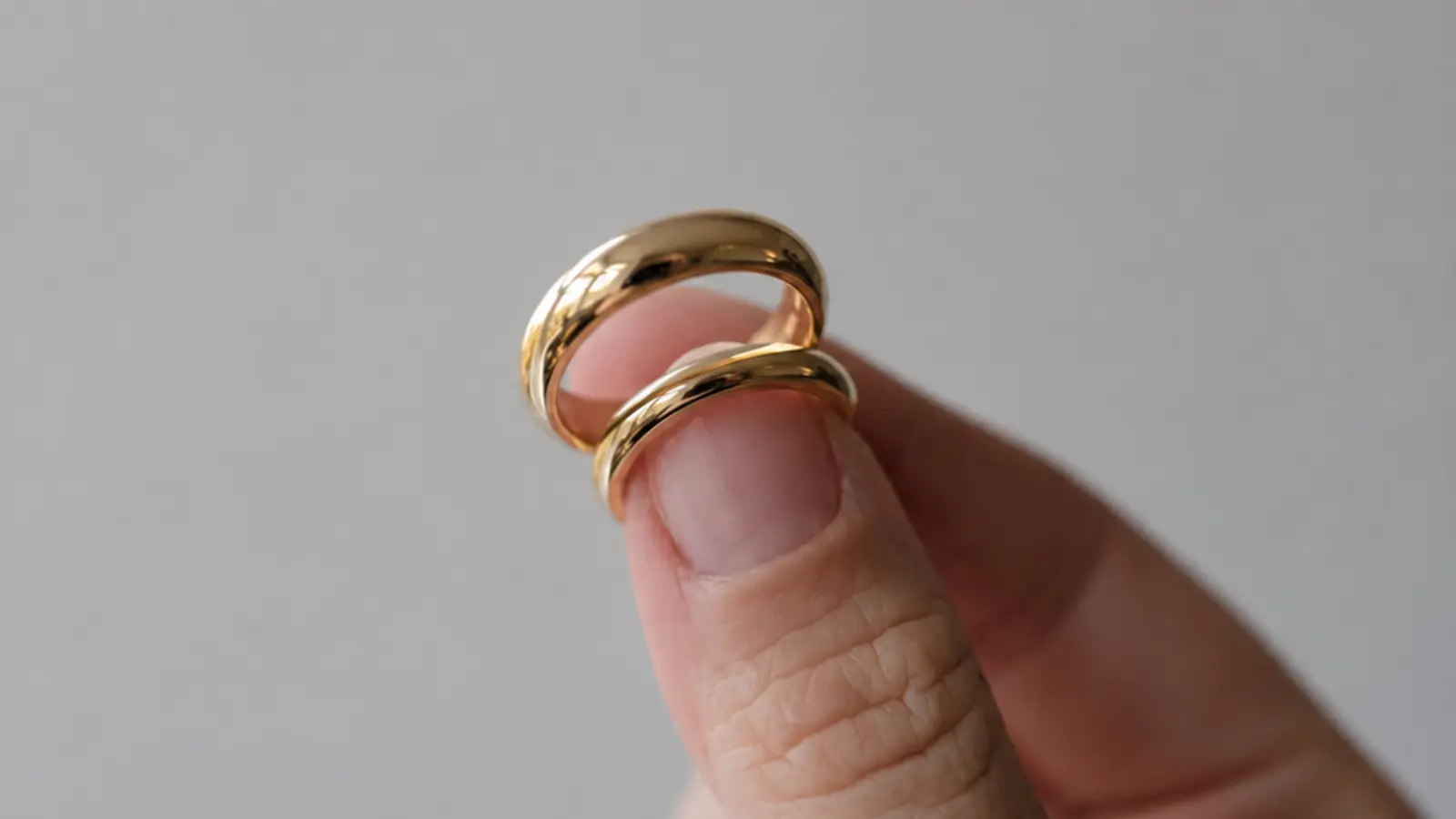
A simple gold ring, a plain band, unadorned, in yellow, white, or rose gold, might be the single most common starting point for minimalist wedding ring design. It’s worth spending a moment on what actually distinguishes one simple gold ring from another, since “simple” doesn’t mean “interchangeable.”
Karat affects both color and durability in gold wedding rings. 18k gold has a noticeably richer, deeper color due to its higher pure gold content, which on a simple band, with nothing else to look at, becomes one of the most defining visual qualities of the ring. 14k gold has a slightly less intense color but is more durable for daily wear, making it a common choice for simple bands that will see continuous use.
Finish matters more on a simple ring than almost anywhere else, precisely because there’s nothing else competing for attention. The table below compares the three finishes that come up most often for simple gold bands.
| Finish | Character | Best For |
|---|---|---|
| High polish | Clean, traditional, maximum reflectivity | Those who want a classic, timeless look |
| Brushed or matte | Quieter, more textured, less reflective | Hands that are on display often, or a softer everyday look |
| Hammered | Subtle texture with movement and light play | A band with a bit more personality, without adding ornamentation |
The choice of finish on a simple band isn’t a minor detail; it’s arguably the primary design decision, since it’s the main thing distinguishing the ring’s character once the metal and karat are decided.
Proportions, the relationship between the band’s width and its depth, and how both relate to the wearer’s hand, are the other major factor, and the one that’s hardest to evaluate without trying rings on in person. A simple band that looks elegant in a photograph can feel either too delicate or too substantial on an actual hand, and because a simple ring has no other design elements to balance that impression, getting the proportions right matters more here than it would on a ring with more going on. This is part of why simple gold rings, despite their apparent plainness, are often worth trying on in several width and profile variations before deciding. Small differences that wouldn’t matter much on a more elaborate ring can change the entire character of a simple one.
Decision Tool: Which Minimalist Style Fits You
Choose a thin band if you want a ring that disappears into your daily routine and stacks easily with other rings.
Choose a dainty ring if you want a touch of sparkle without a stone that competes for attention.
Choose a simple gold band if you want the metal and finish, rather than any stone, to carry the design.
Minimalist Rings for Everyday Wear
If there’s one category of wedding ring where “good for everyday wear” and “the design itself” are almost the same thing, it’s minimalist rings. The qualities that make a ring practical for daily life and the qualities that define minimalist design overlap to an unusual degree.
A thin band has fewer surfaces to catch on clothing, hair, or gloves. A simple, unadorned profile means there’s nothing raised to wear down or loosen over time. A small or flush-set stone, if present at all, doesn’t create the catch points that a larger raised stone or a dense pavé surface might. None of these qualities were necessarily chosen for practical reasons. They’re simply what minimalist design tends to produce, but the practical benefit is real and consistent. For more on how different ring styles hold up day to day, see our guide to how to wear wedding rings.
This means that for someone whose priority is genuinely a ring they can wear without thinking about it, through manual work, through exercise, through every ordinary task a day involves, minimalist styles tend to require the least adaptation. There’s very little to get used to, very little to remember to protect, and very little that changes in how the hand feels from one day to the next, whether the ring is new or has been worn for years.
The one area where minimalist rings ask slightly more of the wearer is the dainty-ring consideration mentioned earlier, very fine settings benefit from periodic checking, and the practical matter of thin bands being easy to misplace when removed. Neither of these is a significant drawback, but they’re the closest thing minimalist design has to a maintenance consideration, and worth being aware of simply so they don’t come as a surprise.
How to Make Minimalist Rings Feel Special
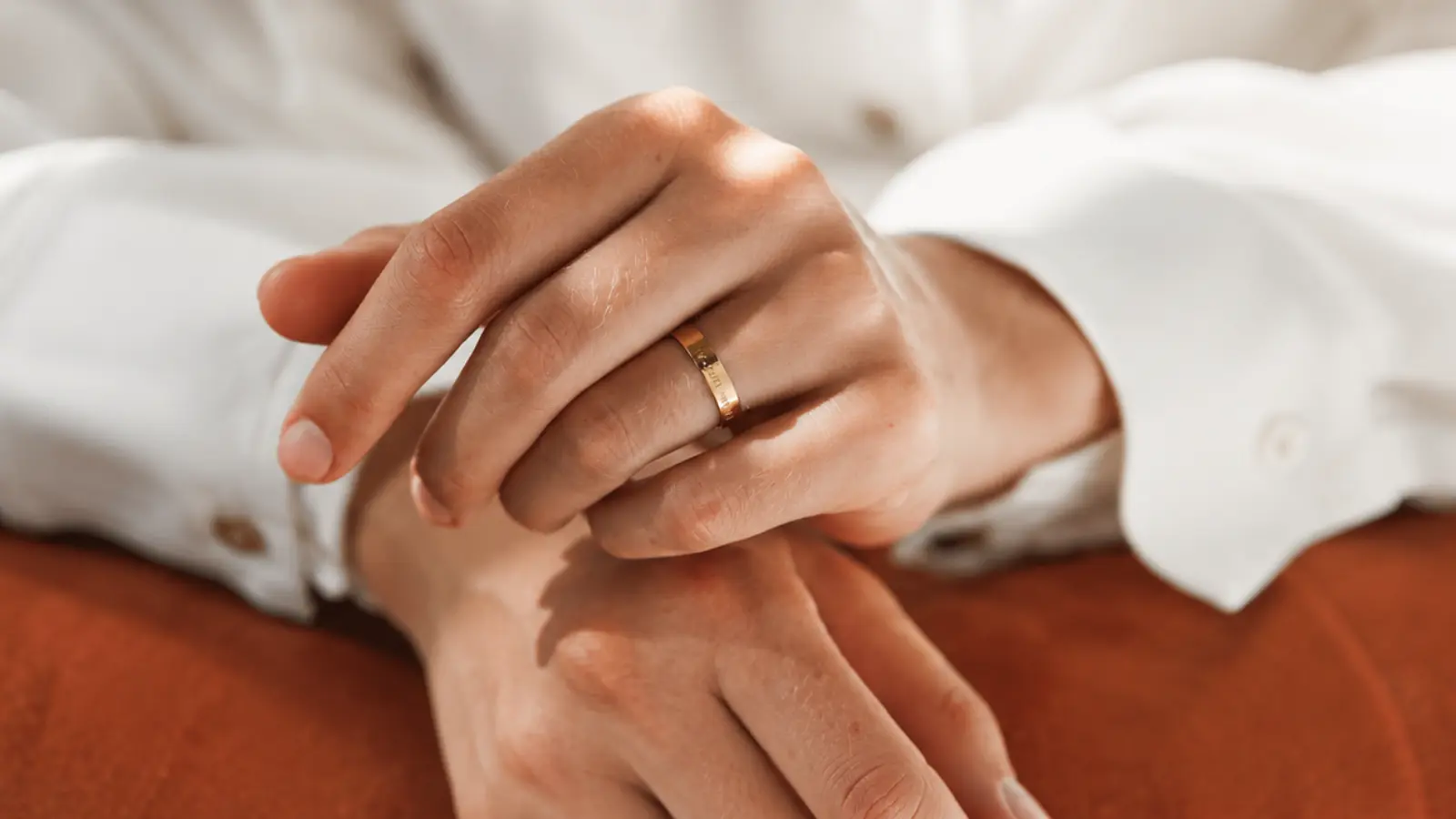
The most common hesitation around minimalist wedding rings isn’t about durability or practicality. It’s a feeling that something this simple might not feel sufficiently meaningful for an object meant to represent a marriage. This concern is understandable, and in most cases it resolves itself once the ring has actually been worn for a while. There are also a few specific things that genuinely add meaning to a minimalist design without compromising its simplicity.
- Engraving — the most direct option, and one that works particularly well with minimalist rings precisely because the exterior is so quiet. An inscription on the inside of the band becomes a private detail that exists only for the wearer.
- Material quality — matters more on a minimalist ring than almost any other style, as covered in the Simple Gold Rings section above. An 18k gold band with an exceptional finish doesn’t need anything added to feel like a considered, valuable object; the quality is the substance of the design, not an accessory to it.
- A single meaningful stone — even a very small one can carry significant personal weight without disrupting a minimalist design, particularly if it has some specific meaning: a birthstone, a stone that matches one in a family heirloom, or a diamond chosen with care even at a modest size.
- The story of how it’s worn — the least tangible but, for many people, the most significant source of meaning over time. A minimalist ring worn every day for years accumulates its meaning through that consistency.
Taken together, these details show how wedding ring meaning can develop quietly through material, private details, and years of everyday wear rather than through visible decoration. That quiet, constant presence is, for a lot of people, exactly what a wedding ring is supposed to be.
Minimalist Wedding Ring Inspiration
Minimalist wedding rings prove that simple designs can still feel personal, elegant, and meaningful. Explore our inspiration board for thin bands, dainty rings, simple gold styles, subtle diamonds, stackable designs, and everyday wedding ring ideas.
Choosing a Minimalist Wedding Ring That Feels Meaningful
A minimalist wedding ring does not need to be the largest, the most detailed, or the most noticeable piece of jewelry to carry meaning. Its beauty comes from the details that remain — the proportions, the materials, the craftsmanship, and the quiet connection it creates with the person wearing it.
Whether you choose a thin gold band, a dainty diamond ring, or a simple design with a private detail only you know about, the right minimalist ring becomes special through the life built around it. Sometimes the most meaningful pieces are not the ones designed to be noticed by everyone else, but the ones that feel completely your own.
Frequently asked questions (FAQ)
Are minimalist wedding rings too simple?
No. A minimalist wedding ring is not less meaningful because it has fewer details. The purpose of minimalist design is to focus on proportion, quality, comfort, and intentional choices rather than decoration. A simple band made with beautiful materials and thoughtful craftsmanship can feel just as special as a more detailed ring because the value comes from what remains, not what was added.
Are thin wedding rings durable enough for everyday wear?
Yes, a thin wedding ring can be durable enough for everyday wear when it is made with quality materials and proper construction. The metal, thickness, and setting style matter more than width alone. A well-made thin band in a durable metal can last for years while keeping the delicate, understated appearance that makes minimalist rings appealing.
What is the best metal for a minimalist wedding ring?
The best metal depends on the look and maintenance level you prefer. Platinum offers durability and a naturally white appearance, while gold remains a timeless choice available in yellow, white, and rose tones. Because minimalist rings have fewer decorative elements, the color, finish, and quality of the metal become especially important parts of the design.
Can minimalist wedding rings have diamonds?
Yes. A minimalist wedding ring can include diamonds as long as they support the simple design instead of becoming the main focus. Small flush-set diamonds, subtle accent stones, or delicate diamond details can add meaning and sparkle while keeping the ring understated and easy to wear every day.
What is the difference between minimalist and classic wedding rings?
Minimalist and classic wedding rings can overlap, but they focus on different ideas. Classic rings are based on designs that have remained popular for generations, while minimalist rings focus on reducing the design to only the most essential elements. A ring can be both classic and minimalist, but not every classic ring is minimalist.
What should you know before choosing a minimalist wedding ring?
Before choosing a minimalist wedding ring, make sure you genuinely love the simplicity rather than choosing it only because it feels safe. Consider the band width, metal quality, comfort, and whether the understated style matches your personality. The best minimalist rings feel intentional — not like something is missing.