Art Deco wedding rings are wedding rings inspired by the Art Deco design movement, known for geometric shapes, strong symmetry, architectural details, and striking combinations of diamonds, gemstones, platinum, and white metals. Originating in the early 20th century, this jewelry style remains popular because its clean lines and bold structure continue to feel timeless and modern.
Unlike softer romantic jewelry styles, Art Deco rings focus on precision, balance, and intentional design. Platinum settings, baguette diamonds, emerald cuts, sapphire accents, milgrain details, and geometric patterns all contribute to the distinctive look that makes Art Deco wedding rings instantly recognizable.
This guide explains Art Deco wedding rings, including their history, defining features, diamond cuts, gemstones, wedding rings and wedding bands, vintage versus modern designs, and how to decide whether this iconic style is right for you.
What Is an Art Deco Wedding Ring?
Art Deco as a design movement emerged in France in the early 1920s and spread rapidly through architecture, furniture, graphic design, fashion, and jewelry across Europe and North America. The name, derived from the 1925 Paris Exposition Internationale des Arts Décoratifs et Industriels Modernes, was applied retrospectively, but the aesthetic was immediately recognizable as a coherent statement: a rejection of the flowing organic forms of Art Nouveau and the delicate romanticism of the Edwardian era, replaced by a boldness that embraced industrialism, geometry, and a modern clarity of form.
In jewelry, this translated to specific and distinctive visual characteristics: settings in platinum that used precise geometric arrangements, stones cut to emphasize clean lines rather than brilliant sparkle, strong contrasts between deep-colored accent stones and colorless diamonds, and a graphic quality that made a ring legible as a design rather than merely as an adornment. An Art Deco ring reads as something that was thought out, with each element placed with intention in relation to every other element, rather than assembled ornamentally.
The Context That Shaped It
Art Deco jewelry was made in the aftermath of World War I and the social upheaval that followed. The women wearing it were, in many cases, leading lives their mothers had not: working, driving, socializing without chaperones, cutting their hair short, wearing clothes that allowed movement. The jewelry of the previous era, soft, garland-draped, lace-like Edwardian work, did not belong to this new context in the same way.
Art Deco jewelry was as modern as the women who wore it. It suited the sharper silhouettes of 1920s fashion, the angular geometries of Art Deco architecture, and a general cultural sensibility that valued precision and novelty over inherited sentiment. That original cultural alignment explains why Art Deco jewelry has retained its appeal across a century rather than settling into the nostalgia that softens other historical styles. The aesthetic was modern before the word meant what it means now, and it remains modern in a way that is not dependent on any particular moment.
Art Deco Design Features
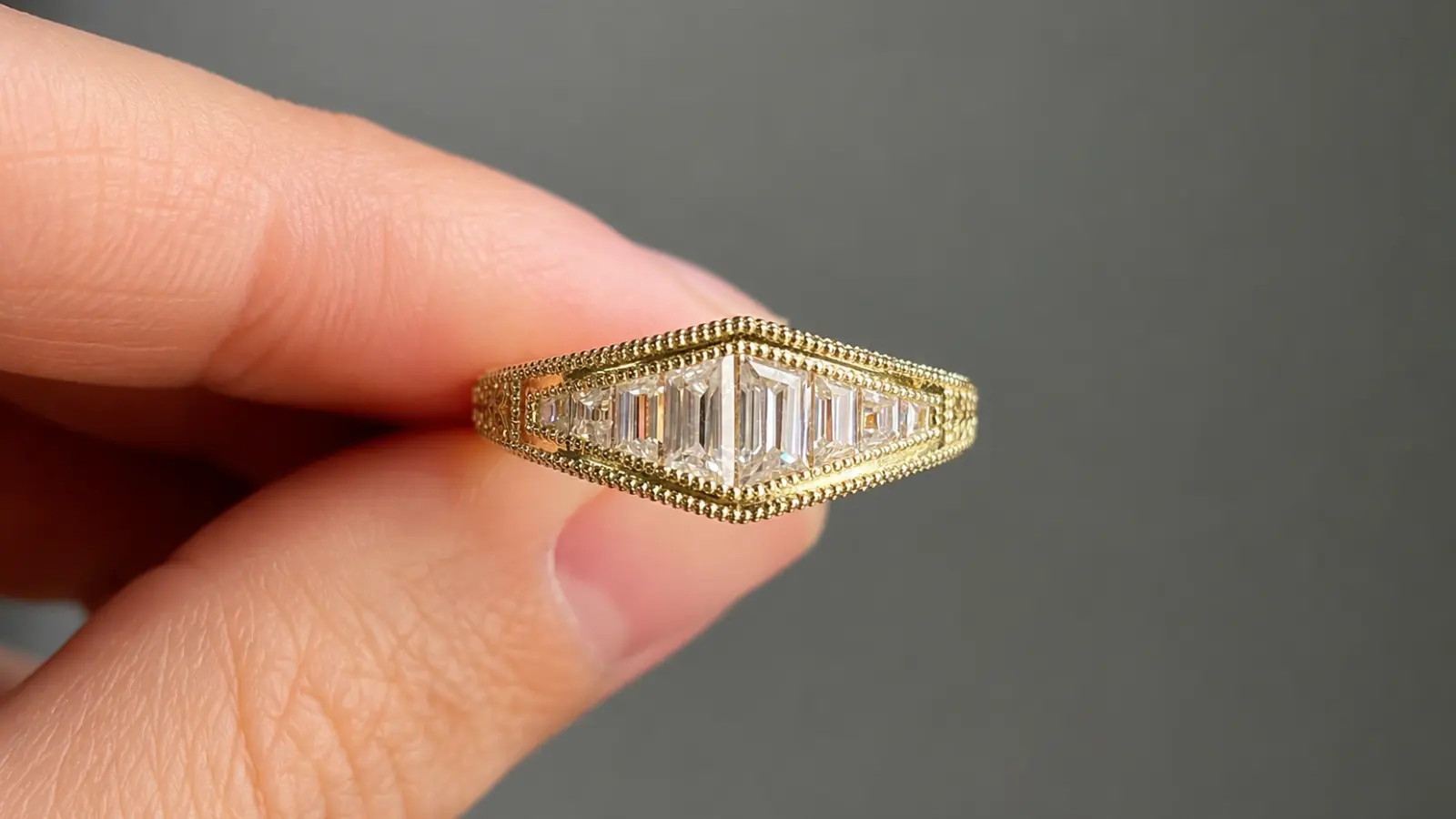
The visual language of Art Deco jewelry is specific enough that most pieces are immediately identifiable, and specific enough that understanding the vocabulary makes it easier to evaluate whether a ring described as Art Deco actually is, and whether a reproduction has been executed with sufficient faithfulness to carry the aesthetic with conviction.
Geometric Forms and Strict Symmetry
The single most defining characteristic of Art Deco jewelry is geometric precision. Where Edwardian filigree flows and Victorian naturalistic motifs curve, Art Deco design is built on straight lines, right angles, chevrons, stepped forms, fans, and sunbursts. The arrangement of stones in an Art Deco ring follows the same logic: stones placed in precisely parallel rows, in exactly symmetrical arrangements around a center stone, in geometric patterns that read as strongly designed rather than decorative in a looser sense.
Symmetry in Art Deco design is close to absolute. The left side of a ring mirrors the right, and the top mirrors the bottom. This rigorous bilateral symmetry is part of what gives Art Deco pieces their quality of formal authority; they look resolved and intentional in a way that asymmetrical or more organically arranged designs do not.
Platinum Settings and Fine Metalwork
Platinum became the metal of choice for high Art Deco jewelry for reasons that were as much practical as aesthetic. Its strength allowed prong settings significantly finer than gold could safely achieve at the same dimensions, which meant stones could be held with minimal visible metal, the prongs nearly disappearing against the color of the stone rather than framing it visibly. Platinum’s cool white color suited the era’s preference for tonal restraint: a platinum ring with white diamonds and black onyx has a near-monochromatic quality in which the contrast comes from value (light and dark) rather than from warm color relationships.
The milgrain detail that appears along the edges of many Art Deco settings, tiny beaded borders applied in rows using a specialized rotating tool, is one of the most immediately recognizable period details. In authentic period pieces, milgrain is hand-applied and slightly irregular in a way that modern machine-produced milgrain is not. The difference is subtle but visible under magnification, and it is one of the details that distinguishes a well-made period piece from a reproduction produced with less attention to craft.
Filigree and Openwork
Art Deco filigree is geometrically precise rather than organic: fine metal threads arranged in grid-like, fan-shaped, or angular patterns rather than the flowing foliate forms of earlier eras. The openwork that results from this technique gives the setting a visual lightness despite its formal rigidity. Looking through the metalwork at the skin beneath creates a lace-like quality that softens the geometric strictness of the overall design without compromising it. In platinum, this effect is particularly pronounced because the metal’s whiteness reduces the visual contrast between the metalwork and the light passing through the openings.
High Contrast and Color Accents
The color palette of Art Deco jewelry is distinctive: primarily cool and tonal, with sharp contrasts used as structural elements of the design rather than decorative flourishes. A center diamond flanked by calibré-set black onyx accents. A deep blue sapphire in a platinum setting with baguette diamond channels on either side. A central emerald surrounded by geometric arrangements of colorless diamonds in alternating rows. These color combinations, consistently controlled and formally organized, give Art Deco pieces a visual weight and clarity that warmer, more varied color palettes do not.
Best Stones for Art Deco Rings
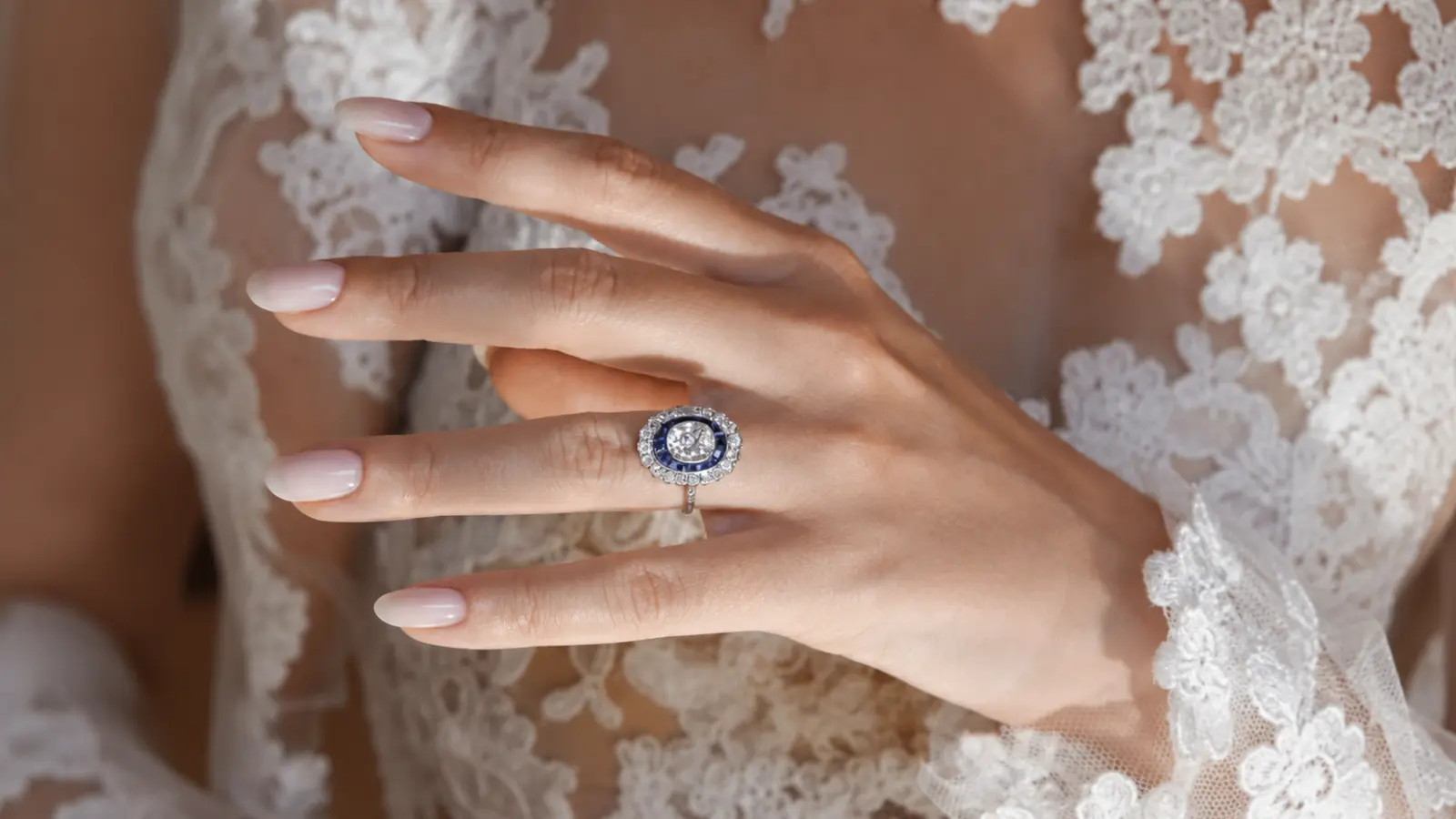
Stone choice in an Art Deco ring is not arbitrary. The stones that work best within the aesthetic are the ones whose visual qualities support the period’s design logic rather than working against it.
Diamonds
Diamonds are the primary stone in most Art Deco rings, with diamond wedding rings from the period using them in both center positions and geometric accent arrangements. In authentic period pieces, the diamonds are almost always cut in styles that predate the modern round brilliant: Old European cuts, Old Mine cuts, and transitional cuts, all of which have a different visual quality from the contemporary round brilliant.
Old European cut diamonds are deeper and smaller in table (the flat top facet) than modern brilliants, with larger facets that produce flashes of light that are more individual and dramatic, often described by antique enthusiasts as “chunky,” compared to the continuous sparkle of a modern brilliant cut. This quality suits Art Deco design particularly well because it reads as one bold geometric flash rather than a diffuse shimmer, which aligns with the era’s emphasis on clarity and contrast over softness.
Blue Sapphire
Blue sapphire is perhaps the most characteristic colored stone in Art Deco jewelry. Its deep, cool color sits naturally against platinum settings, complements the blue-white quality of diamonds, and provides the high-contrast accent that Art Deco design requires without introducing warmth that would work against the era’s cool palette. Sapphire is also a practical choice for daily wear, which is one reason sapphire wedding rings work especially well for rings worn continuously.
Black Onyx
Black onyx, or sometimes black enamel, which produces a similar visual effect, appears in Art Deco rings as a contrast element that creates near-monochromatic compositions of extraordinary graphic strength. A diamond and black onyx ring has a visual clarity that is almost architectural, with the two materials occupying their spaces in the design with no ambiguity about where one ends and the other begins. This quality of clean clarity is one of the more purely Art Deco effects achievable in jewelry, and pieces that use it well have an impact that colored stone combinations typically do not.
Emerald
Emerald appears less frequently in Art Deco rings than sapphire but is particularly well-suited to the era’s aesthetic when used in settings that protect it appropriately. The deep green of a high-quality emerald provides a contrast against platinum and white diamonds as striking as blue sapphire, and the Asscher cut, a square step cut developed in the early Art Deco period, was frequently used for both emeralds and diamonds in the style, its precise geometry reflecting the period’s design logic directly through the cutting of the stone itself. Emerald is softer than sapphire (rated approximately 7.5 on the Mohs scale) and more prone to chipping, which means the setting needs to protect the stone more carefully than a sapphire would require.
Ruby and Coral
Ruby provides the warm-toned contrast option in Art Deco jewelry’s otherwise cool palette. Deep red ruby against platinum and white diamonds creates the vivid contrast found in many gemstone wedding rings, and it is particularly effective when Art Deco geometry emphasizes the color. Coral, which was fashionable in the period for its warm peachy-orange tone, appears in Art Deco pieces from the 1920s as an accent material alongside diamonds and onyx, its matte surface quality providing a different textural contrast from the faceted stones around it.
Diamond Cuts Associated with Art Deco
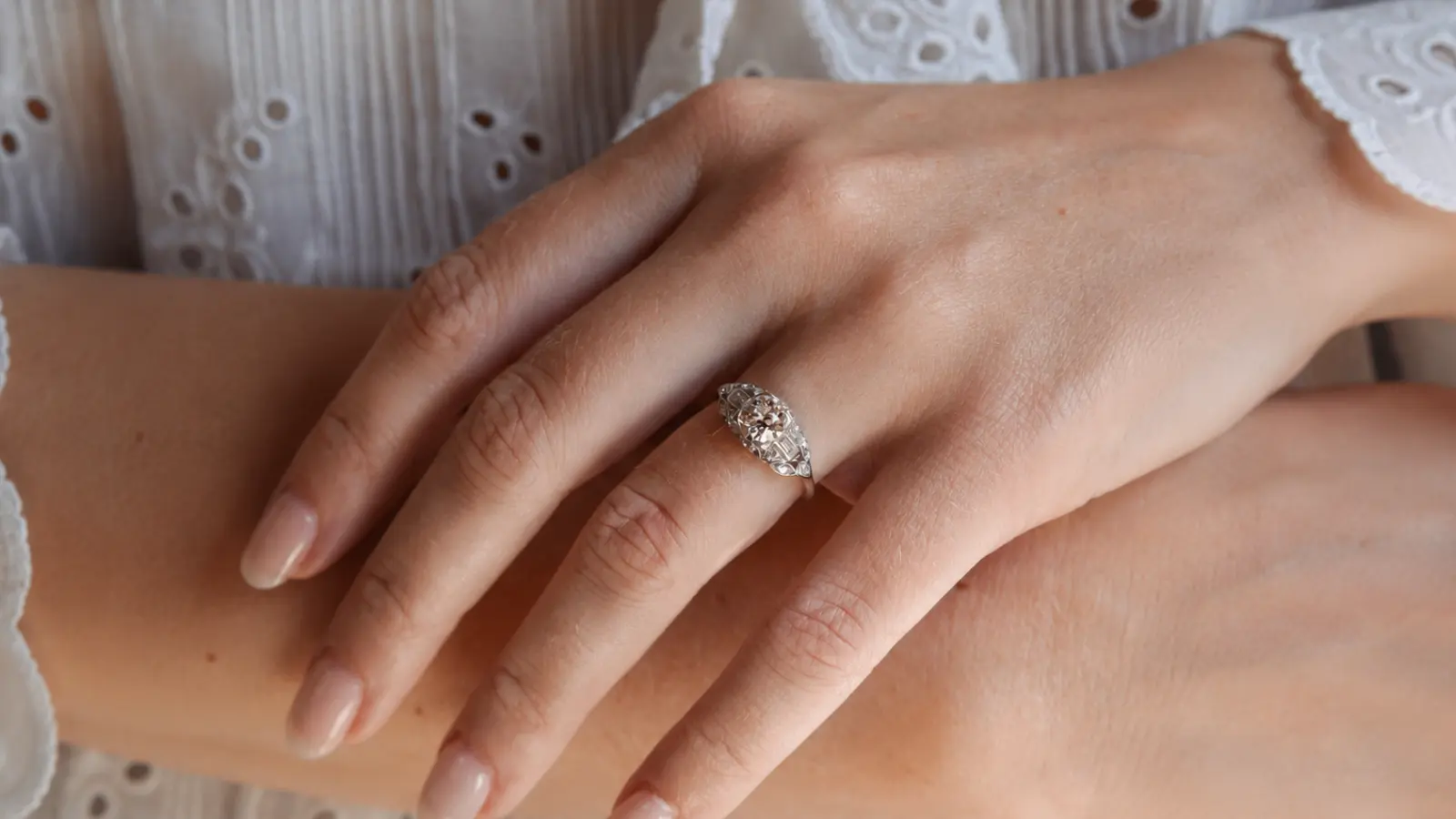
The diamond cuts most closely associated with Art Deco are the ones that were current during the period, each with a visual character the modern round brilliant cut does not replicate, and each suited in specific ways to the aesthetic demands of the era’s design.
Old European Cut
The Old European cut is the direct predecessor to the modern round brilliant and was the dominant round diamond cut from roughly the 1890s through the 1930s. It has a smaller table, a higher crown, and larger facets than a modern brilliant, producing a pattern of light that is more dramatic and less continuous: fewer but larger flashes of brilliance rather than the constant, diffuse sparkle of a modern cut. Old European cuts feel particularly at home in Art Deco settings because their visual character, bold and architectural rather than soft and glittering, aligns with the era’s design sensibility.
Emerald Cut
The emerald cut, a rectangular step cut with cropped corners, is the most strongly geometric of the standard diamond cuts and one of the most closely identified with Art Deco. Its long, parallel facets create a hall-of-mirrors effect rather than the brilliant sparkle of a round diamond, emphasizing the stone’s clarity and color over its light performance. The rectangular geometry of the emerald cut fits naturally into Art Deco settings, which frequently use rectangular and linear forms in both metalwork and stone arrangement. An emerald cut diamond in a platinum Art Deco setting with baguette side stones is one of the most immediately recognizable expressions of the style.
Asscher Cut
The Asscher cut, developed by the Asscher Diamond Company in Amsterdam in 1902, reached its peak popularity during the Art Deco era. It is a square step cut with deeply cropped corners and a high crown, similar in construction to the emerald cut but in a square rather than rectangular format. The combination of its precise square geometry, its large open table, and its step-cut facets produces a visual effect that is both bold and architectural: the stone appears almost like a geometric aperture, a window through which the internal facets are visible in a strong, legible pattern. Royal Asscher cuts, a more recent refinement of the original design with additional facets, are sometimes offered as a modernized alternative that preserves the square geometry while improving light performance.
Baguette Cut
The baguette, a small, elongated rectangle with step-cut facets, is less a center stone choice than a defining element of Art Deco ring design. Baguettes appear in channel-set rows flanking center stones, in geometric arrangements between larger stones, and as the primary design element of many Art Deco bands. Their precise rectangular geometry, their ability to be set in perfectly parallel rows, and their flat, linear light character make them ideal accent stones for a design philosophy that values precision and formality above brilliance and warmth. A contemporary ring without a single baguette can still read as Art Deco-inspired; a ring with a well-executed baguette arrangement reads as unmistakably of the period.
Art Deco Wedding Bands
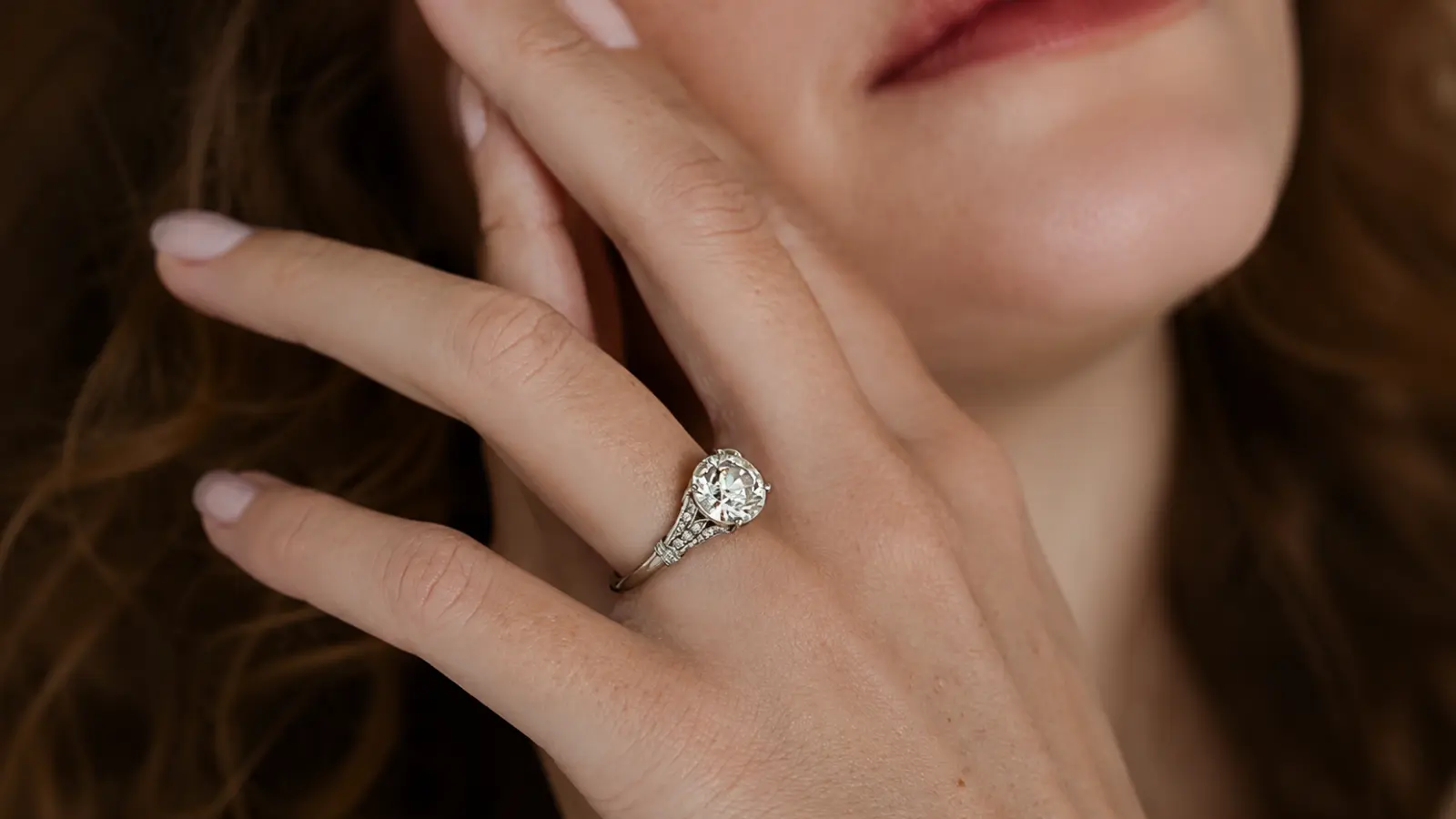
Art Deco wedding bands, rings designed specifically for the band position rather than as engagement rings or three-stone pieces, have a visual strength that many wedding band styles do not. The geometric clarity of the Art Deco aesthetic translates effectively even at the narrow width a band requires, which means an Art Deco band can read as a complete and intentional design rather than simply a plain ring with some decoration applied to it.
Channel-Set Baguette Bands
A channel-set band with baguette diamonds in a straight row is among the most recognizable Art Deco band forms and one of the most effective for daily wear. The baguettes are set within a channel, a groove cut into the metal on either side of the stones that holds them securely without prongs, in a continuous linear arrangement around the ring. The result is a band with a strong graphic quality, significant diamond coverage, and a profile that sits flush against the finger without any raised elements that might catch on fabric or scratch adjacent rings. Channel-set baguette bands also wear well over time because the channel setting protects the stones from the lateral impact that prong-set stones are more vulnerable to.
Geometric Pattern Bands
Art Deco bands with geometric patterns, such as repeating chevrons, alternating diamond and colored stone arrangements, fan motifs, or step-pattern designs in milgrain-edged compartments, carry the era’s design vocabulary in a band format that does not require a center stone. These bands work both as standalone wedding rings and as companion pieces to engagement rings from other style traditions. An Art Deco geometric band alongside a contemporary round brilliant solitaire is a pairing that many couples find more interesting than a coordinated set, allowing each ring to be a distinct piece rather than one ring being compositionally subordinate to the other.
Filigree Bands
Filigree bands in Art Deco style, open metalwork in geometric patterns between wider borders of milgrain or solid metal, are lighter and more delicate in visual character than channel-set or pattern bands. They read more like lace and less like architecture, which makes them the most feminine-coded Art Deco band option and the one most naturally aligned with the Edwardian-influenced early Art Deco aesthetic. Filigree bands are more vulnerable to damage than channel-set bands and require the same careful jeweler attention that Edwardian filigree requires for repair and resizing.
Wearing Art Deco Bands with Engagement Rings
Art Deco bands are versatile alongside engagement rings from other periods and styles because their graphic quality reads as a statement rather than as a complement that needs matching. An Art Deco channel-set baguette band alongside a contemporary solitaire creates an interesting contrast between the clean simplicity of the solitaire and the structured geometry of the band. Alongside a round brilliant pavé band, the contrast may be less successful, since two rings each with significant visual character compete rather than complement. The strongest pairings for Art Deco bands tend to be either other Art Deco pieces or very simple, architecturally clean engagement rings that give the band room to read clearly.
For more on ring stacking and wearing two rings together, the full guide to wearing wedding rings and engagement rings together covers fit, order, and visual coordination in detail.
Vintage vs. Modern Art Deco Rings
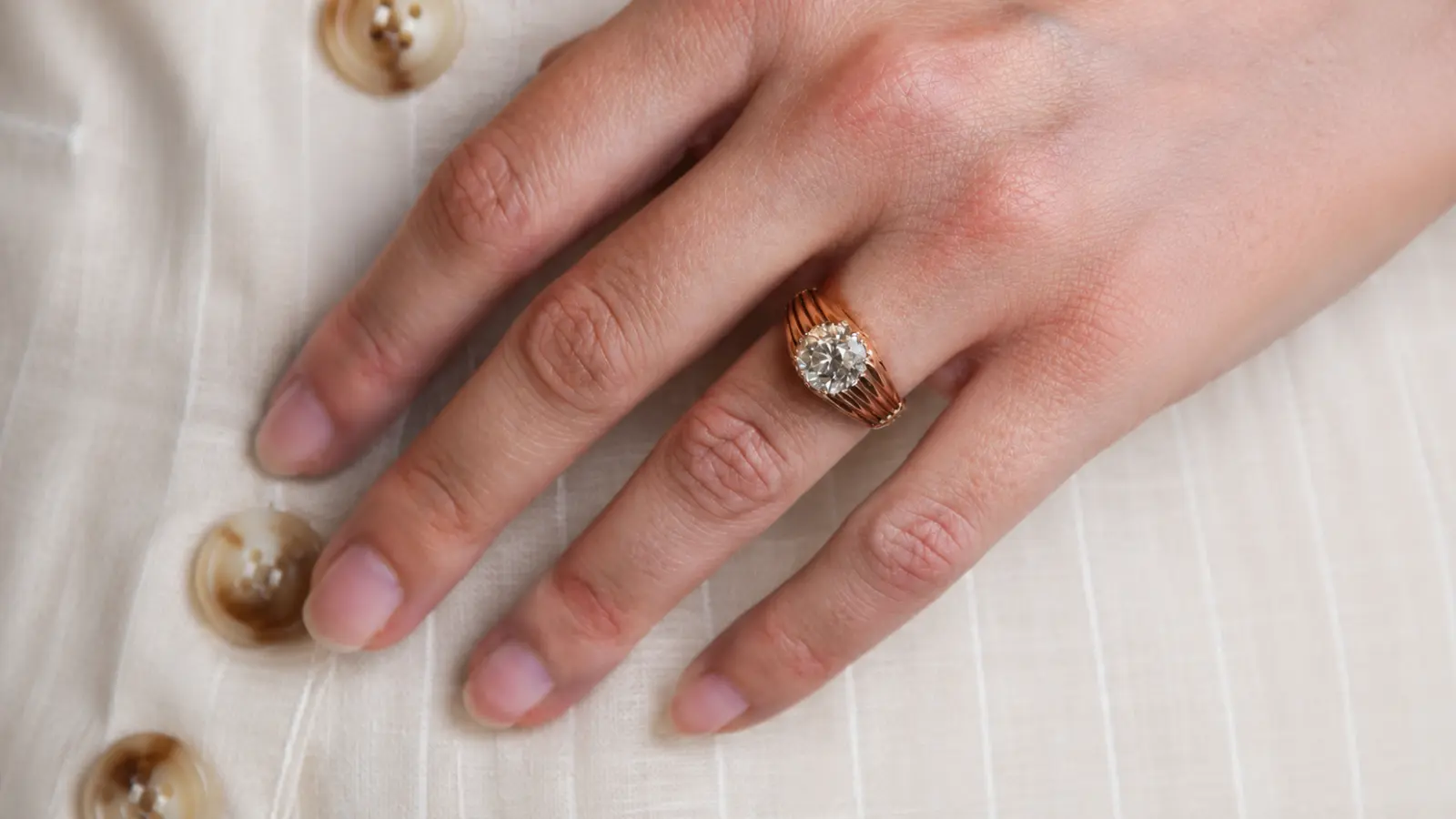
The choice between an authentic period Art Deco ring and a modern reproduction is not simply a question of budget or availability. The two categories of ring are genuinely different objects, and the differences extend beyond provenance into visual quality, stone character, and the specific experience of wearing something that was made in another time versus something that quotes that time.
What Authentic Period Pieces Offer
An authentic Art Deco ring, produced between roughly 1920 and 1935, carries specific visual qualities that are difficult to reproduce precisely. The hand-finishing of metalwork, the slight irregularities in hand-applied milgrain, the specific character of old-cut diamonds in their original settings, and the patina that comes from genuine age all contribute to a quality the best modern reproductions approximate but do not fully replicate. The diamonds in period pieces are almost always old-cut rather than modern brilliant, which changes the visual character of the stone significantly, producing bolder, more dramatic flashes of light rather than the continuous sparkle of a contemporary cut.
Period pieces also carry provenance: documentation of origin, hallmarks that confirm metal content and sometimes date of production, and a history that belongs to the ring rather than being applied retroactively. For buyers to whom the authenticity of an Art Deco piece is part of its meaning, who want to own the actual object from the actual period, no reproduction offers what the period piece offers, however faithfully executed.
What Reproductions Offer
A high-quality modern reproduction of Art Deco design offers practical advantages that authentic period pieces cannot. The ring comes with a contemporary jeweler’s warranty. The stones are freshly set in current-standard prongs. The ring can be ordered in the correct size rather than requiring assessment for resizability. If a stone has a grading report, it will be a current independent assessment rather than an estimate of a stone that may have been cleaned and handled many times over decades.
Reproductions also allow the kind of design customization available with custom wedding rings, including a preferred center stone, a choice between platinum and white gold, and an interior engraving. Many couples drawn to the Art Deco aesthetic find that a well-executed reproduction that fits their finger perfectly and arrives with a warranty is the more sensible choice than a period piece that requires resizing, new prongs, and the uncertainty of unknown history.
How to Evaluate a Reproduction’s Quality
Not all Art Deco reproductions are equally faithful to the original aesthetic. A reproduction that captures the visual vocabulary of Art Deco, such as geometric forms, milgrain detail, calibré stone arrangements, and platinum or white metal setting, but executes it with less precision than the period requires will read as Art Deco-inflected rather than Art Deco. A few indicators of a well-executed reproduction: crisp, consistent milgrain applied by hand rather than machine (visible under magnification); stones set with the tight precision the geometric arrangements require; an overall finish that is exact rather than approximate; and a jeweler who can speak specifically about what Art Deco design elements the piece incorporates and why.
The broader guide to vintage wedding rings covers the full range of period styles, condition assessment, and what distinguishes authentic period pieces from reproductions across all eras.
Who Should Choose Art Deco?
Art Deco wedding rings are not universally flattering, not because any one style is inherently superior, but because the aesthetic has a specific character that resonates deeply with some people and less so with others. The couples who tend to be most satisfied with an Art Deco ring are the ones for whom the decision was personal and specific rather than a response to the style’s current popularity.
The Aesthetic Alignment Test
The most reliable indicator of whether an Art Deco ring will feel right over time is whether the wearer’s broader aesthetic sensibility extends in the same direction. Someone who consistently gravitates toward clean lines, precise geometry, and graphic visual organization in architecture, interior design, clothing, and other jewelry is likely to find that an Art Deco ring feels like an extension of their established preferences rather than a departure from them. Someone whose aesthetic sensibility is more romantic, organic, or maximalist may find the cool precision of Art Deco feels imposed rather than natural, however much they admire the style intellectually.
A useful test: look at the other jewelry you actually wear most often, not the pieces you find interesting in photographs. If the jewelry you reach for consistently has geometric quality, cool color, and formal precision, an Art Deco ring is likely to feel at home in that context. If the jewelry you wear most is soft, organic, or warm-toned, the Art Deco ring may feel mismatched against it in daily life even if it photographs beautifully on its own.
Lifestyle and Practical Context
Art Deco rings in platinum with channel-set stones are among the more practically durable vintage jewelry choices for daily wear. Platinum is extremely hard, channel settings protect stones well, and geometric designs tend to sit close to the finger without raised elements that catch on fabric. Art Deco filigree bands, by contrast, require more care and more specialist maintenance than simpler band designs.
The professional and social context in which the ring will be worn regularly is also worth considering. Art Deco rings carry a formality and specificity that suits some professional environments naturally and may feel elaborate in others. Someone who works in creative fields, fashion, architecture, or the arts may find that an Art Deco ring reads as a confident personal statement in their daily professional context. Someone in a more conservative professional environment may find a very ornate Art Deco piece feels conspicuous in a way a simpler ring would not.
Who May Prefer a Different Style
Buyers drawn primarily to warmth, in metal color, in stone color, and in the emotional register of a ring’s visual character, may find Art Deco’s cool, precise quality less satisfying over time than they expect from its appearance in photographs. The style reads cooler and more formal in person than it sometimes reads in images, where the graphic contrast can appear more glamorous than austere.
Victorian rings tend to suit those who want romantic and organic; Edwardian rings suit those who want delicate and feminine; Retro rings suit those who want bold and warm. Among different wedding ring styles, the Art Deco aesthetic is a specific choice best made when it genuinely suits the person who will wear it every day.
Art Deco Rings and Skin Tone
The platinum and white gold settings that define Art Deco jewelry have a specific relationship with skin tone that is worth understanding before purchase, since a ring seen in a display case or in a photograph looks different against the actual hand that will wear it.
Platinum and white gold tend to suit cool and neutral undertones most naturally, meaning skin with a pink, bluish-pink, or rosy undertone that is complemented by cool-toned metal rather than contrasted by it. Against warmer or golden skin tones, very white metal can read as stark or clinical rather than elegant. This is not a fixed rule, since individual variation in what works is significant, but it is a pattern worth checking by actually trying the ring on before purchasing.
For buyers with warm undertones who are drawn to the Art Deco aesthetic, there are several options that preserve the geometric character of the style while adding warmth. Some Art Deco pieces incorporate yellow gold accents, such as a yellow gold gallery (the interior structure of the setting) beneath a platinum top, or a yellow gold band with platinum-topped prongs. Contemporary Art Deco-inspired pieces are also available in rose gold, which maintains the architectural precision of the style while introducing significant warmth. Deep-colored stones, including sapphire, ruby, and emerald, also add warmth to an otherwise cool-toned ring in a way that colorless diamond and onyx combinations do not.
How Art Deco Rings Photograph
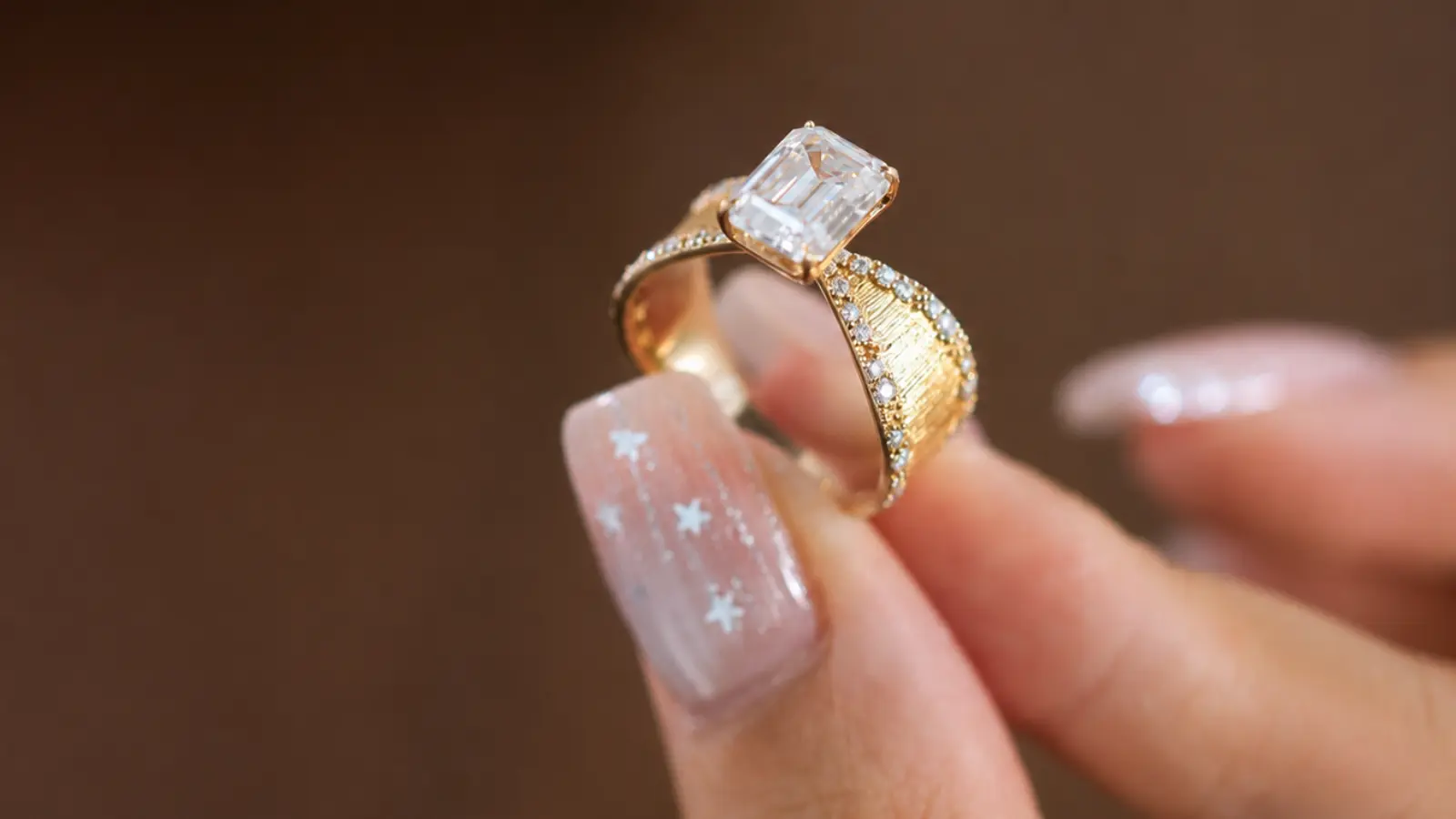
Art Deco rings are among the most photogenic ring styles available, and this is not incidental. The qualities that make them photograph well are the same qualities that define the aesthetic: strong geometric forms that read clearly at any scale, high contrast between light and dark elements that translates well to both color and black-and-white photography, and a formal precision that gives the camera clean edges to resolve rather than soft gradations.
Old European cut diamonds, which appear in most authentic Art Deco rings, produce large, dramatic flashes of light rather than the diffuse sparkle of modern brilliant cuts. In photographs taken with natural light, this produces striking, individual reflections, what photographers sometimes describe as the “candleflame” quality of antique diamond cuts, that are more visually arresting in a photograph than the uniform sparkle of a contemporary brilliant. Wedding photographers who work frequently with couples who have vintage rings often note that Art Deco pieces require less specialized lighting to photograph well than contemporary pavé settings, which can read as a blur of light points rather than a clear design at certain angles and scales.
For couples for whom wedding photography is a significant priority, the visual performance of the ring across different lighting conditions, from bright natural light to the softer light of an indoor reception to the mixed light of an outdoor evening ceremony, is worth discussing with the photographer before the wedding, since certain ring styles require different approaches to be shown at their best.
Art Deco Wedding Ring Inspiration
Art Deco wedding rings are known for geometric shapes, elegant details, and timeless vintage character. Explore our inspiration board for platinum rings, baguette diamonds, emerald cuts, sapphire accents, geometric bands, and modern Art Deco wedding ring ideas.
Choosing an Art Deco Wedding Ring That Feels Timeless
An Art Deco wedding ring is not only a reference to the past. It is a design choice built around balance, structure, craftsmanship, and a style that has remained recognizable for generations.
Whether you choose an authentic vintage piece or a modern Art Deco design, the right ring is the one whose details still feel connected to you years later. The strongest wedding rings are not only beautiful in one moment — they continue to feel meaningful every time they are worn.
Frequently asked questions (FAQ)
Why are Art Deco wedding rings still popular today?
Art Deco wedding rings remain popular because their geometric shapes, symmetry, and architectural details still feel modern even though the style originated a century ago. Unlike softer vintage styles, Art Deco focuses on clean lines and strong design structure, allowing these rings to pair naturally with both classic and contemporary jewelry styles.
How can you tell if a ring is truly Art Deco?
A true Art Deco ring usually shows design elements connected to the 1920s and 1930s, such as geometric patterns, symmetry, platinum settings, milgrain details, old-cut diamonds, baguette stones, or strong color contrast. Authentic period rings may also have hallmarks, construction methods, and craftsmanship details that help verify their age. Modern rings can use the Art Deco style without being original vintage pieces.
Is a vintage Art Deco ring better than a modern Art Deco ring?
Neither option is automatically better. A vintage Art Deco ring offers historical character, original craftsmanship, and the uniqueness of owning a period piece. A modern Art Deco-inspired ring provides the same design influence with new materials, easier sizing, warranties, and less concern about previous wear. The best choice depends on whether authenticity or practicality matters more to you.
What diamond shapes look best in Art Deco wedding rings?
Art Deco wedding rings are especially known for geometric diamond shapes such as emerald cuts, Asscher cuts, baguettes, and old European cuts. These shapes match the structured style of the era because they emphasize lines, symmetry, and bold flashes of light rather than only maximum sparkle.
Can an Art Deco wedding ring be worn every day?
Yes, many Art Deco wedding rings can be worn every day, especially designs with durable metals and secure stone settings. Platinum Art Deco rings and channel-set bands are often practical choices. However, delicate filigree, older prongs, and authentic vintage pieces should be inspected regularly to make sure they remain secure.
What should you know before choosing an Art Deco wedding ring?
Before choosing an Art Deco wedding ring, consider whether you love the style beyond the vintage trend. Art Deco has a very specific personality: geometric, structured, elegant, and often dramatic. It is best for someone who naturally prefers clean lines and architectural details rather than soft, organic, or highly romantic designs.