
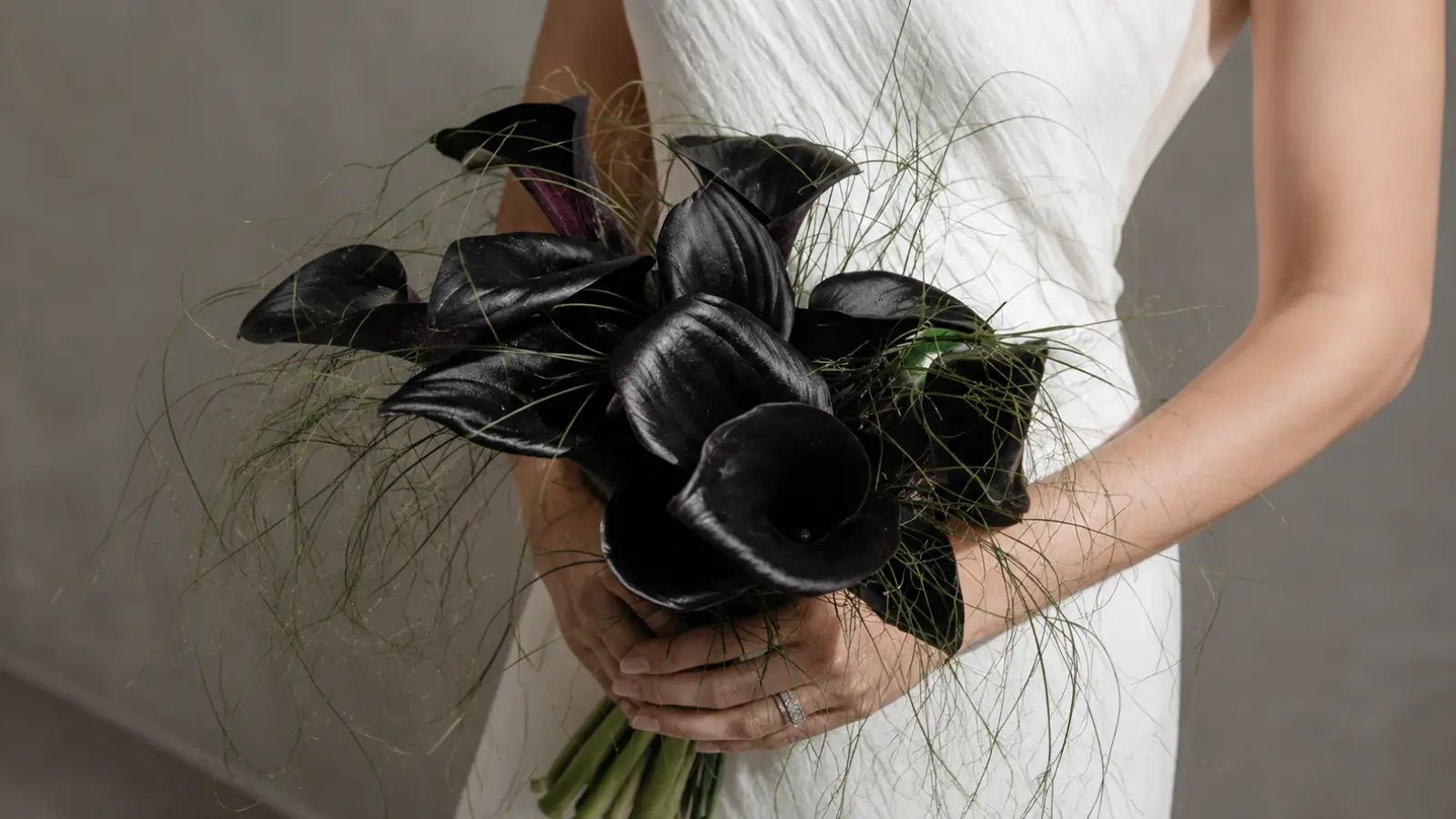
Black wedding bouquets create one of the boldest and most sophisticated looks in bridal florals, combining dramatic beauty with a surprisingly versatile range of styles. Built from the darkest shades of roses, dahlias, calla lilies, anemones, and other near-black flowers, these bouquets can feel modern, romantic, luxurious, or editorial depending on how they’re designed and paired.
Although they’re often associated with gothic weddings, black bouquets extend far beyond that aesthetic. The right combination of contrast, flower selection, greenery, and complementary colors can transform a dark bouquet into something timeless, elegant, and unmistakably bridal.
This guide explores black designs within the broader world of wedding bouquets, including the best near-black flowers, color combinations, styling ideas, photography considerations, and practical advice for creating a bouquet that feels dramatic without overwhelming your overall wedding look.
Black Wedding Bouquet Ideas
The first thing to understand about black wedding bouquets is that shade variation within the “black” flower category is significant. What one grower sells as a “black rose” looks noticeably different from another’s, and the underlying color — deep burgundy versus near-black plum versus chocolate brown — changes how the flower reads in a bouquet and which combinations work alongside it.
| Style Direction | Core Flowers | Mood | Best Suited For |
|---|---|---|---|
| Modern / Editorial | Black calla lilies, dark anemones, white garden roses | Architectural, high-contrast, graphic | Contemporary venues, industrial spaces, minimalist styling |
| Dramatic / Romantic | Black roses, black dahlias, deep burgundy accents | Rich, layered, intensely dark | Formal and ballroom weddings; fall and winter ceremonies |
| Gothic / Avant-Garde | Black roses, dark anemones, deep plum elements, trailing foliage | Moody, theatrical, intentionally unconventional | Non-traditional ceremonies, Halloween-adjacent weddings, dark-themed events |
| Black and White | Near-black roses or anemones with white garden roses or ranunculus | Crisp, bold, timeless high-contrast | Most venues; formal, modern, and classic settings alike |
| Black and Gold | Black calla lilies or dark roses with gold ribbon, dried elements, or metallic accents | Formal, luxurious, editorial warmth | Black-tie events, ballrooms, winter formal weddings |
Among all wedding bouquet colors, black is one of the most versatile because it can feel modern, classic, or dramatic depending on how it’s paired and styled — they work across venue types and wedding styles without requiring the surrounding decor to be equally dark and dramatic. The gothic and avant-garde directions are the most committed aesthetically and work best when the entire event’s styling leans into the same territory.
Black and gold is the most formal of these options and translates particularly well to ballroom and black-tie settings where the gold picks up ambient lighting in a way that plain black alone would not.
Black Rose Wedding Bouquets
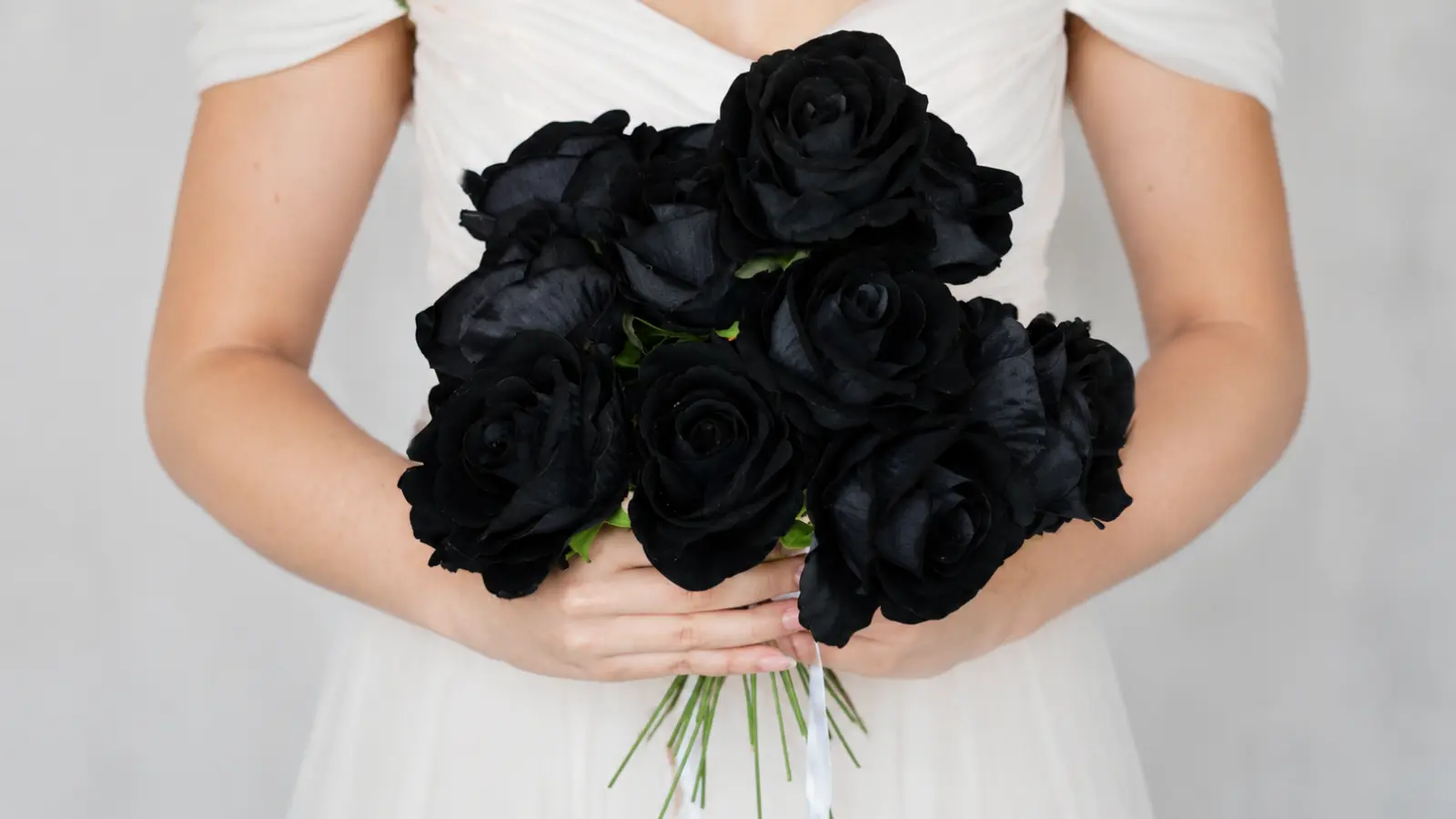
Black roses are the most searched flower in this category and also the most misunderstood. The flowers sold as “black roses” by florists are almost always extremely deep burgundy-red or near-black varieties — the closest the rose family comes to true black without dye. In photographs taken in dim or candlelit light, they read as convincingly black. In natural daylight, they reveal themselves as a rich, deep wine-red tone that’s beautiful in its own right, even if not technically black.
The most commonly sourced near-black rose varieties include deep crimson-black roses that photograph as black under controlled lighting and dark garden roses in very deep burgundy and plum tones. Florists who specialize in dark or dramatic bridal work will typically have access to the deepest-available rose varieties, which are not always the same as standard florist stock. Requesting the darkest available variety, rather than asking for “a black rose” by name, usually produces better results.
A Note on Dyed Black Roses
Florists can also dye white roses black using floral preservative dye, which produces a more uniformly dark flower than natural near-black varieties. Dyed black roses hold their color well if sourced from a reputable supplier, but the petals can look slightly artificial — particularly in close-up photography — compared to the natural depth of a very dark garden rose. If authenticity of flower material matters to you, it’s worth specifying this to your florist and asking whether they’ll be working with naturally dark varieties or dyed stems.
A black rose bouquet reads most elegantly when supported by one or two accent colors rather than left as an all-dark arrangement. White garden roses or cream ranunculus give the near-black roses contrast to stand against, which helps in photos and prevents the bouquet from reading as a single dark shape without detail. Deep burgundy foliage, Italian ruscus, or smoke bush reinforces the dark palette without requiring every element to be nearly black.
Black Calla Lily Bouquets
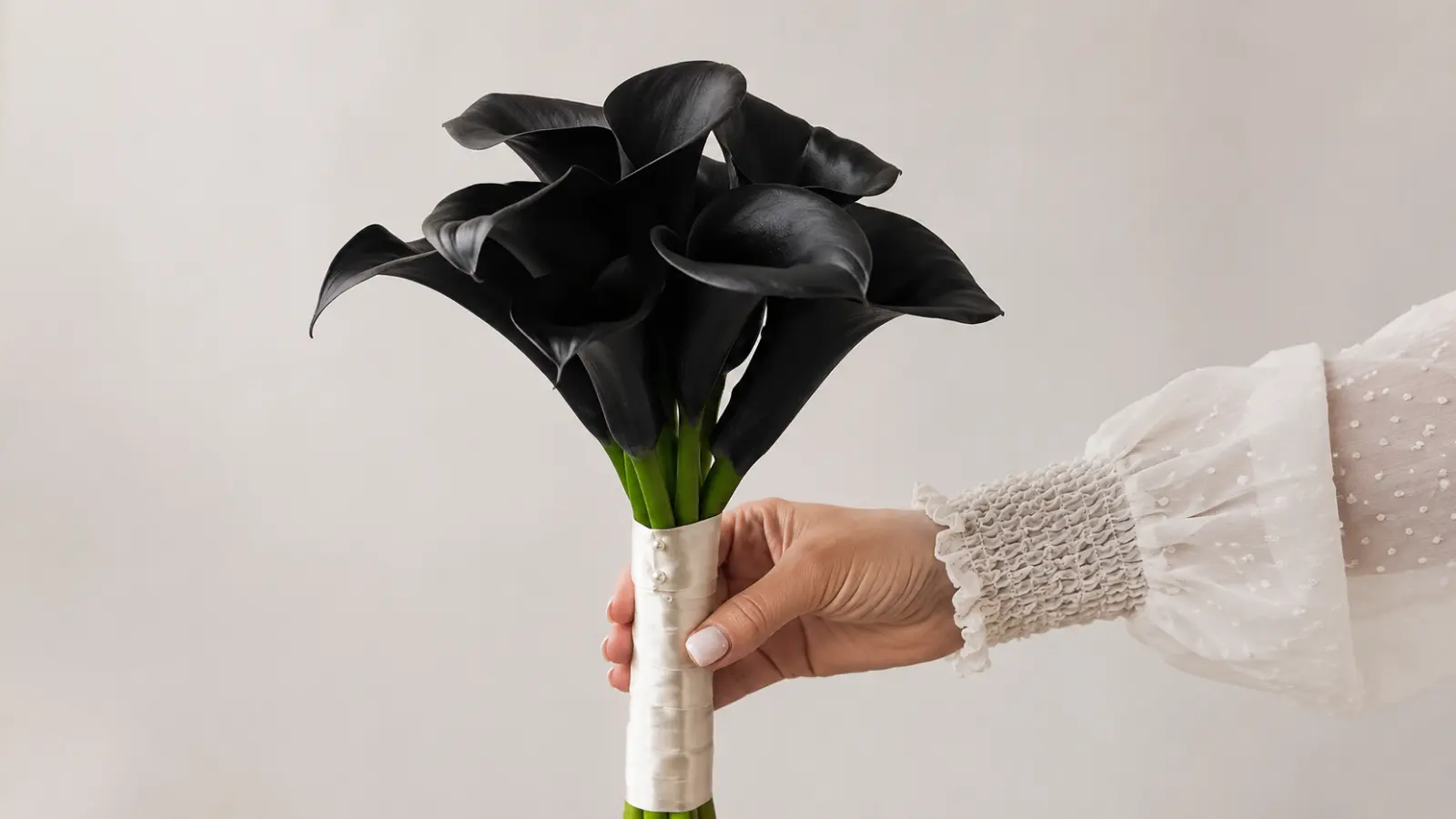
Black calla lilies are one of the most architecturally striking flowers in this palette — smooth, sculptural, and unmistakable. The flowers sold as “black” calla lilies are in reality the deepest available maroon-purple variety in the calla lily family, and they produce a bouquet with a graphic, almost geometric quality that few other dark flowers can match.
Their clean shape is one of the reasons calla lily wedding bouquets are so popular for minimalist and modern bridal aesthetics. A bouquet built around a single generous bunch of black calla lilies, gathered simply with a wide black or gold ribbon wrap, has the kind of deliberate, editorial quality that suits a bride with a strong, confident aesthetic vision. Adding white calla lilies alongside the dark ones creates an immediate graphic contrast within a single flower family — the two tones reading as strikingly different despite sharing a nearly identical shape.
Calla lilies as a species are a good practical choice for a bouquet that needs to travel or last a long day — they’re sturdy and hold up well without constant hydration. The black varieties are generally available year-round through specialty suppliers, though availability and specific shade can vary by region and season, making early florist communication important for couples who need a specific, consistent dark tone across multiple arrangements.
Black Dahlia Bouquets
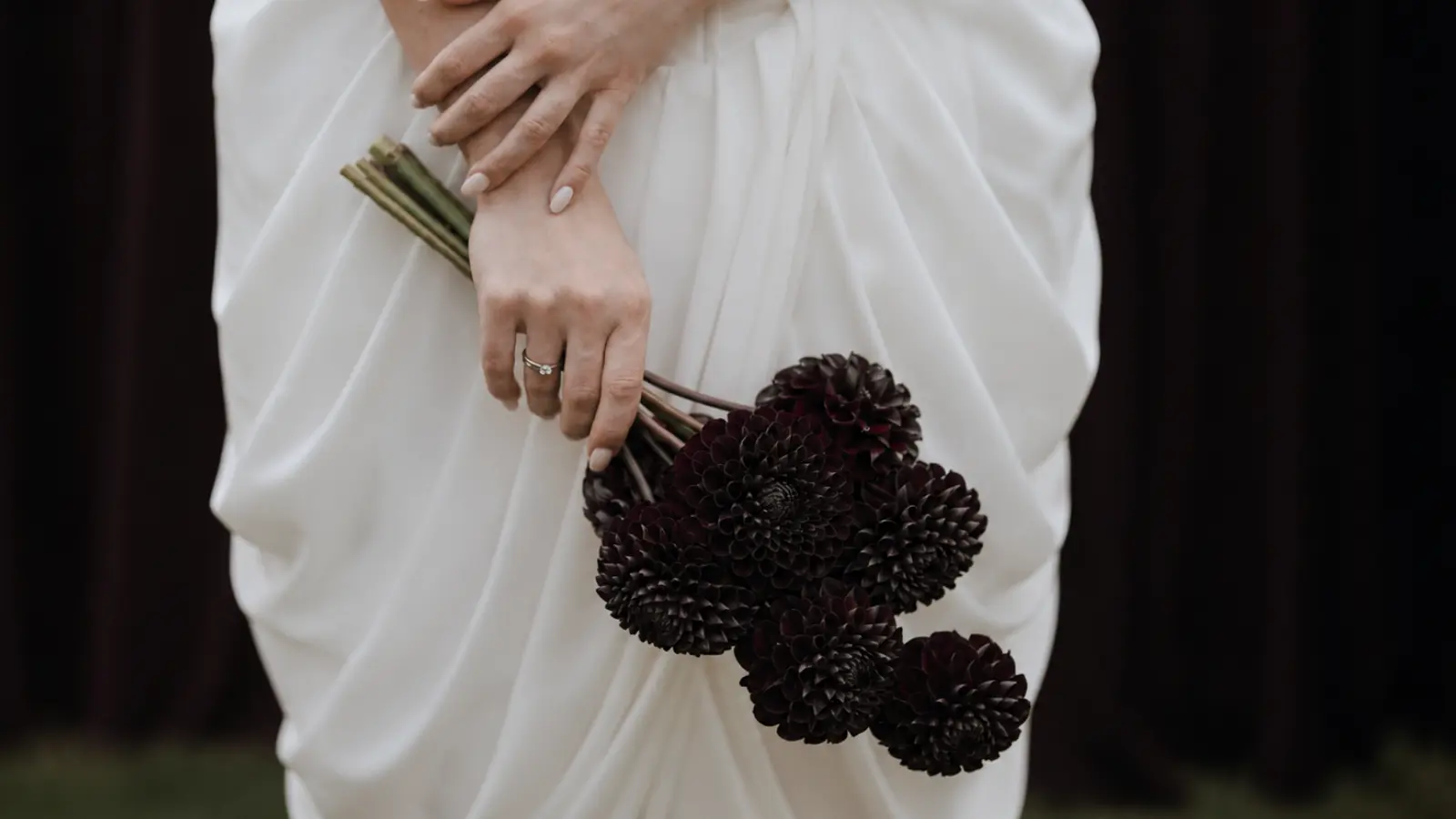
Black dahlias — deep, near-black plum and chocolate varieties — bring a different character to a dark bouquet than roses or calla lilies do. Their full, layered petals and densely textured blooms create a richness that reads as lush and abundant rather than architectural, and they suit romantic, moody, and fall-wedding aesthetics particularly well.
The varieties typically sold as black dahlias range from very deep wine-plum tones with almost no visible red to deep chocolate-brown tones with an earthy warmth. Both photograph beautifully under the right lighting, and the variation in petal layers means they catch and reflect light differently from the smoother surface of a rose, which adds visual interest within an otherwise dark palette. For a near-black bouquet that needs genuine depth and texture rather than graphic simplicity, dahlias are often the more interesting choice than roses.
Dahlias are a summer and fall flower at their seasonal best, which aligns naturally with the dark, dramatic palettes where they tend to be used. Outside of that window, sourcing true near-black dahlias can be more difficult and more expensive, which is worth confirming with your florist early if your wedding falls in spring or winter.
Black and White Wedding Bouquets
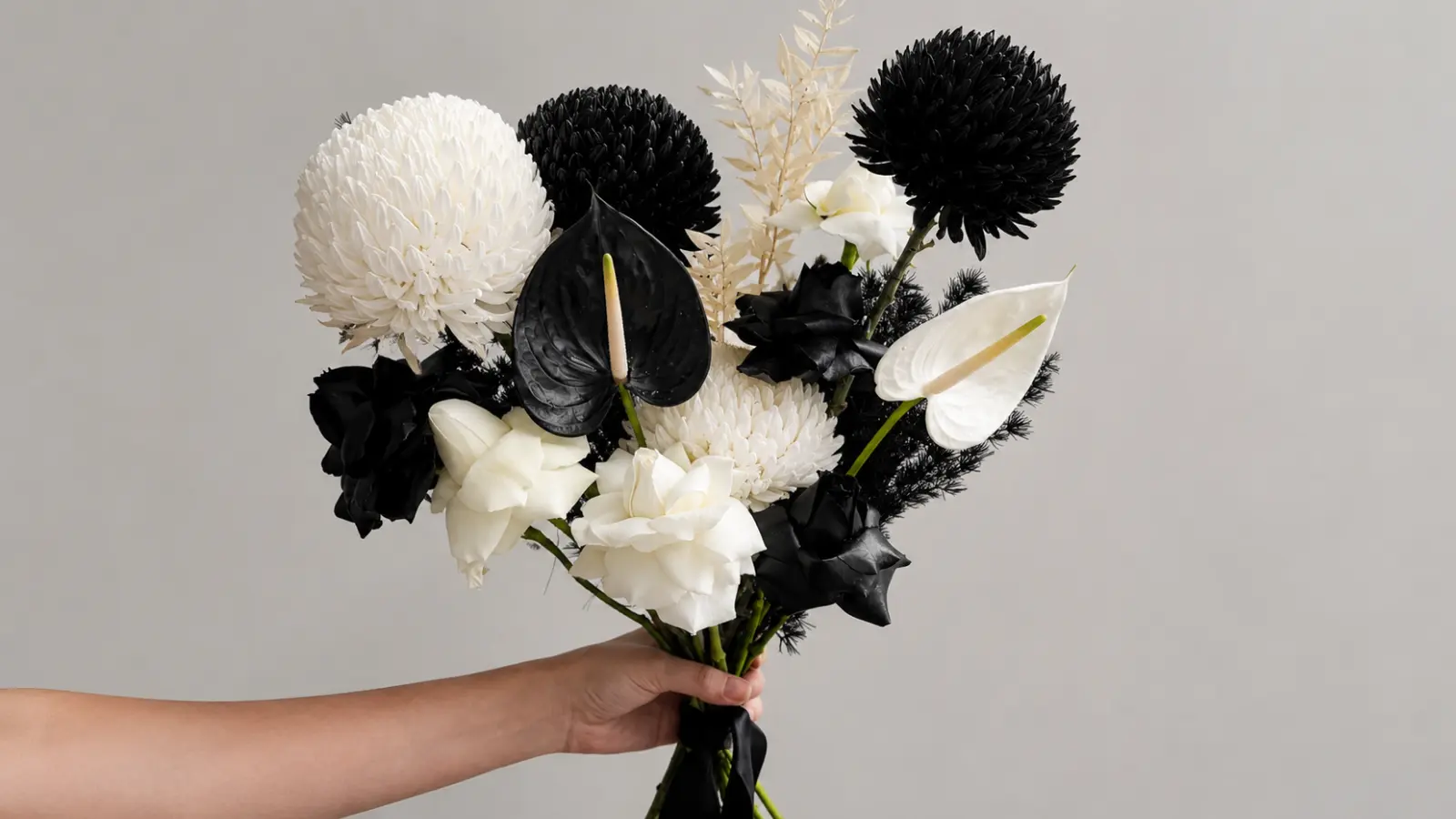
Black and white is the most striking combination in this family — and also the most versatile, because the high contrast between the two tones works in almost any venue, under any lighting condition, and alongside almost any wedding color palette. It’s one of the rare bridal color combinations that reads simultaneously as classic, modern, and editorial depending entirely on how it’s constructed.
The ratio and construction determine the aesthetic. Brides who love white wedding bouquets can create a more dramatic look by weaving black roses or dark anemones through a predominantly white arrangement — the white softens the dark element without eliminating it. Black as the dominant color with white accents reads as more intentional and bold, with the white providing contrast and preventing the bouquet from becoming too heavy. An even split between the two requires confident construction — the tones need enough separation that they read as a designed composition rather than a two-color toss.
For flowers, the strongest black-and-white combinations typically pair near-black roses or calla lilies with white garden roses or white ranunculus, which gives two clearly different petal textures within the same color contrast. Dark anemones with their characteristic near-black centers and white petals are a particularly interesting option — each individual flower contains both tones, which creates a seamless transition within the arrangement rather than a hard line between the two colors.
Black and Red Wedding Bouquets
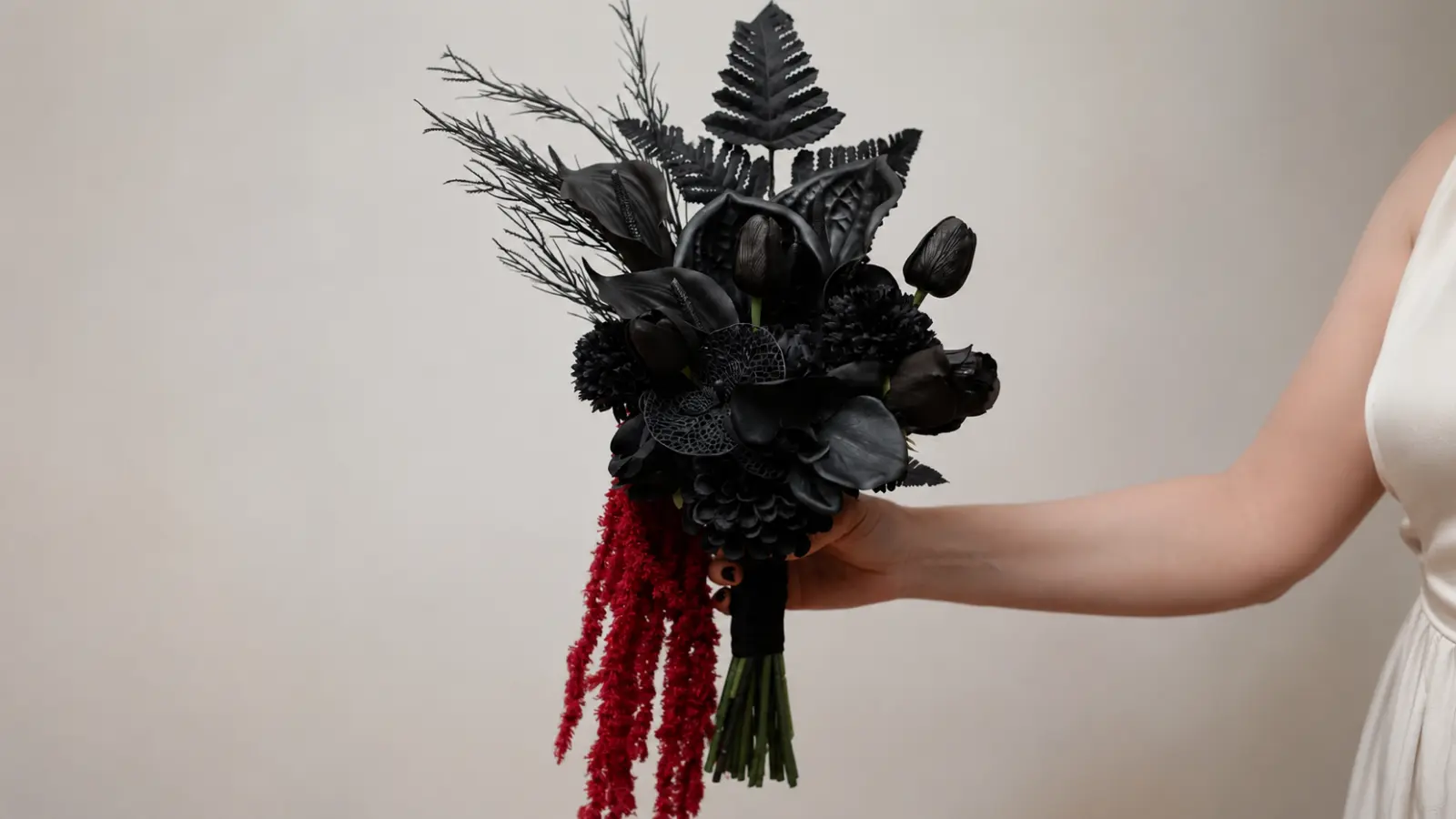
Black and red is the most inherently dramatic combination in the dark bouquet family. Red against near-black creates a tension that reads as passionate, theatrical, and confident — the kind of bouquet that stops people in their tracks when the bride enters a room. It suits formal winter ceremonies, moody fall weddings, and brides who have no interest in subtlety as a design principle.
The most effective approach is to let the black-to-red ratio do the work rather than splitting them evenly. A predominantly dark arrangement with deep red garden roses as the accent color — visible against the near-black field rather than competing with it — creates more visual impact than an even mix. Alternatively, a predominantly red bouquet with near-black calla lilies or dahlias worked through it produces a dramatic result while keeping the red as the primary visual tone.
For anyone considering this combination, the red and burgundy bouquets guide covers the red side of this pairing in depth — the difference between red and burgundy, the best red flowers for bridal use, and how red reads in photos versus in person are all addressed there. Burgundy alongside near-black is a subtler version of this direction: the two dark tones layer beautifully without the same graphic intensity of true red against black, and it’s a palette that suits more intimate, moody settings where the goal is richness rather than drama.
Black and Purple Wedding Bouquets
Black and purple is the most closely toned combination in this family — both colors live on the dark, cool end of the spectrum, which means the challenge is creating enough variation between them to read as an intentional composition rather than a single, undifferentiated dark palette.
The combinations that work best are those where the purple is deep and saturated rather than soft or muted. Deep plum or eggplant alongside near-black creates a richly layered composition where the purple provides warmth and the near-black provides depth, and together they produce something that reads as more interesting and complex than either color used alone. Soft lavender or lilac alongside near-black creates too much tonal gap in the opposite direction — the lightness of the lavender can make the near-black flowers look blunt rather than sophisticated next to them.
For texture, dark anemones work particularly well in this combination because their deep near-black centers and purple-toned outer petals bridge the two colors naturally. Adding a small amount of white or gold as a separating accent helps the purple and near-black read as distinct from each other in photos, where tonal variation between two dark colors can flatten without a third element to create contrast. The purple wedding bouquets guide covers the full range of purple tones and which flowers achieve them, which is useful context for identifying the specific purple that will work alongside near-black without being absorbed by it.
Black and Gold Wedding Bouquets
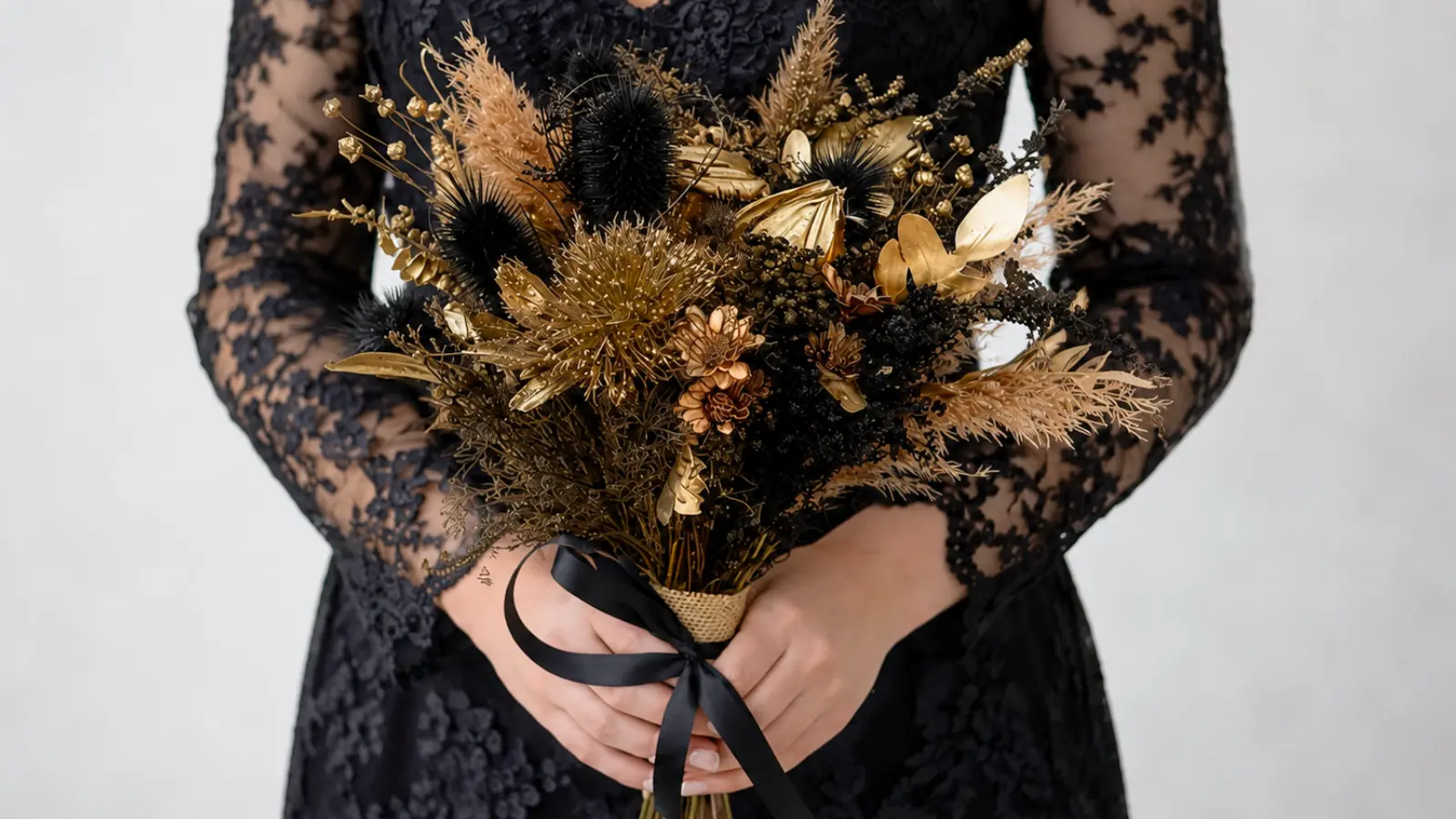
Black and gold is the most formal direction within the dark bouquet palette — the combination reads as intentional, luxurious, and deliberate in a way that suits black-tie, ballroom, and formal winter weddings particularly well. Gold introduces warmth into what could otherwise be a cool, graphic palette, and that warmth photographs beautifully under the candlelight and ambient glow of formal reception spaces.
Gold in a bouquet context doesn’t typically come from flowers — there are very few naturally gold flowers, and forcing a yellow or amber flower into a near-black palette risks looking like a color collision rather than an accent. The most effective gold elements are in the details: a wide velvet or metallic ribbon wrap in deep gold or antique brass, dried lunaria or wheat sprays with a warm golden tone, gilded leaf accents, small dried botanicals with a natural gold finish, or a pressed gold ribbon woven through the stem wrap. These elements add warmth and a sense of considered detail without introducing a competing floral color into the composition.
Black calla lilies or near-black roses are the most natural foundation for a black-and-gold arrangement, since their clean shapes contrast well against the warmth of gold accents. A few ivory or cream blooms softened into the arrangement give the gold element something warm to sit against, which keeps the palette from reading as too stark.
Black Bouquets for Gothic, Modern, and Formal Weddings
A black bouquet communicates very different things depending on the aesthetic context it’s placed in, and understanding that distinction before committing to a design is worth the extra thought.
In a gothic or dark-themed wedding — intentionally moody decor, unconventional styling, perhaps a non-traditional ceremony space — a black bouquet is consistent with the overall vision and functions as part of a coherent aesthetic rather than standing out from it. In this context, an all-dark arrangement with minimal contrast and thematic foliage like trailing vines, dried botanicals, or dark berries is appropriate and fully readable within its setting.
Brides planning modern wedding bouquets often use black as a graphic, editorial accent rather than as the main wedding theme. A black-and-white bouquet in a clean, sculptural shape suits a modern venue without suggesting anything beyond aesthetic confidence. In a formal or black-tie wedding, near-black flowers with gold accents and a polished ribbon wrap are as appropriate as any other formal bouquet — the darkness reads as sophistication rather than unconventionality when the construction and surrounding formality are aligned with it.
The venue and overall wedding aesthetic should be the primary guide. A very dark, all-near-black bouquet can look intentional and striking in a moody stone venue or a dramatically lit ballroom, and out of place at a light-filled outdoor garden ceremony without enough contrast or lightness in the surrounding design to anchor it.
How to Make Black Flowers Look Bridal
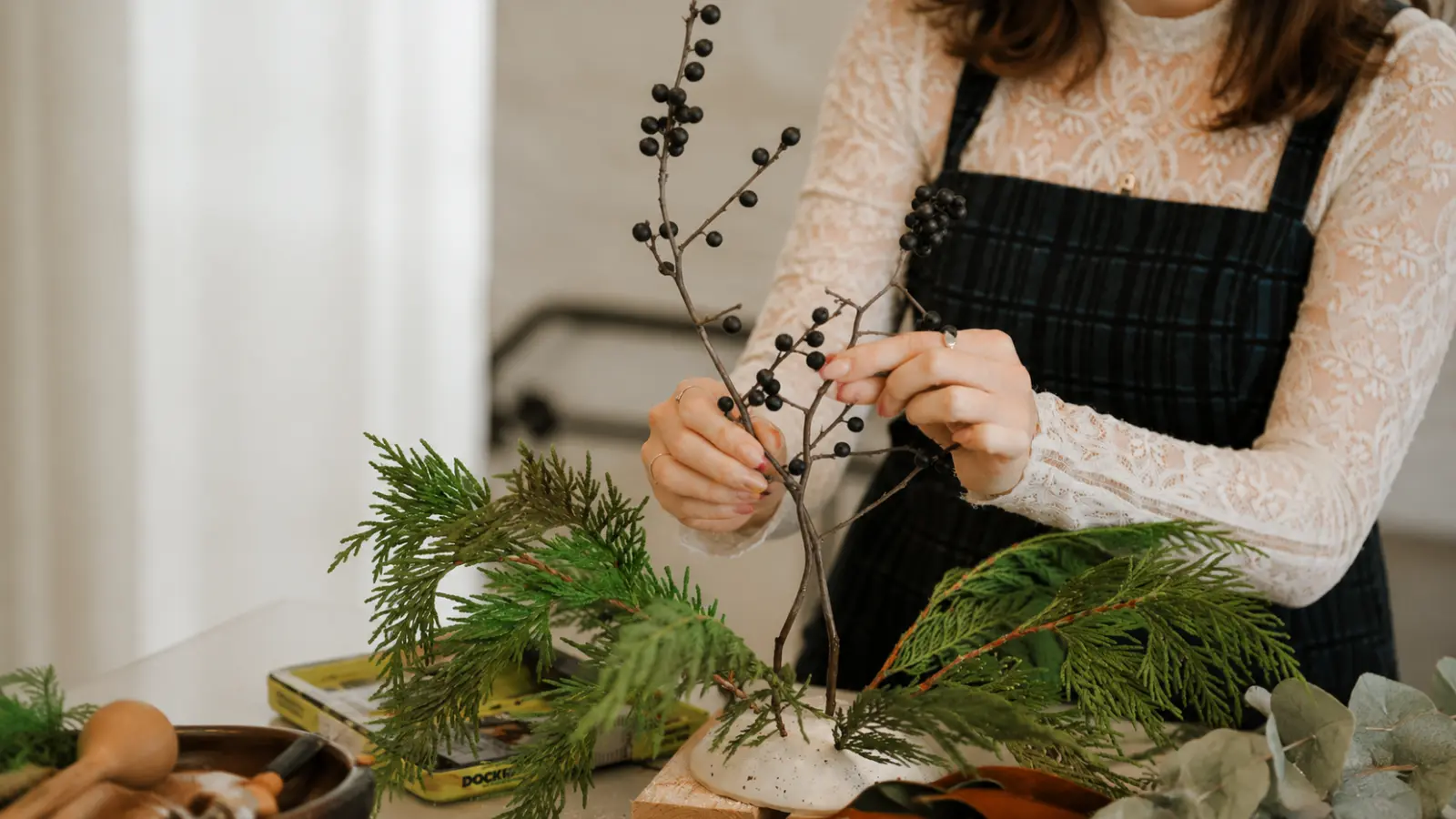
Black wedding flowers have a reputation for reading as dramatic or unconventional, but the gap between a dark bouquet that reads as gothic and one that reads as sophisticated and bridal is narrower than most people expect. These are the specific decisions that pull a dark bouquet into clearly bridal territory.
Add enough contrast. An all-near-black bouquet with no white, cream, red, or gold element reads as very dark in person and can read as a single undifferentiated mass in photos. Adding white garden roses, ivory ranunculus, or cream blooms — even as a minority element — gives the dark flowers something to stand against and immediately elevates the overall look.
Choose the right construction shape. Is one of the most important bridal bouquet styles decisions, since a round, gathered bouquet reads as bridal regardless of color. A more avant-garde or asymmetrical shape in near-black flowers reads as more unconventional. If the goal is dramatic-but-bridal rather than theatrical, a traditional or semi-structured shape is the safer construction choice.
Use rich foliage rather than stark foliage. Deep, lush greenery — Italian ruscus, bay leaves, deep eucalyptus — gives near-black flowers context and softness. Very sparse foliage or sharp, structural greenery can push the arrangement into more editorial territory.
Plan the photography deliberately. Near-black flowers absorb light and need adequate exposure and, ideally, natural or well-balanced lighting to show their texture and depth. Communicating this to your photographer before the wedding day, so they adjust their approach during portrait time, is one of the most practical steps you can take for a dark bouquet.
Coordinate with the dress tone rather than contrast against it. A pure white gown creates the strongest graphic contrast with a near-black bouquet. An ivory or champagne gown softens the contrast slightly, which some brides prefer. The combination to approach carefully is a very heavily embellished or textured gown alongside a very dark bouquet — both demanding attention simultaneously rather than working together.
Black Bouquet Mistakes to Avoid
Dark bouquets have fewer margin-of-error opportunities than lighter palettes, which makes understanding the specific pitfalls worth the investment of attention before ordering.
Assuming the flowers will look as dark in person as they do in photos. Near-black flowers can look significantly less dark in natural daylight than in professional photography, where controlled lighting and post-processing make them read more intensely. Seeing a sample stem in person — ideally in natural light — before finalizing your bouquet design prevents a day-of mismatch between expectation and reality.
Building an all-dark bouquet without contrast. A bouquet of only near-black flowers with no lighter accent color can photograph as a single dark shape, losing all the texture and detail that makes individual flower choices interesting. Even a small amount of white, cream, deep red, or gold gives the camera something to expose against and the eye somewhere to land.
Neglecting to discuss photography with your photographer. Dark flowers require a different exposure approach than standard bridal bouquets. Not flagging this before the wedding means your photographer may default to their usual settings, which can result in the bouquet looking flat or featureless in images where it should be one of the most visually striking elements.
Choosing a venue where a dark bouquet disappears visually. In a dimly lit indoor space with dark decor, a near-black bouquet can become difficult to distinguish against the surroundings. In a brightly lit, airy space with pale walls and natural light, a near-black bouquet stands out with maximum graphic impact. Being deliberate about how the bouquet will read within the actual venue — not just in isolation — is worth factoring into the design decision.
Conflating all “dark” aesthetics. There is a real difference between a modern editorial black-and-white bouquet, a richly romantic dark-red-and-near-black arrangement, and a gothic all-dark construction. Each requires different flowers, different construction, and different surrounding styling to look right. Getting clear on which direction you’re actually after — and communicating it specifically — is what ensures the result matches the vision.
Black Wedding Bouquet Inspiration
Discover black wedding bouquets featuring black roses, calla lilies, dahlias, black and white flowers, gold accents, and dramatic inspiration for modern and elegant weddings.
Black Is About Confidence, Not Just Color
Black wedding bouquets stand out because they communicate intention. Rather than following tradition, they create a distinctive bridal look built around contrast, texture, and thoughtful design. When balanced with the right flowers, complementary colors, and elegant construction, a dark bouquet feels sophisticated rather than overwhelming.
Whether you’re drawn to modern black-and-white arrangements, romantic near-black florals, or luxurious black-and-gold palettes, the most successful bouquet is one that reflects your personal style while complementing your dress, venue, and wedding atmosphere. With careful planning, black becomes one of the most memorable and refined choices a bride can carry.
Frequently asked questions (FAQ)
Are there real black flowers for a wedding bouquet?
There are no naturally true black flowers. Flowers described as black are actually extremely deep shades of burgundy, red, plum, maroon, purple, or chocolate. Near-black roses, dahlias, calla lilies, cosmos, and scabiosa can look convincingly black in photographs or low light, but their underlying color becomes more visible in natural daylight. Ask your florist to show you the exact variety in person so you know how dark it will appear at your venue.
What flowers work best in a black wedding bouquet?
Near-black roses, dark dahlias, deep maroon calla lilies, chocolate cosmos, dark scabiosa, plum lisianthus, and anemones are among the best flowers for a black wedding bouquet. Since each flower has a different underlying tone, the strongest arrangements combine a few varieties with distinct shapes and textures. Dark foliage such as burgundy smoke bush, deep eucalyptus, or Italian ruscus can reinforce the palette without making every element look identical.
How do you make a black wedding bouquet look bridal instead of gothic?
Use contrast, soft floral shapes, and a bouquet construction that feels connected to the rest of the wedding. White, ivory, cream, burgundy, or gold accents can soften near-black flowers and reveal their texture. Garden roses, ranunculus, and rounded bouquet shapes usually feel more romantic and bridal, while an all-dark bouquet with sharp lines, sparse foliage, or highly unconventional styling will lean more gothic or avant-garde.
What colors go best with a black wedding bouquet?
White and ivory create the cleanest and most classic contrast with black flowers. Deep red and burgundy produce a romantic, moody palette, while gold accents add warmth and formality. Plum and deep purple can create a richly layered dark arrangement, but they may need a small amount of white or gold to prevent the colors from blending together in photographs. Keeping the palette limited usually produces a stronger result than combining black with several unrelated colors.
Do black wedding bouquets photograph well?
Yes, but dark flowers need careful lighting and exposure to preserve their texture. In dim indoor spaces, near-black flowers can merge into one dark shape and lose the petal detail that makes the bouquet interesting. Natural light, backlighting, and deliberate portrait lighting help reveal the burgundy, plum, and maroon tones within the flowers. Tell your photographer about the dark bouquet before the wedding so they can plan the portrait lighting accordingly.
What wedding dress colors work with a black bouquet?
White wedding dresses create the strongest and most dramatic contrast with a black or near-black bouquet. Ivory and champagne gowns also work beautifully, producing a softer and warmer effect. A black dress with a black bouquet can create an editorial, avant-garde look, but the flowers need enough texture, shine, or contrasting accents to remain visible against the dress.