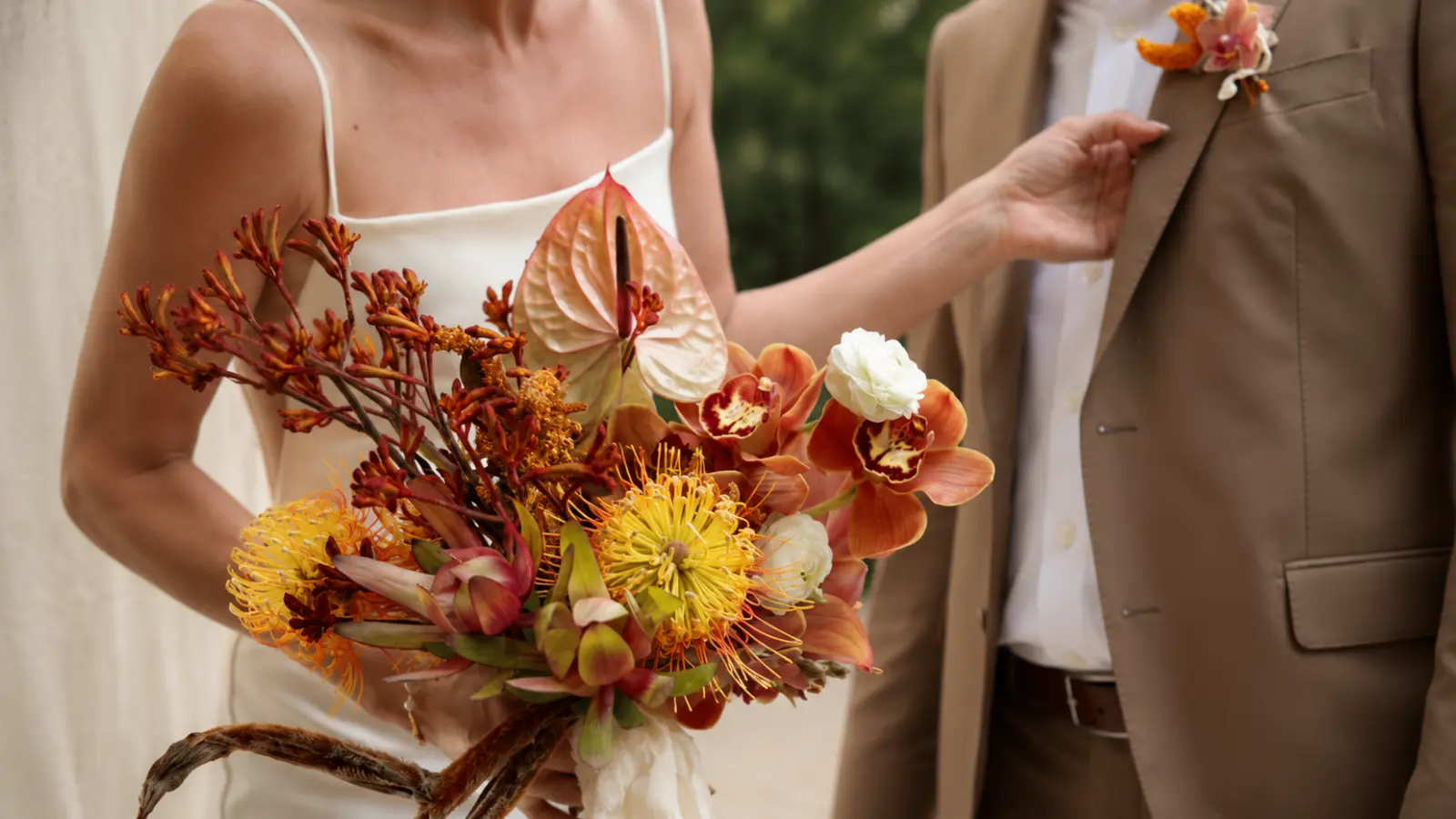
Fall wedding bouquets bring together the rich colors, seasonal flowers, and natural textures that make autumn one of the most beautiful times of year to get married. From dramatic burgundy dahlias to warm rust tones, dried grasses, and elegant chrysanthemums, fall bouquets create a depth and warmth that few other seasons can match.
Designing a bouquet for an autumn wedding isn’t simply about choosing orange flowers. The most memorable fall bouquets balance seasonal color with thoughtful flower pairings, elegant textures, and a style that complements both the venue and the atmosphere of the celebration. Whether your wedding is rustic, romantic, modern, or formal, the right bouquet should feel connected to the season without becoming overly themed.
This guide explores fall designs within the broader world of wedding bouquets, including the best autumn flowers, seasonal color palettes, rustic bouquet ideas, sunflower arrangements, October wedding inspiration, and practical advice for creating a bouquet that feels timeless and beautifully balanced.
Fall Wedding Bouquet Colors
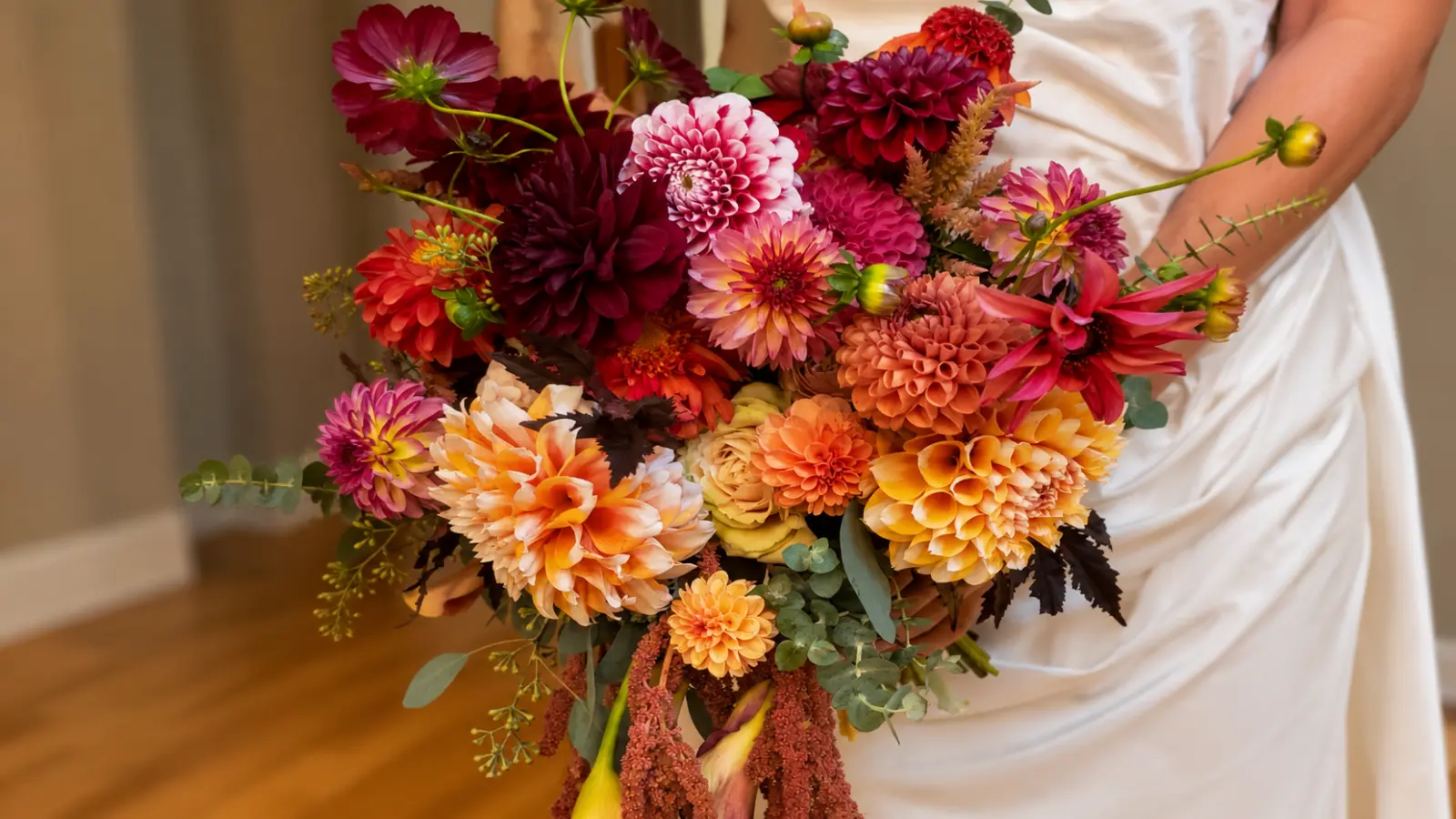
Fall wedding bouquet colors work best when they establish one dominant mood rather than trying to include every autumn shade at once. The most successful fall bouquets tend to fall into one of a few clear directions.
| Palette Direction | Core Colors | Mood |
|---|---|---|
| Warm & Bold | Rust, burnt orange, mustard, cream | Golden, energetic, photographs warmly in late-day light |
| Jewel Tone | Burgundy, plum, deep copper, forest green | Moody and elegant; reads as formal rather than seasonal-themed |
| Earthy Neutral | Terracotta, sand, dried wheat, ivory | Soft and understated; pairs well with rustic or outdoor venues |
| Soft Romantic Fall | Dusty rose, sage, light apricot | Gentle transitional look for early fall or warmer climates |
Of these, jewel tone palettes are the most forgiving for formal evening weddings, while warm and bold combinations tend to suit daytime, outdoor, or barn-style settings. The earthy neutral and soft romantic directions both work well for couples who want a fall feeling without leaning into deep, saturated color — useful if your dress, venue, or wedding party colors are already light or neutral.
One color rule holds across almost every successful fall bouquet: greenery matters as much as the flowers. Deep, dark-toned foliage — eucalyptus with bronze tips, smoke bush, copper beech, or Italian ruscus — does more to set a fall mood than any single flower choice, because it fills the space between blooms with the right undertone instead of standard bright green.
Best Flowers for Fall Wedding Bouquets
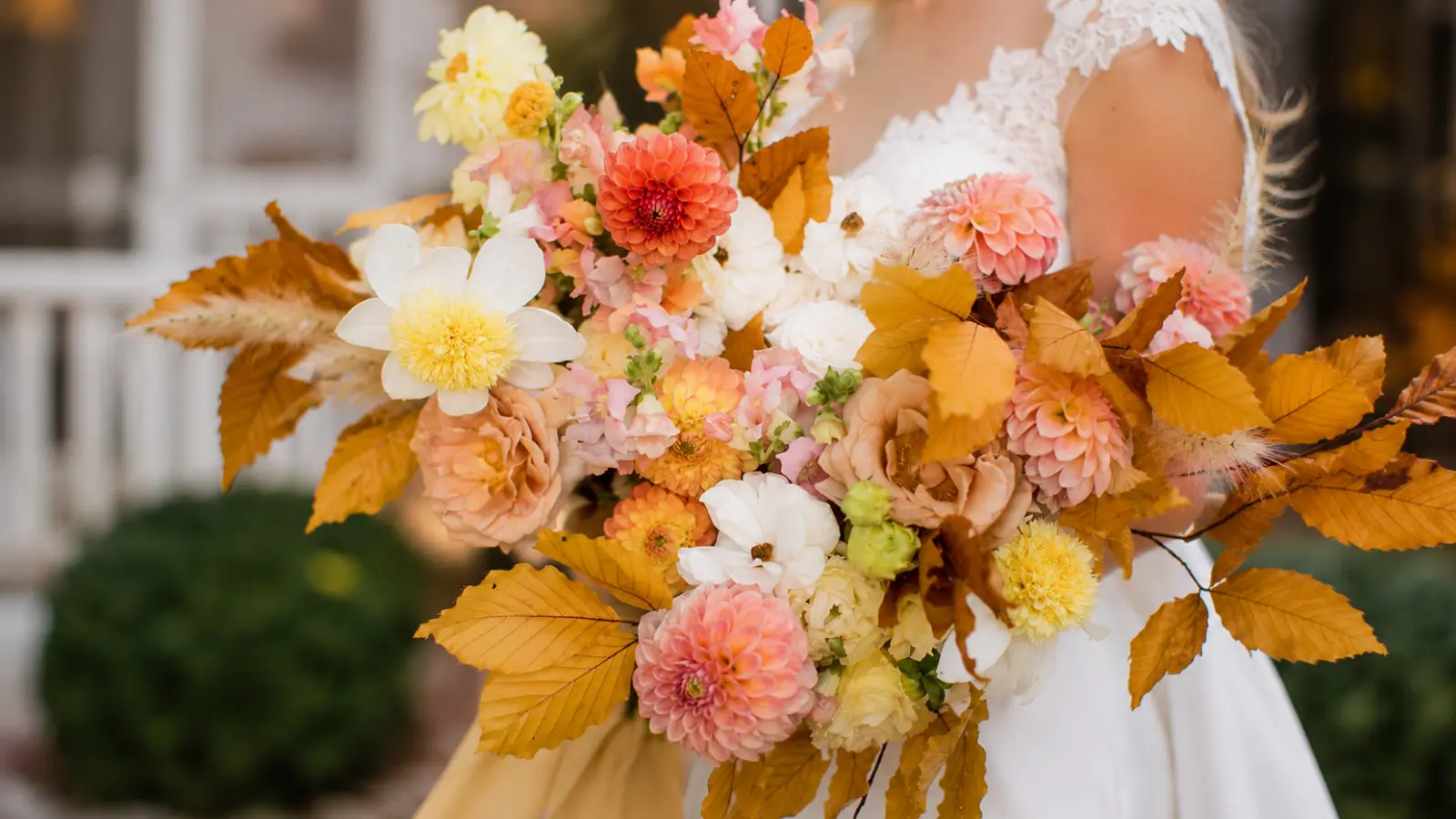
Seasonal availability changes which wedding bouquet flowers make the most sense for fall. Spring and early-summer staples like peonies and ranunculus are typically out of their natural window by this point, so the bouquet shifts toward a different set of focal flowers — ones that are not only in season but built for the richer color story fall calls for.
| Flower | Role in the Bouquet | Notes |
|---|---|---|
| Dahlias | Primary focal flower | Dramatic, full blooms in burgundy, rust, and copper tones; the most reliable fall anchor flower |
| Chrysanthemums | Focal or secondary | Underused and often dismissed, but garden mum varieties bring excellent texture and a long vase life |
| Marigolds | Secondary / accent | Bold orange and gold tones; best used in moderation alongside deeper colors |
| Scabiosa | Secondary / texture | Adds a softer, more delicate texture that balances bolder focal flowers |
| Amaranthus | Trailing / textural | Deep burgundy trailing element that adds movement and a slightly dramatic edge |
| Sunflowers | Focal (early fall) | Best in early fall while still at peak; pair with richer tones to avoid a too-casual look |
| Ornamental grasses / wheat | Textural filler | Core to rustic styling; adds movement and an unmistakably autumn texture |
A practical approach is to choose one dominant focal flower — most often dahlias or chrysanthemums — and build everything else around supporting it: one secondary bloom for contrast, one textural element like amaranthus or grasses, and dark-toned greenery to tie it together. Bouquets that try to feature four or five different focal flowers at once tend to look busy rather than rich, especially with fall’s already-saturated color palette.
Rustic Fall Wedding Bouquets
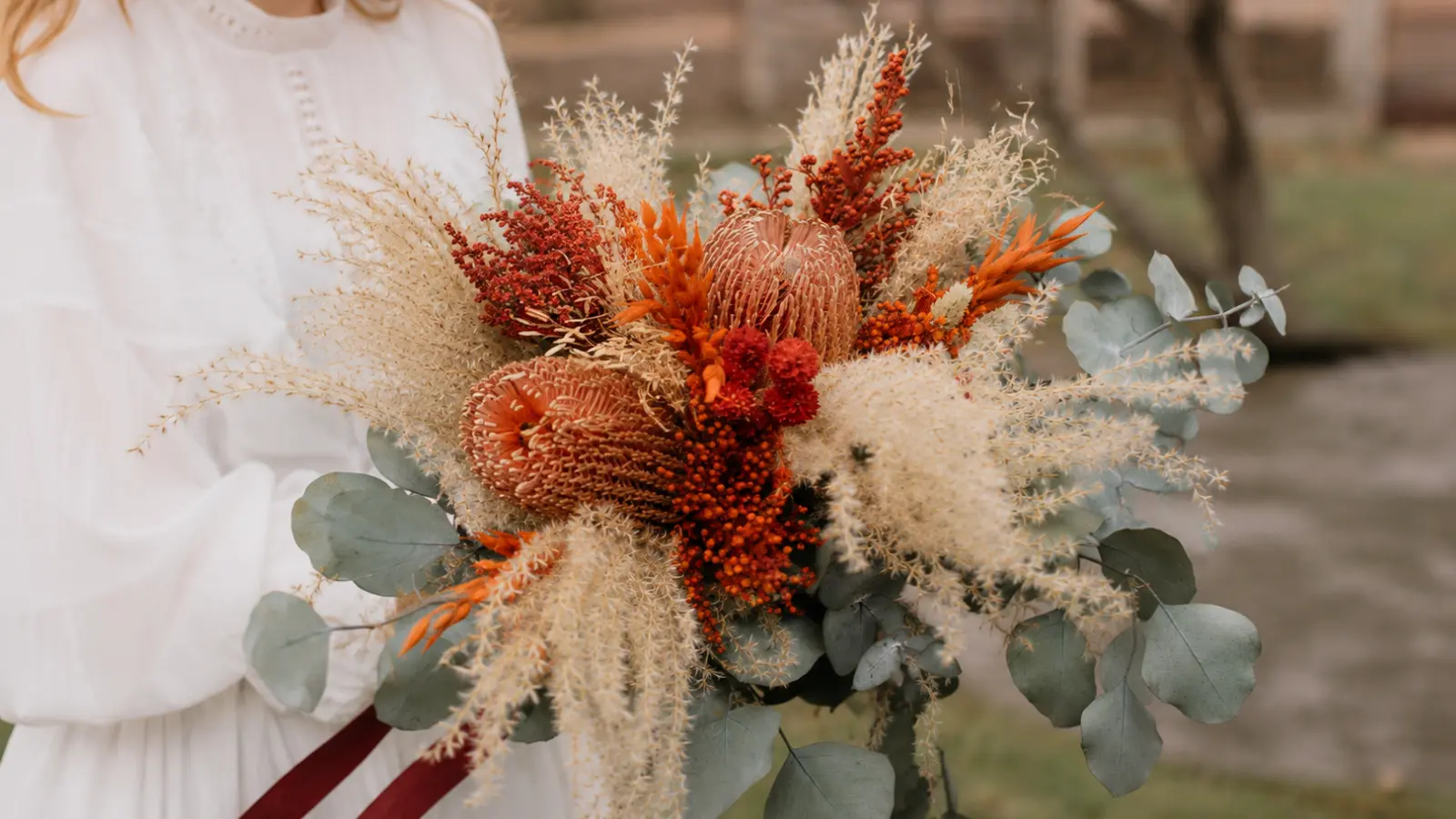
Rustic wedding bouquets and fall designs are grouped together constantly, but they are not the same thing. Fall describes the color palette and flower choices; rustic describes how the bouquet is built and finished. A bouquet can be entirely fall-colored and still look polished and formal, or it can lean fully rustic with a much more relaxed, gathered-from-the-garden construction.
What actually makes a bouquet read as rustic comes down to a handful of specific choices. The shape is looser and less symmetrical than a tight round bouquet — flowers sit at slightly varied heights rather than forming a uniform dome. The flower mix often includes raw, unrefined elements: dried wheat, seed pods, berries on the stem, or grasses left with some natural movement rather than trimmed flat. The handle is typically finished in something with texture and visible material — raw-edge ribbon, twine, or a wrapped strip of fabric — rather than a smooth satin wrap.
Rustic Without Looking Unfinished:
The line between “rustic” and “thrown together” is thinner than it looks. The fix is contrast: pair the loose, gathered shape with one or two flowers that have a clean, defined form — a dahlia or garden rose — so the eye has a focal point. A bouquet that is entirely texture with no clear focal flower tends to look more like a bundle of cuttings than a designed bouquet, no matter how good the individual materials are.
Rustic fall bouquets pair especially well with barn venues, vineyard weddings, and outdoor ceremonies with a natural backdrop. For a more formal venue — a ballroom, a hotel, an elegant indoor reception — a fall color palette without the rustic construction choices usually reads as a better fit; the colors carry the season without the looser styling competing with a more polished setting.
Sunflower Fall Wedding Bouquets
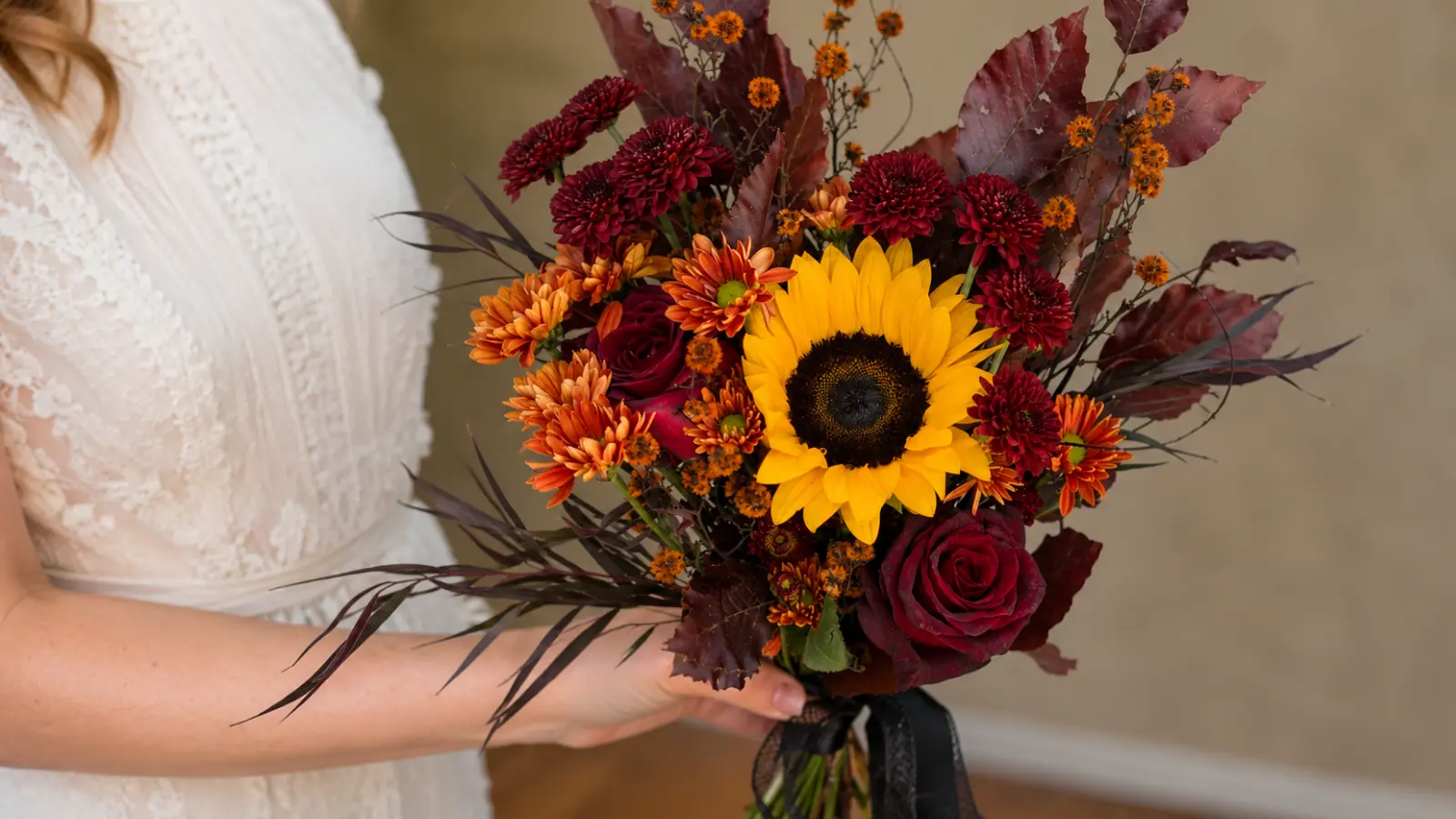
Sunflowers are one of the most polarizing choices in fall bouquets, and the disagreement usually comes down to styling rather than the flower itself. Used on their own in a tight, uniform bouquet, sunflowers can look more like a farmstand bunch than a bridal bouquet. Used as part of a considered mix, they become a genuinely striking, photogenic focal flower.
The flowers that elevate a sunflower bouquet are the ones with more depth and texture: dahlias or chrysanthemums in burgundy or rust to add richness, wheat or grasses for movement, and dark foliage like eucalyptus or smoke bush to ground the bright yellow against something deeper. A small proportion of sunflowers — three or four stems within a larger mixed bouquet — often photographs better than an all-sunflower design, because the contrast does more visual work than repetition.
Timing matters more with sunflowers than with most other fall flowers. They peak in late summer through early fall and are noticeably harder to source — and less vibrant — by the time true late-fall weddings come around. A sunflower-forward bouquet is best suited to a September or early-October wedding rather than one in November. They also wilt faster in heat than dahlias or mums, so outdoor daytime weddings should plan for the bouquet to be assembled close to ceremony time rather than hours in advance.
Burgundy and Orange Bouquets
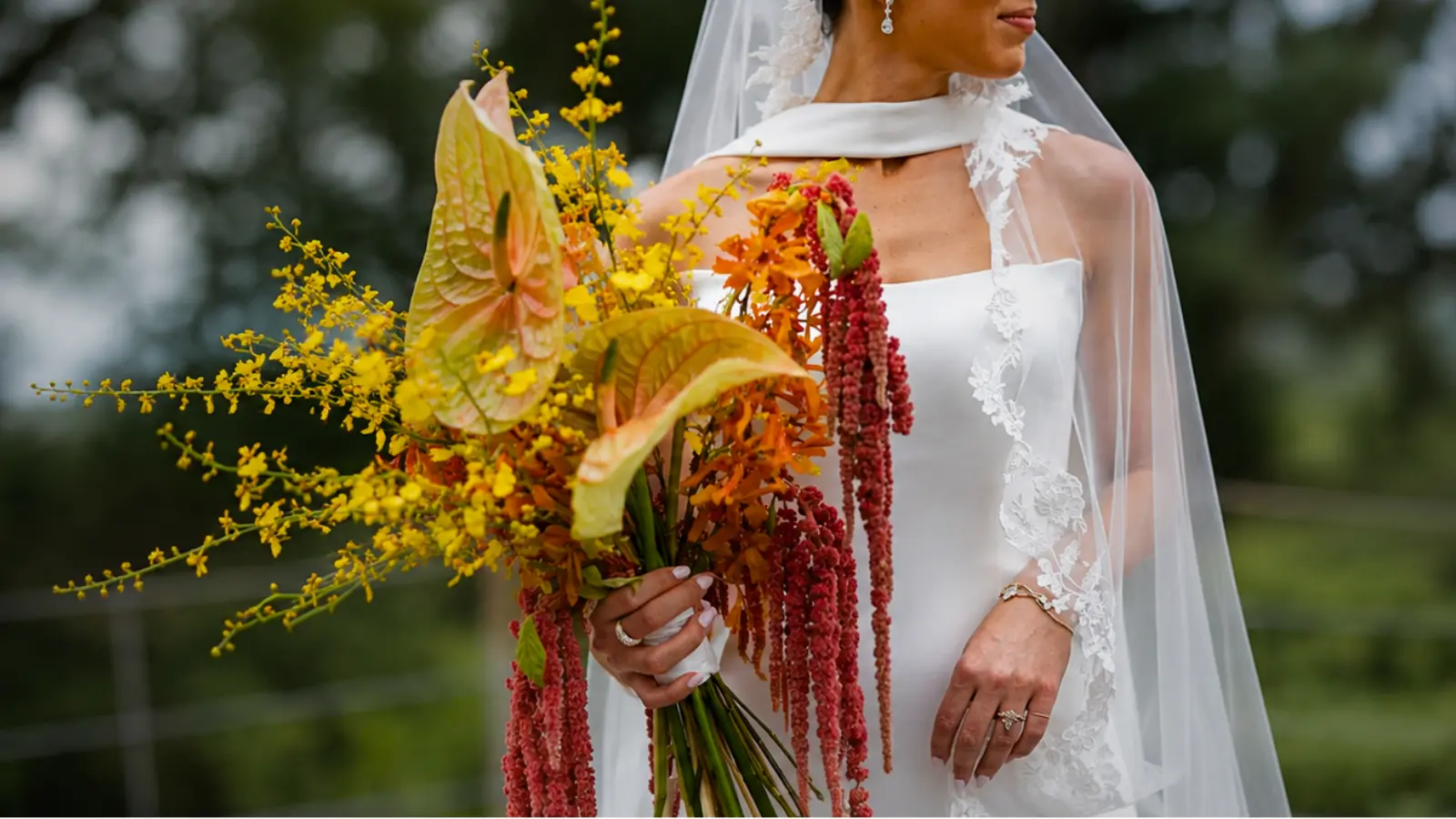
Burgundy and orange is the combination most associated with fall weddings — and also the one most likely to tip into an overly literal, seasonal-themed look if the balance is off. Done well, it is genuinely one of the most striking color pairings available for an autumn bouquet.
The key is proportion. In red and burgundy wedding bouquets, burgundy works best as the dominant tone, with burnt orange or copper used as an accent rather than an equal partner. Flowers that deliver this naturally include dahlias and chrysanthemums in deep wine tones, paired with a smaller number of marigolds, copper-toned roses, or rust-colored ranunculus where available. Ornamental grasses and dark foliage round out the mix and keep the palette from feeling flat.
Where this combination tends to go wrong is when the two colors are given equal weight and paired with bright orange or black accents — that version reads closer to a seasonal display than a bridal bouquet. Keeping the orange muted, using it sparingly, and grounding the whole bouquet in burgundy as the lead color is what separates an elegant autumn bouquet from a Halloween-adjacent one.
October Wedding Bouquet Ideas
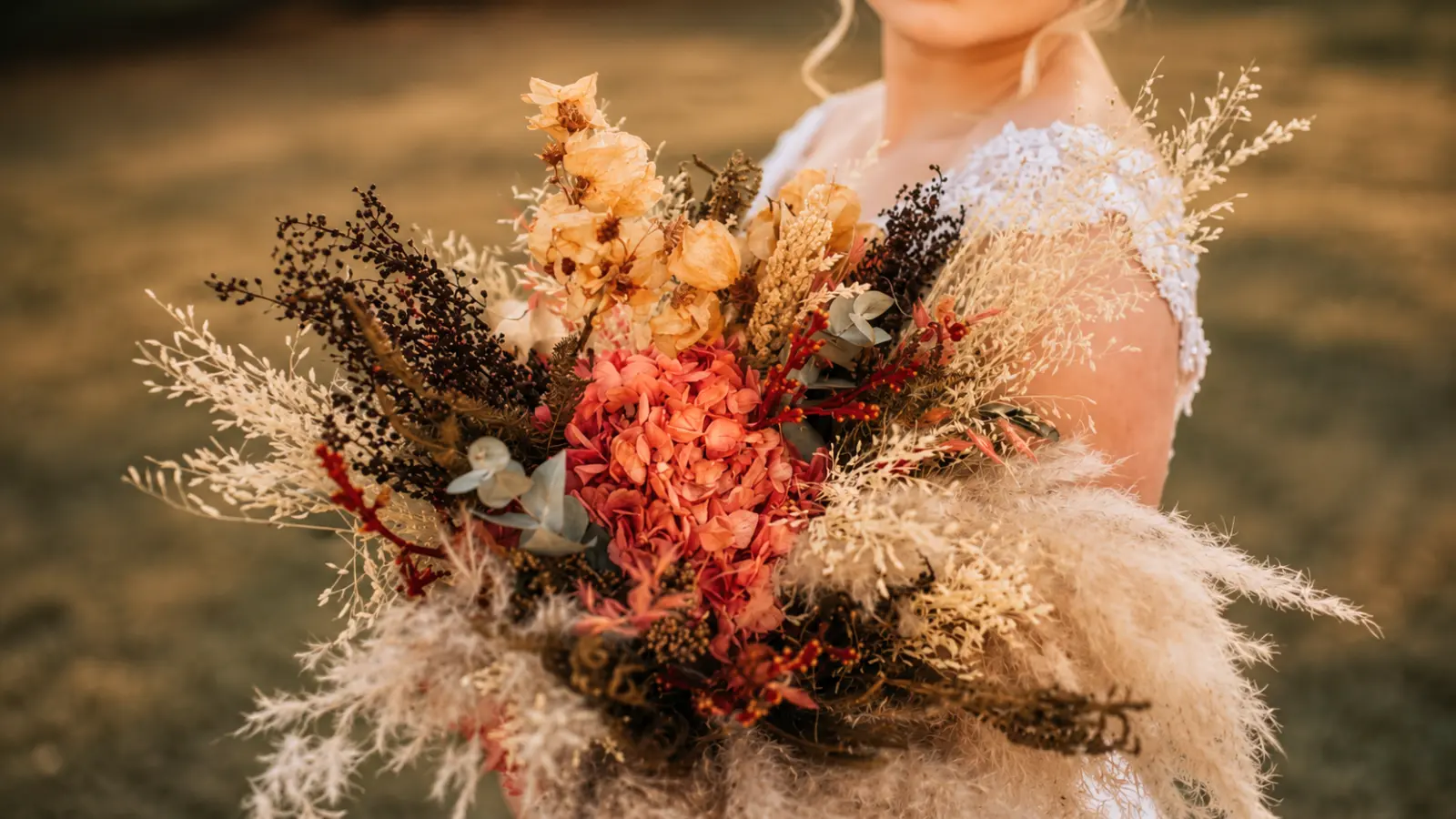
October sits at the most flexible point in the fall calendar, which makes it one of the easier months to plan a bouquet around. Early October still has reasonable access to late-summer flowers like sunflowers and garden dahlias, while late October shifts more fully into chrysanthemums, deeper jewel tones, and textural dried elements as the true peak of fall arrives.
For an early-to-mid October wedding, a warm and bold palette — rust, mustard, and cream — takes full advantage of flowers still at their late-season best, and suits the warmer afternoon light common to this part of fall. For a late October wedding, a jewel-tone palette built around burgundy, plum, and deep copper feels more aligned with the cooler temperatures and earlier-setting light, and pairs naturally with heavier dried textures like wheat and seed pods.
October weddings also have an advantage that summer weddings don’t: cooler air means fresh bouquets hold up noticeably longer between assembly and ceremony, with far less risk of wilting than a July or August wedding. That gives more flexibility on timing, including for bouquets that are partially or fully assembled the day before.
Fall Bouquet Mistakes to Avoid
Fall bouquets fail in a fairly predictable set of ways, and almost all of them are avoidable with a little intention up front.
Going too literal with seasonal props. Mini pumpkins, fake leaves tucked between stems, or acorns wired into the design tend to look like decor rather than a bridal bouquet. The flowers and color palette should carry the seasonal feeling — the bouquet doesn’t need literal autumn objects to read as fall.
Splitting the palette too evenly. Trying to feature burgundy, orange, mustard, and green in equal amounts usually looks busy rather than rich. Pick one dominant tone and let the others play a supporting role.
Using sunflowers without a supporting cast. On their own, sunflowers can skew casual. Paired with deeper-toned flowers and dark foliage, they become a genuinely elevated focal flower.
Ignoring where the wedding falls within fall. Early October and late November are both “fall,” but they call for different palettes and different flower availability. A warm, golden palette suits early fall; a jewel-toned, textural one suits late fall. Building the bouquet around the wrong end of the season leads to sourcing problems and a palette that doesn’t quite match the actual weather and light.
Forgetting how the palette looks against the venue. A deep burgundy and copper bouquet can disappear against a venue already full of warm wood tones and autumn foliage. In a visually rich fall setting, a slightly cooler accent — sage, dusty blue, or cream — often helps the bouquet stand out rather than blend in.
Fall Wedding Bouquet Inspiration
Discover beautiful fall wedding bouquets featuring rich autumn flowers, burgundy dahlias, rustic bouquet ideas, warm seasonal color palettes, sunflower arrangements, and elegant floral inspiration for autumn weddings.
Let the Season Inspire the Bouquet
A fall wedding bouquet feels most beautiful when it reflects the natural richness of the season instead of relying on predictable autumn decorations. Thoughtfully chosen flowers, layered textures, and balanced color palettes create arrangements that feel elegant, timeless, and perfectly suited to the atmosphere of an autumn celebration.
Whether you’re drawn to dramatic jewel tones, warm earthy colors, or soft romantic neutrals, let seasonal flowers guide your design rather than forcing a specific trend. By embracing what autumn naturally offers, your bouquet will not only photograph beautifully but also become one of the most memorable details of your wedding day.
Frequently asked questions (FAQ)
What makes a bouquet feel like fall without looking overly seasonal?
The most elegant fall bouquets rely on rich color, texture, and seasonal flowers rather than obvious autumn decorations. Burgundy, rust, terracotta, deep plum, and forest green create a distinctly fall feeling, while dahlias, chrysanthemums, ornamental grasses, and textured foliage add seasonal character naturally. The goal is to suggest autumn through thoughtful floral design rather than literal seasonal props.
What flowers are in season for fall wedding bouquets?
Dahlias, chrysanthemums, celosia, marigolds, scabiosa, amaranthus, ornamental grasses, and late-season sunflowers are among the best flowers for fall weddings. Choosing blooms that are naturally in season usually results in better quality, stronger stems, fuller bouquets, and more predictable pricing than relying on flowers that have already passed their peak season.
Are sunflowers a good choice for a fall wedding bouquet?
Yes, when styled thoughtfully. Sunflowers work best alongside richer flowers such as dahlias or chrysanthemums and darker foliage that balances their bright yellow color. Used as one focal element rather than the entire bouquet, they create warmth and personality while maintaining an elegant overall design.
What makes a rustic bouquet different from a fall bouquet?
A fall bouquet is defined primarily by seasonal flowers and color palettes, while a rustic bouquet is defined by its construction and styling. Loose hand-tied shapes, visible movement, natural textures, dried grasses, berries, and organic ribbon finishes create a rustic look regardless of the season. Likewise, a bouquet can feature fall colors without feeling rustic at all.
What colors work best for a fall wedding bouquet?
Burgundy, rust, terracotta, mustard, copper, deep plum, forest green, cream, and warm ivory create the most timeless fall palettes. Rather than dividing attention equally among many bold colors, the strongest bouquets choose one dominant tone and use the remaining colors as supporting accents to create balance and visual depth.
How do you keep a fall wedding bouquet elegant instead of looking like Halloween?
Avoid relying on bright orange, black accents, artificial leaves, miniature pumpkins, or novelty seasonal decorations. Elegant fall bouquets achieve their seasonal feeling through sophisticated color combinations, quality flowers, restrained textures, and balanced proportions. Rich burgundy, muted copper, and natural greenery almost always create a more timeless result than literal autumn-themed elements.