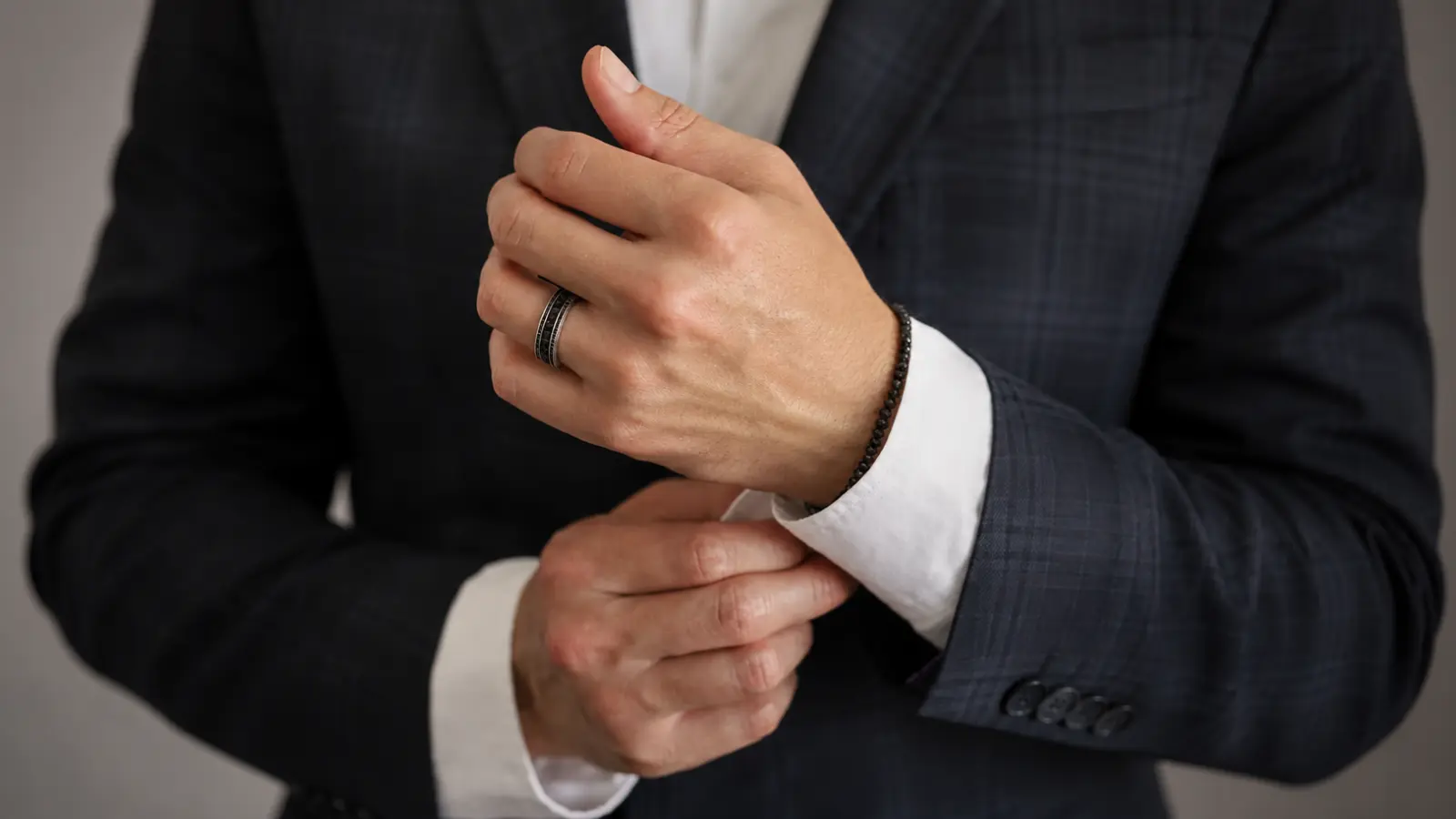
Men’s wedding rings are rings exchanged during a wedding ceremony and worn as a symbol of marriage, commitment, and the life two people build together. Today, men’s wedding rings include everything from classic gold bands and platinum rings to modern black designs, diamond accents, titanium styles, and alternative materials.
For many men, a wedding ring is the first piece of jewelry they have ever thought carefully about. It becomes part of everyday life — worn through work, important moments, ordinary days, and every stage of the marriage that follows.
This guide explains different men’s wedding ring styles, including classic bands, modern designs, black wedding rings, diamond options, different materials, symbolism, and how to choose a ring that feels right for the person wearing it.
Best Wedding Ring Styles for Men
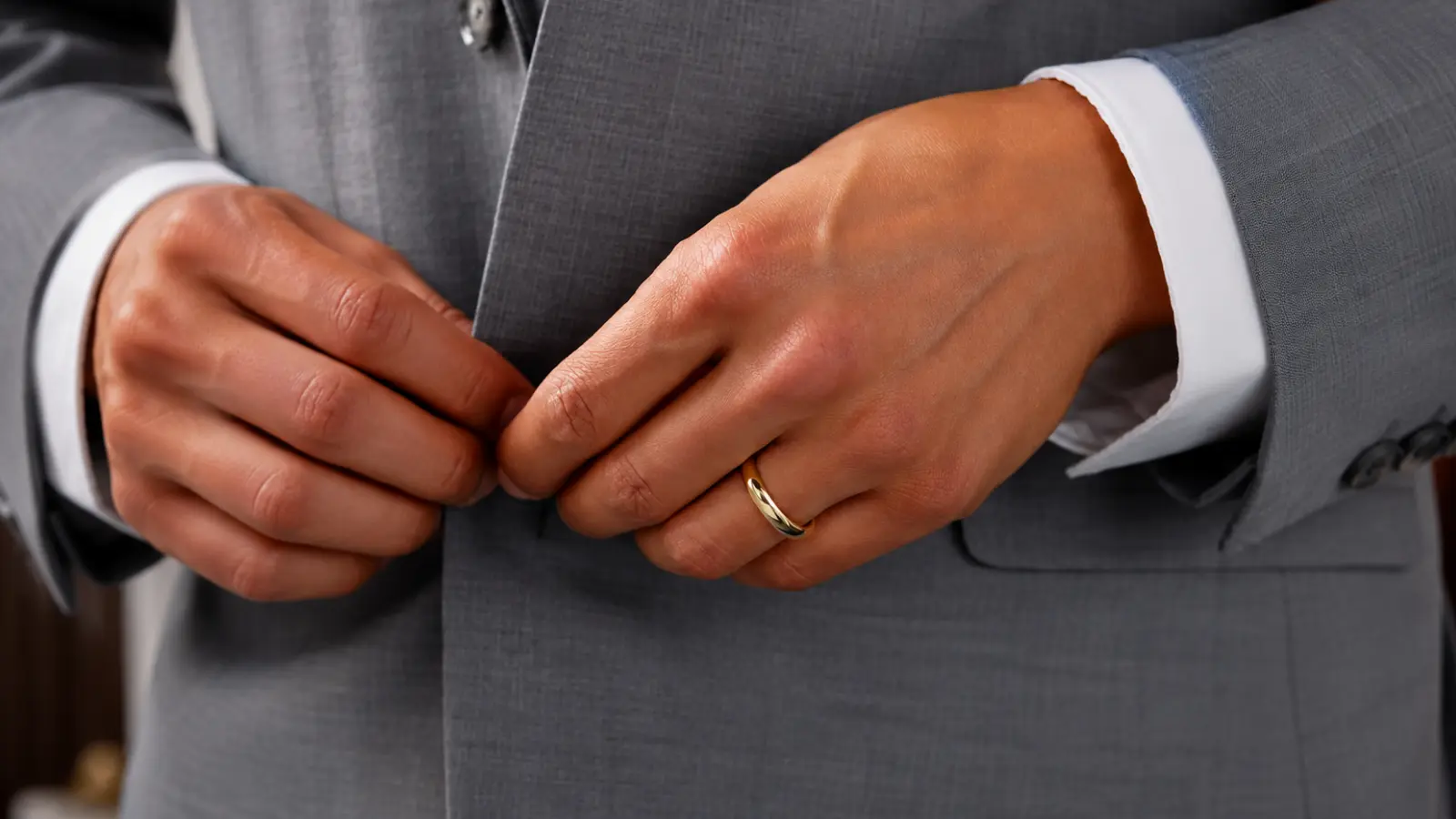
Men’s wedding ring styles cluster into a few broad categories — not because the options are narrow, but because the defining variables are clear: metal, finish, width, and whether the ring carries any additional design detail beyond the band itself. Understanding those variables and how they combine makes the range feel navigable rather than overwhelming.
The terminology worth clarifying first: men’s wedding ring and men’s wedding band describe the same object. Jewelers often use “band” in product categories and “ring” in conversation, and “band” has a historical association with plain, unadorned designs — but neither term carries a definitive style implication today. A man wearing a channel-set diamond ring and a man wearing a plain gold circle are wearing the same category of jewelry. For a full breakdown of how these terms work, the wedding band vs. wedding ring guide covers the distinction in detail.
What most men find when they begin looking is that the initial choice is really between two orientations: classic or modern. Classic styles derive from the long tradition of the plain metal band — unadorned, proportionate, designed to be worn rather than noticed. Modern styles use that tradition as a starting point and depart from it with intention: different materials, textures, surface treatments, and structural details. Both produce beautiful rings; the right one depends almost entirely on the man wearing it.
For detailed guidance on metals, widths, comfort fit, and active-lifestyle considerations, the men’s wedding bands guide goes deeper on the practical side of the purchase.
Classic Men’s Wedding Rings
The classic men’s wedding ring is, at its core, a plain metal band: a continuous circle of gold or platinum, unadorned, worn on the left ring finger. This is the form that became standard in the United States beginning around the mid-twentieth century, and it remains the most widely worn style by a significant margin. Its appeal is not nostalgia — it is the fact that a well-chosen plain band in the right width and metal does exactly what a wedding ring is supposed to do and nothing else.
Plain yellow gold
Yellow gold was the default men’s wedding ring material for most of American wedding history, and it still represents the most direct line between a man and the tradition of the wedding ring as an object. A plain 14k yellow gold band in a 6mm or 8mm width — polished or lightly brushed — is one of the most enduringly correct choices in men’s jewelry. It does not age out of style. It photographs cleanly at any decade. It can be resized by any jeweler, repaired if damaged, and passed down if that kind of continuity matters.
The choice between 14k and 18k is worth a moment: 14k gold is harder and more durable for daily wear, while 18k has a richer, more saturated color that is perceptible when the two are compared side by side. For a ring worn through ordinary life every day, 14k is the more practical choice. For a man whose ring will see less physical use and who values the deeper color, 18k is worth considering.
Platinum
A plain platinum band occupies the same classic orientation as yellow gold but with a distinctly different visual character — cooler, whiter, more contemporary in feel despite its long history as a precious metal. Platinum does not require plating to maintain its white color, unlike white gold, and develops a gentle patina over years that many wearers come to prefer over the original bright surface.
Platinum costs significantly more than gold for the same design, and that premium reflects the metal’s genuine superiority in long-term durability and maintenance requirements. It is heavier than gold — some men find that weight satisfying; others find it noticeable in a way that becomes tiring over a full day. For men who want to spend once and never revisit the decision, platinum makes a strong case for itself.
White gold
White gold achieves a platinum-adjacent look at a more accessible price. The trade-off is the rhodium plating that gives it its bright white finish: it wears through over time and needs renewal every one to three years depending on how the ring is worn. For men who do not mind periodic professional maintenance, white gold is a strong value. For men who want a ring that requires zero attention, platinum is the cleaner long-term choice even at the higher initial cost.
Finish as a design decision
On any classic band, finish is often the most consequential design choice after metal. A high-polish finish gives the ring a formal, light-catching quality. A brushed or matte finish reads as quieter, more contemporary, and more forgiving of daily wear. Many men who choose polished bands find themselves wishing for matte after a year — scratches become visible quickly on polished metal in a way that a brushed finish simply absorbs. A ring that combines both finishes — brushed center with polished edges, or a polished band with a brushed channel — is a middle path that many jewelers recommend specifically for men who are uncertain about the choice.
Modern Men’s Wedding Rings
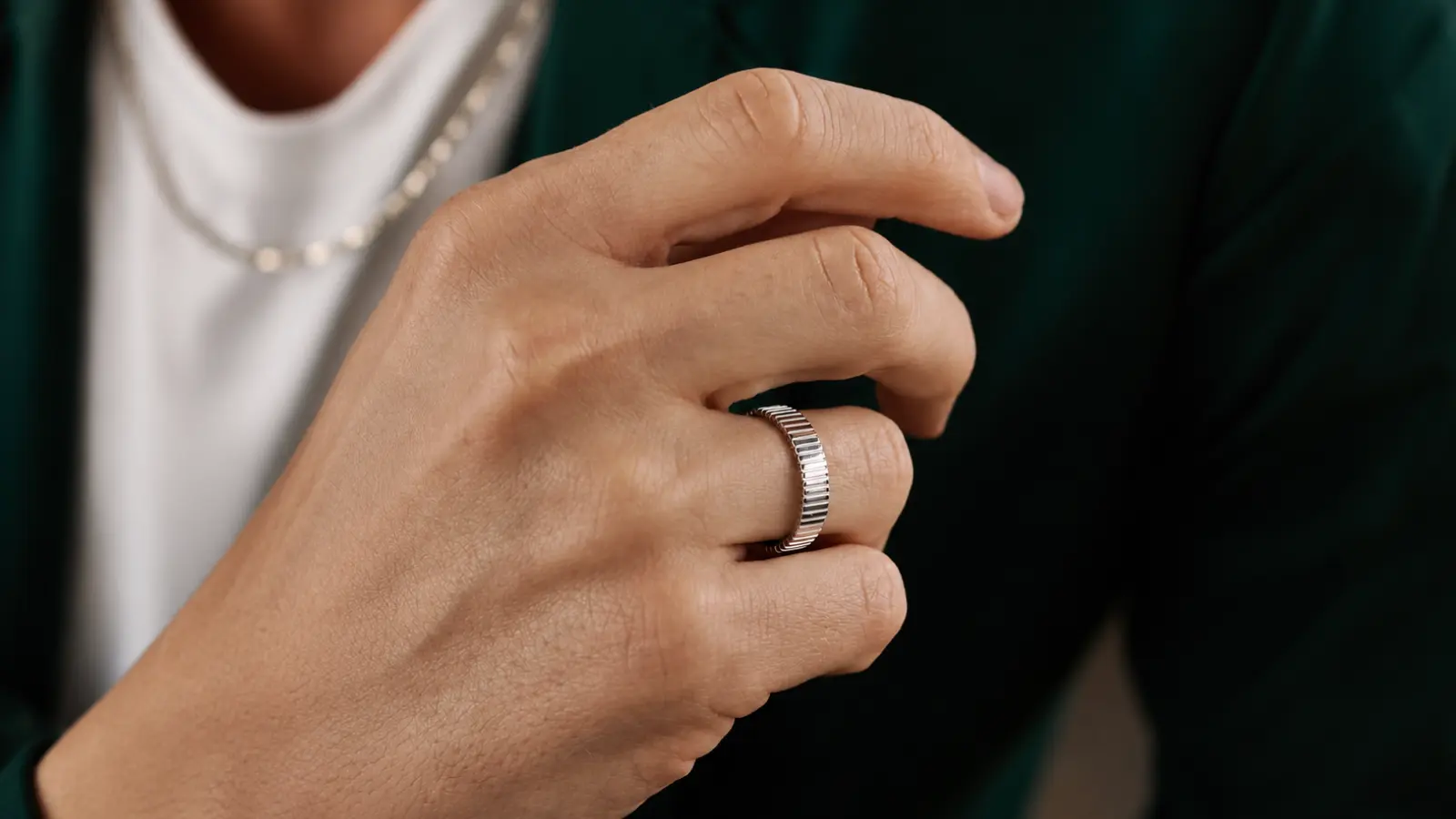
Modern men’s wedding rings work from a different set of assumptions than classic bands. They are still rings worn to mark a marriage, but their design language draws from contemporary materials, industrial aesthetics, and a broader understanding of what men’s jewelry can look like. They tend to appeal to men who already have a strong personal style — or who find that a plain gold band simply does not feel like them, even if they cannot immediately articulate why.
Textured and carved bands
A band with surface texture — hammered metal, a woven or rope-style pattern, a carved geometric detail — occupies a middle space between classic and modern. These rings retain the essential form of the plain band but give it a surface quality that is visually distinct and, in many cases, carries specific personal meaning. A hammered finish evokes handcraft and intentionality; a braided or twisted pattern has historical resonance across many cultural traditions. Textured bands tend to suit men who find plain metal understated to the point of invisibility on the hand.
Mixed-material and inlay rings
Rings with material inlays — wood, carbon fiber, meteorite, antler, ceramic, or colored resin set into a channel within a metal band — have grown substantially in popularity among men looking for something genuinely distinctive. These rings carry a narrative quality that plain bands do not: a band with a wood inlay sourced from a meaningful location, or a meteorite inlay that references a shared interest, carries a layer of personal significance that goes beyond the symbolic weight of the ring itself.
The practical consideration with inlay rings is longevity. Wood, antler, and organic materials can dry, crack, or change over years of daily wear, particularly with frequent water exposure. Carbon fiber and ceramic inlays are considerably more durable. If an inlay ring is the direction, asking the jeweler directly about expected lifespan and care requirements for the specific material is worth the conversation before purchasing.
Two-tone and mixed-metal rings
A ring that combines two metals — a yellow gold exterior with a platinum interior, or a rose gold band with a white gold center channel — creates visual complexity within a restrained form. These rings look traditional from a distance and reveal their detail up close, which suits men who want something considered without something obviously statement-making. They also have a practical dimension: the outer surface can be chosen for aesthetics, while a platinum interior lining provides durability at the contact point where wear is most concentrated.
Wider statement bands
A band at 10mm or above — covering most of the visible ring section of the finger — makes a deliberately bold impression. These rings suit men whose personal style runs toward the architectural or the dramatic. The key is proportionality: a very wide band needs a hand size that can carry it. The same ring that looks considered on a larger hand can look like a costume piece on a slender one. Trying wider bands in person before deciding is even more important at this end of the spectrum than it is for standard widths.
Men’s Wedding Rings With Diamonds
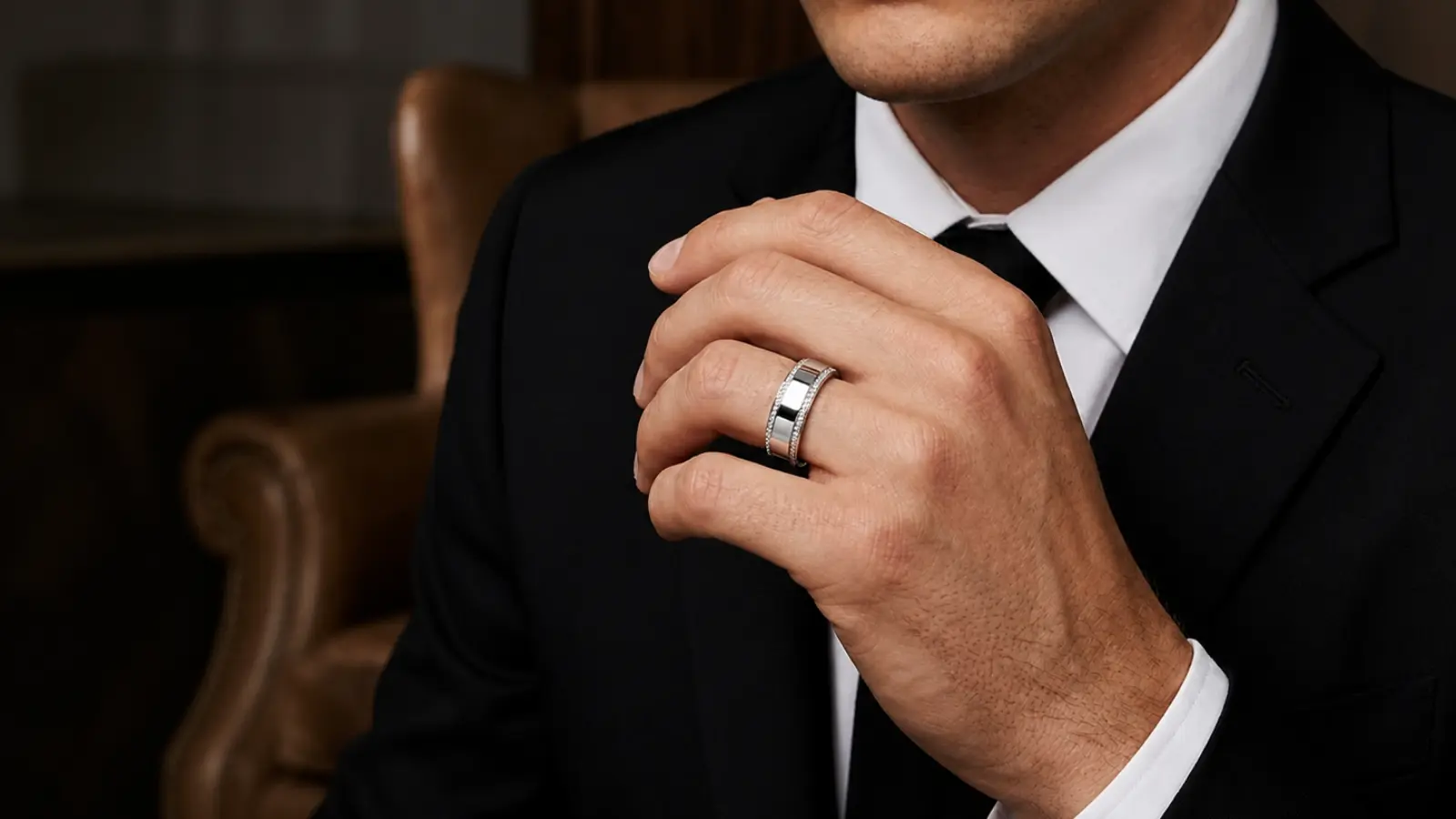
Men’s diamond wedding rings have moved from the margins to the mainstream. They are available from virtually every major bridal jeweler, in a range of styles and price points, and the men wearing them span a wide range of personal styles — from fashion-forward and city-oriented to understated and traditional, with diamond details that read as an accent rather than a centerpiece.
Channel-set diamond bands
A channel-set band — small diamonds set in a recessed channel along the top center of a metal band — is the most commonly worn men’s diamond ring style and tends to be the most photographically versatile. The channel protects the stones, keeps the profile low, and allows the diamonds to catch light without adding significant height or visual drama. From a few feet away, a channel-set men’s band can look like a textured detail rather than a diamond ring, which suits men who want sparkle with discretion.
Channel-set bands are available in widths from 6mm to 10mm, in yellow gold, white gold, and platinum, and occasionally in titanium for a more contemporary look. The number of stones, their size, and the amount of band surface they cover all determine how prominently the diamond element reads in the finished ring.
Single-stone and accent rings
A wider metal band with one or a small number of diamonds set flush into the surface — bezel-set, burnish-set, or flush-set — gives a ring a focal point without the continuous coverage of a channel-set design. A single flush-set diamond in an 8mm platinum band, for example, reads as a strong, considered detail rather than as jewelry in the traditional sense. This style tends to appeal to men who want something distinctive but find the idea of a “diamond ring” too elaborate for their sensibility — the stone reads as a feature of the ring’s design rather than its purpose.
Pavé and fully set bands
Fully pavé-set men’s bands — the entire top surface covered in small diamonds — represent a relatively small segment of men’s wedding ring purchases. They require a confident personal style and tend to suit men who wear other substantial jewelry or who work in creative or fashion-adjacent industries. For men who are uncertain, a channel-set or single-accent ring is a lower-commitment entry point into the diamond band category.
A practical note on settings
Diamonds in men’s rings need to be set in a way that accommodates daily life. High-prong settings that work beautifully in a woman’s engagement ring are impractical in a men’s daily-wear band — they catch on fabric, accumulate debris, and are more vulnerable to damage through hand-heavy activities. Flush, bezel, channel, and burnish settings keep the stones protected and the profile low. The diamond wedding bands guide covers stone quality, coverage options, and what to look for at different price points in more detail.
Black Wedding Rings for Men
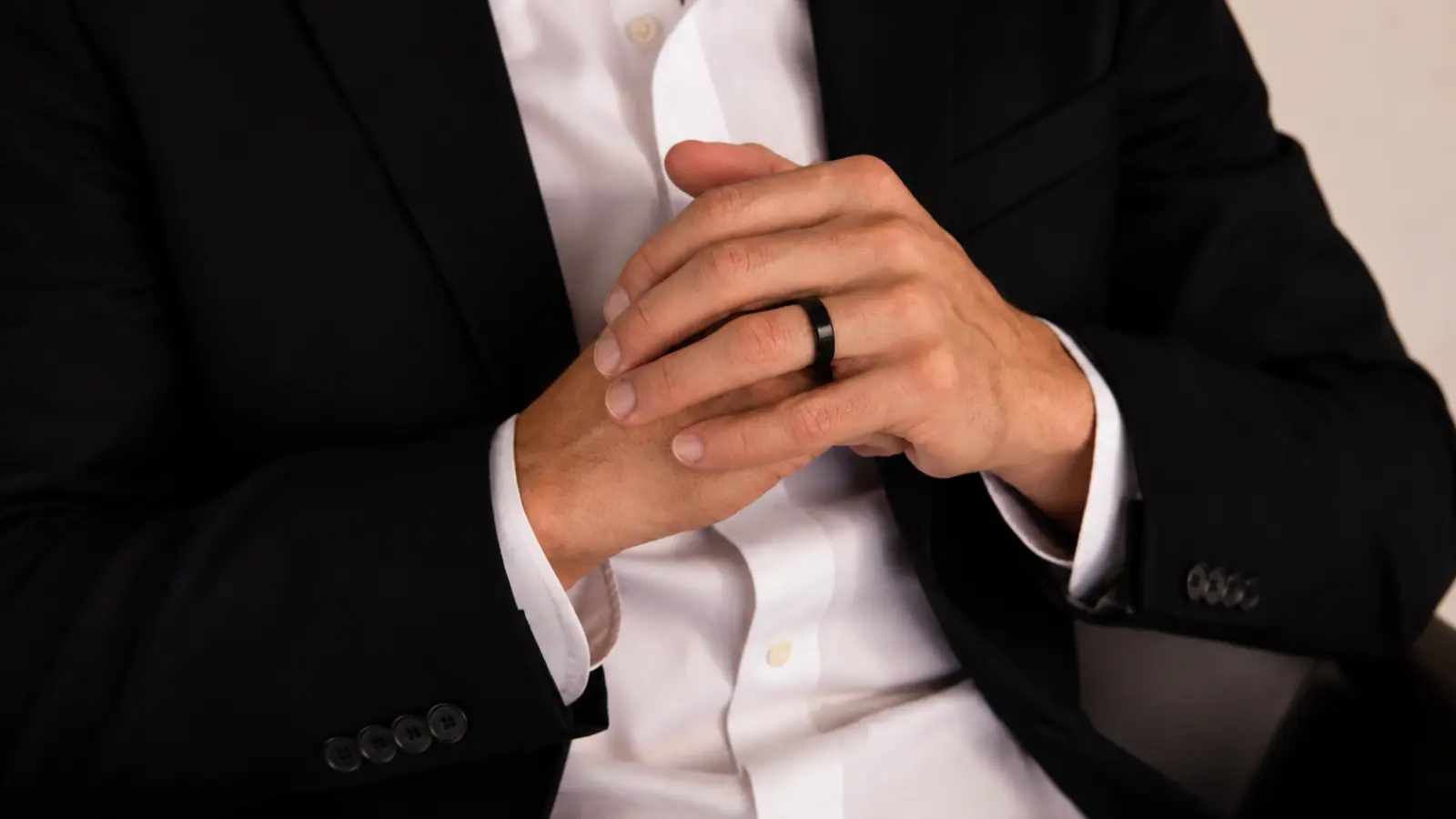
Black wedding rings have become one of the more genuinely distinctive options in contemporary men’s ring design — not a trend that will date quickly, but a coherent aesthetic choice that works well for a specific kind of personal style. They tend to appeal to men who lean minimalist and dark in their overall aesthetic, who prefer a ring that does not look like a conventional wedding ring, or who simply respond to the visual weight of a black ring in a way they do not respond to gold or silver-toned metals.
Black tungsten carbide
Black tungsten is among the most durable black ring options available. Tungsten carbide rings are surface-treated or alloyed to achieve a deep black color that holds better than most coating processes. Tungsten’s extreme hardness means the ring will not scratch easily, and the color is less vulnerable to surface wear than ion-plated alternatives. The significant limitation — tungsten cannot be resized and must be replaced if the size changes — is the same for black tungsten as for standard tungsten. For men who are confident in their ring size and want a genuinely low-maintenance black ring, black tungsten is one of the strongest practical choices.
Black ceramic
Black ceramic rings are made from a technical ceramic material that is naturally black throughout — the color is not a coating applied to a different base material, which means it cannot wear away to reveal a different color underneath. This makes black ceramic more color-stable over time than most coated alternatives. Ceramic is also hypoallergenic and lightweight relative to tungsten, which makes it comfortable for extended daily wear. The limitation shared with tungsten: ceramic rings cannot be resized, and ceramic is brittle under extreme point pressure, which means it can crack if dropped or struck at the right angle.
Black titanium and ion-plated rings
Titanium can be ion-plated — a process that bonds a black coating to the metal at the atomic level — to achieve a black surface that is more durable than paint or simple coating but less permanent than the intrinsic black of ceramic or black tungsten. Ion-plated black titanium rings are lightweight, comfortable, and attractive, but the coating may show wear in high-contact areas after several years of daily use. For men who want a black ring with titanium’s weight advantage and are comfortable with the possibility of eventual re-coating or replacement, this is a valid option.
When black rings work — and when they do not
Black rings tend to suit men whose broader personal style accommodates them: dark clothing preferences, minimal accessory choices, modern or industrial aesthetic sensibilities. They can look slightly out of place in traditional or formal professional environments — though many men wear black rings in traditional settings without issue. The more relevant question is personal style coherence: a black ring on a man who generally wears warm metals and traditional clothing may feel like a mismatch; the same ring on a man whose style is contemporary and understated will feel exactly right. For an in-depth look at specific options across materials and price points, the black wedding bands covers the full range.
How to Choose a Ring for His Lifestyle
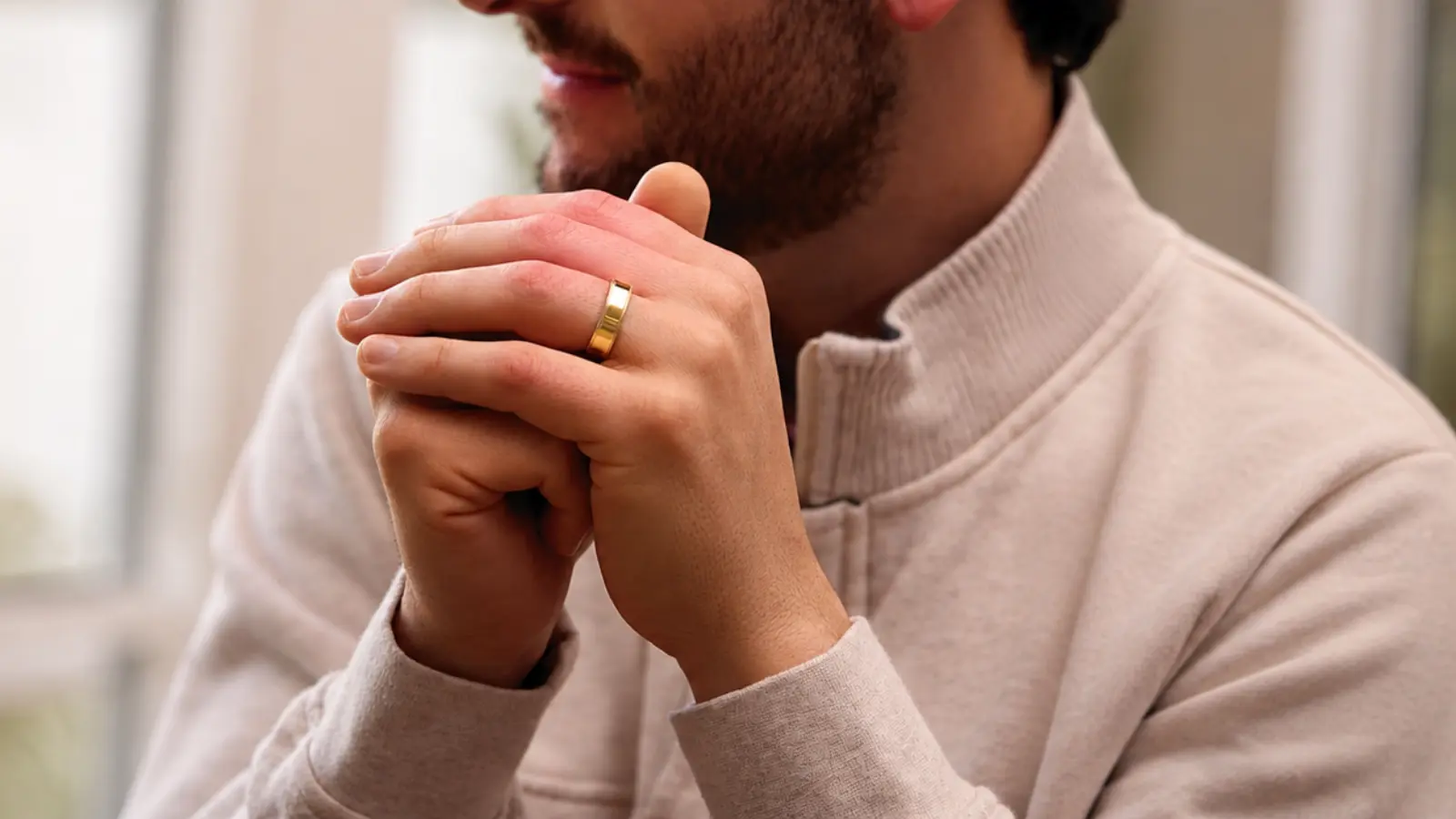
A wedding ring is not chosen once and worn unchanged forever. It is chosen once and then tested against every version of the life that follows: the job that requires hand protection, the gym routine that makes metal uncomfortable, the professional context where the ring is visible in meetings, the physical work that puts wear on materials not built for it. The best men’s wedding ring is not the most beautiful one in isolation — it is the one that holds up across all of that.
Match the ring to the work he actually does
Men’s lifestyle considerations for wedding rings fall into a few clear categories. Office and professional environments are the most forgiving: virtually any metal, any finish, any width works. Physical or trade work introduces the question of ring avulsion safety, material durability under impact and abrasion, and the practicality of wearing a precious metal through conditions that will degrade it quickly. Active and athletic contexts involve the same practical questions, plus the question of comfort during sustained physical movement.
For men in physically demanding work environments, the most practical solution is still the two-ring approach: a titanium or silicone band worn during work, and a gold or platinum band for the rest of life. The work ring is inexpensive enough to treat as a tool; the daily ring can be chosen purely for what it means and how it looks. More on this in the silicone wedding bands guide for men whose work makes a metal ring genuinely unsafe.
Consider what he has never had to think about before
Many men choosing a wedding ring are doing so without any prior experience of wearing jewelry. They may not know whether they will find a ring comfortable or distracting on the hand. They may not have an instinct about which metal or width feels right, because they have never worn either.
The most useful approach for men in this position: try rings in person, in a range of widths and metals, and wear each one for at least fifteen minutes while moving the hand normally. The sensation of a ring on the hand during daily activity is very different from how a ring looks on a display stand, and the difference is only legible through experience.
Narrow down by elimination
A useful decision framework for men who find the range overwhelming: start by eliminating what clearly does not work. Not interested in maintaining a plating? That eliminates white gold. Works in conditions where a metal ring is a safety risk? That likely means silicone for work and a simple metal band for everything else. Prefers a ring that disappears on the hand? That points toward narrower widths and matte finishes. Wants something that can be resized? That eliminates tungsten and most titanium options. Each elimination narrows the field without requiring a positive decision — which is often easier for men who find the initial range of choices difficult to navigate.
The question that cuts through everything
The most useful question to ask at the end of any ring selection process is the simplest one: will he actually wear it? Not whether it looks right in the case, not whether it photographs well, not whether it matches the partner’s ring — will this specific man, in his specific life, put this ring on every morning and leave it there? A ring that will be worn every day is always a better choice than a ring that is technically superior but ends up on the nightstand.
What a Wedding Ring Means for a Man

The wedding ring carries the same fundamental symbolic meaning for a man as for any partner: a visible, continuous mark of a marriage commitment, worn on the finger most associated with that commitment by centuries of tradition. The circular shape — no beginning, no end — communicates permanence without requiring explanation.
The history behind the tradition
The tradition of American men wearing wedding rings is shorter than most people realize. Before the mid-twentieth century, wedding rings were worn primarily by women in most American contexts. The shift happened gradually through the 1940s and 1950s, accelerated in part by World War II — American soldiers stationed abroad wore wedding rings as a visible connection to home and family — and reinforced by jewelers who recognized the commercial opportunity in establishing a male wedding ring tradition.
The tradition is now so established that most American men expect to wear a wedding ring, and many feel its absence as something incomplete. For a deeper look at the history and symbolism behind the tradition, the wedding ring meaning covers where it originated and what it has come to represent across different cultures and time periods.
What it means day to day
For many men, the ring also functions as a meaningful daily touchstone — something felt against the hand that connects an ordinary moment to the person and ceremony it represents. The daily wearing makes a private commitment publicly legible in every ordinary context: a handshake at work, a hand on a steering wheel, a photograph at a child’s birthday party.
What the ring means personally — beyond its cultural and symbolic function — is a conversation that many couples do not have explicitly but that shapes the ring choice more than most other factors. For some men, the ring is a daily reminder of a specific person and a specific moment. For others, it is a public signal of status and commitment. For others still, it is simply a piece of jewelry they chose because they wanted to, without attaching particular narrative weight to it. None of these orientations is more correct than the others — and none changes what the ring is: a small circle of metal, worn every day, that carries the full weight of everything that happens inside a marriage while looking entirely ordinary from the outside.
Men’s Wedding Ring Inspiration
Men’s wedding rings can reflect many different styles, from timeless gold bands to bold black rings, diamond details, and modern designs. Explore our inspiration board for classic men’s rings, unique styles, alternative materials, and ideas to help find a ring that matches his personality and everyday life.
Choosing a Wedding Ring That Feels Like His
A men’s wedding ring is more than a piece of metal chosen for a ceremony. It becomes something he wears through ordinary days, important milestones, and all the moments that happen after the wedding itself.
Whether he chooses a classic gold band, a modern black ring, a diamond design, or something completely unique, the best wedding ring is the one that feels connected to his style, his life, and the commitment it represents.
Frequently asked questions (FAQ)
What are the best men’s wedding rings?
The best men’s wedding rings depend on personal style, lifestyle, and comfort. Classic gold rings, platinum bands, black wedding rings, titanium rings, tungsten rings, and diamond-accented designs are all popular choices. The best ring is usually one that feels natural to wear every day and still matches the wearer’s style years later.
What is the difference between a men’s wedding ring and a men’s wedding band?
Today, men’s wedding rings and men’s wedding bands usually mean the same thing. Both refer to the ring exchanged during the wedding ceremony and worn after marriage. Traditionally, a wedding band described a simpler metal band, while wedding ring could include a wider range of designs, but most jewelers now use both terms interchangeably.
Do men traditionally wear wedding rings?
Yes. Men wearing wedding rings is now a common tradition in the United States and many other countries. Although men’s wedding rings became especially widespread during the twentieth century, they are now considered a normal part of the wedding tradition for many couples.
What does a wedding ring mean for a man?
A man’s wedding ring represents marriage, commitment, and the promises made during the wedding ceremony. The meaning comes from the relationship it represents, not the ring’s price, metal, or design. A simple band and a more detailed ring can carry the same symbolism.
What style of wedding ring should a man choose?
A man should choose a wedding ring based on his daily life, personal style, and comfort. Classic bands work well for men who prefer timeless designs, while black rings, textured styles, diamond accents, and alternative metals may suit men who want something more personal or modern.
What is the most durable men’s wedding ring?
The most durable men’s wedding ring depends on the type of durability needed. Tungsten is highly scratch-resistant, platinum is a strong long-term precious metal choice, and titanium is lightweight and practical for active lifestyles. The best material depends on how and where the ring will be worn.