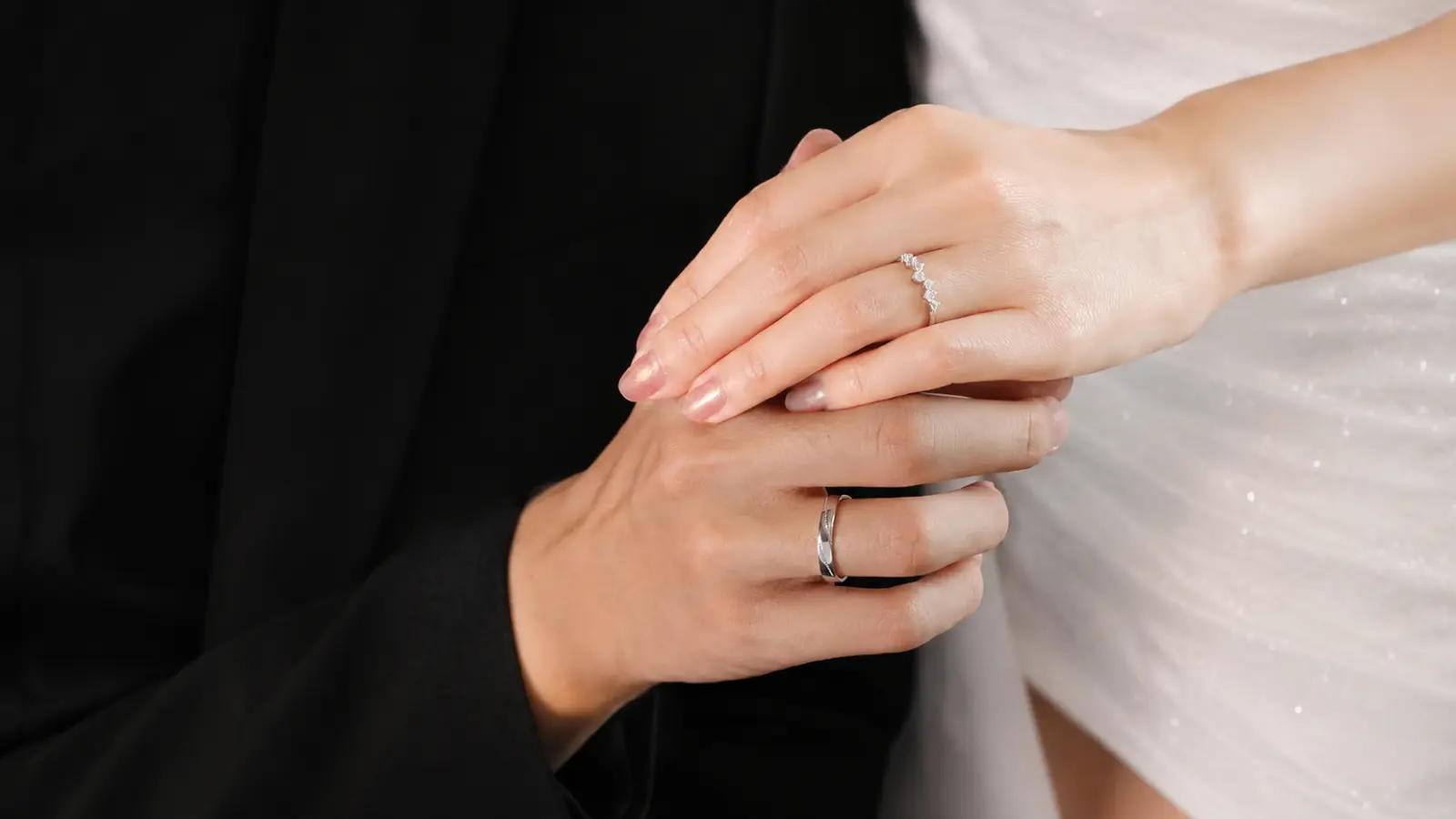
White gold wedding rings are wedding rings made from gold alloys and finished with rhodium plating to create a bright, cool-toned appearance similar to platinum. They offer the beauty and versatility of a white precious metal while keeping the value, flexibility, and resizability of gold.
White gold has remained one of the most popular wedding ring choices because it pairs beautifully with diamonds, works with both classic and modern styles, and offers a platinum-like look at a lower price. However, unlike platinum, white gold requires occasional maintenance to preserve its bright white finish over time.
This guide explains white gold wedding rings, including pros and cons, rhodium plating, 14k vs 18k white gold, white gold vs platinum, styles for women and men, diamond settings, and how this metal compares with other wedding rings and wedding bands.
What Is White Gold?
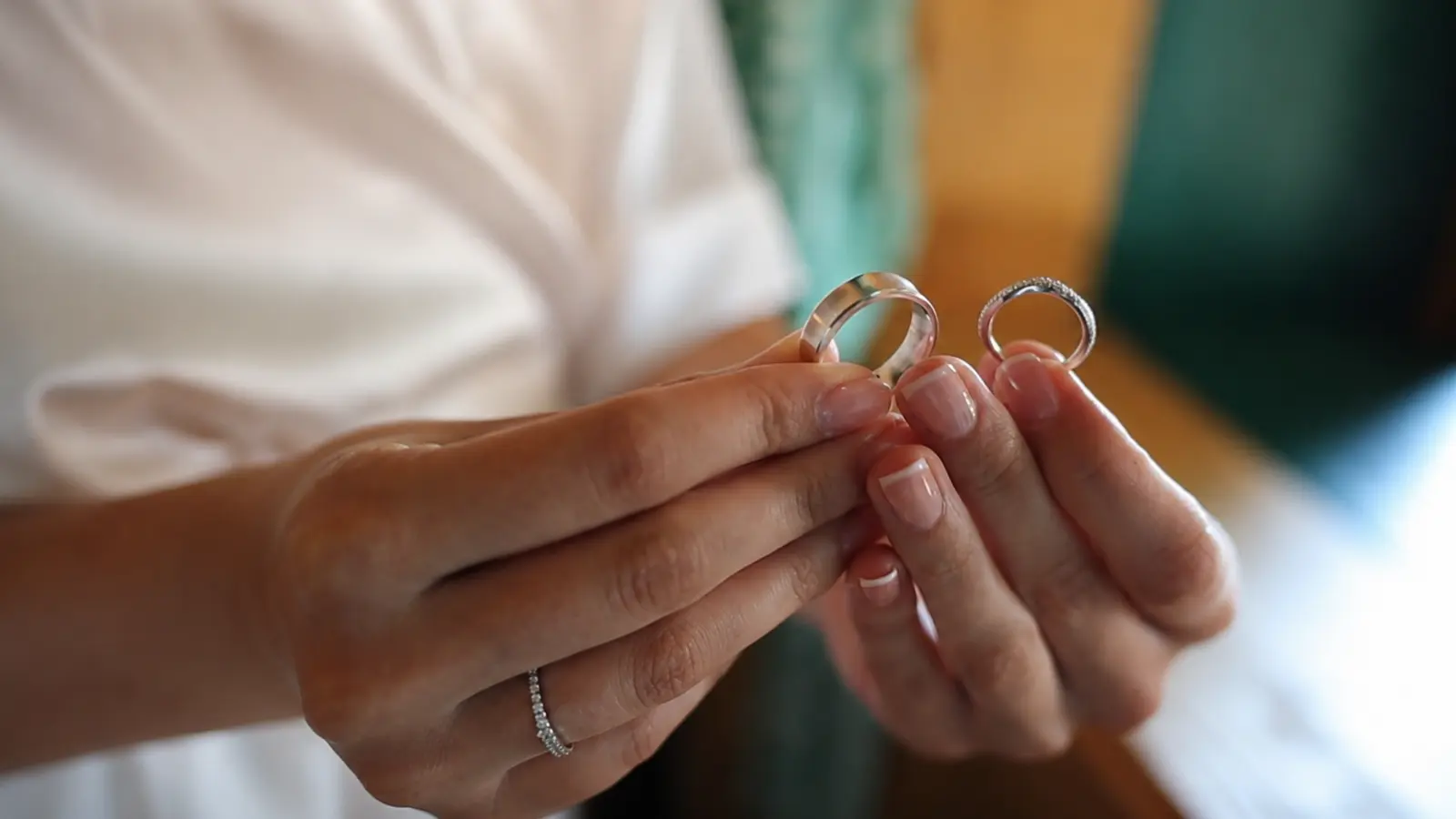
Pure gold — 24 karat — is too soft to wear as jewelry. To make it durable, jewelers alloy it with other metals. Yellow gold rings mix pure gold with copper and zinc, which preserve the warm color. Unlike other gold wedding rings, white gold mixes pure gold with white metals — most commonly nickel, palladium, or manganese — to shift the color toward silver. The resulting alloy is not naturally white, though. It is closer to a pale yellow-gray.
That is where rhodium comes in. Rhodium is a rare metal in the platinum family — naturally bright white, extremely hard, and highly reflective. After a white gold ring is cast and polished, it is plated with a thin layer of rhodium through an electroplating process. The result is the crisp, brilliant white surface you see in a jewelry case. It is that rhodium layer, not the gold underneath, that gives white gold its characteristic appearance.
14k vs. 18k: which karat is right for daily wear?
The karat designation tells you what percentage of the ring is pure gold. 14k white gold is 58.3% gold; the rest is alloy. 18k white gold is 75% gold. For a wedding ring worn every day, 14k is generally the more practical choice — the higher alloy content makes it harder and more resistant to scratching and denting than 18k, and it costs less. The main advantage of 18k is a slightly higher gold content and prestige designation, but for daily wear durability, 14k holds up better over time.
A note on nickel sensitivity
Some 14k white gold alloys use nickel as the whitening agent. Nickel is a common allergen, and people with metal sensitivities occasionally develop skin reactions to nickel-containing alloys. If you have known metal sensitivities, look specifically for palladium-alloyed white gold, which is hypoallergenic. Most reputable jewelers can tell you which alloy their white gold uses — and it is always worth asking before purchase.
White Gold vs. Platinum Wedding Rings
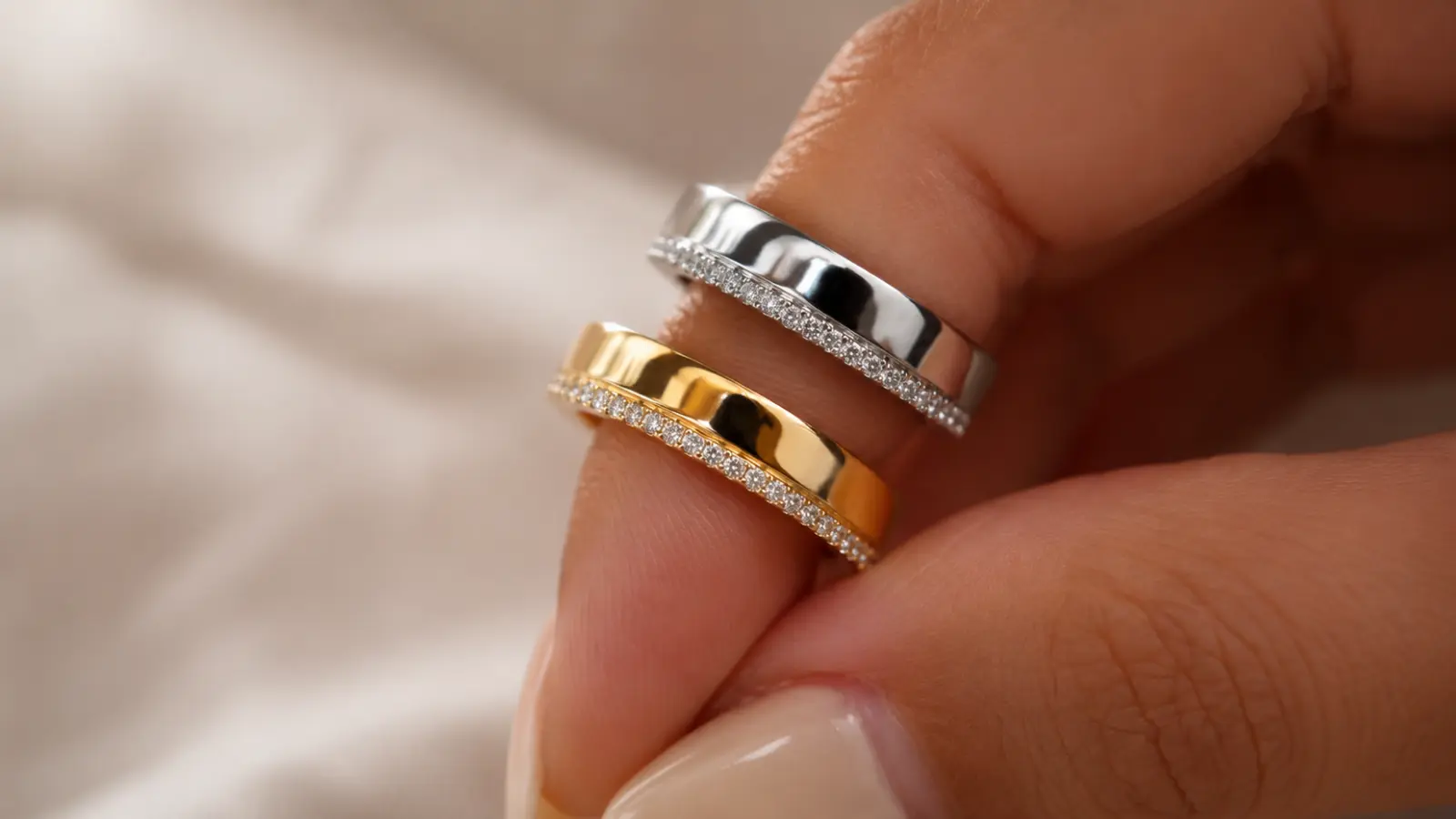
This is the comparison most white gold buyers find themselves making at some point — and it is worth making carefully, because the two metals look nearly identical when a white gold ring is freshly plated, but they behave very differently over time.
| Factor | White Gold (14k) | Platinum |
|---|---|---|
| Color | Bright white when freshly plated; warms slightly as plating wears | Naturally white — does not change color over time |
| Maintenance | Requires rhodium replating every 1–3 years | No plating required — only periodic polishing |
| Durability | Durable for daily wear; gold can wear away gradually over decades | Extremely durable — scratches but does not lose metal; develops patina |
| Weight | Lighter — feels less substantial on the finger | Noticeably heavier — some wearers love it, some find it uncomfortable |
| Hypoallergenic | Depends on alloy — nickel alloys can irritate; palladium alloys are safe | Naturally hypoallergenic |
| Resizable | Yes | Yes, though requires a specialized jeweler |
| Cost | Lower — typically 40–60% less than a comparable platinum ring | Higher — premium reflects metal rarity and density |
The honest case for white gold over platinum
Platinum is undeniably the better metal in purely technical terms — it is more durable, more hypoallergenic, and requires less maintenance. But the cost difference is real and significant. A plain 4mm platinum band can cost two to three times more than an equivalent 14k white gold band. For couples managing a broader wedding budget, or who simply prefer to allocate that difference elsewhere, white gold delivers a nearly identical aesthetic at a substantially lower price.
The replating requirement — platinum’s main argument against white gold — is often overstated as a burden. Most couples who have maintained a white gold ring for years describe it as a minor inconvenience: a 30-minute trip to a jeweler once every year or two, for a cost roughly equivalent to a dinner out. Go into the purchase with clear expectations about that maintenance, and it is rarely the problem it sounds like in the abstract.
When platinum is clearly the better choice
There are situations where the platinum premium is genuinely worth paying. If you have skin that is reactive to metal alloys and your jeweler cannot confirm a palladium-alloyed white gold, platinum removes the question entirely. If you are setting a very high-quality diamond and want to guarantee the prongs will hold their tension for decades without any gradual wear, platinum’s superior density is meaningful. And if the idea of any color shift — however slow and correctable — will bother you more than the price difference, platinum is the lower-friction long-term choice.
For a full breakdown of platinum as a wedding ring metal, see our platinum wedding rings.
Pros and Cons of White Gold Wedding Rings
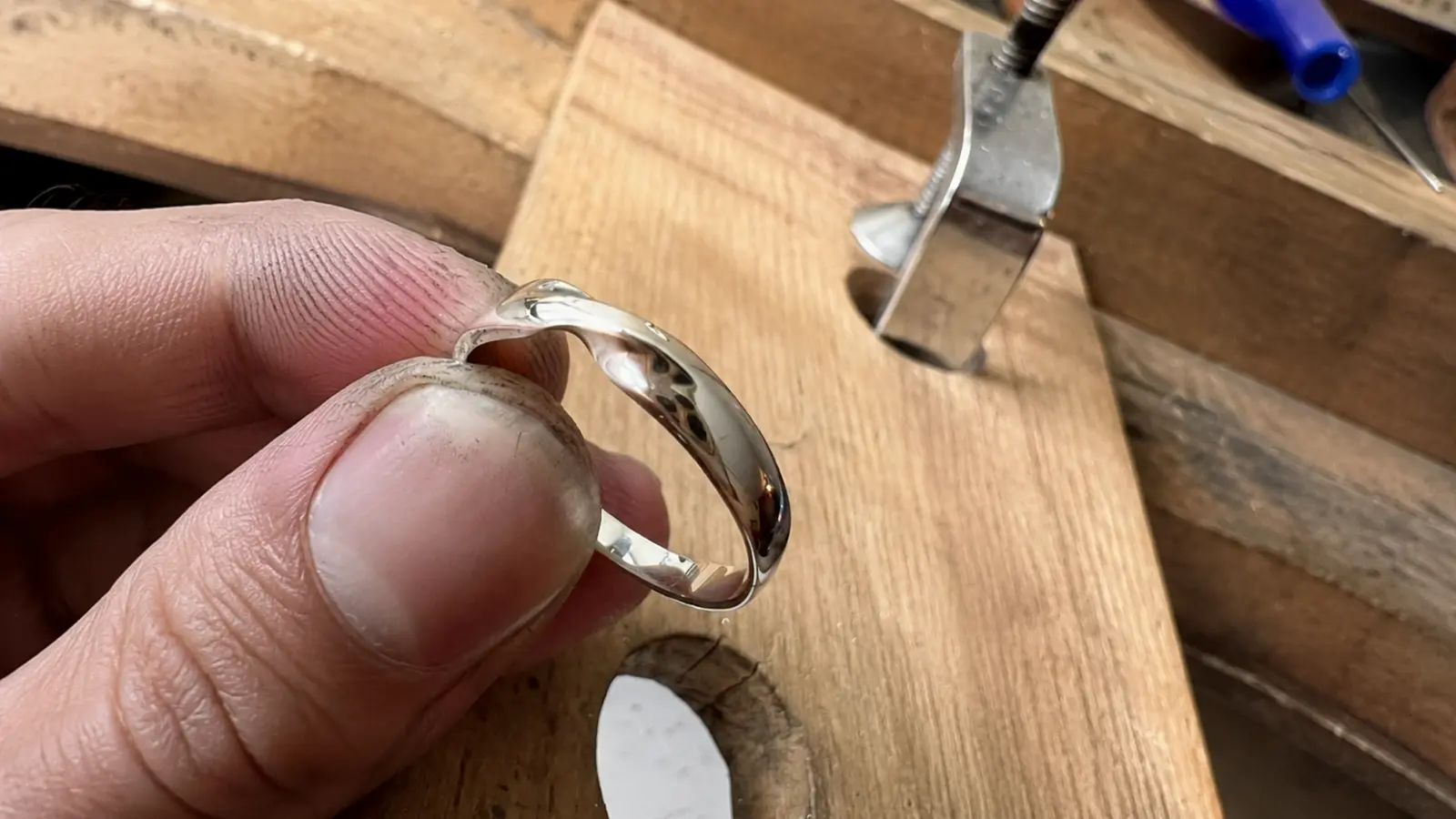
White gold is not a perfect metal — no metal is. What it offers is a specific set of trade-offs that work very well for a large number of couples and less well for a smaller number. Understanding both sides clearly is the most useful thing you can do before committing.
The advantages
Cost. This is the most immediate advantage. A 14k white gold wedding ring will almost always cost significantly less than an equivalent platinum ring — sometimes less than half the price. That savings can be redirected toward the engagement ring, the honeymoon, a home, or simply a less financially strained start to a marriage. The visual difference, once rhodium plating is applied, is minimal to nonexistent.
Appearance with diamonds. White gold is one of the best settings for diamonds and other colorless stones. The bright rhodium surface reflects into the stone and can make a near-colorless diamond appear one to two color grades whiter than it would in yellow gold. For couples prioritizing diamond brilliance, this is a meaningful practical advantage.
Versatility and resizability. White gold suits virtually every aesthetic — minimalist, vintage, modern, maximalist. It pairs equally well with a simple plain band, a pavé diamond design, or an elaborate multi-stone ring. And like all gold alloys, it can be resized by a skilled jeweler, which matters as fingers change over time with age, weight fluctuations, and pregnancy.
The limitations
Rhodium plating wears off. This is the central trade-off, and it deserves honest treatment. The rhodium coating that gives white gold its bright white appearance is not permanent. As it wears away through contact with water, soap, lotions, and the friction of daily life, the ring gradually takes on a slightly warmer tone. The shift is slow — not dramatic — but it is an ongoing maintenance commitment that platinum and yellow gold do not share.
Possible nickel sensitivity. Some people develop contact dermatitis from nickel, which is used in many 14k white gold alloys. This can manifest as redness, itching, or a rash beneath the ring. It is not common, but worth knowing before purchase — particularly if you have reacted to jewelry before. Asking for a palladium alloy or choosing 18k addresses the concern.
Gradual metal loss over decades. Gold alloys, unlike platinum, lose small amounts of metal over time through daily wear. On a long enough timeline — thirty or forty years of continuous wear — a white gold ring may become noticeably thinner. For most modern couples who maintain the ring regularly, this is not a pressing concern, but it is worth understanding if you are thinking in genuinely long-term terms.
Taken together, the picture is straightforward: white gold rewards buyers who go in with clear expectations and a willingness to maintain it. The trade-offs are real but manageable, and the value for what you get is genuine.
White Gold Wedding Rings for Women
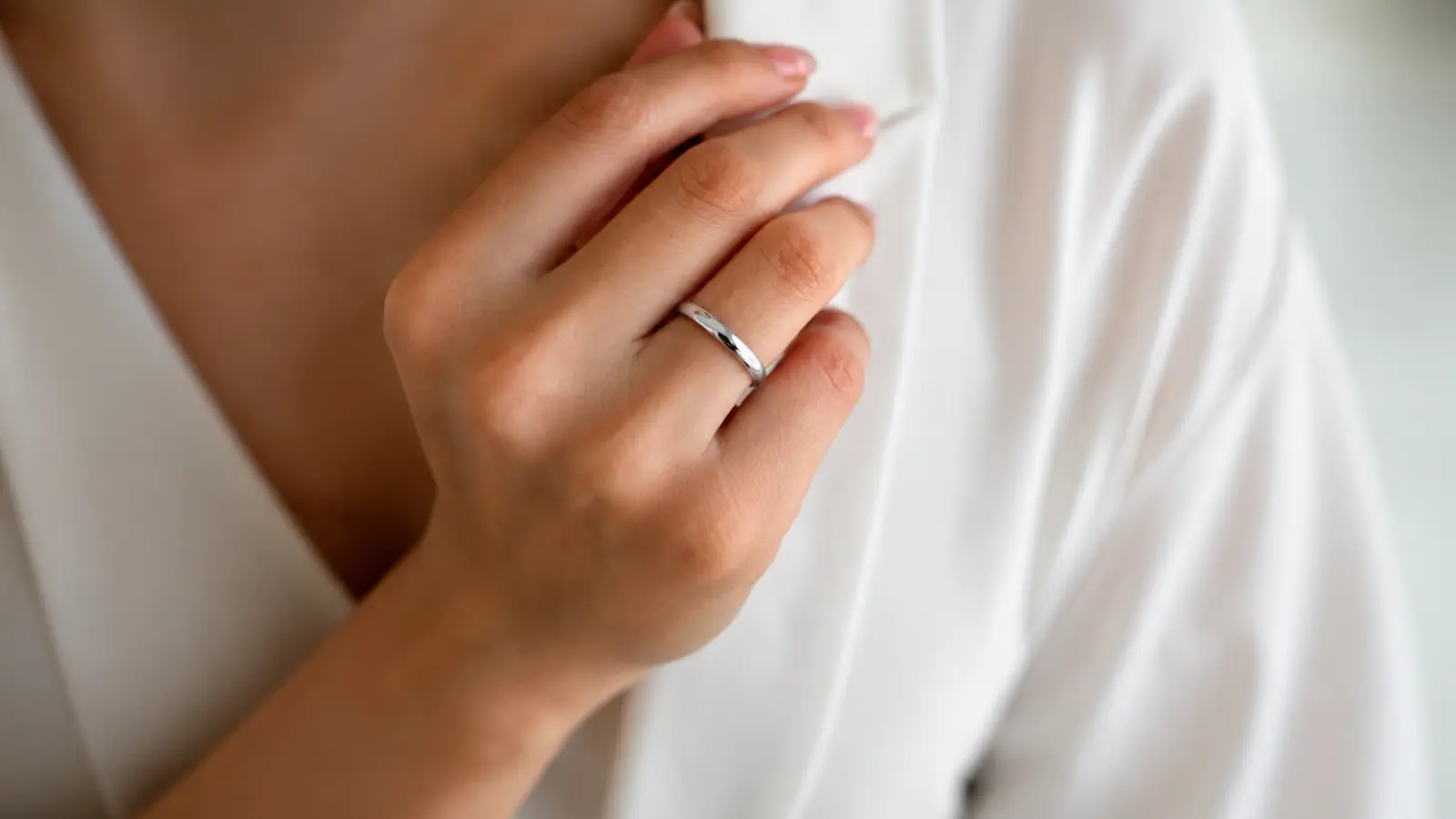
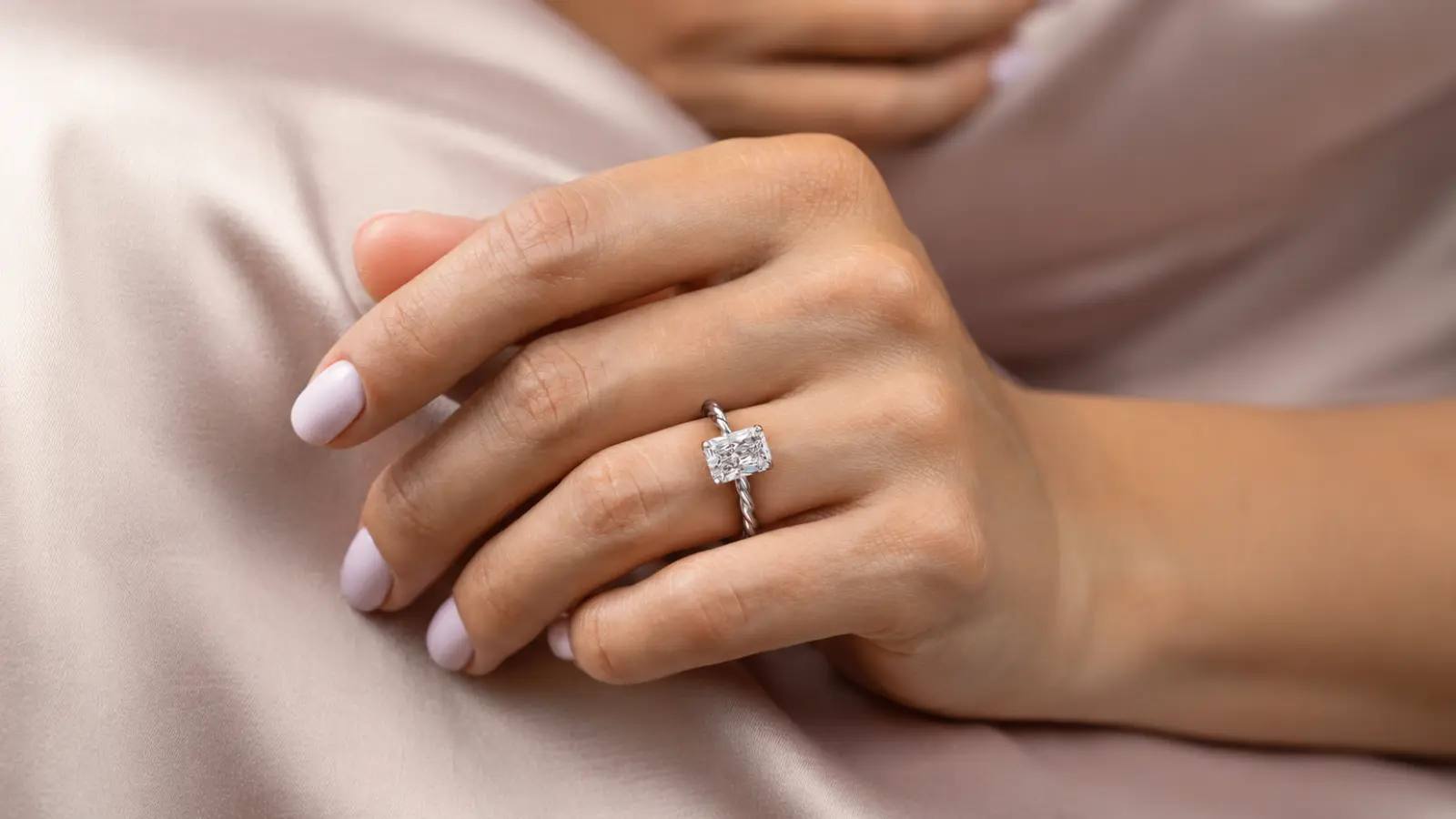
White gold is the dominant choice for women’s wedding rings when a cool-toned metal is preferred. Its versatility across styles — from the most delicate plain band to the most elaborate diamond eternity ring — combined with its compatibility with white diamond engagement rings, makes it the default recommendation for a very wide range of aesthetics and budgets.
Styles that work particularly well in white gold
Diamond eternity and half-eternity bands are among the most popular women’s wedding ring styles, and white gold is arguably the best metal for them. The rhodium surface enhances the whiteness and brilliance of the diamonds, and the consistent color from metal to stone creates a seamlessly bright look that is harder to achieve in yellow or rose gold. Channel-set designs — where diamonds sit inside grooves in the band rather than in exposed prongs — are especially practical for women with active lifestyles.
Plain and satin-finish bands in white gold read as quietly modern. A 2mm to 3mm simple wedding ring in white gold is one of the most enduring choices for women — it disappears beautifully under any engagement ring and reads elegantly on its own. The satin or brushed finish common in modern wedding rings conceals minor scratches better than a high-polish surface, helping the ring maintain a consistent appearance between maintenance visits.
Pavé and micro-pavé designs — where small diamonds are set closely together across the surface of the band — achieve their maximum visual effect in white gold. The metal recedes visually while the stones take over, creating the impression of a continuous band of light. These designs pair best with engagement rings that also use pavé detailing, creating cohesion in the overall bridal look.
Vintage-inspired and milgrain styles translate exceptionally well into white gold. The cool tone gives an Art Deco-adjacent quality to milgrain edging and filigree detailing, creating something that feels genuinely antique rather than merely vintage-adjacent. Couples drawn to earlier-era aesthetics often find that white gold achieves it more convincingly than yellow gold.
Width considerations for women
Women’s white gold bands most commonly run between 1.5mm and 4mm. Narrower bands — under 2mm — are best suited to stacking or pairing with a more substantial engagement ring; they can feel slight when worn alone. Bands in the 2mm to 3mm range are the most versatile, working equally well alone and stacked. Wider bands, above 3.5mm, make a stronger independent statement and tend to work best on longer fingers or as a solo ring choice.
For a full guide to women’s styles across all metals, see our wedding rings for women guide.
White Gold Wedding Bands for Men
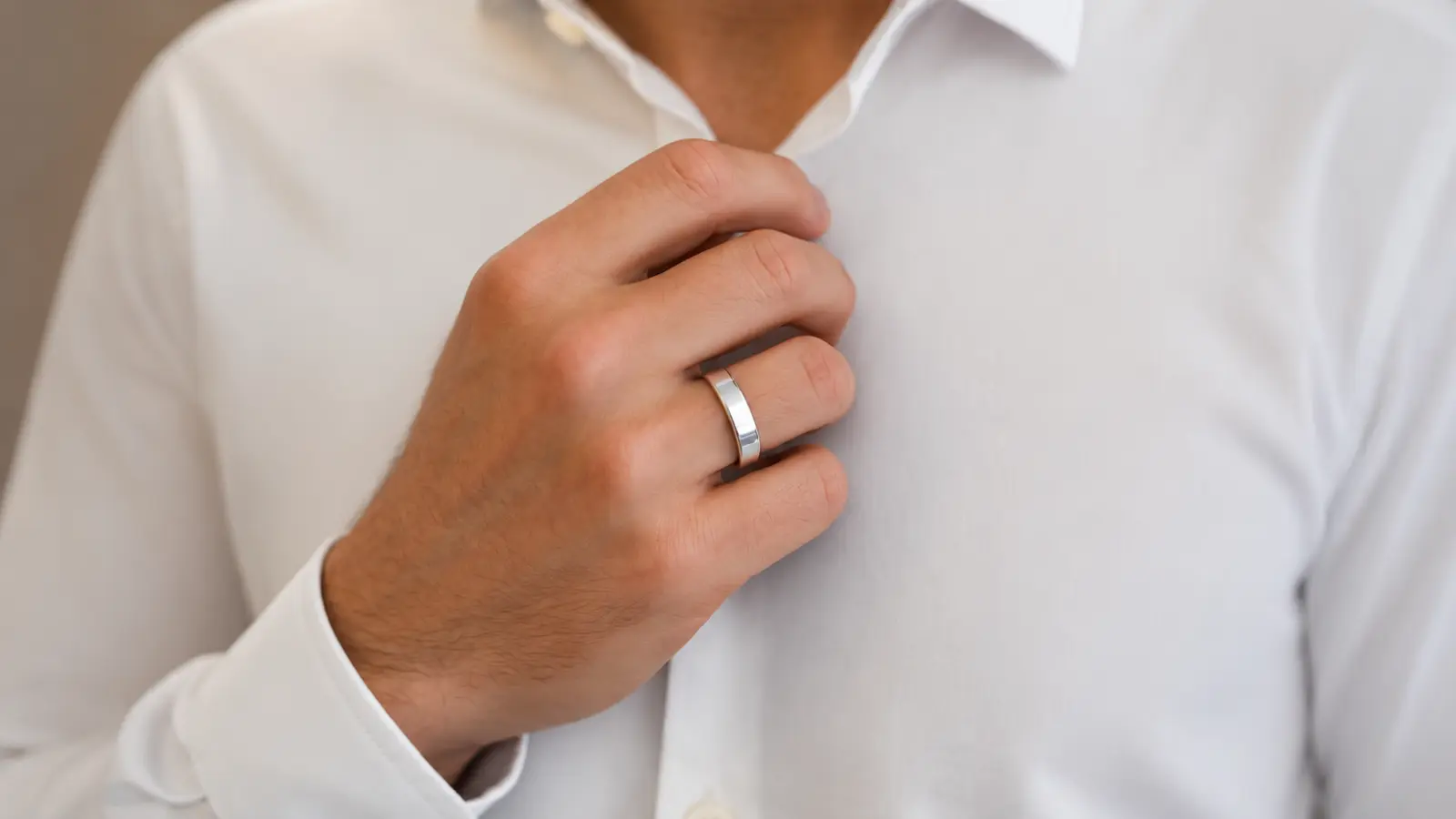
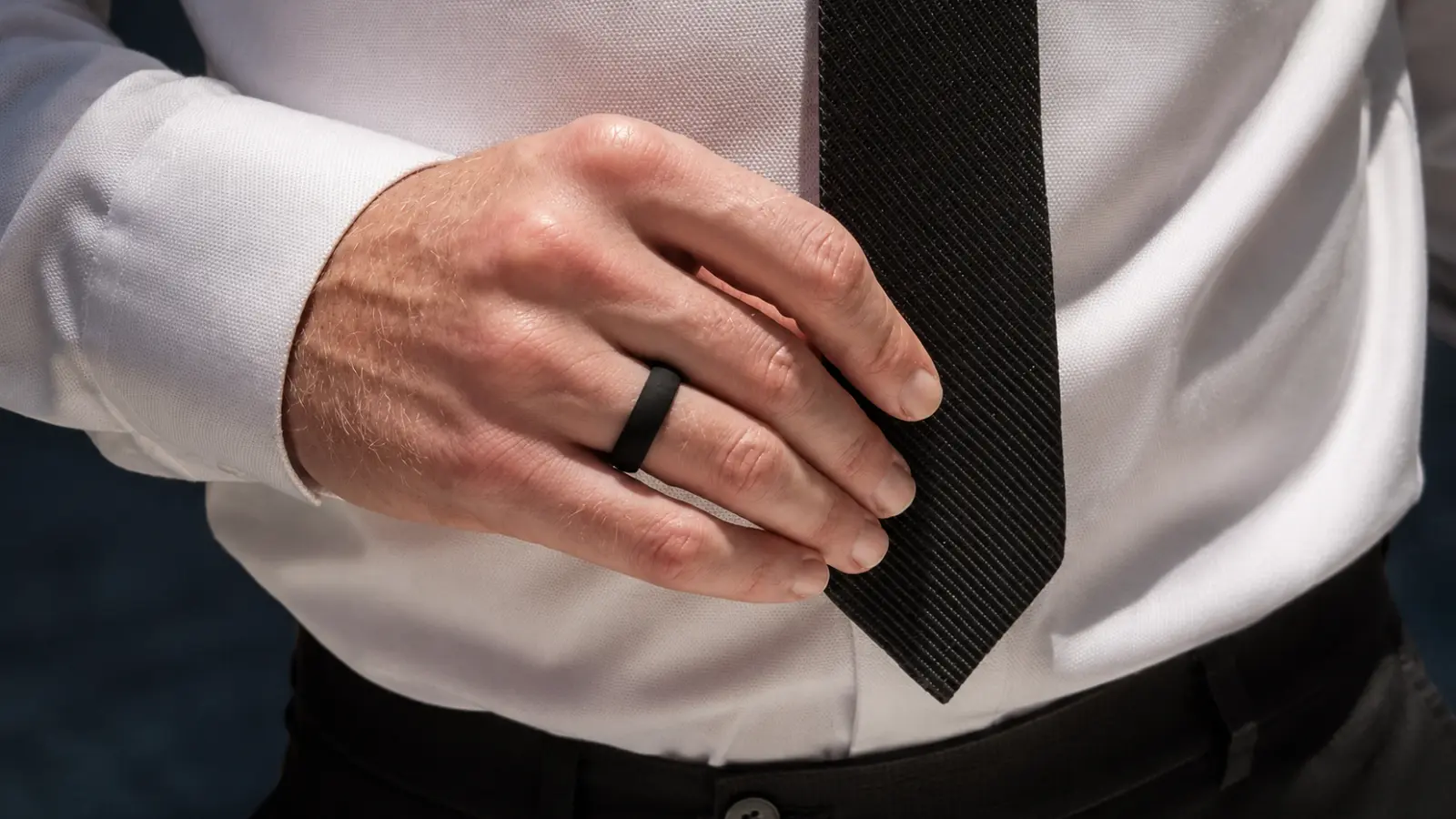
White gold occupies a distinct and useful position for men who want the look of a light-colored precious metal ring without the weight and cost of platinum. It is a less obvious choice than yellow gold or platinum historically, but it appeals strongly to men who prefer a contemporary, understated aesthetic — and to those who want a ring that matches or complements a partner’s white gold or platinum engagement ring.
The decision to choose white gold over platinum for a men’s band is usually a budget consideration. The decision to choose it over titanium or tungsten is usually an aesthetic and practicality one: gold can be resized, engraved, and repaired in ways that alternative metals typically cannot. Those are meaningful practical advantages for a ring worn every day for decades.
Finish options for men’s white gold bands
A high-polish white gold men’s band is the most formal option — it reflects light cleanly and reads as refined and traditional. The limitation is that polished surfaces show scratches more readily, and men who work with their hands will find the mirror finish deteriorates faster between polishings.
A brushed or matte finish conceals daily wear much better. The texture breaks up light rather than reflecting it, which means minor surface scratches are far less visible. Many men’s white gold bands combine both — a brushed center panel with polished beveled edges — giving textural interest and practical durability together. This combination finish tends to be the most popular option for men who want a ring that looks intentional without requiring constant upkeep.
Width and weight
Men’s white gold bands typically run between 5mm and 8mm. At 5mm to 6mm, a white gold band has a traditional, understated presence — substantial enough to read clearly on the hand without dominating it. At 7mm to 8mm, the ring becomes more of a statement piece. Men who have never worn rings before often find that a narrower starting point is the more comfortable adjustment, since width affects how the ring feels at the end of a long day as much as how it looks.
For the full range of men’s wedding band options across all metals and styles, see our men’s wedding bands.
White Gold and Diamond Wedding Rings
If there is one pairing white gold excels at above all others, it is with diamonds. The relationship between the metal and the stone is genuinely symbiotic: the rhodium-plated white surface reflects into the diamond’s facets, enhancing the perception of its whiteness and brilliance, while the diamond’s sparkle draws attention away from the metal itself — which is partly why the gradual yellowing of white gold is much less noticeable in a diamond-set ring than in a plain band.
Prong settings in white gold are the most common choice for diamond solitaire and diamond-accented wedding bands. White prongs are far less visually distracting than yellow gold prongs, which can cast a warm tint into the lower facets of a colorless diamond. If you are choosing a ring with a high-quality diamond — G color or above on the GIA scale — white gold or platinum settings are the recommended choice over yellow gold specifically to preserve the apparent whiteness of the stone.
Diamond band styles in white gold
The half-eternity band — diamonds set across the top half of the ring — is the most practical diamond band style for daily wear. The unset lower half conforms more comfortably to the finger and leaves room for easy resizing if needed. It pairs cleanly with most engagement ring settings and is the most commonly purchased diamond wedding band style.
The full eternity band — diamonds running continuously around the entire ring — is the most visually dramatic option. It cannot be resized, so sizing must be accurate at purchase; many jewelers recommend going up half a size to allow for comfortable wear throughout the day. It also tends to sit higher on the finger than a plain band, which affects how it stacks with an engagement ring.
The channel-set band protects diamonds within grooves in the metal rather than holding them in exposed prongs. This is among the most secure diamond setting styles for daily wear — there are no prongs to snag on fabric or catch on surfaces. Channel-set white gold bands are a practical first choice for women who work with their hands or prefer jewelry that requires minimal ongoing attention.
For a comprehensive look at diamond wedding ring options, see our diamond wedding rings.
How to Maintain a White Gold Wedding Ring
White gold maintenance is genuinely simple once you understand what it actually requires — which is less than most people assume before buying. The core routine has two components: regular at-home cleaning and periodic professional replating.
At-home cleaning
The most effective at-home method requires nothing more specialized than warm water, a small amount of mild dish soap, and a soft-bristle toothbrush. Soak the ring for a few minutes in the warm soapy water, then gently brush around any stone settings or textured surfaces. Rinse thoroughly under warm running water and dry with a lint-free cloth. This is a safe way to clean a wedding ring at home while removing lotion, soap residue, and natural skin oils that dull white gold’s appearance and accelerate rhodium wear.
How often this is needed depends on your lifestyle. Most people find that a quick clean once every week or two maintains the ring’s appearance well. If you are consistent about removing the ring before applying lotion, sunscreen, or perfume — all of which accelerate surface buildup — the cleaning intervals can be longer.
What to avoid
Chlorine is the most significant threat to white gold in everyday life. Pools, hot tubs, and household cleaners containing bleach all react with gold alloys in ways that can cause surface damage and accelerate rhodium loss. Remove your white gold ring before swimming and before using household cleaners. Similarly, remove it before applying hand lotion, self-tanner, or heavy moisturizers.
Ultrasonic jewelry cleaners are effective but not universally safe. Plain bands typically tolerate them well. Diamond-set rings should only go into an ultrasonic cleaner if the setting is confirmed secure — loose prongs can release stones in the vibration process. If you are not certain about your setting’s condition, hand cleaning is the safer choice. When in doubt, your jeweler can inspect the prongs during a routine visit.
Rhodium replating
Replating is the maintenance step most people think about when weighing white gold against platinum, and it deserves a realistic picture. The procedure involves a jeweler cleaning the ring, buffing out any surface scratches, and applying a fresh layer of rhodium through an electroplating process. The ring comes back looking identical to the day it was purchased.
The process typically takes between a few hours and a few days depending on the jeweler. The cost ranges from about $30 to $75 at most independent jewelers. Many jewelers who sold you the ring will replete at a reduced cost or as part of a routine maintenance visit. How often it is needed depends on wear — most people replate once every one to three years, with those who have more physically active lifestyles or more acidic skin chemistry falling closer to the annual end of that range.
One thing worth knowing: the gradual shift in color before replating is often more visible in photographs than in person. The human eye adapts to a ring’s current appearance over time, and many couples do not notice the color shift until they see a photo taken next to a freshly plated piece. This is not a problem — it is simply how the aging of rhodium plating works in practice.
Professional servicing
A full professional service — cleaning, prong check, replating, polish — done every year or two keeps a white gold ring in excellent condition indefinitely. Most jewelers offer this as a routine maintenance visit. For diamond-set rings, the prong inspection is as important as the replating: prongs wear down over time and can eventually become too thin to hold a stone securely. Catching a worn prong in a routine check is far less expensive than replacing a lost stone.
White Gold Wedding Ring Inspiration
White gold wedding rings can range from simple polished bands to brilliant diamond designs and modern styles. Explore our inspiration board for white gold bands, diamond wedding rings, pavé styles, platinum-inspired looks, classic designs, and timeless ideas for women and men.
Choosing a White Gold Wedding Ring Made for Real Life
A white gold wedding ring is not only about achieving a certain look — it is about understanding the balance between beauty, practicality, maintenance, and long-term wear. Its bright appearance, versatility, and ability to pair with almost any style are the reasons it continues to be one of the most chosen wedding ring metals.
Whether you choose a simple white gold band, a diamond design, or a modern style, the best ring is the one that fits your everyday life and the care you are comfortable giving it for the years ahead.
Frequently asked questions (FAQ)
Is white gold good for wedding rings?
Yes. White gold is a popular choice for wedding rings because it offers a bright, modern appearance similar to platinum at a lower price. It pairs especially well with diamonds, works with many ring styles, and can be resized like other gold rings. The main consideration is maintenance, since white gold usually needs rhodium replating over time to keep its bright white color.
Does white gold turn yellow over time?
Yes. White gold can develop a warmer or slightly yellow tone as the rhodium plating on the surface gradually wears away. This does not mean the ring is damaged — the original gold alloy underneath is simply becoming more visible. A jeweler can restore the bright white appearance by applying a new layer of rhodium.
How often does a white gold wedding ring need to be replated?
Most white gold wedding rings need rhodium replating every one to three years, although the timeline depends on lifestyle, skin chemistry, and how often the ring is worn. Rings exposed frequently to friction, chemicals, or heavy daily use may need replating sooner.
Is white gold or platinum better for wedding rings?
White gold and platinum both have advantages. White gold offers a similar bright appearance at a lower cost and is easier for many couples to fit into their budget. Platinum is naturally white, heavier, hypoallergenic, and does not require replating. The better choice depends on budget, maintenance expectations, and personal preference.
Is 14k or 18k white gold better for a wedding ring?
For most wedding rings worn every day, 14k white gold is usually the more practical choice because it is harder, more durable, and more resistant to wear. 18k white gold contains more pure gold and may feel more premium, but it is softer and usually costs more.
How long do white gold wedding rings last?
A well-made white gold wedding ring can last for decades with proper care. The gold itself is a durable precious metal, but the rhodium coating will need refreshing over time. Regular cleaning, occasional replating, and professional inspections help keep the ring looking beautiful for many years.